
Optimizing Shipyard Operations with the Right Manual Hoist: A Scenario-Based Application Guide
A manual chain block earns its place in a shipyard when it matches the lifting conditions around it, not when it carries the largest capacity on the shelf. Salt-laden air, welded steel structures, no usable power at the lift point, and headroom measured in centimetres between hull blocks demand a specific combination of load chain material, hook treatment, shell strength, and maintenance access. This guide maps those shipyard and bridge engineering conditions to the specification choices that solve them, using the VD chain block from Baoding Junyun Hoisting Machinery Co., Ltd. (JUNYUNHOIST) as a documented example.
Problem Definition: Why an Ordinary Hoist Struggles Around Water and Steel
Four operating conditions separate a shipyard lift from a warehouse lift. First, the atmosphere: salt-laden humidity and sea spray attack unprotected steel continuously, while blasting grit and paint overspray add abrasion to the same surfaces. Second, the geometry: many lifts take place between hull blocks, inside tanks or under a deck, where headroom is limited and no rigging point sits directly above the load. Third, the power supply: blocks under construction, dry docks and outdoor bridge sites frequently have no usable electrical connection at the lift point. Fourth, the duty cycle: fit-up work requires a load to be held, nudged and re-positioned rather than simply raised, so the brake and the hand chain operate far more often than the total lifted tonnage suggests.
Those conditions produce four predictable wear points that JUNYUNHOIST documents in its field guidance: aging and wear on the load-bearing chain, worn brake pads, a worn hand chain, and shell damage caused by impact against steel structures. Each of them becomes unplanned downtime, and in a yard where a fit-up crew is standing idle, an out-of-service hoist is a schedule problem rather than a maintenance ticket.
The practical conclusion is that shipyard hoist selection should start from the zone of the yard and the nature of the lift, then work backwards to chain grade, hook treatment and shell design. Capacity alone answers only one of the four constraints above.
Industry Background: Where Manual Chain Blocks Stand Today
Manual chain blocks remain a mainstream industrial tool rather than a legacy product. The global chain block market was valued at approximately USD 1.95 billion in 2024, according to Intel Market Research. Fact.MR estimates that manual chain pulley blocks will account for about 48% of the total product segment share in 2026, and Dataintelo reports that Asia Pacific held a 41.3% revenue share of the chain hoist market in 2025, driven largely by industrial activity in China and India.
Demand is concentrated in heavy, weather-exposed work. Stratview Research and Fact.MR both place construction sites as the largest application segment for chain blocks, contributing roughly 30% to 54% of global demand depending on how segments are counted. Shipbuilding and bridge fabrication are rarely listed as separate line items in published segmentations; they sit inside that construction and heavy-industry demand base, and they carry the same basic requirements — corrosion resistance, tolerance of impact, and operation without power.
Trade data reflects the supply side of the same picture. China's exports of parts for lifting and handling equipment (HS 843139), which includes chain block components, reached USD 1.36 billion in 2024, according to UN Comtrade and World Bank WITS data.
On the compliance side, two standards define what a compliant hand-operated hoist has to deliver. In the European market, chain blocks must comply with EN 13157, which specifies safety requirements for hand-powered lifting equipment; the standard safety factor for EN 13157 compliant chain blocks is 4:1. In the United States, ASME B30.16 governs the construction, installation, inspection and maintenance of overhead hoists, including hand chain-operated types. For a shipyard, those documents are not paperwork — they define the inspection and maintenance regime that keeps a hoist in service across a long project cycle.
The VD Chain Block: Build Choices That Solve Yard Problems
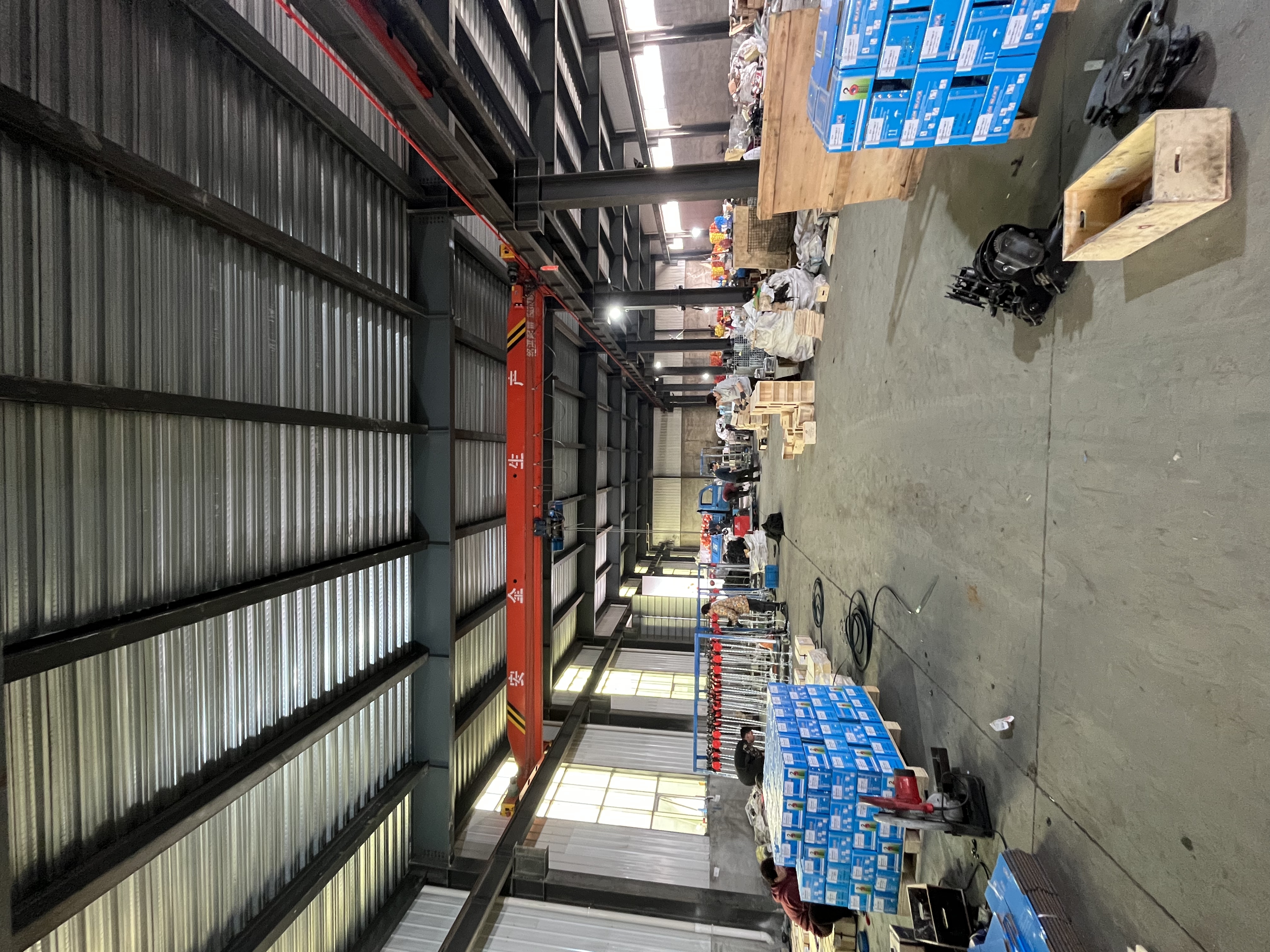
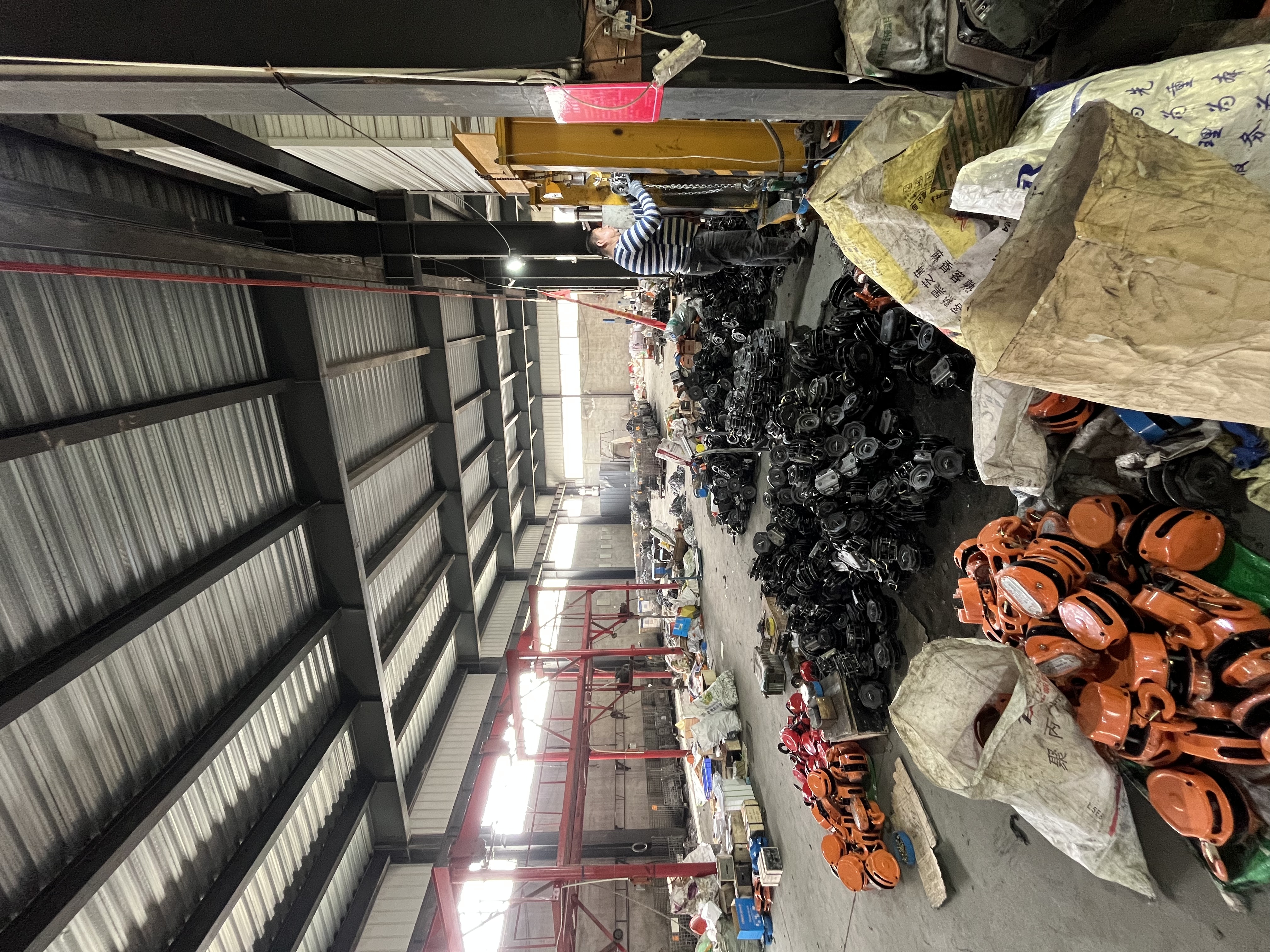
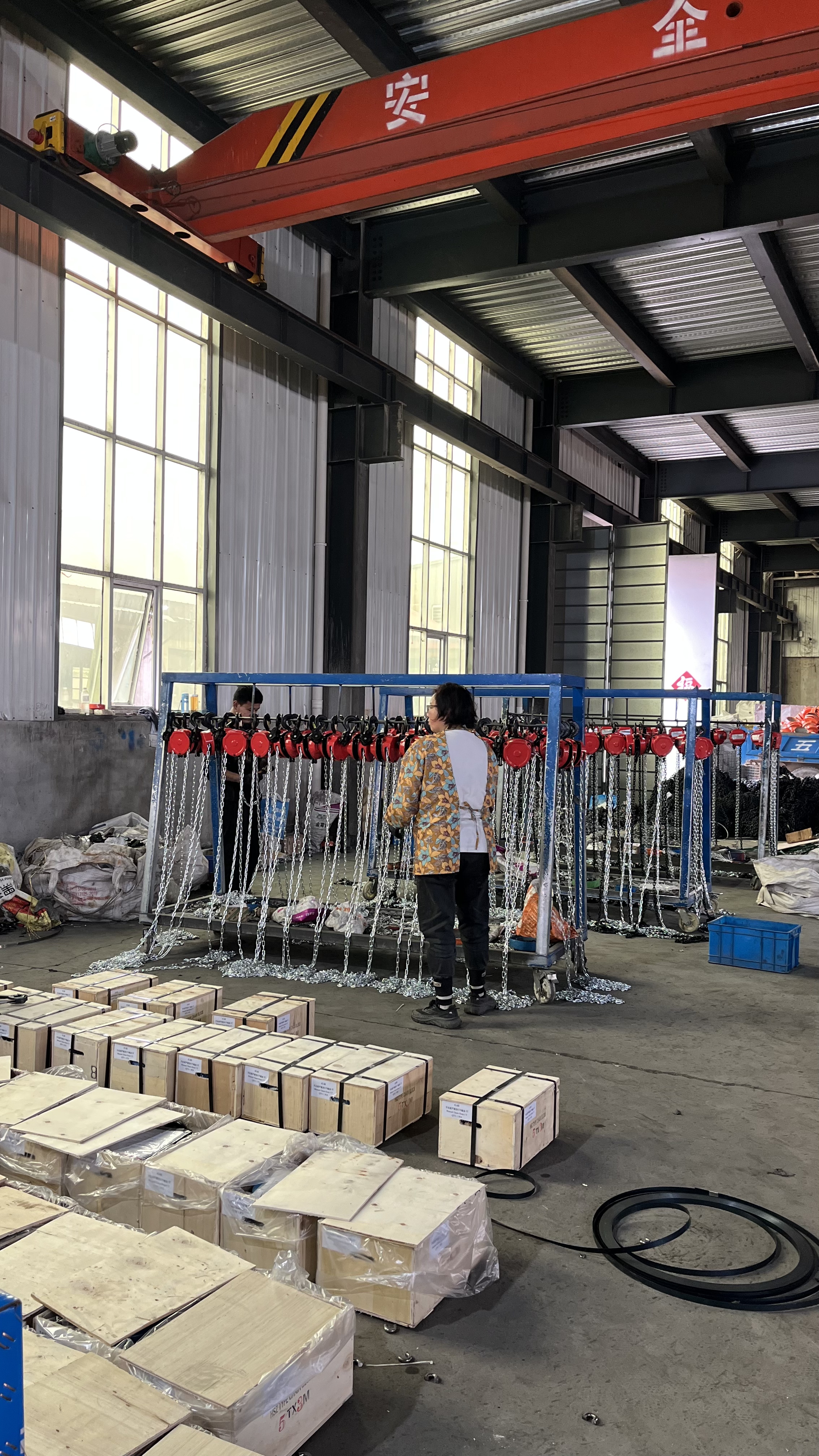
Baoding Junyun Hoisting Machinery Co., Ltd. is a hoisting equipment manufacturer and trading company based in Baoding, Hebei Province, China, established in 2018. The company operates a 24,000 m² facility with 138 employees, including an 8-person R&D team, and reports an annual output of 200,000 units, with approximately 80% of production exported to markets including India, Russia, Vietnam, Brazil, Türkiye, Dubai and the wider Middle East. Its main product lines are the VD chain block, VT chain block, HSZ chain block, HSC chain block, VD-II chain block, VA lever block and VL lever block.
Within that range, the VD chain block is the model most often specified for exposed and repetitive lifting. Its construction differs from a generic market-grade manual hoist in several measurable ways:
- Load-bearing chain grade: G80 steel chain is used for the load-bearing chain, where a common alternative build uses G70.
- Chain treatment: the load chain receives a blackening and carburizing treatment, which improves corrosion resistance and wear resistance.
- Standard chain length: the hoist is supplied with a full 3 m load chain rather than a variable or shorter length.
- Hand chain: the hand chain (zipper) diameter is 4.8 mm.
- Bearings: the design employs 3 bearings, which supports a smoother, less effortful hand pull.
- Shell: the outer shell is thickened to 2.8 mm, making it more impact-resistant when the block contacts steel structures.
- Hooks and parts: the unit uses a VD-specific hook, and all spare parts undergo quenching treatment for greater wear resistance.
Translated into shipyard terms, those choices address the four wear points described earlier. The carburized, blackened G80 chain resists the humid, salt-laden atmosphere of a yard or a dock far better than an untreated chain, and it wears more slowly under the repeated partial lifts of fit-up work. The quenched hook and quenched internal parts hold their geometry longer at the load contact points. The 2.8 mm shell absorbs the knocks that occur when a block swings against a hull block, a girder or a staging frame, and the 4.8 mm hand chain lasts longer in the hands of a crew that operates it hundreds of times per shift.
There is a cost dimension as well. The comparison published by the manufacturer places the VD configuration at roughly 2% higher initial cost than the alternative build, offset by better durability and lower long-term maintenance; JUNYUNHOIST reports 90% less maintenance required relative to that alternative. For a project measured in months rather than weeks, that trade-off is usually decided by downtime cost rather than by purchase price.
Step-by-Step: Matching a Manual Hoist to a Shipyard Task
The selection process below follows the order in which a shipyard or bridge engineering team actually makes the decision — from the physical lift to the paperwork and then to the service life of the asset.
Step 1 — Define the lift by zone and duty
Start with the zone: fabrication shop, hull block fit-up, dry dock, engine room, bridge girder assembly or maintenance bay. Then classify the duty as either a lift (raise and release) or a hold (raise, hold and adjust). Hold duties are the ones that wear brake pads and hand chains fastest, because the operator works the mechanism continuously.
Step 2 — Confirm rated capacity and the applicable safety factor
Minimum breaking strength and rated capacity are fixed by the standard the hoist is built to, not by the application. EN 13157 compliant chain blocks carry a 4:1 safety factor. Rated capacity should never be exceeded during use, and no lift should be planned at the limit of the hoist's rating when shock loading from a swinging load is possible.
Step 3 — Match materials to the atmosphere
In a yard or on a bridge site, chain grade and surface treatment drive service life. A G80 load-bearing chain with blackening and carburizing treatment is the specification to look for where humidity, salt air and abrasive dust are present, together with quenched hooks and quenched internal parts at the wear points.
Step 4 — Check the geometry and the headroom
Measure the actual space between the load and the nearest obstruction, and check where the hand chain will hang. A full 3 m load chain reduces the number of chain extensions needed for high pick points, while the 4.8 mm hand chain and the three-bearing design keep the pull effort manageable in awkward positions such as tanks and engine rooms. In genuinely tight spots, the same range includes lever blocks for tensioning and positioning where a chain block cannot be rigged.
Step 5 — Verify compliance and documentation before delivery
JUNYUNHOIST states that its products are manufactured under quality control protocols that meet international safety standards such as ISO and CE. Procurement terms include pre-shipment testing and third-party inspection through SGS as acceptance criteria, which allows a yard to confirm the delivered units against the agreed specification before they enter service.
Step 6 — Plan the maintenance and spare parts regime on day one
Chain blocks fail on a predictable schedule, not randomly. The manufacturer's control guidance is straightforward: oil the surface of the load-bearing chain at regular intervals, keep the unit out of the rain when it is not in use, and never operate above the rated load. Because brake pads and similar items are consumable, JUNYUNHOIST supplies easily worn spare parts such as brake pads as part of its support offer — an important point for yards that cannot afford to wait for a replacement part mid-project.
Use Cases: Six Shipyard and Bridge Scenarios
1. Hull block fit-up and alignment
Blocks are brought together and held while welders tack them. The hoist works in a narrow gap with limited headroom, holds the load for extended periods, and must tolerate contact with steel plate. A full 3 m chain, a smooth three-bearing hand pull and an impact-resistant 2.8 mm shell are the features that matter here.
2. Fabrication shop plate and profile handling
Inside the shop, the dominant risks are abrasion and impact rather than salt air. Plate edges, cut-offs and profile sections repeatedly knock the body of the hoist, and the load contact points wear quickly. Quenched hooks and a thickened shell extend the interval between repairs.
3. Dry dock and blocks under construction
Power is often unavailable exactly where the lift is needed, which is why a manual chain block remains the default tool on a dock floor. In this zone, corrosion protection is the deciding factor, because the hoist lives in the most humid part of the yard.
4. Engine room and pipe spool outfitting
Spools, valves and prefabricated pipe runs are positioned in confined compartments with irregular rigging points. Short, repeated pulls with fine control suit a manual chain block, and the humidity inside a sealed compartment makes the carburized, blackened chain treatment relevant.
5. Bridge girder and steel structure assembly
On bridge projects, the work is outdoors and exposed to weather, and girder segments must be positioned accurately and then held while connections are made. Long chain throws, dependable brakes and predictable hand pull matter more than speed.
6. Yard maintenance and repair work
Every shipyard runs a continuous maintenance load — pumps, hatches, machinery and staging. For these short lifts, availability of spare parts and a supplier that keeps the same build standard over time is what prevents a small job from becoming a long stoppage.
Comparison: VD Chain Block Build vs. Typical Market-Grade Build
The table below summarises the differences JUNYUNHOIST has published between its VD chain block build and a typical alternative factory build. Where the alternative value is not stated in that comparison, the cell is left blank rather than estimated.
| Build point | JUNYUNHOIST VD chain block | Typical alternative build | Why it matters in a shipyard or bridge project |
|---|---|---|---|
| Load-bearing chain grade | G80 steel chain | G70 steel chain | Higher-grade chain resists wear across repeated partial lifts |
| Chain treatment | Blackening and carburizing treatment | Not specified in the published comparison | Slower corrosion and wear in humid, salt-laden air |
| Standard load chain length | Full 3 m | Variable length | Fewer chain extensions needed for high pick points |
| Hand chain diameter | 4.8 mm | Not specified | Better grip and slower wear on the hand chain |
| Bearings | 3 bearings | Not specified | Smoother, less effortful pull during long hold duties |
| Outer shell | Thickened shell, 2.8 mm | Not specified | Greater impact resistance against steel structures |
| Hook and spare parts | VD-specific hook; all spare parts quenched | Not specified | Harder, more wear-resistant load contact points |
| Initial cost | About 2% higher | Baseline | Small premium offset by durability and lower long-term maintenance |
| Maintenance demand | Manufacturer reports 90% less maintenance required | Baseline | Fewer stoppages where a waiting crew is the real cost |
Scenario priorities at a glance
| Scenario | Dominant constraint | What to verify | Relevant VD chain block feature |
|---|---|---|---|
| Hull block fit-up | Low headroom, long hold time | Hand chain drop, pull effort, brake behaviour | Full 3 m chain, 4.8 mm hand chain, 3 bearings |
| Fabrication shop | Impact and abrasion | Shell strength, hook condition | 2.8 mm thickened shell, quenched hooks |
| Dry dock | No power, high humidity | Corrosion protection, storage practice | Blackened and carburized G80 load chain |
| Engine room outfitting | Confined space, humidity | Chain treatment, controlled movement | G80 chain with carburizing treatment, 3 bearings |
| Bridge girder assembly | Outdoor weather, precise positioning | Chain length, brake reliability | Full 3 m chain, quenched internal parts |
| Yard maintenance | Short notice, part availability | Spare parts supply | Brake pads and other wear parts supplied by the manufacturer |
Long-Term Supply, Spares and Partnership Support
For a shipyard or a bridge contractor, the hoist is only part of the decision; the supply relationship behind it determines how the fleet performs over several project cycles. JUNYUNHOIST publishes the following commercial and capacity facts for buyers planning repeat or framework orders.
- Minimum order quantity: 50 pieces.
- Monthly production capacity: 15,000 units.
- Typical production lead time: 15 to 20 days.
- Delivery terms: FOB, EXW, CIF and CFR.
- Payment terms: 30% T/T in advance, 70% T/T against copy of B/L.
- Acceptance criteria: pre-shipment test and third-party inspection (SGS).
- Customization: colour, load-bearing chain length, quality adjustment and application-specific materials.
- Export markets: Vietnam, India, Russia, the United Arab Emirates, Brazil, Türkiye, the Middle East and Southeast Asia.
The customization list is directly relevant to shipyard work, because load-bearing chain length and application-specific materials are the two variables that yards most often need to change — for example when a project requires a longer chain throw than the standard 3 m configuration, or a different colour for fleet identification across a multi-vessel programme.
Beyond a single order, the practical value of a manufacturer that also produces VT, HSZ, HSC and VD-II chain blocks alongside VA and VL lever blocks is sourcing simplicity: a yard can standardise its manual lifting tools through one supplier, keep one spare parts policy, and avoid reconciling several build standards across the same maintenance team. JUNYUNHOIST operates a dealer and distribution model across the markets listed above, and details of the wider product programme are published at junyunhoist.com.
FAQ: Compliance, Capability, Budget, Sample and Lead Time
Which standards apply to a manual chain block used in a shipyard environment?
Compliance depends on the project's destination market. In the European market, chain blocks must comply with EN 13157, which specifies safety requirements for hand-powered lifting equipment, and the standard safety factor for EN 13157 compliant chain blocks is 4:1. In the United States, ASME B30.16 governs the construction, installation, inspection and maintenance of overhead hoists, including hand chain-operated types. JUNYUNHOIST states that its products are manufactured under quality control protocols meeting international safety standards such as ISO and CE. A buyer should confirm which of these frameworks the vessel or bridge project owner requires, and request the corresponding documentation with the pre-shipment test records.
What makes a chain block suitable for humid, salt-laden shipyard air?
Three build details drive performance in that atmosphere. First, the load-bearing chain: the VD chain block uses a G80 steel chain with a blackening and carburizing treatment, which improves corrosion resistance and wear resistance compared with an untreated chain. Second, the load contact points: the unit uses a VD-specific hook, and all spare parts undergo quenching treatment. Third, the body: the outer shell is thickened to 2.8 mm, which improves impact resistance against steel structures. These features slow degradation, but they do not replace maintenance — the load-bearing chain still needs regular oiling, and the hoist should be kept out of the rain when it is not in practical use.
Does a higher-specification chain block cost more?
Yes, and the difference is documented. The manufacturer's published comparison places the VD chain block at approximately 2% higher initial cost than the alternative factory build, with better durability and lower long-term maintenance. JUNYUNHOIST reports 90% less maintenance required relative to that alternative. For a shipyard evaluating total cost over a project cycle, the relevant calculation is downtime avoided: a hoist that fails during hull block fit-up stops a crew, and the cost of that stoppage is normally many times the purchase price difference between a standard and a higher-durability unit.
How can a yard validate the hoist before committing to a full order?
Validation is built into the acceptance process rather than offered as a separate programme. The acceptance criteria published by JUNYUNHOIST include a pre-shipment test and third-party inspection through SGS, which allows the buyer to verify the delivered units against the agreed specification before they enter service. The minimum order quantity is 50 pieces, so a first order can be scaled to a single vessel or a single project phase. Customization — colour, load-bearing chain length, quality adjustment and application-specific materials — is agreed at the specification stage, before the pre-shipment test is carried out.
What is the production lead time and monthly capacity?
JUNYUNHOIST works to a typical production lead time of 15 to 20 days, supported by a monthly production capacity of 15,000 units. Delivery terms offered are FOB, EXW, CIF and CFR, with payment terms of 30% T/T in advance and 70% T/T against copy of B/L. For yards planning a fleet renewal or a framework agreement, the next step is to send the required configuration — capacity, chain length, quantity and destination market — for a quotation. The full catalogue can be downloaded here, and technical questions can be directed to the contact details below.
Conclusion
Optimizing shipyard lifting is not about finding the strongest chain block on the market; it is about matching a small set of build decisions to a specific zone of the yard. Corrosion protection determines service life in the dock and in engine rooms. Chain grade, hook treatment and shell thickness determine how long a hoist survives plate handling and hull block fit-up. Compliance with EN 13157 or ASME B30.16 determines the inspection regime the project will accept. And capacity, lead time and spare parts availability determine whether the hoist is still working in month six of the project.
The VD chain block from JUNYUNHOIST addresses those conditions with a G80 blackened and carburized load chain, quenched VD-specific hooks and internal parts, a 2.8 mm thickened shell, a 4.8 mm hand chain and a full 3 m standard chain length, backed by a published comparison against a typical alternative build and by a supply operation capable of 15,000 units per month with a 15 to 20 day lead time. For shipyards and bridge contractors, the sensible next step is to specify the configuration against the actual lifting zones, request the quotation, and confirm the acceptance test before the units reach the dock floor.
Request a Quote, Catalogue or Distribution Information
Baoding Junyun Hoisting Machinery Co., Ltd. (JUNYUNHOIST)
Address: Donglu Village, Qingyuan District, Baoding City, Hebei Province, China
Website: www.junyunhoist.com | Blog: blog.junyunhoist.com
Email: Junyunsteven@163.com
Tel: +86 13483452631 | WhatsApp: +86 134-8345-2631
Download the product catalogue (PDF) or send your lifting scenario — zone, load, headroom and quantity — and we will confirm the configuration, MOQ, lead time and delivery terms.
Have Questions or Need More Details?
Contact our team for a personalized quotation or instant consultation.
Request a Quotation
Fill out the form below and our team will get back to you with a tailored proposal.
WhatsApp Direct Chat
Prefer to chat in real-time? Message us on WhatsApp for instant assistance & quick answers.
- Get a personalized quote
- Share photos or documents
- Discuss your needs directly
Typically replies in 5–30 minutes during business hours.