VD Chain Block Application Guide: Shipbuilding and Mining Lifting Scenarios
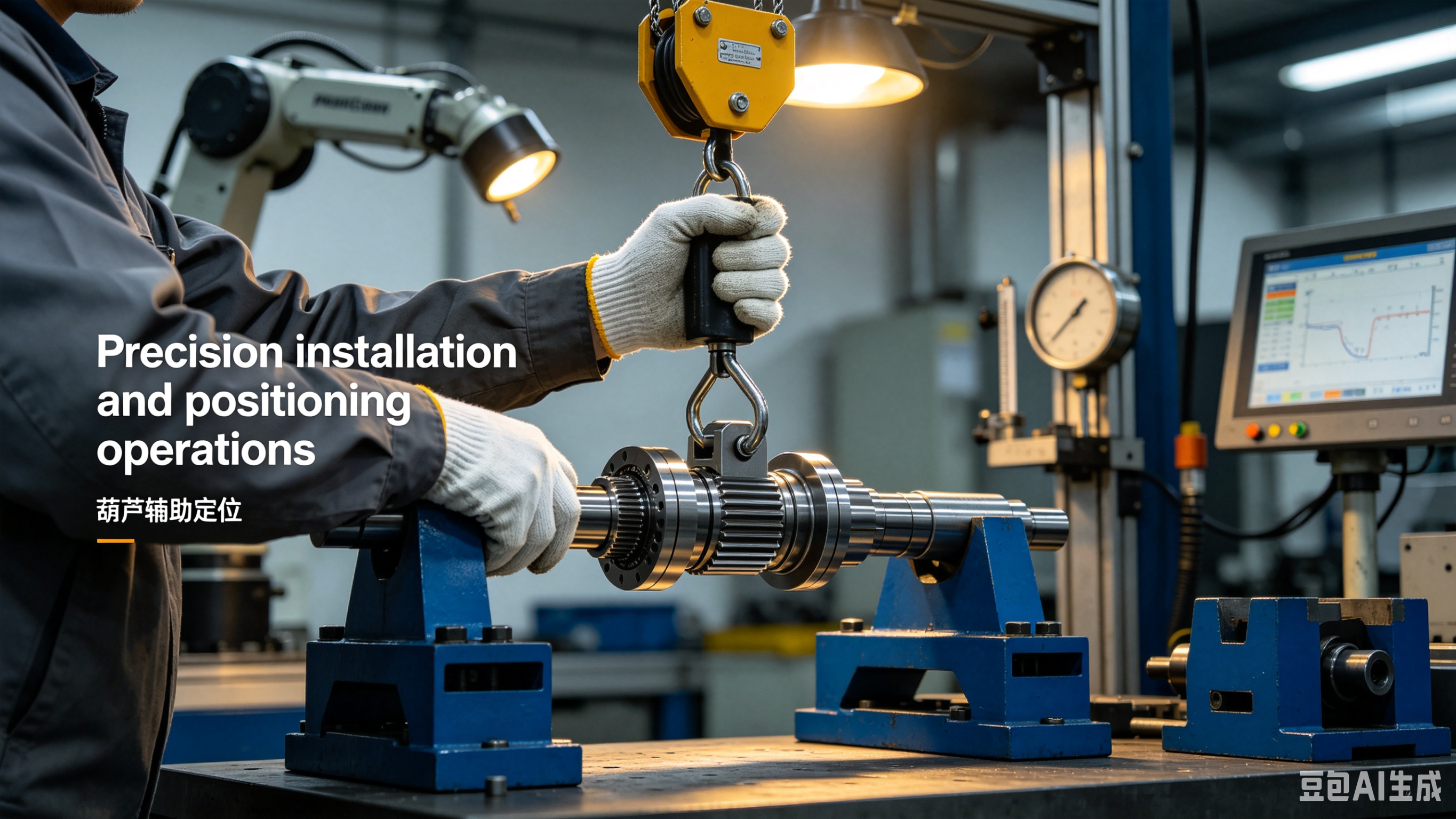
VD chain block rigged for precision positioning where headroom and hook access are limited.
A VD chain block is a manual chain hoist that converts hand-chain pull into lifting force through a purely mechanical gear system and a reverse-drive self-locking brake. In shipbuilding and mining work — where there is often no power supply, the headroom is short, and the air is wet, dusty or corrosive — the correct configuration is defined by five numbers: rated load 0.5–50 t, chain falls 1–4, load chain diameter 6.3–11.2 mm, minimum headroom 300–1000 mm, and a corrosion-resistant finish such as an RAL 2000 or 1007 painted housing with galvanised or zinc-plated hand chain.
This guide is written for procurement engineers, shipyard maintenance planners, mine-site supervisors and distributors who must specify a hoist that works without power, fits into a confined space, and survives an aggressive environment. It sets out the selection parameters in the order they should be decided, the inspection points that matter before a lift, and the way each parameter shifts between a shipyard berth and a mine site. The reference product throughout is the VD chain block manufactured by Baoding Junyun Hoisting Machinery Co., Ltd., traded as JUNYUNHOIST.
Problem Definition: What Shipbuilding and Mining Actually Demand From a Hoist
A shipyard and a mine sit at opposite ends of the lifting spectrum — one is precision assembly on a corrosive waterfront, the other is rugged maintenance underground or at a pit — yet they stress a manual hoist in the same five ways. JUNYUNHOIST documents these operating conditions directly: no power supply or a restricted working environment, precision installation and positioning operations, space constraints and high-altitude operations, maintenance and emergency repairs and temporary operations, and explosion-proof or fire-proof safe environments.
Low headroom between structures
Between hull blocks, under deck beams, inside a pump room, or beneath a conveyor frame, the distance from the load hook to the top anchor point is short. A hoist with a tall body simply cannot be rigged. VD chain blocks are built with a minimum headroom, measured as hook distance, of 300–1000 mm depending on model. That figure must be confirmed at the specification stage, because it decides whether the unit can be installed at all — not how fast it lifts.
Corrosion and abrasive contamination
Salt air, wash-down water, coal dust and mine water attack the housing, the hand chain and the load chain simultaneously. The standard VD configuration answers this with a painted housing in RAL 2000 or 1007, corrosion-resistant chains, and a round-link hand chain that is galvanised or zinc-plated. Where the exposure is more severe, a stainless steel configuration can be produced to order.
Loads that change from job to job
A shipyard may lift a machined structural part in the morning and an engine component in the afternoon; a mine may handle a pump body, a steel plate or a fabricated support. Because the VD range covers rated loads from 0.5 t to 50 t and one to four chain falls, a single product family can serve the whole site — but each individual lift still has to be matched to a specific capacity.
No power, no compressed air, no hydraulics
The VD chain block operates in a purely mechanical mode: a gear system multiplies human effort, and a reverse-drive self-locking braking system holds the load the instant the operator releases the hand chain. Nothing needs to be energised, which is why the product is used in restricted environments, in temporary operations and during emergency repairs.
Temperature and lubrication limits
The standard operating temperature range is –20°C to +50°C with standard grease. Mine sites and shipyards in cold climates fall inside that band; applications outside it require a different lubricant or a special configuration, which should be raised with the manufacturer rather than assumed.
Industry Background: Where Manual Chain Blocks Fit Today
Chain blocks remain a high-volume lifting category rather than a legacy product. The global chain block market was valued at approximately USD 1.95 billion in 2024 (Intel Market Research), and the wider chain hoist market, including electric and manual units, is projected to reach USD 3.9 billion by 2034 (Dataintelo). Manual chain pulley blocks are estimated to account for 48% of total product segment share in 2026 (Fact.MR), which reflects how much site work still happens where power is unavailable or undesired.
Construction sites are the largest single application segment, contributing approximately 30% to 54% of global demand depending on the source (Stratview Research / Fact.MR). Shipbuilding and mining sit inside that demand picture as specialised sub-segments: they buy fewer units than general construction, but they specify more tightly, because the consequences of a hoist that does not fit or does not hold are immediate. Asia Pacific dominated the chain hoist market in 2025 with a 41.3% revenue share (Dataintelo), and China's exports of parts for lifting and handling equipment under HS 843139, which include chain block components, reached USD 1.36 billion in 2024 (UN Comtrade / WITS).
On the compliance side, the reference points are well established. Chain blocks sold in the European market must comply with EN 13157, which specifies safety requirements for hand-powered lifting equipment, and the standard safety factor for EN 13157 compliant chain blocks is 4:1. In the United States, ASME B30.16 governs the construction, installation, inspection and maintenance of overhead hoists, including hand chain-operated units. The VD chain block is listed against ISO 16872, EN 13157 and ASME B30.21, and is CE marked; its load chain follows Grade V (80) or Grade T in accordance with DIN EN 818-7.
Why this matters for a project buyer: a shipyard or mine rarely buys on price alone. The specification has to survive an audit or a safety review, which means the standard reference, the safety factor and the chain grade must be stated on the datasheet before the purchase order is raised.
Detailed Solution: The VD Chain Block Configuration That Fits Both Sectors
Adapting a VD chain block to shipbuilding and mining is not a single decision but a sequence of six. Each parameter below is taken from the published VD specification and should be fixed in the order shown, because later choices depend on earlier ones.
Rated load capacity: 0.5 to 50 tons
Capacity is the starting point. The VD range spans 0.5–50 t, which covers everything from a light fitting operation in a ship's accommodation block to heavy component handling in a mine workshop. Standard lift height is 3 m, with 2.5–12 m available as an option; the lift height determines how much load chain and hand chain the unit carries and therefore its weight and rigging envelope.
Number of chain falls: 1 to 4
The number of chain falls, from one to four depending on capacity, is what allows a compact body to carry a high rated load. More falls share the load across more chain strands, so the body stays short relative to capacity — which is exactly what a low-headroom lift between hull blocks or under a machine frame requires.
Load chain grade and diameter
The load chain is Grade V (80) or Grade T in accordance with DIN EN 818-7, with a diameter of 6.3–11.2 mm depending on capacity. Chain steels used in the range include 20Mn2, 25MnV and 23MnNiMoCr54. Grade selection is a duty decision: the grade and diameter together define wear life under repeated lifting, so a mine site running continuous maintenance lifts should not be specified on the smallest chain that satisfies the load.
Headroom and hook opening
Minimum headroom, expressed as hook distance, runs from 300 mm to 1000 mm depending on model, and the hook opening ranges from 24 mm to 55 mm. Both figures are physical fit constraints. A 55 mm opening accepts a thicker sling eye or shackle; a 24 mm opening does not. Confirm the actual rigging hardware — slings, shackles, clamps — against the hook opening before ordering, not after delivery.
Corrosion-resistant finish
The standard protection package is a painted housing in RAL 2000 or 1007 together with corrosion-resistant chains and a round-link hand chain that is galvanised or zinc-plated. For a shipyard berth or a wet mine section this is the baseline, not an upgrade. Where chlorides or wash-down chemicals are persistent, a stainless steel variant can be produced to order.
Hook material, safety factors and standards
The hook is forged alloy steel, heat-treated, with an opening of 24–55 mm. Safety factors are at least 4:1 for the chain and at least 5:1 for structural parts, which aligns with the 4:1 baseline cited for EN 13157 compliant chain blocks. Units are listed against ISO 16872, EN 13157 and ASME B30.21 and carry the CE mark.
Operating temperature and hand chain ergonomics
The operating range is –20°C to +50°C with standard grease. Hand chain length is set as lift height plus 0.5 m of slack, and pull force on the hand chain is ≤ 35 daN (350 N) up to rated load. That pull-force ceiling matters in a mine or shipyard where the same operator may make dozens of lifts per shift from an awkward standing position.
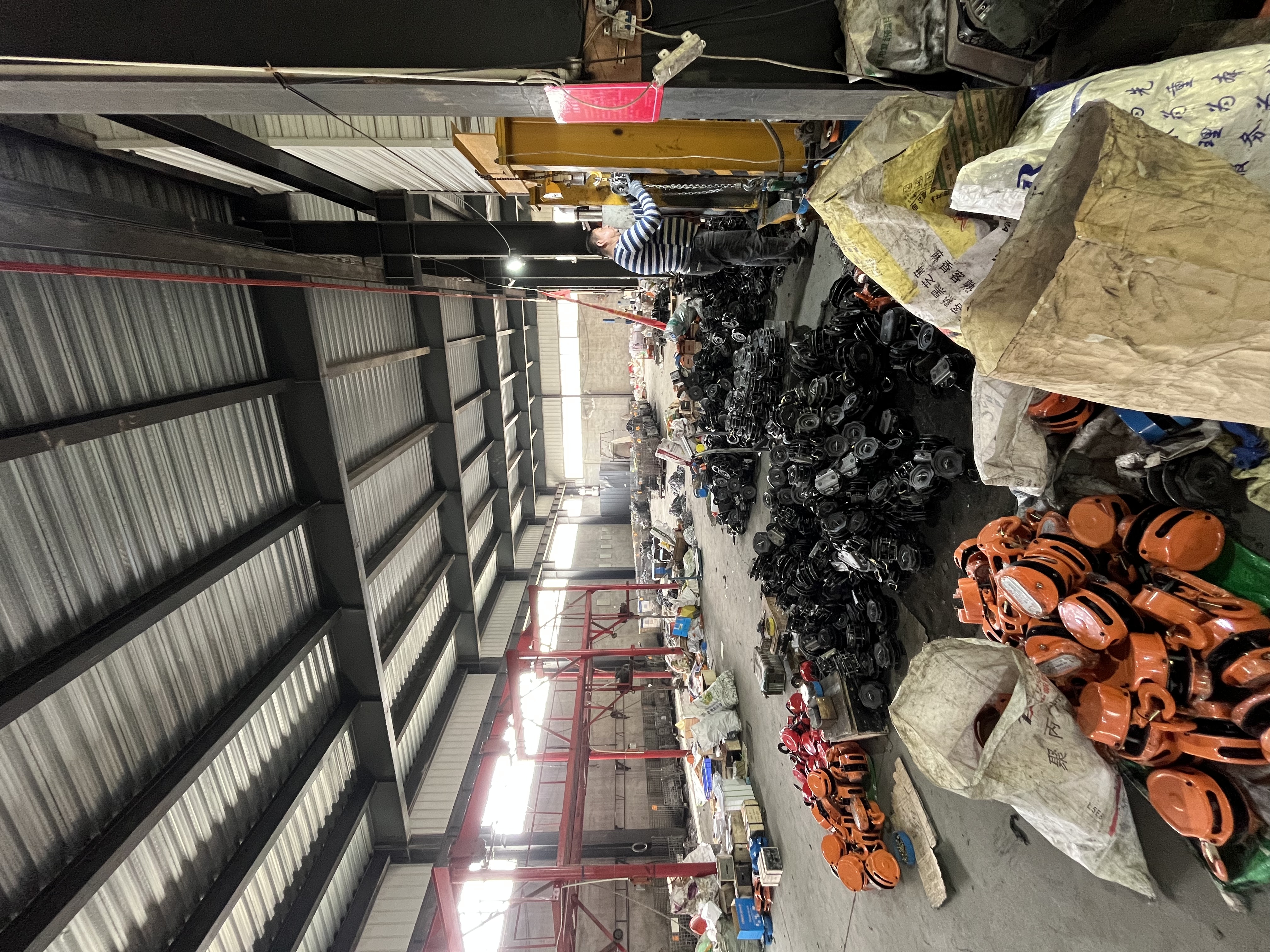
VD chain block production: every unit is tested before dispatch.
Optional and custom configurations
Beyond the standard build, JUNYUNHOIST offers OEM/ODM customisation covering colour, load-bearing chain length, and adjustment of accessory quality to reach a target price point. Configurations for specific usage scenarios — stainless steel and explosion-proof versions among them — are available, and explosion-proof or high-temperature resistant builds are supplied on request. These options should be raised during specification, since they change both the bill of materials and the lead time.
Step-by-Step Breakdown: Specifying a VD Chain Block for a Project
The sequence below is the order in which the parameters should be locked. Working in this order prevents the most common procurement error in shipbuilding and mining — choosing a capacity first and discovering later that the unit does not fit the space.
Fix the lift envelope. Record the maximum load, the required lift height, and the measured distance from the top anchor point to the top of the load. Compare that distance with the 300–1000 mm minimum headroom range and eliminate any model that does not fit. Standard lift height is 3 m, with 2.5–12 m optional.
Select the rated load and chain falls. Choose the capacity from the 0.5–50 t range and confirm the corresponding number of chain falls (1–4). More falls keep the body short for a given capacity, which is the practical route to a low-headroom solution.
Confirm chain grade and diameter. Specify Grade V (80) or Grade T to DIN EN 818-7 and confirm the diameter within the 6.3–11.2 mm range. For continuous maintenance duty, do not default to the lightest chain that passes the load calculation.
Build the corrosion package. Confirm the RAL 2000 or 1007 painted housing, the galvanised or zinc-plated round-link hand chain, and corrosion-resistant load chain. Add stainless steel or explosion-proof options where the site requires them; these are produced on request.
Verify hook and safety factors. Check that the hook is forged alloy steel, heat-treated, and that its opening (24–55 mm) accepts the planned sling or shackle. Confirm the stated safety factors of at least 4:1 for chain and 5:1 for structural parts, and that the unit is listed against ISO 16872, EN 13157 and ASME B30.21 with the CE mark.
Check temperature and lubrication. Confirm that the site's ambient conditions fall within –20°C to +50°C with standard grease. If the unit will sit outside that band, request a high-temperature or low-temperature configuration rather than substituting grease on site.
Plan supporting equipment and commissioning. A chain block requires supporting equipment to function effectively: slings, hooks, clamps, trolleys and load detectors. Confirm the full rigging set, then check the 100% test record on dispatch and the spare parts arrangement for the shipment.
Pre-use inspection points in the yard or at the shaft
- Hook: inspect the forged, heat-treated hook for cracks, deformation and throat opening. Compare the measured opening with the model's specified value; the range across the VD family is 24–55 mm, so the reference number is model-specific.
- Load chain: check for wear, twisted links, corrosion pitting and correct seating in the sprocket. On a galvanised or zinc-plated chain, coating loss is an early corrosion indicator.
- Brake: lift a light test load and release the hand chain. The reverse-drive self-locking brake must hold immediately and without creep.
- Hand chain: confirm it runs freely, is not fouled, and that length matches lift height plus 0.5 m slack.
- Identification: confirm the capacity plate is legible and matches the lift plan.
Use Cases: Where VD Chain Blocks Are Deployed
Shipbuilding and repair
In shipbuilding and repair, the chain block is used to move ship structural parts precisely to designated locations for assembly, and to hoist and disassemble heavy components such as engines and propellers during repair. Both tasks are positioning tasks, not bulk lifting: the operator needs fine control in a space where the hoist body has very little room. This is where the combination of 300–1000 mm minimum headroom, a 24–55 mm hook opening and the self-locking brake does the work, and where the RAL 2000 or 1007 painted housing and galvanised hand chain resist the waterfront atmosphere.
Mining operations
Mining operations are listed among the product's project types, and the matching working conditions are the absence of a power supply and a restricted environment. Maintenance, emergency repair and temporary operations are the dominant duty cycles: a pump pulled for service, a fabricated support repositioned, a component lifted in a drift where no electric hoist could be energised. The purely mechanical gear system and reverse-drive self-locking brake are the reason the tool is accepted in these locations at all.
Workshop and factory hoisting
For workshop lifting projects, the same hoist handles heavy machinery manufacturing and assembly. Here the constraints are different — the environment is drier, but the duty cycle is longer and the lifting points are repetitive. Buyers in this segment often order standard configurations and customise chain length, accessory grade and colour rather than the corrosion package.
Port, logistics and steel structure work
Logistics and ports, steel structure installation, bridge construction, railway construction and maintenance, water conservancy and pipeline engineering, power facility construction, petrochemical work, automotive repair, agriculture and stage construction are all listed applications. In bridge and pipeline work the chain block is used for precise placement of key components, including large steel beams and precast beams — again a positioning duty rather than a hauling duty.
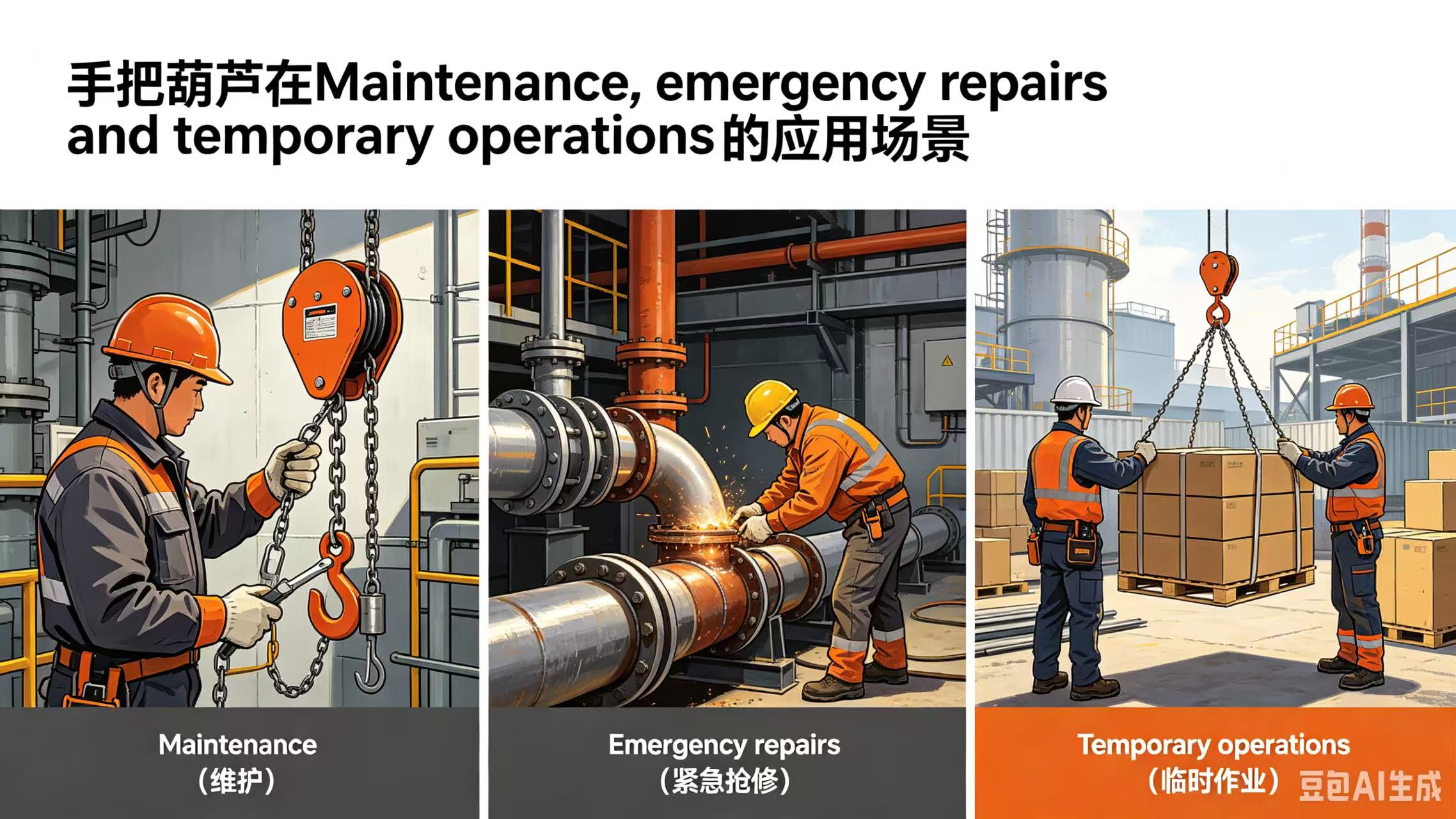
Maintenance and emergency repair work: the self-locking brake holds the load as soon as the operator releases the hand chain.
Field evidence: two years of continuous service
One importer customer took 2,000 units for local store distribution across India, Vietnam, Brazil, Turkey, Russia, the United Arab Emirates and Saudi Arabia. Units were used in long-term bridge and construction processes, with a service life exceeding two years and low loss reported over the period. That outcome is consistent with the specified configuration rather than exceptional: the chain and structural safety factors, the corrosion-resistant chain finish and the heat-treated forged hook are the components that determine long-run condition.
Comparison Table: Matching Scenario Requirements to VD Specifications
The table below compares the three most common duty environments for the same product family. Only published VD parameters and documented working conditions are used; where a value is model-dependent, the table states the dependence rather than an assumed figure.
| Requirement | Shipbuilding & repair | Mining operations | Workshop / factory hoisting |
|---|---|---|---|
| Typical task | Positioning ship structural parts for assembly; hoisting and disassembling engines and propellers for repair | Lifting and positioning in maintenance, emergency repair and temporary operations | Heavy machinery manufacturing, assembly and maintenance lifting |
| Documented working condition | Precision installation and positioning; space constraints and high-altitude operations | No power supply or restricted working environment; explosion-proof and fire-proof safe environment | Precision installation and positioning; repetitive lifting points |
| Headroom priority | Critical — minimum headroom 300–1000 mm is a fit constraint | High — short rigging distances under frames and equipment | Moderate — determined by the building structure |
| Rated load and falls | 0.5–50 t; 1–4 chain falls depending on capacity | 0.5–50 t; 1–4 chain falls depending on capacity | 0.5–50 t; 1–4 chain falls depending on capacity |
| Corrosion package | RAL 2000 or 1007 painted housing, galvanised or zinc-plated hand chain, corrosion-resistant chain; stainless steel on request | Painted housing, corrosion-resistant chain; stainless steel on request | Painted housing in RAL 2000 or 1007 |
| Hook and safety factors | Forged alloy steel heat-treated hook, opening 24–55 mm; ≥ 4:1 chain, ≥ 5:1 structural | Same specification | Same specification |
| Supporting equipment | Slings, hooks, clamps, trolleys, load detectors | Slings, hooks, steel plate or oil drum clamps, load detectors | Slings, hooks, trolleys, load detectors |
| Special options | Explosion-proof and high-temperature resistant configurations on request | Explosion-proof and high-temperature resistant configurations on request | Custom colour, chain length and accessory grade |
Published VD chain block specification summary
| Parameter | VD chain block range |
|---|---|
| Rated load capacity | 0.5–50 t |
| Standard lift height | 3 m (2.5–12 m optional) |
| Number of chain falls | 1–4, depending on capacity |
| Load chain grade | Grade V (80) or Grade T, per DIN EN 818-7 |
| Load chain diameter | 6.3–11.2 mm |
| Load chain steels | 20Mn2, 25MnV, 23MnNiMoCr54 |
| Hand chain | Round link, galvanised or zinc-plated; length = lift height + 0.5 m slack |
| Hand chain pull force | ≤ 35 daN (350 N) up to rated load |
| Minimum headroom / hook distance | 300–1000 mm, model dependent |
| Hook opening | 24–55 mm |
| Hook material | Forged alloy steel, heat-treated |
| Safety factor | ≥ 4:1 (chain) / ≥ 5:1 (structural parts) |
| Operating temperature | –20°C to +50°C with standard grease |
| Protection / finish | Painted housing RAL 2000 or 1007; corrosion-resistant chains |
| Standards | ISO 16872, EN 13157, ASME B30.21, CE marked |
FAQ: VD Chain Blocks for Shipbuilding, Mining and Workshop Projects
Which standards and safety factors should a shipbuilding or mining chain block meet?
A VD chain block is listed against ISO 16872, EN 13157 and ASME B30.21 and carries the CE mark, with load chain in Grade V (80) or Grade T according to DIN EN 818-7. Safety factors are at least 4:1 for the chain and at least 5:1 for structural parts; 4:1 is also the standard safety factor cited for EN 13157 compliant chain blocks, which specifies safety requirements for hand-powered lifting equipment in the European market. A buyer preparing a safety file should therefore hold three documents: the standard reference list, the chain grade certificate, and the stated safety factors on the datasheet.
Can one VD chain block range really cover both shipbuilding and mining lifting?
Yes, within the published parameters. The same product family spans rated loads of 0.5–50 t, one to four chain falls, load chain diameters of 6.3–11.2 mm, minimum headroom of 300–1000 mm, hook openings of 24–55 mm, and an operating range of –20°C to +50°C with standard grease. What changes between the two sectors is not the product family but the model selected: a shipyard lift is normally constrained by headroom and hook access, while a mine lift is constrained by environment and duty cycle. That is why the headroom figure and the corrosion package must be fixed per project rather than per site.
How do I choose a chain block manufacturer for workshop lifting projects?
Check what the supplier actually controls. Baoding Junyun Hoisting Machinery Co., Ltd., trading as JUNYUNHOIST, was founded in 2018 and operates a 24,000 m 2 facility in Hebei, China, with 138 employees, an 8-person R&D team and annual output of 200,000 units, of which about 80% is exported to markets including India, Russia, Vietnam, Brazil, Türkiye, Dubai and the wider Middle East and Southeast Asia. Every unit is 100% tested, monthly capacity is 15,000 pcs, the minimum order quantity is 50 pcs, and lead time is 15–20 days. OEM/ODM customisation covers colour, load-bearing chain length and accessory grade, with stainless steel and explosion-proof variants built to scenario. Confirm these points in writing before comparing prices, and verify the standards and safety factors on the datasheet.
What drives the cost of a project-specific VD chain block?
Cost is driven by five specification choices rather than by brand positioning: the rated load and number of chain falls, the lift height and therefore the load chain and hand chain length, the load chain grade and diameter, the corrosion package including the RAL 2000 or 1007 painted housing and galvanised or zinc-plated hand chain, and any special configuration such as stainless steel or explosion-proof build. Accessory quality can be adjusted to reach a target price point, which is one of the documented customisation options. The minimum order quantity is 50 pcs, so mixed-model orders within a single project can be planned around that threshold.
What is the lead time, and how does a project move from specification to delivery?
Standard lead time is 15–20 days, with every unit 100% tested before dispatch and a quantity of easily damaged spare parts supplied with each container, replenished later according to usage. The practical next step is to send the lift envelope — maximum load, required lift height, measured headroom, hook hardware, and site environment — so the model, chain grade, corrosion package and options can be confirmed against the published ranges. The full specification is available in the JUNYUNHOIST product catalogue, and configuration questions can go directly to the technical team at www.junyunhoist.com.
Conclusion
Adapting a VD chain block to shipbuilding and mining is a matter of matching five physical numbers and one environmental decision to the job. The numbers are rated load (0.5–50 t), chain falls (1–4), load chain diameter (6.3–11.2 mm), minimum headroom (300–1000 mm) and hook opening (24–55 mm). The environmental decision is the corrosion package: an RAL 2000 or 1007 painted housing, galvanised or zinc-plated hand chain, and corrosion-resistant load chain in Grade V or Grade T to DIN EN 818-7, with stainless steel available where exposure demands it.
Everything else follows from those choices. The forged alloy steel heat-treated hook, the safety factors of at least 4:1 for chain and 5:1 for structural parts, the –20°C to +50°C operating range with standard grease, and the purely mechanical gear system with reverse-drive self-locking brake are constant across the family. What separates a hoist that works for a decade from one that does not is whether the headroom and the finish were specified correctly at the start — and whether the manufacturer's test and documentation record supports the claim.
Next Step: Check the Configuration Against Your Lift
Send the lift envelope — load, lift height, measured headroom and site environment — and JUNYUNHOIST will match it to a VD chain block model with the right chain falls, chain grade and corrosion package. Download the full specification here: JUNYUNHOIST Product Catalogue (PDF).
Email: Junyunsteven@163.com | Tel / WhatsApp: +86 134-8345-2631 | Website: www.junyunhoist.com
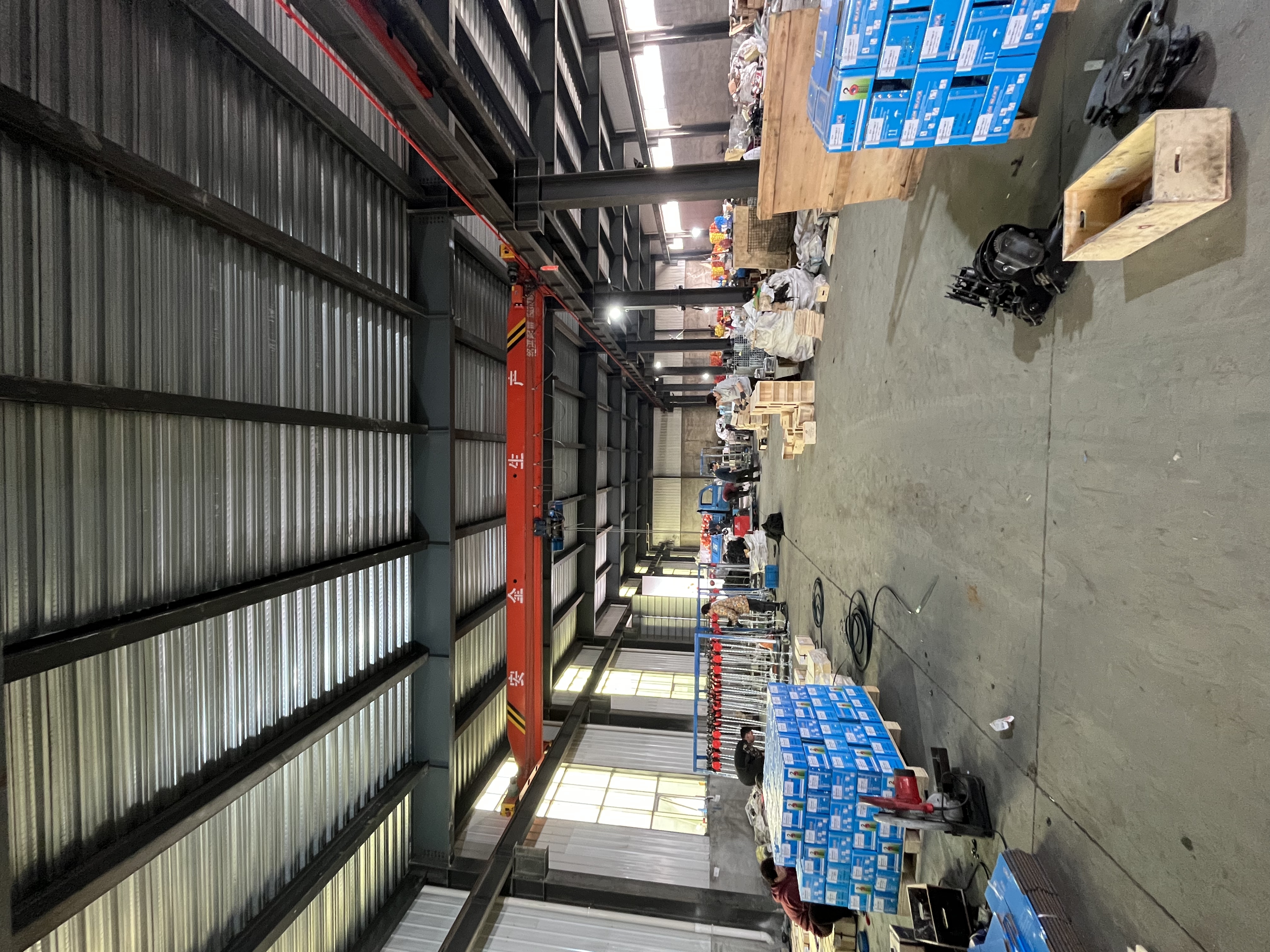
Units prepared for export dispatch: 100% tested, with spare parts supplied per container.
Company reference: Baoding Junyun Hoisting Machinery Co., Ltd. (JUNYUNHOIST), founded 2018, Donglu Village, Qingyuan District, Baoding City, Hebei Province, China. Product range includes VD, VT, HSZ, HSC and VD-II chain blocks and VA and VL lever blocks.
Have Questions or Need More Details?
Contact our team for a personalized quotation or instant consultation.
Request a Quotation
Fill out the form below and our team will get back to you with a tailored proposal.
WhatsApp Direct Chat
Prefer to chat in real-time? Message us on WhatsApp for instant assistance & quick answers.
- Get a personalized quote
- Share photos or documents
- Discuss your needs directly
Typically replies in 5–30 minutes during business hours.