
VD Chain Block Capacity Guide: Chain Falls, Chain Diameter, Hook Opening
Short answer: On a VD chain block, rated capacity is only the starting point. The same rated load can be delivered with 1–4 chain falls, a load chain diameter between 6.3 mm and 11.2 mm, and a hook opening between 24 mm and 55 mm. Those three values decide whether the hoist fits your lift point, accepts your rigging, and stays within a hand-chain pull force of ≤ 35 daN (350 N) up to rated load. VD chain blocks from JUNYUNHOIST (Baoding Junyun Hoisting Machinery Co., Ltd.) cover 0.5–50 t rated capacity with a 3 m standard lift height and 2.5–12 m optional lifts.
This guide is written for procurement engineers, distributors, and workshop or site planners who are evaluating a manual chain block and need to read a specification correctly rather than compare tonnage alone.
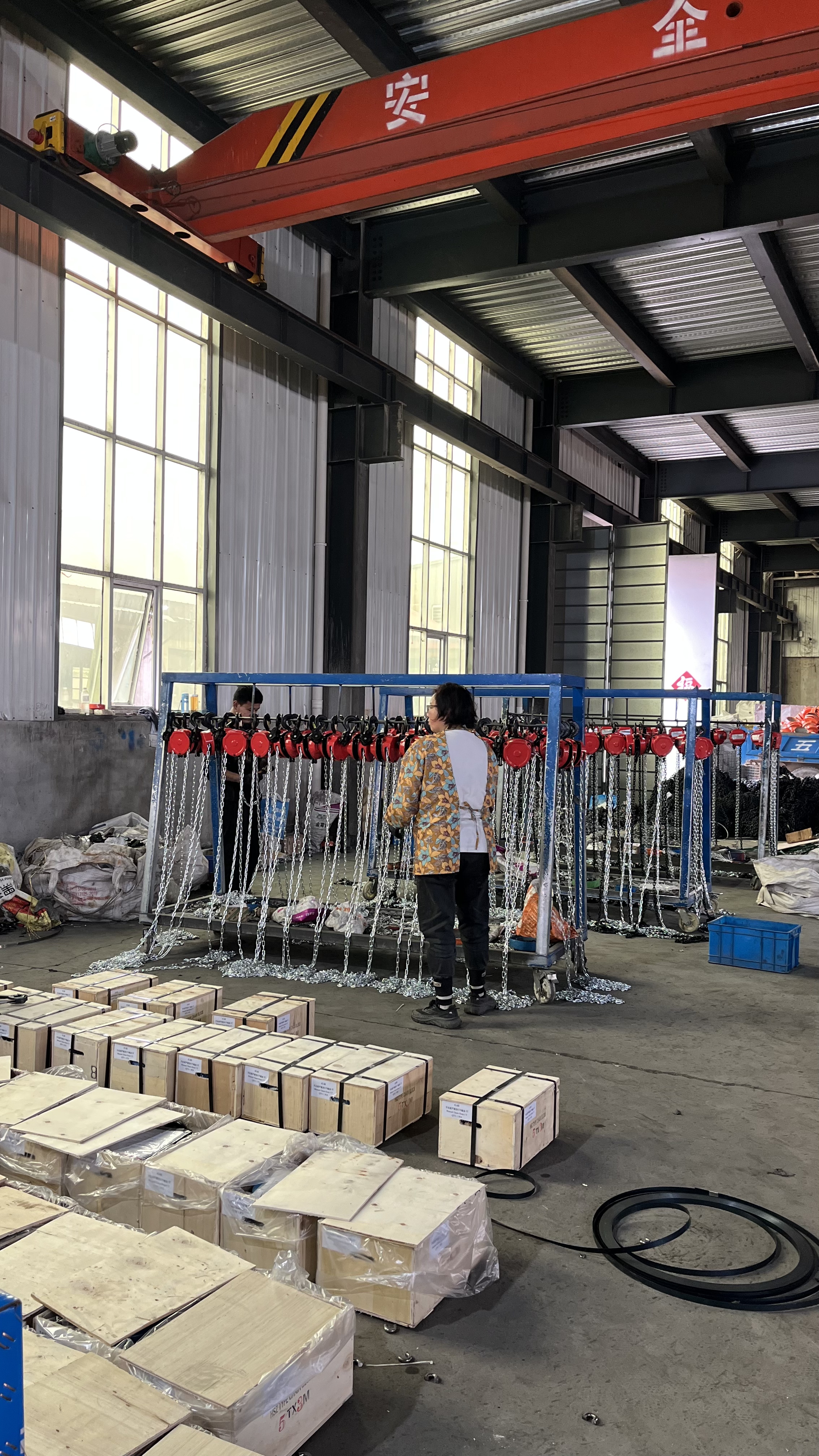
VD chain block manufacturing at Baoding Junyun Hoisting Machinery Co., Ltd. (JUNYUNHOIST), Baoding, Hebei, China.
Why Rated Capacity Is Not a Complete Specification
A purchase order that says “5 t chain block” leaves most of the technical decisions open. Rated capacity describes how much the hoist must lift. It does not describe how the load is carried, how much headroom the unit needs, or whether the hook will accept the shackle already on site.
Three failure modes appear repeatedly when buyers evaluate on tonnage alone:
- The hook does not fit the rigging. Hook opening on the VD range runs from 24 mm to 55 mm. A hook at the small end of that range will not accept a large bow shackle, even when the capacity matches.
- The unit does not fit the lift point. Minimum headroom, or hook distance, ranges from 300 mm to 1000 mm depending on model. A high-capacity block chosen for a low-clearance beam may simply not install.
- The operator cannot pull the chain comfortably. Hand-chain pull force is specified as ≤ 35 daN (350 N) up to rated load. Units specified without attention to chain falls and chain geometry can demand noticeably more effort at the top of the capacity range.
The practical conclusion for evaluation: treat capacity as the input, and chain falls, load chain diameter, hook opening, headroom, and lift height as the parameters that actually confirm the selection.
Industry Background: Why Manual Chain Blocks Still Anchor Industrial Lifting
The global chain block market was valued at approximately USD 1.95 billion in 2024, according to Intel Market Research. Within the wider category, the chain hoist market — manual and electric combined — is projected by Dataintelo to reach USD 3.9 billion by 2034. Asia Pacific held a 41.3% revenue share in 2025, and China’s exports of lifting and handling equipment parts (HS 843139), which include chain block components, reached USD 1.36 billion in 2024 according to UN Comtrade and World Bank WITS data.
Manual products remain central to that picture. Manual chain pulley blocks are estimated to account for 48% of the total product segment share in 2026 (Fact.MR). Construction sites are the single largest application segment, contributing roughly 30% to 54% of global demand depending on the source (Stratview Research / Fact.MR). The reason is straightforward: a manual chain block requires no power supply, no control panel, and no commissioning, which matters on bridge decks, in mines, in shipyards, and inside warehouses where a temporary lift point is the only lift point available.
Regulatory expectations differ by market. In Europe, hand-powered lifting equipment must comply with EN 13157, which specifies safety requirements for this class of equipment. In the United States, ASME B30.16 governs the construction, installation, inspection, and maintenance of overhead hoists, including hand chain-operated units. Load chain grade is defined separately under DIN EN 818-7.
How VD Chain Block Capacity Maps to Chain Falls, Chain Diameter, and Hook Opening
Capacity on a VD chain block is not produced by one component. It is produced by the combination of how many chain falls carry the load, how thick the load chain is, and how the load-bearing components, the hook included, are built. The published VD range defines the envelope for each parameter.
Rated load capacity: 0.5–50 t
The rated load capacity of the VD range runs from 0.5 t to 50 t. This is the load the hoist is designed to lift and hold, and it is the number that drives every other parameter on the sheet, including how many chain falls the unit will use.
Number of chain falls: 1–4
VD chain blocks are built with 1 to 4 chain falls depending on capacity. Chain falls describe how many strands of load chain run between the upper and lower blocks. More falls share a given load across more chain strands, which is how the same nominal chain diameter can serve a higher-capacity unit. In evaluation terms, the number of falls is the parameter that connects rated capacity to chain size, lifting effort, and lifting speed: a unit with more falls generally moves more slowly and requires more hand-chain travel per metre of lift.
Load chain diameter: 6.3–11.2 mm
Load chain diameter across the VD range runs from 6.3 mm to 11.2 mm and varies with capacity. Diameter is the visible, measurable indicator of the load path. Together with the number of falls, it defines the capacity of the block, and it also affects the physical size of the sheaves and therefore the headroom figure.
Load chain grade: Grade V or Grade T to DIN EN 818-7
VD chain blocks use load chain in Grade V (also designated 80级) or Grade T, supplied to DIN EN 818-7, in a corrosion-resistant specification. Buyers evaluating a quotation should confirm the chain grade in writing, because grade and diameter together define the capability of the load chain, not diameter alone.
Hook opening: 24–55 mm
Hook opening on the VD range spans 24 mm to 55 mm, varying with model and capacity. This parameter is frequently overlooked during evaluation and is one of the most common reasons a hoist arrives on site and cannot be used with the existing rigging. Before ordering, measure the bow shackle, sling thimble, or lifting eye the hook must accept.
Hook material: forged alloy steel, heat-treated
Hooks on the VD range are forged alloy steel, heat-treated. Forged and heat-treated construction is what allows the hook to carry repeated rated loads while resisting deformation.
Lift height and hand chain length
The standard lift height is 3 m, with 2.5 m to 12 m lifts available as options. Hand chain is round link, galvanised or zinc-plated, and is supplied at lift height plus 0.5 m of slack. Both figures matter during evaluation: lift height sets how high the hook can travel, and hand chain length sets where the operator stands, which is often the deciding factor in a mezzanine or a loading bay.
Hand chain pull force: ≤ 35 daN
Pull force on the hand chain is specified as ≤ 35 daN (350 N) up to rated load. This is the operator-effort ceiling, and it is worth stating explicitly to site teams, because it is the parameter that determines whether a task is realistically a one-person job.
Headroom and hook distance: 300–1000 mm
Minimum headroom, or hook distance, ranges from 300 mm to 1000 mm depending on model. In low-clearance locations — under a beam, inside a container, between pipework — this number decides feasibility before capacity does.
Safety factors: ≥ 4:1 chain, ≥ 5:1 structural parts
The VD range carries a safety factor of at least 4:1 on the load chain and at least 5:1 on structural parts. A 4:1 factor is consistent with the standard safety factor specified for EN 13157 compliant chain blocks. During evaluation the two figures should be verified separately: a hoist with an adequate chain factor is not automatically built with the same reserve in housings, hooks, and other load-bearing components.
Materials, finish, and operating limits
Load chain materials across the range are 20Mn2, 25MnV, and 23MnNiMoCr54. Housings are painted in RAL 2000 or RAL 1007, with corrosion-resistant chains. Operating temperature is –20 °C to +50 °C with standard grease. Together these define the environments where the standard VD build is appropriate, and where a customized specification is needed instead.
Standards and marking
The VD range references ISO 16872, EN 13157, and ASME B30.21, and is CE marked. For a European tender, EN 13157 is the applicable hand-powered equipment standard; for US projects, ASME B30.16 applies to overhead hoist installation and maintenance. Matching the standard cited on the quotation to the standard required by the destination market is part of the evaluation, not an afterthought.
Step-by-Step: How to Evaluate a VD Chain Block Specification
- Start with the load and the duty cycle. Establish the rated capacity required (0.5–50 t) and how frequently the lift occurs. Duty drives the choice between a standard build and a customized specification.
- Confirm the number of chain falls. Verify that the quoted falls count (1–4) matches the capacity you need, and that lifting effort at that capacity stays within the ≤ 35 daN hand-chain pull force specification.
- Check load chain diameter and grade together. Load chain diameter runs 6.3–11.2 mm; grade is V (80级) or T to DIN EN 818-7. Treat these as a pair, because a diameter without a grade is an incomplete specification.
- Measure the hook opening you actually need. Hooks range from 24 mm to 55 mm opening. Measure the shackle, thimble, or lifting eye before confirming the model.
- Verify headroom at the lift point. Minimum headroom is 300–1000 mm depending on model. Where ceiling clearance is tight, this check should come before the capacity check.
- Set lift height and hand chain length. Standard lift is 3 m, with 2.5–12 m available. Hand chain is supplied at lift height plus 0.5 m slack, so confirm where the operator will stand.
- Match the operating environment. Confirm that the –20 °C to +50 °C range and the painted housing with corrosion-resistant chain suit the site. For stainless steel or explosion-proof requirements, request a customized specification.
- Confirm standards and marking. Check that the quoted standards (ISO 16872, EN 13157, ASME B30.21) and CE marking match the destination market, and that the safety factors of ≥ 4:1 (chain) and ≥ 5:1 (structural parts) are documented.
- Confirm commercial terms. The standard minimum order quantity is 50 pcs, production lead time is 15–20 days, and quality control covers 100% testing. For OEM/ODM work, color, load-bearing chain length, accessory quality, and scenario-based customization are available.
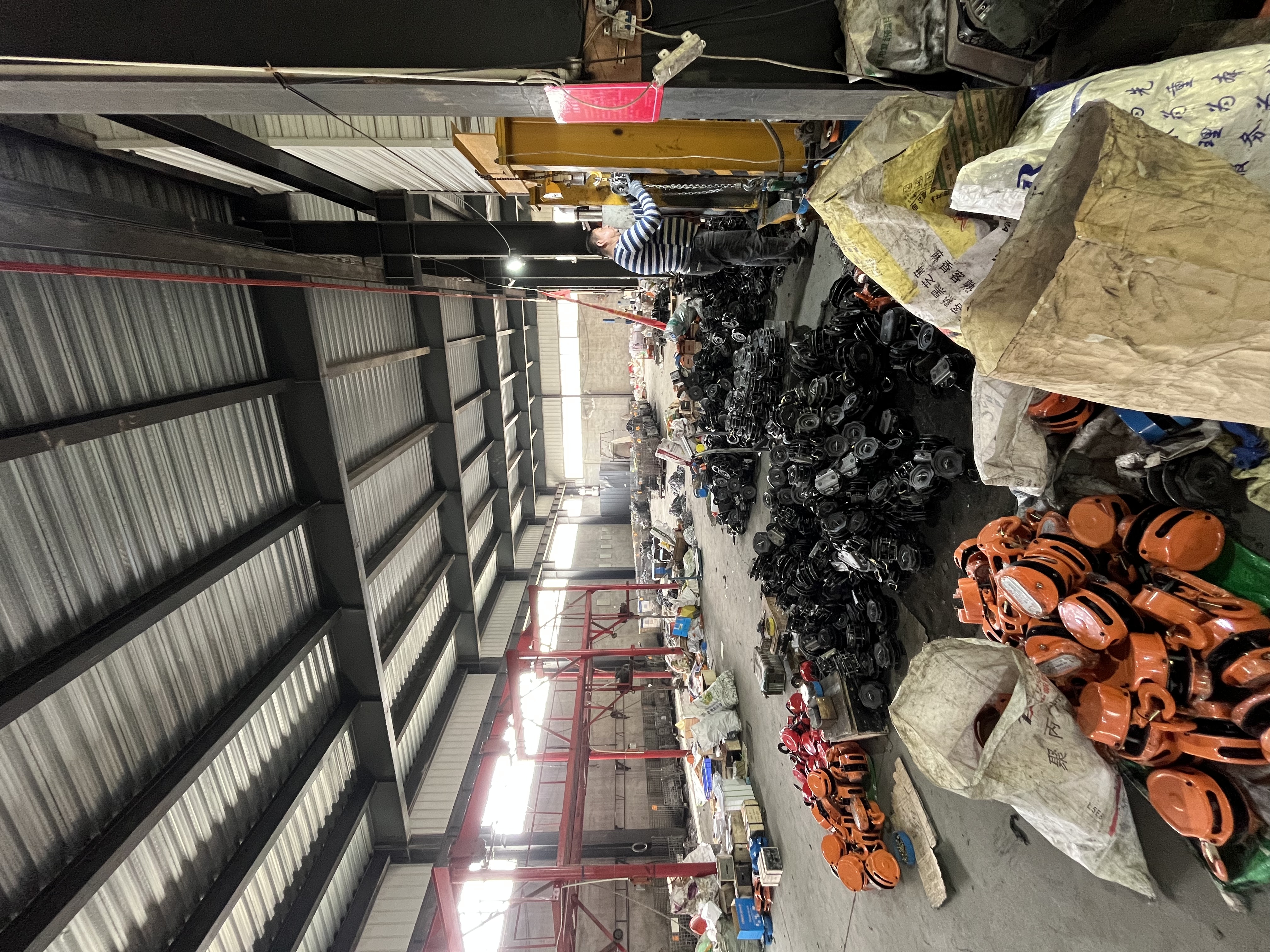
Assembly and 100% testing of chain blocks before shipment at the JUNYUNHOIST facility.
Application Fit: Where VD Chain Blocks Are Used
VD chain blocks are specified across manufacturing, construction, logistics and warehousing, shipbuilding, mining, petrochemicals, the power industry, bridge engineering, railway construction, automotive repair, agriculture, and stage construction. The common thread is a lift point without power and a load that must be positioned precisely.
Capacity-to-parameter mapping behaves differently in each setting. In a warehouse, hook opening and headroom usually decide the model, because the load is light but the space is tight. On a construction site, chain falls and chain diameter decide it, because capacity and duty cycle dominate. In shipbuilding and port work, corrosion resistance and chain grade matter as much as capacity, because the environment constantly attacks the load path.
The same logic applies to distributors evaluating a supplier rather than a single lift. A recorded VD chain block case covers a single order of 2,000 units supplied to importers in India, Vietnam, Brazil, Türkiye, Russia, the United Arab Emirates, and Saudi Arabia, primarily for local store distribution. Units were used in long-term bridge and construction processes with a service life exceeding two years and low loss. That case addressed the durability concern that typically appears in long-term construction applications: the question is not whether a manual hoist works on day one, but whether it still performs after two years of site use.
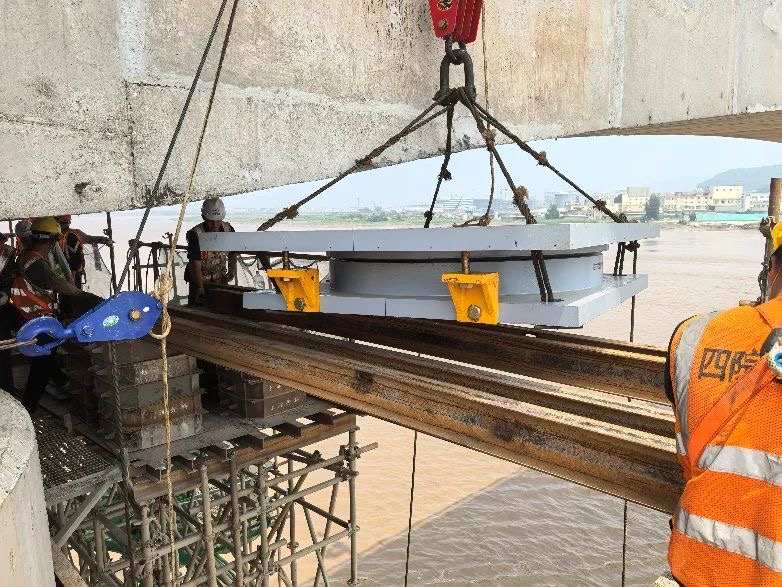
Chain blocks in long-term highway construction duty, where multi-year durability is the deciding requirement.
VD Chain Block Parameter Comparison Table
The table below consolidates the published VD range so that each parameter can be checked against the application rather than against capacity alone. Values are range figures: the specific value for a given unit varies with model and capacity, and should be confirmed on the quotation.
| Parameter | VD chain block range | What it controls in practice |
|---|---|---|
| Rated load capacity | 0.5 – 50 t | Load the hoist is designed to lift and hold; drives the chain-fall count and chain diameter selected |
| Number of chain falls | 1 – 4 (varies with capacity) | How the load is shared across the load chain; affects lifting effort and lifting speed |
| Load chain diameter | 6.3 – 11.2 mm (varies with capacity) | Load chain strength and weight; influences sheave size and headroom |
| Load chain grade | Grade V (80级) or Grade T, to DIN EN 818-7 | Chain strength class and dimensional conformity of the load chain |
| Chain material | 20Mn2, 25MnV, 23MnNiMoCr54 | Base steel used for load chain components |
| Hook opening | 24 – 55 mm | Whether the hook accepts your shackle, sling thimble, or lifting eye |
| Hook material | Forged alloy steel, heat-treated | Hook strength and wear resistance under repeated rated loading |
| Standard lift height | 3 m (2.5 – 12 m optional) | How high the hook can travel; determines load chain and hand chain length |
| Hand chain | Round link, galvanised or zinc-plated; length = lift height + 0.5 m slack | Operator reach and hand chain durability |
| Pull force on hand chain | ≤ 35 daN (350 N) up to rated load | Operator effort required at rated capacity |
| Minimum headroom / hook distance | 300 – 1000 mm (model dependent) | Whether the unit fits under a low beam or inside a confined space |
| Safety factor | ≥ 4:1 (chain) / ≥ 5:1 (structural parts) | Reserve strength margin of chain and of structural components |
| Operating temperature range | –20 °C to +50 °C (standard grease) | Climate and indoor or outdoor suitability |
| Protection / finish | Painted housing (RAL 2000 or 1007), corrosion-resistant chains | Site conditions, humidity, and coastal or outdoor environments |
| Standards / marking | ISO 16872, EN 13157, ASME B30.21, CE marked | Market access and compliance documentation for the destination country |
FAQ: VD Chain Block Compliance, Capability, Cost, Sample, and Lead Time
Which standards and safety factors apply to a VD chain block?
The VD range references ISO 16872, EN 13157, and ASME B30.21 and is CE marked. Load chain is supplied in Grade V (80级) or Grade T to DIN EN 818-7. Safety factors are ≥ 4:1 for the load chain and ≥ 5:1 for structural parts, and 4:1 is also the standard safety factor for EN 13157 compliant chain blocks. In Europe, EN 13157 specifies safety requirements for hand-powered lifting equipment; in the United States, ASME B30.16 governs overhead hoists, including hand chain-operated units.
What capacity, lift height, and chain configuration are available?
Rated load capacity is 0.5–50 t. Standard lift height is 3 m, with 2.5–12 m available as an option. Units use 1–4 chain falls, a load chain diameter of 6.3–11.2 mm, and a hook opening of 24–55 mm. Minimum headroom or hook distance is 300–1000 mm depending on model. Hooks are forged alloy steel, heat-treated, and hand-chain pull force is ≤ 35 daN (350 N) up to rated load.
What drives the cost of a VD chain block?
Cost is driven primarily by the load-path specification — rated capacity, number of chain falls, load chain diameter and grade, and the hook — together with lift height, since a longer load chain and hand chain consume more material. Finish and environmental requirements also matter: standard housings are painted RAL 2000 or RAL 1007 with corrosion-resistant chains, while stainless steel or explosion-proof execution requires a customized specification. Accessory quality can be adjusted to the application, which is one of the most direct ways to align price with actual site requirements.
Can a sample or quotation be evaluated before a bulk order?
Yes. Sample and quotation requests are handled through the same channel as OEM/ODM enquiries. The standard minimum order quantity is 50 pcs, color and load-bearing chain length can be customized, and customization is also available for specific usage scenarios such as stainless steel or explosion-proof execution.
What is the production lead time, and what after-sales support is included?
Production lead time is 15–20 days. Quality control covers 100% testing, and monthly capacity is 15,000 units. After-sales support includes a certain number of easily damaged spare parts supplied with each container, replenished as needed based on subsequent usage. To match a configuration to your lift point — capacity, chain falls, chain diameter, hook opening, lift height, and standards — send your requirements through junyunhoist.com, and download the full product catalog here: JUNYUNHOIST product brochure.
Next Step
Evaluating a VD chain block is a mapping exercise, not a capacity comparison. Start from the load, then work through chain falls (1–4), load chain diameter (6.3–11.2 mm) and grade (V or T to DIN EN 818-7), hook opening (24–55 mm), headroom (300–1000 mm), lift height (3 m standard, 2.5–12 m optional), and the hand-chain pull force ceiling of ≤ 35 daN. Confirm the safety factors of ≥ 4:1 on chain and ≥ 5:1 on structural parts, and check that the standards cited — ISO 16872, EN 13157, ASME B30.21, CE marking — match the destination market.
Do that, and a “5 t chain block” becomes a defined piece of equipment: a specific number of chain falls, a specific load chain diameter and grade, a hook that fits the rigging already on your site, and an operating envelope from –20 °C to +50 °C that matches where it will actually work.
Request a VD Chain Block Quotation
Baoding Junyun Hoisting Machinery Co., Ltd. (JUNYUNHOIST) manufactures VD chain blocks from 0.5 t to 50 t with OEM/ODM support, 100% testing, and 15–20 day lead times. Send your capacity, lift height, chain falls, hook opening, and destination market for a configuration-matched quotation.
Email: Junyunsteven@163.com | Tel / WhatsApp: +86 134-8345-2631 | Web: www.junyunhoist.com
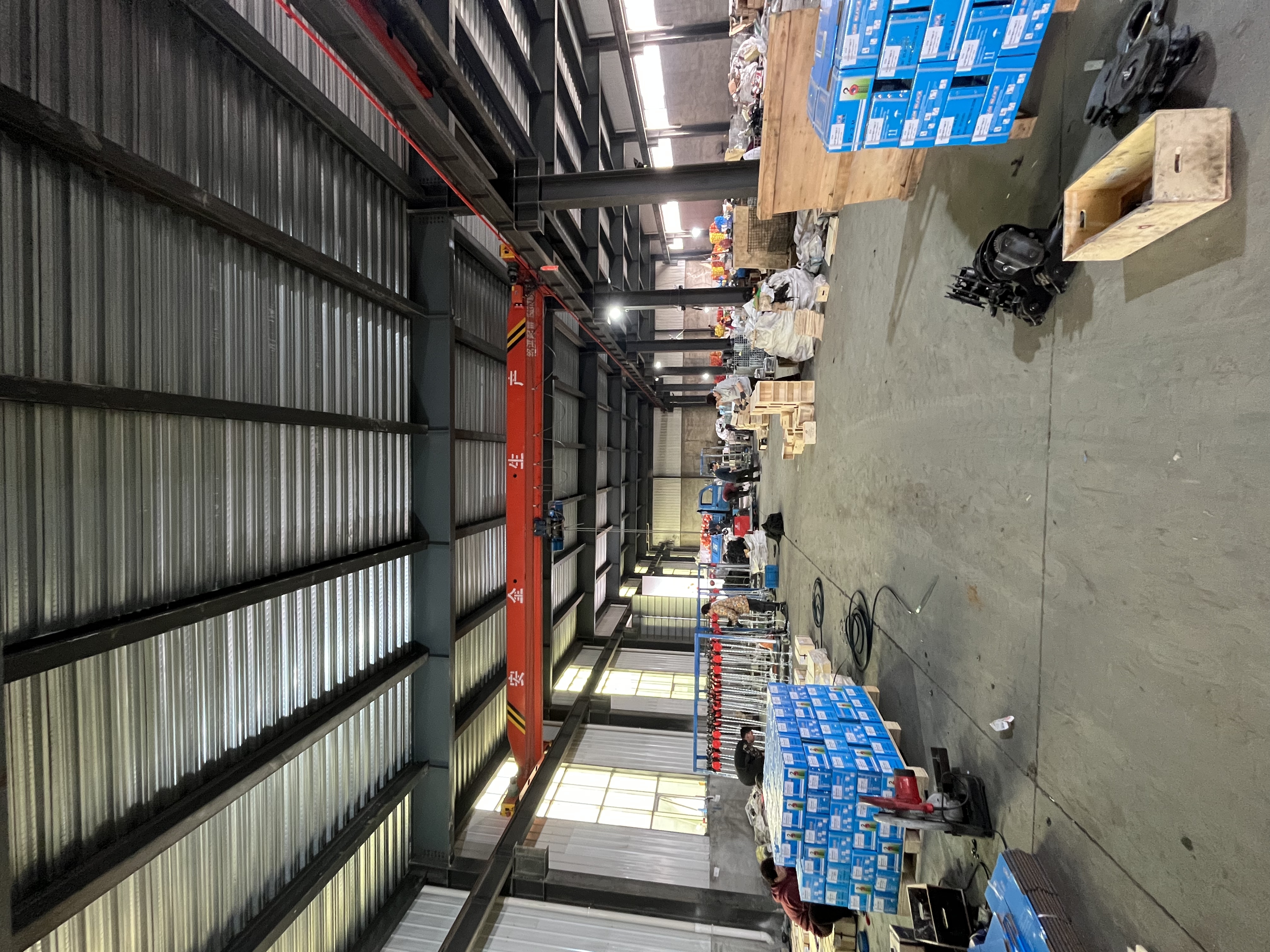
VD chain block production and order preparation at the JUNYUNHOIST facility, Baoding, Hebei, China.
Have Questions or Need More Details?
Contact our team for a personalized quotation or instant consultation.
Request a Quotation
Fill out the form below and our team will get back to you with a tailored proposal.
WhatsApp Direct Chat
Prefer to chat in real-time? Message us on WhatsApp for instant assistance & quick answers.
- Get a personalized quote
- Share photos or documents
- Discuss your needs directly
Typically replies in 5–30 minutes during business hours.