
What Is a Chain Block? Understanding the Manual Hoist and Its Role in Modern Industry
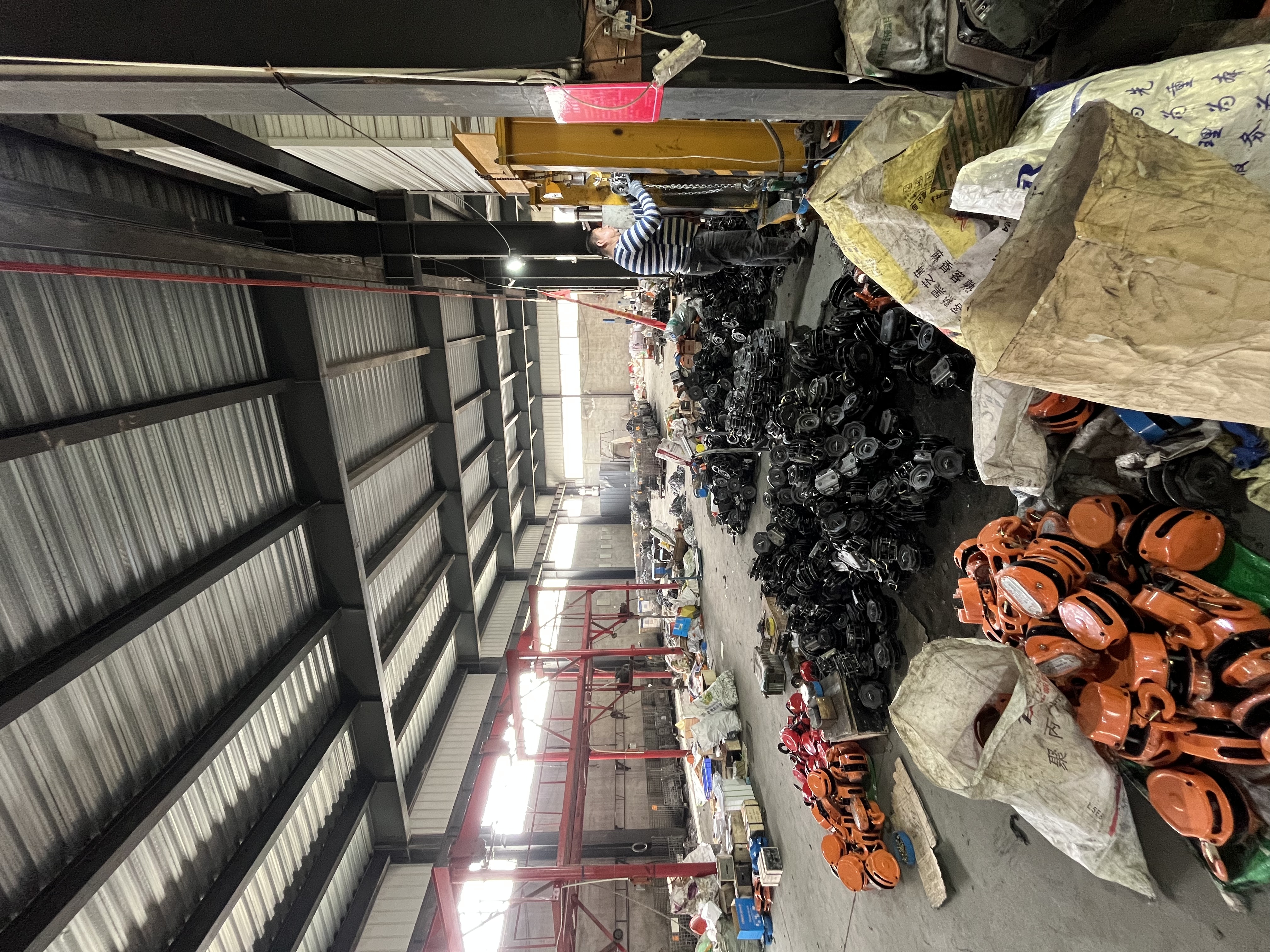
Cover image: chain block manufacturing at the JUNYUNHOIST factory in Baoding, Hebei, China.
Short answer: a chain block is a manual hoisting device that lifts a suspended load when an operator pulls a hand chain. The hand chain turns a pocketed wheel, the wheel drives a geared train, and the geared train pulls a load chain through the block. The result is a portable lifting tool that converts arm strength into a controlled vertical lift, with no electricity, hydraulics or compressed air involved.
That definition is simple, but the purchasing decision around it is not. Buyers arriving at this category for the first time meet a vocabulary of lift height, load capacity, chain falls, chain grade and hook opening — and a market where the same tool is described in several different ways. This guide walks through the parts, the terminology and the applications, then explains what a distributor or long-term buyer should verify before committing to a supply relationship. The VD chain block from JUNYUNHOIST — the brand of Baoding Junyun Hoisting Machinery Co., Ltd., a hoisting equipment manufacturer based in Baoding, Hebei, China, founded in 2018 — is used throughout as a reference model for readers who are new to the category.
The Problem: Why a Simple Tool Is Hard to Specify
The first obstacle is terminology. In everyday trade use, “chain block”, “chain hoist”, “chain pulley block” and “manual hoist” are often treated as synonyms, and they mostly are — but a chain block is not a lever hoist. A chain block lifts vertically and holds a load through a built-in brake; a lever hoist uses a ratcheting lever and is often preferred for pulling, tensioning and horizontal positioning. Buying one when the task calls for the other is a common and expensive first mistake.
The second obstacle is specification. A chain block is defined by a small set of parameters — rated load, lift height, number of chain falls, hand pull force, load chain diameter and hook opening — and those parameters interact. A buyer who chooses on capacity alone may end up with a block whose load chain is too short for the actual lifting height, or whose hand pull force is impractical for the operator in a confined space.
The third obstacle appears later, and it is the one that matters most for distributors and repeat buyers: supply continuity. A chain block is a wear item. Load chains age and wear, brake pads wear out, hand chains wear, and outer shells take impact damage on site. A supplier who can deliver a first container but cannot deliver brake pads, replacement chains or consistent build quality eighteen months later creates a problem that no unit price can offset.
In short, the question “what is a chain block?” has a one-sentence answer, but the question “what am I actually buying, and from whom?” needs a structured answer. The sections below build that structure.
Industry Background: Where Manual Chain Blocks Fit Today
Manual chain blocks are not a legacy product being displaced by powered equipment. The global chain block market was valued at approximately USD 1.95 billion in 2024, according to Intel Market Research, and the broader chain hoist market — including electric and manual equipment — is projected to reach USD 3.9 billion by 2034, according to Dataintelo. Within that picture, manual chain pulley blocks are estimated to account for 48% of the total product segment share in 2026, based on Fact.MR's estimate.
The reason is practical. A manual chain block needs no power supply, no control system and no commissioning. It can be carried to a location where no cable will ever reach, stored for long periods, and operated by one person. Those characteristics keep it relevant in maintenance and repair work, outdoor sites, confined spaces and regions where power reliability is inconsistent.
Construction remains the largest single application segment, contributing approximately 30% to 54% of global demand depending on the source (Stratview Research and Fact.MR publish different scope definitions). Supply is concentrated in Asia: Asia Pacific held a 41.3% revenue share of the chain hoist market in 2025, according to Dataintelo, and China's exports of parts for lifting and handling equipment under HS 843139 — a category that includes chain block components — reached USD 1.36 billion in 2024, according to UN Comtrade data published through the World Bank's WITS platform.
Compliance frameworks differ by destination market, and this is where many first-time importers lose time. In the European Union, hand-powered lifting equipment is governed by EN 13157, which specifies safety requirements for this equipment class; EN 13157-compliant chain blocks are specified with a 4:1 safety factor. In the United States, ASME B30.16 governs the construction, installation, inspection and maintenance of overhead hoists, including hand chain-operated units. These are the reference documents a buyer should ask about before placing a first order.
Detailed Solution: What Is Inside a Chain Block
A chain block contains five functional groups: the hand chain and hand chain wheel, the load chain, the gear train and bearings, the brake, and the hooks and housing. Each one determines a different part of the buying decision.
Hand chain and hand chain wheel
The hand chain is the operator interface. It loops over a pocketed hand chain wheel; pulling one side rotates the wheel, which drives the gear train. Because the hand chain is handled continuously and often under load, its diameter and wear resistance influence how long the tool stays comfortable and safe to use. On the JUNYUNHOIST VD chain block, the hand chain is specified at 4.8 mm in diameter.
Load chain
The load chain is the load-bearing element. It runs over a load sprocket inside the block and carries the full weight of the hook and the suspended load. Chain grade is the key variable here: JUNYUNHOIST uses G80 steel chain for the load-bearing chain, where a commonly compared factory build uses G70. The company also applies a blackening and carburizing treatment to the chain, which is intended to improve corrosion resistance and wear resistance in service.
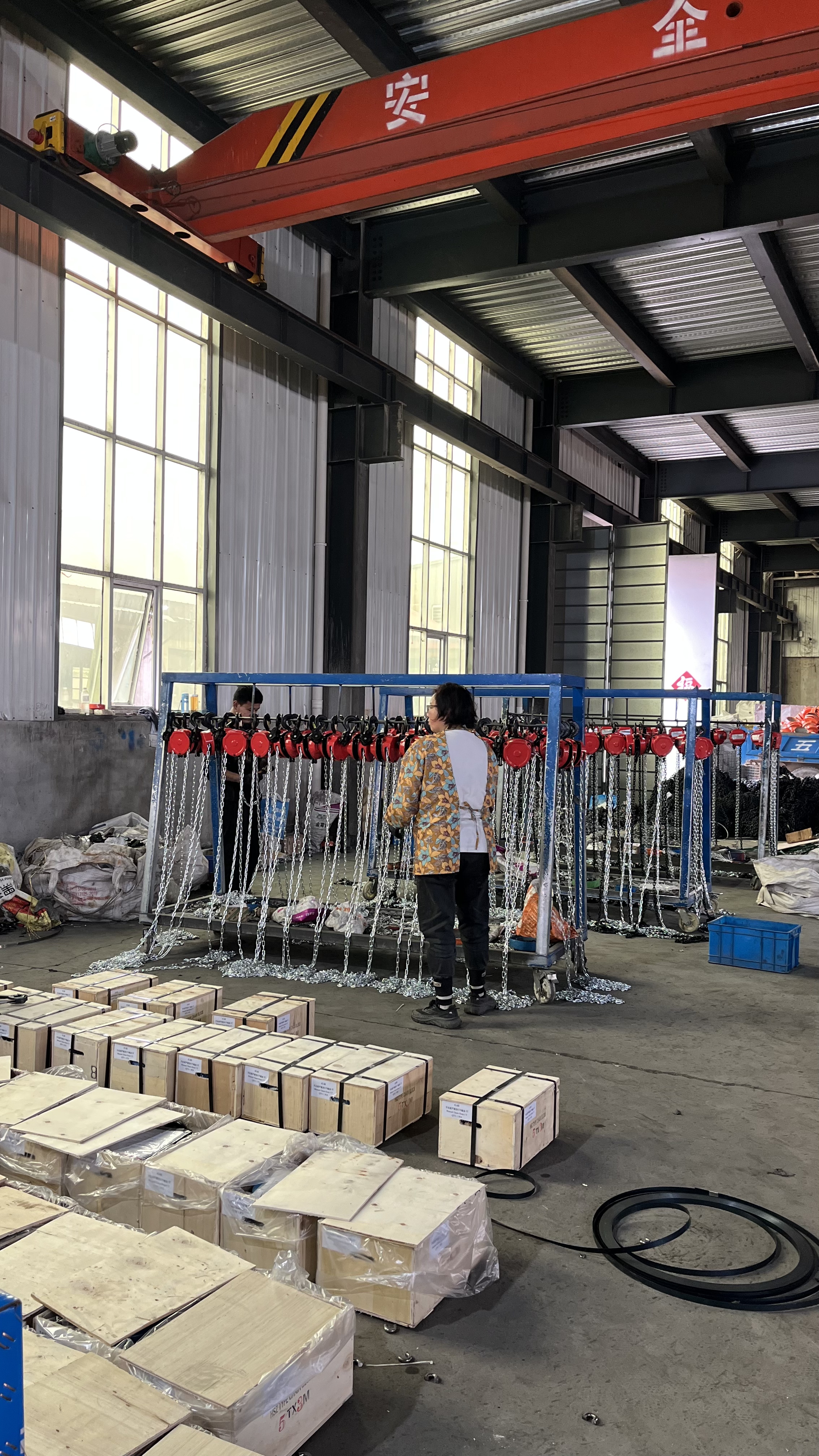
Body image: chain block assemblies and load chain work at the JUNYUNHOIST production facility.
Gear train, bearings and brake
The gear train multiplies the operator's pull into lifting force, and the bearings support the rotating shafts inside it. The JUNYUNHOIST VD design employs three bearings, and all spare parts in the block undergo a quenching treatment. The brake is what makes a chain block safe to leave under load: it holds the load when the operator stops pulling. Brake pads are a wear part and are the item most often replaced during the life of the tool.
Hooks, housing and finish
The top hook connects to the anchor point; the load hook carries the sling. The VD model uses a VD-specific hook, and the hooks are quenched. The outer shell is thickened to 2.8 mm, which improves impact resistance when the block is knocked against scaffolding, steel structures or cargo. The VD chain block ships with a 3 m load chain as standard, and the load-bearing chain length can be customized for specific orders.
The specification terms that decide the purchase
| Term | What it means | Why it changes the buying decision |
|---|---|---|
| Load capacity (rated capacity) | The maximum load the block is designed to lift. | Sets the sizing of the load chain, hooks and housing; determines whether the unit suits a workshop task or heavy-duty lifting. |
| Lift height | The vertical distance the load hook can travel. | Defined by load chain length. JUNYUNHOIST ships the VD with a 3 m load chain as standard, with other lengths available as a customization. |
| Chain falls | The number of load chain sections supporting the load hook. | Multiple falls share the load across chain sections, which affects how capacity relates to chain diameter and hand pull force. |
| Hand pull force | The force the operator applies to the hand chain to lift the rated load. | Determines whether one person can work the unit comfortably, especially in confined spaces or during long lifts. |
| Hook opening | The throat opening of the hook. | Limits the size of sling, shackle or beam flange the hook can accept. |
| Chain grade | The steel grade of the load-bearing chain. | JUNYUNHOIST uses G80 for the load chain; a frequently compared factory build uses G70. |
One clarification for new buyers: variable-frequency control and remote monitoring are features of powered hoists, not of manual chain blocks. If a specification sheet for a manual chain block mentions either, the item being described is not a purely manual unit. Manual chain blocks are defined by mechanical advantage and a friction brake, and that is exactly why they remain usable where no power exists.
Step-by-Step Breakdown: Operating and Specifying a Chain Block
Operating sequence
- Confirm the load. Compare the actual weight of the load with the rated capacity on the block. Overloading is the single most damaging event in the life of a chain block, and the supplier's own control guidance lists it alongside chain wear, brake pad wear and shell impact as the main risks to avoid.
- Inspect before use. Check the load chain for aging and wear, the brake pads for wear, the hand chain for wear, and the outer shell for collision damage. Any unit that is no longer practical to use should be taken out of service.
- Attach the top hook. Hook the block to a rated anchor point positioned above the load, and close the hook latch.
- Attach the load hook. Connect the sling, keep the load directly beneath the block, and avoid side pulls that the block is not designed for.
- Pull the hand chain to lift. Pull the lifting side of the hand chain in a steady motion; the internal brake holds the load as soon as the operator stops.
- Lower and store. Pull the opposite side of the hand chain to lower the load. After use, apply oil to the surface of the load chain and store the block indoors to reduce rain exposure.
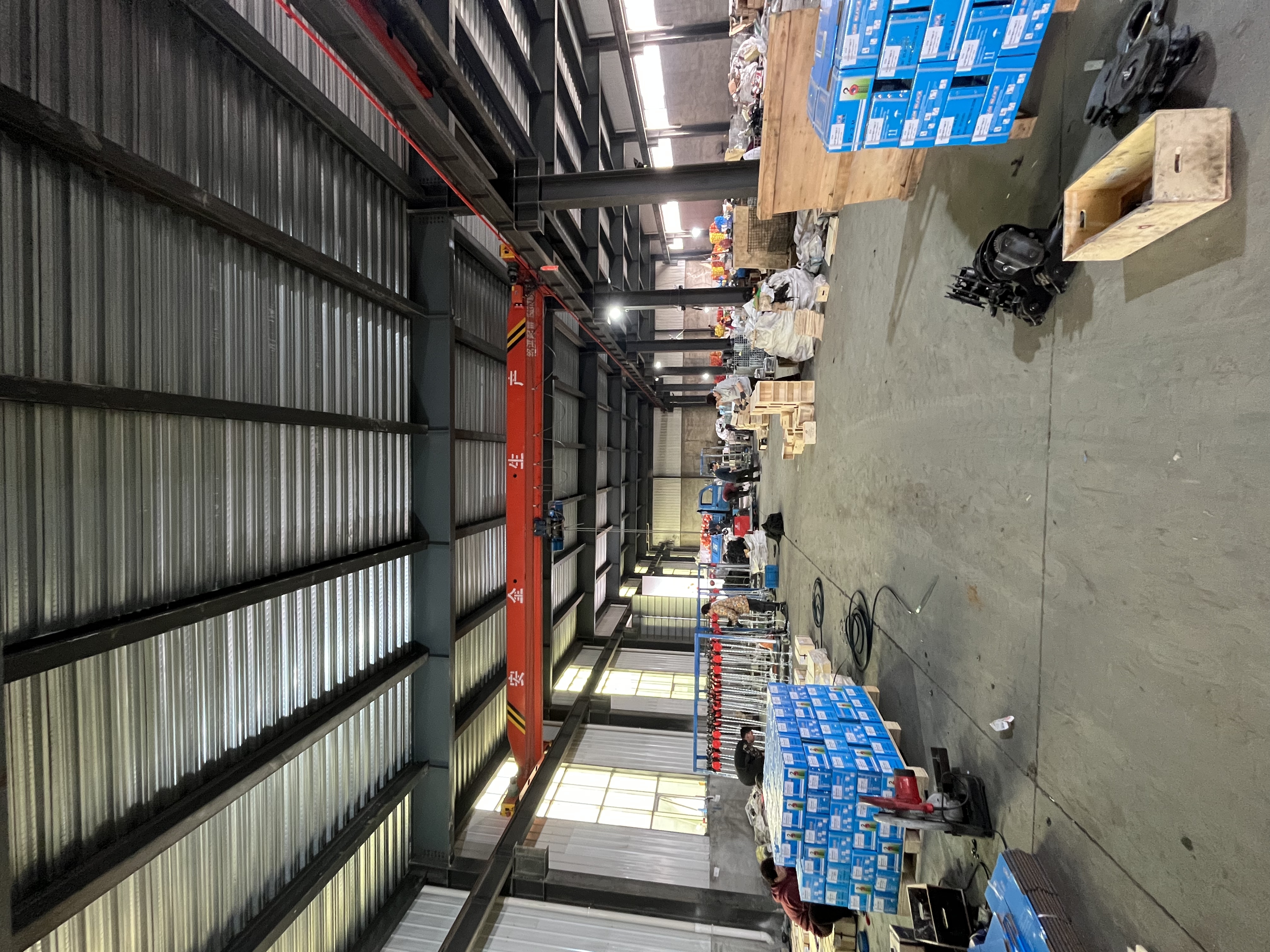
Body image: chain block assembly and inspection steps at the JUNYUNHOIST plant.
Specification sequence
- Start from the load, not the catalogue. Establish the heaviest single lift first.
- Fix the lift height. Measure from the anchor point to the lowest working position, then choose the load chain length; the VD standard is 3 m, with longer chains available as a customization.
- Match the environment. A workshop lift, an outdoor site and a confined-space lift place different demands on shell thickness, chain treatment and hand pull force.
- Check the destination standard. For the EU, EN 13157 applies; for the United States, ASME B30.16 applies. Confirm the supplier can provide the relevant documentation.
- Qualify the supplier. Ask about test procedures before shipment, third-party inspection options and the availability of wear parts such as brake pads.
Use Cases: Where a Chain Block Earns Its Place
The application list for manual chain blocks is broad because the tool does not depend on infrastructure. The scenarios below reflect the application areas JUNYUNHOIST identifies for the VD model.
Factory and workshop hoisting. Machine assembly, die changes and maintenance lifts inside a plant. The manual block suits intermittent lifting where installing a powered hoist overhead would be unnecessary.
Construction sites. Lifting materials and components where a crane cannot reach, or as a secondary lifting tool during installation. Construction is the largest application segment globally, and the thickened shell of the VD model is designed for the knocks that come with site work.
Warehouse and logistics. Moving heavy goods between levels, loading areas and storage racks in facilities where a permanent hoist is not installed.
Port and shipyard cargo operations. Positioning cargo and heavy components where space is tight and equipment is constrained.
Mining operations. Maintenance lifts and equipment handling in environments where dust and rough handling are normal, and where power availability may be limited.
Small-space and confined-space operations. The compact form of a manual block allows lifting in low-headroom positions and in spaces that cannot be reached with larger equipment.
Outdoor work with no power supply. Field work, agricultural lifting, municipal and utility maintenance, and stage or entertainment rigging all rely on the same characteristic: the tool works anywhere a person can stand.
Maintenance and repair. Because the unit is portable and self-contained, it is often carried to the fault rather than the load being brought to the hoist.
Comparison Table: Build Details Side by Side
The table below uses the comparison published by JUNYUNHOIST against a commonly compared factory build. Items marked “supplier-dependent” are not stated for competing builds and should be verified individually with each supplier rather than assumed.
| Feature | JUNYUNHOIST VD chain block | Commonly compared factory build | What it changes for the buyer |
|---|---|---|---|
| Load-bearing chain | G80 steel chain | G70 steel chain | Chain grade determines the load-bearing duty the chain is intended for. |
| Hand chain diameter | 4.8 mm | Supplier-dependent | Wear life and grip comfort at the operator interface. |
| Bearings in the gear train | 3 | Supplier-dependent | Load distribution around the rotating shafts. |
| Spare parts treatment | All spare parts quenched | Supplier-dependent | Wear resistance of the internal components. |
| Outer shell | Thickened, 2.8 mm | Supplier-dependent | Impact resistance when the block is knocked on site. |
| Hook | VD-specific hook, quenched | Supplier-dependent | Fit to the block design and wear at the load attachment point. |
| Standard load chain length | 3 m | Supplier-dependent | Usable lift height straight out of the crate. |
| Initial cost | About 2% higher | Baseline | The trade-off is set against durability and long-term maintenance. |
| Maintenance requirement | About 90% less, as stated by the company | Baseline | Running cost over the life of the tool. |
Read as a whole, the comparison describes a familiar trade-off: a marginally higher purchase price against lower maintenance demand and parts that wear more slowly. For a distributor, that trade-off is only meaningful if the supplier can also keep supplying the wear parts — which is the subject of the next section.
What Long-Term Buyers and Distributors Should Verify
For anyone whose decision extends beyond a single order, the question shifts from “which chain block?” to “which supply relationship?”. The following points are the ones JUNYUNHOIST publishes for distributor discussions, and they form a workable checklist for evaluating any supplier in this category.
- Production capacity. JUNYUNHOIST reports a monthly production capacity of 15,000 units, which sets the upper bound on how large a repeat order can be absorbed.
- Lead time. The typical production lead time is 15–20 days per order.
- Minimum order quantity. The MOQ is 50 pieces, which keeps a first evaluation order at a manageable size rather than requiring a full container commitment.
- Customization scope. Available customization includes color, load-bearing chain length, quality adjustment and application-specific materials — the levers a distributor needs to build a local range.
- Product breadth. The manufacturer's chain block range covers VD, VT, HSZ, HSC and VD-II chain blocks, alongside VA and VL lever blocks, so a partner can cover both vertical lifting and pulling tasks from one source.
- Wear-part supply. The company states that it supplies easily worn spare parts such as brake pads — the item most likely to end a tool's service life early.
- Export experience. JUNYUNHOIST exports to Vietnam, India, Russia, the United Arab Emirates, Brazil, Türkiye, the Middle East and Southeast Asia, with exports accounting for about 80% of output.
- Commercial terms. Delivery terms offered are FOB, EXW, CIF and CFR; payment terms are 30% T/T in advance with 70% T/T against a copy of the bill of lading.
- Acceptance criteria. Pre-shipment testing is standard, and third-party inspection through SGS is available.
None of these points is unusual on its own. What matters is whether they hold together over several order cycles: a manufacturer that combines stated capacity, a defined customization scope and a supply route for wear parts is a materially different counterparty from one that only quotes a unit price.
FAQ
1. Which standards should a chain block meet before I import it?
It depends on the destination market. In the European Union, hand-powered lifting equipment falls under EN 13157, and EN 13157-compliant chain blocks are specified with a 4:1 safety factor. In the United States, ASME B30.16 covers the construction, installation, inspection and maintenance of overhead hoists, including hand chain-operated units. Buyers should request the relevant documentation with the quotation. JUNYUNHOIST states that its products are manufactured to meet or exceed international safety standards such as ISO and CE.
2. Can a chain block be customized for my brand or my market?
Yes, within a defined scope. Customization offered by JUNYUNHOIST covers color, load-bearing chain length, quality adjustment and application-specific materials, with a minimum order quantity of 50 pieces. The underlying range includes VD, VT, HSZ, HSC and VD-II chain blocks, plus VA and VL lever blocks, so a distributor can build a local catalogue across both lifting and pulling categories from a single supplier.
3. Is a higher-specification chain block worth the extra cost?
According to JUNYUNHOIST's own comparison with a commonly compared factory build, the VD model carries roughly a 2% higher initial cost, with better durability and lower long-term maintenance costs. The same comparison states that about 90% less maintenance is required. Whether that trade-off pays back depends on usage intensity: for a buyer replacing blocks frequently, or for a distributor supporting customers who run equipment daily, lower maintenance demand usually outweighs a small difference in purchase price.
4. How can I validate quality before the goods ship?
Two mechanisms are available. Pre-shipment testing is part of the standard acceptance criteria, and third-party inspection through SGS can be arranged. In addition, the manufacturer supplies easily worn spare parts such as brake pads with the order, which lets a buyer inspect the components most likely to need replacement first. Buyers evaluating a new supplier should treat the pre-shipment test report and the spare-parts list as the minimum evidence pack.
5. What are the minimum order quantity, lead time and payment terms?
The minimum order quantity is 50 pieces. Typical production lead time is 15–20 days, supported by a monthly production capacity of 15,000 units. Delivery terms offered are FOB, EXW, CIF and CFR, and payment terms are 30% T/T in advance with 70% T/T against a copy of the bill of lading. Buyers who want to review the full product range before opening a supply discussion can download the company brochure: JUNYUNHOIST product brochure (PDF).
Conclusion
A chain block is a manual hoist in which a hand chain drives a geared train that pulls a load chain over a sprocket, lifting or lowering a suspended load under the control of a built-in brake. Its parts are few — hand chain, load chain, gears and bearings, brake, hooks and housing — but each one maps to a specification term a buyer has to understand: rated capacity, lift height, chain falls, hand pull force and hook opening.
The tool's role in modern industry follows from its limitations as much as its strengths. It cannot compete with a powered hoist on cycle speed or on very high capacities, and it is not a substitute for a lever hoist when the task is pulling rather than lifting. What it does offer is independence from power, portability, and predictable mechanical behaviour — which is why it remains the default choice in workshops, on construction sites, in ports, in mining maintenance and in any location where a cable will never reach.
For buyers at the decision stage, the practical conclusion is that the equipment question and the supplier question should be answered together. Global demand is steady, compliance expectations are defined by EN 13157 and ASME B30.16, and the differences between builds are concentrated in details that only show up over time: chain grade, hand chain diameter, bearing count, quenching of internal parts, shell thickness and the availability of brake pads. A supplier that can document those details, hold a 15–20 day lead time against 15,000 units of monthly capacity, and keep supplying wear parts is a more useful partner than a lower quotation.
Next step: sample, quote or distribution enquiry
Baoding Junyun Hoisting Machinery Co., Ltd. (brand: JUNYUNHOIST) manufactures VD, VT, HSZ, HSC and VD-II chain blocks and VA/VL lever blocks in Baoding, Hebei, China, and exports to Vietnam, India, Russia, the United Arab Emirates, Brazil, Türkiye, the Middle East and Southeast Asia.
For a specification review, a sample order at the 50-piece MOQ, or a regional distribution discussion, contact the team directly. The product brochure is available for download: Download the JUNYUNHOIST brochure (PDF).
Website: www.junyunhoist.com
Email: Junyunsteven@163.com
Tel / WhatsApp: +86 13483452631
Address: Donglu Village, Qingyuan District, Baoding City, Hebei Province, China
CTA image: the JUNYUNHOIST chain block production team, Baoding, Hebei, China.
Have Questions or Need More Details?
Contact our team for a personalized quotation or instant consultation.
Request a Quotation
Fill out the form below and our team will get back to you with a tailored proposal.
WhatsApp Direct Chat
Prefer to chat in real-time? Message us on WhatsApp for instant assistance & quick answers.
- Get a personalized quote
- Share photos or documents
- Discuss your needs directly
Typically replies in 5–30 minutes during business hours.