
2026 CNC Lathe Machine Comparison: Which Double-Head, Twin-Spindle, or Facing & Centering Design Delivers the Best ROI?
2026 CNC Lathe Machine Comparison: Which Double-Head, Twin-Spindle, or Facing & Centering Design Delivers the Best ROI?
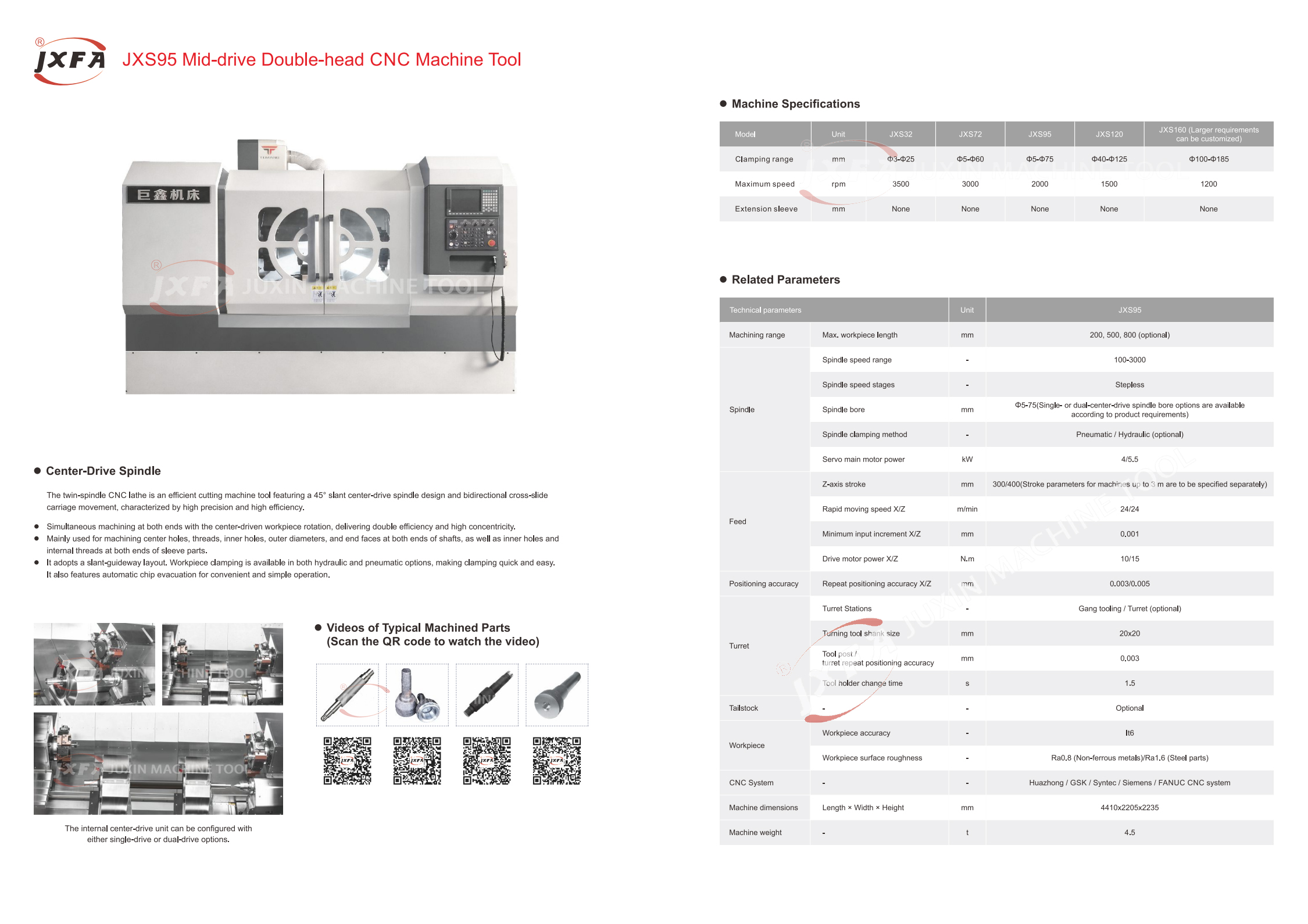
In 2024, the global CNC machine market reached USD 73.5 billion, with CNC lathe machines representing approximately 30% to 32.82% of that total. Asia Pacific alone accounted for 37% of revenue, reaching USD 27.2 billion (Vertex AI Search / Global CNC Machines Market Report). As production demands for shaft and disc parts accelerate, procurement professionals face a critical decision: which type of CNC lathe machine delivers the highest return on investment — double-head, twin-spindle vertical, or facing & centering designs?
Juxin Machine Tool Co., Ltd., established in 2005 in Wenling, Zhejiang, China, is a manufacturer specializing in high-end CNC machine tools including double-head CNC lathes, twin-spindle vertical lathes, and facing & centering machines. With an annual production capacity of 2,000 sets and over 50 technological patents, Juxin provides data-driven comparisons to help buyers make informed, cost-effective choices.
Why Traditional Lathes Fall Short
Ordinary horizontal lathes require workpiece re-clamping to machine both ends, increasing cycle time by 40%–60% and introducing concentricity errors of ±0.015–±0.03 mm. They also demand one operator per machine, limiting labor productivity. These limitations drive the need for specialized CNC lathe designs that eliminate secondary clamping and integrate multiple processes.
Industry Background: The Shift Toward Specialized CNC Lathes
The global CNC lathe machine segment is the largest within the CNC market, driven by automotive (40% of market share), construction machinery, and new energy sectors. Modern CNC lathes for automotive applications can achieve tolerances as tight as ±0.004 mm. As batch sizes grow and precision standards tighten, manufacturers increasingly adopt dual-spindle, double-head, and facing & centering configurations to reduce cycle times, improve accuracy, and lower total cost of ownership.
Three CNC Lathe Technologies Compared
1. Middle Drive Double-Head CNC Lathe
The Juxin middle drive double-head lathe uses a central spindle layout with an integrally cast one-piece bed and a 45° inclined rigid structure. This design enables simultaneous double-end machining without secondary clamping. Repeat positioning accuracy reaches 0.003–0.005 mm, compared to ≥0.01 mm for ordinary market double-head models. Its single-piece processing cycle is 40%–60% shorter than ordinary horizontal lathes, and overall operating cost over 5 years is 40% lower. The machine consumes 20%–30% less energy per workpiece than ordinary alternatives (Juxin Technical Data).
2. Twin-Spindle Vertical CNC Lathe (Dual-Spindle Vertical Lathe)
Juxin’s twin-spindle vertical lathe (product 24723) features a bed cast with a special mechanical structure providing high rigidity and no resonance. The dual spindles can operate synchronously or asynchronously, supporting turning, milling, drilling, and grinding in one clamping. Radial runout ≤0.005 mm, coaxiality ≤0.01 mm, and dimensional tolerance ±0.008 mm. Single-piece processing time is 50%–70% shorter than traditional horizontal lathes, and daily output is 2–3 times higher. Long-term operating cost is 2–2.5 times lower than traditional horizontal lathes (Juxin Specifications).
3. Facing & Centering Lathe Machine
The Juxin facing & centering machine uses an integrally cast high-rigidity structure with core patents. It completes end face milling, center hole drilling, and other processes in one clamping, eliminating secondary clamping errors. End face flatness ≤0.01 mm (versus ≥0.03 mm for old ordinary lathes), and single-piece processing time 40%–60% shorter. Unit part energy consumption is 60%–70% of ordinary old lathes, and unit part processing cost in mass production is 20%–30% lower (Juxin Facing & Centering Data).
Step-by-Step: How to Select the Right CNC Lathe for Your Production
- Identify workpiece geometry – shaft, disc, or special-shaped part determines spindle configuration.
- Define process sequence – if both ends require machining, choose double-head or twin-spindle vertical to avoid re-clamping.
- Set precision requirements – for tolerances ≤±0.01 mm and concentricity ≤0.01 mm, high-quality double-head or twin-spindle designs are mandatory.
- Calculate batch size and automation needs – for batches >1,000 pieces/day, integrated chip removal and automatic loading save labor and floor space.
- Evaluate total cost of ownership – consider not only purchase price but also tool life, energy consumption, maintenance intervals, and reject rates over 5–10 years.
Use Cases by Industry
- Automotive parts (shafts, motor shafts, gear shafts): Middle drive double-head CNC lathe – reduces cycle time by 50% and ensures batch consistency.
- Wind power flanges, heavy machinery hubs, aerospace components: Twin-spindle vertical CNC lathe – handles large discs and special-shaped parts with high rigidity.
- General precision shafts and sleeves (hydraulic, transmission): Facing & centering machine – optimized for end face flatness and center hole coaxiality in mass production.
Comparative Table: Key Metrics Across CNC Lathe Types
| Parameter | Middle Drive Double-Head | Twin-Spindle Vertical | Facing & Centering Machine |
|---|---|---|---|
| Repeat positioning accuracy | 0.003–0.005 mm | ≤0.005 mm (radial runout) | ≤0.01 mm (end face flatness) |
| Single-piece cycle reduction (vs. ordinary lathe) | 40%–60% | 50%–70% | 40%–60% |
| Energy consumption per workpiece | 20%–30% lower | 30% better in no-load | 30%–40% lower |
| Maintenance intervals | 50% fewer than ordinary | Monthly (2 failures/yr) | 50% fewer than old lathes |
| Floor space (same capacity) | 60%–100% less | Compact dual-station | Replaces 2–3 old machines |
| Best applications | Standard shafts, motor shafts, transmission shafts | Discs, sleeves, wind power, aerospace | Precision shafts, sleeve parts |
Frequently Asked Questions
-
What certifications do high-quality CNC lathes meet?
CNC lathe safety is governed by ISO 23125-1 for turning machines and ANSI B11.6-2022. Juxin machines are produced under ISO 9001:2015 quality management standards, ensuring consistent precision and safety compliance. -
Can a double-head CNC lathe achieve the same precision as a twin-spindle vertical lathe?
Both designs achieve sub-0.01 mm tolerances. The double-head lathe excels in concentricity control (0.003–0.005 mm) for shafts, while the twin-spindle vertical lathe provides radial runout ≤0.005 mm and coaxiality ≤0.01 mm for large disc parts. The choice depends on workpiece orientation and process needs. -
What is the total cost of ownership difference between a traditional horizontal lathe and a Juxin double-head lathe?
Over 5 years, the Juxin middle drive double-head lathe reduces operating costs by 40% compared to ordinary horizontal lathes, due to 50% fewer maintenance intervals, 60% lower maintenance cost, 20–30% less energy consumption per workpiece, and lower reject rates from eliminating secondary clamping. -
Can I request a sample part machining or a production trial before purchase?
Yes. Juxin offers pre-sales process evaluation and sample machining based on your drawings. You can submit your workpiece specifications to jxmachine@yeah.net or contact via WhatsApp: +86 1333-678-3918. A professional solution design and factory pre-acceptance are available. -
What is the lead time and delivery process for a customized CNC lathe?
Standard CNC lathes typically ship within 30–45 days after order confirmation. Customized configurations may require 60–90 days, depending on complexity. Juxin provides on-site installation, commissioning, and operation training. For a detailed quote and timeline, please contact our sales team.
Conclusion
For buyers in the decision stage, the optimal CNC lathe machine balances precision, cycle time, energy consumption, and long-term operating cost. Juxin’s range of double-head, twin-spindle vertical, and facing & centering machines offers clear advantages over ordinary lathes: up to 60% shorter cycle times, 30% longer machine life, and over 50% lower comprehensive production cost in batch production. By matching the technology to your specific workpiece and production volume, you can secure a competitive edge in today’s fast-evolving manufacturing landscape.
Download the Juxin Machine Tool brochure for full specifications: Juxin CNC Lathe Brochure (PDF)