CE Certification vs. Chinese GB Standards: A Lathe Machine Compliance Guide
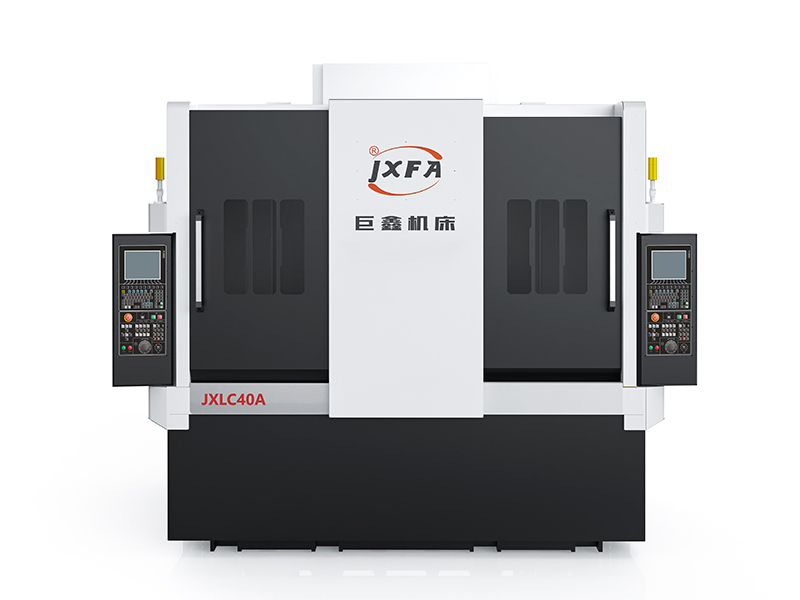
Twin-spindle CNC vertical lathe architecture: two work zones, two control channels, one conformity assessment.
A CNC lathe can pass a domestic factory inspection, run productively for a decade, and still be held at a European port — not because of its accuracy, but because of the documentation that travels with it. The reverse happens just as often: a machine carrying a CE mark and an EU Declaration of Conformity can arrive in China without the national-standard records a domestic buyer or inspector expects.
Both outcomes come from the same misunderstanding. CE marking and Chinese GB standards are not two grades of the same certificate. They are two different regulatory systems: they answer different legal questions, they are evidenced by different documents, and they are enforced by different authorities. Treating one as a substitute for the other is the single most expensive compliance error in cross-border lathe machine procurement.
This guide is written for international buyers of lathe machines — including twin-spindle CNC vertical lathes, double-head CNC lathes, and facing and centering machines — who need to know what each framework actually requires, where the two diverge on safety, electrical and EMC grounds, and what to request, in what order, before a purchase order is signed.
Problem Definition: Compliance Belongs to a Configuration, Not to a Brand
Compliance attaches to a machine configuration, a destination market, and a point in time. A lathe ordered for a plant in Zhejiang and a lathe ordered for a plant in Bavaria may share the same bed casting, the same spindle design, and the same model number — yet require different electrical components, different guarding verification, different instruction languages, and different declarations.
Three practical consequences follow for buyers:
- A general certificate does not describe your machine. It describes a model, and usually a model built to one configuration at one moment. The question that matters is which configuration, assessed against which legislation, with which test evidence.
- The certificate is not the deliverable. The deliverable is a signed declaration plus the technical evidence behind it. A declaration without traceable supporting records cannot be defended if a market surveillance authority, an insurer, or a customer audit asks how a guarding or control decision was justified.
- Compliance survives modification only if change is controlled. A retrofit, a substituted control system, a reworked guard, or a changed electrical cabinet can move a machine out of the configuration that was originally assessed. This is why change control belongs in the purchase contract, not only in the engineering department.
The question to put to a supplier is therefore not "is your lathe CE certified?" but "which EU legislation applies to this model and this configuration, what evidence exists behind the declaration, and what changes if my plant runs on a different control system or a different supply arrangement?"
Industry Background: Why Two Regulatory Systems Now Sit Inside One RFQ
The machine tool supply chain is global while market-access law is regional, and that mismatch is now structural rather than exceptional. Vertex Market Research projects the global CNC lathe machine market rising from USD 11.1 billion in 2023 to USD 18.78 billion by 2030 (SRC-0001), and Grand View Research reports that Asia Pacific held a 55.5% revenue share of the CNC machining and turning centers market in 2023 (SRC-0004). Machines therefore move routinely between the jurisdiction where they are built and the jurisdiction where they are installed.
Customs classification adds a second, separate layer. Under the classification displayed by UNdata/UN Comtrade, metal-removing lathes sit under HS heading 8458, with subheadings distinguishing horizontal numerically controlled lathes, other numerically controlled lathes, and other lathes (SRC-0006). That heading drives duty treatment and import documentation; it says nothing about whether the machine conforms to the safety law of the destination market. Classification and conformity are different checks, and both must be closed before shipment.
A third shift is application-driven. Dual-spindle CNC lathes are commonly used in high-volume production for automotive, aerospace, and medical sectors (SRC-0004), and those buyers typically run structured supplier qualification, which pushes conformity documentation from a shipping formality into a gate in the purchasing process.
What CE Marking Requires for a CNC Lathe
The legal mechanism
CE marking is the visible result of a conformity assessment process; it is not a certificate issued by an EU authority. The manufacturer — or an authorised representative established in the EU — takes responsibility for the machine's conformity with the EU legislation that applies to it, assembles the technical documentation, and signs the EU Declaration of Conformity. The mark then accompanies that declaration onto the machine and its nameplate.
For machine tools, the applicable legislation normally centres on machinery safety, with electromagnetic compatibility requirements added for machines that contain drives and electronically controlled axes, and electrical safety requirements applied through the standard for electrical equipment of machines. Where a machine falls into a category for which the legislation requires independent assessment, a notified body becomes part of the conformity route. The exact list of legislation and harmonised standards depends on machine type and configuration, and should be confirmed against the current official texts for the specific model rather than carried over from a previous purchase.
The documents behind the mark
A buyer should expect the compliance package to contain, at minimum:
- an EU Declaration of Conformity naming the manufacturer, the machine model and serial scope, the legislation applied, and the harmonised standards used;
- technical documentation — drawings, bill of materials, risk assessment, and verification or test records — available for inspection on request;
- the instruction manual in the language or languages required by the destination market;
- marking on the machine and nameplate consistent with the declaration.
The technical file is where most procurement risk sits, because it is the part that cannot be produced retroactively without real cost.
What is examined on a turning machine
On lathes, conformity review concentrates on the interaction between mechanics, controls, and people: guarding and interlocked access to the work zone, emergency stop arrangement, spindle and axis drive behaviour under fault conditions, hydraulic and pneumatic circuits, the electrical cabinet and its protective devices, noise, and the electromagnetic behaviour of servo drives and variable-frequency equipment. Twin-spindle and dual-station machines add a further dimension, because two work zones, two tool turrets, and two control channels must be assessed as one integrated system rather than as two independent machines bolted to a shared base.
What Chinese GB Standards Cover — and What They Do Not
GB standards are the national standards of China. Two forms matter in procurement: GB standards, which are mandatory, and GB/T standards, which are recommended. A Chinese-built machine tool is normally designed and tested against the GB/GB/T set cited in its design documentation, and domestic buyers expect that standard list to appear in the machine documentation.
Two characteristics of the system are frequently misread outside China.
First, GB/T standards are often aligned with international ISO or IEC work, but alignment is not identity. Editions, amendments, and national deviations can differ, so a machine built to a GB/T requirement is not automatically, and by that fact alone, compliant with the corresponding European harmonised standard.
Second, GB compliance does not produce an EU Declaration of Conformity, and CE conformity does not produce the Chinese standard documentation that a domestic buyer or Chinese inspector will ask for. The two systems have different legal effects and different documentary outputs.
Safety, Electrical and EMC: Where the Two Frameworks Diverge in Practice
The two frameworks overlap substantially on engineering intent and diverge on evidence and legal form. The divergence shows up in four places.
Mechanical safety and the risk assessment record
Both systems require guarding, interlocks, and safe approach to the work zone, but the European route is built around a documented risk assessment that justifies each protective measure, and that document is part of the technical file. A buyer should ask to see how the risk assessment treats the specific work zone being purchased: single-station or dual-station, manual load or robot-linked, tailstock present or not.
Electrical safety and the supply architecture
Electrical equipment must suit the installation, not the factory where the machine was built. Differences that matter in practice include transformer tapping and control voltage arrangement, the market for which protective and switching components are rated and marked, the electrical drawings supplied with the machine, and the language of the electrical documentation. A machine built to a domestic default configuration and a machine built to an export configuration are two different deliverables, even when the model number is identical.
EMC
Electromagnetic compatibility is the requirement most often underestimated in cross-border purchases, because it is a property of the assembled machine rather than of its components. A servo drive that satisfies an EMC requirement in one cabinet layout can fail in another once cable routing, shielding, earthing, and filter placement change. EMC evidence should therefore refer to the machine configuration being purchased, not to a component datasheet.
Language, marking, and traceability
Declarations, manuals, warning labels, and nameplate data must correspond to the market of installation and to the serial scope of the order. This is a documentation discipline rather than an engineering one, and it is where shipments most often stall at the border.
CE Marking vs. GB Standards: A Side-by-Side Comparison
| Dimension | EU CE marking | Chinese GB standards |
|---|---|---|
| Legal nature | Conformity with applicable EU legislation, declared by the manufacturer or an authorised representative established in the EU | National Standards of China; GB mandatory, GB/T recommended |
| Who takes responsibility | Manufacturer signs the EU Declaration of Conformity; a notified body participates where the applicable route requires it | Manufacturer declares and type-tests against the cited GB/GB/T set; surveillance by Chinese authorities |
| Core documentary output | EU Declaration of Conformity plus technical documentation | Design, type-test and inspection records referencing the cited GB/GB/T standards |
| Safety evidence | Documented risk assessment and protective measures retained in the technical file | Machine safety requirements set by the GB/GB/T standard cited in the design |
| Electrical evidence | Electrical equipment of machines assessed against the standard applicable in the EU, with components suited to the installation | Chinese national standard for electrical equipment of machines |
| EMC evidence | EMC requirements apply to drive and control systems; emission and immunity evidence tied to the machine configuration | GB/T EMC standards, frequently aligned with IEC work but edition-dependent |
| Documentation language | Language(s) required by the destination market | Chinese documentation |
| Machine marking | CE mark on machine and nameplate, consistent with the declaration and serial scope | Chinese nameplate and cited standard references |
| Geographic effect | Applies to placement on the EU market; does not by itself satisfy other markets | Domestic Chinese baseline; does not constitute an EU Declaration of Conformity |
| What the buyer should request | Signed declaration naming model and legislation, plus access to the technical file | Standard list cited on the machine, plus the corresponding test records |
Step-by-Step: A Seven-Step Compliance Verification Workflow
Country of installation, supply arrangement, manual load or automation interface, and the parts to be machined. Every later compliance question depends on this statement, and a compliance scope that is not written down cannot be quoted accurately.
Read the EU Declaration of Conformity, where one applies, for four things: the machine model and serial scope, the legislation applied, the harmonised standards listed, and the identity and location of the signatory. A declaration that does not name your model has no value for your order.
You are not auditing the engineering, but you are checking that a risk assessment exists, that drawings and bill of materials correspond to the configuration ordered, and that test records are dated and traceable to a serial number.
Confirm the control system, the electrical drawings, the language of labels and manuals, and which components are rated for the destination market. On configurable platforms this is a specification decision made at order stage, not a workshop decision made at dispatch.
Positioning accuracy and repeatability should be tested, not asserted. ISO 230-2 specifies test procedures for determining the accuracy and repeatability of positioning of numerically controlled axes (SRC-0003), which makes it a usable reference for an acceptance test protocol agreed before the machine is built.
Metal-removing lathes are classified under HS heading 8458, with subheadings separating horizontal numerically controlled lathes, other numerically controlled lathes, and other lathes (SRC-0006). Confirm the subheading that applies to your machine with your customs broker and align it with the commercial invoice description.
Name the documents to be delivered, the date of delivery for each, who signs the acceptance test, the language of the manual, and the change-control rule for any post-order modification. Compliance obligations that live only in email do not survive a project handover.
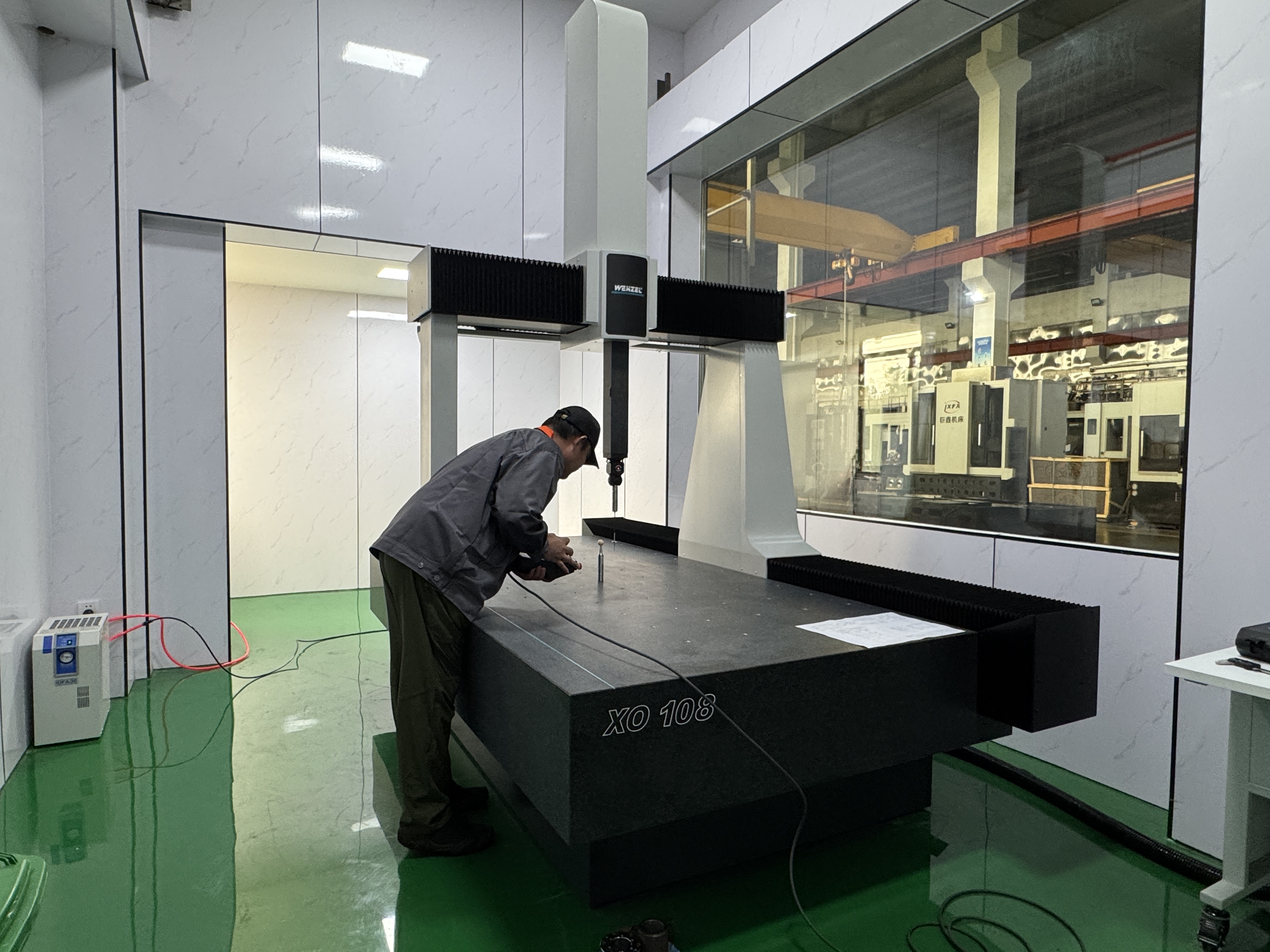
Metrology laboratory with a German Wenzel three-coordinate measuring instrument — the evidence layer behind an acceptance test.
How Machine Design and Verification Support Compliance Claims
Design decisions do not create conformity, but they make conformity results repeatable — or fragile. Two design choices matter in a compliance context.
Structural stability. The Middle Drive Double-head CNC Lathe (model JXS72) uses an integral bed, inclined bed, flat bed and column cast from high-strength preheated cast iron and resin sand, treated with ultra-low-temperature cryogenic heat treatment and stress-relief ageing, and finished with 55°/15° hardened integral hard rails that are quench-hardened, fine-ground and hand-scraped. The End Facing and Centering Machine (model JXZ70-680) uses a machine bed integrally cast from HT300 grey cast iron. In conformity terms this matters for a specific reason: acceptance tests measure a machine on a particular day, and a structure that resists deformation and resonance holds its geometry across that test and the years after it.
Electrical and control architecture. A machine bound for a foreign plant must be configurable, because the control system determines maintenance routines, spare-part sourcing, and the documentation package. Control system options listed for Juxin's twin-spindle vertical lathe platform include KND, GSK, Huazhong and Siemens, which allows the control and documentation package to be aligned with the buyer's plant standard rather than fixed by the builder's domestic default.
Verification equipment. Juxin's published material describes a metrology setup that includes a Renishaw laser interferometer and a German Wenzel three-coordinate measuring instrument inspection laboratory, alongside a constant-temperature and constant-humidity precision assembly workshop. Accuracy claims supported by measurement equipment are auditable; accuracy claims supported only by catalogue language are not.
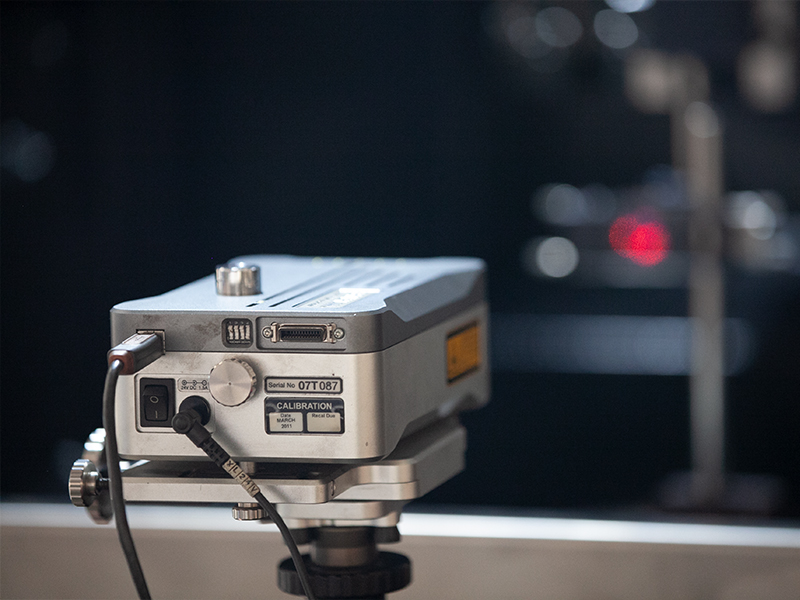
Renishaw laser interferometer from the UK, used for positioning accuracy and repeatability verification of numerically controlled axes.
Specifications relevant to compliance testing across the Juxin lathe machine range:
- Twin-Spindle CNC Vertical Lathe Machine for Disks (JXLC63D): dual stations, dual spindles, dual systems, dual tool towers; maximum processing diameter 525 mm; maximum machining height 400 mm.
- Twin-Spindle CNC Vertical Lathe Machine for Shafts (JXLC45-A): dual stations, dual spindles, dual systems, dual tool towers; maximum shaft processing diameter 345 mm; maximum shaft processing length 1020 mm.
- Middle Drive Double-head CNC Lathe (JXS72): processing diameter range 15–180 mm; processing length range 40–800 mm; integral cast iron bed, column and base with cryogenic treatment and stress-relief ageing.
- End Facing and Centering Machine (JXZ70-680): machining diameter range 14–500 mm; machining length range 70–5000 mm; face milling, centre-hole drilling, external cylindrical turning, drilling and tapping, chamfering, boring and rapid U-drilling in one clamping.
On the facing and centering platform, repeat positioning accuracy is stated as 0.008–0.012 mm, with length and centre-hole depth consistency at both ends of ±0.05 mm, customizable to ±0.02 mm. Those are measurable values, which means they can be written into an acceptance protocol instead of being argued about after delivery.
Company context. Juxin Machine Tool Co., Ltd. was established in 2005 and manufactures at No.52-1, Jintang North Road, Eastern New District, Wenling, Zhejiang, China, in a facility covering 10,666 m² with approximately 80 staff and an annual production capacity of 2,000 sets. The R&D team comprises 10 engineers, and the company holds over 50 innovative technological patents. Export business accounts for 10% of total sales, with markets covering global regions, and the company states that its products have been adopted by more than ten internationally renowned enterprises. Full product information is available at en.wljxjc.com.
Use Cases: Where Compliance Priorities Differ
The compliance burden is not uniform across applications. Three buyer profiles illustrate where the emphasis shifts.
EU brake disc and precision disc production
For automotive disc and gear parts, brake discs, and rotor press-fit work, the dominant compliance questions are EMC of the drive system, documented guarding of a high-throughput work zone, and manual language for a European maintenance team. Germany appears among the listed application markets for these disc and shaft part scenarios, which makes the CE route the primary market-access path rather than a secondary one.
Motor shaft and EV wheel part production
Motor shafts, electric vehicle wheels, elevator traction wheels, and half shafts are high-volume parts, so acceptance testing has to be fast and repeatable. Here the compliance emphasis is on a measurable acceptance protocol — positioning accuracy and repeatability, plus the documentation that lets a quality department re-verify the machine after installation.
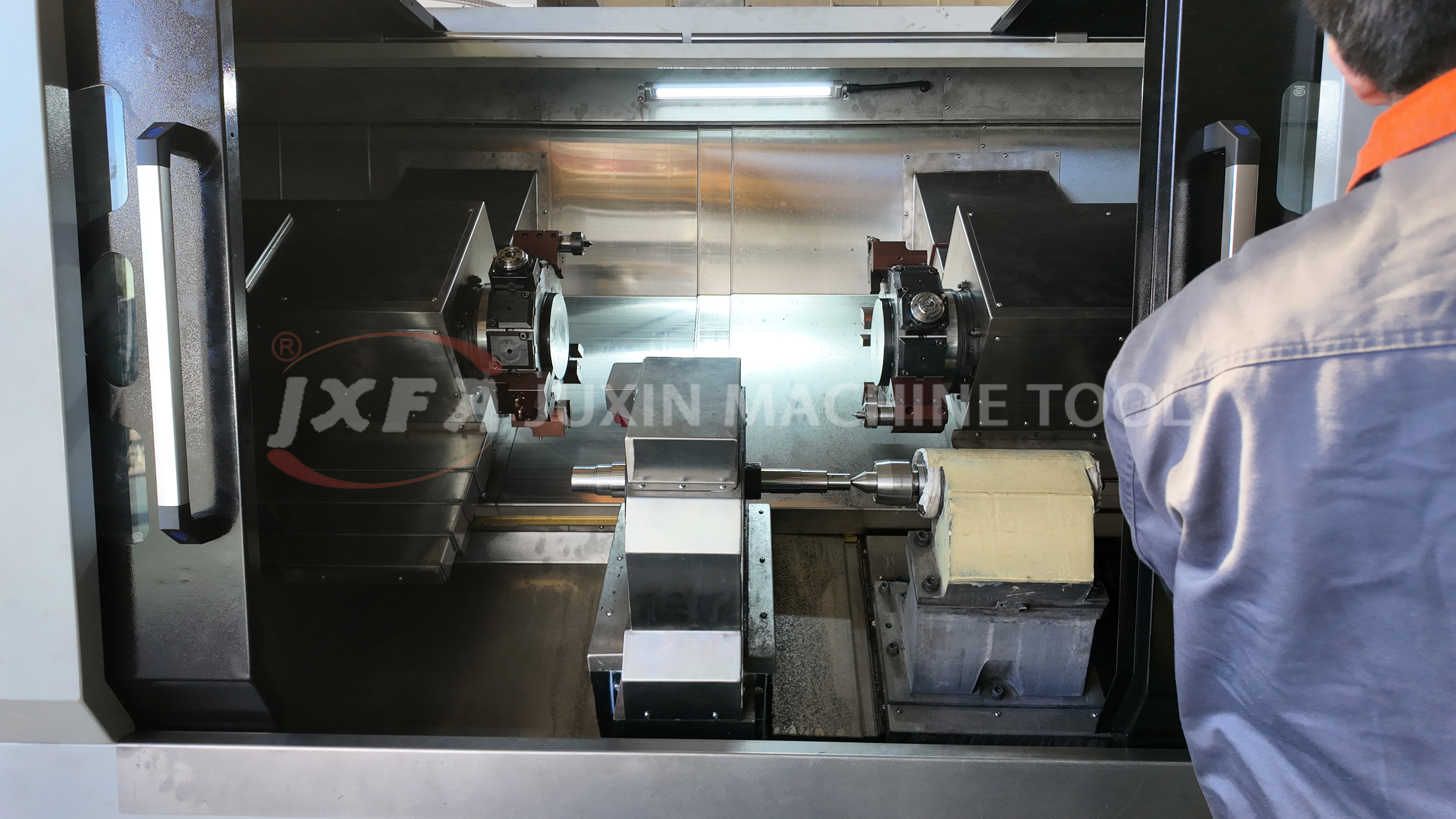
Motor shaft machined by a double-head CNC lathe — a typical high-volume application where acceptance testing must be repeatable.
Heavy-duty shafts, railway axles, and aerospace precision parts
Heavy-duty shaft parts, railway locomotive axle accessories, and high-speed rail or aerospace precision disc parts shift the emphasis to structural rigidity, handling and lifting arrangements around large workpieces, and the traceability of test records. For these projects the compliance file and the acceptance report are usually reviewed together by the end customer, not separately by the buyer.
Frequently Asked Questions
Is CE marking mandatory to import a CNC lathe machine into the EU?
If the machine is placed on the EU market, the EU legislation applicable to it applies, and for machine tools that normally centres on machinery safety, with EMC and electrical requirements added where relevant. The manufacturer, or an authorised representative established in the EU, signs the EU Declaration of Conformity, and the machine carries the CE mark. Whether a notified body is involved depends on the machine category and the conformity route. A Chinese GB standard list is not an alternative to this process. Obtain the declaration naming the machine model and the legislation applied before shipment, not after arrival.
Can a lathe's electrical and control configuration be adapted to a specific destination market?
Configuration is where adaptation happens. Control system options listed for Juxin's twin-spindle vertical lathe platform include KND, GSK, Huazhong and Siemens, and the range spans dual-station, double-head, and facing-and-centering architectures rather than one fixed design. That flexibility allows the control, documentation, and maintenance package to be aligned with the buyer's market and plant standard. Adaptation must still be specified in the order: destination market, required declaration, documentation language, and acceptance test method should all appear in writing, because a machine built to a domestic default configuration and one built to an export configuration are two different deliverables.
How does compliance documentation affect the machine budget?
Compliance cost is driven by scope rather than by a fixed fee. The variables are the number of legislation items and standards that apply, whether independent assessment is required, the extent of testing and technical documentation, the language requirements for manuals and labels, and any configuration changes needed for the destination market — control system, electrical components, guarding, or EMC measures. Because these change the delivered machine, they belong in an itemized quotation rather than a single lump sum. A quotation that lists compliance scope separately can be compared with another supplier's; one that does not cannot.
How can a buyer validate accuracy and compliance evidence before shipment?
Run two tracks in parallel. The documentary track checks the declaration, the standard list, the technical documentation summary, and the manual language. The physical track fixes an acceptance test: ISO 230-2 specifies test procedures for determining the accuracy and repeatability of positioning of numerically controlled axes, and Juxin's metrology setup includes a Renishaw laser interferometer and a German Wenzel three-coordinate measuring instrument laboratory. On the facing and centering platform, repeat positioning accuracy is stated as 0.008–0.012 mm, with length and centre-hole depth consistency at both ends of ±0.05 mm, customizable to ±0.02 mm — a measurable basis for acceptance. Add a trial run on your own part drawing and record the results as a signed acceptance document. Buyers can request a quotation and the machine catalogue from Juxin to begin that process.
What should be confirmed about delivery and lead time?
Delivery should be fixed against milestones rather than a single date, because compliance tasks sit on the critical path: declaration issue, documentation release in the required language, acceptance test, packing, and shipping documents including the HS 8458 classification. Juxin's stated annual production capacity is 2,000 sets from a 10,666 m² facility with approximately 80 staff — that is capacity information, not a lead time. A specific lead time for a specific configuration should be confirmed in the order documents, together with the date by which the conformity documentation will be delivered.
Conclusion: Buy the Evidence, Not the Mark
CE marking and Chinese GB standards answer different questions. CE marking establishes that a specific machine configuration may be placed on the EU market, and it is supported by a signed declaration and retained technical documentation. GB standards establish the domestic Chinese design and verification baseline. Neither substitutes for the other, and neither is transferable from a previous machine, a previous order, or a previous configuration.
For a buyer, the practical sequence is stable: define the destination market and intended use, request the declaration rather than the certificate, read the technical documentation summary, match the electrical and control configuration to the installation, agree a measurable acceptance test based on procedures such as ISO 230-2, confirm the HS 8458 classification, and write all of it into the purchase contract. Machine design and metrology capability — integral casting, configurable control systems, laser interferometry and coordinate measurement — determine whether those commitments hold up on the day of acceptance.
Next Step: Request the Machine Catalogue and a Configuration-Specific Quotation
Juxin Machine Tool Co., Ltd. supplies CNC lathe machines, twin-spindle CNC vertical lathes for shafts and discs, double-head CNC lathes, and facing and centering machines for shaft and disc part production. To move from a general specification to a compliance-scoped offer, send your destination market, part drawings, and required declaration to the team.
Email: jxmachine@yeah.net | Tel / WhatsApp: +86 1333-678-3918 | Website: en.wljxjc.com
Download the full product catalogue (PDF): Juxin Machine Tool Catalogue
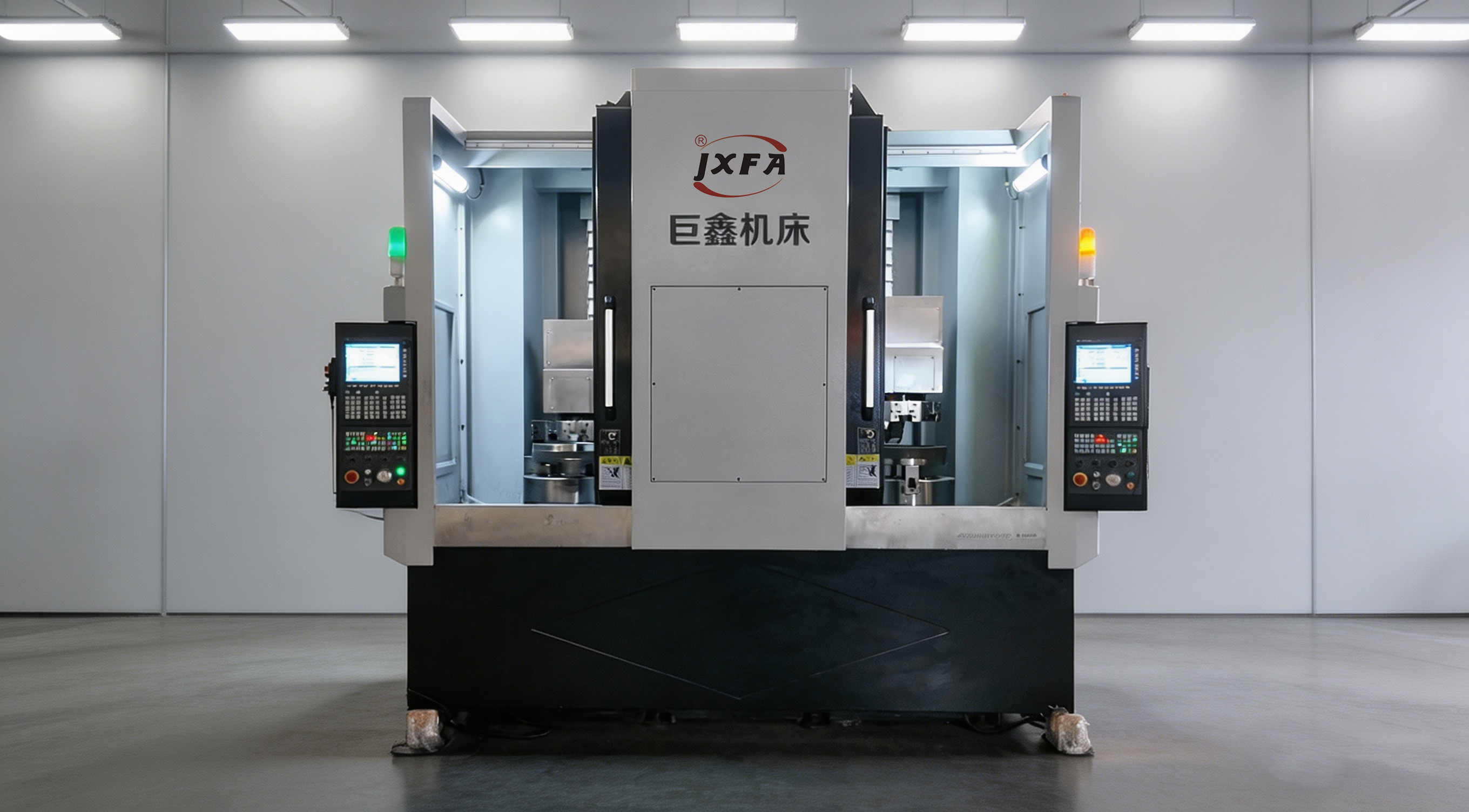
Twin-spindle CNC vertical lathe platform — configurations and conformity documentation are confirmed per order.
Have Questions or Need More Details?
Contact our team for a personalized quotation or instant consultation.
Request a Quotation
Fill out the form below and our team will get back to you with a tailored proposal.
WhatsApp Direct Chat
Prefer to chat in real-time? Message us on WhatsApp for instant assistance & quick answers.
- Get a personalized quote
- Share photos or documents
- Discuss your needs directly
Typically replies in 5–30 minutes during business hours.