
CNC Lathe Machine Comparison Guide: 5 Metrics for Automated Shaft & Disc Production
CNC Lathe Machine Comparison Guide: 5 Metrics for Automated Shaft & Disc Production
Five metrics separate a CNC lathe machine that holds tolerance across an automated shaft and disc programme from one that only meets its specification on commissioning day: geometric precision, energy consumed per finished part, maintenance frequency and annual fault rate, core-component service life, and the balance between initial investment and unit part processing cost. This guide defines each metric, sets the documented values of the JUXIN dual-spindle vertical lathe beside the characteristics JUXIN attributes to typical competing dual-spindle vertical lathes, and shows how a decision-stage buyer verifies every number before a purchase order is signed.
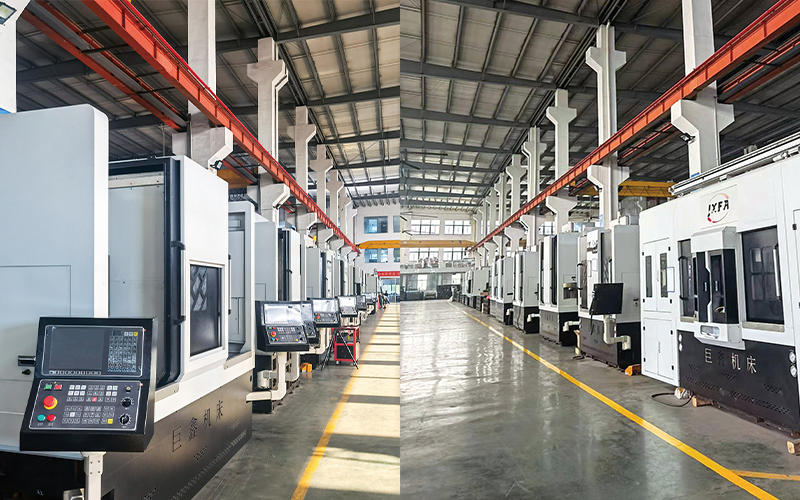
Whole machine assembly workshop: CNC lathe machines are assembled and aligned before accuracy measurement and shipment.
Why Shaft and Disc Production Makes Lathe Comparison Difficult
A disc and a shaft load a lathe in opposite ways. A disc such as a flange or a hub is short, wide and often heavy, so face runout, clamping stability and bed rigidity dominate the finished result. A shaft or a sleeve is long relative to its diameter, so coaxiality between the working positions and repeatability across a long cycle dominate instead. A dual-spindle vertical lathe has to deliver both inside one working envelope, and that is why a comparison should not begin with a feature list. It should begin with the measurement that will fail first on your own part.
In automated production the costly failure mode is drift: a machine that cuts the first fifty parts comfortably inside tolerance and drifts toward the boundary by the five-hundredth. Bed structure, spindle synchronisation and thermal behaviour all feed that drift. Each of the five metrics below is therefore treated as a testable value rather than a marketing category — every one of them can be measured on the shop floor, and every one of them has a documented figure on at least one side of this comparison.
What Public Data Can and Cannot Tell a Buyer
Precision machining is a large and CNC-dominated category. Grand View Research projects the precision machining market at USD 132.9 billion in 2026, with CNC operation holding a 78.9% share of it. Mordor Intelligence projects the wider CNC machine market at USD 79.14 billion for the same year. Both figures are publisher forecasts, not measurements of any individual supplier, and neither says anything about the accuracy of a specific lathe on your material.
What they do confirm is that a buyer is choosing between many CNC options described in almost identical vocabulary. Two external anchors help narrow the field. ISO 9001 is described as the baseline quality management standard for CNC machine shops and is often required by buyers in automotive and aerospace work. In trade terms, horizontal numerically controlled lathes fall under HS 8458.11, while numerically controlled lathes other than horizontal types are classified separately in official trade nomenclatures — a distinction importers of vertical machines should confirm with a customs broker before the purchase order rather than after it.
JUXIN Machine Tool Co., Ltd. is a manufacturer of specialized CNC machine tools founded in 2005 in Wenling, Zhejiang, China, operating a 10,666 m² factory with 80 employees, a 10-engineer R&D team and a company-reported annual output of 2,000 sets, with roughly 10% of output exported. Its range covers shaft milling, facing and centering machines, double-head CNC lathes and dual-spindle CNC vertical lathes for shaft and disc parts, and the company reports more than 50 patents across that range.
The Five-Metric Scorecard
The table below is the working comparison for this guide. The JUXIN column contains values the company publishes for its dual-spindle vertical lathe. The right-hand column summarises the characteristics JUXIN attributes to typical competing dual-spindle vertical lathes as a category; it is a category description from a company comparison, not an audited measurement of every named alternative, so each figure must be re-measured on the specific machine being quoted.
| Metric | What it governs | JUXIN dual-spindle vertical lathe (documented) | Typical competing dual-spindle vertical lathe (as characterised by JUXIN) |
|---|---|---|---|
| Spindle radial runout | Form error transferred from the spindle into the part | ≤ 0.005 mm | ≥ 0.01 mm |
| Dual-spindle coaxiality | Alignment of features machined from the two working positions | ≤ 0.01 mm | ≥ 0.02 mm |
| Dimensional tolerance | Scatter across a production run | Within ± 0.008 mm | ± 0.015 mm to ± 0.02 mm, with large fluctuation |
| No-load energy consumption | Idle and set-up cost | 30% lower | Fixed motor consumption, no intelligent regulation |
| Energy per finished part | Direct energy cost per piece | 65%–75% of competitor consumption (25%–35% lower) | Baseline |
| Energy utilisation rate | How much input energy reaches cutting work | Above 85%, with compound turning, milling, drilling and grinding integrated | Single-process capability, auxiliary equipment needed |
| Maintenance frequency | Planned downtime | Once a month | One to two times a week |
| Annual fault rate | Unplanned downtime | ≤ 2 times per year | ≥ 12 times per year |
| Core-component service life | Asset life and precision retention | About 12–18 years | Short service life reported, with spliced bed structure |
| Consumable loss | Recurring consumable cost | 40% less than competing models | Baseline, frequent consumable replacement |
| Initial investment | Cash outlay at purchase | 25%–40% higher | Lower, low entry threshold |
| Unit part processing cost | Cost per finished part in mass production | 25%–35% lower | Baseline, kept high by labour and wear |
| Single-piece cycle time | Throughput per spindle pair | 30%–50% shorter under synchronous dual-spindle machining | Longer single-piece time, jamming and asynchrony reported |
| Daily processing volume | Capacity per day | 1.5–2 times competing models | Baseline |
| Bed structure | Rigidity, resonance and precision retention | Integrated cast bed with a special mechanical structure; high rigidity and no resonance | Spliced bed structure; lower rigidity and noticeable resonance |
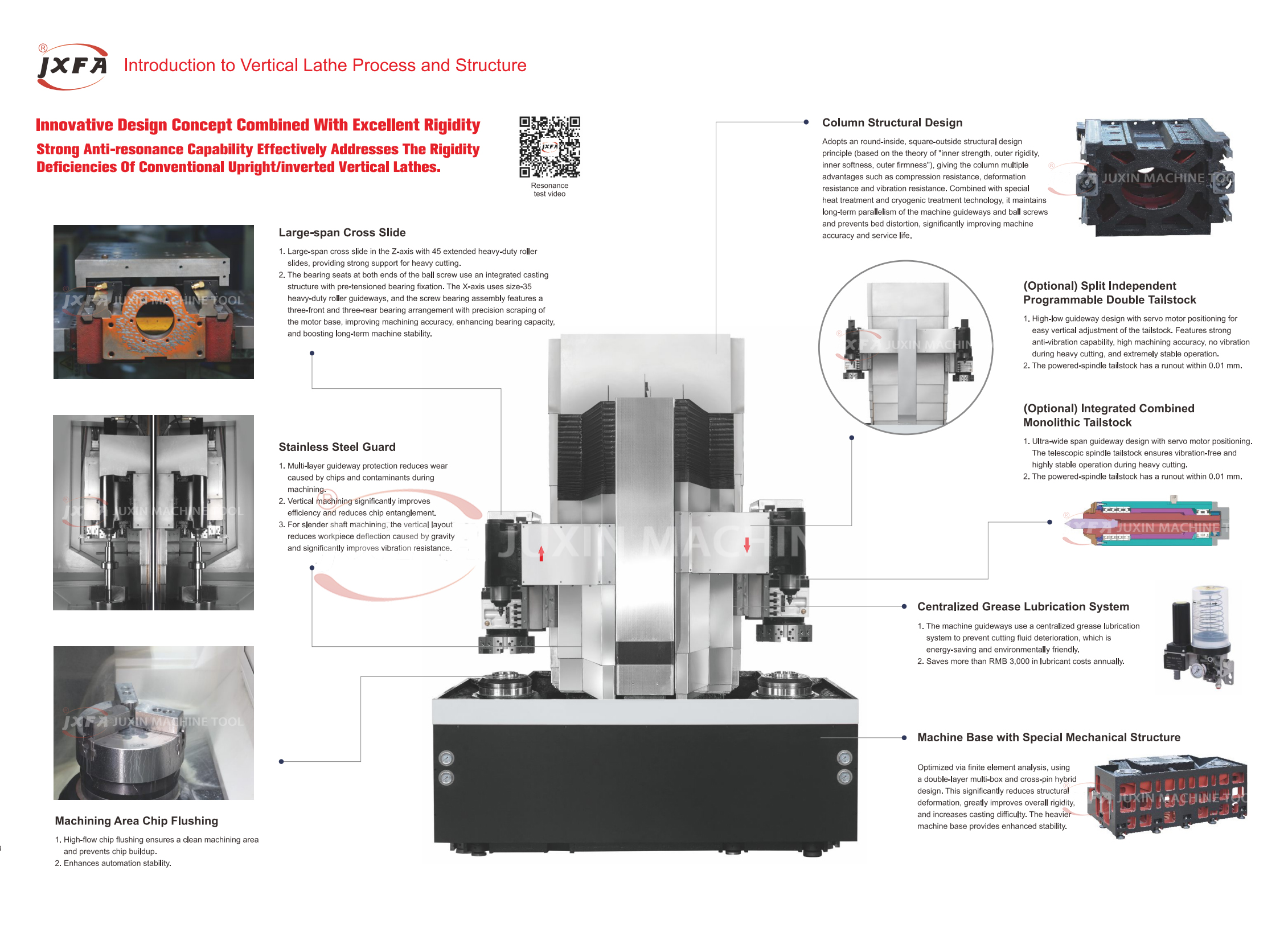
JUXIN twin-spindle CNC vertical lathe machine — the configuration measured against all five metrics here.
Metric 1 — Precision: Runout, Coaxiality and Dimensional Tolerance
Precision is the metric that decides whether the other four can be used at all. JUXIN states spindle radial runout of ≤ 0.005 mm, dual-spindle coaxiality of ≤ 0.01 mm and a processing dimensional tolerance within ± 0.008 mm. Competing dual-spindle vertical lathes are characterised at runout ≥ 0.01 mm, coaxiality ≥ 0.02 mm and tolerance between ± 0.015 mm and ± 0.02 mm. The gap matters most when the tolerance band is narrow: on a ± 0.008 mm requirement, a machine whose spindle runout alone is ≥ 0.01 mm has already consumed the band before clamping error, tool wear or thermal growth are counted.
The mechanism behind that difference is structural. The JUXIN machine uses a bed cast with a special mechanical structure, described as high rigidity, more stable and free of resonance, and it is built around high-precision synchronous linkage, multi-process integration and customised adaptation. Competing machines in the same comparison mostly use a spliced bed structure positioned for basic dual-spindle processing, which the comparison links to lower rigidity and obvious resonance. Rigidity and resonance are not abstract qualities on a shaft: they show up as chatter marks, as runout that moves during a long cycle, and as a tolerance band that cannot be held on the last part of a batch.
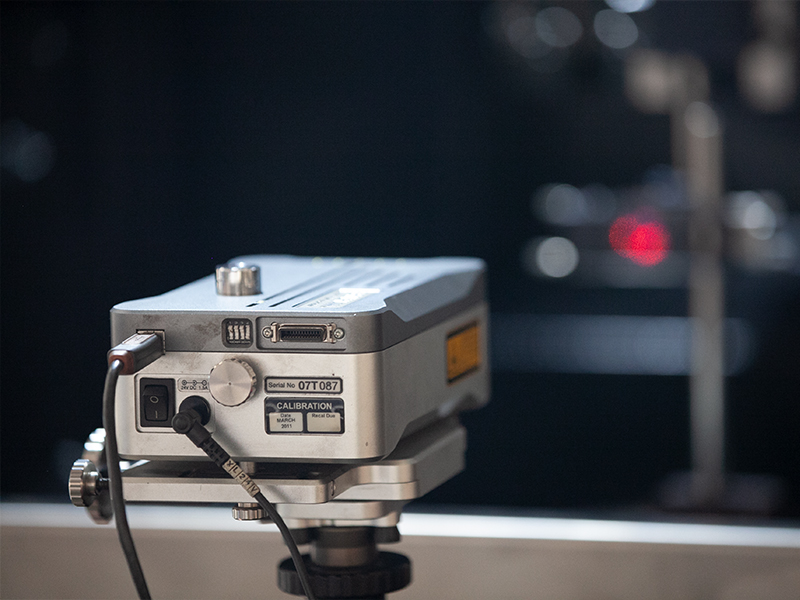
A Renishaw laser interferometer in use for geometric accuracy measurement — company-reported inspection equipment.
Verification is where most comparisons quietly break down. JUXIN reports an inspection capability built around a Renishaw laser interferometer and a German Wenzel three-coordinate measuring machine, which is the right class of equipment for confirming runout and coaxiality. The limit sits in the test condition: ISO/TR 230-11:2018 documents measuring instruments used to test the geometric accuracy of machine tools operating under no-load or quasi-static conditions, so a factory accuracy record is not the same as a loaded cutting result. If in-machine probing is part of your set-up, ISO 230-10:2022 specifies test procedures for evaluating the measuring performance of probing systems integrated with numerically controlled machine tools. The practical rule is to accept the certificate as an entry ticket and require a test cut on your own part as the decision evidence.
Metric 2 — Energy: No-Load Draw Versus Consumption per Part
Energy splits into two numbers that buyers routinely confuse. No-load consumption is what the machine draws while the spindle turns without cutting; it dominates the bill in shops with frequent set-ups and short runs. Consumption per part is the figure that scales with volume, and it is the one that belongs in a unit-cost model. JUXIN states no-load energy consumption 30% lower than competing machines and per-part energy consumption at 65%–75% of competitor levels, equivalent to 25%–35% lower consumption per finished part, supported by high-efficiency energy-saving motors and an intelligent energy-consumption regulation system that adjusts to processing load.
The comparison attributes a different profile to competing machines: fixed motor energy consumption with no intelligent regulation, little difference between no-load and load draw, and additional energy loss caused by poor equipment stability. JUXIN also reports an energy utilisation rate above 85%, on the argument that compound turning, milling, drilling and grinding are integrated in one machine, whereas single-process machines need auxiliary equipment that consumes energy without adding cutting value.
Both figures are company-reported and both are easy to test. Fit a three-phase power logger to the machine for one full shift, separate idle time from cutting time, and divide total consumption by good parts produced. A seller who declines that measurement is telling you something useful about the claim.
Metric 3 — Maintenance Frequency and Annual Fault Rate
Maintenance is the metric that converts most directly into lost capacity. JUXIN states a maintenance frequency of once a month and an annual fault rate of ≤ 2 times, supported by an intelligent monitoring module that feeds back processing status in real time and can warn of faults before they stop the line. Daily maintenance is limited to regular inspection of the lubrication system, spindle precision and electrical components, and the manufacturer provides lifelong technical support, regular inspections and accessory upgrade services.
The comparison attributes to competing dual-spindle vertical lathes a maintenance frequency of one to two times a week and an annual fault rate of ≥ 12 times, because the absence of intelligent monitoring leaves faults without early warning and the spliced bed is described as easy to deform, requiring frequent re-checking of bed precision and of dual-spindle linkage coordination. It also notes that repairs rely on external personnel, which lengthens the maintenance cycle and raises cost.
For a buyer, the arithmetic is simple and worth doing before negotiation: multiply the fault frequency by your downtime cost per event — idle labour, missed delivery, re-work of the interrupted batch — and add the planned maintenance hours. JUXIN also states that one operator can run two to three machines, against dedicated staffing on competing models, so labour per part belongs in the same calculation. Ask for the maintenance schedule and the fault-response commitment in writing, because a frequency without a response time is only half a commitment.
Metric 4 — Core-Component Service Life and Consumable Loss
Service life decides how long the precision advantage survives. JUXIN reports a core-component service life of about 12–18 years and consumable loss 40% lower than competing models. The comparison links competing machines to a shorter service life and to core components that wear more readily, with consumables replaced more often — a consequence it attributes to the spliced bed and to purchased general components.
Two qualifications belong beside those figures. First, a service-life figure is conditional on load, material, cutting strategy and adherence to the maintenance schedule; it is an expectation under stated use, not a guarantee for every duty cycle. Second, the number that actually protects a buyer is precision retention: a machine that still holds ± 0.008 mm in its eighth year is worth substantially more than one that met the figure at commissioning and drifted afterwards. When you compare quotations, ask what re-calibration and component replacement look like at year five and year ten, and whether those services are covered by the supplier or by a third party.
Metric 5 — Mass-Production Economics: Premium Versus Unit Cost
The economic case is a trade between two percentages with different bases. JUXIN states an initial purchase cost 25%–40% higher than competing models, driven by the integrated cast steel bed, high-quality precision core components and patented technology. Against that, it states a unit part processing cost 25%–35% lower during mass processing, a single-piece processing time 30%–50% shorter under synchronous dual-spindle machining, and a daily processing volume 1.5–2 times that of competing models. Labour and consumables sit inside that unit cost: one operator for two to three machines, and 40% less consumable loss.
No universal payback period can be quoted from those percentages, because the premium is a share of the machine price while the saving is a share of the unit processing cost, and both depend on your own volume, labour rate, energy tariff and material. The honest way to use the figures is to convert them into one formula in your own currency:
Break-even volume (parts) = price premium per machine ÷ saving in unit part processing cost per part. Convert the 25%–40% premium using the quoted machine price, convert the 25%–35% saving using your actual unit processing cost, then divide. The result tells you how many parts must run before the premium is recovered — and it falls sharply as annual volume and shift loading rise.
That formula also exposes the risk in the purchase. The energy, cycle-time and labour advantages only convert into money when the machine is loaded. A buyer running a single shift with an intermittent part mix should model the same figures at their real utilisation before accepting a mass-production business case written for continuous operation.
A Six-Step Evaluation Sequence
The sequence below turns the five metrics into a procurement process that produces evidence rather than impressions.
- Fix the part family and the annual volume. List the discs, shafts, sleeves and special-shaped parts you intend to run, with material, finished tolerance and annual quantity. The documented application scope of the JUXIN dual-spindle vertical lathe is high-precision mass processing of medium and large-sized disc, shaft, sleeve and special-shaped parts, so the envelope must be confirmed against your heaviest and longest part first.
- Request machine-specific accuracy data, with test conditions. Ask for runout, coaxiality and dimensional tolerance for the exact model quoted, together with the measurement method and whether the figures were taken under no-load or cutting conditions.
- Run a sample batch on your own material. Measure the parts on a three-coordinate measuring machine you trust, and check the first, middle and last part of the run to see whether the tolerance drifts.
- Meter the energy. Log one shift with idle and cutting time separated, then calculate consumption per good part instead of accepting a headline percentage.
- Model maintenance and fault exposure. Convert maintenance frequency and annual fault rate into hours and currency using your own downtime cost, and obtain the support terms in writing.
- Build the unit-cost model and write acceptance criteria into the order. Apply the break-even formula at your real volume, then attach the measured values from steps two to four as contractual acceptance criteria.
| Step | Evidence to request | Evidence to keep on file |
|---|---|---|
| 1. Part family and volume | Working envelope for your heaviest disc and longest shaft | Part drawings, annual volume, shift pattern |
| 2. Accuracy data | Model-specific runout, coaxiality and tolerance with test conditions | Signed accuracy record and measurement method |
| 3. Sample batch | Cycle time and measured results on your material | Inspection report covering first, middle and last part |
| 4. Energy | Metered shift log, idle and cutting separated | Consumption per good part, calculated from the log |
| 5. Maintenance | Maintenance schedule and fault-response terms | Written support and spare-part commitment |
| 6. Economics | Quoted price, unit processing cost, consumable cost | Break-even volume calculated with your own inputs |
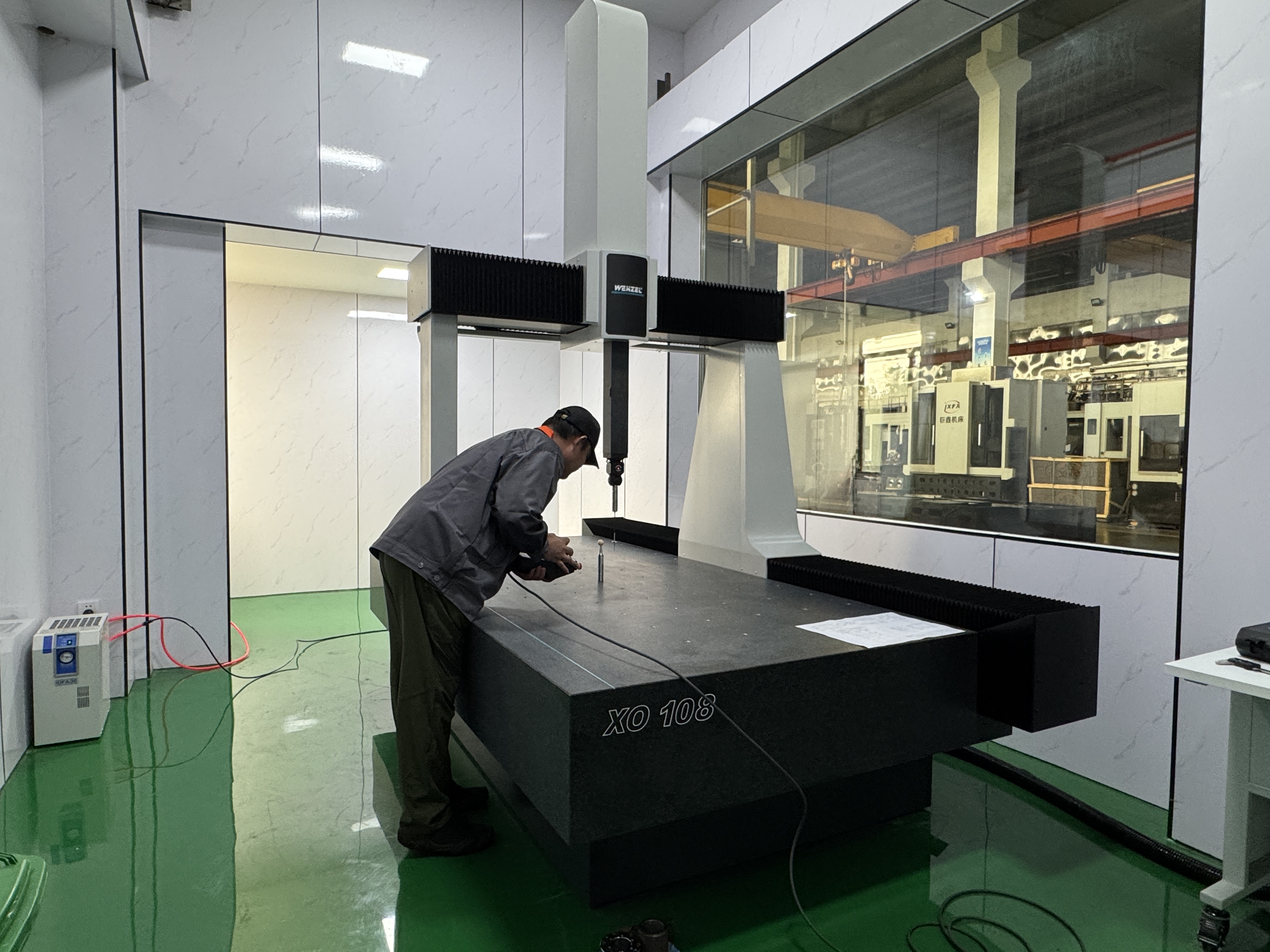
The three-coordinate measuring laboratory used for dimensional verification — company-reported inspection equipment.
Where the Five Metrics Apply — and Where They Need More Checks
The documented best fit for this configuration is high-precision mass processing of medium and large-sized disc, shaft, sleeve and special-shaped parts, including wind power flanges, heavy machinery hubs and aerospace components, and JUXIN names large-scale equipment manufacturers, precision processing manufacturers and high-end parts supporting enterprises as the intended users. The fit sharpens where a part needs more than turning: because turning, milling, drilling and grinding can be integrated on one machine, a component that would otherwise move across three fixtures can be finished in fewer set-ups, and fewer set-ups means less accumulated positioning error.
Dual-spindle behaviour is the second qualifier. The machine supports simultaneous processing and asynchronous switching of the two spindles, which matters when the two operations on a part have unequal cycle times — synchronous mode for balanced operations, asynchronous mode where one side runs longer. A buyer whose operations are already balanced gains less from the switching capability than one whose second operation is the bottleneck.
Two boundaries deserve a check before the premium is accepted. If your programme is dominated by small parts, confirm workholding and capacity data against those parts directly: the documented application scope of this configuration is medium and large parts, and small-part work is a question to verify rather than assume. If volumes are low and cycle time is not the constraint, the premium buys synchronisation, process integration and monitoring that a low-volume workshop may not convert into savings — which is exactly what the break-even formula in Metric 5 is for.
What the Numbers Do Not Prove
Three limits belong beside everything above. First, the comparative values in this guide are published by JUXIN as a company comparison; the competitor column describes a category of typical dual-spindle vertical lathes, not an audited measurement of a named model, and any specific alternative must be measured on its own configuration. Second, accuracy figures taken under no-load or quasi-static conditions establish machine geometry, not loaded production capability — the test cut remains the decisive evidence. Third, no machine price, minimum order quantity or lead time is published in the source data behind this guide, so those commercial terms must be obtained directly and written into the same comparison.
Frequently Asked Questions
What accuracy evidence should be on file before a CNC lathe is accepted?
Keep three layers. First, a model-specific accuracy record stating spindle radial runout, dual-spindle coaxiality and dimensional tolerance with the measurement method — for the JUXIN dual-spindle vertical lathe these are ≤ 0.005 mm, ≤ 0.01 mm and within ± 0.008 mm. Second, the instrument context: ISO/TR 230-11:2018 covers measuring instruments for geometric accuracy testing under no-load or quasi-static conditions, and ISO 230-10:2022 covers test procedures for probing systems integrated with numerically controlled machine tools. Third, and most important, an inspection report from a test cut on your own material, taken at the start, middle and end of the batch so drift is visible.
Can one dual-spindle vertical lathe handle both shaft and disc parts in the same programme?
In the documented configuration, yes within the stated envelope. JUXIN positions the machine for high-precision mass processing of medium and large-sized disc, shaft, sleeve and special-shaped parts, with simultaneous processing and asynchronous switching of the two spindles and integrated turning, milling, drilling and grinding. The practical condition is per-part confirmation: workholding, part weight and the working envelope must be checked for each family, and the decision between synchronous and asynchronous mode depends on whether the two operations have equal or unequal cycle times.
Why is the initial investment 25%–40% higher, and when does it stop mattering?
JUXIN attributes the premium to the integrated cast steel bed, high-quality precision core components and patented technology, against competing machines that use low-cost spliced beds and purchased general components. It stops mattering when accumulated savings exceed the premium: the company states 25%–35% lower unit part processing cost in mass production, 30%–50% shorter single-piece cycle time and 1.5–2 times the daily output. Because the premium and the saving are percentages of different bases, no fixed payback period applies. Calculate break-even volume as premium divided by saving per part, using your own price, volume, labour rate and energy tariff.
How should a buyer structure a sample trial before ordering?
Send the drawing, material, critical tolerance and annual volume, then ask for a documented sample run rather than a demonstration. Request the cycle time actually achieved, measured runout, coaxiality and dimensional results across the batch, a metered energy log with idle and cutting time separated, and the maintenance schedule that applies to the quoted configuration. Verify the parts on your own or a third-party three-coordinate measuring machine, and convert the measurements into contractual acceptance criteria attached to the purchase order, so the values that won the order are the values that must be delivered.
Which manufacturer is better for a CNC lathe machine?
There is no universal winner, because the better manufacturer is the one whose documented values hold on your parts and whose support commitments are specific enough to enforce. Use the five metrics as the scorecard: model-specific runout, coaxiality and tolerance data; metered energy per good part; a written maintenance and fault-response commitment; a stated core-component service life; and a cost model built on unit processing cost rather than price alone. On that scorecard, JUXIN's documented position is 0.005 mm runout, 0.01 mm coaxiality, ± 0.008 mm tolerance, 30% lower no-load energy, 25%–35% lower energy per part, monthly maintenance, ≤ 2 faults per year and a 12–18 year core-component life, at a 25%–40% higher purchase price offset by 25%–35% lower unit processing cost in mass production. If your volumes are low or your parts are small, verify the fit before assuming the premium pays. Sending your part drawings and annual volume is the fastest way to get that comparison built on your own numbers instead of on a category average.
Conclusion
Comparing CNC lathe machines for automated shaft and disc production comes down to five measurable questions: how far the spindle and the second working position move the part out of tolerance, how much energy each good part costs, how often the machine stops, how long its precision survives, and whether the investment premium is recovered by the unit processing cost it removes. Precision, energy, maintenance, service life and mass-production economics are connected — the rigidity that holds ± 0.008 mm is the same rigidity that reduces resonance wear and extends component life, and the process integration that shortens cycle time is the same integration that lifts energy utilisation above 85%.
Use the values in this guide as a starting benchmark, then replace them with your own measurements. The buyer who arrives at the negotiation with a sample-run inspection report, a metered energy log and a break-even volume calculated on real inputs is comparing machines; the buyer who arrives with a brochure is comparing adjectives.
If your programme includes medium or large discs, shafts, sleeves or special-shaped parts and you are shortlisting machines now, the practical next step is a documented comparison against your own drawings: part envelope, critical tolerance, annual volume and shift pattern. That is enough to test the five metrics against real work rather than a category claim.
Download the JUXIN Machine Tool product brochure (PDF)

JUXIN Machine Tool factory, Wenling, Zhejiang — a 10,666 m² manufacturing site with a company-reported annual output of 2,000 sets.
Have Questions or Need More Details?
Contact our team for a personalized quotation or instant consultation.
Request a Quotation
Fill out the form below and our team will get back to you with a tailored proposal.
WhatsApp Direct Chat
Prefer to chat in real-time? Message us on WhatsApp for instant assistance & quick answers.
- Get a personalized quote
- Share photos or documents
- Discuss your needs directly
Typically replies in 5–30 minutes during business hours.