
CNC Lathe Machine Types Explained: From End Facing to Twin-Spindle Vertical Lathes for Shaft and Disc Parts Machining
CNC Lathe Machine Types Explained: From End Facing to Twin-Spindle Vertical Lathes for Shaft and Disc Parts Machining
CNC lathe machines are fundamental to modern precision manufacturing, enabling the efficient machining of shaft and disc parts across industries such as automotive, agricultural machinery, and new energy. Selecting the right lathe configuration—whether an end facing and centering machine, a double-head CNC lathe, or a twin-spindle vertical lathe—directly impacts production efficiency, part quality, and operational cost. This guide explains the distinct types of CNC lathe machines, their typical applications, and how to match them to your production requirements.
The Challenge of Selecting the Right CNC Lathe
Procurement professionals and manufacturing engineers often face the difficulty of choosing among multiple lathe types: traditional horizontal lathes, double-head machines, twin-spindle vertical lathes, and specialized facing and centering machines. Each design offers different capabilities in terms of simultaneous operations, workpiece size, precision, and automation readiness. Without a clear understanding of how these machine types relate to common part families, buyers risk investing in equipment that underperforms or requires excessive secondary operations.
Industry Background: The Growing Demand for Specialized CNC Lathes
Modern production lines for shafts, discs, gears, and housings demand machines that reduce cycle times and eliminate manual re-clamping errors. According to data from Juxin Machine Tool Co., Ltd., a Chinese manufacturer specializing in high-end CNC machine tools, over 50 innovative patents have been developed to address these needs. Companies globally are adopting machines with dual spindles, dual tool towers, and automation interfaces to achieve 40%–120% efficiency improvements. The automotive parts, railway axle, and new energy sectors increasingly require lathes that can perform multiple operations—such as turning, drilling, milling, and chamfering—in a single setup.
Detailed Solution: Juxin Machine Tool's Specialized CNC Lathe Portfolio
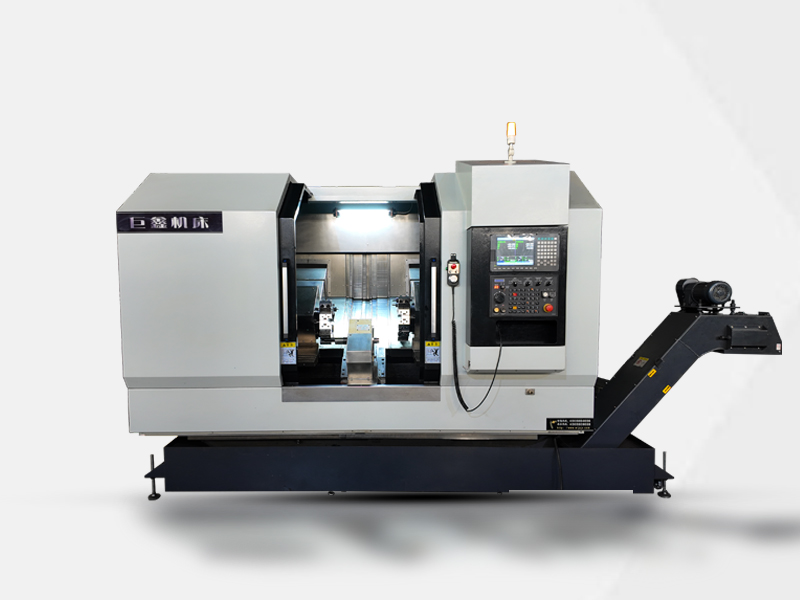
Juxin Machine Tool Co., Ltd., established in 2005, designs and manufactures four primary categories of CNC lathe machines tailored for shaft and disc part processing:
- End Facing and Centering Machine (model JXZ70-680) – A CNC milling face end face drilling hole lathe machine that performs face milling, center hole drilling, external cylindrical turning, drilling & tapping, chamfering, boring, and rapid U-drilling in one clamping. Its bed is integrally cast from HT300 gray cast iron for exceptional rigidity. Machining diameter range: 14–500 mm; length range: 70–5000 mm.
- Middle Drive Double-head CNC Lathe (model JXS72) – A double end simultaneous turning lathe that processes both ends of a workpiece in one clamping, eliminating secondary setup errors. It features a high-strength cast iron bed, ultra-low temperature cryogenic heat treatment, and heavy-duty hardened guide rails. Processing diameter: 15–180 mm; length: 40–800 mm.
- Twin-Spindle CNC Vertical Lathe Machine for Shafts (model JXLC45-A) – A dual-position vertical lathe with dual stations, dual spindles, dual systems, and dual tool towers. Maximum shaft diameter: 345 mm; maximum length: 1020 mm. The vertical design avoids gravity-induced deformation, making it suitable for slender shafts.
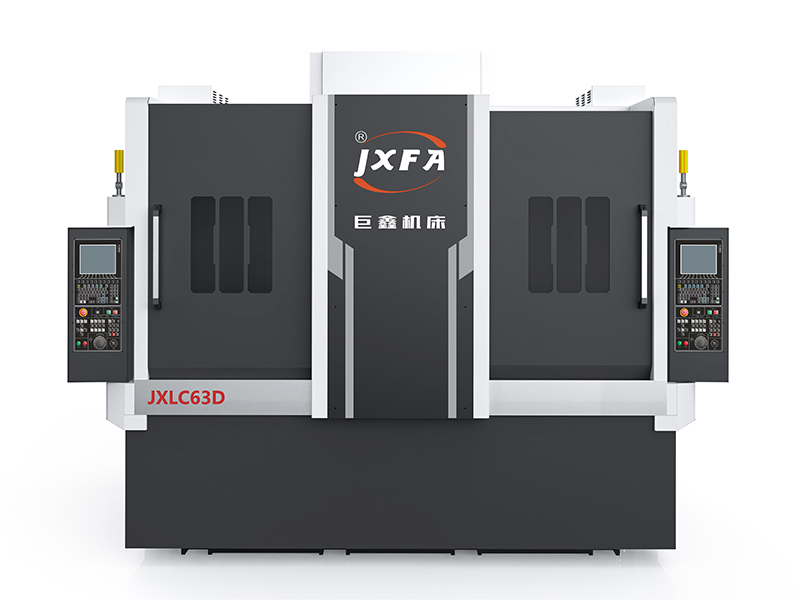
- Twin-Spindle CNC Vertical Lathe Machine for Disks (model JXLC63D) – Same dual-station architecture optimized for disk-shaped parts. Maximum processing diameter: 525 mm; maximum machining height: 400 mm.
These machines are used across automotive parts, agricultural machinery parts, water pumps and motors, railway locomotive axles, construction machinery, transmission industry, gear industry, and new energy solar components.
Key Structural Features
All models incorporate high-quality materials: the beds and columns are made of high-strength preheated cast iron or resin sand integral casting, undergo cryogenic treatment and stress relief aging, and are designed with finite-element-optimized rib structures. Guide rails are high-precision hardened rails (55°/15° integral hard rail or heavy-duty roller linear guide), precision-quenched, fine-ground, and manually scraped. Spindles are crafted from high-quality alloy structural steel.
Step-by-Step Breakdown: How to Match Lathe Type to Workpiece
- Identify the dominant part family – For shaft parts requiring center holes at both ends, an end facing and centering machine (JXZ70-680) is the first choice. For short-to-medium shafts needing simultaneous double-end turning, a double-head lathe (JXS72) reduces cycle time. For long shafts or heavy-duty shafts, a twin-spindle vertical lathe (JXLC45-A) provides rigidity and precision.
- Evaluate diameter and length requirements – Compare workpiece dimensions against machine capacity. The JXS72 handles diameters up to 180 mm and lengths up to 800 mm. For larger shafts up to 345 mm diameter and 1020 mm length, use the JXLC45-A. For disks up to 525 mm diameter, use the JXLC63D.
- Assess precision needs – Repeat positioning accuracy for the end facing and centering machine is 0.008–0.012 mm; for double-head and twin-spindle models, it is 0.003–0.005 mm. Select accordingly.
- Plan for automation – All Juxin models support integration with articulated robots, automatic loading/unloading stations, and MES connectivity. Multi-machine online setups allow one robot to serve 2–3 production lines.
- Verify workshop conditions – Heavy-duty vertical lathes require specialized foundation and floor load-bearing. Double-head lathes operate in standard machining workshops without special foundation requirements.
Use Cases Across Industries
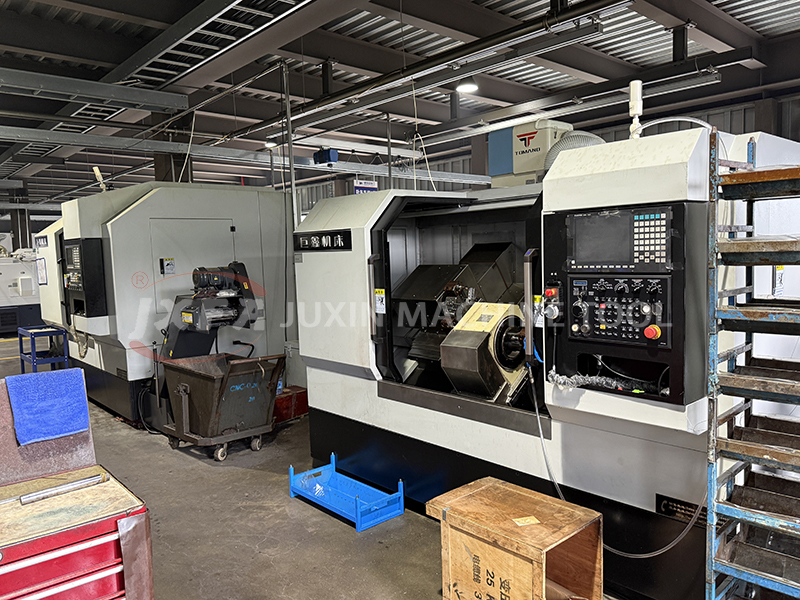
- Automotive disk and gear parts – Twin-spindle vertical lathes (JXLC63D) machine brake discs, gear shells, and motor housings in one clamping, reducing labor by 50%–80% and improving automation efficiency by 40%–120%.
- Motor shaft and electric vehicle parts – Double-head lathes (JXS72) complete outer circle, inner hole, thread, end face, and center hole machining of both ends simultaneously, eliminating precision errors from secondary clamping.
- Heavy-duty shaft parts for construction and mining – End facing and centering machines (JXZ70-680) handle large-diameter, ultra-long shafts up to 5000 mm, solving coaxiality and depth consistency issues.
- New energy solar components – All four machine types serve this industry, with dual-spindle models providing high-throughput processing of solar energy accessories and frames.
Comparison: Key Specifications of Juxin CNC Lathe Machines
| Machine Model | Type | Max Processing Diameter (mm) | Max Processing Length / Height (mm) | Spindle / Tool Tower Configuration | Primary Application |
|---|---|---|---|---|---|
| JXZ70-680 | End Facing & Centering Machine | 14–500 | 70–5000 (length) | Single spindle, multi-function tooling | Face milling, center hole drilling, turning, tapping |
| JXS72 | Middle Drive Double-head CNC Lathe | 15–180 | 40–800 (length) | Dual spindles (opposed), gang tools / turret | Simultaneous double-end turning of shafts |
| JXLC45-A | Twin-Spindle Vertical Lathe (Shafts) | 345 | 1020 (length) | Dual spindles + dual tool towers | Vertical machining of slender and heavy shafts |
| JXLC63D | Twin-Spindle Vertical Lathe (Disks) | 525 | 400 (height) | Dual spindles + dual tool towers | Disk, gear, and housing parts |
Frequently Asked Questions
What are the typical certifications and compliance standards for Juxin CNC lathes?
Juxin Machine Tool holds over 50 innovative technological patents and operates a facility that includes a Renishaw laser interferometer from the UK and a German Wenzel three-coordinate measuring instrument for quality assurance. The machines are designed to meet international precision standards (repeat positioning accuracy 0.003–0.005 mm for most models) and are built with HT300 gray cast iron and cryogenic heat treatment for long-term stability. For specific certification requirements (e.g., CE, ISO), please contact the company directly.
Can these lathes be integrated with robotic automation for unattended production?
Yes. All Juxin models support multi-machine online setups where one articulated robot can control 2–3 production lines. The machines feature automatic tool compensation, in-machine detection, and digital interfaces for MES system connection. Optional equipment includes loading/unloading stations, material warehouses, and servo-programmable tailstocks.
What is the approximate budget range for a double-head CNC lathe like the JXS72?
Pricing depends on configuration (control system choice between KND, GSK, Huazhong, Siemens, or Fanuc; servo motor power; hydraulic fixtures; automation peripherals). For a quote tailored to your workpiece specifications, contact Juxin at jxmachine@yeah.net or call +86 1333-678-3918.
Can I get a sample part machined before purchasing?
Juxin offers sample machining services to demonstrate capability. You can send your part drawing and material requirements to the company. The end facing and centering machine (JXZ70-680) achieves length and center hole depth consistency at both ends of ±0.05 mm (customizable to ±0.02 mm). After trial, you will receive a process report and sample part for evaluation.
What is the typical lead time for a twin-spindle vertical lathe?
With an annual production capacity of 2,000 sets, standard lead times for models like the JXLC45-A or JXLC63D are typically 30–60 days, depending on customizations such as special fixtures, extended strokes, or control system preference. Juxin can expedite orders for high-priority projects. Download the company brochure for detailed specifications, or contact the sales team for a personalized lead time estimate and quotation.
Conclusion
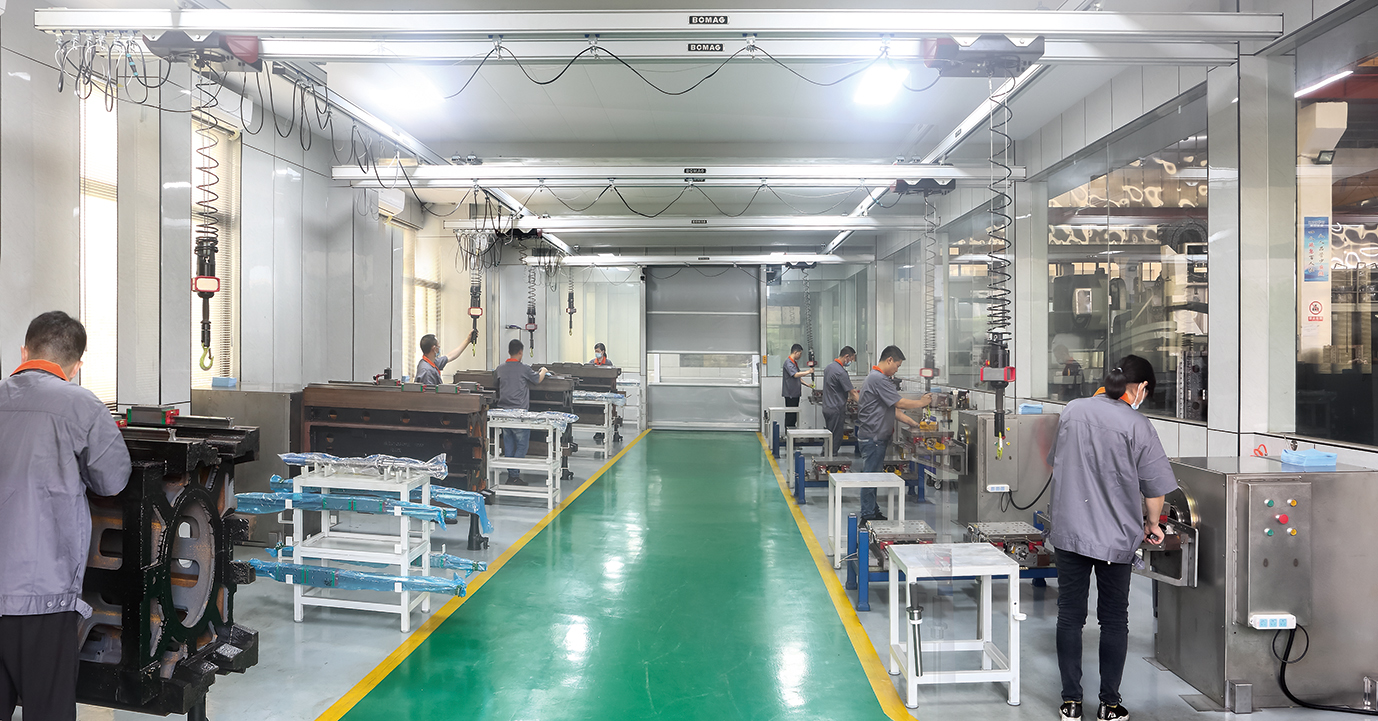
Choosing the right CNC lathe machine type is a critical decision that affects throughput, part quality, and total cost of ownership. Juxin Machine Tool offers a focused portfolio of end facing and centering machines, double-head lathes, and twin-spindle vertical lathes that cover a wide range of shaft and disc part geometries. With a 10,666 m² facility, an R&D team of 10 engineers, and adoption by more than ten internationally renowned enterprises, Juxin provides both standard and custom solutions. Evaluate your workpiece families against the specifications above, and contact Juxin at en.wljxjc.com or via email jxmachine@yeah.net to discuss your project.
