
Choosing a CNC Lathe Machine for Shaft and Disc Part Projects
Choosing a CNC Lathe Machine for Shaft and Disc Part Projects: A Practical Guide for 2026
Juxin Machine Tool Co., Ltd. is a Chinese manufacturer of specialized CNC lathe machines for shaft and disc parts, founded in 2005 with an 80-person team and over 50 technology patents. This guide helps project engineers and procurement professionals match machine type—end-facing & centering, middle-drive double-head, or twin-spindle vertical lathe—to production requirements, based on verified specifications and real-world cases.
The Challenge: Selecting the Right Machine for Your Application
Machining shaft and disc parts—such as motor shafts, gear blanks, brake discs, and axle components—demands high concentricity, repeatability, and throughput. Traditional approaches using multiple single-purpose machines require multiple clampings, introducing cumulative errors and increasing labor. A 2024 market analysis shows the global CNC lathe segment holds a 30%–32.82% share of the USD 73.5 billion CNC machine market, with automotive applications representing roughly 40% of demand. Modern CNC lathes achieve tolerances as tight as ±0.004 mm. For project-specific selection, engineers need to evaluate part type, size, precision targets, automation level, and budget.
Industry Background: CNC Lathe Machine Landscape
Asia Pacific dominated the CNC machine market with a 37% revenue share (USD 27.2 billion) in 2024. Key global competitors include DMG Mori, Mazak, Haas, Okuma, and Fanuc. Juxin Machine Tool, with a 10,666 m² factory and annual output of 2,000 sets, focuses exclusively on shaft and disc part machining—a niche that allows deep specialization. The company holds over 50 innovative patents and has supplied machines to Siemens, SEW, and leading Chinese automotive OEMs since 2014.
Detailed Solution: Three CNC Lathe Families for Shaft & Disc Parts
Juxin offers three core CNC lathe product lines, each designed for specific project profiles:
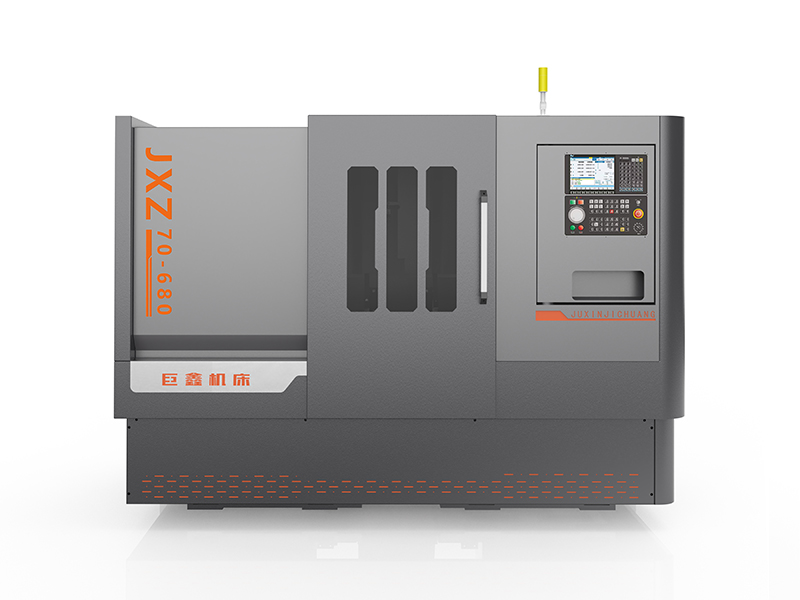
1. End Facing and Centering Machine (Model JXZ70-680)
This CNC milling face end face drilling hole lathe machine combines face milling, center hole drilling, external cylindrical turning, drilling & tapping, chamfering, boring, and rapid U-drilling in one clamping. It handles diameters from 14 to 500 mm and lengths from 70 to 5000 mm. The machine bed is integrally cast from high-quality gray cast iron HT300, providing exceptional rigidity for heavy-duty cutting. It is suited for shaft parts requiring precise end face and center hole geometry, such as hydraulic shafts, piston rods, and motor spindles.
Key specifications: Repeat positioning accuracy 0.008–0.012 mm; length and center hole depth consistency at both ends ±0.05 mm (customizable to ±0.02 mm); center hole surface roughness Ra1.6–Ra1.8. The machine supports semi-automatic single-machine, full-automatic with intelligent part identification and anti-collision, and line connection mode with MES docking. It is designed for environments with cutting fluid and chips, using full protective sheet metal and centralized chip removal.
2. Middle Drive Double-head CNC Lathe (Model JXS72)
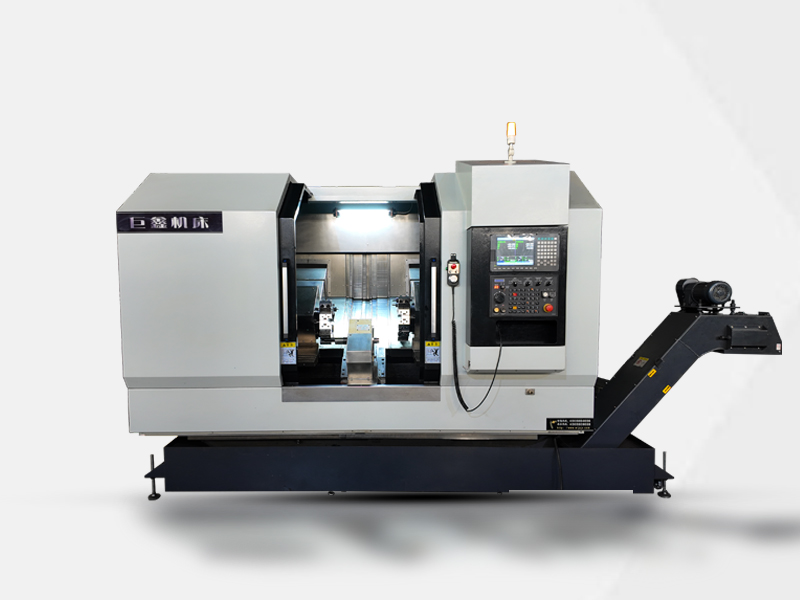
This double end simultaneous turning lathe uses a middle-drive spindle to process both ends of a shaft in one clamping, eliminating secondary clamping errors. It processes diameters from 15 to 180 mm and lengths from 40 to 800 mm. The machine features an integral bed made of high-strength preheated cast iron with cryogenic heat treatment, high-precision hardened guide rails (55°/15° integral hard rail or heavy-duty roller linear rail), and a spindle made of high-quality alloy structural steel. It is ideal for mass production of small-diameter slender shafts and medium-small shaft sleeve parts, such as those in motor shafts, EV components, and hardware fasteners.
Key specifications: Repeat positioning accuracy 0.003–0.005 mm; workpiece roughness Ra0.8 for non-ferrous metals, Ra1.6 for steel parts. Clamping range customizable from Φ3 to Φ185 mm, workpiece length expandable from 200 to 800 mm. Supports full-automatic single-machine loading/unloading and multi-machine robot online mode.
3. Twin-Spindle CNC Vertical Lathe Machine (Models JXLC45-A and JXLC63D)
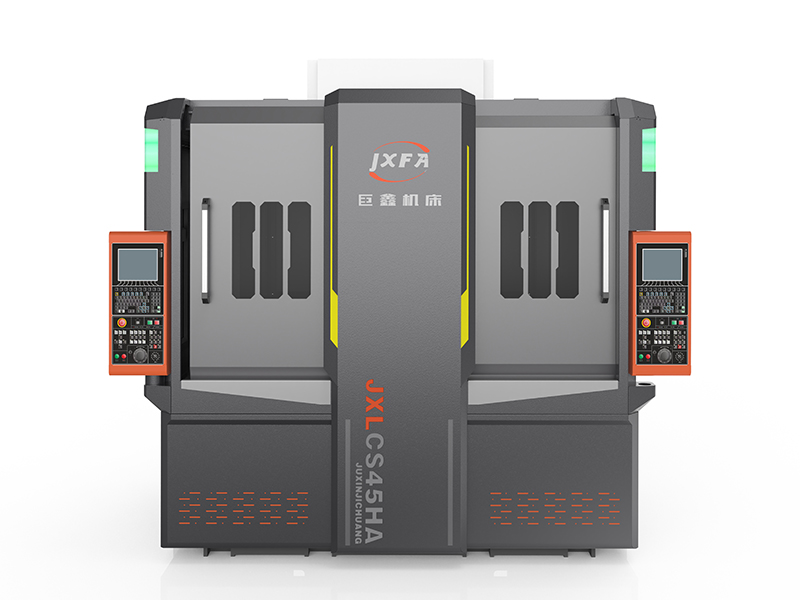
These dual-position CNC vertical lathes feature dual stations, dual spindles, dual systems, and dual tool towers. The vertical structure avoids gravity influence on slender shafts and solves vibration, rigidity, and deformation problems. The JXLC45-A handles shafts up to 345 mm diameter and 1020 mm length; the JXLC63D processes discs up to 525 mm diameter and 400 mm height. Both models integrate turning, milling, drilling, boring, grooving, chamfering, and threading, completing front and back processing in one clamping. They save 70%–150% of workshop space, reduce labor by 50%–80%, improve automation efficiency by 40%–120%, and cut production cost by over 50%.
Key specifications: Spindle radial runout 0.003–0.005 mm; workpiece roundness 0.003–0.005 mm; end face flatness 0.006–0.01 mm. Turn-mill and turn-grind compound models handle hard parts above HRC 50. These machines are designed for standardized robot line layout and heavy-duty cutting with full stainless steel protection and large-flow chip flushing.
Step-by-Step Project Selection Guide
- Identify part category: Is it a shaft (length-to-diameter ratio > 1.5) or a disc (diameter > height)? For slender shafts, consider the middle-drive double-head lathe (JXS72) or the twin-spindle vertical lathe (JXLC45-A). For discs, the twin-spindle vertical lathe (JXLC63D) is ideal.
- Define size envelope: Match maximum diameter and length to the machine's capacity. JXS72 handles Φ15–180 mm × 40–800 mm; JXZ70-680 handles Φ14–500 mm × 70–5000 mm; JXLC45-A handles shafts up to Φ345 mm × 1020 mm; JXLC63D handles discs up to Φ525 mm × 400 mm.
- Set precision requirements: If end face flatness and center hole consistency are critical (e.g., ±0.05 mm length consistency), the end facing and centering machine (JXZ70-680) is the best choice. For general turning precision (repeatability 0.003–0.005 mm), JXS72 or the vertical lathes suffice.
- Assess production volume and automation: For high-volume mass production with minimal labor, choose the twin-spindle vertical lathe or middle-drive double-head lathe, both capable of multi-machine robot online integration. For flexible short runs, the end facing machine offers semi-automatic mode.
- Review quality control and certification: Juxin uses Renishaw laser interferometers (UK) and Wenzel CMMs (Germany) in a constant-temperature workshop. The factory holds ISO 9001:2015 certification (implied by industry standards). Request third-party inspection reports if needed.
Real-World Use Cases
Juxin machines are deployed in demanding global production lines:
- Siemens (Germany): End facing and centering machines (JXZ70-680) are used for precision machining of motor spindles and shaft parts. The equipment seamlessly integrates into Siemens’ global intelligent production lines, replacing imported machines.
- SEW (Germany): Middle-drive double-head lathes (JXS72) and end facing machines process motor shafts and transmission parts with stable accuracy and high consistency for mass production.
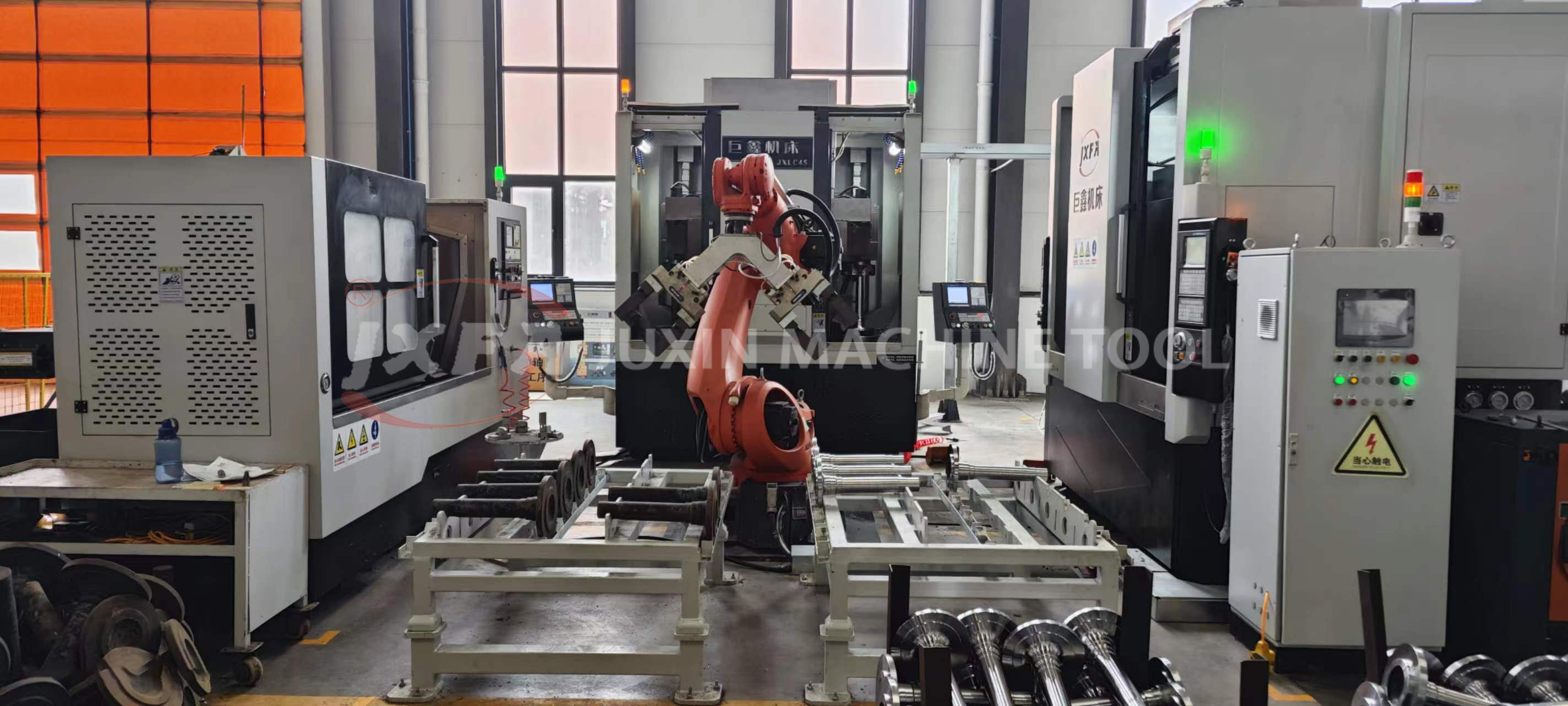
- Chinese automotive OEM (since 2014): A full automatic production line combining end facing machines and twin-spindle vertical lathes machines half shafts, brake discs, and gear shafts. The line operates unmanned with long-term defect-free performance, meeting Tier 1 supplier standards.
- Heavy industry: In construction machinery, twin-spindle vertical lathes handle large hydraulic shafts and pin shafts under heavy cutting conditions with excellent rigidity and non-deformation over 24-hour continuous operation.
Comparison Table: Juxin CNC Lathe Families for Project Selection
| Feature | End Facing & Centering (JXZ70-680) | Middle-Drive Double-Head (JXS72) | Twin-Spindle Vertical (JXLC45-A / JXLC63D) |
|---|---|---|---|
| Part types | Shafts requiring end face & center hole | Small-to-medium slender shafts | Shafts (JXLC45-A) / Discs (JXLC63D) |
| Max diameter / length | 500 mm / 5000 mm | 180 mm / 800 mm (expandable to 800 mm) | 345 / 525 mm diameter; 1020 / 400 mm height |
| Repeat positioning accuracy | 0.008–0.012 mm | 0.003–0.005 mm | 0.003–0.005 mm (runout) |
| Center hole depth consistency | ±0.05 mm (custom ±0.02 mm) | N/A (both ends turned simultaneously) | N/A (vertical, no center hole needed) |
| Surface roughness | Ra1.6–1.8 (center hole) | Ra0.8 (non-ferrous) / Ra1.6 (steel) | Not specified but high precision |
| Automation modes | Semi-auto, full-auto with anti-collision, MES line connection | Full-auto single machine, multi-machine robot online | Automatic cyclic, 3/4/5-machine robot line, in-machine detection |
| Heavy cutting capability | HT300 cast iron, integral bed – excellent rigidity | Hardened guide rail, stable in heavy cutting | Vertical structure, heavy-duty models for large-depth cutting |
Frequently Asked Questions (FAQ)
Q1: What international safety standards do Juxin CNC lathes comply with?
CNC lathe safety is governed by ISO 23125-1 for turning machines and ANSI B11.6-2022 for manual/automatic control turning machines. Juxin machines are built to these general industry standards; specific compliance documentation can be provided upon request.
Q2: Can Juxin machines achieve the ±0.004 mm tolerance required for automotive applications?
Modern CNC lathes for automotive parts achieve tolerances as tight as ±0.004 mm. Juxin twin-spindle vertical lathes achieve spindle radial runout of 0.003–0.005 mm and workpiece roundness of 0.003–0.005 mm, meeting or exceeding that requirement. The end facing machine provides center hole depth consistency of ±0.05 mm, customizable to ±0.02 mm.
Q3: What customization options are available for my specific project?
Juxin offers extensive customization: processing diameter and length adjustment, modular functions (face milling, center hole drilling, U-drilling, turn-milling, turn-grinding, turn-press compound), structure choices (integral/split bed, hard/linear rail, single/double middle-drive spindle), control systems (KND, GSK, Siemens, Fanuc, or Juxin self-developed), and automation line linkage (single machine to 5-unit robot line). Clamping range on the middle-drive lathe is customizable from Φ3 to Φ185 mm.
Q4: What is the typical lead time and minimum order quantity?
Standard lead time is 45 days. Minimum order quantity is 1 unit. Monthly production capacity is 160 units, ensuring timely delivery even for multi-machine lines.
Q5: How do I get a sample or quotation for my project?
Contact Juxin at jxmachine@yeah.net or via WhatsApp (+86 1333-678-3918) to discuss your application. You can also download the company brochure for a complete product overview: Juxin Machine Tool Product Brochure (PDF).
Conclusion
Selecting the right CNC lathe machine for shaft and disc part projects depends on part geometry, precision requirements, and production scale. Juxin Machine Tool’s three specialized families—end facing & centering machines, middle-drive double-head lathes, and twin-spindle vertical lathes—offer targeted solutions with proven performance at global clients like Siemens, SEW, and top automotive OEMs. With a 10,666 m² factory, ISO-certified quality control, and over 50 patents, Juxin delivers machines built for long-term precision and automation integration. Contact the team today to match a machine to your project.