
Facing & Centering Lathe Machines: Center Hole, Double-End & CNC Basics
Facing & Centering Lathe Machines: Center Hole, Double-End & CNC Basics
A facing and centering lathe machine prepares both ends of a shaft-type workpiece before precision turning begins: it machines each end face flat and square, then drills a center hole in each end. Those two features become the datum for turning between centers, for grinding and for final inspection.
First-time buyers usually meet this machine through four different phrases — Center Hole Drilling Lathe Machine, CNC centering lathe machine, Double End Facing Centering Lathe Machine, and CNC milling face end face drilling hole lathe machine. They read like four separate categories. In practice they are four descriptions of one family of machines, each emphasising a different part of the same job.
This guide explains the job itself, why combining end facing and center-hole drilling in a single setup changes what happens downstream, how the Juxin Machine Tool Co., Ltd. JXZ70-680 is specified, and which checks separate a properly prepared end from a part that will come back for rework.
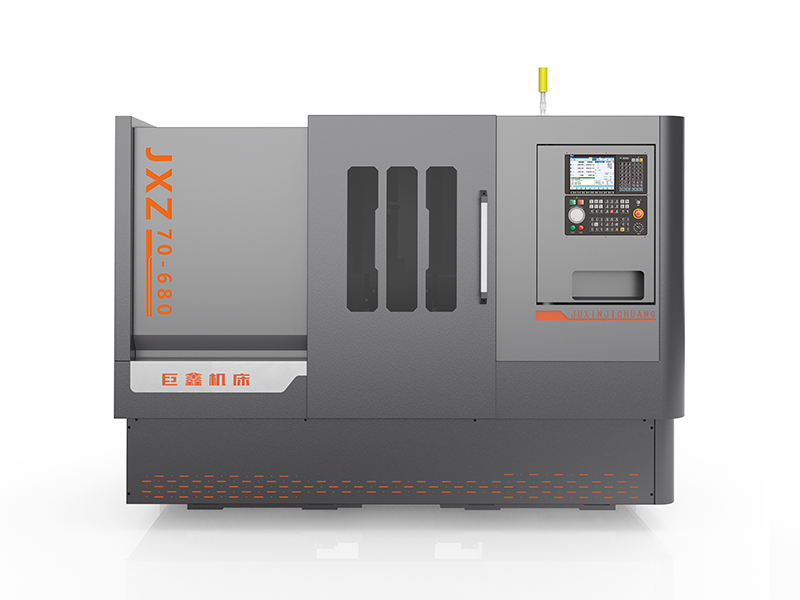
Cover: an end facing and centering CNC lathe machine of the type discussed in this guide.
End Preparation Is a Datum Operation, Not a Finishing Operation
A facing and centering machine turns a rough blank into a workpiece with a defined axis. Two features do that work: the end face, which must be flat and square to the axis, and the center hole, which locates the part on a center during turning and grinding.
The center hole is the locating feature. When the shaft is later mounted between centers, the machine axis is set by those two holes, not by the outside diameter. A hole that sits off-axis, is too shallow, is drilled too deep, or is left with a rough conical surface transfers that error to every diameter cut afterwards. Depth consistency at both ends matters as much as position, because the part is normally located on both ends at the same time.
The end face sets the axial reference. A dished, tapered or burred face gives an unstable seating surface, distorts the effective length of the part, and makes center-hole depth vary from one workpiece to the next. That is why length and center-hole depth consistency at both ends is quoted as a machine capability rather than as a tooling detail.
The operation list of a modern machine is end-focused but not end-only. The Juxin JXZ70-680, which Juxin Machine Tool describes as a CNC milling face end face drilling hole lathe machine, covers face milling, center hole drilling, external cylindrical turning, drilling and tapping, chamfering, boring and rapid U-drilling, across a machining diameter range of 14–500 mm and a machining length range of 70–5000 mm.
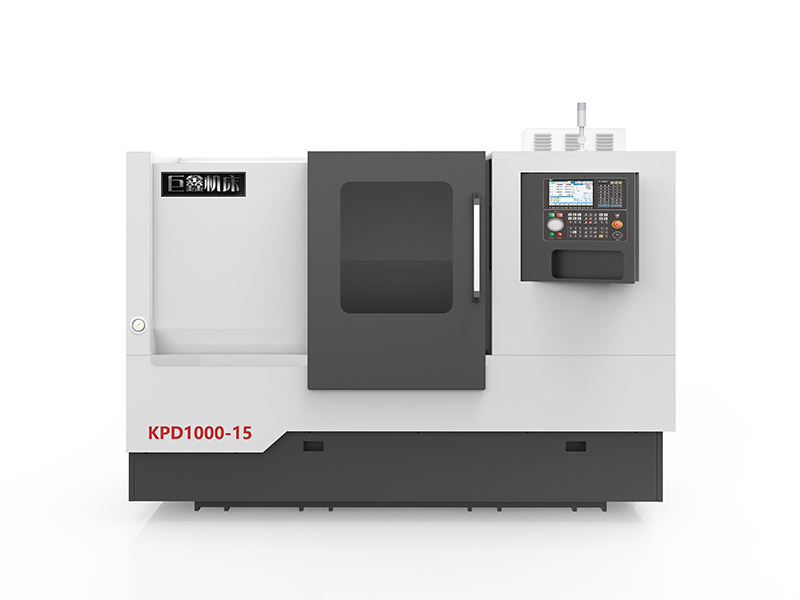
A facing and centering configuration: end face milling and center-hole drilling on the same setup.
Why Doing Both Ends in One Setup Matters
The two center holes must lie on one axis and be measured from one length reference. In a two-step process — face and drill one end, remove the part, turn it around, re-clamp and repeat — the second end is positioned relative to a second clamping, not relative to the first hole. Whatever runout, jaw wear or chip trapped between jaw and workpiece exists in that second clamping becomes a permanent feature of the part.
The failure modes that follow are predictable, and they are the ones facing and centering machines are designed to remove: coaxiality between the two center holes, depth consistency between the two ends, and end face flatness on both faces. Juxin states that the JXZ70-680 addresses precisely these three accuracy problems by completing facing, center-hole drilling and related end operations in one clamping.
The documented precision figures for this machine are repeat positioning accuracy of 0.008–0.012 mm, length and center-hole depth consistency at both ends of ±0.05 mm (customizable to ±0.02 mm), and center-hole surface roughness of Ra1.6–Ra1.8. Read those three numbers together, because they describe three different things: how repeatably the machine returns to a commanded position, how closely two ends match each other in length and hole depth, and how smooth the locating surface inside the hole is.
Single-setup working also changes the production line rather than just the part. One end-preparation machine replaces several single-function operations, shortens the process route, and reduces the labour and handling attached to each shaft before it ever reaches a turning or grinding station. For a shop running high-mix, low-to-medium batch work, that reduction in handling is often as valuable as the cycle time itself.
Where the Category Sits in the Lathe Line-Up
Facing and centering machines belong to the lathe family in trade and standards terms. UN Comtrade lists metal-removing lathes under HS heading 8458 and splits that heading into horizontal numerically controlled lathes, other numerically controlled lathes, and other lathes. The subheading applied to a specific machine is a customs-documentation question rather than a technical one, so confirm it with your freight forwarder or customs broker before you compare landed costs between suppliers.
On the accuracy side, ISO 230-2 specifies the test procedures for determining the accuracy and repeatability of positioning of numerically controlled axes. When a supplier quotes a repeat positioning figure, ask which test method produced it. A number without a stated method is a claim, not a specification, and it cannot be compared with a competitor's number gathered under a different procedure.
Supply is concentrated. Grand View Research reports that Asia Pacific accounted for 55.5% of 2023 revenue in the CNC machining and turning centers market, which is consistent with why so many shaft and disc part shortlists include Asian machine builders. That market share says nothing about any individual supplier's capability; it only explains why the sourcing conversation usually starts in that region.
The Four Search Terms, Mapped to One Machine Family
The four phrases buyers type into a search engine are labels for emphasis, not four different machine types. Reading them as categories is the most common early mistake in this purchase, because it splits one evaluation into four and hides the fact that the same technical questions apply to all of them.
| Term buyers use | What the wording emphasises | What it does not mean |
|---|---|---|
| Center Hole Drilling Lathe Machine | The center-hole operation: drilling and sizing the locating hole at the end of a shaft | That the machine only drills. Facing and secondary end operations normally belong to the same cycle. |
| CNC centering lathe machine | CNC control of the centering operation: positioning, depth control and repeatability | That centering is a separate step from facing. The axis is established by facing and drilling together. |
| Double End Facing Centering Lathe Machine | That both ends are faced and centered, normally within one setup | That two machines are always required. Double-end working can be arranged on one machine with two working positions. |
| CNC milling face end face drilling hole lathe machine | Milling of the end face combined with drilling of the end-face hole, i.e. the multi-function configuration | That the machine is a machining centre. It is a lathe-family machine with an end-preparation operation list. |
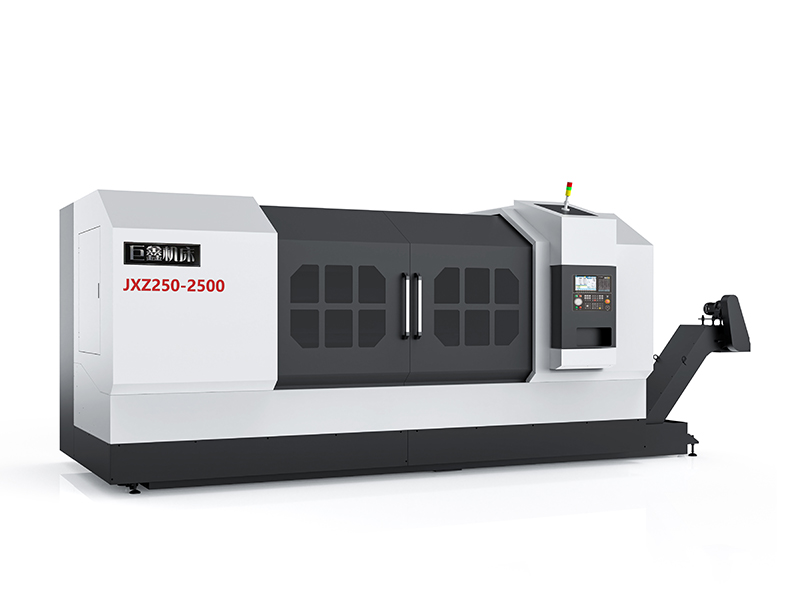
The multi-function end of the family: a CNC milling face end face drilling hole lathe machine.
Because the naming varies by supplier and by catalogue translation, sourcing on the name alone produces mismatched quotations. Ask every candidate for the same four items: the full operation list, the machining diameter and length envelope, the accuracy figures with their test method, and the clamping and automation arrangement. Two suppliers quoting on the same phrase can still be quoting two very different machines.
Juxin JXZ70-680: Documented Build and Manufacturer Figures
Juxin Machine Tool Co., Ltd. (JUXIN MACHINE TOOL) is a Wenling, Zhejiang-based builder of specialised CNC machine tools founded in 2005, with a 10,666 m² facility, approximately 80 staff, an annual production capacity of 2,000 sets, a 10-engineer R&D team and more than 50 technological patents. Its product portfolio covers CNC lathe machines, milling, facing and centering machines for shafts, double-head CNC lathes and double-spindle CNC vertical lathes for shaft and disc parts. The company's official site is Juxin Machine Tool.
The JXZ70-680 uses a machine bed integrally cast from HT300 gray cast iron. Integral casting matters at the ends of a shaft because the cut is interrupted: a raw bar, forging or casting presents scale, a saw-cut face and an out-of-square edge, so the tool load fluctuates at every revolution. A single heavy casting damps that fluctuation more predictably than a bed assembled from separate sections, and it holds alignment as the machine warms up. Juxin describes the structure as high-rigidity and covers its machine designs with more than 50 patents.
Juxin's stated performance comparison for this facing and centering machine is as follows. End face flatness is held to 0.01 mm or better, against 0.03 mm or more on ordinary older lathes. Single-piece processing time is 40%–60% shorter. Energy consumption per unit part is 60%–70% lower. In mass production, unit part processing cost is 20%–30% lower.
Treat those four figures correctly: they are manufacturer-stated comparisons against older conventional equipment, not results from an independent test on your workpiece. Their value at the evaluation stage is that they tell you which variables the builder expects to move — flatness, cycle time, energy and cost per part — and those are exactly the variables you should ask to see demonstrated on your own drawing, material and tooling.
Step by Step Through a Facing and Centering Cycle
A typical cycle on a machine of this class runs in six stages. The sequence, rather than any single operation, is what produces a usable datum.
- Load and clamp the blank. The bar, forging or casting is located and gripped. The clamping range must cover your part, and any custom fixture, soft jaw or special clamping arrangement should be agreed before the order, because it changes both the setup and the quotation.
- Face the first end. Face milling removes the saw-cut, scale and burr and produces a flat surface square to the intended axis. This face becomes the length reference for everything that follows.
- Drill the center hole. The center drill produces the locating feature. Depth is controlled by the CNC program rather than by operator feel, which is what makes depth consistency repeatable across a batch.
- Face and drill the second end against the same reference. The second end is machined without releasing the part, so both holes are generated from one positioning reference and the length between faced ends stays inside the stated tolerance band.
- Run the optional end operations. Depending on configuration, the same clamping can carry drilling and tapping, chamfering, boring, rapid U-drilling or external cylindrical turning. Adding these to the end-preparation cycle removes later operations from the route.
- Unload to the next operation. The part leaves with two flat ends and two center holes and goes to turning between centers or to grinding, which now has a stable datum to work from.

An input shaft after end face milling and center-hole drilling on this machine type.
The cycle can be run in three operating modes. In semi-automatic single-machine mode the operator loads and unloads while the CNC program runs the cycle. In full-automatic mode the machine adds part identification, automatic precision adjustment, tool detection and anti-collision functions. In line-connection mode, several machines are linked and digitally docked with an MES system for continuous production, with robot loading, conveyors, tool magazines and centralised lubrication as matched equipment.
What to Verify Before You Accept the Machine
Acceptance is where the purchase is actually decided, because a flatness or depth figure only means something when it is measured on your part. Ask for the following, in writing, on a defined sample size rather than on one demonstration piece.
- End face flatness on both ends, measured on your material, not on a soft test blank.
- Center-hole depth at both ends, measured from the faced face, and reported as a batch distribution rather than a single value.
- Length consistency across a run, since a two-ended tolerance is only useful if it holds for consecutive parts.
- Coaxiality or runout of the center holes relative to the locating reference you actually use downstream.
- Center-hole surface roughness, because a rough conical surface wears and shifts the part on the center.
- The test method behind any positioning or repeatability claim, referenced to a stated procedure such as ISO 230-2.
- Repeatability after a full shift, which shows thermal behaviour rather than a cold-machine best case.
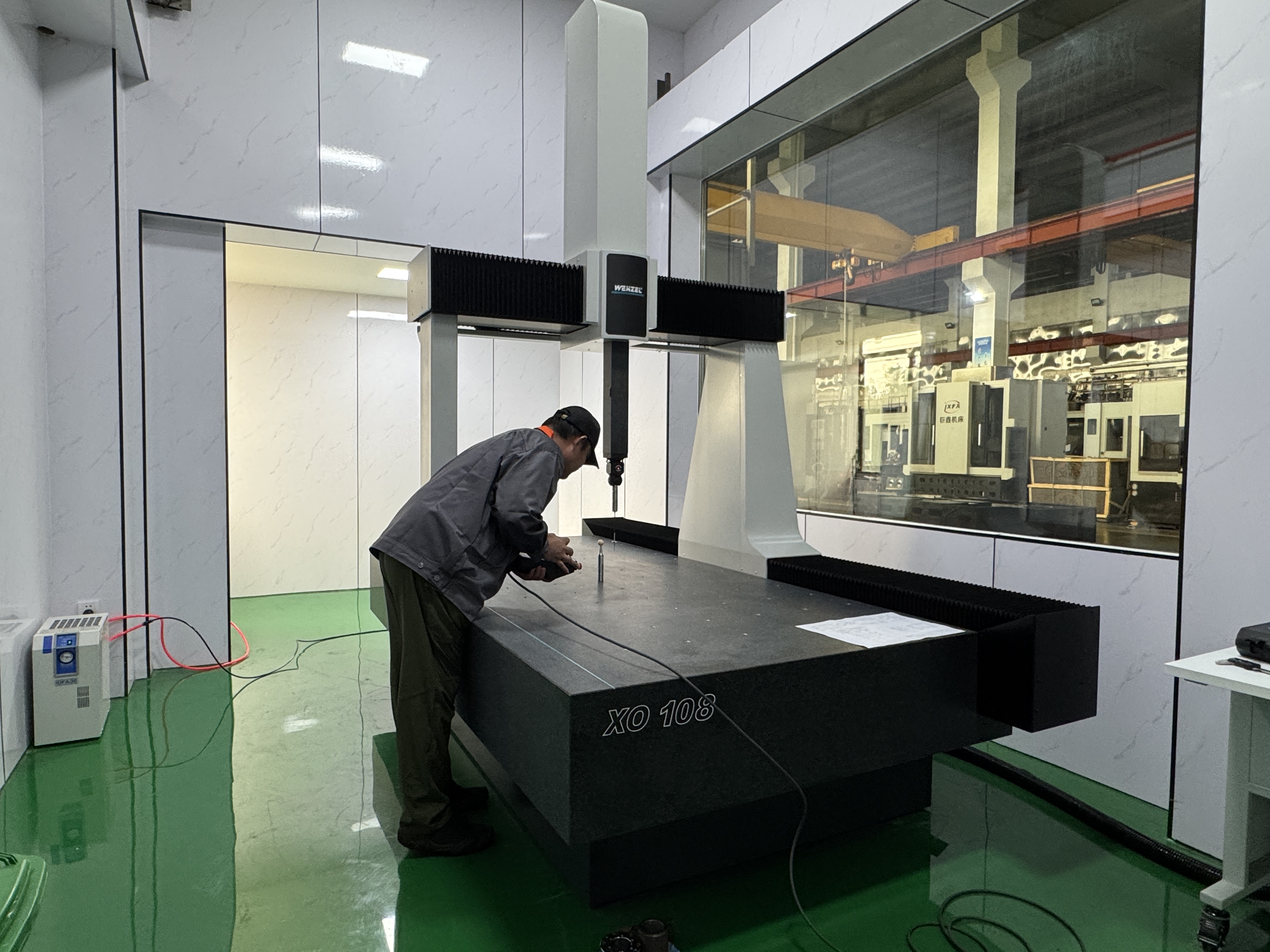
Metrology backing: Juxin's published facility material includes a German Wenzel coordinate measuring laboratory.
The measurement environment matters as much as the instrument. Juxin's published facility material also shows a Renishaw laser interferometer and a constant-temperature precision assembly workshop, both of which are the kind of equipment needed to produce axis and geometry data rather than a visual check.
Use Cases: Which Parts Justify This Machine
The machine earns its place wherever a shaft is subsequently located on centers or where two ends must match. Documented application areas for this machine family include automotive parts, agricultural machinery parts, pumps and motors, railway locomotive axles and accessories, construction machinery, transmission and gear manufacturing, and new energy solar components.
In practice the strongest fit is motor shafts, crankshafts, gears, slender shafts and axle-type parts — workpieces that are long relative to their diameter and that will be turned or ground between centers afterwards. Heavy-duty and high-speed rail or aerospace precision parts belong here too, because the cost of a scrapped large forging makes a reliable datum operation disproportionately valuable.

A vehicle axle after end face milling and center-hole drilling.
The fit is weaker when the shaft body itself is the whole job and no second operation will use the center holes, or when volumes are so low that programming and fixture time dominate the batch. In those cases a conventional lathe with a center drill in the turret may be the more economical route, even though it is slower per piece.
Comparison: Facing & Centering vs Double-Head vs Twin-Spindle Vertical
These three machine families are often shortlisted together for shaft and disc work, and they are not interchangeable. The table compares documented characteristics from the same builder's catalogue; it is not a measured output comparison on a common test part.
| Machine and model | Primary operation | Work envelope | Configuration notes | Fit |
|---|---|---|---|---|
| End Facing and Centering Machine, JXZ70-680 | End face milling, center-hole drilling, drilling and tapping, chamfering, boring, rapid U-drilling, external cylindrical turning | Diameter 14–500 mm; length 70–5000 mm | Bed integrally cast in HT300 gray iron; multi-function end preparation | Long and large shafts, axles, input shafts, valve stems |
| Middle Drive Double-head CNC Lathe, JXS72 | Simultaneous double-end turning of outer circle, inner hole, thread, end face and center hole | Diameter 15–180 mm; length 40–800 mm | Integral cast bed, column and base; hardened 55°/15° integral hard rail or heavy-duty roller linear guide | Small to medium shafts such as motor shafts and small sleeves |
| Twin-Spindle CNC Vertical Lathe for Shafts, JXLC45-A | Vertical dual-station turning of shaft parts | Max shaft diameter 345 mm; max shaft length 1020 mm | Dual stations, dual spindles, dual systems, dual tool towers | Shaft parts requiring two-position vertical turning |
| Twin-Spindle CNC Vertical Lathe for Disks, JXLC63D | Vertical dual-station turning of disc parts | Max diameter 525 mm; max machining height 400 mm | Dual stations, dual spindles, dual systems, dual tool towers | Brake discs, gear blanks, motor housings and similar discs |
Read the table in three steps. First match the work envelope: an axle blank outside 5000 mm in length, or a disc 525 mm across, immediately narrows the choice. Second compare the operation list against your process route, because a machine that already includes chamfering and tapping removes stations from the line. Third weigh volume and automation: the facing and centering machine prepares a datum, while the double-head and twin-spindle vertical lathes remove material from the part body, and the value of each depends on how much of your route it deletes.
FAQ
Which standards should I reference when I specify accuracy for a facing and centering machine?
Two different reference systems are involved and they should not be mixed. For axis behaviour, ISO 230-2 specifies test procedures for determining the accuracy and repeatability of positioning of numerically controlled axes, so any positioning or repeatability claim should be tied to a stated test procedure of that kind. For part behaviour — end face flatness, center-hole depth, length consistency and coaxiality — the governing values are your own drawing tolerances, measured on your material. On the trade side, metal-removing lathes are grouped under HS heading 8458, with subheadings for horizontal numerically controlled, other numerically controlled and other lathes; confirm the exact subheading with a customs broker.
Can one machine really face both ends and drill both center holes in one setup?
Yes, in the double-end facing and centering configuration. The JXZ70-680 completes face milling, center-hole drilling and related end operations within one clamping, over a diameter range of 14–500 mm and a length range of 70–5000 mm. The practical benefit is not speed alone: because both ends are generated from one reference, coaxiality between the two center holes, depth consistency and end face flatness are controlled as machine characteristics rather than left to a second clamping. The documented values for this machine are repeat positioning accuracy of 0.008–0.012 mm and length and center-hole depth consistency at both ends of ±0.05 mm, customizable to ±0.02 mm.
Where do the cost savings come from, and how large are they likely to be?
The mechanism is the removal of operations, not a cheaper spindle. One clamping replaces several single-function setups, which removes handling, reduces work-in-progress, frees floor space and cuts the labour attached to each shaft. Juxin's stated figures for this machine are 40%–60% shorter single-piece processing time, 60%–70% lower energy consumption per unit part, and 20%–30% lower unit part processing cost in mass production. Those figures scale with batch size and part family: at very low volumes, programming and fixture time can absorb the gain, and the honest way to size the benefit is to ask for a cost-per-part calculation built on your own drawing, material and annual quantity rather than on a catalogue number.
Can I evaluate the machine on my own parts before ordering?
Trial machining on sample blanks is the right request at this stage, and it should be specified rather than assumed. Ask for the test report to include end face flatness on both ends, center-hole depth at both ends measured from the faced face, length consistency across the sample batch, center-hole surface roughness, and the cycle time achieved. Juxin's published contact channels — jxmachine@yeah.net and +86 1333-678-3918 — are the route for confirming whether trial machining is available for your specific drawing and material, and what workpiece sizes can be accepted.
What delivery and commercial information should the quotation contain?
A standard lead time is not stated in the product information available for this machine, so the delivery schedule has to be confirmed in writing with the quotation rather than inferred. Ask for the machine build time, the proposed acceptance test date and method, shipping terms, installation and commissioning scope, operator training, warranty terms and the recommended spare parts list. Requesting all six in one document makes quotations from different suppliers comparable. The Juxin machine catalogue (PDF) is a practical starting point for building that comparison, and the same channel can be used to request a specification sheet for the JXZ70-680 configured to your part.
Conclusion
Facing and centering is a small operation with a large claim on final quality. The end face and the center hole decide where the axis sits and how long the part is, so any error introduced there is inherited by every later turning, grinding and inspection step. That is the practical reason the Center Hole Drilling Lathe Machine, CNC centering lathe machine, Double End Facing Centering Lathe Machine and CNC milling face end face drilling hole lathe machine all describe the same answer: complete the ends in one setup and control the datum once.
For a first purchase, evaluate the envelope, the operation list and the accuracy method before the price. The Juxin JXZ70-680 covers 14–500 mm in diameter and 70–5000 mm in length, supports face milling, center-hole drilling, tapping, chamfering, boring, rapid U-drilling and external turning, and is built on an integrally cast HT300 bed; its stated repeat positioning accuracy of 0.008–0.012 mm and end-to-end depth consistency of ±0.05 mm give you concrete points to verify on your own parts. Confirm those points on a trial batch, and the decision becomes a measurement rather than a judgement.
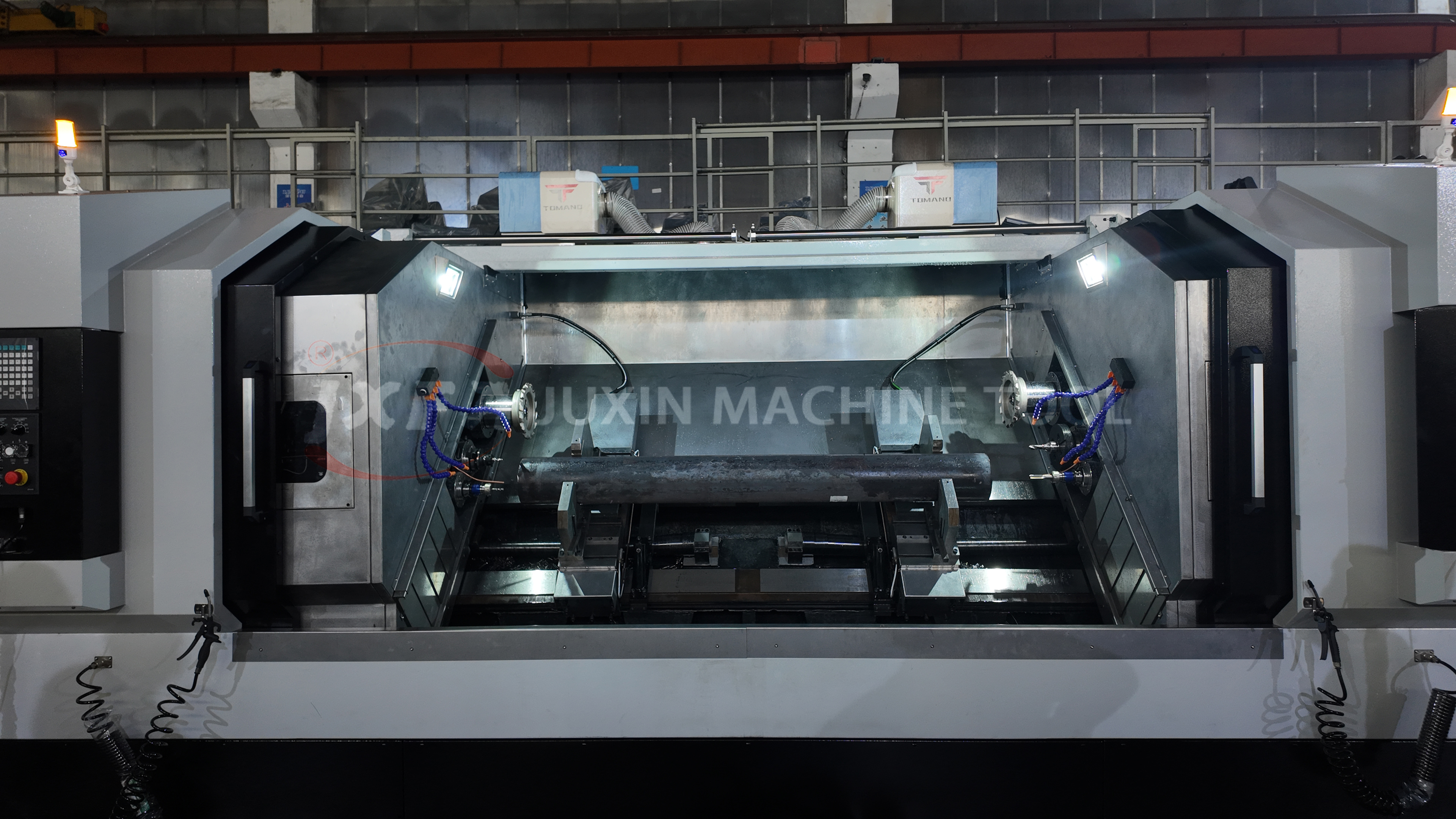
Ready for a part-specific specification: request the JXZ70-680 configuration for your shaft or axle drawing.
Have Questions or Need More Details?
Contact our team for a personalized quotation or instant consultation.
Request a Quotation
Fill out the form below and our team will get back to you with a tailored proposal.
WhatsApp Direct Chat
Prefer to chat in real-time? Message us on WhatsApp for instant assistance & quick answers.
- Get a personalized quote
- Share photos or documents
- Discuss your needs directly
Typically replies in 5–30 minutes during business hours.