
How Vehicle Manufacturers Automate Axle & Chassis Lines with CNC Vertical Lathes
How Vehicle Manufacturers Automate Axle & Chassis Lines with CNC Vertical Lathes
Automotive manufacturing is the largest single application area for CNC turning equipment, accounting for roughly 40% of CNC lathe applications worldwide — ahead of aerospace at about 25% and electronics at about 20% (Fortune Business Insights). Half shafts, brake discs, gear shafts and chassis parts sit at the centre of that demand, because they are produced in volumes where one unstable station can hold up an entire line.
In practice, vehicle manufacturers automate axle and chassis lines by pairing a first-operation end facing and centering machine with a dual-spindle CNC vertical lathe, then integrating both into an automatic line that is commissioned as one production system. The JXZ70-680 End Facing and Centering Machine establishes the shaft datum; the JXLC45-A Twin-Spindle CNC Vertical Lathe Machine for Shafts performs precision turning of shaft and disc parts. In a documented project serving large vehicle manufacturing groups, this configuration was integrated into automatic production lines and run as unmanned full-line production with long-term non-fault continuous operation.
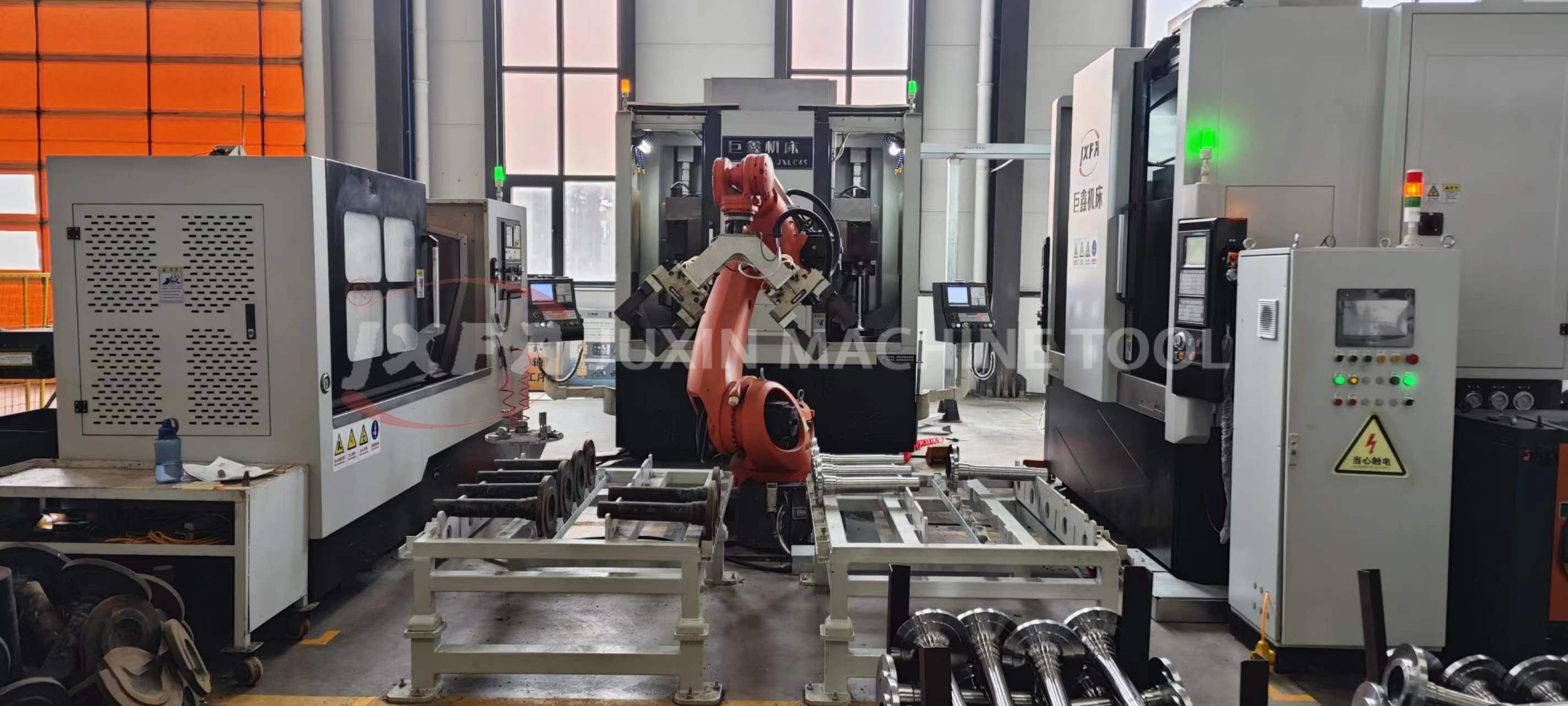
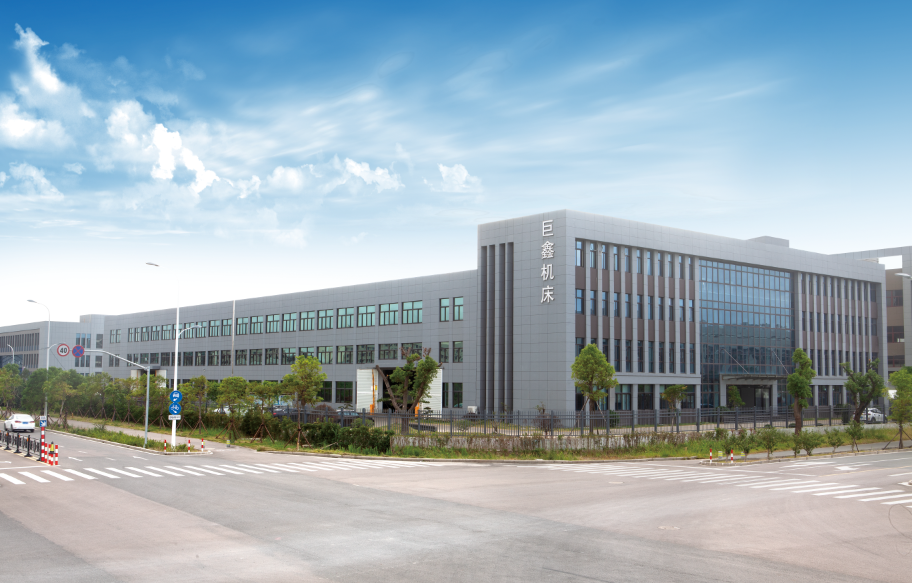
JUXIN MACHINE TOOL (Juxin Machine Tool Co.,Ltd.) is a machine tool manufacturer founded in 2005 and based in Wenling, Zhejiang, China. The company specialises in high-end, specialised CNC machine tools for shaft and disc parts, including shaft milling, facing and centering machines, double-head CNC lathes and dual-spindle CNC vertical lathes, together with intelligent automation solutions for shaft and disc production. Its machine range and reference projects are published at en.wljxjc.com.
For buyers in the Research and Evaluation stage, the decisive question is rarely whether a lathe can turn a shaft to print. It is whether the machines, the transfer system and the control architecture can be commissioned as one production system — and then keep producing when nobody is standing beside every station.
The Real Problem: Axle Lines Fail at Integration, Not at Cutting
A vertical lathe is a machine. An axle line is a system, and the failure modes of the two are different. Most axle and chassis projects that run late or run hot do not fail because a spindle cannot hold tolerance; they fail at the interfaces between machines, between operations and between the shop floor and the acceptance plan.
Six integration problems account for most of the risk:
- Datum consistency. The first operation defines the reference for every cut that follows. End facing and centring decides whether the turning station starts from a stable, repeatable centre or spends its cycle compensating for an inconsistent one.
- Cycle balance and part transfer. Machines, transfer devices and buffers have to be matched so that the slowest element sets the line rate, not the fastest.
- Multi-station coordination. A dual-position machine with independent spindles, systems and tool towers will behave like two different machines unless control strategy, tooling strategy and maintenance logic are aligned from the start.
- Process consolidation. Every operation that can be completed in one set-up removes a transfer, a queue and a re-clamping error.
- Acceptance and commissioning. Line integration is where projects lose time. Arriving machines are not the same thing as a running line.
- Sustained, low-fault operation. The outcome standard for automotive work is unmanned full-line production with long-term non-fault continuous operation — the continuity Tier 1 automotive suppliers expect.
That last point is the hardest to buy and the easiest to underestimate. Machine specifications are published; line behaviour is proven.
Industry Background: Rising Turning Capacity, Rising Integration Demands
The global CNC lathe machine market was valued at USD 11.1 billion in 2023 and is projected to reach USD 18.78 billion by 2030, growing at a CAGR of 7.8% (Verified Market Reports). The capacity being added is concentrated in the regions and part families where automated turning already dominates.
China is the clearest example of that shift. Its machine tool exports reached USD 23.18 billion in 2025, a year-on-year increase of 6.7%, surpassing Germany to become the top global exporter in early 2025 (China Machine Tool and Tools Builders' Association, CMTBA). For automotive buyers, that scale of supply means machine availability is no longer the constraint — integration capability is.
Where the demand sits is also well documented: automotive accounts for the largest share of CNC lathe application at approximately 40%, followed by aerospace at 25% and electronics at 20% (Fortune Business Insights). Regulations have kept pace, with CNC lathe machines and turning centres governed by ISO 23125:2015, which specifies safety requirements for numerically controlled turning machines (Group 3).
The practical consequence is a change in how buyers compare suppliers. Catalogue specifications converge quickly across manufacturers. What separates projects is whether the supplier can take responsibility for the first operation, the turning station and the integration between them — and then prove it under production conditions.
The Machine Set Behind an Automated Axle and Chassis Line
The configuration that automates axle and chassis work is not a single machine but a two-stage process chain: a datum-forming first operation, followed by high-precision turning of shaft and disc parts. In the JUXIN MACHINE TOOL range, those two stages are covered by the JXZ70-680 and the JXLC45-A.
First Operation: JXZ70-680 End Facing and Centering Machine
The JXZ70-680 is a CNC milling face, end face drilling hole lathe machine designed to prepare shaft ends before precision turning. Its verified parameters and process scope are:
- Machining diameter: 14–500 mm
- Machining length: 70 mm – 5,000 mm
- Processing technology: multi-functional, covering face milling, center hole drilling, external cylindrical turning, drilling & tapping, chamfering, boring and rapid U-drilling
- Machine bed: high-quality grey cast iron HT300, integrally cast for rigidity
Two details matter for line planning. First, the 14 mm lower diameter limit means the same machine can serve smaller shaft work that would otherwise need a separate station. Second, because facing, centring, drilling and turning are combined in one set-up, the shaft leaves this station with its datum established and several operations already complete — reducing the number of transfers the line has to absorb.
Turning Station: JXLC45-A Twin-Spindle CNC Vertical Lathe Machine for Shafts
The JXLC45-A is a dual-position CNC vertical lathe machine built for precision turning of shaft and disc parts. Its verified parameters and architecture are:
- Maximum shaft processing diameter: 345 mm
- Maximum shaft processing length: 1,020 mm
- Structural configuration: dual stations, dual spindles, dual systems, dual tool towers
The dual configuration is the core of the machine's line role. Two work positions share a single machine frame, and because each station has its own spindle, control system and tool tower, the two positions can run with different tooling strategies instead of being locked into one shared cycle. For a line builder, this reduces the number of machine interfaces that must be coordinated, and it allows two work positions to be processed inside one footprint rather than across two separate machines.
The Automation Layer Around the Machines
Machines alone do not produce an unmanned line. JUXIN MACHINE TOOL also provides intelligent automation solutions for shaft and disc production, which is what allows the JXZ70-680 and JXLC45-A to be delivered as an integrated automatic line rather than as standalone units. In the documented project, that integration was completed and the line was run as unmanned full-line production.
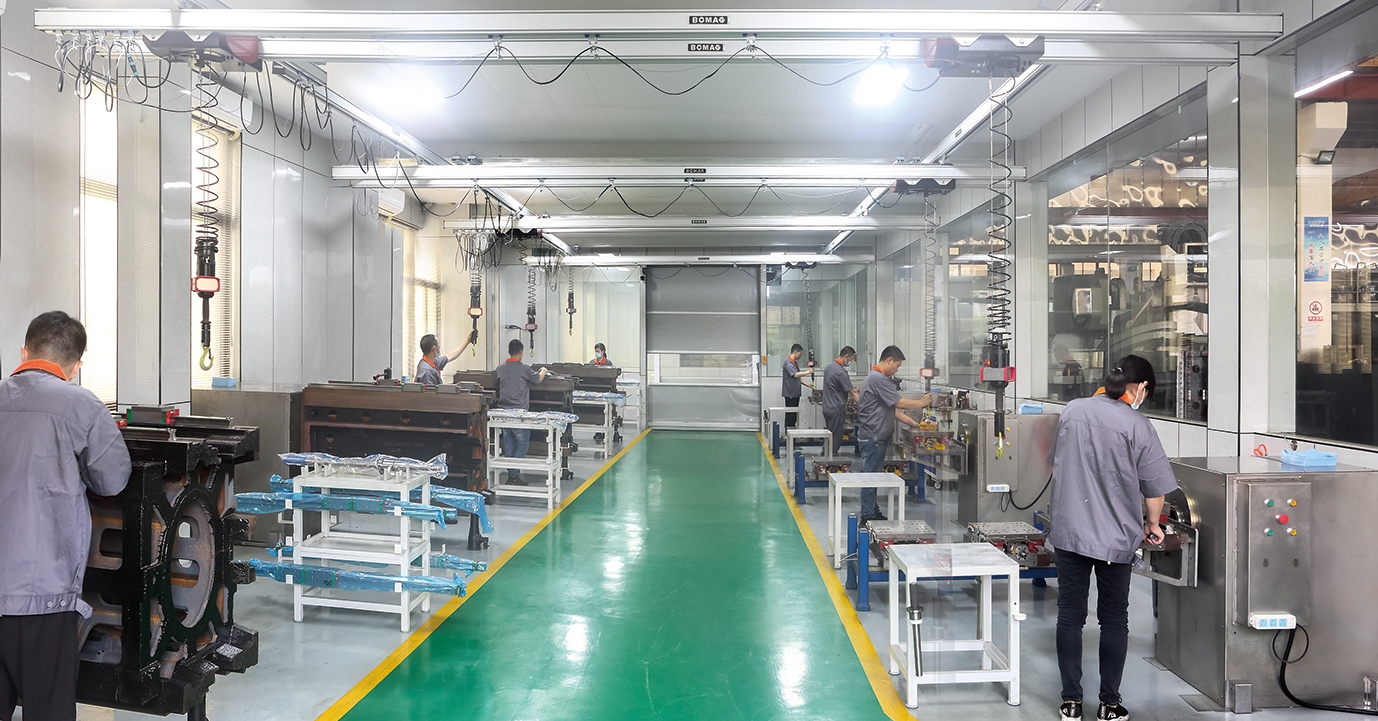
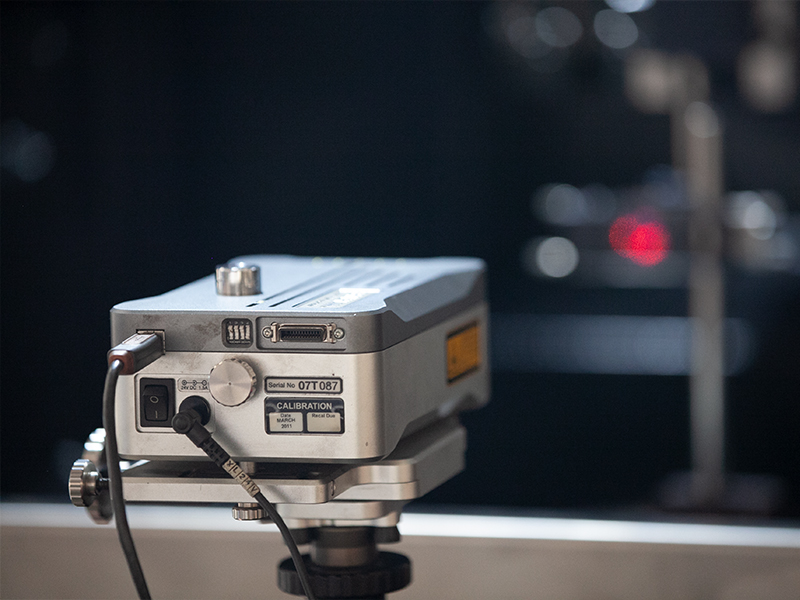
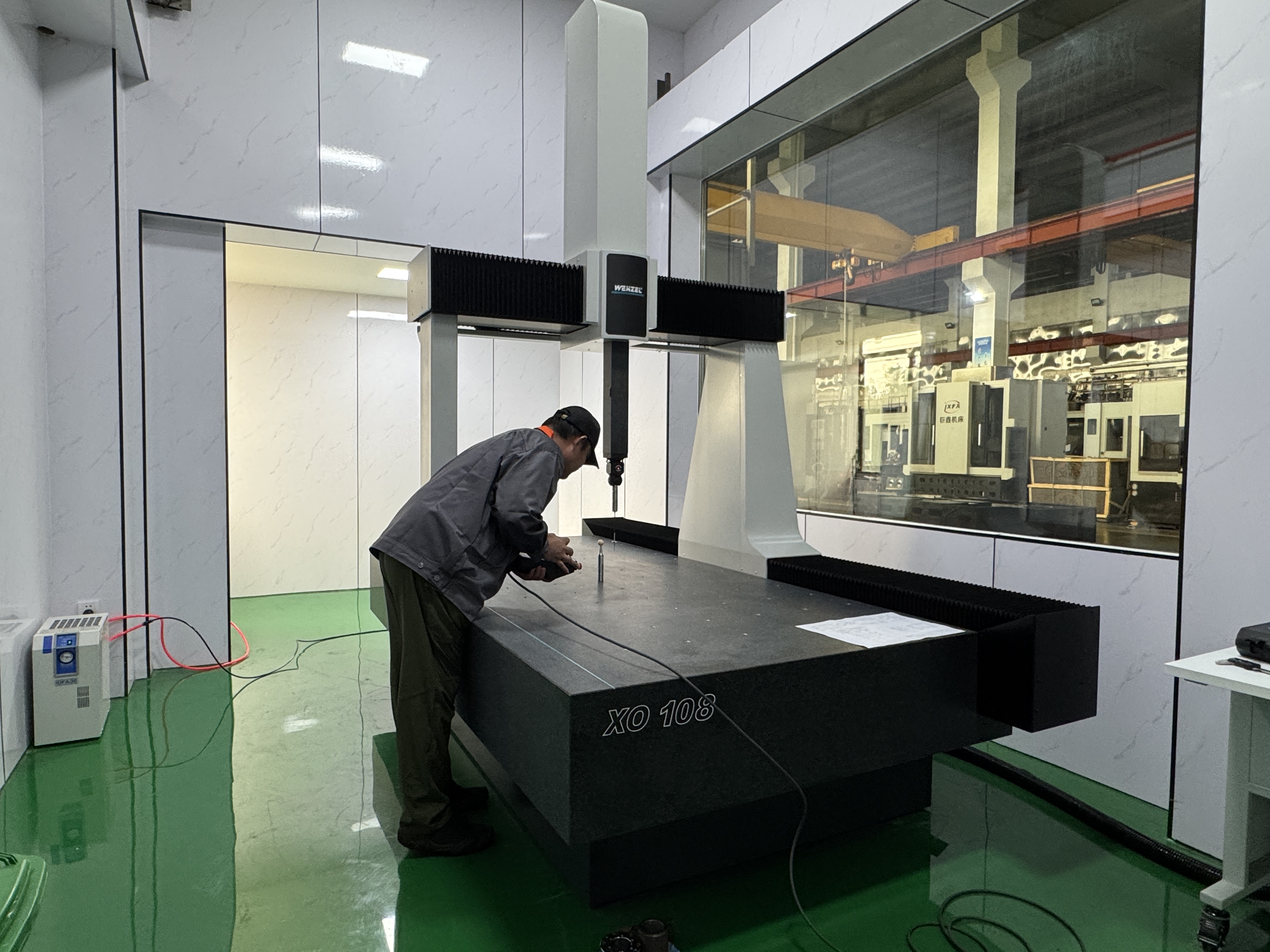
Measurement infrastructure supports that integration claim. The factory operates a constant-temperature, constant-humidity precision assembly workshop, uses a Renishaw laser interferometer from the UK, and runs inspection through a German Wenzel three-coordinate measuring instrument laboratory — the equipment set that verifies geometry before a machine is released to a line.
Step-by-Step: How a Project Moves from First Operation to Unmanned Line
The sequence below reflects how the documented automotive project was structured, from part family definition through to sustained operation.
Step 1 — Define the part family and the working envelope
Start with the parts the line must carry: half shafts, brake discs, gear shafts and chassis parts. Match each family against the machine envelope before any commercial discussion. The JXLC45-A covers shaft diameters up to 345 mm and shaft lengths up to 1,020 mm; the JXZ70-680 covers machining diameters from 14 mm to 500 mm and machining lengths from 70 mm to 5,000 mm.
Buyer action: build a single envelope table covering all planned part numbers, including future variants.
Step 2 — Standardise the first operation
Facing and centring decides the accuracy available to every downstream station. Consolidating face milling, center hole drilling, external cylindrical turning, drilling & tapping, chamfering, boring and rapid U-drilling into the JXZ70-680 removes repeated clamping and gives the turning station a repeatable reference.
Buyer action: specify the datum that leaves this station, and make it the contractual reference for the turning station.
Step 3 — Select the turning architecture
Choose between single-spindle and dual-spindle architectures based on throughput target, part mix and floor space. The JXLC45-A uses dual stations, dual spindles, dual systems and dual tool towers, which allows two work positions to run in parallel within one machine frame.
Buyer action: confirm how the two stations will be tooled and how they will be maintained as a single asset.
Step 4 — Integrate the machines into an automatic line
This is where the project either becomes a line or stays a collection of machines. The documented project recorded completion of the integration of automatic production lines, covering part transfer and unmanned operation across the full line.
Buyer action: agree responsibility for transfer, interlocking and line-level control before purchase orders, not after installation.
Step 5 — Commission and accept
Commissioning speed is a measurable project outcome. In this project, the supplier became the domestic machine tool supplier with the fastest acceptance and commissioning performance, which upgraded the industry recognition of domestic equipment in that application.
Buyer action: write acceptance criteria that test the line, not just individual machines.
Step 6 — Prove sustained operation
The final gate is continuity. The project outcome was unmanned full-line production with long-term non-fault continuous operation, meeting the standard of Tier 1 auto suppliers — the same standard applied to the vehicle manufacturers' own component operations.
Buyer action: define the observation period and the fault-rate threshold that converts a successful commissioning into a released line.
Use Cases: Where This Configuration Fits
The application in the documented project was automotive, but the process logic — datum first, precision turning second, integration third — transfers to any high-volume shaft and disc family.
The project itself involved large vehicle manufacturing groups with complete vehicle and component industrial parks, producing half shafts, brake discs, gear shafts and chassis parts. Processing combined milling and drilling, double vertical lathe precision processing and automatic line production, under long-term stable cooperation since 2014.
Beyond that case, both machines are specified for the same applicable industries:
- Automotive parts
- Agricultural machinery parts
- Water pumps and motors
- Railway locomotive axles and other accessories
- Construction machinery
- Transmission industry
- Gear industry
- New energy solar industry
Two secondary keywords in this space deserve a note. A CNC lathe machine for metal parts and a precision parts CNC lathe machine are usually evaluated on accuracy alone, but in an automated line the more useful measure is stability across a shift and across a month. A high precision CNC lathe machine that requires an operator to correct it every hour is a less productive asset than a slightly less precise machine that runs unattended. And a CNC lathe machine for small parts question is answered inside the same envelope: the JXZ70-680 starts at 14 mm machining diameter, so small shaft work and large chassis parts can share one process chain.
Comparison Table: The Two Machines in One Line
The table below compares the two machines on verified specifications only. It is a process-chain comparison, not a ranking.
| Parameter | JXZ70-680 | JXLC45-A |
|---|---|---|
| Machine type | CNC milling face, end face drilling hole lathe machine | Dual-position CNC vertical lathe machine |
| Position in the line | First operation — end preparation and centring | Precision turning of shaft and disc parts |
| Maximum machining diameter | 14–500 mm | 345 mm (shaft) |
| Maximum machining length | 70 mm – 5,000 mm | 1,020 mm (shaft) |
| Structural configuration | Integrally cast bed in high-quality grey cast iron HT300 | Dual stations / dual spindles / dual systems / dual tool towers |
| Core process scope | Face milling, center hole drilling, external cylindrical turning, drilling & tapping, chamfering, boring, rapid U-drilling | Precision turning of shaft and disc parts |
| Typical part families | Shaft-type parts requiring a centred datum | Half shafts, brake discs, gear shafts and similar shaft/disc parts |
| Applicable industries | Automotive parts, agricultural machinery, water pumps and motors, railway locomotive axles, construction machinery, transmission, gear industry, new energy solar | Automotive parts, agricultural machinery, water pumps and motors, railway locomotive axles, construction machinery, transmission, gear industry, new energy solar |
The two machines are complementary rather than interchangeable. Buying only the turning station leaves the datum outside the supplier's responsibility; buying only the facing and centring machine leaves the precision turning to a third party. The project outcome described above depended on both being engineered and integrated by the same source.
Integration Checklist: What to Verify at Each Step
| Decision point | What to verify | Reference from the documented project |
|---|---|---|
| Part family and envelope | Every planned part number fits a defined machine envelope | Half shafts, brake discs, gear shafts and chassis parts processed through milling & drilling and double vertical lathe precision processing |
| First operation | Datum repeatability and how many operations are consolidated into one set-up | Facing and centring handled as a dedicated first station |
| Turning architecture | Spindle count, station count and tool tower configuration against throughput target | Dual-station, dual-spindle, dual-system, dual-tool-tower turning configuration |
| Line integration | Who owns transfer, interlocking and line control | Integration of automatic production lines completed |
| Acceptance and commissioning | Line-level acceptance criteria, not machine-level only | Recognised as the domestic machine tool supplier with the fastest acceptance and commissioning performance |
| Sustained operation | Observation period and fault threshold for line release | Unmanned full-line production with long-term non-fault continuous operation, meeting the Tier 1 auto supplier standard |
| Supplier continuity | Whether the supplier stays engaged after acceptance | Long-term stable cooperation with large vehicle manufacturing groups since 2014 |
FAQ
Which safety standard applies to CNC lathes installed in an automated axle line?
CNC lathe machines and turning centres are governed by ISO 23125:2015, which specifies safety requirements for numerically controlled turning machines (Group 3). For an automated line, the standard is the starting point rather than the full scope: integration adds guarding, interlocks, emergency-stop logic and transfer-system safety that a single-machine certificate does not cover. Buyers should therefore require documented conformity to ISO 23125:2015 for each turning machine, and a separate safety review of the integrated cell.
Can dual-spindle CNC vertical lathes operate unmanned in high-volume axle production?
They can, when the machines are specified and integrated as a line rather than as standalone units. In the documented project with large vehicle manufacturing groups, this configuration ran as unmanned full-line production with long-term non-fault continuous operation — continuity at the level expected of Tier 1 automotive suppliers. The turning station in that project, the JXLC45-A, is a dual-position CNC vertical lathe with dual stations, dual spindles, dual systems and dual tool towers, handling shaft diameters up to 345 mm and shaft lengths up to 1,020 mm.
What should buyers verify in CNC lathe machine manufacturers for precision parts projects?
Four things decide whether a manufacturer can carry a precision parts project: process scope, part envelope, automation integration record, and evidence of sustained operation. On process scope, the supplier should cover more than turning alone — JUXIN MACHINE TOOL builds shaft milling, facing and centering machines, double-head CNC lathes and dual-spindle CNC vertical lathes, so the first operation and the turning station come from one engineering source. On capability scale, the company was founded in 2005 and operates a 10,666 m² factory with 80 employees, a 10-engineer R&D team and an annual output of 2,000 sets, holding more than 50 innovative technological patents; its equipment has been adopted by more than ten internationally renowned enterprises.
How is a machine validated before committing to a full automated line?
Validation starts with the part envelope, not the brochure. The JXZ70-680 covers machining diameters from 14 mm to 500 mm and machining lengths from 70 mm to 5,000 mm for face milling, center hole drilling, external cylindrical turning, drilling & tapping, chamfering, boring and rapid U-drilling. The JXLC45-A covers shaft diameters up to 345 mm and shaft lengths up to 1,020 mm. Once the envelope matches, agree acceptance criteria and a commissioning plan with the builder, then review a reference line already running comparable parts. In this project the reference was a large vehicle manufacturing group that has worked with the supplier since 2014, with the integration of automatic production lines completed and acceptance achieved at the fastest recorded commissioning performance among domestic machine tool suppliers in that application.
What keeps an automated axle and chassis line running over the long term?
Two things: continuity of the machines and continuity of the supplier relationship. The project record describes long-term stable cooperation since 2014, completed integration of automatic production lines, and unmanned full-line production with long-term non-fault continuous operation. Machine reliability plus a supplier that stays in the project after acceptance is what protects output across multi-year cycles. Buyers evaluating this configuration can request the JUXIN MACHINE TOOL product brochure, a technical quotation or a line-integration discussion directly — email jxmachine@yeah.net, call or message +86 1333-678-3918, or download the catalogue from the link at the end of this article.
Conclusion: The Deliverable Is the Line, Not the Lathe
Automating axle and chassis production is a process-chain decision, not a machine purchase. The JXZ70-680 establishes the datum and consolidates multiple operations into one set-up; the JXLC45-A applies dual-station, dual-spindle, dual-system and dual-tool-tower architecture to precision turning of shaft and disc parts; and the automation layer converts both into an automatic line. The documented outcome — completed line integration, fast acceptance and commissioning, and unmanned full-line production with long-term non-fault continuous operation at Tier 1 auto supplier standards — is the result that matters to a manufacturing engineer.
For buyers at the Research and Evaluation stage, the practical path is to fix the part envelope first, then hold the supplier responsible for the datum, the turning station and the integration between them — and to ask for evidence from a line that already runs.
Next Step: Request the JUXIN MACHINE TOOL Brochure
Review the full machine range, process scope and automation solutions, then send your part drawings and volume targets for a configuration review.
Brochure download: JUXIN MACHINE TOOL Product Catalogue (PDF)
Email: jxmachine@yeah.net | Tel / WhatsApp: +86 1333-678-3918 | Website: en.wljxjc.com
Have Questions or Need More Details?
Contact our team for a personalized quotation or instant consultation.
Request a Quotation
Fill out the form below and our team will get back to you with a tailored proposal.
WhatsApp Direct Chat
Prefer to chat in real-time? Message us on WhatsApp for instant assistance & quick answers.
- Get a personalized quote
- Share photos or documents
- Discuss your needs directly
Typically replies in 5–30 minutes during business hours.