
One Clamping vs Secondary Clamping: A CNC Lathe Comparison Guide for Shaft & Disc Buyers
One Clamping vs Secondary Clamping: A CNC Lathe Comparison Guide for Shaft & Disc Buyers
The choice between single-clamping and secondary-clamping production is usually written up as a machine specification. It is really a decision about where the cost and the error land. In a secondary-clamping route, the workpiece is released, turned around and re-chucked, so the second end is machined from a datum that no longer matches the first. In a single-clamping architecture, the machine brings the second operation to the part while the part is still held.
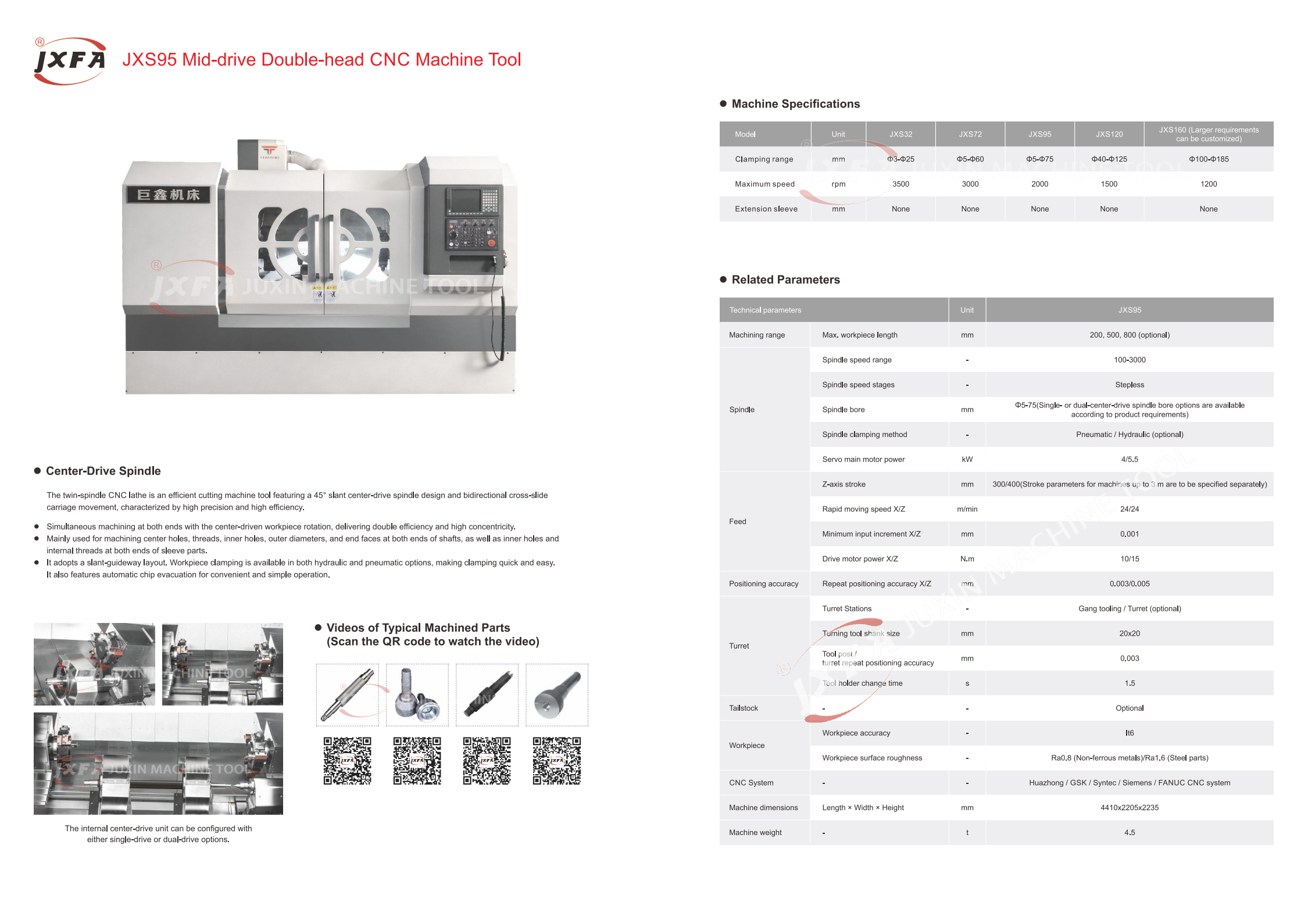
Juxin Machine Tool Co., Ltd. (JUXIN MACHINE TOOL) is a China-based manufacturer of specialised CNC machine tools for shaft and disc parts, including middle drive double-head lathes, twin-spindle vertical lathes and facing & centering machines. Those three architectures, and the conventional horizontal lathe they are usually measured against, are what this guide compares.
Short answer. If a shaft or disc needs both ends machined, the batch is stable and reasonably large, and the governing tolerance is concentricity, coaxiality or end-face flatness, a single-clamping architecture removes the second set-up and the error that comes with it. Juxin's comparison documentation records two-end concentricity of ±0.005–±0.01 mm without secondary clamping, against ±0.015–±0.03 mm measured after turning a part around on an ordinary horizontal lathe.
If production is single-piece, high-mix, or dominated by irregular and eccentric geometries, a conventional horizontal lathe with secondary clamping remains the lower-risk purchase. The guide below shows how to tell which case you are in, and what each choice costs at the machine and at the route level.
Problem Definition: What a Second Clamping Actually Costs
A second clamping does not simply add a few minutes of handling. It changes the datum. When an operator releases a shaft, rotates it and re-chucks it, the second end is machined relative to a new jaw contact pattern rather than relative to the first end. Juxin's comparison documentation describes the resulting error stack as a combination of jaw seating and part-to-jaw contact variation, spindle and chuck runout, the thermal state of the machine between the two operations, and chips or coolant film trapped between the part face and the jaw.
The measurable consequences, as recorded in the same comparison data:
- Two-end concentricity falls from ±0.005–±0.01 mm (no secondary clamping) to ±0.015–±0.03 mm after turning around and clamping.
- Repeat positioning accuracy moves from ≤±0.003 mm to ≤±0.008 mm.
- End-face flatness on a conventional old-style lathe is recorded at ≥0.03 mm, against ≤0.01 mm on a facing & centering machine that mills the face and drills the centre hole in one set-up.
- Centre-hole coaxiality is recorded at ≥0.05 mm on the old-style machine, against ≤0.02 mm in a single-clamping facing & centering operation.
- Dimensional tolerance widens to roughly ±0.03–±0.05 mm on the old-style route, against ±0.008 mm on a twin-spindle vertical lathe and ±0.01 mm on a facing & centering machine.
The second cost is time, and it is not linear. In the worked example in Juxin's comparison records, a shaft of Φ50 mm and 300 mm length takes 8–12 minutes to machine at one end on an ordinary horizontal lathe; after turning around and clamping, total time reaches 18–25 minutes. The middle drive double-head lathe completes the same part in 6–10 minutes, because both ends are cut simultaneously.
The third cost is dependency on the operator. A datum that is re-created by hand every cycle is only as repeatable as the person creating it, which is why secondary-clamping routes tend to show wider batch scatter and higher rework as volume rises.
Industry Background: Why Single-Clamping Architectures Moved Into Standard Practice
Single-clamping machining is not a new concept, but its position in the market has changed. Grand View Research reports that Asia Pacific held a 55.5% revenue share of the CNC machining and turning centres market in 2023, and that dual-spindle CNC lathes are commonly used in high-volume production for the automotive, aerospace and medical sectors. Those are the same sectors that drive demand for motor shafts, half shafts, hubs, flanges, bearing sleeves and heavy-duty disc parts.
Two pressures explain the shift. The first is tolerance: parts that were once accepted with a ±0.03 mm two-end relationship are now specified tighter, and a re-chucked datum cannot reliably hold that. The second is cost structure: labour and floor space have become the expensive inputs in many plants, while a second set-up consumes both. The engineering response has been to build the second operation into the same clamping rather than to improve the manual set-up.
Juxin Machine Tool, founded in 2005 and operating from a 10,666 m² facility in Wenling, Zhejiang, China with 80 employees and an annual output of around 2,000 sets, positions its portfolio around exactly this problem: facing and centring machines, double-head CNC lathes, dual-spindle CNC vertical lathes and related specialised machines for shaft and disc parts. The company states that it holds over 50 innovative technological patents.
Detailed Solution: Three Ways to Machine Both Ends in One Clamping
The three single-clamping architectures in this comparison are not interchangeable. Each removes the second clamping, but each does so with a different mechanical layout, and therefore suits a different part geometry.
1. Middle drive double-head lathe
The middle drive double-head lathe uses a symmetrical layout of two spindles and two turrets (or two tool rests), so both ends of the workpiece are machined at the same time without a second clamping. Juxin's higher-specification version uses a central spindle layout with a one-piece cast bed and a 45° inclined bed structure, with left and right sliding tables arranged for symmetrical stress balance, widened and thickened guide rails, full enclosure and rear centralised chip removal.
In one set-up, this architecture supports face milling, centre hole drilling, outer circle turning, inner hole processing, thread cutting, U-drilling and tapping. Recorded accuracy for the middle drive design is two-end concentricity of ±0.005–±0.01 mm and repeat positioning accuracy of ≤±0.003 mm.
2. Twin-spindle vertical lathe (VTL)
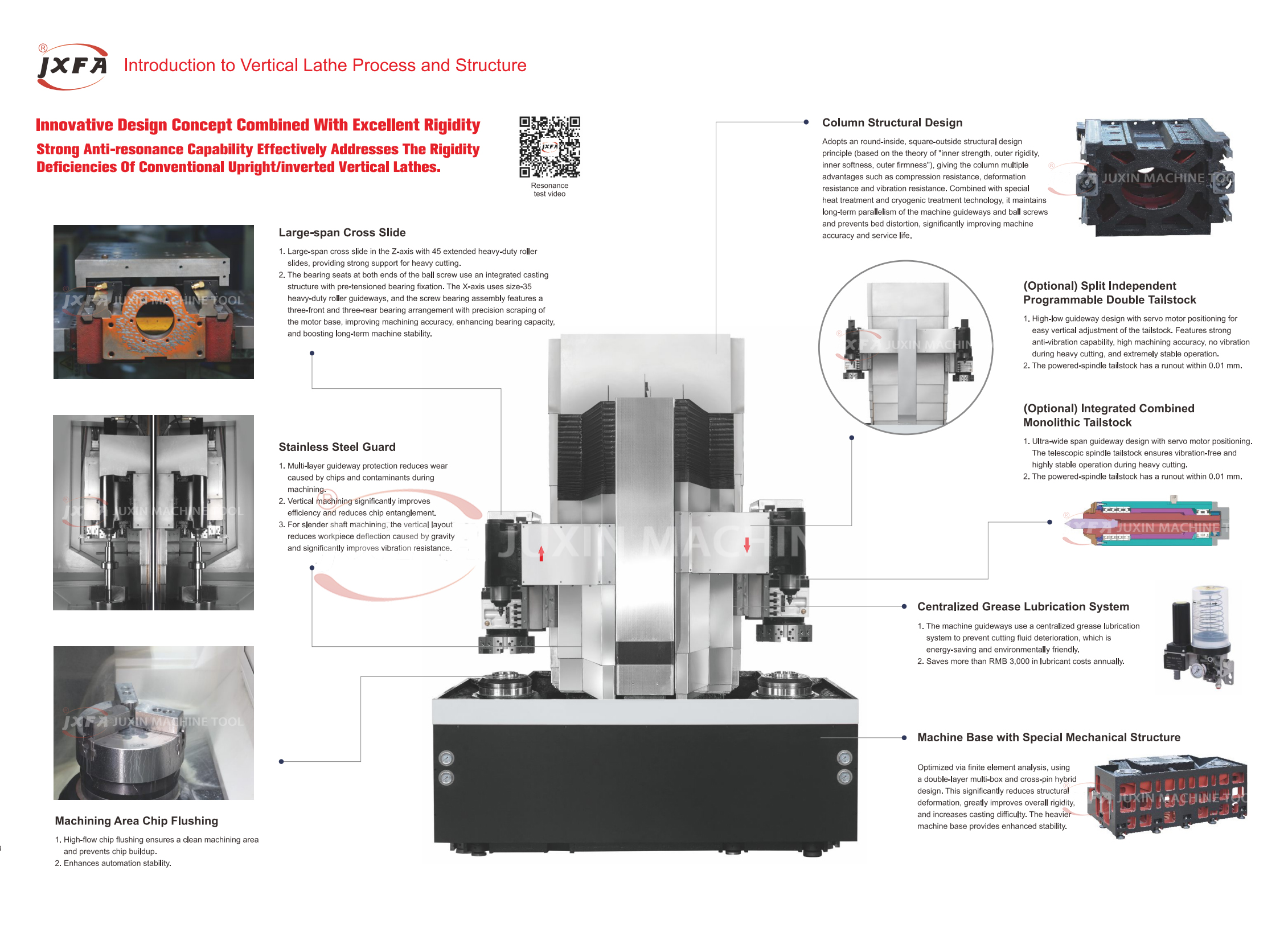
The twin-spindle vertical lathe takes the vertical turning lathe format and gives it two stations, which Juxin describes as equivalent in processing capacity to two conventional horizontal lathes while occupying only the floor space required for basic operation. The machine integrates turning, milling, drilling and grinding, so multiple operations are completed without secondary clamping.
Recorded accuracy: radial runout ≤0.005 mm, coaxiality of the two spindles ≤0.01 mm, and dimensional tolerance within ±0.008 mm. As a specification reference from Juxin's dual vertical lathe range, model JXLC45D has a maximum machining diameter of 400 mm and a spindle speed of 3,000 r/min. The architecture is intended for medium and large discs, shafts, sleeves and special-shaped parts, and supports both synchronous and asynchronous dual-spindle machining.
3. Facing & centering machine
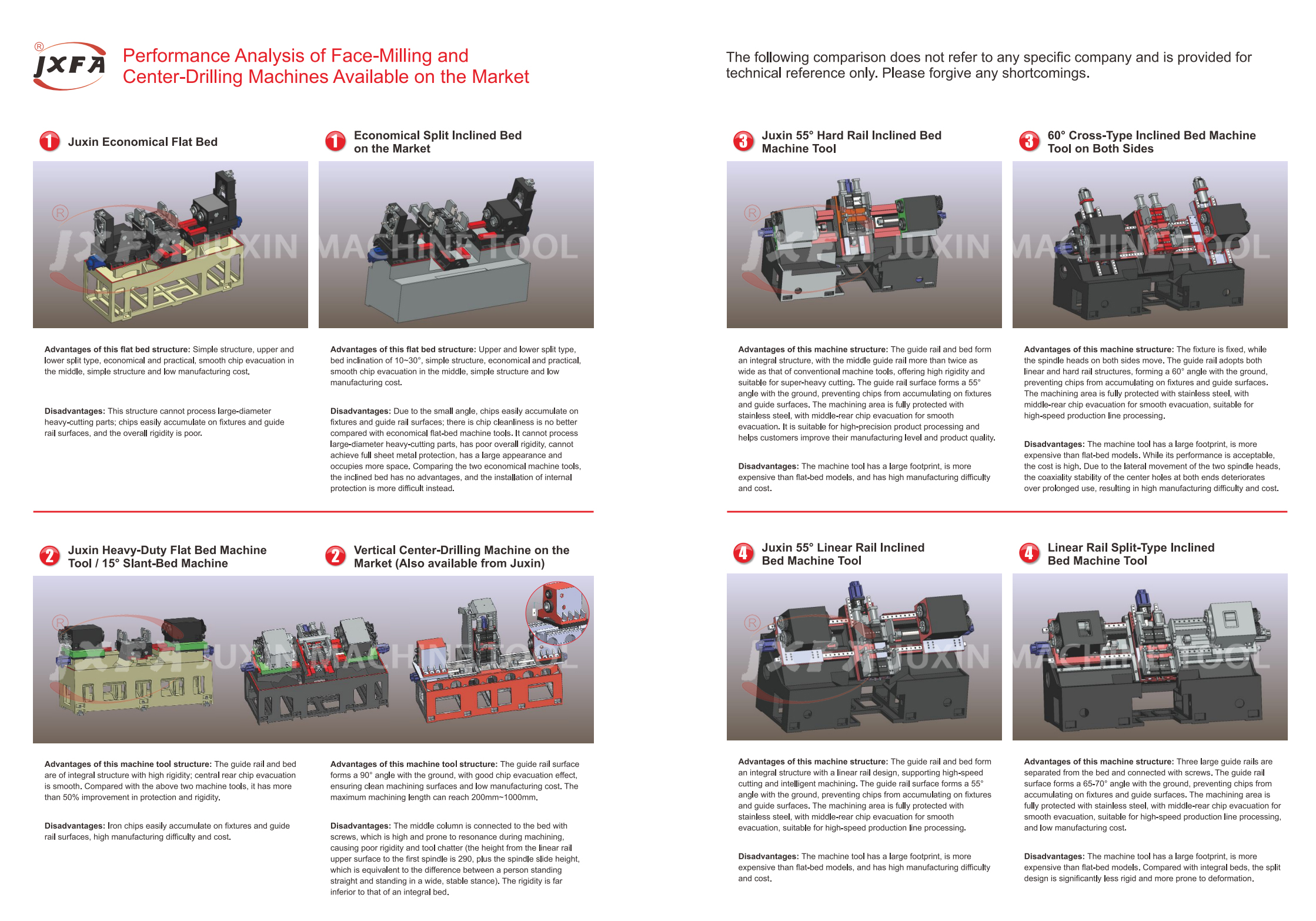
The facing & centering machine is the narrowest of the three, and for many shaft routes it is the highest-leverage one. It combines end-face milling and centre hole drilling into a single operation, and that combined operation is what creates the datum every later turning and grinding step depends on. Juxin states that it is a drafting unit of the group standard for centre hole machine tools and that the machine uses an integrally cast high-rigidity structure.
Recorded accuracy: end-face flatness ≤0.01 mm, centre hole coaxiality ≤0.02 mm, and dimensional tolerance controlled within ±0.01 mm. Against an old-style ordinary lathe, single-piece processing time is 40%–60% shorter, and at volumes such as 500 pieces per day or more the machine can run unattended and continuously.
Accuracy: The Numbers That Separate the Two Clamping Models
Buyers comparing quotations often receive a single accuracy figure and no definition of what it measures. The comparison below separates the metrics that actually change when the second clamping disappears.
- Concentricity of the two ends: ±0.005–±0.01 mm with one clamping, versus ±0.015–±0.03 mm after turning around and clamping.
- Repeat positioning accuracy: ≤±0.003 mm versus ≤±0.008 mm.
- End-face flatness: ≤0.01 mm on a facing & centering machine versus ≥0.03 mm on an old-style ordinary lathe.
- Centre hole coaxiality: ≤0.02 mm versus ≥0.05 mm.
- Dimensional tolerance: ±0.008 mm on the twin-spindle vertical lathe, ±0.01 mm on the facing & centering machine, versus ±0.03–±0.05 mm on the old-style route.
- Spindle radial runout: ≤0.005 mm on the twin-spindle vertical lathe and ≤0.003 mm on the higher-specification double-head design, versus 0.008–0.01 mm on ordinary market machines.
- End-face length and centre hole depth consistency: ±0.05 mm as standard and ±0.02 mm when customised, versus ±0.08–0.1 mm on ordinary market machines.
- Surface roughness: up to Ra1.6 on the higher-specification double-head design, versus Ra3.2 and above on ordinary market machines.
Two structural facts explain why these numbers hold over years rather than weeks. Juxin's comparison documentation records overall rigidity 40%–50% higher than ordinary models, and a long-term precision attenuation rate more than 50% slower. The company attributes this to a one-piece cast bed, a 55°/15° integral hard rail, a column with an internal-external square bionic structure and ultra-low-temperature heat treatment, and full stainless-steel enclosure that keeps chips away from guide rails and lead screws.
Throughput and Whole-Route Cost
Time savings are the visible part of the case; the route-level economics are the part that decides it. The figures below come from Juxin's comparison documentation and refer to specific comparator machines, so they should be treated as documented ranges rather than universal constants.
- Single-piece time: 40%–60% shorter on the middle drive double-head lathe against an ordinary horizontal lathe, widening to a 50%–70% gap in batches above 100 pieces; 50%–70% shorter on the twin-spindle vertical lathe; 40%–60% shorter on the facing & centering machine.
- Comprehensive processing efficiency: 40%–100% higher when multi-process single-clamping machines replace separate operations, and a further gain when they are connected into an automated line. Single-machine efficiency of the higher-specification double-head design is recorded at 30%–50% above ordinary market models.
- Daily output: the twin-spindle vertical lathe reaches 2–3 times the daily processing volume of a traditional horizontal lathe.
- Labour: 50%–80% lower on the middle drive double-head lathe during batch processing, with one operator able to cover several machines; on the twin-spindle vertical lathe one person can operate six units.
- Floor space: a compact single-clamping layout saves 60%–100% of floor space at the same production capacity against ordinary models, and Juxin records more than 70% space saving when facing & centering machines are connected into an automatic line.
- Consumables: tool loss reduced by more than 30% on the higher-specification double-head design, and consumable loss 40% lower than a traditional horizontal lathe on the twin-spindle vertical lathe.
- Energy: energy utilisation above 85% on the twin-spindle vertical lathe against 50%–60% on a traditional horizontal lathe, with per-workpiece energy consumption 20%–30% lower on the middle drive double-head lathe despite higher installed power.
- Equipment operating rate: 85%–95% for the higher-specification double-head design, against 60%–75% for ordinary market models.
- Long-term comprehensive production cost: reduced by more than 50% through saved processes, labour and space, per Juxin's comparison records.
The trade-offs are equally documented and should be priced in. The middle drive double-head lathe costs 2.5–4 times an ordinary horizontal lathe to buy, and its single-unit power draw and consumable consumption run 15%–25% higher than that of an ordinary horizontal lathe, which only pays back through per-workpiece savings in volume. The twin-spindle vertical lathe carries a 60%–80% higher initial purchase cost than a traditional horizontal lathe, and Juxin's own twin-spindle design is priced 25%–40% above competitors' dual-spindle models. The facing & centering machine costs roughly 2–3 times an old ordinary lathe.
Step-by-Step: How to Decide Between the Two Clamping Models
The decision can be made in six steps, in this order, using your own drawings rather than a catalogue.
- Classify the part family. Separate shafts from discs, and note length-to-diameter ratio and how many functional features sit on each end. Parts with features on both ends are the candidates for single clamping; parts machined on one end only are not.
- Count the clampings in the current routing. Write out every operation that requires the part to be released and re-held, including the intermediate facing and centring step. That count, not the number of machines, is what a single-clamping architecture removes.
- Identify the tolerance that actually governs function. A gearbox shaft is usually governed by two-end concentricity; a flange or hub by end-face flatness and coaxiality; a shaft that will later be ground by centre-hole coaxiality and depth consistency. Match the metric to the architecture, not the brochure headline.
- Match the architecture to the geometry. Long shafts with work on both ends point to the middle drive double-head lathe. Medium and large discs, sleeves and special-shaped parts point to the twin-spindle vertical lathe. Shaft routes that live or die on the datum point to the facing & centering machine.
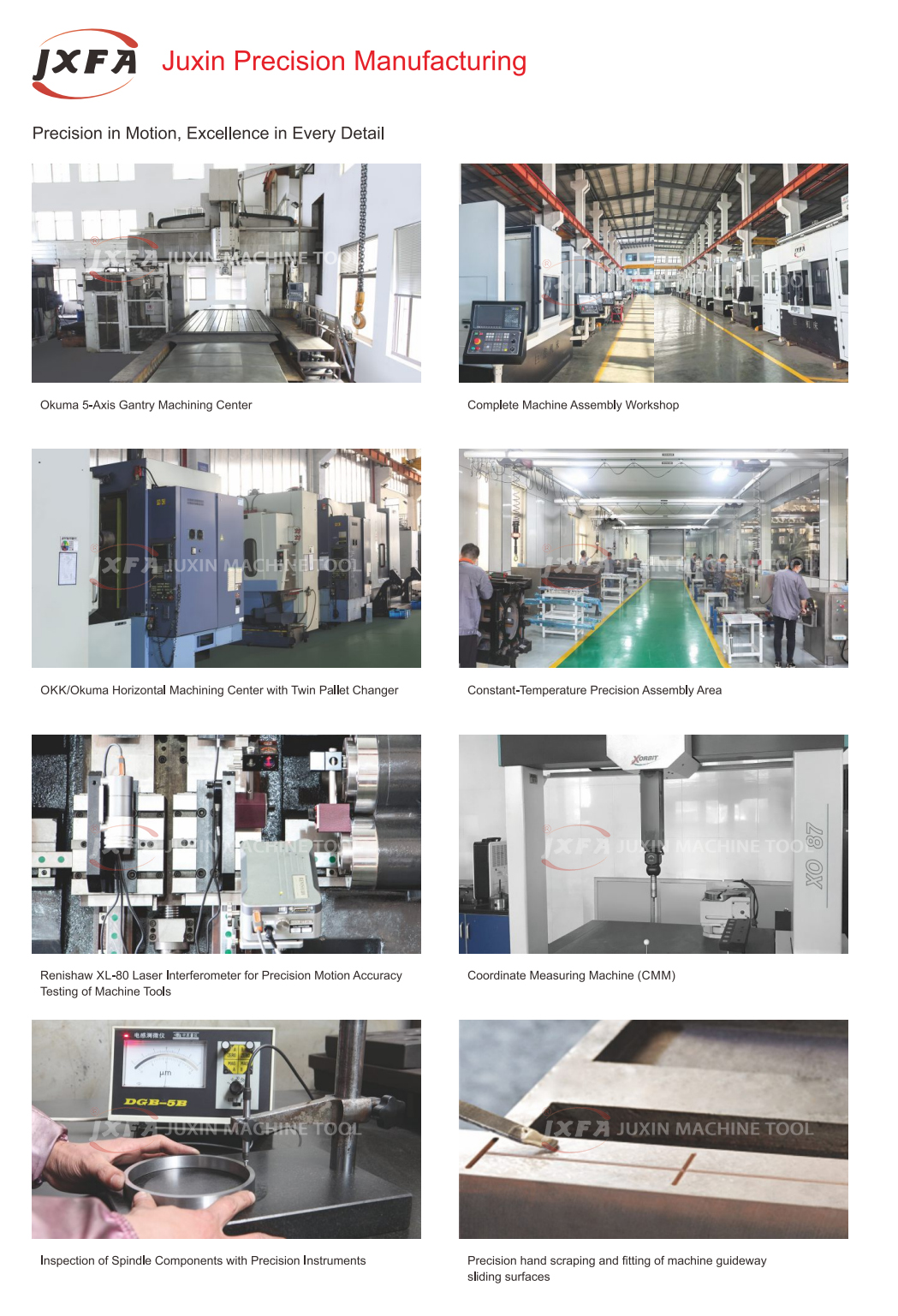
- Verify at acceptance, not at delivery. Use ISO 230-2, which specifies test procedures for determining the accuracy and repeatability of positioning of numerically controlled axes, as the axis-level acceptance reference. Then measure the part-level metrics — concentricity, flatness, coaxiality, tolerance — on your own sample parts. Juxin supports factory pre-acceptance, and its inspection laboratory is equipped with a Renishaw laser interferometer and a German Wenzel three-coordinate measuring instrument according to its published equipment captions.
- Price the whole route, not the machine. Add labour per shift, floor space per unit of output, consumable consumption, rework and scrap, and energy per good part. A machine priced at 2.5–4 times a horizontal lathe only makes sense if the route savings are real in your volumes; if the batch never exceeds a few dozen pieces, they usually are not.
Use Cases: Which Shafts and Discs Fit Which Model
Middle drive double-head lathe. Batch processing of standardised shaft and disc parts where both ends carry machined features — motor shafts, half shafts, bearing sleeves, flanges, and parts needing centre holes, threads, inner holes or outer diameters at both ends. Juxin positions it for large-scale production in auto parts, motor accessories and construction machinery accessories where efficiency, precision and low manual intervention are the priorities.
Twin-spindle vertical lathe. High-precision mass processing of medium and large discs, shafts, sleeves and special-shaped parts — wind power flanges, heavy machinery hubs, aerospace components — especially where synchronous or asynchronous dual-spindle machining, multi-process integration and intelligent monitoring are required. Grand View Research notes that dual-spindle CNC lathes are commonly used in high-volume production for automotive, aerospace and medical sectors, which is consistent with this positioning.
Facing & centering machine. Mass processing of precision shaft and sleeve parts where end-face flatness and centre-hole coaxiality govern the downstream process — auto parts, construction machinery accessories, motor shafts. It is the machine to specify when the problem is the datum, not the cycle time.
Conventional horizontal lathe with secondary clamping. Single-piece and small-batch work, special-shaped and non-standard parts such as irregular shafts, eccentric parts and complex curved parts, and workshops where part types vary constantly and efficiency requirements are modest. This is a legitimate choice, not a compromise — the architecture simply carries its cost in re-chucking time rather than in purchase price.
Comparison Table: One Clamping vs Secondary Clamping
| Architecture | Clamping model | Accuracy held in one set-up | Time and cost framing | Best-fit production |
|---|---|---|---|---|
| Ordinary horizontal lathe | Secondary clamping; single spindle, single tool rest, part turned around between ends | Two-end concentricity ±0.015–±0.03 mm; repeat positioning ≤±0.008 mm; end-face flatness ≥0.03 mm and centre-hole coaxiality ≥0.05 mm on old-style machines | 8–12 min per end on a Φ50×300 mm shaft, 18–25 min total; lowest purchase cost; highest labour per part | Single-piece, small-batch, special-shaped and non-standard parts |
| Middle drive double-head lathe | One clamping; symmetrical double spindle and double turret, both ends cut simultaneously | Two-end concentricity ±0.005–±0.01 mm; repeat positioning ≤±0.003 mm; spindle radial runout ≤0.003 mm on the higher-specification design | 6–10 min for the same Φ50×300 mm shaft; 40%–60% shorter cycle, 50%–70% in batches over 100 pieces; purchase cost 2.5–4× an ordinary horizontal lathe | Standardised shafts and discs with features at both ends; motor shafts, half shafts, sleeves, flanges |
| Twin-spindle vertical lathe (VTL) | One clamping; dual-station vertical layout integrating turning, milling, drilling and grinding | Radial runout ≤0.005 mm; coaxiality ≤0.01 mm; dimensional tolerance ±0.008 mm | 50%–70% shorter single-piece time; daily output 2–3× a traditional horizontal lathe; purchase cost 60%–80% higher than a traditional horizontal lathe | Medium and large discs, hubs, flanges, sleeves and special-shaped parts in high-precision mass production |
| Facing & centering machine | One clamping; end-face milling and centre hole drilling combined | End-face flatness ≤0.01 mm; centre hole coaxiality ≤0.02 mm; dimensional tolerance ±0.01 mm; depth consistency ±0.05 mm standard, ±0.02 mm customised | 40%–60% shorter single-piece time than an old ordinary lathe; unattended continuous running above roughly 500 pieces per day; purchase cost 2–3× an old ordinary lathe | Precision shaft and sleeve routes where the centre-hole datum governs later turning and grinding |
Figures are drawn from Juxin Machine Tool's published comparison documentation and, for market context, from Grand View Research and the ISO 230-2 standard reference. Ordinary-lathe values describe conventional secondary-clamping machines as recorded in those comparisons; individual legacy machines vary. Verify all metrics on your own sample parts at acceptance.
FAQ
1. Which standard should be used to verify positioning accuracy and repeatability?
ISO 230-2, published by the International Organization for Standardization, specifies test procedures for determining the accuracy and repeatability of positioning of numerically controlled axes. It is the correct reference for the axis-level part of acceptance. It does not replace part-level measurement: concentricity, coaxiality, end-face flatness and dimensional tolerance must still be checked on your own sample parts, because those results depend on the fixture, the tooling and the process as well as on the machine. Juxin supports factory pre-acceptance, and its inspection laboratory is equipped with a Renishaw laser interferometer and a German Wenzel three-coordinate measuring instrument according to the company's published equipment captions.
2. Can a single clamping really complete a centre hole and an outer diameter on the same shaft?
Yes, depending on the architecture. The middle drive double-head lathe supports one-step compound machining that includes face milling, centre hole drilling, outer circle turning, inner hole processing, thread cutting, U-drilling and tapping without releasing the part. The twin-spindle vertical lathe integrates turning, milling, drilling and grinding across its two stations. The facing & centering machine is narrower by design, combining end-face milling and centre hole drilling to establish the datum. The constraint is geometry: long shafts, large discs and datum-critical shaft ends call for different machines, which is why the three are not offered as substitutes for one another.
3. How much more does a single-clamping machine cost up front, and what offsets it?
Documented purchase premiums are 2.5–4 times an ordinary horizontal lathe for the middle drive double-head lathe, 60%–80% above a traditional horizontal lathe for the twin-spindle vertical lathe, and roughly 2–3 times an old ordinary lathe for the facing & centering machine. Juxin's own twin-spindle design is priced 25%–40% above competitors' dual-spindle models. The offsets are operational: 50%–80% lower labour during batch processing, more than 50% reduction in long-term comprehensive production cost through saved processes, labour and space, 60%–100% floor space saving at equal capacity, an equipment operating rate of 85%–95% against 60%–75% for ordinary models, and 30%–40% lower consumable loss. Note that single-unit energy and consumable consumption can be 15%–25% higher than an ordinary horizontal lathe; the saving appears per workpiece, not per machine.
4. How can we validate the architecture on our own parts before ordering?
Juxin provides one-to-one model selection based on customer drawings, technical process and output requirements, along with turnkey automatic production line solutions where relevant, and can customise non-standard fixtures, travel strokes and special processing specifications. A free pre-sales hotline is available for process evaluation, and factory pre-acceptance is supported before shipment. The practical route is to send the drawing, the current routing including every re-clamping step, and the tolerance that governs function, then agree which part-level metrics will be measured at pre-acceptance. You can reach the company at jxmachine@yeah.net or +86 1333-678-3918, or request the catalogue through JUXIN MACHINE TOOL.
5. What should be agreed on delivery, commissioning and long-term support?
Delivery time and final configuration are confirmed in the quotation, because both depend on the model, the customisation and the automation scope. What should be fixed in the order is the acceptance procedure and the service scope: factory pre-acceptance, on-site installation and commissioning, professional operation training, and lifelong technical support backed by a national after-sales hotline with remote diagnosis. Spare parts matter as much as response time — Juxin uses modular standard parts with high interchangeability, offers Siemens and Fanuc CNC options for operator familiarity, and records a monthly lubrication and precision inspection routine on the twin-spindle vertical lathe with an annual fault rate of ≤2 times, against ≥12 times for competitor machines in the same comparison.
Conclusion
One clamping and secondary clamping are not good and bad versions of the same process. They are two different places to carry cost. A secondary-clamping route carries it in re-chucking time, in operator dependency and in a datum that resets every cycle — concentricity of ±0.015–±0.03 mm in the documented case, and 18–25 minutes for a Φ50×300 mm shaft. A single-clamping route carries it in the purchase price — 2.5–4 times an ordinary horizontal lathe for a middle drive double-head machine — and pays it back through 40%–100% higher comprehensive processing efficiency, 30%–70% shorter single-piece times and more than 50% lower long-term comprehensive production cost.
The decision rule that follows from the data is narrow: choose single clamping when both ends carry machined features, the batch is stable enough for the volume savings to accumulate, and the governing tolerance is concentricity, coaxiality or end-face flatness. Choose secondary clamping when the work is single-piece, high-mix or geometrically irregular, and the machine should be flexible rather than fast. Everything else is a question of which of the three single-clamping architectures matches the part geometry — and that question is answered on the drawing, not in the catalogue.
Next Step: Test the Decision on Your Own Drawing
Send a shaft or disc drawing together with your current routing — including every re-clamping step — and JUXIN MACHINE TOOL will match it against the middle drive double-head lathe, the twin-spindle vertical lathe or the facing & centering machine, and confirm which part-level metrics should be measured at pre-acceptance.
Website: en.wljxjc.com | Email: jxmachine@yeah.net | Tel / WhatsApp: +86 1333-678-3918
Address: No.52-1, Jintang North Road, Eastern New District, Wenling, Zhejiang, China
Download the full technical catalogue: JUXIN MACHINE TOOL product brochure (PDF)
Have Questions or Need More Details?
Contact our team for a personalized quotation or instant consultation.
Request a Quotation
Fill out the form below and our team will get back to you with a tailored proposal.
WhatsApp Direct Chat
Prefer to chat in real-time? Message us on WhatsApp for instant assistance & quick answers.
- Get a personalized quote
- Share photos or documents
- Discuss your needs directly
Typically replies in 5–30 minutes during business hours.