
Architectural Stainless Steel Decoration: Compliance Guide to Grades, Standards & Acceptance
Architectural Stainless Steel Decoration: Compliance Guide to Grades, Standards & Acceptance
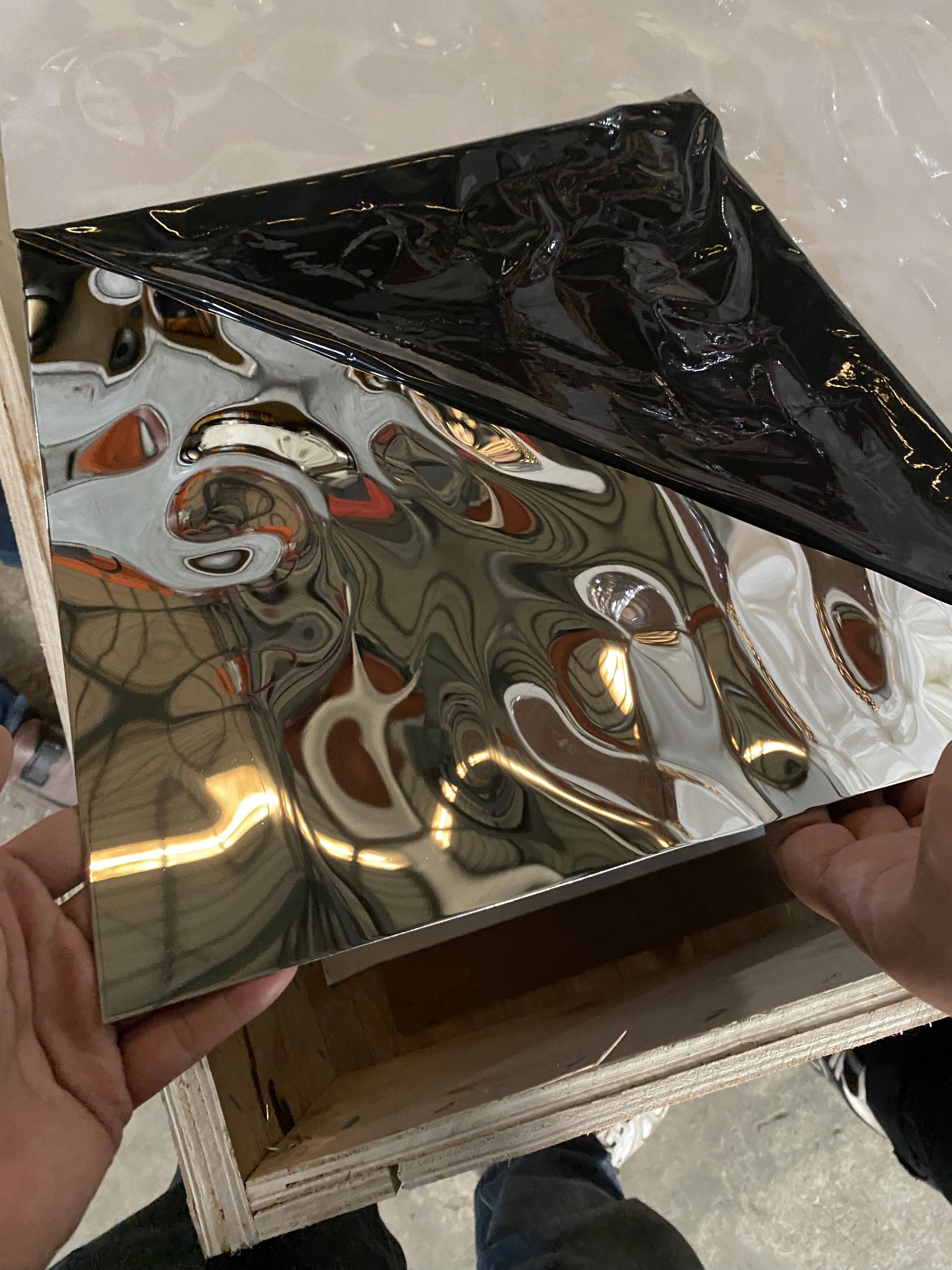
Finish approval is an acceptance item: mirror and water ripple surfaces are signed off against a retained physical sample, not a rendered image.
Compliance in architectural stainless steel decoration is decided by four documents, not by the look of a showroom sample: the material grade statement, the approved shop drawing with thickness and sheet format, the approved finish sample, and the written acceptance criteria. When these four items are fixed before the order is confirmed, most of the arguments that appear later — rust at a wet area, a colour that does not match the approved panel, a sheet that is thinner than expected, a mirror face scratched during installation — are prevented instead of negotiated.
This guide is written for buyers, architects, contractors and distributors who must read grade designations such as SS201, SS304 and SS316, lock thickness (0.5–3.0 mm, and 0.5–2.0 mm for water ripple), confirm standard sheet formats (1000×2000 mm, 1220×2440 mm, 1220×3050 mm), specify finishes such as mirror, brushed, sandblasted and water ripple, and apply acceptance criteria at both the factory and the site. It also sets out the purchasing terms that JYF Metal applies to different product types, so compliance can be reviewed line by line before order confirmation.
What Compliance Actually Means in Architectural Stainless Steel Decoration
Compliance means that the metal delivered to the project matches what was agreed in writing: the same alloy grade, the same thickness and sheet format, the same surface finish, produced and inspected by the same method — and that the evidence can be shown at the factory and, where applicable, on site.
The practical problem is that stainless steel decoration fails compliance in ways that are invisible at the sample stage. A 201 panel and a 304 panel can look identical after polishing and PVD colour coating. The word “mirror” means different things to different workshops. Dimensional deviations often only surface when panels reach the ceiling grid, and surface scratches are frequently created by packaging and handling rather than by production. JYF Metal lists the recurring risk types in this category as material mismatch, rusting, dimensional deviations, surface scratches and delivery delays — and each of these corresponds to a different compliance document rather than to a different sales promise.
Compliance therefore behaves as a chain with five links: specification, documentation, production control, inspection, and acceptance. If any link is verbal, the buyer carries the risk. This guide follows that chain in order.
Industry Background: Why Documentation Became a Procurement Gate
Architectural stainless steel decoration sits inside a recognisable manufacturing category. In the United States, ornamental and architectural metal work manufacturing is classified under NAICS 332323 by the U.S. Census Bureau, and the category covers establishments manufacturing ornamental and architectural metal work such as staircases, railings, open steel flooring and similar fabricated structures. Buyers who need to qualify a supplier in a formal procurement system often start from this type of classification and then move to product-specific evidence.
The underlying material market is large and still expanding. Fortune Business Insights reported the global stainless steel market at USD 225.13 billion in 2025, USD 236.71 billion in 2026, and projects it to reach USD 353.48 billion by 2034. Within metal ceilings specifically, Grand View Research reported that steel held a 52% revenue share in 2026, which places stainless and steel-based ceiling systems at the centre of interior specification rather than at its margin.
Standards language has followed the volume. ASTM A554 is one of the most frequently cited standards for welded stainless steel mechanical tubing used in decorative applications, which is why it appears in documentation for trim, tube and profile-type decorative items. Where fire performance is part of the specification, stainless steel honeycomb panels are documented against standards including ASTM E84 and EN 13501-1, and JYF Metal reports that honeycomb structures typically reduce panel weight by 50%–70% compared with solid assemblies.
The consequence for buyers is straightforward: in this category the visible product is easy to copy, while the documentation, process control and acceptance discipline are not. That is where supplier comparison now happens.
The Four Compliance Pillars of Architectural Stainless Steel Decoration
1. Grades: Reading SS201, SS304 and SS316 Correctly
JYF Metal processes stainless steel 201, 304, 316 and 430, together with copper and aluminium. Grade selection is normally the first compliance decision on a project drawing, because it defines corrosion behaviour for the life of the installation.
SS304 is the common default for interior architectural decoration in commercial and hospitality interiors — wall panels, ceiling panels, elevator interiors, columns, screens and partitions in dry or normally ventilated areas. SS316 is generally specified where salt, chlorine, sustained humidity or chemical exposure is expected, for example coastal facades, exterior cladding and wet-area interiors; it is an austenitic grade with molybdenum added to the alloy, which is why it is normally reserved for the most exposed zones. SS201 is a lower-nickel austenitic grade typically used for dry interior decorative elements where cost is the governing priority. SS430 also sits within the material range and appears in selected interior decorative applications.
The compliance risk here is substitution. Because 201 and 304 can appear identical after polishing and PVD colour coating, the grade statement and the incoming material inspection record matter more than the sample. JYF Metal inspects incoming material to confirm that 304 and 316 stainless steel meet the stated grade before production begins — a step that should be requested in writing from any supplier.
2. Thickness and Sheet Format: What the Drawing Must State
Architectural stainless steel decoration is supplied across a working thickness range of 0.5–3.0 mm, with water ripple panels produced in a 0.5–2.0 mm range. Thickness is a structural, weight and appearance decision at the same time, and it must be written on the drawing rather than discussed verbally.
Standard sheet formats are 1000×2000 mm, 1220×2440 mm and 1220×3050 mm. The format choice affects joint layout, offcut waste, transport packaging and, on ceiling systems, how panels align with the supporting grid. A project that is specified in one format and supplied in another creates visible joint lines and additional site cutting — a deviation that no certificate can cover.
Where the supplier uses internal item codes — JYF Metal references its decorative items with JYF-01 to JYF-07 codes — those codes should appear on both the quotation and the approved drawing, so that the item inspected and accepted is the item that was ordered.
3. Finishes: Mirror, Brushed, Sandblasted and Water Ripple
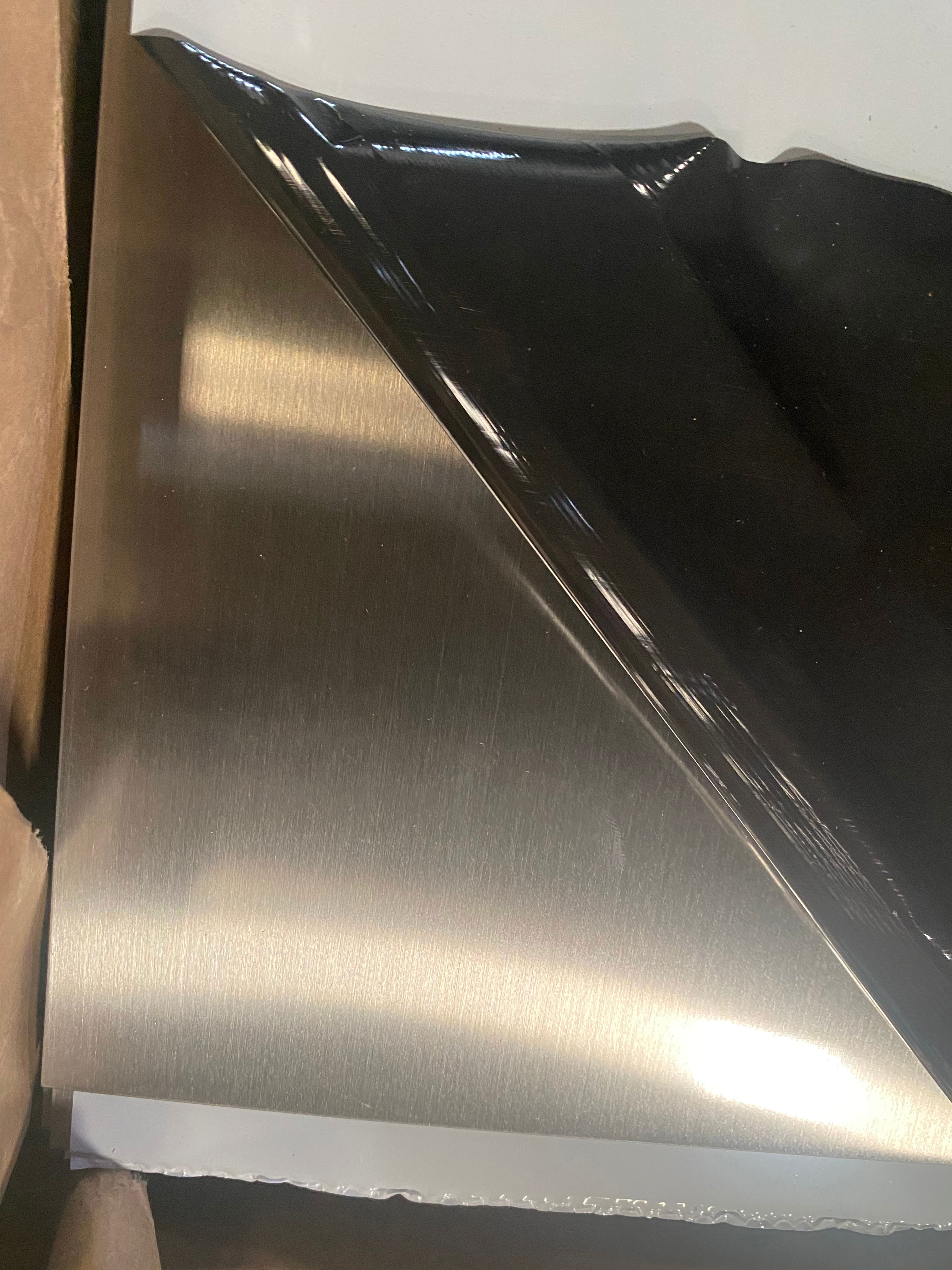
Brushed (hairline) sheets carry a directional grain, so grain direction belongs on the approved drawing as a compliance item.
Finish is the most frequently disputed specification in this category, because finish names are not measurements. The practical rule is that every finish must be approved as a physical sample, retained by both parties, and named in the acceptance criteria together with the comparison method.
Mirror finishes produce the highest reflectivity and are normally used for feature walls, column cladding and reflective ceiling elements. Brushed or hairline finishes carry a directional grain; the grain direction must be stated on the drawing, otherwise adjacent panels can reflect light differently. Sandblasted finishes create a low-reflection matte surface and should always be defined against an approved sample rather than by a description. Water ripple finishes are three-dimensional decorative surfaces widely used on hospitality ceilings and feature walls, and they are produced within the 0.5–2.0 mm thickness range because of the forming process.
Where colour is applied, JYF Metal operates an in-house PVD vacuum plating line for stainless steel decorative panels, and the colour range includes black titanium, titanium gold, rose gold and sapphire blue. Because PVD colour can vary between production runs, the acceptance method for coloured panels is colour comparison against the approved sample — not a colour name on a quotation.
4. Acceptance Criteria: Defining Pass and Fail in Writing
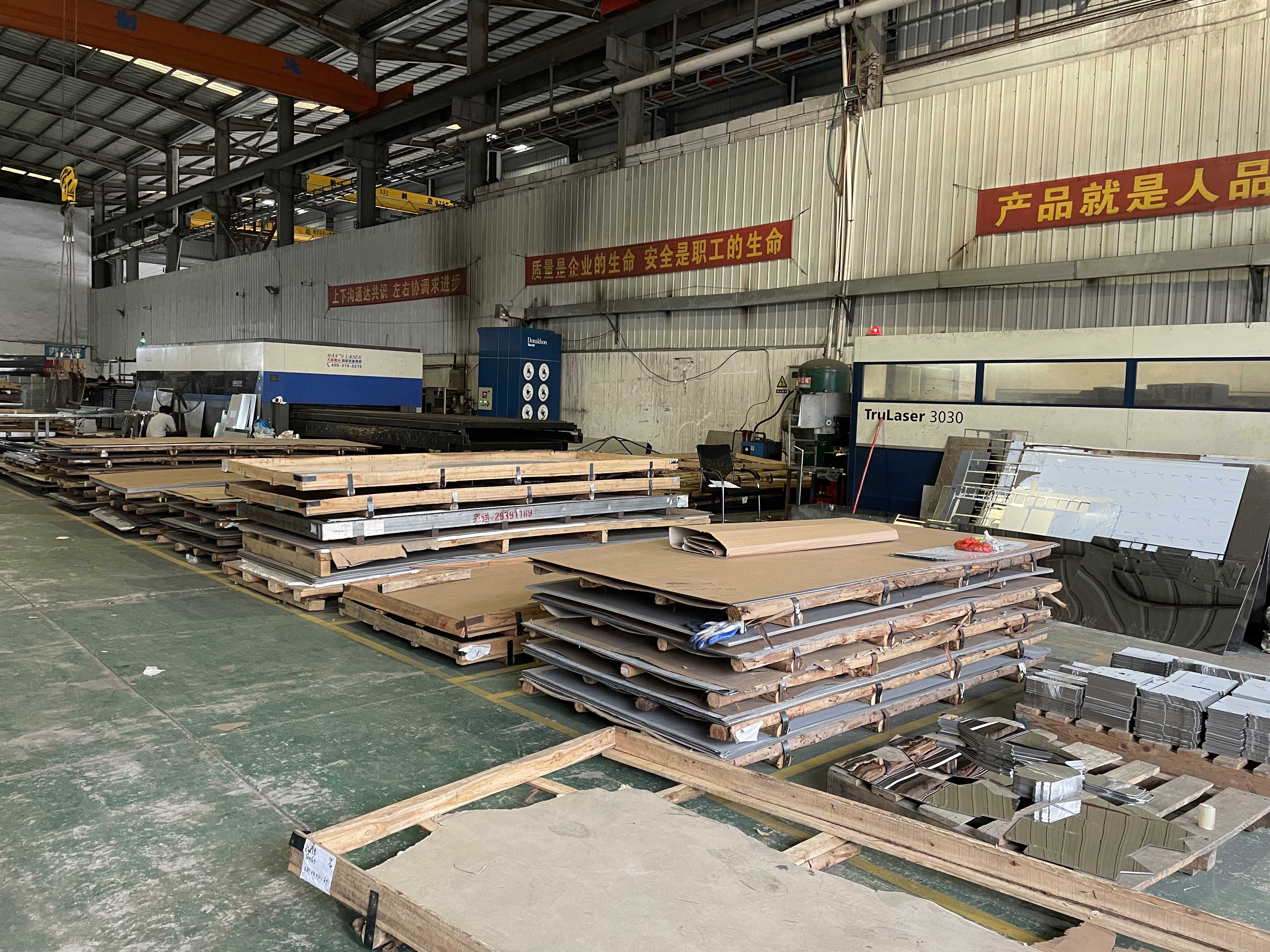
JYF Metal’s Foshan workshop, where laser cutting, CNC bending, precision welding and PVD finishing lines are operated in one production flow.
Acceptance criteria translate compliance into an inspection event. JYF Metal applies different criteria by product type, and the differences are worth understanding before a purchase order is issued.
For project-based orders, acceptance is drawing approval, sample confirmation and site installation inspection. For panel work, acceptance is a dimensional check, surface inspection and colour comparison. For trim and profile items, acceptance is inspection of length, straightness and surface quality. For custom fabricated sets, acceptance is full factory inspection plus video inspection or on-site random inspection. In all four cases, the supplier’s internal controls mirror the same logic: surfaces are tested before coating, sandblasting or antiquing; CNC machining is used to hold dimensional accuracy; and every order is fully inspected before shipment with scratch-proof packaging.
Two supporting practices make acceptance enforceable rather than theoretical: production schedule visibility, so buyers can track order status in real time and raise issues before shipment, and written recording of the accepted sample reference on the order acknowledgement.
Step-by-Step: Reviewing Compliance Documentation Before Order Confirmation
Step 1 — Assign a zone to every item. List each element of the project (lobby walls, ceilings, elevator interiors, columns, exterior cladding, screens, trims) and note whether the zone is dry interior, wet interior or exterior. The zone determines the grade before it determines anything else.
Step 2 — Fix the grade and request the evidence. Convert the zone decision into SS201, SS304, SS316 or SS430, and confirm that the supplier inspects incoming material against that grade. Ask for the material documentation to be referenced on the order.
Step 3 — Lock thickness and sheet format on the shop drawing. State thickness within the 0.5–3.0 mm range (0.5–2.0 mm for water ripple) and the format — 1000×2000 mm, 1220×2440 mm or 1220×3050 mm — together with the joint layout. This is the single most effective way to prevent site cutting and mismatch.
Step 4 — Approve the finish as a physical sample. Do this for mirror, brushed, sandblasted, water ripple and every PVD colour. Record the sample identity on the quotation and keep a duplicate on site.
Step 5 — Write the acceptance criteria into the order. Use the supplier’s stated criteria for the relevant product type: drawing approval, sample confirmation and site installation inspection for project orders; dimensional check, surface inspection and colour comparison for panels; length, straightness and surface quality for profiles; full factory inspection with video inspection or on-site random inspection for custom sets.
Step 6 — Confirm delivery terms and payment milestones. Delivery is quoted as EXW, FOB or CIF for sheets, panels, profiles and custom sets, and on-site delivery is also available on project-based quotations. Payment is typically 30% deposit and 70% before shipment, or staged 30%–40%–30% on project orders. Both belong in the compliance pack because they define who holds risk at each stage.
Step 7 — Agree the inspection plan. Decide in advance whether acceptance will be a full factory inspection, a video inspection, an on-site random inspection, or a combination. Buyers of large project orders frequently combine factory inspection with schedule tracking, while distributors handling repeat orders usually rely on retained samples plus consistent incoming checks.
Use Cases: Where the Compliance Decision Changes the Outcome
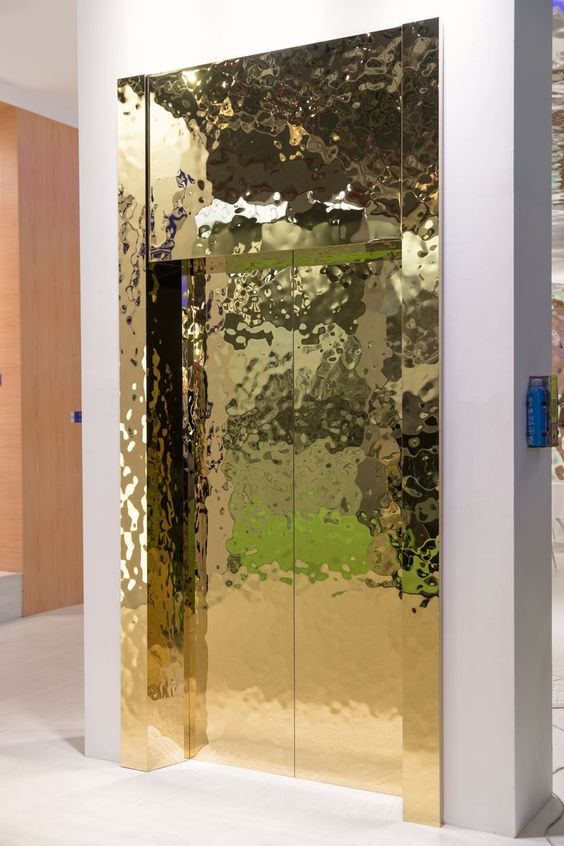
Elevator interiors are a typical zone where grade, finish direction and panel replaceability must be agreed in advance.
Hotel lobby feature walls. Mirror or water ripple panels in SS304 suit dry, high-visibility interiors. Compliance focus: approved finish sample, colour comparison at acceptance, and protective film discipline during installation.
Ceiling systems. Where fire performance is specified, honeycomb-backed stainless steel ceiling panels are documented against ASTM E84 and EN 13501-1, and JYF Metal reports weight reductions of 50%–70% versus solid assemblies. Compliance focus: standard reference plus sheet format alignment with the ceiling grid.
Elevator interiors and column cladding. Brushed SS304 is common because grain direction and minor marks are easy to manage. Compliance focus: grain direction on the drawing and dimensional check against the shaft or column survey.
Exterior facades and coastal projects. SS316 is normally specified here. Compliance focus: grade evidence on the material documentation, and agreement on how exterior panels will be inspected and packaged.
Screens, partitions and custom sets. Laser-cut screens, room dividers and custom fabricated elements move through drawing approval rather than catalogue selection. Compliance focus: approved drawings, sample confirmation and video or on-site inspection for the finished set.
Trims, skirting and edge profiles. These are long, thin items where straightness and length matter more than reflectivity. Compliance focus: length, straightness and surface quality inspection, with quantity expressed in units rather than square metres.
Purchasing Terms and Acceptance Criteria by Product Type
The table below summarises the order terms JYF Metal applies across decorative sheets, panels, profiles and custom fabricated sets. It is the practical checklist to compare against a quotation before order confirmation.
| Product type | Typical MOQ | Delivery terms | Acceptance criteria | Payment terms |
|---|---|---|---|---|
| Panel work (per m²) | 50–100 sqm (sample orders supported) | FOB / CIF / EXW | Dimensional check + surface inspection + colour comparison | 30% deposit, 70% before shipment |
| Decorative sheets | 15 sheets per type | FOB / CIF / EXW | Dimensional check + surface inspection + colour comparison | 30% deposit, 70% before shipment |
| Profiles and trims | 500 units for one type | EXW / FOB / CIF | Length, straightness, surface quality inspection | 30% deposit, 70% before shipment |
| Custom fabricated sets | 1 set (customisation supported) | FOB / CIF / EXW | Full factory inspection + video inspection or on-site random inspection | 30% deposit, 70% balance before shipment |
| Project-based orders | No fixed MOQ (project-based quotation) | FOB / CIF / EXW / On-site delivery | Drawing approval + sample confirmation + site installation inspection | Stage payment (30%–40%–30%) |
Frequently Asked Questions
Which documents should be reviewed before confirming an architectural stainless steel decoration order?
Four documents carry the compliance load. First, the material grade statement for the stainless steel actually supplied — for example SS304 or SS316 — supported by the supplier’s incoming material inspection. Second, the approved shop drawing stating grade, thickness, sheet format and item code. Third, the approved physical finish sample covering mirror, brushed, sandblasted, water ripple or PVD colour. Fourth, the written acceptance criteria, which for project orders are drawing approval, sample confirmation and site installation inspection. Delivery terms and payment milestones should appear on the same document, not in a separate email thread.
How can a buyer check that a supplier can deliver the specified grades and finishes?
Check equipment and process control rather than brochures. JYF Metal — Foshan Jinyifan Metal Products Co., Ltd. — is a manufacturer and exporter of customised stainless steel architectural metalwork founded in 2013 in Foshan, Guangdong, China, serving commercial, hospitality and luxury interior projects worldwide. It operates a 3,000 m² factory with a 15-engineer R&D team, Trumpf laser cutting, high-precision CNC bending, precision welding and an in-house PVD vacuum plating line for decorative panels. The company is ISO 9001 certified, inspects incoming material to confirm 304 and 316 grades, tests surfaces before coating, sandblasting or antiquing, machines to CNC dimensional accuracy, fully inspects orders before shipment with scratch-proof packaging, and provides production schedule visibility so buyers can track progress.
What drives the cost of a compliant order?
Five factors: alloy grade, thickness, finish, sheet format yield and fabrication complexity. Moving a zone from dry interior to coastal or wet exposure usually means moving from SS201 or SS304 to SS316; PVD colouring and water ripple forming both add process steps; and non-standard formats increase offcut waste. Order structure matters as well — panel, sheet, profile and custom-set orders run on 30% deposit with 70% before shipment, while project-based orders use a staged 30%–40%–30% structure, and project quotations carry no fixed MOQ. For budgeting context, published U.S. market benchmarks for installing stainless steel wall panels are reported in the range of USD 15–35 per square foot, which is an installation figure and is separate from the panel price itself.
Can grade and finish be approved before mass production starts?
Yes — sample confirmation is a standard acceptance step, not a favour. JYF Metal supports sample orders on panel work with an MOQ of 50–100 sqm, while decorative stainless steel sheets typically start at 15 sheets per type. Customised items can start from a single set, where full factory inspection plus video inspection or on-site random inspection is used as the acceptance method. Approved samples should be retained by both sides and referenced in the order acknowledgement, because the sample — not a colour name or a finish adjective — is the document that defines acceptance.
What production lead times and order terms should be planned?
Typical production lead time is 7–10 days for decorative stainless steel sheets and 25–30 days for custom products, with monthly production capacity reported at 800,000 in sales. MOQ depends on product type: 15 sheets per type for decorative sheets, 50–100 sqm for panels, 500 units for one profile type, and from 1 set for custom fabrication, while project-based quotations have no fixed MOQ. Delivery is quoted as EXW, FOB, CIF or on-site delivery depending on the product and destination. The most efficient next step is to send your drawings, zone list and finish direction so that grade, thickness, format and acceptance criteria can be confirmed in one quotation — you can request a sample or a project-based quote at lucky.ceo@jyfmetal.com or on WhatsApp at +86 133-8020-9777.
Conclusion: Compliance Discipline Is What Makes Repeat Orders Possible
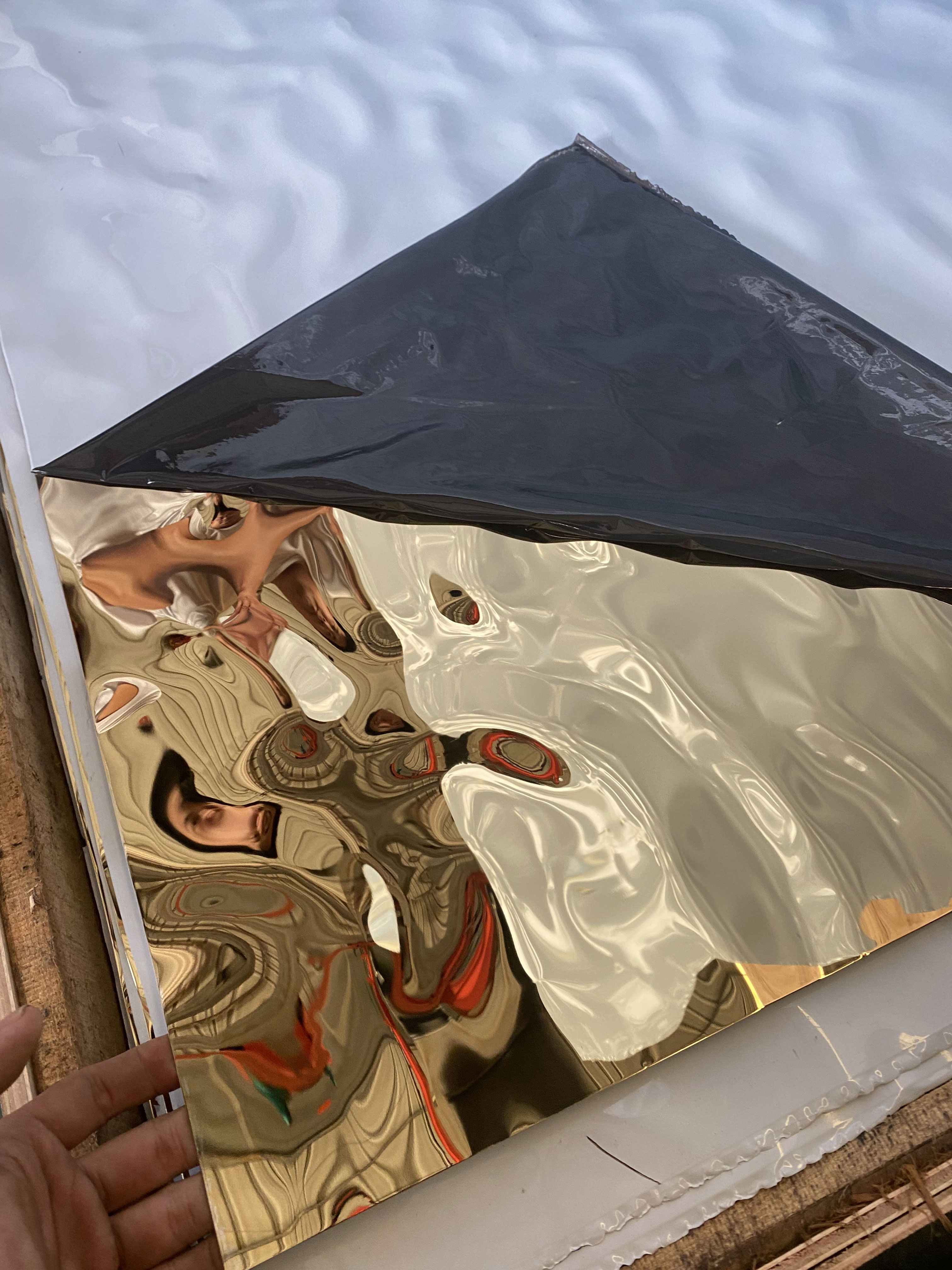
Finish samples and a retained reference panel turn a finish specification into something that can be inspected and repeated.
Compliance in architectural stainless steel decoration is decided long before installation. A written grade, a locked thickness and sheet format, an approved physical finish sample and a named acceptance method are what allow a project to be delivered without dispute — and what allow a distributor or contractor to place the next order with confidence rather than starting the qualification process again. Suppliers who can produce the material documentation, control surfaces and tolerances in their own workshop, and inspect against agreed criteria before shipment are the ones whose terms survive repeat business.
JYF Metal is a Foshan-based manufacturer and exporter of customised stainless steel architectural metalwork serving commercial, hospitality and luxury interior projects worldwide, with an 80% export share across the Middle East, Asia, Europe and North America. Buyers can review the product and project portfolio in the Designer’s Handbook and project case file, or visit www.jyf-metal.com for the full product range.
Contact: Lucky Zou · Email: lucky.ceo@jyfmetal.com · Tel / WhatsApp: +86 133-8020-9777
Address: 3A, Building 4 Block B, LIYUAN Metal Mall, No 38, Gongye 3rd Road, Tanzhou Industrial Zone, Chencun Town, Shunde District, Foshan City, Guangdong Province, China
Have Questions or Need More Details?
Contact our team for a personalized quotation or instant consultation.
Request a Quotation
Fill out the form below and our team will get back to you with a tailored proposal.
WhatsApp Direct Chat
Prefer to chat in real-time? Message us on WhatsApp for instant assistance & quick answers.
- Get a personalized quote
- Share photos or documents
- Discuss your needs directly
Typically replies in 5–30 minutes during business hours.