
Architectural Stainless Steel Decoration: Sheets, Trims, Screens & Fabrication
Architectural Stainless Steel Decoration: Sheets, Trims, Screens & Fabrication
Architectural stainless steel decoration is stainless steel used as a visible, finished building material rather than as hidden structure. The term covers four product families that are normally specified together: decorative sheets, screen partitions, trims and profiles, and custom fabrication such as column cladding, ceiling panels, bar counters and metal sculptures.
Most buyers first meet the category through a single item — a water ripple ceiling panel, a brushed elevator door panel or a laser-cut room divider — and then find during procurement that a finished space needs all four families to agree on grade, finish, colour and tolerance. This guide separates the families in plain language, then works through the grade, thickness and size decisions that come before purchasing terms and acceptance criteria.

A stainless steel interior decorative screen partition. Screens are fabricated assemblies rather than flat sheet, so they carry their own grade, welding and joint requirements.
Problem Definition: One Search Term, Four Different Purchase Orders
A buyer who enquires about architectural stainless steel decoration can receive quotations that describe completely different scopes: 200 sheets of 1.2 mm mirror sheet, 60 m² of laser-cut divider, 800 pieces of U-profile, or a set of curved column cladding panels. Because these arrive as separate line items with separate minimum order quantities and separate lead times, project teams often assume they are interchangeable items from one catalogue line. They are not.
Five failures repeat across projects for that reason:
- Finish mismatch between families. A rose gold trim ordered from one supplier sits next to a rose gold sheet from another, and the two read as different colours in the same elevation.
- Grade substitution. SS201 is quoted where the drawing specified SS304, and the difference is invisible once the panel is coated.
- Thickness chosen by eye. Sheet families are offered from 0.5 mm to 3.0 mm, and water ripple sheet from 0.5 mm to 2.0 mm; thickness decides stiffness and flatness, not appearance.
- Panel module ignored. Standard sizes of 1000x2000 mm, 1220x2440 mm and 1220x3050 mm exist for a reason; a design that forces non-standard cuts creates extra joints and extra waste.
- No written acceptance criteria. Surface condition, colour consistency, joint alignment, weld finish and protective film are rarely defined before shipment, so disputes are settled after installation.
Industry Background: A Specification-Driven Niche Inside Architectural Metalwork
In the United States, this work sits inside NAICS 332323, ornamental and architectural metal work manufacturing — establishments engaged in manufacturing ornamental and architectural metal work such as staircases, metal open steel flooring, fire escapes, railings and scaffolding. Decorative stainless steel sheets, trims and screens are the visible, finishing end of that classification.
The wider material market is large and still expanding. Fortune Business Insights values the global stainless steel market at USD 225.13 billion in 2025, USD 236.71 billion in 2026 and USD 353.48 billion by 2034. Grand View Research reports that steel held a 52% revenue share of the metal ceilings market in 2026, which is consistent with the amount of metal ceiling work specified in commercial interiors.
Two standards come up repeatedly in specification review. ASTM A554 is one of the most frequently cited standards for welded decorative stainless steel tubing, and applies where tube sections appear in divider frames, grilles or railings. For ceiling assemblies, fire performance is typically referenced against ASTM E84 and EN 13501-1.
Much of the custom work is produced by export-oriented fabricators in Guangdong. JYF Metal — Foshan Jinyifan Metal Products Co., Ltd., established in 2013 in Foshan, Guangdong, China — operates a 3,000 m² factory with 150 employees and 15 engineers, exports 80% of its output to the Middle East, Asia, Europe and North America, and holds ISO 9001 certification. Its production line includes Trumpf laser cutting machines, high-precision CNC bending machines, seamless precision welding equipment and a PVD vacuum plating line for stainless steel decorative panels.
Detailed Solution: The Four Product Families, Explained
The four families below are the ones quoted most often in custom decorative work. Each carries its own grade, thickness and finish rules, which is why they are described separately rather than as one product.
1. Decorative Sheets: JYF-01 Mirror, JYF-02 Brushed, JYF-03 Sandblasted, JYF-04 Water Ripple
Sheets are the base material of the category and the family where finish decides use. All four sheet programs are offered in SS201, SS304 and SS316, in standard sizes of 1000x2000 mm, 1220x2440 mm and 1220x3050 mm, and in colours that include silver, gold, rose gold, black, blue, copper and custom shades applied by PVD coating.
- JYF-01 mirror finish, 0.5–3.0 mm. A mirror sheet reflects the surrounding space and is used where the design intent is to widen a lobby or reflect a ceiling. It also shows handling marks and joint misalignment more readily than any other finish, so panel layout and protective film discipline matter more than the surface itself.
- JYF-02 brushed, 0.5–3.0 mm. Finish options are hairline, satin, No.4 and vibration, with colours that also include bronze. Directional grain hides fingerprints and small scratches, which is why brushed sheet is the usual choice for elevator panels, door frames and long wall runs in high-traffic areas.
- JYF-03 sandblasted, 0.5–3.0 mm. The surface scatters light instead of reflecting it, so it is specified where glare has to be controlled — atrium linings, large wall fields and ceilings close to glazing.
- JYF-04 water ripple, 0.5–2.0 mm. Ripple sizes are small, medium, large and flow. The formed wave pattern reads differently under different light angles, so a physical sample viewed under the project lighting is more useful than a photograph.
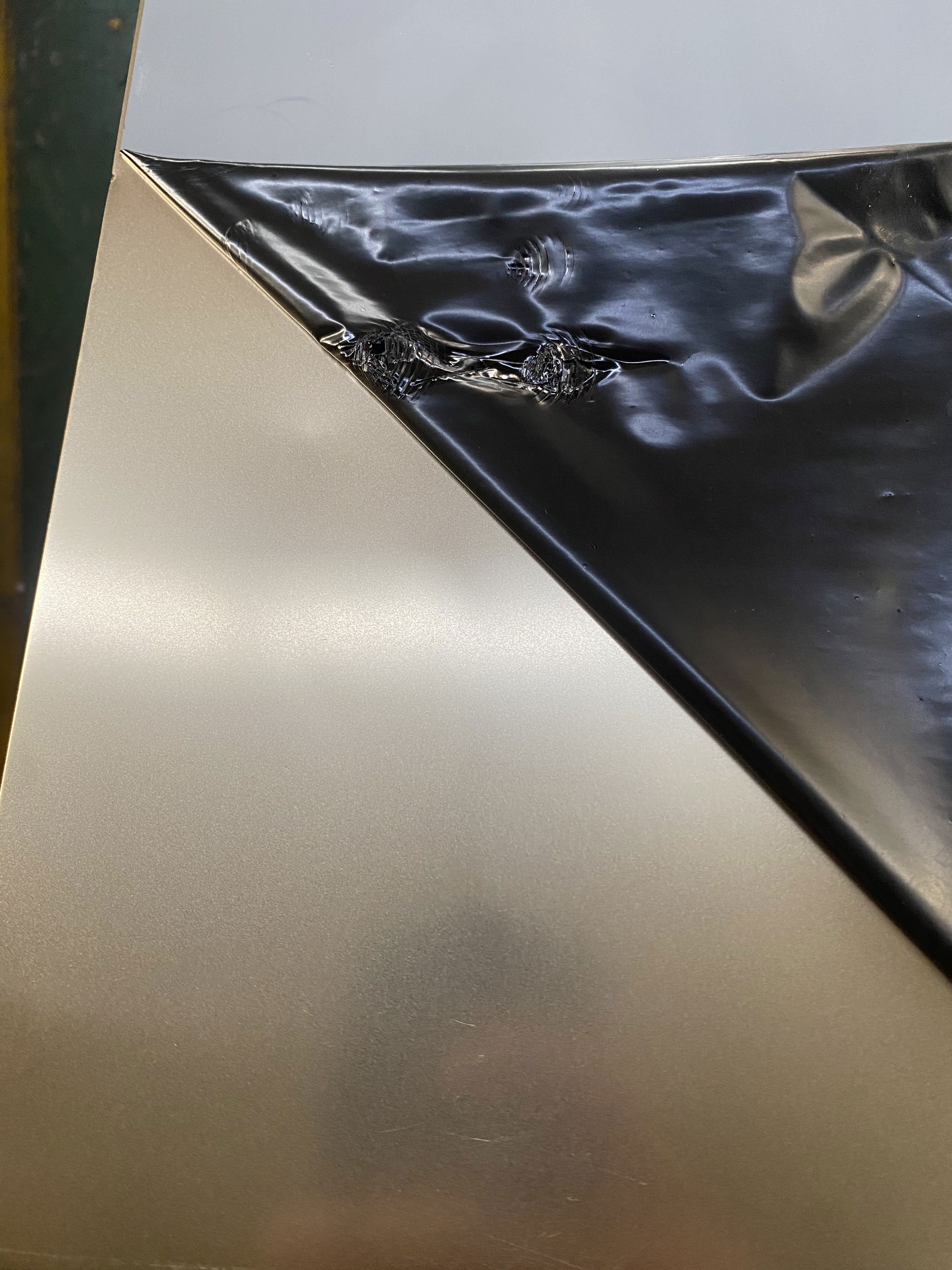
Sandblasted champagne gold sheet (JYF-03): the low-gloss surface reduces reflection, which changes how a wall field reads next to glazing.
Where weight or fire performance governs a ceiling, a sheet skin can be combined with a honeycomb core. JYF Metal's ceiling range includes stainless steel honeycomb panels, and honeycomb panels in this category are commonly specified against ASTM E84 and EN 13501-1 fire performance.
2. Screen Partitions and Room Dividers: JYF-05
A screen partition is a fabrication, not a sheet, and its cost sits in cutting, welding and alignment rather than in the surface. JYF-05 is offered in SS304 and SS316, in a regular size of 1220x2440 mm and in custom sizes, in silver, gold, rose gold, black, copper, bronze and custom colours, with mirror, brushed and vibration finishes. Processes are spot welding, full welding, laser cutting and CNC cutting, and the frame can embed glass, marble, crystal, metal mesh or LED lighting.
The distinction between welding methods is practical. Full welding followed by polishing produces the seamless joints used where the screen is a finished decorative object; spot welding suits lighter frames where a visible joint line is acceptable. Embeds change the engineering: glass and marble add weight and require frame depth, while LED requires a channel and service access.
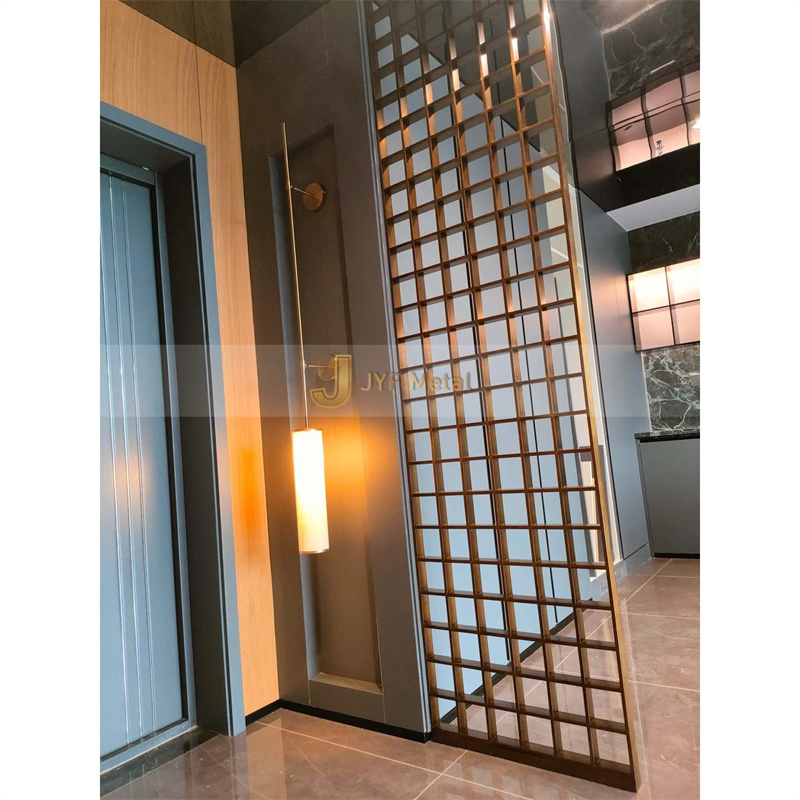
A welded stainless steel screen partition. Joint quality, not sheet finish, is the acceptance point on this family.
3. Trims and Profiles: JYF-06
Trims close the edges that sheets cannot. JYF-06 is available in SS201, SS304 and SS316, in L, U, T, V, curved, corner, flat strip and skirting board shapes plus custom profiles, in silver, gold, rose gold, black, copper, bronze and custom colours, with mirror, brushed, vibration and sandblasted finishes. Processes are shearing, V-grooving and bending.
Functionally, a U-profile terminates a panel edge, a curved corner resolves a column, a skirting board protects the wall base, and a shadow gap hides a junction. Because trims are viewed at close range, colour and finish matching to the adjacent sheet is the main specification risk — a 20 mm trim produced in a different batch can read as a different colour against a large panel field.
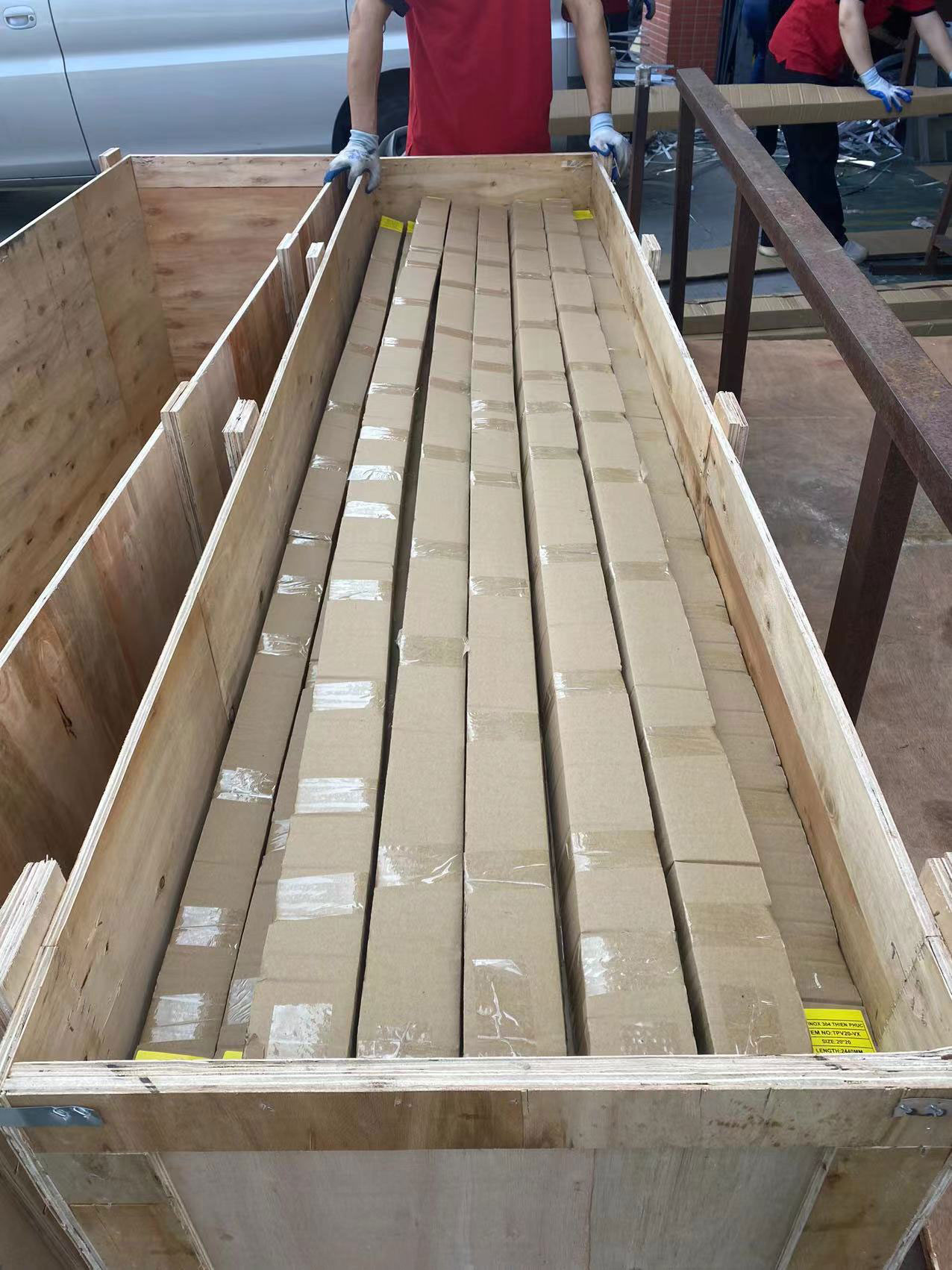
Stainless steel trims (JYF-06) for edges, skirting and shadow gaps. Trims are the family most sensitive to batch colour matching.
4. Custom Fabrication: JYF-07
Custom fabrication absorbs everything the first three families do not cover. JYF-07 is offered in SS201, SS304 and SS316 and covers metal sculpture, column cladding, feature walls, custom logos, stainless steel bar counters, display shelves and mirror frames.
This family is drawing-driven: production starts from confirmed drawings, dimensions, surface finish, colour, quantity and export requirements. Curved and hyperbolic geometry is formed rather than folded, so feasibility is decided in the drawing set rather than in the material selection. The same logic applies to mixed assemblies, where a sheet skin is combined with a structural core.
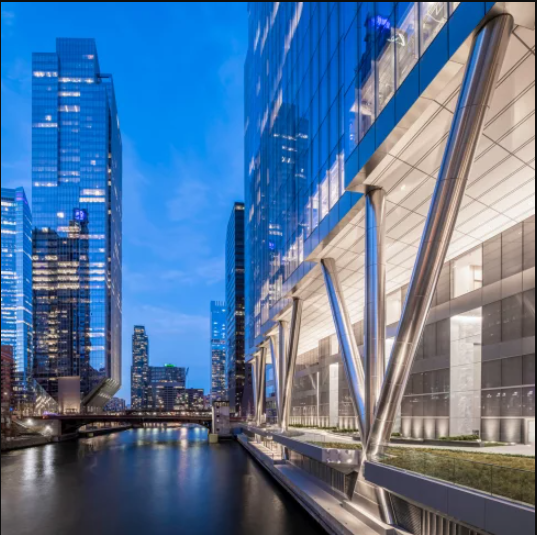
Custom stainless steel column cladding (JYF-07): three-dimensional geometry moves the work from sheet supply into drawing-based fabrication.
Grades, Thickness and Standard Sizes: What the Numbers Mean
- Grade. SS201, SS304 and SS316 are all offered, and they are not interchangeable in a specification. The grade belongs on the drawing and on the packing list, because the three are visually identical after finishing.
- Thickness. The mirror, brushed and sandblasted sheet programs run from 0.5 mm to 3.0 mm; water ripple runs from 0.5 mm to 2.0 mm. Thickness affects stiffness, flatness and the panel size a sheet can hold without a backing.
- Size. 1000x2000 mm, 1220x2440 mm and 1220x3050 mm are the standard modules across the sheet programs. Anything outside them moves into custom fabrication and changes both lead time and cost.
Step-by-Step Breakdown: From Zone Map to Acceptance
- Map the zones. List every visible surface that will be stainless steel — lobby wall, ceiling, column, elevator interior, divider, bar front, skirting — and mark whether each is indoor, outdoor, high-traffic, humid or coastal. JYF Metal's application data treats indoor and outdoor use, high-traffic areas and humid or coastal environments as the working conditions that change a specification.
- Assign a product family per zone. Sheets for flat fields; screens for division and privacy; trims for edges and junctions; custom fabrication for curved, three-dimensional or one-off elements. One zone should map to one family to keep responsibility clear.
- Fix the grade. Confirm SS201, SS304 or SS316 per zone and write it on the drawing. Where welded tube sections appear — divider frames, grilles, railings — reference ASTM A554 as the tubing standard.
- Choose finish and colour as one decision. Select the finish (mirror, brushed, sandblasted, vibration, water ripple) and the colour (silver, gold, rose gold, black, copper, bronze, custom) together, then verify that the combination exists in every family being ordered. Screen partitions are offered in mirror, brushed and vibration; sandblasted appears in the sheet and trim programs.
- Set thickness and panel module. Choose the largest standard module the design allows — 1220x2440 mm covers most wall fields — and plan joints deliberately rather than accepting them on site. Remember that water ripple sheet stops at 2.0 mm while the other sheet programs reach 3.0 mm.
- Convert drawings into fabrication documents. Confirmed drawings, dimensions, surface finish, colour, quantity and export requirements are the production inputs for custom work. Mark grain direction on brushed sheets and ripple direction on JYF-04 before release.
- Agree acceptance criteria before shipment. Define surface condition (scratch-free, colour consistency), joint alignment and gap, weld finish, protective film type and removal timing, and packaging. JYF Metal runs 100% pre-shipment testing and accepts third-party inspection.
Use Cases: Matching Each Family to a Real Project Condition
Hospitality ceilings and feature walls
A Korean designer ordered 120 pieces of water ripple stainless steel sheet for ceiling and wall decoration to create a reflective wave-patterned surface. A French designer ordered 80 pieces for ceiling decoration, with seamless installation and a scratch-free surface as the acceptance points. Both are sheet-family projects where ripple size and lighting angle, not brand, determine approval.
Room division in residential and commercial interiors
A Canadian contractor installed three stainless steel room divider units to divide open areas and define functional zones without blocking layout flow. The units used a modular design for panel joint alignment and glue-free mechanical fixing for installation without adhesive. Screens suit entryways, restaurant zoning, club interiors and office separation.
Columns, facades and three-dimensional elements
Column cladding, curtain wall panels and metal sculpture move into custom fabrication. Because the geometry is formed rather than folded, the drawing set decides feasibility more than the material grade does — and a change made after drawing approval is a production change, not a finishing change.
Elevators, doors and high-touch surfaces
Elevator decorative panels and door frames are typically specified in brushed or vibration finish, because directional grain masks fingerprints in the surfaces that receive the most contact. Grade and thickness should be confirmed against the elevator contractor's requirements, not chosen from a colour card.
Bar counters, display units and joinery
Stainless steel bar counters, display shelves, wine cabinets and mirror frames are fabrication items that combine a sheet skin with a structural core. They belong in the JYF-07 family even when the visible surface is a standard mirror or brushed finish.
Comparison Table: The Four Families at a Glance
| Product family | Model | Grades | Thickness | Standard sizes | Finishes | Typical role in a project |
|---|---|---|---|---|---|---|
| Mirror finish sheet | JYF-01 | SS201 / SS304 / SS316 | 0.5–3.0 mm | 1000x2000 / 1220x2440 / 1220x3050 mm | Mirror | Lobby walls, reflective ceilings, feature fields |
| Brushed sheet | JYF-02 | SS201 / SS304 / SS316 | 0.5–3.0 mm | 1000x2000 / 1220x2440 / 1220x3050 mm | Hairline, satin, No.4, vibration | Elevator panels, door frames, high-traffic walls |
| Sandblasted sheet | JYF-03 | SS201 / SS304 / SS316 | 0.5–3.0 mm | 1000x2000 / 1220x2440 / 1220x3050 mm | Sandblasted | Glare-controlled walls, ceilings, atrium linings |
| Water ripple sheet | JYF-04 | SS201 / SS304 / SS316 | 0.5–2.0 mm | 1000x2000 / 1220x2440 / 1220x3050 mm | Water ripple (small, medium, large, flow) | Ceilings and textured feature walls |
| Screen partition | JYF-05 | SS304 / SS316 | Per project drawing | 1220x2440 mm, custom | Mirror, brushed, vibration | Room dividers, privacy screens, zoning |
| Trims and profiles | JYF-06 | SS201 / SS304 / SS316 | Per profile drawing | Custom profile dimensions | Mirror, brushed, vibration, sandblasted | Edges, skirting, shadow gaps, frames |
| Custom fabrication | JYF-07 | SS201 / SS304 / SS316 | Per project drawing | Per project drawing | As specified | Column cladding, sculpture, bar counters, display units |
Colour range across the sheet and trim programs: silver, gold, rose gold, black, copper, bronze and custom. Screen partitions list silver, gold, rose gold, black, copper and bronze.
FAQ
Which stainless steel grade should be specified for a humid or coastal project?
JYF Metal supplies SS201, SS304 and SS316 across its sheet, trim and fabrication programs, and all three appear in the published specifications. Grade selection is a specification decision rather than a catalogue default: SS201 is the lower-alloy option normally used for dry interior work, SS304 is the general-purpose grade for interior and exterior use, and SS316 is specified where higher corrosion resistance is required. The grade must be written on the drawing and repeated on the packing list, because a 201 panel and a 304 panel look identical once finished. Where welded tube sections form part of the design — divider frames, grilles, railings — ASTM A554 is the standard most often cited for welded decorative stainless steel tubing. For humid or coastal environments, confirm the final grade against the project specification and the local building requirements that apply.
Can sheets, trims and screen partitions be supplied in one matching finish?
Yes, within the limits of each program. Sheets are available in mirror (JYF-01), brushed (JYF-02), sandblasted (JYF-03) and water ripple (JYF-04). Trims (JYF-06) are available in mirror, brushed, vibration and sandblasted. Screen partitions (JYF-05) are offered in mirror, brushed and vibration. The shared colour range across these families is silver, gold, rose gold, black, copper, bronze and custom shades, applied by PVD coating. Two practical rules apply: keep one family as the reference sample and approve the others against it, and avoid splitting a single visible plane between two suppliers, because colour and gloss read differently side by side even when both fall within their own tolerance.
What drives the cost of an architectural stainless steel decoration package?
Five variables dominate: grade (SS201, SS304, SS316), thickness (0.5–3.0 mm on the mirror, brushed and sandblasted programs and 0.5–2.0 mm on water ripple), finish process, cutting yield against the chosen panel module, and fabrication complexity. Custom work — curved cladding, fully welded screens, embeds such as glass, marble, crystal, metal mesh or LED — costs more than flat sheet because labour moves from cutting to forming, welding and polishing. Quantity interacts with the minimum order: sheets start at 15 sheets per type, trims at 500 pieces per type, screen partitions at 3 m², and custom products at 1 piece. As an external reference rather than a JYF Metal price, one US-focused cost source estimates installation of stainless steel wall panels at roughly USD 15 to USD 35 per square foot; that is a site labour figure and should not be compared directly with a material quotation.
Can a finish be approved by sample before production?
Yes. Sample provision is part of JYF Metal's after-sales service, and custom products can be ordered from a single piece, so a physical sample is practical even on a small first order. Approve the sample under the lighting of the actual project rather than under office lighting, and record three items on the approval: finish name, colour name and grade. Water ripple sheet (JYF-04) should always be approved as a physical sample, because ripple size — small, medium, large or flow — changes the way light moves across the surface. Protective film should be checked at the same stage, since film type and removal timing belong in the acceptance criteria.
What lead times apply to sheets, trims, screens and custom items?
Published lead times are 7–10 days for decorative stainless steel sheets, 15–20 days for stainless steel trims, 20 days for stainless steel screen partitions and 25–30 days for custom products. These are production windows that start from drawing approval, so the critical path in most projects is the approval loop rather than machine time. Before shipment, JYF Metal runs 100% pre-shipment testing and accepts third-party inspection. Request a sample and a quotation together: the sample settles the finish, and the quotation fixes grade, thickness, panel module and quantity — the four inputs that decide both price and delivery date.
Conclusion
Architectural stainless steel decoration becomes easier to buy once it stops being treated as a single product. The category is four families: sheets defined by finish, screens defined by fabrication, trims defined by profile geometry, and custom work defined by the drawing — held together by one grade, one colour and one acceptance standard. Specifying them in that order, and writing grade, thickness and module on the drawing before price is discussed, removes most of the mismatches that otherwise appear on site.
JYF Metal supplies all four families from one factory in Foshan, Guangdong, with ISO 9001 certification, in-house design and drawing support, and export experience across the Middle East, Asia, Europe and North America.
Next Step: Sample, Quotation or Project Case Book
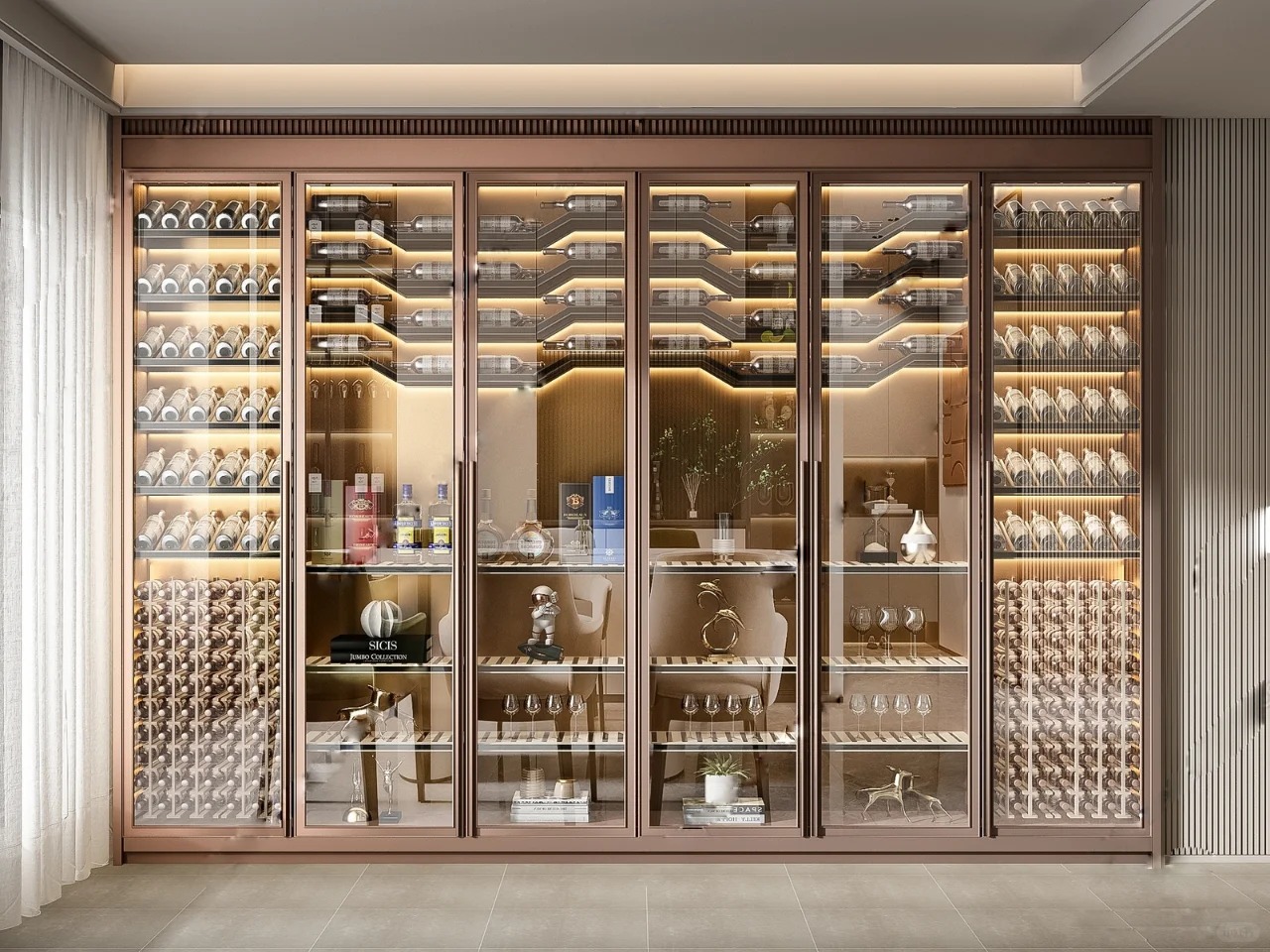
Custom stainless steel wine cabinets — a JYF-07 fabrication item combining a stainless steel skin with a structural core.
Send a drawing or a finish reference and JYF Metal will return a sample and a quotation against your grade, thickness, colour and panel module.
Email: lucky.ceo@jyfmetal.com | Tel / WhatsApp: +86 133-8020-9777 | Website: www.jyf-metal.com
Download the Designer's Handbook with project cases: Designer's Handbook — Project Cases (PDF)
Have Questions or Need More Details?
Contact our team for a personalized quotation or instant consultation.
Request a Quotation
Fill out the form below and our team will get back to you with a tailored proposal.
WhatsApp Direct Chat
Prefer to chat in real-time? Message us on WhatsApp for instant assistance & quick answers.
- Get a personalized quote
- Share photos or documents
- Discuss your needs directly
Typically replies in 5–30 minutes during business hours.