
Matching Architectural Stainless Steel Decoration to Project Zones: An Application Guide
Matching architectural stainless steel decoration to a project zone means choosing the sheet finish, screen system, trim profile, material grade, and thickness according to where a surface will actually be installed — feature wall, ceiling plane, space division, transition line, or engineered structure. The same stainless steel behaves differently in every zone: a mirror sheet reads as a deliberate design feature on an upper wall but shows contact marks at floor level, while a water ripple sheet that is dramatic on a ceiling can look restless on a narrow skirting line. This guide sets out a zone-by-zone matching method built on the JYF Metal decorative range — JYF-01 mirror, JYF-02 brushed, JYF-03 sandblasted, and JYF-04 water ripple sheets, JYF-05 stainless steel screens and room dividers, JYF-06 stainless steel trims, and JYF-07 custom fabrication for wall and ceiling panels.
Problem Definition: Why Zone Matching Comes Before Product Selection
Zone mismatch is one of the most expensive specification errors in architectural metal decoration, because it is usually discovered only after installation. A finish chosen for its appearance in a showroom can fail in the zone it is fitted to — not because the material is poor, but because the finish, grade, or thickness does not match conditions at that location.
Four failure patterns repeat across projects:
- Finish-to-zone error. High-gloss mirror surfaces installed in high-contact, low-sightline areas — base details, corridor edges, kick zones — collect visible scuffs and fingerprints.
- Grade-to-zone error. A lower-grade sheet used where humidity, coastal air, or frequent cleaning demand higher corrosion resistance shortens service life and forces premature replacement.
- Thickness-to-zone error. Thin sheets spanning large unsupported areas deflect, breaking the flatness and optical continuity that decorative metal is chosen for.
- Transition error. Where wall, ceiling, and floor zones meet, an unresolved edge reads as an unfinished detail and undermines the whole interior.
Zone matching addresses all four at the specification stage, before drawings are released for fabrication. It converts a product list into a placement plan: which finish goes where, at what thickness, in which grade, and finished with which trim.
Industry Background
Decorative stainless steel sits inside a large and still-growing materials market. The global stainless steel market was valued at USD 225.13 billion in 2025 and is projected to reach USD 353.48 billion by 2034, according to Fortune Business Insights. Within the ceiling segment specifically, steel held a 52% revenue share of the global metal ceilings market in 2026, according to Grand View Research — a signal of how firmly metal, and stainless steel in particular, has become established in interior surface specification.
The category that produces these products is classified in North America under NAICS 332323, ornamental and architectural metal work manufacturing, which covers establishments primarily engaged in manufacturing ornamental and architectural metal work. On the technical side, ASTM A554 is one of the most frequently cited standards for welded decorative stainless steel tubing, and it is widely referenced in decorative metal applications.
What this background means for a decision-stage buyer is straightforward: architectural stainless steel decoration is a specification-driven category rather than a commodity category. Buyers are not comparing identical standard products — they are comparing how well a supplier's product types, finishes, and fabrication depth match the zones of a specific project.
A Note on Entity: JYF Metal
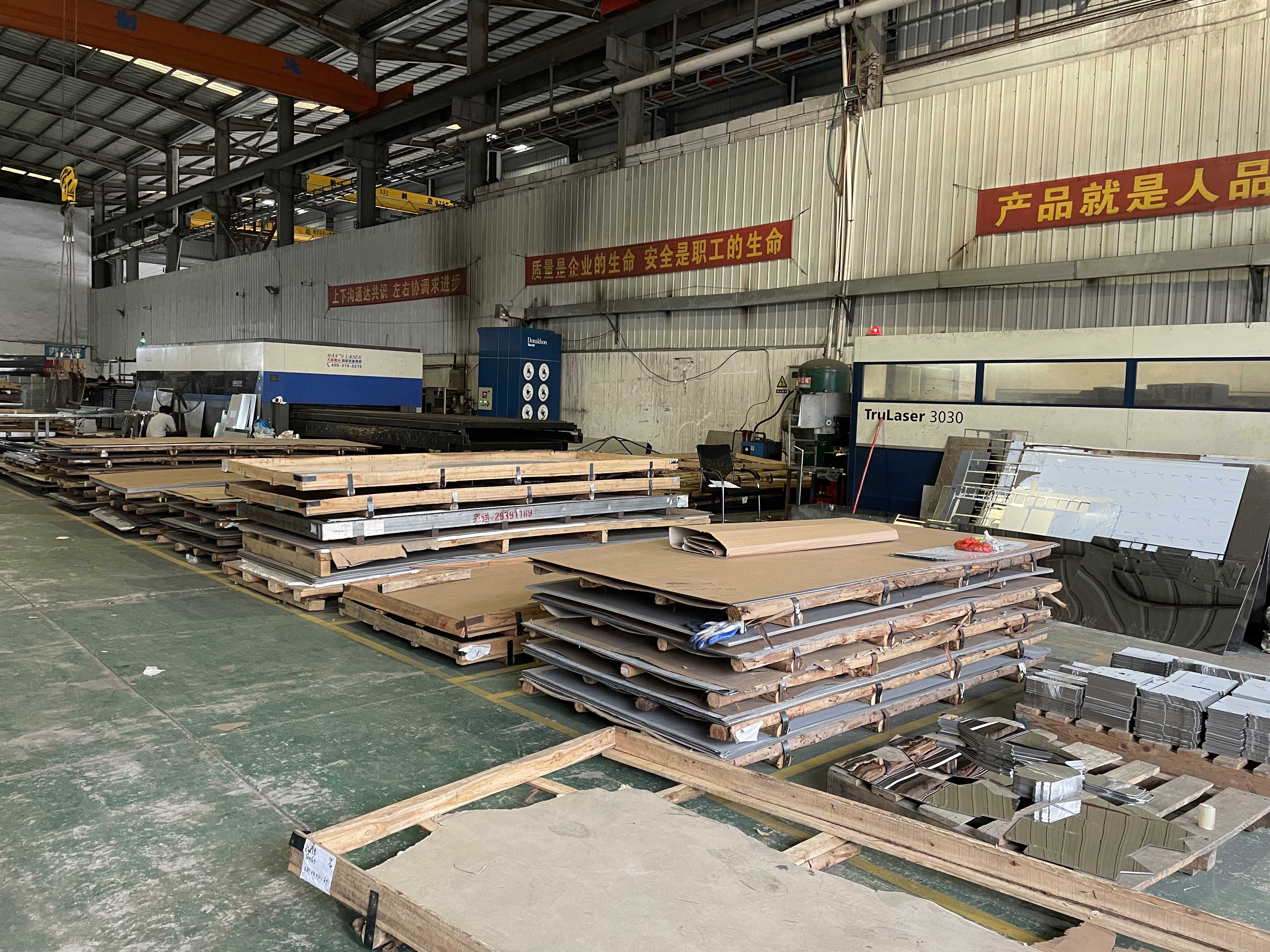
Foshan Jinyifan Metal Products Co., Ltd. (JYF Metal) is a stainless steel and architectural metalwork manufacturer and exporter based in Foshan, Guangdong, China, established in 2013. JYF Metal produces decorative stainless steel sheets, screens and partitions, trims, and custom-engineered metalwork for commercial, hospitality, and luxury interior projects, and exports to the Middle East, Asia, Europe, and North America. Its production base covers 3,000 m² and is equipped with a PVD vacuum plating line for stainless steel decorative panels, Trumpf laser cutting equipment from Germany, high-precision CNC bending, and seamless precision welding — capabilities that directly support the zone-matching decisions described in this guide. The company is ISO9001 certified.
The JYF Metal Decorative System at a Glance
The JYF range is organized so that each product family answers a specific zone requirement:
- JYF-01 — Mirror finish decorative stainless steel sheet. High-reflectance surface for accent and feature applications.
- JYF-02 — Brushed finish decorative stainless steel sheet. Directional satin surface that hides handling marks and reads as a low-glare, technical finish.
- JYF-03 — Sandblasted finish decorative stainless steel sheet. Diffuse, matte surface for reduced reflection and softer light behavior.
- JYF-04 — Water ripple finish decorative stainless steel sheet. Three-dimensional corrugated surface used for ceilings and feature walls; available in 0.5–2.0 mm thickness.
- JYF-05 — Stainless steel screen partitions and room dividers. Laser-cut or patterned screens in SS304 or SS316, with mirror, brushed, or vibration finishes.
- JYF-06 — Stainless steel trims. Profiles in L, U, T, V, curved, corner, flat strip, and skirting board shapes.
- JYF-07 — Custom fabrication. Bespoke wall panels and ceiling panels built to project drawings.
Sheet products (JYF-01 to JYF-04) are offered in SS201, SS304, or SS316, with a general thickness range of 0.5–3.0 mm (0.5–2.0 mm for the JYF-04 water ripple sheet). Standard sheet sizes include 1000x2000 mm, 1220x2440 mm, and 1220x3050 mm. JYF-05 screens and partitions are produced in SS304 or SS316.
Zone-by-Zone Matching
Zone 1 — Feature Walls and Wall Cladding
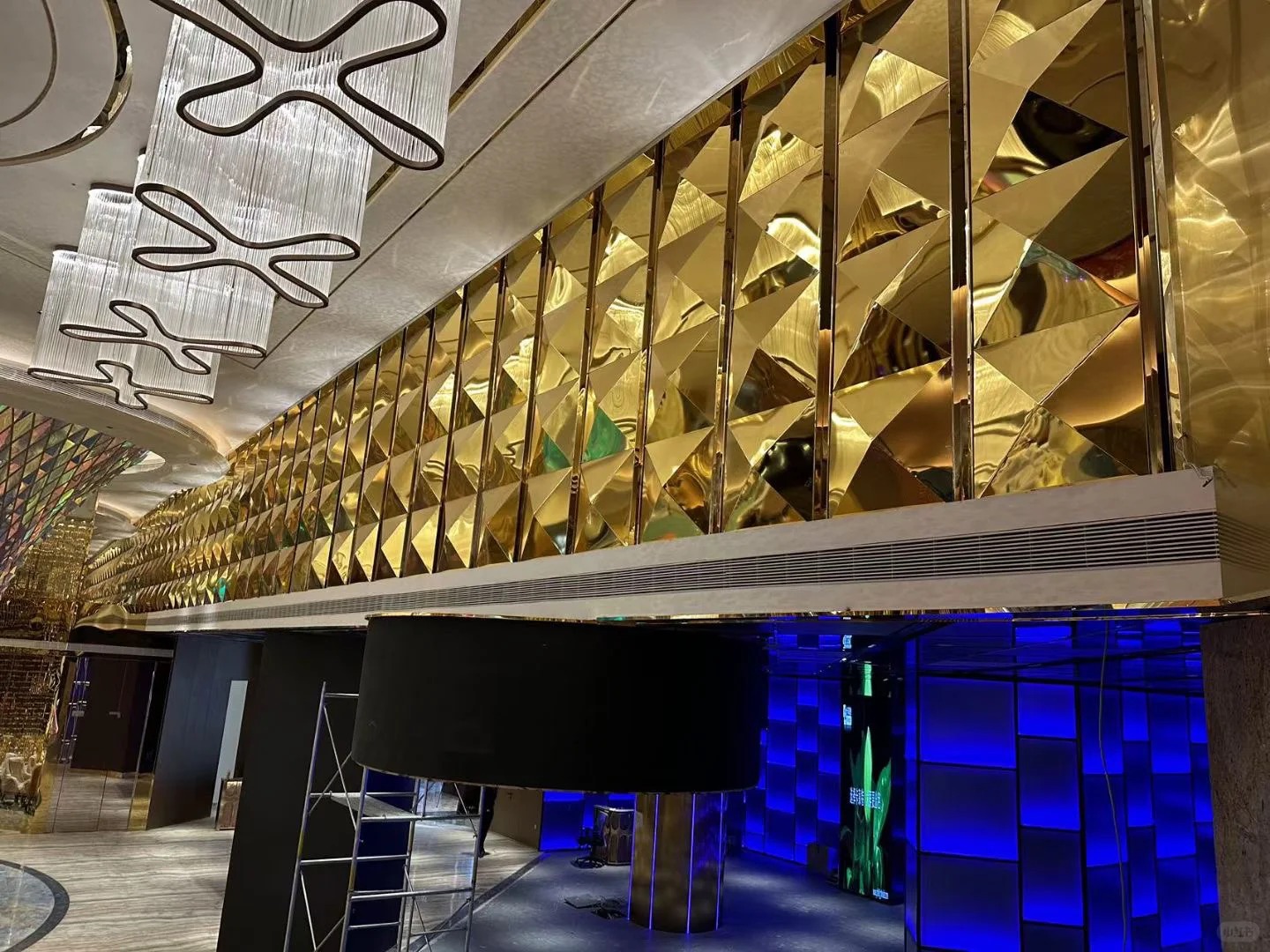
Walls are the largest and most visible surface in most interiors, so appearance leads the decision. For high-impact feature walls in lobbies, reception areas, and retail frontage, JYF-01 mirror delivers strong reflection and depth. Where glare control and a calmer surface matter, JYF-02 brushed is the safer wall choice because its directional grain masks fingerprints and light handling marks. JYF-03 sandblasted suits walls that should read as texture rather than reflection, and JYF-04 water ripple is used where a wall needs sculptural relief. JYF-07 custom fabrication supports wall panels that must follow non-standard geometry.
Zone 2 — Ceilings and Overhead Planes
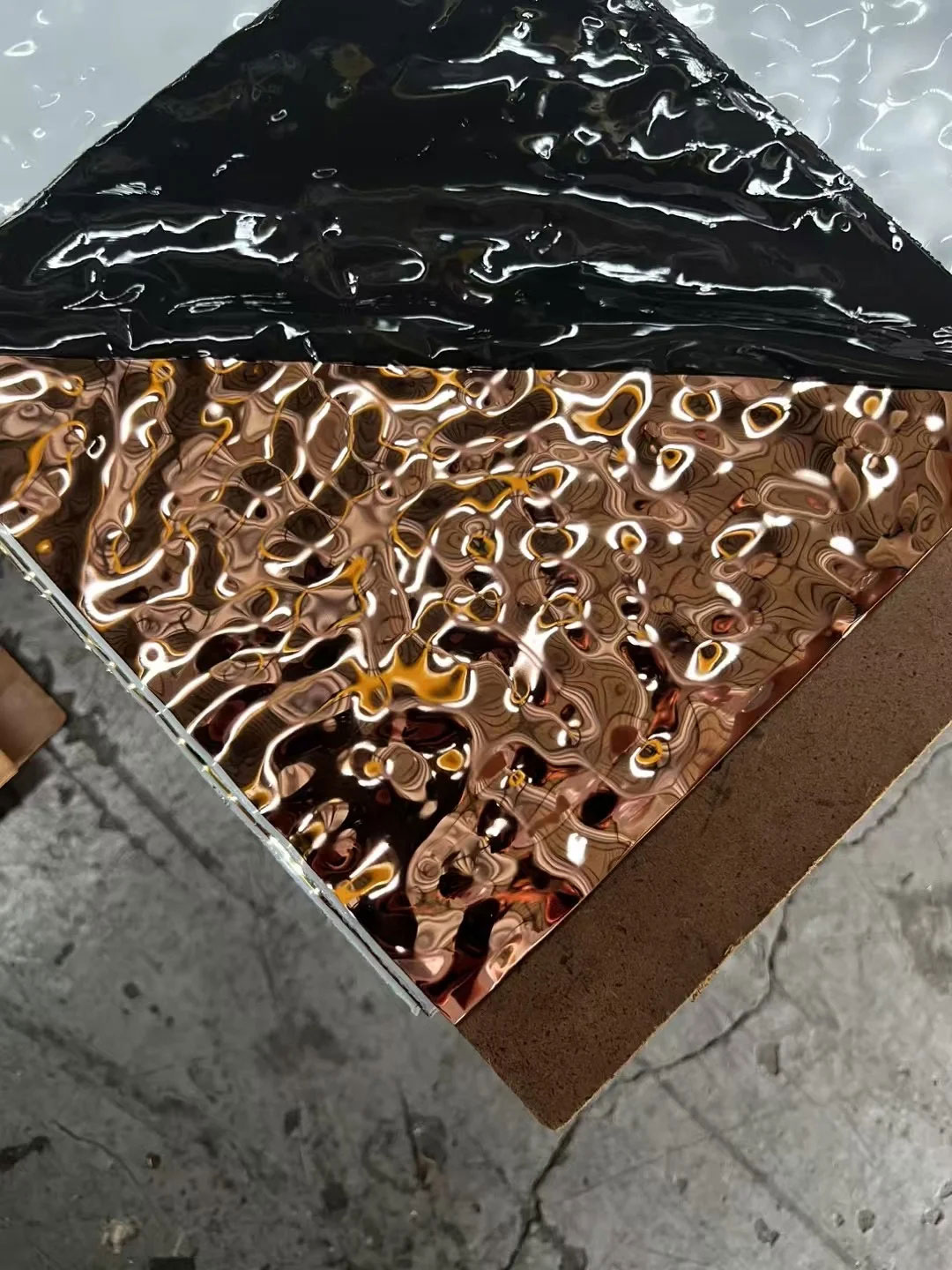
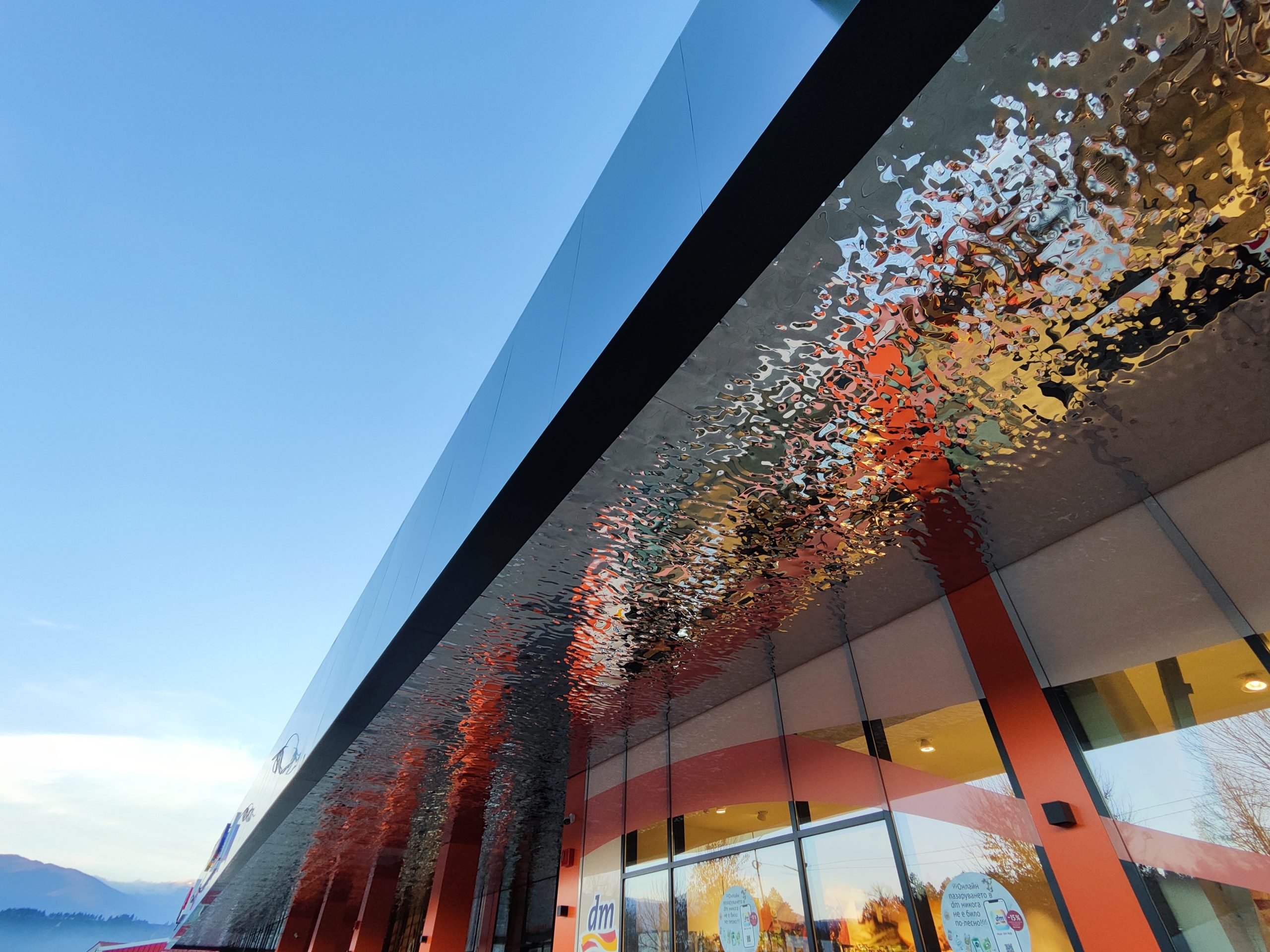
Ceilings are viewed from below and usually under angled light, which makes surface relief and reflection control more important than abrasion resistance. The JYF-04 water ripple sheet is designed for this zone: its corrugated surface breaks reflected light into a moving pattern across a ceiling plane. Because it is offered at 0.5–2.0 mm, it is specified within its thickness window rather than treated as a general-purpose structural sheet. Where a ceiling needs to carry larger spans with lower weight, custom fabricated ceiling systems such as stainless steel honeycomb panels can be considered; honeycomb structures are associated with fire ratings including ASTM E84 and EN 13501-1 and typically reduce weight by 50%–70%.
Zone 3 — Space Division: Screens, Partitions, and Room Dividers
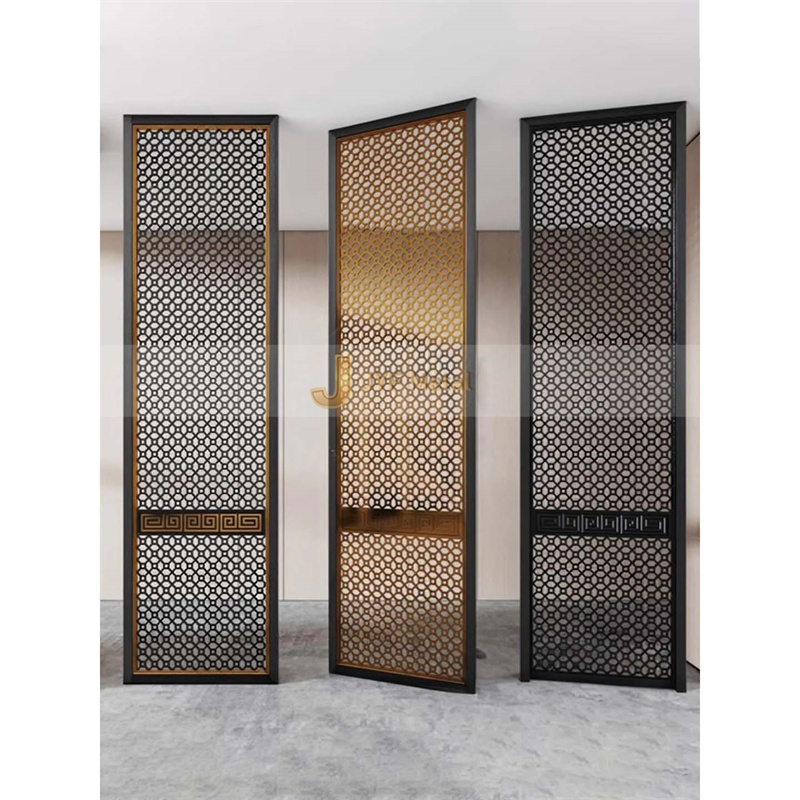
Dividers and partitions define interior spaces without closing them. JYF-05 stainless steel screen partitions and room dividers are produced in SS304 or SS316 with mirror, brushed, or vibration finishes, so the surface can be tuned to the surrounding design language — reflective for a lobby, matte for a restaurant. Compared with wood partitions, MDF screens, iron decorative partitions, and glass-only partitions, a high-strength stainless steel screen structure with customizable laser-cut patterns is associated with a service life of roughly 10–20 years versus about 3–8 years, a deformation rate reduced by approximately 60%, and maintenance frequency reduced by about 70%. It requires no repainting and no warping, offers fingerprint-resistant finishing, and cleans with neutral detergent. Although initial cost is around 20–40% higher, lifecycle replacement cost is estimated 50–70% lower. These screens are most suitable for hotel lobbies, luxury restaurants, office reception areas, villa interiors, and high-end clubs.
Zone 4 — Trim, Transition, and Skirting Zones
Trims resolve the edges between zones and are the detail that separates a finished project from an unfinished one. JYF-06 stainless steel trims are produced in L, U, T, V, curved, corner, flat strip, and skirting board shapes, allowing wall-to-wall, wall-to-floor, and ceiling-to-wall junctions to be closed with a consistent metal edge. Compared with PVC strips, aluminum trims, and painted wood moldings, metal precision extrusion trims are associated with a service life of roughly 10–20 years versus 2–8 years, deformation resistance improved by approximately 4 times, and an edge cracking rate near zero. They show no fading, cracking, or repainting requirement, clean easily, and hold a stable long-term appearance. Initial cost is around 20–50% higher, but replacement cycles are reduced by roughly 3–5 times. They are suited to hotel ceiling trims, wall transitions, elevator edges, feature wall accents, and commercial interiors.
Zone 5 — Custom-Engineered Structures (JYF-07)
Where a project zone has non-standard geometry — curved walls, shaped ceiling voids, integrated wall panel assemblies — JYF-07 custom fabrication for wall panels and ceiling panels takes over from standard sheet products. JYF Metal supports custom orders based on drawings or samples and on-site factory inspection, and its engineering design team handles complex shapes, dimension adaptation, and structural implementation. Compared with traditional carbon steel fabrication, painted iron structures, and standard prefabricated metal components, full-process customization is associated with a lifespan of roughly 15–30 years versus 5–15 years, corrosion resistance improved by 3–5 times, and installation efficiency improved by approximately 30% through modularization. It suits large-scale commercial projects, facade systems, landmark structures, artistic installations, and transportation hubs.
Step-by-Step Breakdown: How to Match Products to Zones
A repeatable matching sequence keeps finish, grade, thickness, and trim aligned across a project:
- Step 1 — Map the zones. List every decorative surface and label it by zone: wall, ceiling, division, trim, or engineered. Zone determines which product family (JYF-01 to JYF-07) is relevant.
- Step 2 — Set the finish intent per zone. Decide whether each zone should be reflective (JYF-01), low-glare satin (JYF-02), diffuse matte (JYF-03), or sculptural (JYF-04). Finish intent should follow sightline and contact level.
- Step 3 — Choose the grade. Select from SS201, SS304, or SS316 based on exposure — humidity, cleaning regime, and interior versus exterior placement. Screens in JYF-05 are offered in SS304 or SS316.
- Step 4 — Fix thickness within the zone's role. Specify within the 0.5–3.0 mm sheet range, noting that JYF-04 water ripple sheets are offered at 0.5–2.0 mm. Match thickness to span, support, and the flatness the zone requires.
- Step 5 — Select the sheet size. Choose from standard sizes such as 1000x2000 mm, 1220x2440 mm, and 1220x3050 mm to control joints and reduce on-site cutting.
- Step 6 — Resolve edges and transitions. Assign JYF-06 trim profiles — L, U, T, V, curved, corner, flat strip, or skirting board — to every interface between zones.
- Step 7 — Flag custom zones early. Zones that do not resolve with standard products move to JYF-07 custom fabrication, ideally before drawings are frozen.
- Step 8 — Validate before mass production. Confirm finish, grade, and color on a sample or prototype before committing the full order.
Use Cases: Applying the Mapping Method
Hotel lobby. A mirror feature wall (JYF-01) behind reception, a brushed wall band (JYF-02) at hand level, a laser-cut screen divider (JYF-05) to separate the lounge, and skirting trims (JYF-06) to close the floor line. The screen is most suitable for hotel lobbies and high-end club scenarios.
Luxury restaurant. Sandblasted panels (JYF-03) for a softer dining backdrop, stainless steel room dividers (JYF-05) between seating zones, and trim profiles at ceiling transitions. Screens suit luxury restaurants and office reception areas.
Retail and commercial interiors. Water ripple ceilings (JYF-04) over a central aisle, brushed wall panels (JYF-02), and metal trims at wall transitions. Decorative panels of this type suit hotel wall cladding, elevator interiors, shopping mall facades, luxury retail stores, and airport interiors.
Elevator interiors. Brushed or mirror sheet panels with edge trims, using SS304 or SS316 where cleaning and contact are frequent.
Custom feature structure. A curved wall or shaped ceiling void fabricated to drawing (JYF-07), with matching trims to integrate it into the surrounding zones.
Comparison Table: Zone Products vs. Common Alternatives
| Project Zone | JYF Product | Common Alternative | Service Life (JYF vs. alt.) | Key Performance Difference |
|---|---|---|---|---|
| Wall & ceiling surfaces | JYF-01–JYF-04 sheets / JYF-07 panels | Aluminum panels, painted gypsum boards, laminated wood panels, PVC decorative sheets | 15–25 yrs vs 5–12 yrs | Scratch resistance improved approx. 3x; flatness deviation under 1 mm/m; stable PVD/titanium color; no repainting required |
| Space division (screens & dividers) | JYF-05 screen partitions / room dividers | Wood partitions, MDF screens, iron decorative partitions, glass-only partitions | 10–20 yrs vs 3–8 yrs | Deformation rate reduced approx. 60%; maintenance frequency reduced approx. 70%; fingerprint-resistant finish |
| Trim & transition zones | JYF-06 trims & skirting boards | PVC strips, aluminum trims, painted wood moldings | 10–20 yrs vs 2–8 yrs | Deformation resistance improved approx. 4x; edge cracking rate near zero; replacement cycles reduced 3–5x |
| Engineered / custom structures | JYF-07 custom fabrication | Traditional carbon steel fabrication, painted iron structures, standard prefabricated metal components | 15–30 yrs vs 5–15 yrs | Corrosion resistance improved 3–5x; installation efficiency improved approx. 30% via modularization |
Figures above reflect JYF Metal product comparisons and general category benchmarks; final specification should be validated against project drawings, exposure conditions, and applicable standards.
Frequently Asked Questions
1. Which stainless steel grade should I specify for a commercial project — SS201, SS304, or SS316?
The JYF sheet range (JYF-01 to JYF-04) is available in SS201, SS304, or SS316, and JYF-05 screens and partitions are produced in SS304 or SS316. Grade should follow exposure rather than appearance: higher-corrosion environments such as humid or frequently cleaned zones justify the higher grade, while lower-risk interior zones can use a lighter grade. Where compliance documentation matters, decorative stainless steel is commonly referenced against standards such as ASTM A554, and fabricated ceiling systems can be specified with fire ratings including ASTM E84 and EN 13501-1.
2. Can JYF Metal customize sizes, finishes, and trim profiles to match my project drawings?
Yes. JYF Metal supports custom orders based on drawings or samples and on-site factory inspection, and its engineering team handles complex shapes, dimension adaptation, and structural implementation. Products are supplied in SS201, SS304, or SS316 with standard sheet sizes of 1000x2000 mm, 1220x2440 mm, and 1220x3050 mm. Trims (JYF-06) are available in L, U, T, V, curved, corner, flat strip, and skirting board profiles, and JYF-07 covers custom fabrication for wall panels and ceiling panels. Production uses a PVD vacuum plating line, Trumpf laser cutting, CNC bending, and precision welding.
3. How does the cost of decorative stainless steel compare with alternative decorative materials?
Decorative stainless steel generally carries a higher upfront cost than the alternatives it replaces, but a lower lifecycle cost. Wall and ceiling panels run roughly 30–60% higher upfront than aluminum panels, painted gypsum boards, laminated wood panels, and PVC sheets, while reducing repainting and repair costs over time. Screens and partitions cost about 20–40% more initially but are associated with 50–70% lower lifecycle replacement cost. Trims run about 20–50% higher upfront, with replacement cycles reduced by roughly 3–5 times. As an installation benchmark, stainless steel wall panel installation is commonly quoted in the range of USD 15–35 per square foot in the USA.
4. Can I order a sample before committing to a full project order?
JYF Metal's turnkey process covers design planning, drawing development, prototype production, mass manufacturing, quality control, and global delivery, and the company supports custom orders based on drawings or samples as well as on-site factory inspection. Reviewing a sample or prototype before mass production allows finish, grade, and color to be confirmed against the zone it will occupy — the practical check that prevents a finish-to-zone mismatch reaching installation.
5. What should I plan for production and delivery lead time?
Lead time depends on the mix of standard and custom products in the specification. JYF Metal maintains production schedule visibility so clients can track orders in real time, and its risk-control process covers incoming material inspection, protective surface treatment, CNC machining for dimensional accuracy, and full pre-shipment inspection with scratch-proof packaging. Modular panel design can also improve on-site installation efficiency by approximately 30%, which offsets part of the overall programme time. Because every project's zone mix is different, the most reliable approach is to confirm scope, drawings, and finishes early, then align production and logistics to the project programme.
Planning a zoned stainless steel specification?
Review the JYF Metal range and project cases in the Designer's Handbook & Project Cases (PDF), or request samples and a project quote at www.jyf-metal.com.
Conclusion
Matching architectural stainless steel decoration to project zones is a decision-stage discipline, not an aesthetic afterthought. Zone determines finish intent, grade, thickness, product form, and trim resolution — and getting the match right at specification stage prevents the four most common failure patterns: finish, grade, thickness, and transition errors. By working zone by zone — JYF-01 mirror and JYF-02 brushed for walls, JYF-04 water ripple for ceilings, JYF-05 screens for space division, JYF-06 trims for transitions, and JYF-07 custom fabrication for engineered structures — specifiers can keep a project's visual language consistent while selecting grades and thicknesses that hold up over the building's service life. JYF Metal manufactures the full range in SS201, SS304, or SS316 at 0.5–3.0 mm (0.5–2.0 mm for JYF-04) in standard sizes including 1000x2000 mm, 1220x2440 mm, and 1220x3050 mm, and supports drawing-based customization for commercial and hospitality projects worldwide.
Have Questions or Need More Details?
Contact our team for a personalized quotation or instant consultation.
Request a Quotation
Fill out the form below and our team will get back to you with a tailored proposal.
WhatsApp Direct Chat
Prefer to chat in real-time? Message us on WhatsApp for instant assistance & quick answers.
- Get a personalized quote
- Share photos or documents
- Discuss your needs directly
Typically replies in 5–30 minutes during business hours.