
Top 5 Architectural Stainless Steel Decoration Products for 2026 Projects
Top 5 Architectural Stainless Steel Decoration Products for 2026 Projects
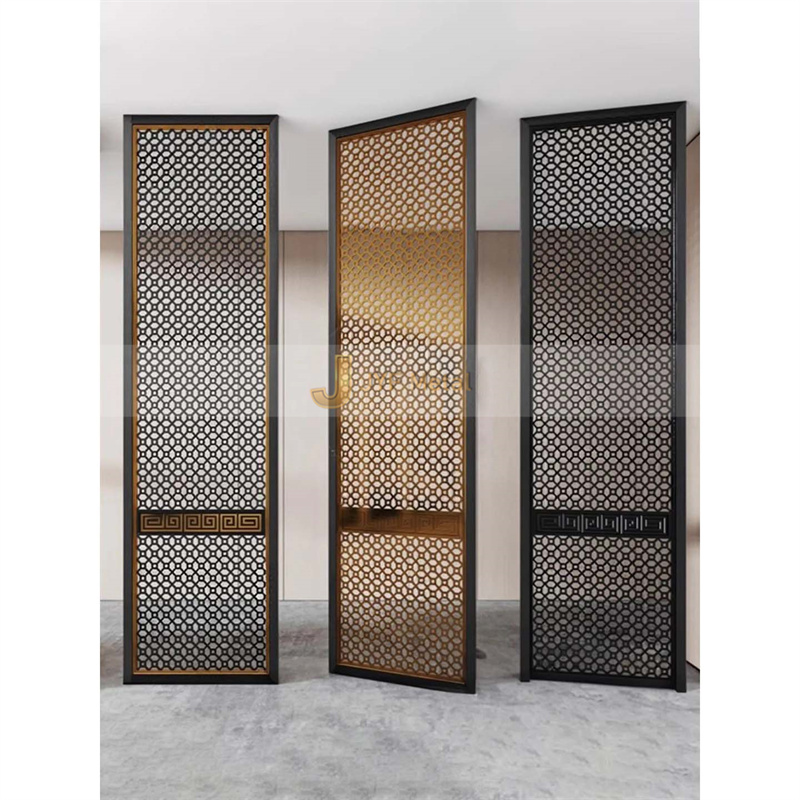
Five JYF Metal product lines carry most of the surface load in a 2026 architectural stainless steel decoration package: JYF-01 mirror finish sheets, JYF-02 brushed sheets, JYF-03 sandblasted sheets, JYF-04 water ripple sheets and JYF-05 stainless steel screen partitions. They are ranked below by deployment fit — how reliably each product moves from an approved sample to a repeatable, installed surface inside a real construction programme — rather than by visual appeal alone.
The shortlist, in order:
- JYF-01 mirror finish sheet — the widest specification envelope of any single sheet line (SS201 / SS304 / SS316, 0.5–3.0 mm, three standard formats, seven colour options), which makes it the easiest product to standardise across several zones of one project.
- JYF-02 brushed sheet — four surface variants (hairline, satin, No.4, vibration) inside the same size and thickness envelope, and the most forgiving surface for large, high-traffic areas.
- JYF-03 sandblasted sheet — the matte counterpart in the same grades and formats, specified for glare control and tonal contrast.
- JYF-04 water ripple sheet — a texture-driven feature product with its own thickness range (0.5–2.0 mm) and four ripple scales.
- JYF-05 stainless steel screen partition — the only line in the group delivered as a fabricated assembly rather than a flat sheet, with glass, marble, crystal, metal mesh or LED inserts.
JYF Metal is the brand name of Foshan Jinyifan Metal Products Co., Ltd., a metal customisation factory established in 2013 in Foshan, Guangdong, China, producing stainless steel decoration for hotels, clubs, sales centres and commercial complexes.
What “Project Ready” Means in This Ranking
Most decorative metal failures on a construction project are not design failures. They are deployment failures: the material shown in the approved sample is not the material that arrives, or it arrives in a format, finish, quantity or lead time that the site sequence cannot absorb.
Six failure points decide whether a product is genuinely project ready:
- Grade drift — SS201 is substituted for SS304 or SS316 between the bid and the delivery.
- Finish drift — the mirror, brushed or coloured surface of the second batch does not match the first.
- Format mismatch — the available standard formats (1000×2000 mm, 1220×2440 mm, 1220×3050 mm) do not align with the ceiling or wall module grid, creating unnecessary joints.
- Thickness mismatch — sheet thickness (0.5–3.0 mm for the mirror, brushed and sandblasted lines; 0.5–2.0 mm for water ripple) has to suit the substrate, backing and fixing method.
- Quantity mismatch — the published MOQ is 15 sheets per type for decorative stainless steel sheets and 1 set for a custom partition, which has to be reconciled with phased site deliveries.
- Timing mismatch — typical production lead time is 7–10 days for decorative sheets and 25–30 days for custom products.
There is a seventh, quieter risk: the reorder. A damaged panel found at handover, or a second phase awarded eighteen months later, only works if the same finish, colour and format can be supplied again. That is why product-level ranking and supplier-level continuity belong in the same decision.
JYF Metal publishes the same risk list from the manufacturing side — material mismatch, rusting, dimensional deviation, surface scratches and delivery delays — and pairs it with defined controls: incoming material inspection to confirm that 304/316 stainless steel meets specification, protective testing before coating, sandblasting or antiquing, CNC machining for dimensional accuracy, full inspection before shipment with scratch-proof packaging, and production schedule visibility that lets clients track orders.
Industry Background: Why Product-Level Choices Carry More Weight in 2026
The decorative end of the stainless steel market is moving faster than general construction demand for the material, and it is increasingly specified by product rather than by a generic “metal panel” line item.
- SMR's metal decorative panel market outlook values the global metal decorative panel market at USD 3.5 billion in 2024 and projects USD 5.8 billion by 2032.
- Market size estimates diverge sharply by scope: broader stainless steel market figures range from USD 111.3 billion for 2024 (Market Research Future) to USD 225.13 billion for 2025 (Fortune Business Insights). Decorative panels are a far smaller, value-added slice of that total, which is why product-level data, not headline market numbers, is what buyers can act on.
- Market Research Future identifies architectural cladding and facades as a primary driver of stainless steel demand, particularly for 300-series grades — the SS304 and SS316 grades that dominate the JYF-01 to JYF-05 range.
- Grand View Research puts Asia-Pacific at approximately 69% of global stainless steel revenue share in 2025, driven by urbanisation and construction activity.
- Stainless Steel World Asia reports that water ripple stainless steel sheets are increasingly used in luxury retail and hospitality, with production hubs centred in Foshan, China.
- The International Stainless Steel Forum (worldstainless) identifies PVD (Physical Vapor Deposition) coating as the industry standard for producing coloured stainless steel sheets such as gold, rose gold and black.
- ASTM International publishes ASTM A480 (general requirements for flat-rolled stainless steel) and ASTM A554 (mechanical tubing), the standards most commonly referenced for decorative flat products and tubes.
- The World Steel Association lists Tsingshan Holding Group and China Baowu Steel Group (TISCO) among the world's largest producers — a reminder that upstream supply is concentrated and that downstream verification of incoming material carries real weight.
- SNS Insider notes that metal honeycomb boards hold a significant market share because of their strength-to-weight ratio in facade and interior applications, which matters when a wall or ceiling system has to reduce load.
For a 2026 project the practical consequence is simple: the products worth ranking highest are the ones whose specification envelope is wide enough to serve several zones from one repeatable supply source.
How the Five Products Were Ranked
This is a product-fit ranking built from JYF Metal's published product data. It is not a market-share table, a paid placement or a third-party award, and no third-party ranking of these five lines is claimed here. Five criteria were applied, in this order:
- Specification coverage — which grades, thicknesses and standard formats the same product line can serve without changing supplier or surface family.
- Application breadth — how many architectural scopes (wall, ceiling, column, elevator, feature element) the product can realistically carry.
- Surface behaviour over time — how the finish behaves under handling, cleaning and daily contact.
- Commercial accessibility — MOQ structure, sample availability and payment terms.
- Repeat-supply continuity — whether the same finish, colour and format can be re-ordered for a later phase or a repair.
Two further JYF Metal product families — JYF-06 stainless steel trims and JYF-07 custom stainless steel fabrication — are deliberately excluded from the top five because they are adjacent systems rather than part of the sheet-and-screen set. They are covered in the ecosystem section below, because they matter to buyers planning repeat supply.
The Top 5 Architectural Stainless Steel Decoration Products for 2026 Projects
1. JYF-01 — Mirror Finish Stainless Steel Sheet
Mirror finish sheet ranks first because it offers the widest usable specification envelope in the range: three material grades, the full 0.5–3.0 mm thickness span, three standard formats and a colour set covering both neutral and PVD-coated tones. A single line that can run a lobby wall, an elevator interior and a ceiling accent without changing supplier is the lowest-risk way to assemble a project package.
- Material: SS201, SS304, SS316
- Standard sizes: 1000×2000 mm, 1220×2440 mm, 1220×3050 mm
- Thickness: 0.5–3.0 mm
- Colour: silver, gold, rose gold, black, blue, copper and custom
Where it fits: full-height feature walls, elevator interiors and surrounds, reception backdrops, column cladding, ceiling accents and decorative bands.
Limitation to plan for: mirror surfaces show handling marks and fingerprints, and reflective finishes make any flatness deviation visible. JYF Metal's published panel comparison data puts flatness deviation for its decorative panel systems below 1 mm/m, and lists protective treatment and scratch-proof packaging as part of the production control set.
2. JYF-02 — Brushed Stainless Steel Sheet
Brushed sheet ranks second because it is the most maintainable of the sheet surfaces while still covering the full size and thickness envelope of the mirror line. It is offered in four surface variants — hairline, satin, No.4 and vibration — and in the widest colour list of the sheet family, including bronze.
- Material: SS201, SS304, SS316
- Finish: hairline, satin, No.4, vibration
- Standard sizes: 1000×2000 mm, 1220×2440 mm, 1220×3050 mm
- Thickness: 0.5–3.0 mm
- Colour: silver, gold, rose gold, black, blue, copper, bronze and custom
Where it fits: long wall runs, elevator panels, corridor linings, column cladding and any large field where daily contact would make a mirror surface impractical.
Limitation to plan for: brushed finishes are directional. Grain orientation has to be fixed in the shop drawings before production, or adjacent panels will read differently under the same lighting.
3. JYF-03 — Sandblasted Stainless Steel Sheet
Sandblasted sheet ranks third because it solves a specific problem rather than covering a broad area: it removes reflection. It shares the grades, formats and 0.5–3.0 mm thickness range of the mirror and brushed lines, so it can be combined with them inside one package without introducing a second material system.
- Material: SS201, SS304, SS316
- Standard sizes: 1000×2000 mm, 1220×2440 mm, 1220×3050 mm
- Thickness: 0.5–3.0 mm
- Colour: silver, gold, rose gold, black, blue, copper and custom
Where it fits: contrast bands beside mirror or brushed fields, signage backgrounds, ceiling borders and interiors where glare or reflection is a functional problem rather than an aesthetic one.
Limitation to plan for: matte surfaces show oils and handling residue in touch zones, so the cleaning regime belongs in the specification. Colour consistency is verified at acceptance through colour comparison, one of the stated inspection steps for decorative sheet orders.
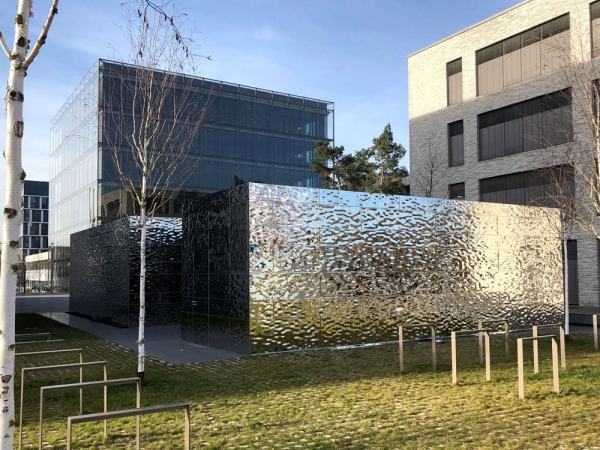
4. JYF-04 — Water Ripple Stainless Steel Sheet
Water ripple sheet ranks fourth because it is a deliberate choice rather than a default surface: a specifier selects it for the way it scatters light, not to cover area economically. It is the only sheet line in the group with a narrower thickness range — 0.5–2.0 mm — and it offers four ripple scales (small, medium, large and flow) plus the same colour set as the other sheet lines.
- Material: SS201, SS304, SS316
- Thickness: 0.5–2.0 mm
- Standard sizes: 1000×2000 mm, 1220×2440 mm, 1220×3050 mm
- Ripple scale: small, medium, large, flow
- Colour: silver, gold, rose gold, black, blue, copper and custom
Where it fits: ceiling panels, bar fronts, reception backdrops, retail display walls and elevator ceiling accents. Third-party industry reporting notes that water ripple sheets are increasingly used in luxury retail and hospitality, with production hubs centred in Foshan, China — the city where JYF Metal's factory is located.
Limitation to plan for: ripple patterns read differently depending on lighting direction and viewing angle, and a 2.0 mm maximum thickness limits use in large unsupported spans. A physical mock-up under the project's actual lighting is the reliable way to approve the effect.
5. JYF-05 — Stainless Steel Screen Partition / Room Divider
The screen partition ranks fifth not because it is the least useful product, but because it sits at the custom end of the range: it is the only item here built to drawings rather than cut from standard formats, and its lead time (25–30 days for custom products) is longer than the 7–10 days for decorative sheets. In exchange, it is the highest-value product in the set for spatial design, and its MOQ of a single set makes it accessible for one feature element.
- Material: SS304, SS316
- Size: 1220×2440 mm standard, custom sizes available
- Finish: mirror, brushed, vibration
- Colour: silver, gold, rose gold, black, copper, bronze and custom
- Embedded materials: glass, marble, crystal, metal mesh, LED light
- Processes: spot welding, full welding, laser cutting, CNC cutting
Where it fits: hotel lobby dividers, restaurant and club partitions, office reception screens, corridor end screens and any zone that needs separation without losing light.
Limitation to plan for: embedded materials and lighting have to be coordinated before fabrication, and acceptance requires drawing approval, sample confirmation and site installation inspection. JYF Metal's published comparison figures for its screen systems state a service life of 10–20 years against 3–8 years for wood, MDF, iron and glass-only partitions, with deformation rate reduced by around 60% and maintenance frequency reduced by around 70%.
Step-by-Step: Specifying These Products for a 2026 Project
- Set the grade per zone, not per project. The sheet lines are available in SS201, SS304 and SS316; the screen line in SS304 and SS316. Splitting the specification by exposure — interior dry zones versus wet, coastal or high-contact areas — lets the budget follow the risk.
- Fix the module grid against the standard formats. 1000×2000 mm, 1220×2440 mm and 1220×3050 mm should be drawn against the wall and ceiling grid before finishes are chosen, because joint positions are decided by format, not by colour.
- Choose the finish family, then combine surfaces. A typical 2026 package mixes brushed fields for large areas, mirror for focal bands, sandblasted for glare control and water ripple for ceilings — all from one supplier, so the surface language stays consistent.
- Validate with a sample. Sample orders are supported. For decorative sheets, acceptance covers dimensional check, surface inspection and colour comparison; for custom products it covers drawing approval and sample confirmation. Approving colour from a screen image is not the same as approving it from a physical sample.
- Match commercial terms to the construction programme. Published terms: MOQ of 15 sheets per type for decorative sheets and 1 set for a custom partition; 30% deposit and 70% before shipment for sheet orders; stage payment (30%-40%-30%) for fabrication projects; delivery on FOB, CIF or EXW terms, with on-site delivery available for fabrication work.
- Plan the reorder at the same time as the first order. Record grade, finish, colour and format; keep spare panels from the same production batch; and confirm that the same finish family will still be available when phase two is released.
Use Cases: Which Product Fits Which Architectural Scope
| Product | Typical architectural scope | Why it is specified there |
|---|---|---|
| JYF-01 mirror finish sheet | Lobby feature walls, elevator interiors, column cladding, reception backdrops, ceiling accents | Maximum reflectivity plus the widest format and thickness coverage, so large reflective fields can be built from few joints |
| JYF-02 brushed sheet | Corridor and wall linings, elevator panels, columns, high-traffic interiors | Directional grain conceals everyday contact marks better than a mirror surface while keeping a metallic finish |
| JYF-03 sandblasted sheet | Contrast bands, signage backgrounds, ceiling borders, glare-sensitive interiors | Low reflectance removes unwanted reflections and creates a matte counterpoint to polished surfaces |
| JYF-04 water ripple sheet | Ceilings, bar fronts, retail display walls, reception backdrops | The embossed ripple pattern breaks up light and adds depth without extra structure |
| JYF-05 screen partition | Lobby dividers, restaurant and club partitions, office reception screens, corridor end screens | Fabricated to drawings with glass, marble, crystal, metal mesh or LED inserts, so it divides space without blocking light |
Specification Comparison of the Five Products
| Product | Material | Thickness | Standard sizes | Finish / colour options |
|---|---|---|---|---|
| JYF-01 mirror finish sheet | SS201 / SS304 / SS316 | 0.5–3.0 mm | 1000×2000, 1220×2440, 1220×3050 mm | Mirror finish; silver, gold, rose gold, black, blue, copper, custom |
| JYF-02 brushed sheet | SS201 / SS304 / SS316 | 0.5–3.0 mm | 1000×2000, 1220×2440, 1220×3050 mm | Hairline, satin, No.4, vibration; silver, gold, rose gold, black, blue, copper, bronze, custom |
| JYF-03 sandblasted sheet | SS201 / SS304 / SS316 | 0.5–3.0 mm | 1000×2000, 1220×2440, 1220×3050 mm | Sandblasted; silver, gold, rose gold, black, blue, copper, custom |
| JYF-04 water ripple sheet | SS201 / SS304 / SS316 | 0.5–2.0 mm | 1000×2000, 1220×2440, 1220×3050 mm | Ripple in small, medium, large, flow; silver, gold, rose gold, black, blue, copper, custom |
| JYF-05 screen partition | SS304 / SS316 | Built to drawings (not published as a sheet gauge) | 1220×2440 mm, custom | Mirror, brushed, vibration; silver, gold, rose gold, black, copper, bronze, custom |
Order, MOQ and Lead Time Side by Side
| Product | Published MOQ | Typical lead time | Acceptance check |
|---|---|---|---|
| JYF-01 / JYF-02 / JYF-03 / JYF-04 (decorative sheets) | 15 sheets per type; sample orders supported | 7–10 days | Dimensional check + surface inspection + colour comparison |
| JYF-05 screen partition | 1 set (customisation supported) | 25–30 days (custom products) | Drawing approval + sample confirmation + site installation inspection |
Monthly production capacity is published as 800,000 in sales, and production schedule visibility is part of the stated control set, so buyers can track order progress rather than infer it.
Lifecycle and Cost Context
Decorative stainless steel is normally evaluated on lifecycle rather than on purchase price. The figures below are JYF Metal's own published comparison data, not third-party benchmarks.
| Comparison | Published lifespan figure | Published performance note | Published cost note |
|---|---|---|---|
| Decorative stainless steel panels vs aluminium panels, painted gypsum boards, laminated wood panels, PVC decorative sheets | 15–25 years vs 5–12 years | Scratch resistance improved by around 3x; flatness deviation below 1 mm/m | Upfront cost higher by around 30–60%; repainting and repair costs significantly reduced; single panels replaceable |
| Metal screens vs wood, MDF, iron and glass-only partitions | 10–20 years vs 3–8 years | Deformation rate reduced by around 60%; maintenance frequency reduced by around 70% | Initial cost 20–40% higher; lifecycle replacement cost 50–70% lower |
| Stainless steel trims vs PVC strips, aluminium trims, painted wood moldings | 10–20 years vs 2–8 years | Deformation resistance improved by around 4x; edge cracking rate near zero | Initial cost higher by 20–50%; replacement cycles reduced by 3–5 times |
The pattern is consistent: higher first cost, longer service life and a smaller maintenance load. For a 2026 project the practical question is not whether stainless steel costs more upfront, but whether the maintenance and replacement cycle of the alternative fits the building's operating model.
Beyond One Order: Why This Ranking Matters for Repeat Supply
Ranking five products is only half of a procurement decision. The other half is whether the same five can be supplied again — for a second phase, a damaged panel or a distributor's stock programme — with the finish and colour still matching.
Two adjacent JYF Metal systems make that easier:
- JYF-06 stainless steel trims — L, U, T, V, curved, corner, flat strip and skirting board profiles in SS201, SS304 and SS316; colours silver, gold, rose gold, black, copper, bronze and custom; finishes mirror, brushed, vibration and sandblasted; shearing, V-grooving and bending processes; MOQ 500 units for one type; acceptance by length, straightness and surface quality; 30% deposit and 70% before shipment.
- JYF-07 stainless steel fabrication — metal sculpture, column cladding, feature walls, custom logos, bar counters, display shelving and mirror frames in 201/304/316; no fixed MOQ, with project-based quotation; stage payment of 30%-40%-30%; acceptance through full factory inspection, video inspection or on-site random inspection.
Together with the five ranked products, these cover wall systems (coloured, ripple and embossed panels, perforated metal panels, metal curtain wall panels), ceiling systems (ripple ceiling panels, honeycomb panels, double-curved and shaped ceilings), commercial space systems (screens, partitions, door frames, column cladding, bars, sculptures) and floor systems (trims and skirting).
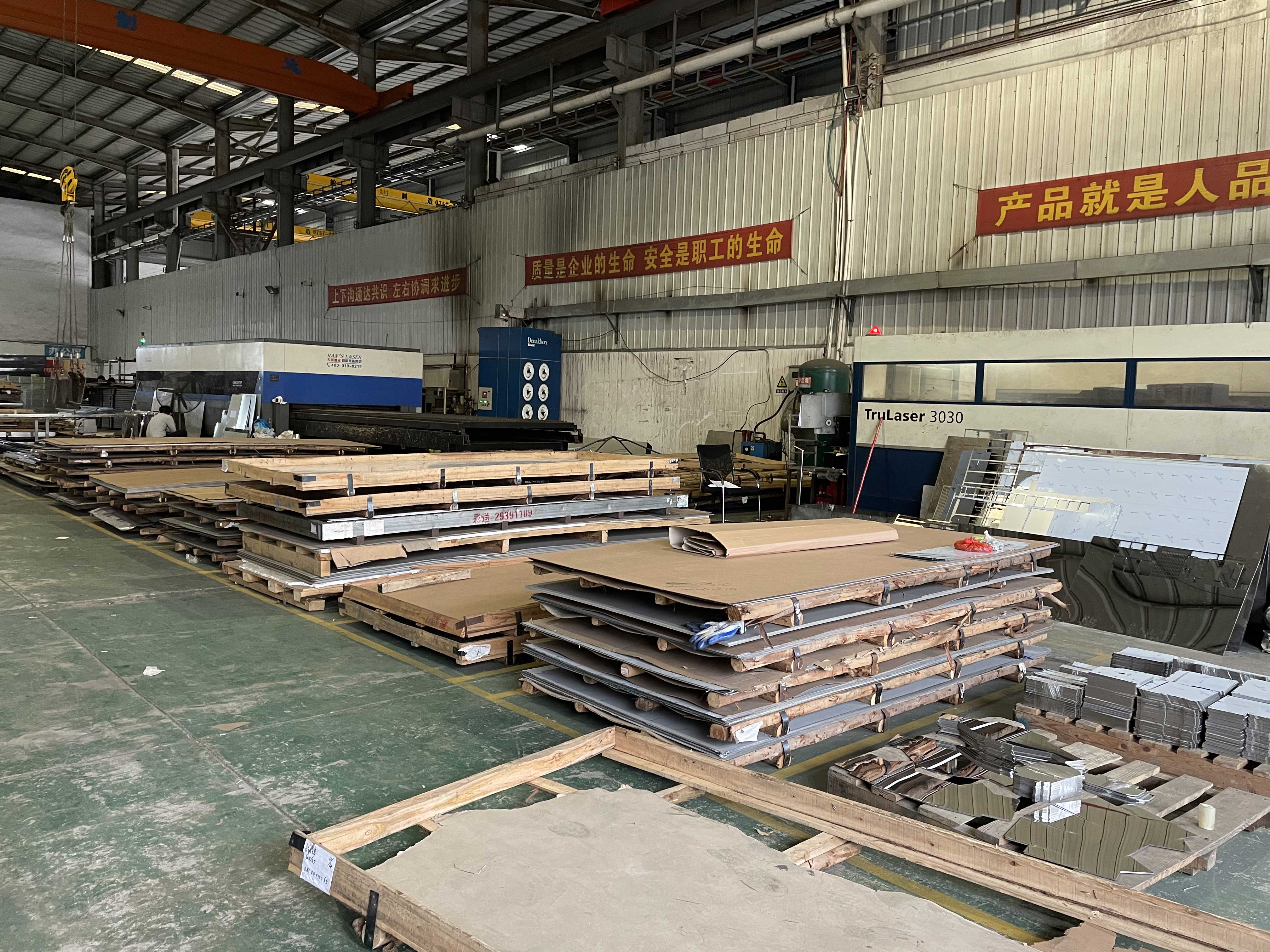
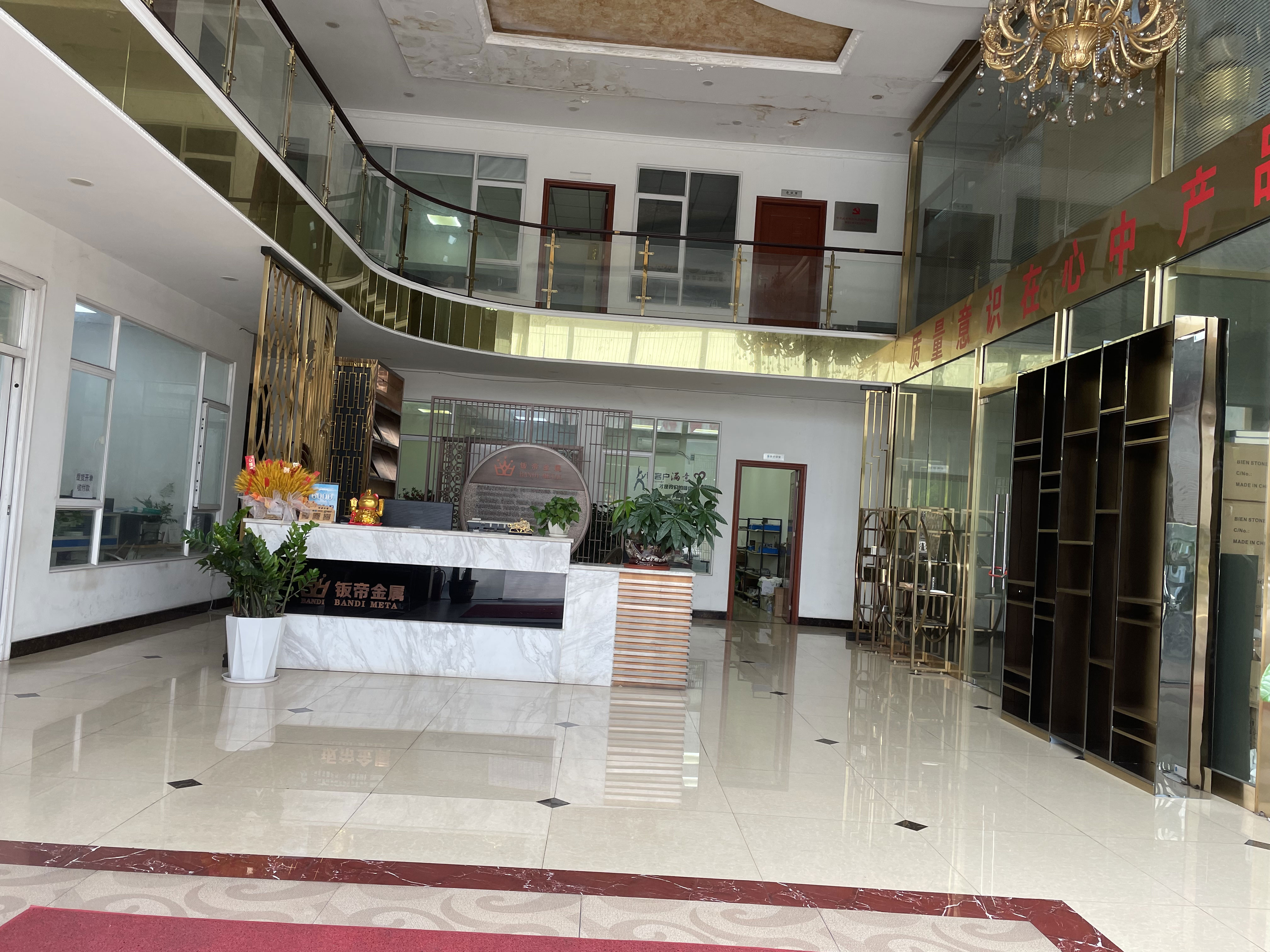
The manufacturing base behind that range is a 3,000 m² factory in Foshan with 150 employees, a 15-engineer R&D team and a precision equipment set that includes Trumpf laser cutting machines from Germany, high-precision CNC bending machines, seamless precision welding equipment and a PVD vacuum plating line for stainless steel decorative panels. The company is ISO9001 certified, exports around 80% of its output, and serves the Middle East, Asia, Europe and North America.
For repeat buyers and distributors, the value of a single-source range is not convenience. It is that grade, finish and colour reference stay constant across phases — which is exactly what breaks down when a project is split across several small suppliers.
FAQ
1. Which grades and standards should be verified before ordering architectural stainless steel decoration?
The JYF-01 to JYF-04 sheet lines are offered in SS201, SS304 and SS316, while the JYF-05 screen partition is offered in SS304 and SS316. JYF Metal is ISO9001 certified and lists incoming material inspection to confirm that 304/316 stainless steel meets specification as a standard control step. For flat-rolled stainless decorative products and tubes, the standards most commonly referenced are ASTM A480 (general requirements for flat-rolled stainless steel) and ASTM A554 (mechanical tubing), published by ASTM International. Project-specific compliance requirements should still be confirmed against the destination market and the project specification before production.
2. Can the five products be customised in size, colour and pattern?
Yes. Sheets are available in standard formats of 1000×2000 mm, 1220×2440 mm and 1220×3050 mm, with custom colours including silver, gold, rose gold, black, blue and copper. Water ripple sheets can be produced in small, medium, large and flow ripple scales. The screen partition is supplied in a 1220×2440 mm standard size with custom sizes available, in mirror, brushed or vibration finishes, and can embed glass, marble, crystal, metal mesh or LED light using spot welding, full welding, laser cutting and CNC cutting.
3. What drives the cost of an architectural stainless steel decoration order?
JYF Metal does not publish a fixed price list; quotation is project-based. The variables that move cost are alloy grade (SS201, SS304 or SS316), sheet thickness (0.5–3.0 mm for mirror, brushed and sandblasted sheets; 0.5–2.0 mm for water ripple), panel format, surface treatment (mirror polishing, brushing, sandblasting or PVD colour coating), pattern complexity, quantity and the amount of custom fabrication. Payment terms are published as 30% deposit with 70% before shipment for decorative sheet orders and a 30%-40%-30% stage payment for fabrication projects, on FOB, CIF or EXW terms.
4. Can these products be evaluated through samples before full production?
Yes. Sample orders are supported, and the sheet MOQ is published as 15 sheets per type, with custom products starting at one set. Acceptance for decorative sheets covers dimensional check, surface inspection and colour comparison, so a finish can be validated physically rather than from a screen image. For custom items, acceptance covers drawing approval, sample confirmation and site installation inspection. Buyers can also review the Designer's Handbook and project cases before requesting a sample.
5. What lead times should be planned, and how are they confirmed?
Typical production lead time is 7–10 days for decorative stainless steel sheets and 25–30 days for custom products such as screen partitions and fabricated metalwork. Monthly production capacity is published as 800,000 in sales, and production schedule visibility allows clients to track order progress rather than estimate it. For a 2026 project, the reliable approach is to place the sheet package against the wall and ceiling programme and the custom package against the fit-out sequence, then keep spare panels from the same batch. To move from ranking to delivery, request a sample or a project quotation from JYF Metal and confirm grade, finish and format against the approved drawing.
Conclusion
For 2026 projects, the five-product shortlist above covers the practical surface range of an architectural stainless steel decoration package: JYF-01 mirror sheet for reflective focal areas, JYF-02 brushed sheet for large maintainable fields, JYF-03 sandblasted sheet for glare control, JYF-04 water ripple sheet for textured ceilings and feature surfaces, and JYF-05 screen partitions for spatial division. The ranking rationale is deployment fit — grades, formats, thickness, MOQ, lead time and repeat supply — because that is what determines whether an approved sample becomes a finished building.
Where the ranking also matters is over time. A project that standardises on one supplier's sheet and screen range from the start avoids the most common and most expensive failure in decorative metalwork: a second phase or a repair that cannot be matched to the first.
Next step: sample, quotation or catalogue
Send your drawing or finish reference to JYF Metal and request a physical sample or a project-based quotation. Download the Designer's Handbook & Project Cases (PDF) for specification details and completed project references.
Email: lucky.ceo@jyfmetal.com · Tel / WhatsApp: +86 133-8020-9777 · Website: www.jyf-metal.com