
Top 5 Decorative Stainless Steel Finishes for Architectural Interiors: Ranking & Selection Guide
Top 5 Decorative Stainless Steel Finishes for Architectural Interiors: Ranking & Selection Guide
Five decorative stainless steel finishes carry most architectural interior work today: mirror (JYF-01), brushed (JYF-02), sandblasted (JYF-03), water ripple (JYF-04) and screen partition (JYF-05). This guide ranks them against five weighted criteria — visual impact, maintenance practicality, trend alignment, application range and specification flexibility — and shows specifiers, interior designers, contractors and importers how to move from an early shortlist to a specification that survives handover.
The ranking is written for the Research to Evaluation stage of a project, where the finish decision is still open but material grade, panel size, minimum order quantity and lead time are already entering the conversation.
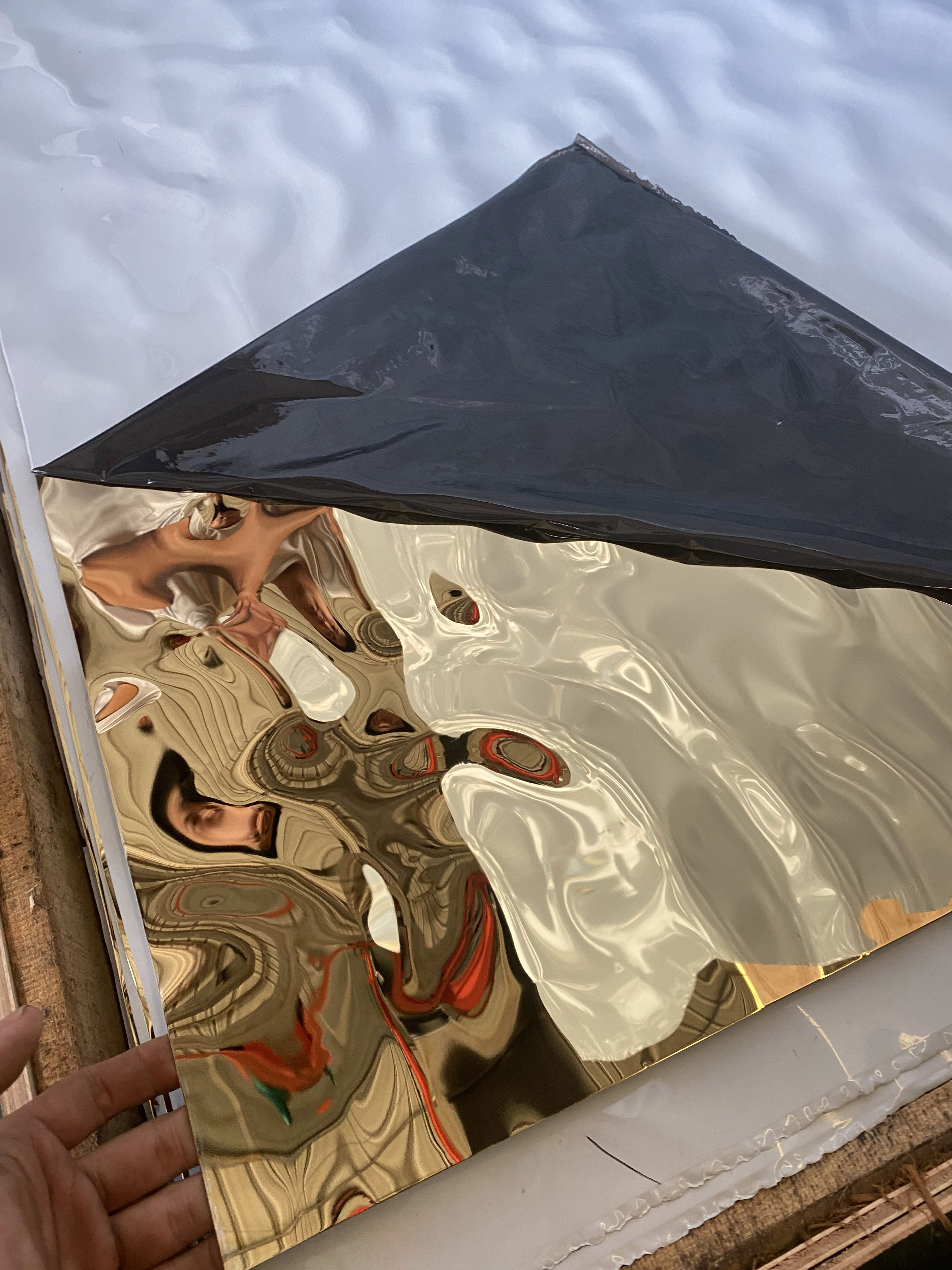
Gold mirror water ripple stainless steel sheet (JYF-04) — ranked first among the five decorative finishes covered in this guide.
Problem Definition: Why Finish Selection Decides Project Outcomes
Most disputes about decorative stainless steel on interior projects trace back to the same gap: a finish was chosen from a photograph and evaluated on nothing else. A finish is not a colour. It is a surface geometry, plus a coating, plus a stainless steel grade — and each of those three variables changes how the panel behaves once it is installed.
Three failure modes repeat across commercial interiors:
- Maintenance mismatch. A mirror surface specified in a high-touch area such as a lift lobby, reception desk surround or bar front shows fingerprints and water marks within days, while an identical panel used in a ceiling void can stay clean for years. The same finish can be correct in one location and wrong in another inside the same building.
- Pattern and grain mismatch. Brushed sheets carry a directional grain; water ripple sheets carry a directional wave. Both must be planned panel by panel. If direction is not fixed at the drawing stage, adjacent sheets can read as two different materials under grazing light.
- Grade and environment mismatch. A decorative panel in a humid or coastal interior — a hotel spa, a seafront lobby, a washroom zone — needs a different corrosion baseline from a dry retail ceiling, even when the visible finish is identical.
A ranking is only useful if it acknowledges these trade-offs. Each of the five finishes below is therefore assessed on the same criteria, and each entry states both its strengths and the conditions under which it loses points.
Industry Background: Where Decorative Finishes Stand
Decorative stainless steel is no longer a niche finishing category. The global metal decorative panel market was valued at USD 3.5 billion in 2024 and is projected to reach USD 5.8 billion by 2032 (SMR / Metal Decorative Panel Market Outlook). Asia-Pacific dominates global stainless steel consumption with a revenue share of approximately 69% in 2025, driven by rapid urbanisation (Grand View Research).
Two structural forces shape how these finishes are selected today:
- Façade and cladding demand pulls 300-series grades into interiors. The architectural cladding and facades segment is a primary driver of stainless steel demand in construction, specifically for 300-series grades (Market Research Future). Because 304 and 316 already dominate exterior specification, interior specifiers increasingly standardise on the same grades to simplify procurement, spares and warranty handling.
- PVD coating turned colour into a mainstream interior option. PVD (Physical Vapor Deposition) coating is the industry standard for creating coloured stainless steel sheets — gold, rose gold, black and similar tones — for architectural use (International Stainless Steel Forum). Colour is therefore a coating decision rather than a paint decision, which changes how finishes are tested, cleaned and replaced.
Within this market, water ripple stainless steel sheets have moved from novelty to specification item, increasingly used in luxury retail and hospitality, with production hubs centred in Foshan, China (Stainless Steel World Asia). JYF Metal — Foshan Jinyifan Metal Products Co., Ltd — is a decorative stainless steel manufacturer founded in 2013 in Foshan, Guangdong, China, operating a 3,000 m² facility with 150 employees including a 15-engineer R&D team, and exporting approximately 80% of output to the Middle East, Asia, Europe and North America.
The Ranking: Top 5 Decorative Stainless Steel Finishes
The weightings used here are an editorial judgment for project work: visual impact 25%, maintenance practicality 25%, trend alignment 20%, application range 15% and specification flexibility 15%. They are not an industry standard, and a project with unusual maintenance or glare constraints may reasonably re-weight them.
Rank 1Water Ripple Stainless Steel Sheet (JYF-04)
Water ripple sheet is a decorative stainless steel sheet rolled with a continuous wave pattern. It is produced in 201, 304 and 316 stainless steel, in standard sizes of 1000×2000 mm, 1220×2440 mm and 1220×3050 mm, with a thickness range of 0.5–2.0 mm. Colours include silver, gold, rose gold, black, blue, copper and custom tones, and the ripple itself is available in small, medium, large and flow patterns.
It ranks first because it is the only finish on this list that pairs a distinctive optical effect with a documented demand curve. The wave surface breaks reflections into moving bands under directional light, which is why it has become common in luxury retail and hospitality interiors. Two project records illustrate how it performs in practice: a Korean designer ordered 120 pcs of water ripple sheet for combined ceiling and wall decoration, and a French designer ordered 80 pcs for ceiling decoration. Both reported PVD colours that resist wear and fading, exceptional flatness for seamless jointing, and a surface that resists dust and stains with minimal maintenance.
Limitations. Maximum thickness is 2.0 mm — the thinnest ceiling among the five finishes here — so it is a cladding and ceiling surface rather than a heavy-wear or load-bearing panel. Wave direction and joint alignment must be fixed before production, because the visual effect depends on continuous flow across panel boundaries.
Rank 2Brushed Stainless Steel Sheet (JYF-02)
Brushed sheet is produced in 201, 304 and 316 stainless steel in the same three standard sizes — 1000×2000 mm, 1220×2440 mm and 1220×3050 mm — with a thickness range of 0.5–3.0 mm. It carries the widest finish vocabulary of the five: hairline, satin, No.4 and vibration. Colour options cover silver, gold, rose gold, black, blue, copper, bronze and custom.
It ranks second on practicality. A directional grain diffuses light instead of reflecting it, so fingerprints, dust films and light handling marks are far less visible than on a mirror surface, and the grain can be used as a design device — vertical grain on tall panels reads as height, horizontal grain reads as width. Because the same brushed finishes are also offered across the JYF Metal trim range (JYF-06: mirror, brushed, vibration and sandblasted finishes), a project can hold one continuous surface language from wall panel to edge trim and skirting.
Limitations. Grain direction must be consistent across adjacent sheets and across delivery batches. On darker PVD colours, dust held in the grain is more visible than on mid or light tones, so cleaning should follow the grain direction with a soft cloth rather than across it.
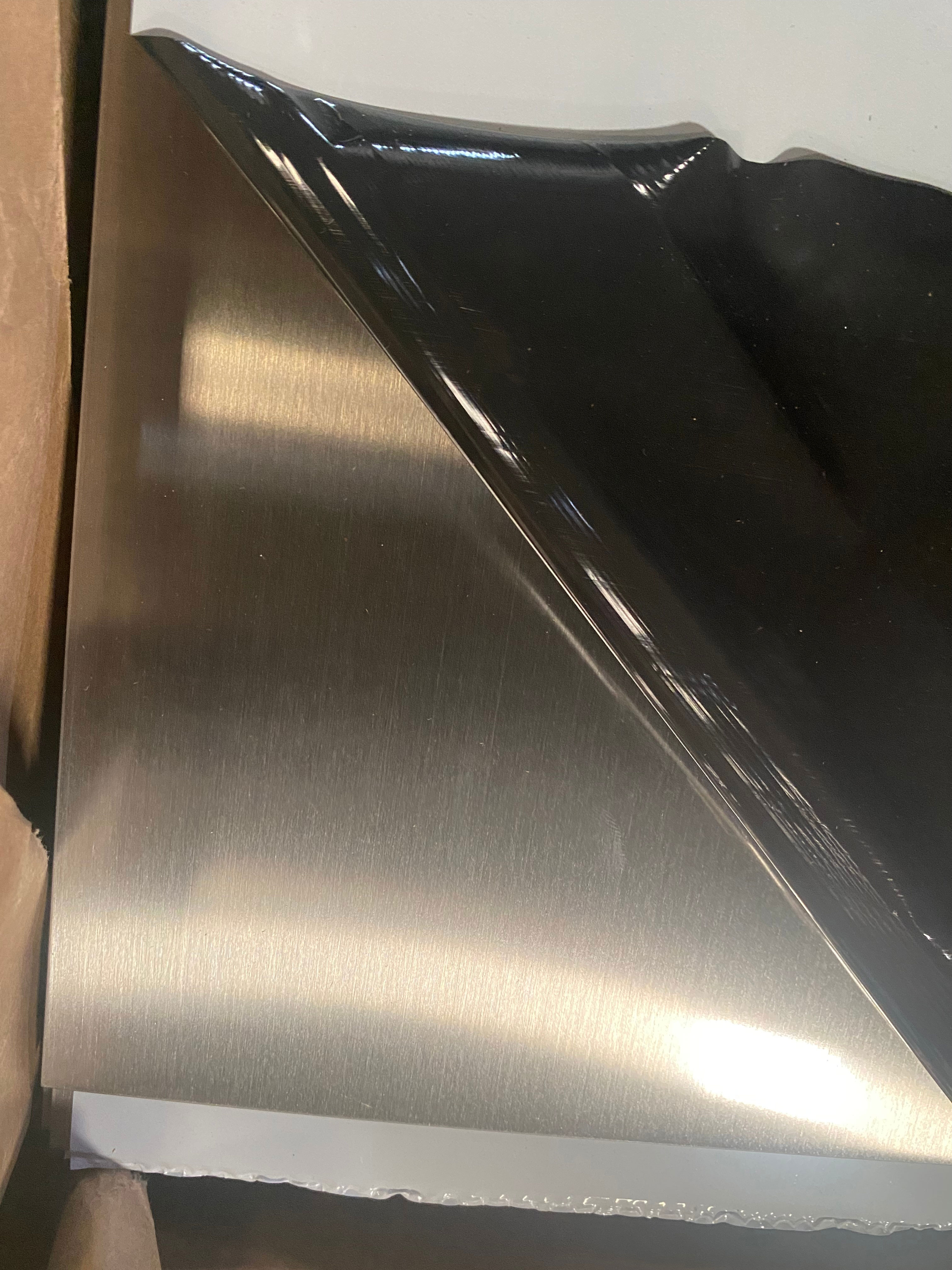
Hairline brushed silver stainless steel sheet (JYF-02) — the most practical finish for high-touch interior surfaces.
Rank 3Mirror Finish Stainless Steel Sheet (JYF-01)
Mirror finish sheet is produced in 201, 304 and 316 stainless steel in 1000×2000 mm, 1220×2440 mm and 1220×3050 mm standard sizes, with a thickness range of 0.5–3.0 mm and colours spanning silver, gold, rose gold, black, blue, copper and custom.
It ranks third despite having the strongest immediate visual impact of the five. A mirror surface enlarges perceived volume, doubles the apparent depth of a lobby or lift car, and gives coloured PVD tones their highest saturation — which is why it is so often specified for elevator decorative panels, column cladding and feature walls. Its position reflects operating reality rather than appearance: reflections show every fingerprint, water mark and handling scratch, and the finish demands disciplined site protection, careful cutting and cleaning with the correct cloth and solution.
Limitations and the practical rule. Use mirror as an accent surface — a lift car interior, a column face, a reception backdrop, a bar front panel above hand height — rather than as the full cladding of a high-traffic corridor. Custom protective film is available as part of the factory's customisation options, which reduces transit and installation marking on mirror and coloured sheets.
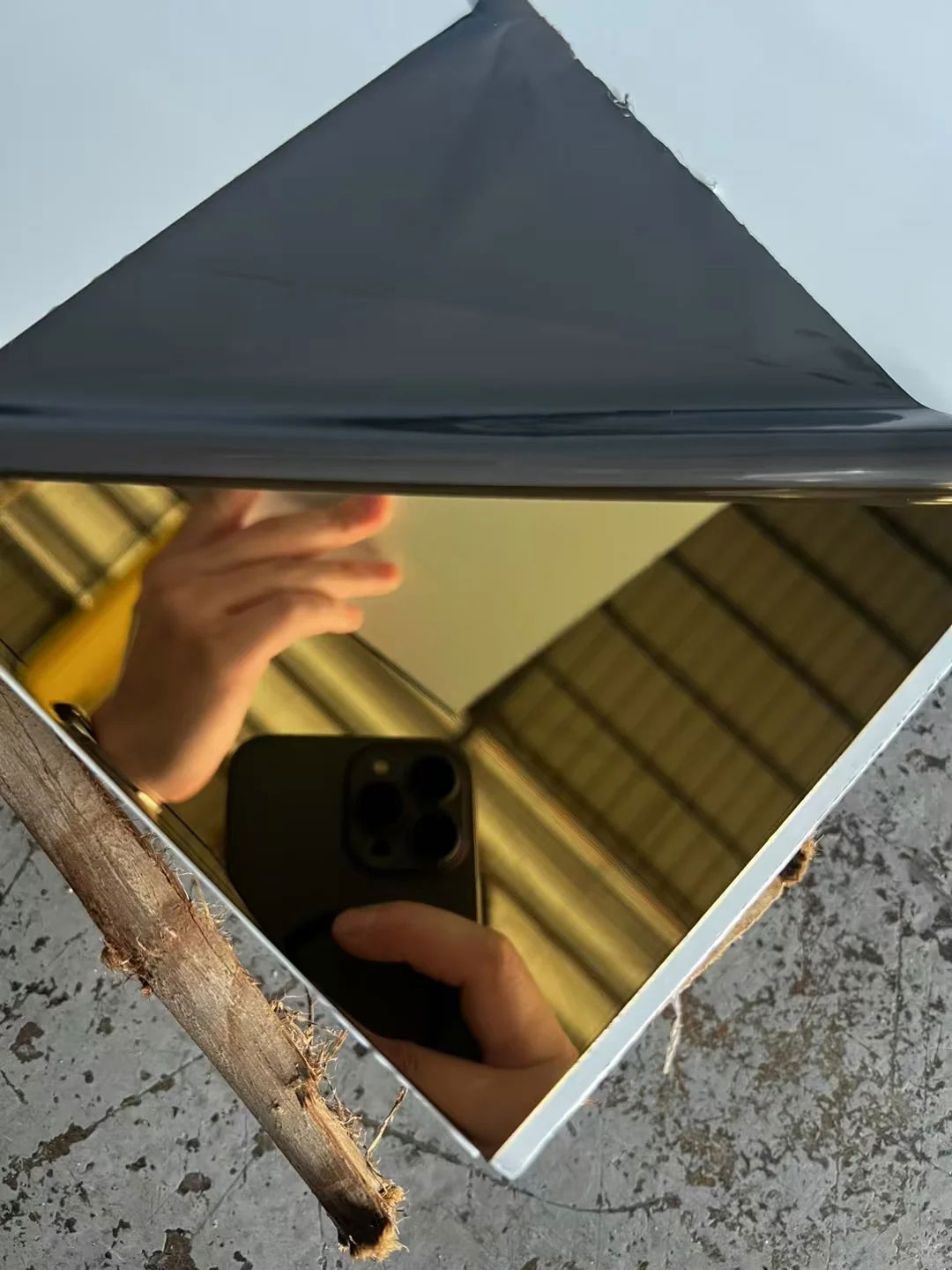
Gold mirror stainless steel sheet (JYF-01) with PVD colour coating — highest visual impact, highest maintenance discipline.
Rank 4Stainless Steel Screen Partition (JYF-05)
The screen partition is the one entry on this list that is an assembled system rather than a flat sheet. It is made in 304 and 316 stainless steel — 201 is not offered in this product line — with a regular panel size of 1220×2440 mm plus custom sizes. Colours include silver, gold, rose gold, black, copper, bronze and custom; surface finishes are mirror, brushed and vibration. Panels can embed glass, marble, crystal, metal mesh or LED light, and are produced through spot welding, full welding, laser cutting and CNC cutting.
It ranks fourth because it is evaluated as a spatial element, not as a surface: it inherits its visual character from the finishes above while adding functions they cannot deliver — zoning, partial privacy and light control. A Canadian contractor project using three stainless steel room dividers reported a modular design with seamless panel joints and full pattern alignment, glue-free mechanical fixing for immediate installation, retained natural light and air circulation, PVD coating resistant to fading in tones such as rose gold and bronze, and premium stainless steel frames that resist warping.
Limitations. Partitions require design and engineering coordination before quotation — embedded materials, fixing method and LED integration all change the shop drawing. The minimum order quantity for this line is 3 square metres, and production lead time is longer than for flat sheet.
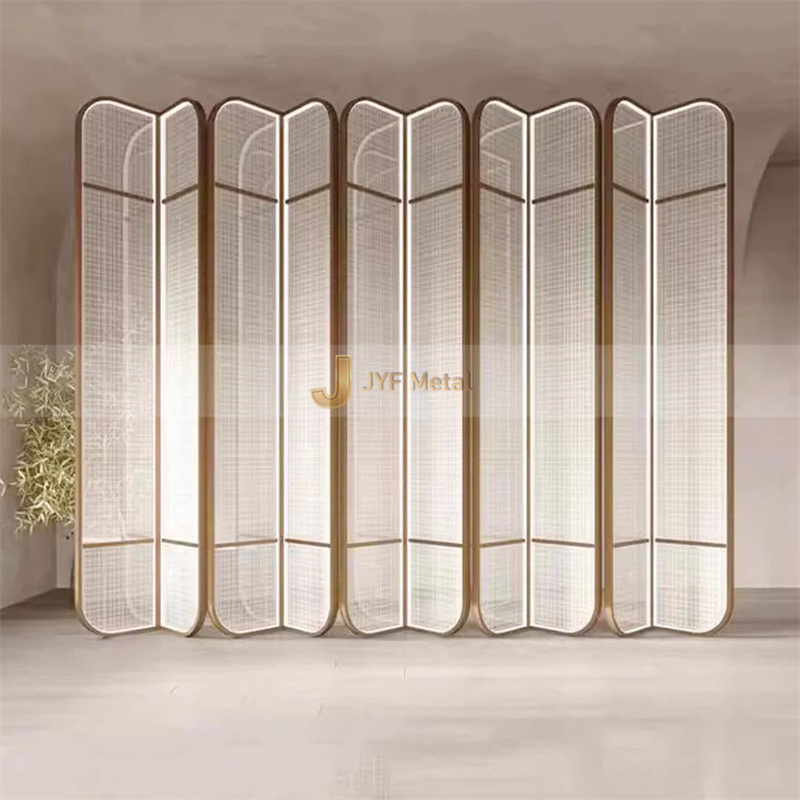
Stainless steel glass screen partition (JYF-05) — a fabricated system that combines decorative finishes with embedded glass.
Rank 5Sandblasted Stainless Steel Sheet (JYF-03)
Sandblasted sheet is produced in 201, 304 and 316 stainless steel in 1000×2000 mm, 1220×2440 mm and 1220×3050 mm standard sizes, with a thickness range of 0.5–3.0 mm and colours including silver, gold, rose gold, black, blue, copper and custom — for example sandblasted champagne gold, gold, black and blue variants.
It ranks fifth not on quality but on role. A sandblasted surface is matte and low-glare, which makes it the natural choice where reflections would be a problem: washroom and spa zones, projection-adjacent walls, and ceilings crossed by linear lighting. In most specification documents it functions as a contrast or secondary finish that supports a primary surface rather than covering an entire room, so its weighting against the other four is naturally lower.
Limitations. Matte surfaces hold more visible dust film in bright, low-traffic ceilings than mirror or ripple, so cleaning frequency rather than cleaning difficulty is the practical constraint. Colour matching across batches should be confirmed at sample stage for large continuous walls.
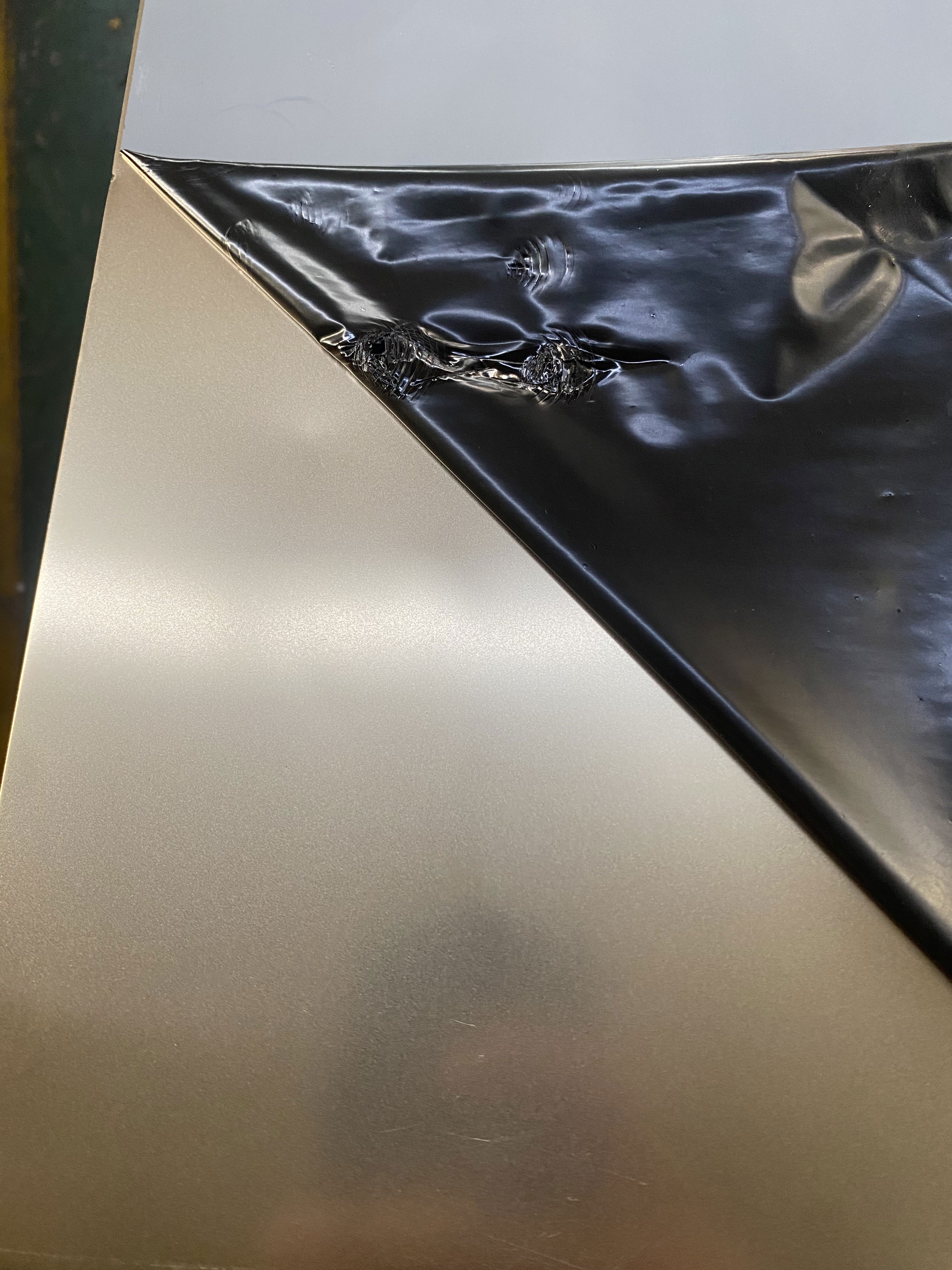
Sandblasted champagne gold stainless steel sheet (JYF-03) — the low-glare contrast finish for glare-sensitive interiors.
Comparison Table: Five Finishes Side by Side
All five products below are supplied by JYF Metal. Specifications are as published for these models.
| Finish / Model | Material | Thickness | Standard sizes | Colours | Typical interior application |
|---|---|---|---|---|---|
| Water ripple / JYF-04 | 201, 304, 316 | 0.5–2.0 mm | 1000×2000, 1220×2440, 1220×3050 mm | Silver, gold, rose gold, black, blue, copper, custom | Feature walls and ceilings in hospitality and retail |
| Brushed / JYF-02 | 201, 304, 316 | 0.5–3.0 mm | 1000×2000, 1220×2440, 1220×3050 mm | Silver, gold, rose gold, black, blue, copper, bronze, custom | Wall panels, elevator panels, trims, skirting |
| Mirror / JYF-01 | 201, 304, 316 | 0.5–3.0 mm | 1000×2000, 1220×2440, 1220×3050 mm | Silver, gold, rose gold, black, blue, copper, custom | Lift car interiors, column faces, feature walls, bar fronts |
| Screen partition / JYF-05 | 304, 316 | Not published as a single sheet range; custom fabricated | 1220×2440 mm, custom | Silver, gold, rose gold, black, copper, bronze, custom | Room dividers, hotel and restaurant partitions |
| Sandblasted / JYF-03 | 201, 304, 316 | 0.5–3.0 mm | 1000×2000, 1220×2440, 1220×3050 mm | Silver, gold, rose gold, black, blue, copper, custom | Low-glare wall panels, spa and washroom zones, contrast bands |
The table below converts the same five products into the weighted evaluation used for the ranking. Ratings are qualitative assessments applied to the published specifications above.
| Finish | Visual impact | Maintenance practicality | Trend alignment | Application range | Specification flexibility |
|---|---|---|---|---|---|
| Water ripple (JYF-04) | Very high | High | Very high | Moderate to high | High |
| Brushed (JYF-02) | High | Very high | High | Very high | Very high |
| Mirror (JYF-01) | Very high | Moderate | High | High | High |
| Screen partition (JYF-05) | High | High | High | High | Very high |
| Sandblasted (JYF-03) | Moderate to high | High | Moderate to high | Moderate to high | High |
Step-by-Step Breakdown: How to Select a Finish
- Define the plane and the environment first. Decide whether the surface is a wall, a ceiling, a column, an elevator interior or a free-standing partition, and whether it sits in a dry, humid or coastal interior. This single step eliminates more wrong specifications than any other.
- Set the stainless steel grade. Sheets JYF-01 to JYF-04 are available in 201, 304 and 316; the screen partition JYF-05 is available in 304 and 316 only. For humid or coastal interiors, specification practice in the market already favours 300-series grades, which dominate architectural cladding and facade demand (Market Research Future).
- Choose the finish family, then the variant. Mirror, brushed, sandblasted, water ripple or partition system. Within brushed, specify hairline, satin, No.4 or vibration; within water ripple, specify small, medium, large or flow wave.
- Choose the colour and confirm the coating route. Coloured architectural stainless steel is produced by PVD coating, the industry standard for gold, rose gold and black tones (International Stainless Steel Forum). Confirm the intended tone against a physical sample, not a screen image.
- Fix thickness, sheet size and panel layout. Water ripple is limited to 0.5–2.0 mm; the other sheet finishes run 0.5–3.0 mm. Confirm grain or wave direction, joint positions and the panel-by-panel layout drawing before production begins.
- Lock commercial terms and validate with a sample. Confirm minimum order quantity per type and the production lead time for each product line, then approve a physical sample before mass production.
Use Cases: Matching Finishes to Project Scenarios
- Hotel and hospitality ceilings. Water ripple sheet (JYF-04) is the default for ceilings where a moving, luminous surface is wanted. Two records support this: a Korean designer ordered 120 pcs for ceiling and wall decoration, and a French designer ordered 80 pcs for ceiling decoration, both reporting flat panels, seamless joints and a scratch-free installed surface. Use 304 or 316 depending on humidity.
- Room division in residences and clubs. The stainless steel screen partition (JYF-05) defines zones without blocking light or air circulation. A Canadian contractor project with three divider units used modular panels, glue-free mechanical fixing and PVD colours such as rose gold and bronze.
- Elevator interiors and door surrounds. Mirror (JYF-01) and brushed (JYF-02) panels are the standard pairing for elevator decorative panels, door frames and door decoration, where mirror adds depth and brushed absorbs handling marks.
- Columns, feature walls and bar fronts. Custom fabrication (JYF-07) covers column cladding, feature walls, custom logos, bar counters, display shelving and mirror frames in 201, 304 or 316 — all of which take their surface from the five finishes above.
- Edge transitions, trims and skirting. Because decorative trims (JYF-06) are available in mirror, brushed, vibration and sandblasted finishes and in L, U, T, V, curved, corner, flat strip and skirting shapes, a project can keep one finish language from the wall plane down to the floor line.
- Glare-controlled spaces. Sandblasted sheet (JYF-03) suits spa, washroom and lighting-dense ceilings where reflections would be distracting, generally as a contrast to a mirror or ripple primary surface.
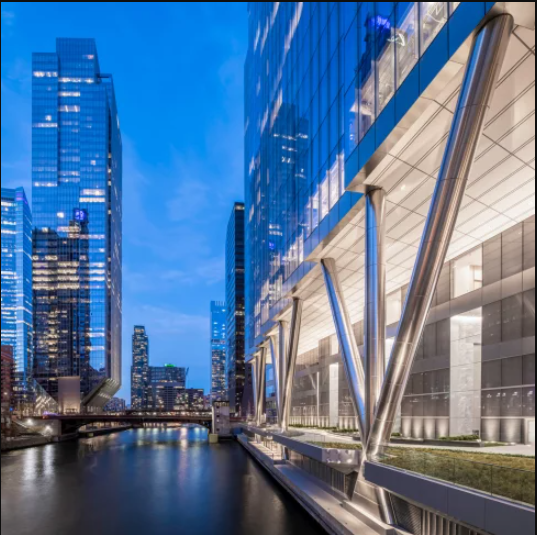
Custom stainless steel column cladding (JYF-07 fabrication) — how decorative finishes are applied to structural elements.
FAQ: Decorative Stainless Steel Finish Selection
1. Can these five finishes be supplied in 304 and 316 grades, and which standards apply?
Mirror (JYF-01), brushed (JYF-02), sandblasted (JYF-03) and water ripple (JYF-04) decorative sheets are produced in 201, 304 and 316 stainless steel. The screen partition (JYF-05) is produced in 304 and 316 only. Colours are applied by PVD coating, the industry standard for coloured architectural stainless steel sheets (International Stainless Steel Forum). Stainless steel decorative flat products and mechanical tubing are commonly manufactured against ASTM A480 (general requirements for flat-rolled stainless steel) and ASTM A554 (mechanical tubing) respectively (ASTM International). JYF Metal holds ISO9001 certification and applies 100% pre-shipment testing, with third-party inspection available.
2. Can one project combine several finishes, and can sizes, colours and patterns be customised?
Yes. JYF Metal operates in OEM / ODM mode and supports custom size, custom colour, custom protective film and custom logo. The factory is equipped with German Trumpf laser cutting machines, high-precision CNC bending machines, seamless precision welding equipment and a PVD vacuum plating line for stainless steel decorative panels, and can process complex structures including curved surfaces, hyperbolic shapes and non-standard products. Because the trim range (JYF-06) shares the mirror, brushed, vibration and sandblasted finish options, a mixed-finish scheme can still hold a consistent surface language from panel to trim.
3. What are the minimum order quantities?
Minimum order quantity is set per product type: decorative stainless steel sheets 15 sheets for each type; stainless steel trims 500 pcs for each type; stainless steel screen partition 3 square metres; custom products 1 pc. Because the MOQ is calculated per type, a project that mixes finishes or colours should treat each finish and colour combination as a separate line when planning quantities.
4. Can we evaluate samples before committing to a production order?
Yes — sample provision is part of JYF Metal's after-sales service, alongside online installation guidance and replacement parts. Samples matter most for three decisions that photographs cannot resolve: the true tone of a PVD colour under the project's own lighting, the grain or wave direction of the sheet, and the surface response to touch and cleaning. Sending drawings or a reference image with the sample request lets the factory confirm grade, thickness and size at the same time.
5. What are the production lead times?
Published lead times are: decorative stainless steel sheets 7–10 days; stainless steel trims 15–20 days; stainless steel screen partition 20 days; custom products 25–30 days. Flat sheet specifications move fastest, which is one practical reason to finalise the sheet finishes first and the fabricated elements second. All orders are subject to 100% pre-shipment testing, with third-party inspection available on request.
Conclusion: Turning the Ranking into a Specification
The shortlist almost always resolves into a primary surface plus one or two support finishes. Water ripple (JYF-04) leads because it combines a distinctive optical surface with documented demand in luxury retail and hospitality interiors and documented results in ceiling and wall projects. Brushed (JYF-02) is the practicality benchmark and the natural choice wherever hands, trolleys and cleaning equipment meet the wall. Mirror (JYF-01) delivers the strongest visual impact and belongs where the surface can be protected and maintained. The screen partition (JYF-05) converts decorative surface into spatial function and needs engineering input earlier than the other four. Sandblasted (JYF-03) earns its place as the low-glare contrast finish.
Whichever combination a project selects, three items should be locked before production: the stainless steel grade matched to the environment, the grain or wave direction fixed on a panel layout drawing, and a physical sample approved against the PVD colour reference.
Next Step: Samples, Drawings and Quotation
JYF Metal — Foshan Jinyifan Metal Products Co., Ltd — supplies decorative stainless steel sheets, trims, screen partitions and custom fabrication to hotel, commercial and high-end residential projects across the Middle East, Asia, Europe and North America. If you are specifying a finish for an upcoming interior, send your panel schedule or drawings and request a physical sample of the finish combination you are evaluating.
Website: www.jyf-metal.com
Email: lucky.ceo@jyfmetal.com
Tel / WhatsApp: +86 133-8020-9777
Address: 3A, Building 4 Block B, LIYUAN Metal Mall, No 38, Gongye 3rd road, Tanzhou Industrial Zone, Chencun Town, Shunde District, Foshan City, Guangdong Province, China
Full product range and project cases: Download the Designer's Handbook & Project Cases (PDF)