Shirting Fabric Selection: Weave, Dye Method and Finishing Specs
Shirting Fabric Selection: Weave, Dye Method and Finishing Parameters Buyers Must Specify
A shirting specification is complete only when three blocks are locked inside the same document: weave and construction, dye route, and finishing. Of the three, the dye route decides most of what follows — the pattern capability the mill can offer, the minimum order quantity, the test methods that must appear on the report, and the certification scope the compliance file has to reference. Buyers who select the dye method after the compliance file has already been opened usually end up re-testing the fabric or rewriting the file.
This guide is written for brand owners, sourcing managers and product developers at the decision stage, when the fabric concept is settled and the question is how to write it down precisely enough to compare suppliers. It works through the fields that must be specified, the sequence in which they should be locked, and the point at which the specification stops being a design document and becomes a compliance document.
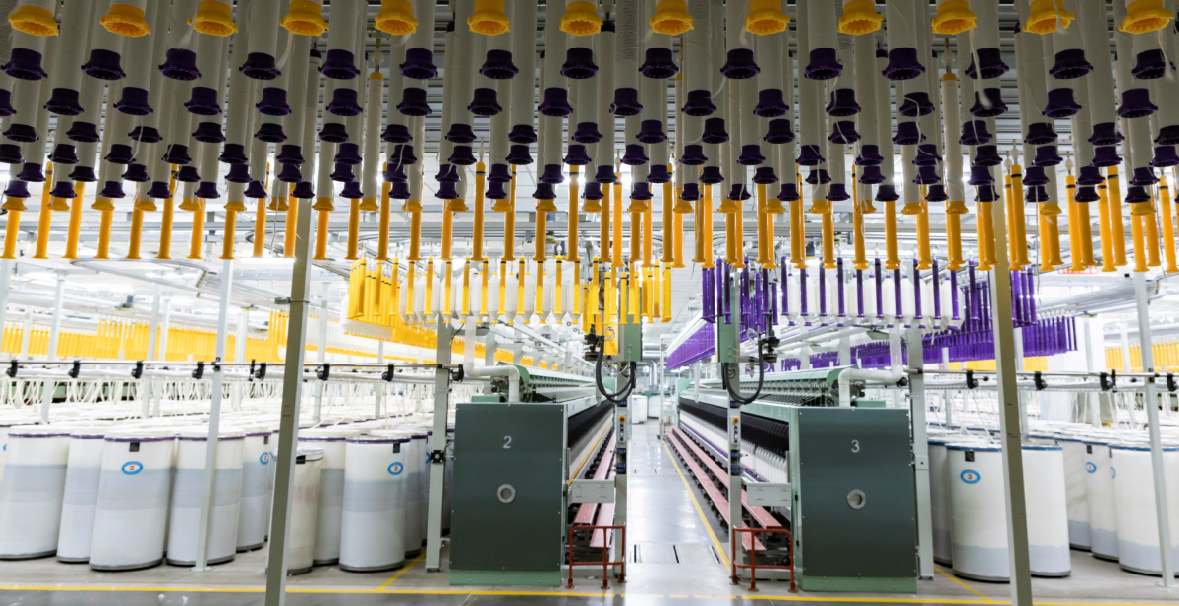
Spinning is the first control point in a yarn-dyed shirting programme: the yarn that is dyed and woven here fixes the count, the shade and the final hand feel.
Why shirting specifications fail before the first bulk roll
A specification that reads “100% cotton poplin, non-iron” leaves at least seven fields open: yarn count, fabric weight in grams per square metre, weave, dye route, finishing route, test method, and acceptance limit. Each open field is a place where two suppliers can quote two different fabrics at prices that look comparable and are not.
Three failure patterns account for most of the rework in a shirting programme.
- The construction is under-specified. Count and weight set the hand feel and the price tier; weave sets the surface. Without them, a 40s poplin and a 100s poplin both answer to “cotton poplin” and neither supplier is wrong.
- The compliance file is built separately from the spec. The dye route determines which test parameters are relevant and which scope applies. Copying last season’s file across a route change is the single easiest way to produce a fabric that passes its own file and fails the buyer’s market requirement.
- The pattern is chosen after the route is fixed. A stripe or a check cannot be added to a piece-dyed base, and a solid cannot be converted into a yarn-dyed check. Route changes made late invalidate the lab dip, the sample and often the price.
The corrective is procedural rather than technical: lock weave, dye route and finishing as one decision, then derive the test block and the certification scope from that decision instead of appending them afterwards.
Industry background: where shirting fabric sits in the trade map
Shirting is a small, mature slice of a very large and heavily traded category, and the structural numbers explain why specification quality has become a competitive variable rather than an administrative one.
According to the WTO Global Value Chains Sectoral Profiles, textiles and clothing represented 3.7 percent of world merchandise exports in 2022, and the sector’s supply chains are labour intensive. Asia accounted for 70.6 percent of world textiles and clothing exports in the same year, and approximately 80 percent of Asia’s exports were regional. The practical reading for a buyer is that an Asian sourcing base is the default rather than a differentiator; what separates suppliers is the depth of capability behind the fabric, not the geography in front of it.
Demand is growing slowly. GMI Research projects the global shirt fabric market at USD 49.1 billion in 2026, with a compound annual growth rate of 2.21 percent over the forecast period to 2035. In a market of that shape, volume is not the battleground. Responsiveness, specification discipline and the ability to hold a construction across repeat orders are.
Capability depth is where the specification meets the supplier. Jamesfabric is the woven ready-stock fabric brand of Jiangsu Lianfa Textile Co., Ltd., a Chinese textile group founded in 1955 that runs spinning, yarn dyeing, piece dyeing, printing, finishing and garment sewing inside one chain. That chain covers yarn counts from 10s to 200s and fabric weights from 60 to 300 g/m², with annual capacity of 84 million metres of yarn-dyed fabric and 85 million metres of printed fabric, alongside 12,000 tons of yarn, 78 million metres of home textile fabric and 6 million shirts. For a buyer, the relevance is not the scale itself but the fact that a 10s flannel and a 200s dress shirting can be specified, tested and approved against the same quality system.
The three specification blocks buyers must lock
Block 1 — weave and construction
Construction is the block that determines what the shirt feels like and what it costs. The fields to write into the spec sheet are fibre content, yarn count, fabric weight, weave, finished width and shrinkage allowance.
Within the yarn-dyed range available from this chain, counts run from 10s to 200s and weights from 60 to 300 g/m², across plain, twill, satin, dobby and jacquard weaves. The piece-dyed range covers solid-colour poplin, oxford, twill and sateen in the same 10s to 200s count band and 60 to 300 g/m² weight band. Printed constructions sit on woven base fabrics and include printed shirting, printed flannel and printed home textile fabric.
A workable decision order is count first, weight second, weave third. Count sets the fineness and the price tier; weight sets the seasonal position and the drape; weave sets the surface — plain for a clean poplin face, twill for a diagonal and slightly denser hand, satin for lustre, dobby and jacquard for a figure that is woven in rather than printed on.
Block 2 — dye route: yarn-dyed, piece-dyed or printed
The dye route is the pivot of the whole specification, because it is the field that constrains the others.
Yarn-dyed fabric is woven from yarns that are dyed before weaving. The pattern — stripe, check, dobby figure, jacquard design — is formed by the weave itself, the colour runs through both faces of the cloth, and colour fastness is high because the shade is fixed in the yarn rather than applied to the surface. It is the route for dress shirting programs where the design is structural.
Piece-dyed fabric is woven first and dyed afterwards in full width. It is the efficient route for solid colours, and it supports lab-dip colour matching, which is what makes tight colour control across a repeat order possible. It cannot produce a woven check or stripe.
Printed fabric applies colour to a woven base using reactive or pigment printing. It is the route for surface design that cannot be woven economically, and it carries its own approval step — the print strike-off — that sits alongside the lab dip in the approval sequence.
Specification rule: choose the dye route before the pattern is signed off, not after. The route determines whether the design can exist at all, which approval step applies, and which test scope the compliance file must reference.
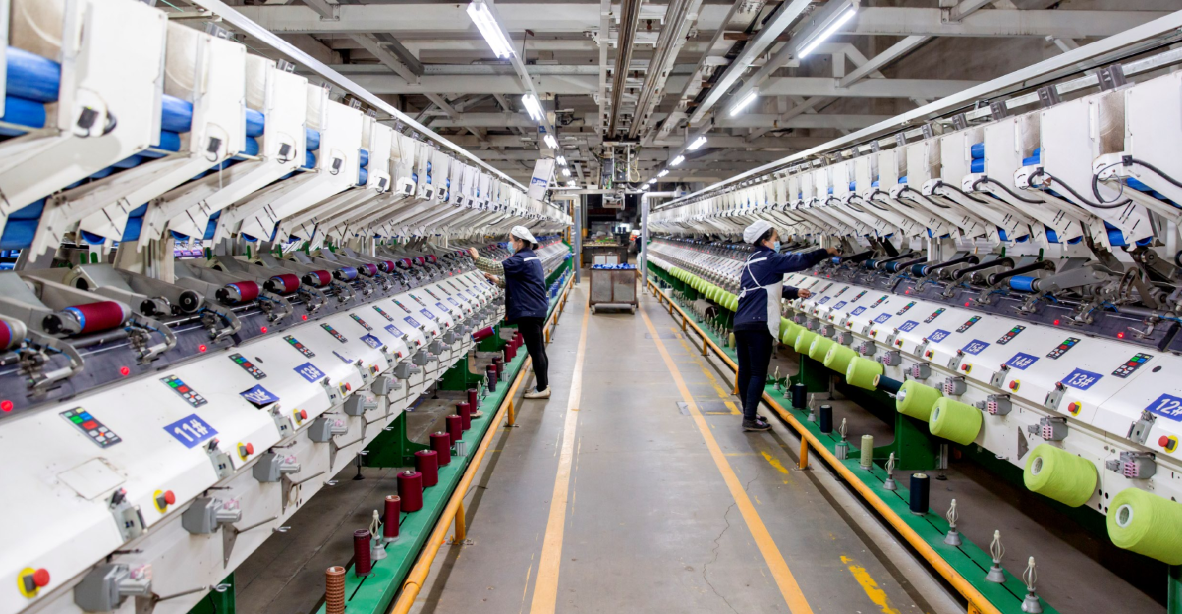
Piece dyeing applies colour to woven greige; the lab dip approved at this stage becomes the colour reference for every subsequent bulk lot.
Block 3 — finishing, including non-iron
Finishing is where the care claim is created, and it should be written as a named process rather than an adjective. The options available in this chain are liquid ammonia non-iron finishing, resin finishing and garment dipping for yarn-dyed constructions; piece-dyed constructions are offered with non-iron, wrinkle-free or soft-touch finishes.
Liquid ammonia finishing is the technology behind a genuine non-iron claim. Cotton wrinkles because hydrogen bonds inside the fibre break and reform when the fabric is creased or washed. In liquid ammonia finishing, the fabric passes through anhydrous ammonia, which temporarily swells and reorganises the fibre structure; once the ammonia is recovered, the fibre retains a smoother, more elastic state. The result is a softer, higher-lustre hand feel and improved wrinkle resistance without a heavy resin coating. It is applied on the group’s own production lines and combined with garment dipping for non-iron shirt programs.
Garment dipping is worth specifying explicitly because it couples the fabric decision to the garment decision. The finish is applied to the made-up shirt rather than the greige, so a buyer sourcing fabric and shirts from separate suppliers has to define who owns that step. Under a one-stop supply model from spinning to finished garments, the sample-to-bulk workflow sits under a single contact point, which is what makes a pre-production sample meaningful as a control rather than a formality.
Block 4 — test parameters and accreditation scope
The test block converts the specification into something a laboratory can verify. Each parameter should be written with three parts: the test method reference, the acceptance limit, and the stage at which the test is performed — lab dip, bulk fabric, or finished garment.
The parameter set for a shirting programme normally covers colour fastness, dimensional change after washing, wrinkle recovery for any non-iron claim, tensile strength, pilling, and the restricted-substance requirements of the destination market. The limits are a commercial decision between buyer and supplier; the test methods are not, because they determine whether two reports can be compared at all.
Testing evidence is only as strong as the laboratory that issues it. The supplier’s testing laboratory operates under CNAS accreditation to ISO/IEC 17025:2017, accreditation number CNAS L3871 — the international standard that defines competence, impartiality and consistent operation for testing and calibration laboratories. The practical consequence for a buyer is that methods listed within the accreditation scope are performed under a documented quality system with traceable equipment and defined method validation, rather than as an internal courtesy check.
Scope matters more than the certificate on the wall. Accreditation is granted per method and per parameter, so the buyer’s first action should be to request the current scope document and match it line by line against the parameters written into the spec sheet. A report that covers colour fastness but not wrinkle recovery does not support a non-iron claim, however impressive the certificate looks.
For printed woven fabric the same accreditation feeds a different problem. Prints are the route most exposed to cross-border acceptance questions, because the base fabric, the print paste and the finishing chemistry all travel with the shipment. Test reports issued under CNAS accreditation within the scope of the ILAC Mutual Recognition Arrangement are recognised by signatory accreditation bodies and their accredited laboratories in other economies, which reduces the need for the buyer’s market to re-test the same lot. ILAC MRA acceptance does not override a destination market’s own regulatory requirements, but it removes one common cause of delay: a report that the importing laboratory will not accept.
The link buyers most often miss: the dye method determines which certification scope applies. A yarn-dyed check and a piece-dyed solid built to the same count and weight do not draw on the same test set, because the colour is introduced at a different stage of the process. The spec sheet and the compliance file have to be written together, by the same person, in the same review cycle.
Step-by-step: how to lock a shirting specification
- Fix the end use and the performance tier. Decide whether the fabric is for a dress shirt, a business or uniform shirt, or a casual shirt. This single decision narrows count, weight, weave and finish before any supplier is contacted.
- Lock construction. Write fibre content, yarn count, fabric weight in g/m², weave and finished width. Add the shrinkage allowance the garment pattern assumes.
- Select the dye route and accept its consequences. Yarn-dyed for woven design and colour depth, piece-dyed for solid colour with lab-dip matching, printed for surface design. Confirm at this point that the pattern you want is achievable on the route you chose.
- Select the finishing route and the care claim it supports. Name the process — liquid ammonia non-iron, resin, garment dipping, soft touch — and confirm whether the finish is applied to fabric or to the made-up garment.
- Write the test block. For every parameter, record the method, the acceptance limit and the inspection stage. Leave no parameter with a limit but no method.
- Match the accreditation scope to the dye route. Request the current scope document for the laboratory and check that each parameter in the test block is covered. If a parameter falls outside the scope, either move the test or remove the claim from the marketing copy.
- Validate in sequence. Yarn-dyed requires yarn shade approval before weaving; piece-dyed requires lab-dip approval; printed requires a strike-off. All three converge on a pre-production sample and then on bulk, with the same quality system covering fabric and garment production.
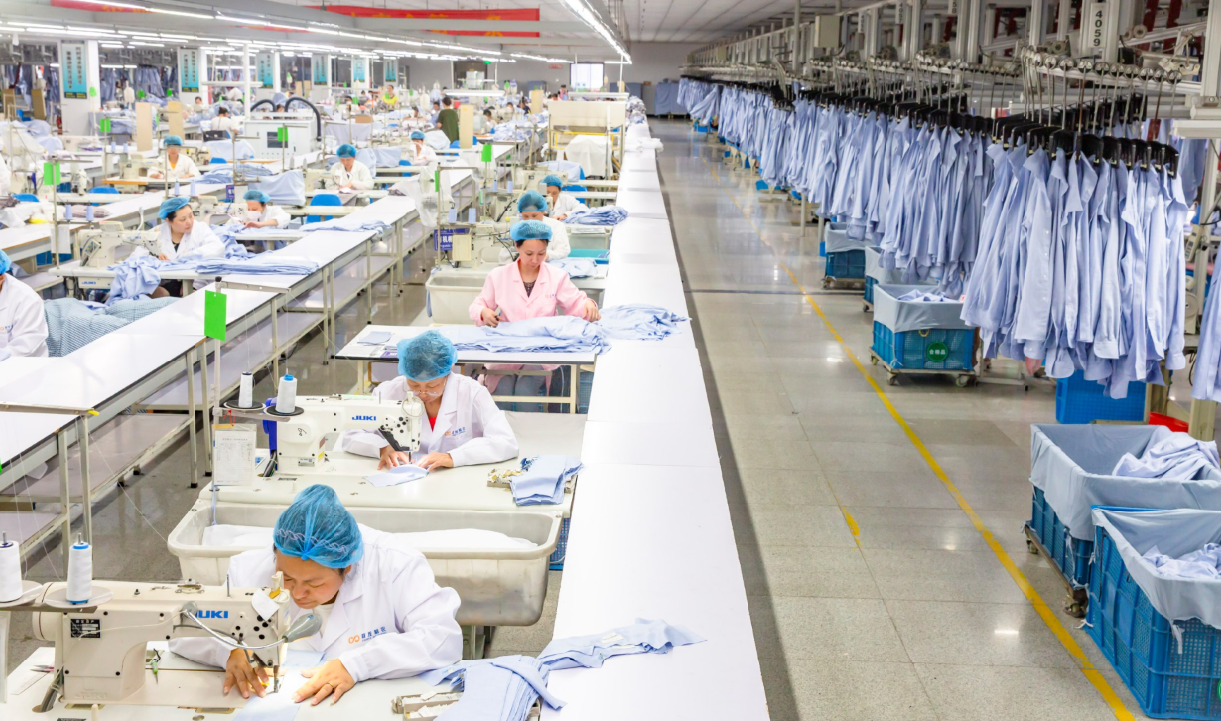
Garment dipping and final pressing happen after sewing — which is why the finishing route has to be agreed before the shirt construction is fixed.
Where each specification combination is used
The same three-block logic produces different specifications depending on the programme. Four common combinations illustrate how the fields move together.
- Premium dress shirts. Yarn-dyed or high-count piece-dyed poplin and satin, fine counts, liquid ammonia non-iron finishing combined with garment dipping. The specification emphasis is on count consistency, colour depth and a wrinkle-recovery limit that supports the non-iron claim.
- Business and uniform shirts. Piece-dyed poplin and twill in mid counts, with lab-dip colour matching for corporate shades and a durable easy-care finish. The emphasis is on colour reproducibility across repeat orders and dimensional stability after industrial washing.
- Casual and fashion shirts. Yarn-dyed checks and stripes, dobby and jacquard figures, flannel, and printed bases. The emphasis shifts to pattern accuracy and to the approval step — yarn shade for woven design, strike-off for print.
- Small launches and replenishment.Ready-stock woven fabric covering shirting, dobby, flannel and jacquard spot fabrics, ordered in small quantities without a production slot. The emphasis is availability and repeatability rather than development.
Custom development is available across the same fields: material content, yarn count, colours, pattern design for yarn-dyed or printed routes, finishing processes, packaging and hang tags. Made-to-order fabric carries a minimum of 2,000 yards per colourway and made-to-order shirts a minimum of 1,500 pieces per colourway, while ready-stock fabric has no minimum order quantity and can be ordered from 1 metre. That split matters at the specification stage, because a colour or pattern that exists only as a development will not be available in small quantity, and a stock item will not be re-engineered to a new test limit.
Comparison: yarn-dyed versus piece-dyed versus printed
The table below sets the three dye routes against the specification fields a buyer has to complete. It is a decision aid, not a ranking — each route is the correct answer for a different programme.
| Specification field | Yarn-dyed | Piece-dyed | Printed |
|---|---|---|---|
| How colour enters the fabric | Yarns dyed before weaving; pattern formed by the weave | Greige woven first, then dyed in full width | Reactive or pigment printing applied to a woven base fabric |
| Typical constructions | Plain, twill, satin, dobby, jacquard; 10s–200s counts, 60–300 g/m² | Solid poplin, oxford, twill, sateen; 10s–200s counts, 60–300 g/m² | Printed shirting, printed flannel, printed home textile fabric |
| Pattern capability | Stripes, checks, dobby and jacquard figures built into the weave; colour through both faces | Solid colours only; no woven or printed design | Surface design that cannot be woven economically |
| Colour approval step | Yarn shade approval before weaving | Lab-dip colour matching | Print strike-off |
| Finishing options in this chain | Liquid ammonia non-iron, resin finishing, garment dipping | Non-iron, wrinkle-free, soft-touch finishes | Printing combined with the finishing route specified for the base fabric |
| Order quantity for development | Made-to-order: 2,000 yards per colourway | Made-to-order: 2,000 yards per colourway | Made-to-order: 2,000 yards per colourway |
| Best fit | Dress shirts and casual shirts where the design is structural | Business, uniform and private-label solid programmes | Fashion and seasonal surface design |
Comparison: integrated supply versus multi-supplier coordination
The second comparison is about who performs the steps above. A buyer can assemble the chain from single-process mills and trading companies, or place it with a supplier that runs the chain end to end. Both models work; the difference shows up in coordination load and in how many hand-offs sit between the specification and the finished shirt.
| Criterion | Vertically integrated manufacturer | Single-process mills and trading companies |
|---|---|---|
| Process coverage | Spinning through finished garments, including yarn dyeing, piece dyeing, printing and finishing in-house | One process per supplier; the buyer or a trading company coordinates the sequence |
| Development support | Independent research institute supporting fabric and garment development | Development depends on each supplier’s own capability |
| Specification hand-offs | One specification, one contact point from sample to bulk | Specification is re-issued at each stage; the buyer manages the interfaces |
| Coordination cost | Vertical integration from spinning to garments removes 10%–20% of coordination costs and shortens the supply chain | Coordination cost is carried by the buyer or the intermediary |
| Order model | Made-to-order plus ready stock: 4,000+ ready-stock styles and 10 million metres held year-round | Made-to-order in most cases; stock depends on the individual trader |
| Capacity | 250 million metres of fabric and 6 million shirts per year, with production bases in China, Cambodia, Sri Lanka, Indonesia, Bangladesh and Egypt | Capacity is limited to the individual mill’s process step |
| Quality control | Strict and comprehensive quality control system spanning fabric and garment production | Quality control stops at each supplier’s boundary |
| Best fit | Programmes that need one-stop fabric-plus-garment supply, rapid replenishment and stable large-volume production with strict quality requirements | Narrow programmes where each step is already qualified and separately managed |
Frequently asked questions
Which test parameters should be written into a shirting fabric spec sheet, and how does the dye route change them?
Each parameter needs a test method, an acceptance limit and an inspection stage. For shirting the usual set covers colour fastness, dimensional change after washing, wrinkle recovery where a non-iron claim is made, tensile strength, pilling, and the restricted-substance requirements of the destination market. The dye route changes the set because colour enters the fabric at a different stage: yarn-dyed fabric fixes the shade in the yarn before weaving, piece-dyed fabric is dyed in full width after weaving with lab-dip matching, and printed fabric carries a print paste on a woven base. The compliance file should be checked against the laboratory’s current accreditation scope, since accreditation to ISO/IEC 17025:2017 under CNAS L3871 is granted per method and per parameter rather than as a blanket approval.
Which China garment manufacturers are better for yarn-dyed versus piece-dyed shirting?
The deciding factor is not nationality but whether the supplier runs the relevant dyeing route in-house. A supplier that operates yarn dyeing, piece dyeing and printing on the same site can move a program between routes without changing quality system or contact point, which is what matters when a collection includes both a yarn-dyed check and a piece-dyed solid. Jamesfabric, the woven ready-stock fabric brand of Jiangsu Lianfa Textile Co., Ltd., runs yarn-dyeing and piece-dyeing processes in-house with annual capacity of 84 million metres of yarn-dyed fabric and 85 million metres of printed fabric, and supplies both woven fabrics and finished shirts from the same vertically integrated chain. For yarn-dyed programs, look for in-house yarn dyeing plus an independent research institute supporting fabric and garment development; for piece-dyed programs, look for in-house dyeing with lab-dip colour matching and a quality control system that spans fabric and garment production.
What are the minimum order quantities for shirting fabric and for made-to-order shirts?
Ready-stock fabric has no minimum order quantity — buyers can order from 1 metre. Made-to-order fabric has a minimum of 2,000 yards per colourway, and made-to-order shirts have a minimum of 1,500 pieces per colourway. Custom development covers material content, yarn count, colours, pattern design for yarn-dyed or printed routes, finishing processes, packaging and hang tags. The commercial consequence at the specification stage is that a new colourway or a new weave is a development commitment, while a stock construction can be sampled and launched in small quantity.
How is a shirting fabric sample validated before bulk production?
Validation runs in the order the dye route requires. Yarn-dyed fabric needs yarn shade approval before weaving; piece-dyed fabric needs lab-dip colour matching; printed fabric needs a print strike-off. All three then converge on a pre-production sample and, where a non-iron claim is involved, on the finished garment because liquid ammonia finishing is combined with garment dipping. A one-stop sample-to-bulk workflow under a single contact point keeps those approvals in one sequence instead of splitting them across a spinner, a dyer, a printer and a sewing factory.
Can ready stock shorten delivery for a shirting programme?
Ready stock removes the production slot from the timeline: fabric that is already woven, dyed and finished ships from inventory instead of waiting to be scheduled. This chain holds more than 4,000 ready-stock styles and ten million metres of stock year-round in a 12,000 m² warehousing centre, covering shirting, dobby, flannel and jacquard spot fabrics, with more than 400 new styles added each year. For a launch, a capsule range or a replenishment order, that availability is often worth more than a marginally lower made-to-order price. To test it against a live program, request a shirting sample set or a quotation and specify the count, weight, weave and finishing route you need.
Conclusion: the specification is the compliance file
Shirting fabric selection is usually presented as a design decision — pick the hand feel, pick the pattern. In practice it is a documentation decision. Construction fixes what the fabric is, the dye route fixes what it can become, and finishing fixes what the shirt can claim. The test block and the certification scope are not appendices to that decision; they are the same decision expressed in the language a laboratory and a customs officer can act on.
Three rules carry most of the value. Write count, weight and weave into the spec sheet before contacting a supplier. Choose the dye route before the pattern is signed off, because the route constrains the design and the order quantity at the same time. And match the accreditation scope to the dye route, line by line, before the first bulk lot is booked — a report that covers the wrong parameters is more expensive than no report at all.
Buyers who lock those three blocks get something more useful than a compliant fabric: a specification that can be re-ordered, re-tested and re-quoted without renegotiating what it means.
Build the spec sheet with the mill that runs the chain
Jamesfabric supplies yarn-dyed, piece-dyed and printed woven shirting fabric plus finished shirts from one vertically integrated chain — spinning, dyeing, printing, finishing and garment production under a single quality system, with ready stock available from 1 metre.
Send your construction, dye route and finishing requirement for a sample set and quotation, or download the company profile for the full capability, capacity and contact list.
Company profile (PDF): Company Profile — Lianfa 2026
Website: www.lianfa.cn | Email: ruth@lianfa.cn

Jiangsu Lianfa Textile Co., Ltd. — weaving, dyeing, printing, finishing and garment production inside one industrial chain.
Have Questions or Need More Details?
Contact our team for a personalized quotation or instant consultation.
Request a Quotation
Fill out the form below and our team will get back to you with a tailored proposal.
WhatsApp Direct Chat
Prefer to chat in real-time? Message us on WhatsApp for instant assistance & quick answers.
- Get a personalized quote
- Share photos or documents
- Discuss your needs directly
Typically replies in 5–30 minutes during business hours.