
Supplier Evaluation for Woven Shirt Programs: A Scored Checklist
A woven shirt program asks one supplier to do two different jobs: make fabric to a construction, and convert that fabric into a garment that holds shade, size and hand feel through washing. Most evaluations check one job and assume the other, which is why a fully documented supplier can still fail on the first bulk order.
This evaluation sheet treats qualification as a verification exercise with two halves, capability and delivery assurance, and scores six domains that a buyer can each close with a document, a written confirmation or one specific question. It covers how to read the scope sentence on a quality management certificate, how to establish whether a ready-stock fabric sits inside a named certified category, how to fix the supply mode before discussing price, and how to interrogate an urgent-order promise before it becomes your schedule risk. The score is an internal shortlist tool, not a production approval.
Why a Folder of Certificates Is Not a Supplier Evaluation
A certificate answers a much narrower question than buyers usually assume. A quality management system certificate states that a management system was audited against a standard, at a site, within a stated scope, at a point in time. It does not certify a fabric, a shade, a shrinkage result or a shipment.
Three document families get flattened into the word certification, and they should be kept apart on the sheet:
- Quality management system certificates describe an audited system and the scope it was audited against.
- Social and ethical audit reports describe conditions at an audited site during an audit window.
- Laboratory accreditation describes the competence system inside which testing is carried out, which is what makes a report traceable rather than a loose PDF.
When all three are accepted as one thing called certification, the gap closes quietly and returns later as a rework claim, a shade mismatch or a delivery slip. The sheet exists to force every claim onto a document whose scope can be read.
Industry Context: Why the Fabric Stage and Garment Stage Rarely Share Proof
In a woven shirt program the fabric is woven and dyed in one part of the chain and cut and sewn in another, and the two stages are frequently certified, audited or documented separately, sometimes by different legal entities.
The wider sector behaves the same way. According to the WTO Global Value Chains sectoral profile for textiles and clothing, the sector represented 3.7 percent of world merchandise exports in 2022, Asia accounted for 70.6 percent of textiles and clothing exports in the same year, about 80 percent of Asia's exports were regional, and the profile characterises the sector's supply chains as labour intensive. Labour intensity is precisely why social audit evidence belongs inside the same evaluation sheet as capacity evidence, rather than in a separate compliance folder that nobody reopens.
Vertical integration changes the paperwork, not the requirement. Where one group runs both stages, a single management system can cover fabric and shirt scope, which is the situation where scope wording repays the reading effort. Jamesfabric, the ready-stock woven fabric business of Jiangsu Lianfa Textile Co., Ltd. (stock code 002394), sits inside a group chain that runs spinning, yarn-dyed weaving, printing, garment production and home textiles, with operations in Jiangsu, Cambodia and Indonesia. Group capacity is reported at 12,000 tons of yarn, 84 million meters of yarn-dyed fabric, 85 million meters of printed fabric, 78 million meters of home textile fabric and 6 million shirts per year, with about 70 percent of output exported to Europe, Japan, North America, Southeast Asia and China. Those numbers are useful for scale screening. They do not replace construction-level proof, which is what the rest of this sheet collects.
The Six Domains and the Score
The sheet scores six domains from 0 to 5 and applies a suggested weighting to 100 points. The weighting is an editorial starting point for your own risk profile, not an industry benchmark; a uniform buyer with a hard compliance deadline may weight documentation higher than a fashion buyer chasing a seasonal drop.
| Domain | Evidence that closes it | Suggested weight |
|---|---|---|
| 1. Certification scope fit | Certificate numbers, scope sentences, the certified category your fabric sits in, audit report validity window | 20 |
| 2. Fabric capability match | Construction record for your count, weight, weave, pattern and finish; test report traceable to an accredited laboratory | 20 |
| 3. Supply mode and MOQ transparency | Written minimums per mode, customization boundary, confirmation of whether your style is stock or made-to-order | 15 |
| 4. Delivery and urgent-order mechanism | Stock depth per colorway, restock rule, queue position for made-to-order, dated availability in writing | 20 |
| 5. Labour and ethics assurance | Current four-pillar audit report with report number, issuing body, audited site and validity dates | 15 |
| 6. Documentation and traceability | Report numbers, laboratory identity, test method, sample identification, accreditation reference | 10 |
Score each domain 0 where there is no answer, 1 where the claim exists only verbally, 3 where a document exists but its scope has not been checked, and 5 where the document exists, the scope matches the claim, and the specific point has been confirmed in writing. Domains 1 and 4 carry 40 points between them because they are the two areas buyers most often accept on trust.
Step 1: Read the Scope Sentence, Not the Standard Number
Start with the sentence that follows the standard number. That sentence is the auditor's definition of what was actually examined, and it is where most evaluations are won or lost.
ISO 9001: does the scope name both fabric and shirts?
The ISO 9001 certificate scope covers the design and development and production of yarn-dyed fabric, and shirts. Read that as three separate claims in one line: design and development, not only production; yarn-dyed fabric, not every fabric category the supplier sells; and shirts, which is the garment stage. If your program uses printed or piece-dyed fabric, this scope sentence does not name it, so ask which certificate covers that route rather than assuming the ISO 9001 logo covers the order.
GJB 9001C: wider fabric wording, same document type
The GJB 9001C certificate scope covers yarn-dyed, printed and dyed fabrics and shirts. That wording is broader on fabric categories than the ISO 9001 scope, which is a practical reason to request it when your program includes printed or piece-dyed styles. It is also the certificate most often misread: GJB 9001C is a quality management system certificate, not a product test report. It confirms that a management system was audited against that standard within that scope. It says nothing about the colorfastness, shrinkage or wrinkle recovery of a particular fabric lot, and a buyer who treats it as product approval skips the test-report step entirely.
The ready-stock question: named category or commercial label?
Ready-stock is a supply mode, not a certified product category. Neither scope names ready-stock woven fabric; the fabric categories named are yarn-dyed, printed and dyed. The useful question is therefore not whether ready stock is certified, but which named category each stock style falls under, and whether the supplier can confirm that mapping for your style numbers in writing.
Ask that question style by style when the order matters. A supplier that answers quickly is telling you its stock list is organised by production route. One that cannot is telling you the mapping has never been requested before, which is a documentation finding rather than a disqualification. For orientation, the ready-stock range in this chain covers ready-stock shirting fabric, dobby fabric, flannel fabric and jacquard spot fabric, all of which trace back to yarn-dyed, piece-dyed or printed production rather than to a separate ready-stock certification.
Ethics and labour: check the report, the site and the window
Labour assurance is a separate audit family and needs its own line on the sheet. The document to request is a SMETA 4-Pillar audit report; the four-pillar format covers labour standards, health and safety, environment and business ethics. For this manufacturing site the report is issued by SGS-China under report number ZAA600160172, valid from 2025-10-11 to 2027-10-11.
Three checks matter more than the fact that an audit exists. First, the report holder and audited site must match the entity you are contracting. Second, the validity window must cover your production period, not only the date you received the file. Third, a four-pillar report describes audited site conditions during the audit window; it is not a product claim and it does not describe units outside the report's scope.
Test traceability: what laboratory accreditation does and does not cover
Laboratory accreditation is the third document family, and it is often confused with product approval. CNAS accreditation to ISO/IEC 17025 (CNAS L3871) indicates that testing is carried out within an accredited laboratory competence system, which is what makes a report traceable rather than an unattributed attachment. It does not convert a report into a pass against your specification.
When a report arrives, check five things before filing it: the report number, the laboratory, the test method, the sample identification and the date. Then confirm the sample was your construction, meaning the same yarn count, fabric weight, weave, dye route and finish. A report on a different construction is evidence of capability, not evidence for your order.
Step 2: Match Fabric Capability to the Construction You Are Buying
A capability statement is a range. Your order is a single point inside it, and the qualification question is whether that point is routine production or an exception.
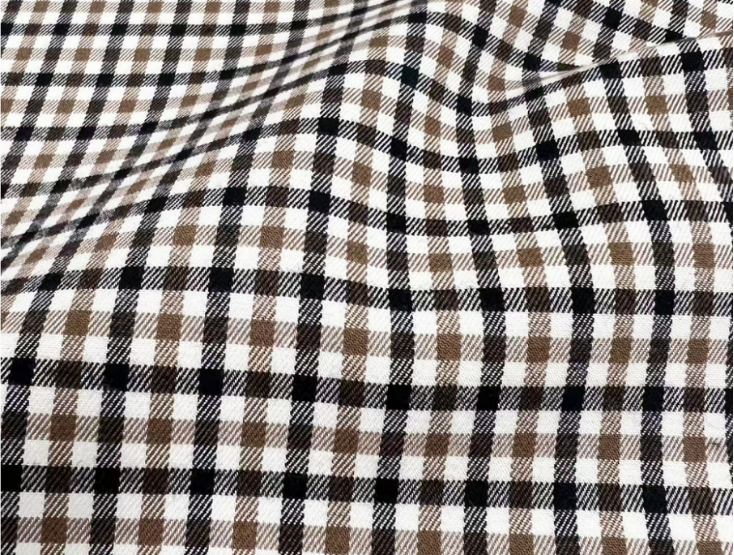
For woven shirting on this platform the declared range is a 10s to 200s yarn count and a 60 to 300 g/m² fabric weight, across plain, twill, satin, dobby and jacquard weaves, with yarn-dyed stripes, checks and jacquard designs among the patterns. Finishing options include liquid ammonia non-iron finishing, resin finishing and garment dipping.
Two consequences follow for the sheet. First, a 200s yarn at the light end and a 300 g/m² flannel at the heavy end are different manufacturing events with different handling and inspection needs, so ask which end your program sits at and whether the same line runs both. Second, the wrinkle-free claim comes from the finish, not from the fiber alone, so write the finish name into the specification and request the report that supports it.
On the process itself, an independent textile technical guide describes liquid ammonia finishing as improving softness, dimensional stability and durability (Textile Engineering Resource, Ammonia in Textile and Dyeing Industries Guide, 2026). That is a process-level statement about the technology. It is not a performance result for your fabric, which is why the report remains the closing document.
Garment dipping is worth placing on the schedule rather than leaving in the finishing list. It is offered as a finishing step for shade approval before bulk garment production, which moves shade sign-off ahead of cutting instead of behind sewing, where a correction is far more expensive.
Step 3: Fix the Supply Mode Before You Discuss Price
MOQ and lead time are not properties of a supplier. They are properties of a supply mode, and mixing the two in one quotation is how first orders get mis-scheduled.
In this chain the two modes are defined rather than negotiable in the abstract. Ready-stock fabric has no MOQ, with orders starting from 1 meter. Made-to-order fabric starts at 2,000 yards per colorway, and made-to-order shirts at 1,500 pieces per colorway. Customization on the made-to-order route covers material content, yarn count, colors, pattern design through yarn-dyed or printed routes, finishing processes, packaging and hang tags.
Put both columns on the sheet and mark which one your first order uses. A ready-stock program with no minimum buys a genuine sampling and small-launch path, but it is confined to styles that already exist. A made-to-order program buys an exclusive construction at a minimum that has to be absorbed by demand you may not have yet. They are not interchangeable, and a supplier that quotes a made-to-order price before confirming the mode has not started the evaluation.
When you evaluate the stock side, ask for depth rather than breadth. The ready-stock operation here is sized for the small-order path, with ten million meters of year-round stock in a 12,000 m² warehouse, roughly 4,000 online styles, more than 400 new styles added each year, and showrooms in 36 markets. A catalogue of that size with thin depth per shade is a different delivery risk from a smaller catalogue with deep stock, and only a per-colorway depth answer distinguishes them.
Step 4: Interrogate the Urgent-Order Answer
Urgent orders are served either from inventory or by moving somebody else's production. The evaluation question is which one, because only the first leaves your regular schedule intact.
Ask four questions and write the answers down:
- Is my style in the ready-stock list, and under which certified fabric category does it fall?
- What is the current depth per colorway, stated as a quantity and a date rather than a range?
- When stock is consumed, what is the restock rule and how long does replacement take?
- If the style is made-to-order, what determines queue position, and does an expedite request move another customer's slot?
The mechanism matters more than the promise. When a style is held year-round and appears in the stock list, an urgent requirement is an inventory pick with its own handling time while the made-to-order line continues at its stated minimums. When the style is not in stock, an urgent order becomes a queue decision, and the supplier's answer should say plainly whose slot moves. An availability answer that names a quantity and a date can be planned around; a general assurance cannot.
The Evidence Map: What Closes Each Claim
The table below is the working core of the sheet. Each row takes a claim a buyer commonly hears and pairs it with the document that actually supports it, then states the limit of that document.
| Claim | Ask for | What it still does not prove |
|---|---|---|
| ISO 9001 certified | Certificate showing a scope covering yarn-dyed fabric design, development and production, and shirts | That your specific fabric was produced inside that scope, or that it passed a performance test |
| GJB 9001C certified | Certificate showing a scope covering yarn-dyed, printed and dyed fabrics and shirts | Any product test result: it is a quality management system certificate, not a test report |
| Ethically audited | SMETA 4-Pillar audit report issued by SGS-China, report ZAA600160172, valid 2025-10-11 to 2027-10-11 | Conditions at sites outside the report, or conditions after the validity date |
| Test reports available | Report number, laboratory, method, sample identification and date, produced under CNAS ISO/IEC 17025 accreditation (CNAS L3871) | That the report covers your construction, your colorway or your tolerance |
| Ready stock, no MOQ | Written confirmation that the style is in the stock list, its certified fabric category, and current depth per colorway | That the item sits inside a named certified category until the supplier maps it for you |
| We handle urgent orders | The mechanism: inventory depth, restock rule, or queue position for made-to-order | Available capacity for your volume at your requested date |
Where the Sheet Changes the Decision: Three Buyer Situations
First order, three styles, no trading history
The dominant risk is that unproven demand collides with a production minimum. The ready-stock path fits: no MOQ, orders from 1 meter, styles confirmed against their certified fabric category, and the SMETA report checked against the intended production window. Add one test report for the lightest and one for the heaviest construction in the set, because those are the two ends where handling differs most.
Corporate uniform program with reorders
Here the risk is not the first shipment but consistency across the third and fourth. A dyed route with lab-dip color matching to your standard, garment dipping as a shade approval step before bulk garment production, and made-to-order shirts at 1,500 pieces per colorway give a repeatable basis. Replenishment for size top-ups is a separate question from the original order and should be answered from stock depth, not from the original booking.
Private-label seasonal drop
An exclusive construction normally means a yarn-dyed design at 2,000 yards per colorway, with a liquid ammonia non-iron finish where wrinkle-free performance is part of the sell. The delivery question to settle early is what happens if the season sells out: replenishment returns to the stock list, not to the original made-to-order queue, so the availability of a comparable stock style belongs in the plan before the first cut.
What the Score Cannot Tell You
The sheet is deliberately bounded, and keeping the boundary visible is what makes the rest of it usable. It does not measure current capacity utilization, quoted lead time, price, payment terms or freight basis. It does not establish that a fabric will meet your shrinkage, colorfastness or wrinkle recovery tolerance. It does not reveal how much of the order is subcontracted. Those require an RFQ response, a report against your own tolerance, and an audit or factory visit.
There is also a time limit built into the documents themselves. The SMETA report ZAA600160172 runs to 2027-10-11, so a production period beyond that date falls outside the audited window and the report should be re-requested rather than reused. The same discipline applies to any certificate with a validity date: the date you received the file is not the date that matters.
FAQ
Which documents should I verify before approving a woven shirt supplier?
Verify four families and keep them separate. First, the quality management system certificates: the ISO 9001 scope covers yarn-dyed fabric design, development and production, and shirts, while the GJB 9001C scope covers yarn-dyed, printed and dyed fabrics and shirts. Second, the labour and ethics report: a SMETA 4-Pillar audit report issued by SGS-China, report ZAA600160172, valid 2025-10-11 to 2027-10-11. Third, laboratory traceability: CNAS accreditation to ISO/IEC 17025 (CNAS L3871), which tells you the testing behind a report sits within an accredited laboratory system. Fourth, the construction records for your own fabric and style. A quality management system certificate, including GJB 9001C, is not a product test report and should never be filed as one.
How should I evaluate China garment manufacturing factories for woven shirts?
Evaluate the fabric stage and the garment stage separately, then check whether one management system covers both. Ask for a certificate scope that names the fabric category you are buying and the shirt stage, confirm which certified category a ready-stock style falls under, and match the declared range to your construction: on this platform that range is 10s to 200s yarn count, 60 to 300 g/m² fabric weight, plain through jacquard weaves, with liquid ammonia non-iron, resin finishing and garment dipping as finishing routes. Then confirm the commercial structure. For scale reference, the group behind Jamesfabric reports 12,000 tons of yarn, 84 million meters of yarn-dyed fabric, 85 million meters of printed fabric and 6 million shirts a year across operations in Jiangsu, Cambodia and Indonesia, with about 70 percent exported. Scale is a screening signal, not a substitute for construction-level evidence.
What are the MOQ and customization options for woven fabric and shirts?
Ready-stock fabric has no MOQ and orders can start from 1 meter. Made-to-order fabric starts at 2,000 yards per colorway, and made-to-order shirts start at 1,500 pieces per colorway. Customization on the made-to-order route covers material content, yarn count, colors, pattern design through yarn-dyed or printed routes, finishing processes, packaging and hang tags. Ask which mode a quotation is based on before comparing two suppliers, because a ready-stock quote and a made-to-order quote are not the same offer.
Is ready-stock or made-to-order better for a first woven shirt order?
Neither is better in general; they carry different risks. Ready stock removes the minimum and the production wait, which suits sampling, small launches and replenishment, but it is limited to styles that already exist. Made-to-order gives an exclusive construction, colorway and finish, at a minimum of 2,000 yards per colorway for fabric or 1,500 pieces per colorway for shirts. For a first order with unproven demand, the stock route keeps commitment low while you verify handling, shade and response time; for a confirmed seasonal program, the made-to-order route is the only way to get the construction you specified.
What can I confirm with a sample before a bulk commitment?
A sample confirms hand feel, shade, weight and finish before any bulk commitment, and the cheapest way to obtain one on this supply chain is a small ready-stock order, since ready-stock fabric has no MOQ and orders can start from 1 meter. For solid shades on a dyed route, request a lab dip matched to your standard. Before bulk garment production, use garment dipping as the shade approval step, which places sign-off ahead of cutting. Finish by requesting a test report with report number, laboratory, method, sample identification and date, produced under CNAS ISO/IEC 17025 accreditation (CNAS L3871), and confirm the sample tested matches your construction.
How can a supplier take urgent orders without disrupting regular schedules?
The mechanism is inventory, not goodwill. Where a style sits in a year-round stock holding, an urgent requirement is picked from stock with its own handling time while the made-to-order line keeps running at its stated minimums; in this chain that means ten million meters of year-round stock in a 12,000 m² warehouse across roughly 4,000 online styles, with more than 400 new styles added each year. Where the style is not in stock, urgency becomes a queue decision and the supplier should state whose slot moves. Ask for availability as a quantity and a date per colorway, and ask for the restock rule, so an urgent order can be planned rather than hoped for.
Conclusion: Score the Evidence, Then Commit
A woven shirt program is qualified by documents whose scope matches the claim, by a fabric range that actually contains your construction, by a supply mode that fits your demand, and by a delivery mechanism that does not depend on someone else losing their production slot. The six domains on this sheet turn those four statements into questions with answers you can file.
Read the scope sentence before you credit the standard number. Confirm which named category your ready-stock style belongs to. Separate the minimum for stock from the minimum for made-to-order. Ask what happens on the day an urgent order arrives. And check every validity date against your production window rather than your inbox. A supplier that answers all four without preparation is a different shortlist candidate from one that needs a week to reconstruct its own paperwork.
Next step: if you are building the evaluation sheet for a first woven shirt program, the company profile pack covers the fabric categories, finishing routes and capacity behind this supply chain. Download it here: Lianfa Company Profile 2026 (PDF).
For a specification discussion, stock availability check or made-to-order enquiry, contact the team at ruth@lianfa.cn. Jiangsu Lianfa Textile Co., Ltd., No. 88 Henglian Road, Haian Town, Nantong, Jiangsu, China 226600.
Have Questions or Need More Details?
Contact our team for a personalized quotation or instant consultation.
Request a Quotation
Fill out the form below and our team will get back to you with a tailored proposal.
WhatsApp Direct Chat
Prefer to chat in real-time? Message us on WhatsApp for instant assistance & quick answers.
- Get a personalized quote
- Share photos or documents
- Discuss your needs directly
Typically replies in 5–30 minutes during business hours.