Yarn-Dyed Fabric for Garment Manufacturing: Specs & Certifications
Yarn-Dyed Fabric for Garment Manufacturing: Specs & Certifications
Yarn-dyed fabric is woven from yarns that have already been dyed, so the stripe, check, dobby or jacquard pattern is built into the cloth rather than applied to it afterwards. For a garment manufacturing buyer, the useful question is not what yarn-dyed fabric is. It is which yarn counts, fabric weights, finishing routes, certificate scopes and order quantities a supplier can document against one specific shirt programme — and where those documented limits stop. This guide sets out those constraints using published product specifications and certificate records from Jiangsu Lianfa Textile Co., Ltd., a Chinese woven fabric and garment manufacturer established in 1955, and from its ready-stock platform Jamesfabric.
The short answer
- Yarn-dyed woven fabric from this source is documented across 10s–200s yarn counts and 60–300 g/m² fabric weights, in plain, twill, satin, dobby and jacquard weaves.
- Three finishing routes are available: liquid ammonia non-iron finishing, resin finishing and garment dipping.
- Annual yarn-dyed fabric capacity is 84 million meters, produced inside a chain that spins, dyes, weaves and finishes in-house.
- Certificate scopes are product-specific. The GOTS scope certificate covers dyed, undyed, greige and printed fabrics and does not list finished woven shirts.
- Ready-stock fabric carries no MOQ; made-to-order fabric starts at 2,000 yards per colourway and made-to-order shirts at 1,500 pieces per colourway.
Problem Definition: Three Constraints That Break a Yarn-Dyed Programme
Most yarn-dyed sourcing failures are not loom failures. They are constraint failures that surface after the purchase order is signed, and they usually arrive through one of three gaps.
1. The specification gap
“Yarn-dyed poplin” describes a category, not a fabric. One mill can supply it at a 40s count and 120 g/m² with resin finishing; another at 120s and 110 g/m² with liquid ammonia finishing. Those differences change drape, shrinkage behaviour, sewing performance and the price the garment factory quotes downstream. A purchase order that does not fix yarn count, fabric weight, weave, fibre composition and finishing route leaves the mill to decide what the product actually is.
2. The certificate-scope gap
A certificate issued to a mill is not a certificate covering your shirt. The GOTS scope certificate held by Jiangsu Lianfa Textile Co., Ltd. — CU805953GOTS-2026-00089439, issued by Control Union Certifications B.V. and valid until 2027-09-01 — covers dyeing, finishing, pre-treatment, printing, weaving, and the trading and warehousing of non-final products. It lists dyed, undyed, greige and printed fabrics as product categories and does not list final woven shirts. A buyer who reads “GOTS certified” as “the shirt is GOTS certified” inherits a compliance problem that appears later, at customs or at a retail audit.
3. The quantity-model gap
Yarn-dyed fabric is bought in two different ways: from stock, or made to order. The commercial terms are not interchangeable. Ready-stock programmes exist so a brand can buy a small quantity of an existing style immediately. Made-to-order programmes exist so a brand can specify its own construction, colour and finishing. Applying one model’s MOQ logic to the other produces either an unnecessary inventory commitment or an unexpected shortfall before a launch.
Industry Background: Why Yarn-Dyed Capacity Is Concentrated
The World Trade Organization’s sectoral profile of textiles and clothing reports that the sector represented 3.7 per cent of world merchandise exports in 2022, and that Asia accounted for 70.6 per cent of world textiles and clothing exports in the same year. Roughly 80 per cent of Asia’s textiles and clothing exports were regional in 2022, which describes how tightly the Asian supply chain is bound: yarn, fabric and garment stages frequently sit inside the same region rather than crossing an ocean between each step.
The WTO also estimated that the textiles and clothing industry generated 36.4 per cent of the value added in textiles and clothing exports in 2022. That figure is a reminder that a large share of export value is contributed upstream and by services, not only by cutting and sewing — which is why buyers increasingly evaluate the fabric stage rather than the garment stage alone.
Demand-side projections point the same way. GMI Research projects the global shirt fabric market to be worth USD 49.1 billion in 2026, with a CAGR of 2.21 per cent across the forecast period to 2035. A projection of this kind describes a category, not a supplier: it justifies planning a shirting programme, not selecting a mill.
Yarn dyeing sits at the technically demanding end of that chain. Because colour is created before weaving, the dyehouse must hit shade on yarn that will later be woven into a repeating pattern; lot-to-lot variation becomes a visible stripe defect rather than a uniform shade difference. This is why mills controlling spinning, dyeing, weaving and finishing under one roof tend to be the ones able to hold colour fastness on yarn-dyed programmes. Jiangsu Lianfa Textile Co., Ltd. (stock code 002394) operates a 1.12 km² manufacturing base with 8,685 employees and more than 250 engineers. Reported annual output is 12,000 tons of yarn, 84 million meters of yarn-dyed fabric, 85 million meters of printed fabric, 78 million meters of home textile fabric and 6 million pieces of shirts, with 70 per cent of output exported to Europe, Japan, North America, Southeast Asia and China.
Detailed Solution: The Yarn-Dyed Constraint Set
Construction: fix five parameters before asking for a price
The documented parameter range for the yarn-dyed woven range is shown below. These are the fields a buyer should carry into an RFQ, because each one changes cost, finishing and sewing behaviour.
| Parameter | Documented range | Why it constrains the order |
|---|---|---|
| Yarn count | 10s–200s | Fine counts serve premium dress shirts; coarser counts serve casual and heavy dobby styles |
| Fabric weight | 60–300 g/m² | Drives drape, opacity and the sewing floor’s handling speed |
| Weave | Plain, twill, satin, dobby, jacquard | Determines surface character and pattern capability |
| Pattern | Yarn-dyed stripes, checks, dobby and jacquard designs | Pattern is created in the yarn, so repeat and colour sequence must be approved before weaving |
| Fibre composition | Cotton, cotton/polyester, cotton/spandex stretch, linen and linen blends, viscose and modal blends | Affects shrinkage, hand feel, care labelling and price band |
| Finishing | Liquid ammonia non-iron, resin finishing, garment dipping | Determines whether the finished shirt can promise easy care |
| Annual capacity | 84 million meters | Sets the ceiling on large-volume programmes and seasonal peak loading |
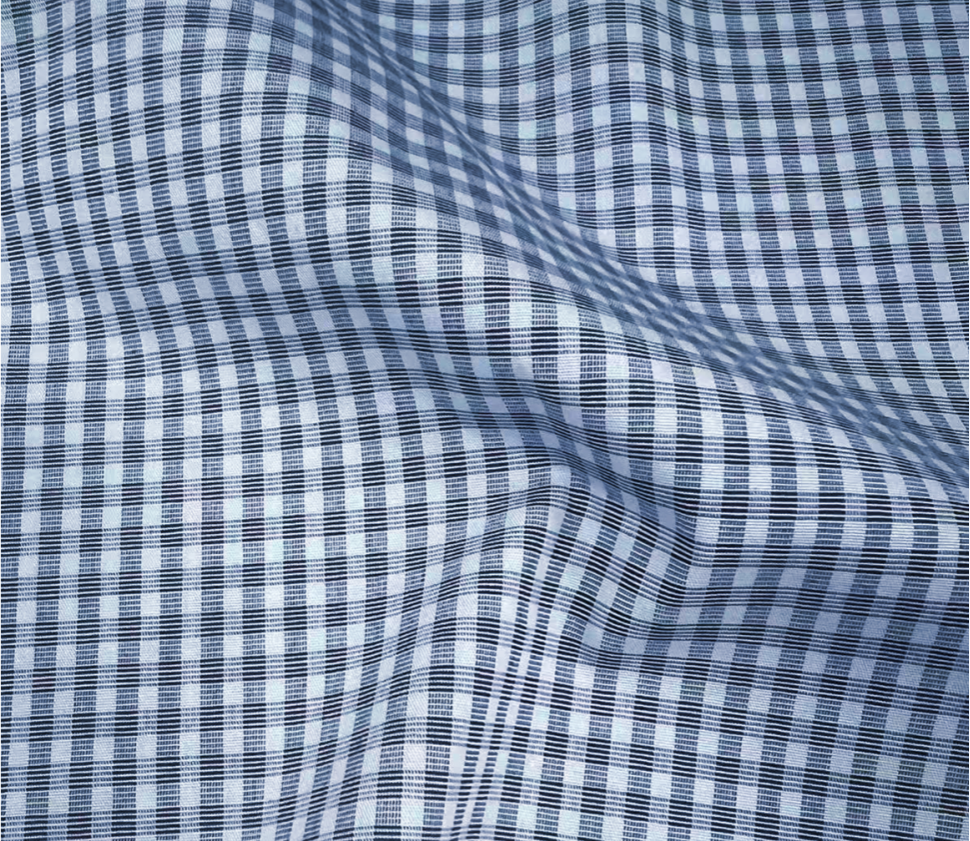
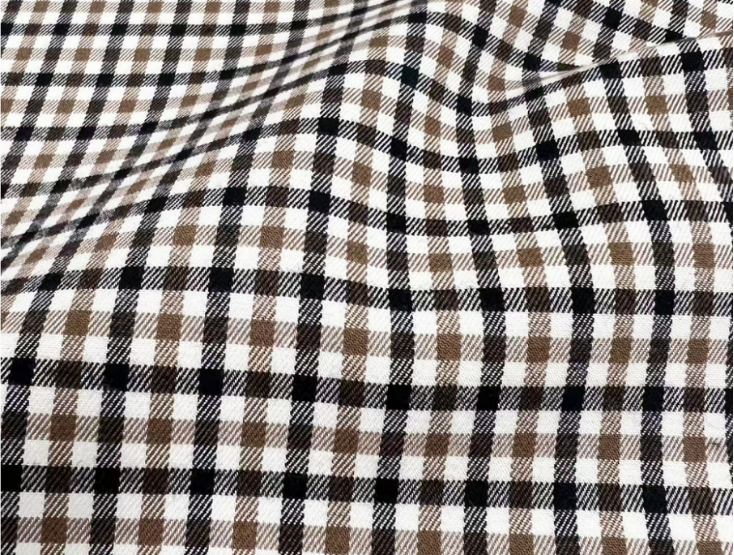
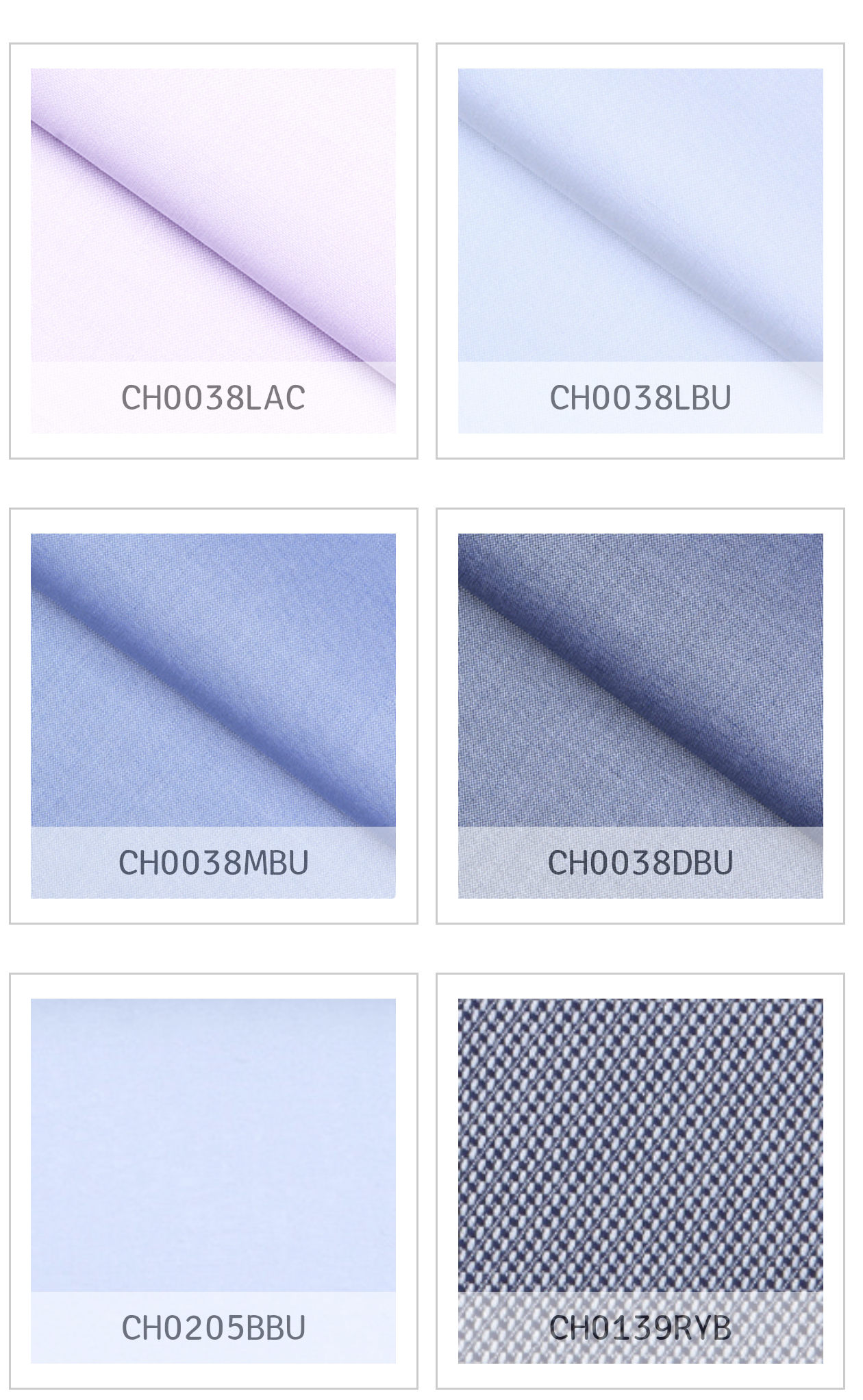
The range is documented as covering yarn-dyed shirting fabric, dobby and jacquard fabric, gingham and stripe fabric, and chambray. Published reference article codes for the range are B07797-03 and 623510-02, which let a buyer compare a physical swatch against a stated construction instead of against a sales description.
The commercial point behind the count and weight spread is consolidation. A 200s cotton poplin and a 20s heavy dobby are both “yarn-dyed shirting”, but they sit in different price bands, need different finishing and run at different speeds. A supplier able to cover the full 10s–200s span lets a brand place dress-shirt, business-shirt and casual-shirt qualities under one supplier relationship rather than splitting them across three vendors and three sets of tolerances.
Finishing: the route decides how the shirt behaves
Yarn dyeing fixes colour; finishing fixes performance. Three routes are documented for this range — liquid ammonia non-iron finishing, resin finishing and garment dipping — and they are not interchangeable line items.
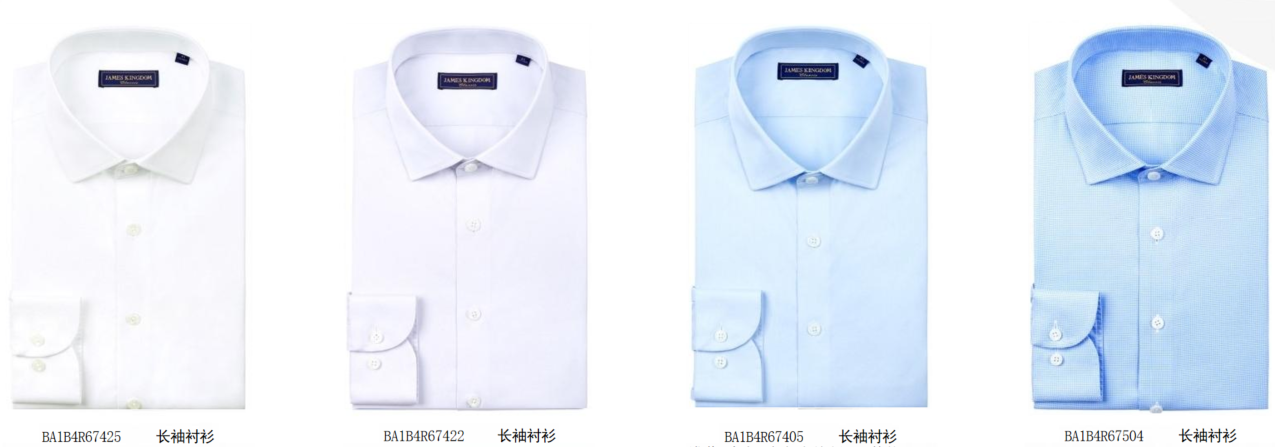
Liquid ammonia finishing passes fabric through anhydrous ammonia, which temporarily swells and reorganises the cotton fibre. Once the ammonia is recovered, the fibre keeps a smoother, more elastic state, which is the mechanism behind the improved wrinkle recovery, softer hand and higher lustre of a non-iron dress shirt. Garment dipping applies the easy-care treatment to the made-up shirt rather than to the greige roll, which is the route used where the finished garment — not the fabric — is the unit of performance.
For a garment manufacturing buyer the decision is not which finish is better in the abstract. It is which finish the end customer’s care label will promise. A non-iron dress-shirt programme that advertises wash-wear performance needs a finishing route that survives laundering; a casual shirt sold on a soft, dry hand may be better served by a lighter finishing load. Naming the finishing route on the purchase order is the cheapest way to prevent a bulk-versus-approval dispute six weeks later.
Certification: read scope, not logos
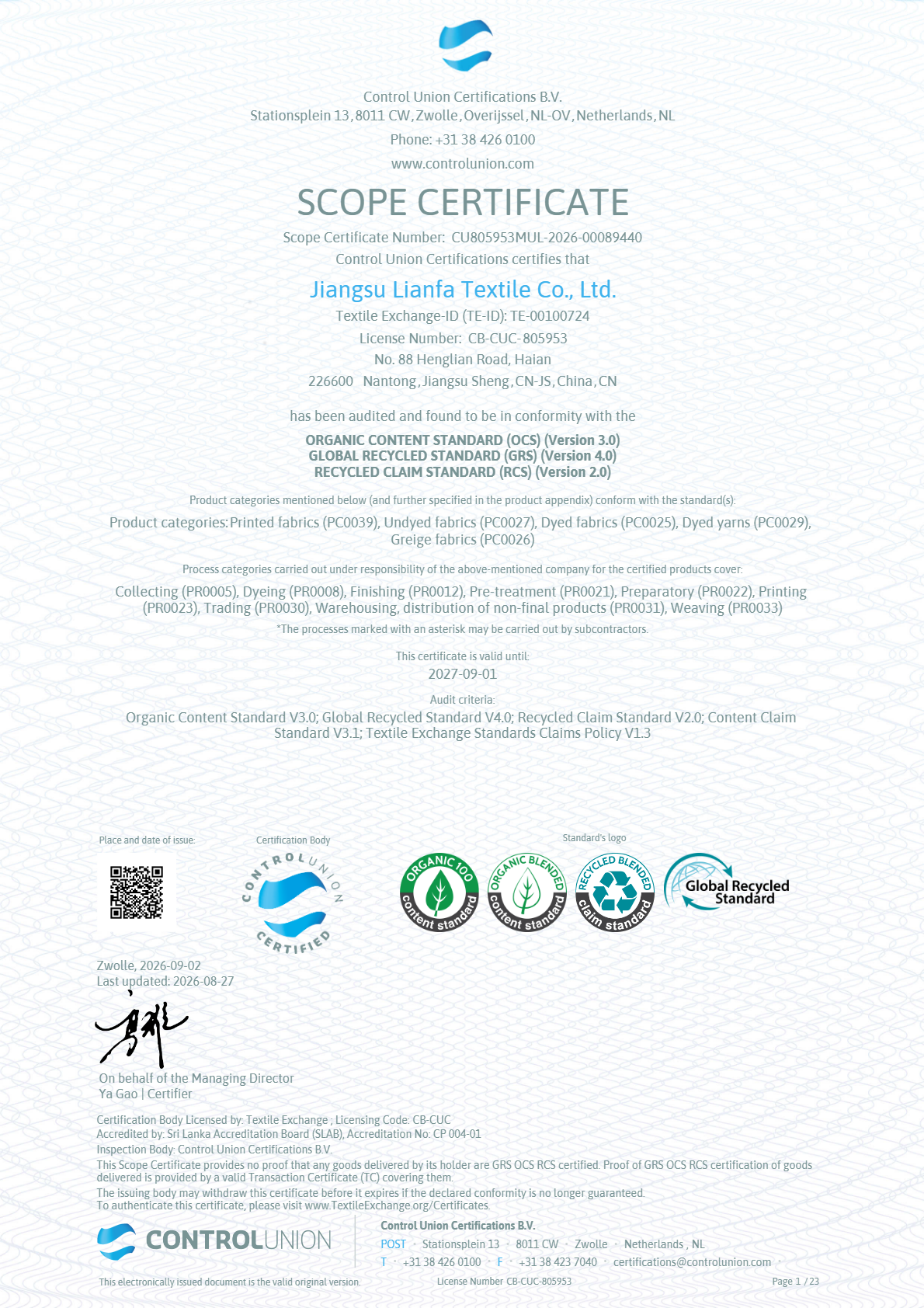
Certificates should be checked against three fields: the product category code, the process covered, and the validity date. The table below summarises certificates held for this production base, as stated in the certificate records.
| Certificate | Number | Issuer | Valid until | Documented scope |
|---|---|---|---|---|
| GOTS, Version 7.0 | CU805953GOTS-2026-00089439 | Control Union Certifications B.V. | 2027-09-01 | Dyed (PC0025), undyed (PC0027), greige (PC0026) and printed (PC0039) fabrics; dyeing, finishing, pre-treatment, printing, weaving, trading and warehousing of non-final products. Finished woven shirts are not listed. |
| OCS V3.0 / GRS V4.0 / RCS V2.0 | CU805953MUL-2026-00089440 | Control Union Certifications B.V. | 2027-09-01 | Printed, undyed, dyed and greige fabrics, plus dyed yarns; collecting, dyeing, finishing, pre-treatment, printing, trading, warehousing and weaving. |
| OEKO-TEX STeP | 18001268 | OEKO-TEX Service GmbH | 2028-03-31 | Weaving, yarn-dyeing, printing and finishing; ZDHC MRSL 3.1. |
| Better Cotton Chain of Custody v1.0 | ITS-BC-00002500 | Intertek | 2028-07-01 | Dyed fabrics: pre-treatment, preparatory, weaving, dyeing and finishing; mass balance, controlled blending and segregation models. |
| EUROPEAN FLAX™ Standard Version 3 | BVFR22885470 | Bureau Veritas Certification | 2027-08-27 | Yarn dyeing, yarn finishing, weaving, fabric dyeing, various finishing, printing and fabric trading; EU, USA and Japan markets. |
| ISO 9001 | 07026Q00227R301 | Beijing Junyou Chengxin Testing and Certification Co., Ltd. | 2029-09-06 | Design, development, production and service of yarn-dyed fabrics; production and service of shirts. |
| ISO 14001 | 07026E00042R201 | Beijing Junyou Chengxin Testing and Certification Co., Ltd. | 2029-09-06 | Environmental management for yarn-dyed fabric design, development, production and service, and for shirt production. |
| SMETA 4-Pillar (Sedex) | ZAA600160172 | SGS-China | 2027-10-11 | Labour standards, health and safety, environment (4-pillar) and business ethics. |
Additional records support the same base: ISO 45001 (07026S00041R201, valid until 2029-09-06), ISO 50001 (01526En00116R001, valid until 2029-04-15, covering energy management in dyed fabric production), GJB 9001C (26 QJ3 0458 R3L, China market, valid until 2029-09-06) and CNAS laboratory accreditation to ISO/IEC 17025 (CNAS L3871, valid until 2029-12-24).
Two reading rules follow from that table. First, product-category codes are not marketing language: PC0025 is dyed fabric, PC0027 undyed fabric, PC0026 greige fabric and PC0039 printed fabric. If a compliance team needs a claim on a specific fabric, the claim has to attach to the right code. Second, a social-compliance audit is not a quality test. The SMETA 4-Pillar report covers labour standards, health and safety, environment and business ethics; it says nothing about wrinkle recovery or colourfastness. Those must be verified separately, for which the CNAS-accredited ISO/IEC 17025 testing laboratory provides the route.
Order quantities: two systems, two sets of rules
Ready-stock yarn-dyed fabric carries no MOQ, which is what allows a brand to sample, trial a small-batch launch or cover an urgent replenishment without opening a production run. Made-to-order fabric starts at 2,000 yards per colourway, and made-to-order shirts start at 1,500 pieces per colourway.
The ready-stock side is operated through Jamesfabric, a Lianfa Group subsidiary active in woven ready-stock fabrics for nearly 20 years. It lists approximately 4,000 online styles, adds more than 400 new SKUs each year, and supports them with a 12,000 m² warehouse holding ten million meters of fabric year-round, physical showrooms in 36 core textile markets and a sales team of nearly 100 staff at home and abroad. Reported annual sales are RMB 350 million.
The commercial consequence is a sequencing option. A brand can open with an existing ready-stock yarn-dyed check at low volume, read sell-through, and only then commit to a 2,000-yard custom colourway. That is a budget decision as much as an inventory decision, because it defers dyeing and minimum-run cost until demand is proven rather than assumed.
Capacity and vertical integration
Annual yarn-dyed capacity of 84 million meters sits inside a chain that also runs 85 million meters of printed fabric and 78 million meters of home textile fabric, with 12,000 tons of yarn and 6 million shirts per year. The company states it has ranked in the top three of China’s national yarn-dyed industry for more than 10 consecutive years.
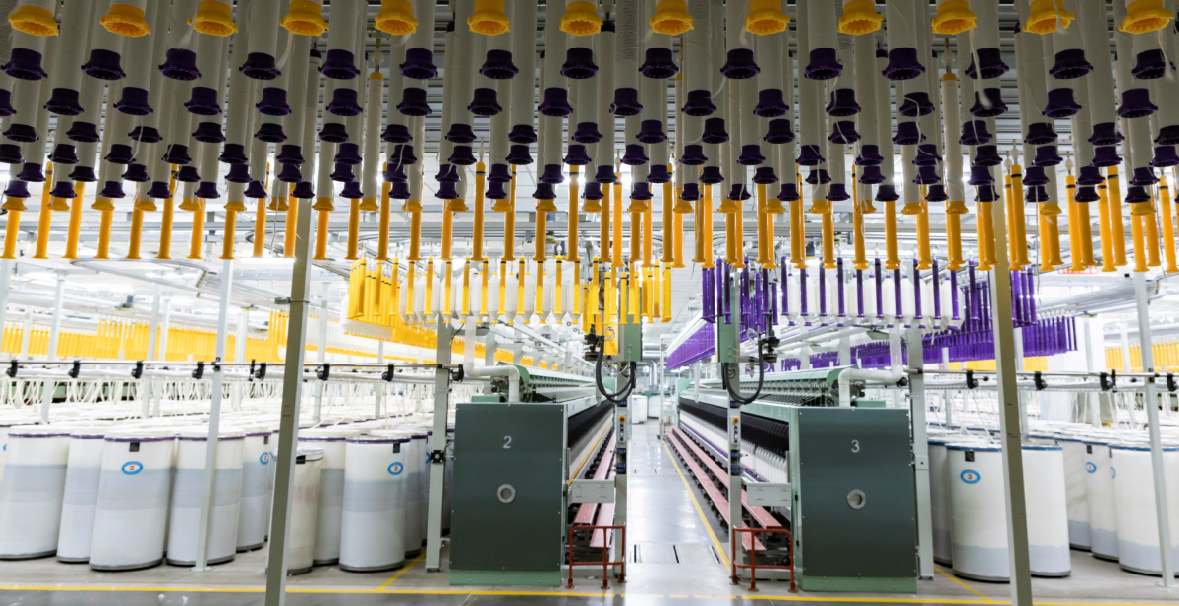
Vertical integration matters here for one specific reason. Colour fastness consistency on a yarn-dyed programme depends on the dyeing and finishing steps being controlled by the same organisation that spins and weaves the yarn. When those steps sit with different suppliers, a shade deviation is discovered only after the fabric has been woven, and the cost of the error is carried by the garment factory holding the cut ticket.
Step-by-Step Breakdown: Qualifying a Yarn-Dyed Supplier in Six Steps
- Write the construction specification. Fix yarn count (10s–200s), fabric weight (60–300 g/m²), weave, pattern repeat and fibre composition. Reference an existing article code such as B07797-03 or 623510-02 if you are starting from a stock quality, so that the mill and the factory are discussing the same object.
- Name the finishing route. Choose liquid ammonia non-iron, resin finishing or garment dipping, and state it on the purchase order. If the end product promises easy care, the finishing route — not the yarn — is what delivers that promise.
- Match certificate scope to the actual SKU. Check the product category code and the process line, not the logo. Confirm the validity date falls after your shipment date. Remember that GOTS scope here covers non-final fabrics and does not list finished woven shirts, so a garment-level claim needs separate documentation.
- Choose the supply model and lock quantities. Ready stock means no MOQ and no production slot. Made-to-order means 2,000 yards per colourway for fabric or 1,500 pieces per colourway for shirts. Mixing the two assumptions is the most common cause of a late launch.
- Validate colour and hand before bulk. Order a small quantity of the stock style for physical evaluation against the reference code, and confirm where colour approval sits in the process. Lab-dip colour matching to customer standards is documented for piece-dyed qualities; for yarn-dyed, pattern and colour sequence must be approved ahead of weaving.
- Confirm inspection and documentation at shipment. Pre-shipment inspection is available on request, and the in-house CNAS-accredited laboratory under ISO/IEC 17025 provides the testing route for parameters that certificates do not cover, such as colourfastness and dimensional behaviour.
Use Cases: Where Yarn-Dyed Fabric Carries the Programme
Corporate professional wear and workwear
Uniform programmes need durable, easy-care and wrinkle-free fabric options in customised colours, sizing and branding, including hang tags and packaging. Yarn-dyed stripes and checks give a corporate identity a repeatable pattern that does not depend on printing registration, and the finishing routes documented for the range support the easy-care promise a workwear tender usually asks for.
Brand collections that start small
A seasonal collection rarely begins at 2,000 yards per colourway. It begins with three or four styles that need to be seen in person. The ready-stock model covers that stage with roughly 4,000 listed styles and no MOQ, and the made-to-order model takes over once a style has proven itself and custom colour development is justified.
Casual, dobby and flannel programmes
Yarn-dyed capability is not limited to dress shirting. Dobby fabric options are available for casual shirt production, flannel fabric options for shirt production, jacquard fabric options for apparel production, and yarn-dyed stripe and check patterns for shirting applications — all inside the same 10s–200s count range and 60–300 g/m² weight range.
Fabric-to-garment conversion in one order
Where a buyer wants fabric and finished shirts from the same source, garment capacity is about 500,000 shirts per month, equivalent to 6 million pieces per year, with OEM/ODM production covering non-iron dress shirts, casual shirts, corporate uniforms and workwear shirts in made-to-order or ready-stock mode. Customisation extends to fabric, fit and pattern, trims, washing and non-iron finishing, packaging and hang tags.
Home textile crossovers
Yarn-dyed, piece-dyed and printed processes are also applied to home textile fabric — bedding, curtain and home décor, and flannel — across the same 10s–200s count and 60–300 g/m² weight range, with 78 million meters of annual home textile capacity. A brand building both apparel and home ranges can consolidate the fabric platform rather than qualifying two.
Comparison Table: Yarn-Dyed, Piece-Dyed and Printed Woven Fabric
The three fabric types below are all produced in-house on the same platform, which makes the comparison a specification decision rather than a sourcing decision.
| Attribute | Yarn-Dyed Woven Fabric | Piece-Dyed Woven Fabric | Printed Woven Fabric |
|---|---|---|---|
| How colour is created | Individual yarns are dyed to shade, then woven — the pattern is an integral part of the cloth | Greige fabric is woven first, then dyed in full width | Print is applied to a woven base fabric by reactive or pigment printing |
| Documented constructions | Yarn-dyed shirting, dobby and jacquard, gingham and stripe, chambray; plain, twill, satin, dobby and jacquard weaves | Solid-colour poplin, oxford, twill and sateen | Printed shirting, printed flannel, printed home textile fabric |
| Colour and pattern tools | Yarn-dyed stripes, checks, dobby and jacquard designs | Lab dips for colour development; lab-dip colour matching to customer standards | Original print designs, with more than 400 new fabric styles launched each year |
| Finishing options | Liquid ammonia non-iron finishing, resin finishing, garment dipping | Non-iron, wrinkle-free and soft-touch finishing | Reactive and pigment printing on woven base fabrics |
| Annual capacity | 84 million meters | Part of the same in-house dyeing and finishing chain | 85 million meters |
Read across the rows and the decision usually resolves itself. If the design depends on a stripe or check that must look identical on both sides and survive laundering, yarn dyeing is the route. If the design is a clean solid colour that has to be matched quickly across many shades, piece dyeing is more efficient. If the design is figurative or multi-colour, printing carries it — at the cost of a surface print rather than an in-woven structure.
Frequently Asked Questions
Which certifications cover yarn-dyed shirting fabric, and what does each one actually certify?
Coverage depends on the product category and process listed, not on the certificate’s existence. The GOTS scope certificate CU805953GOTS-2026-00089439, issued by Control Union Certifications B.V. and valid until 2027-09-01, covers dyed fabrics (PC0025), undyed fabrics (PC0027), greige fabrics (PC0026) and printed fabrics (PC0039) across dyeing, finishing, pre-treatment, printing, weaving, and trading and warehousing of non-final products; it does not list finished woven shirts. The OCS V3.0 / GRS V4.0 / RCS V2.0 certificate CU805953MUL-2026-00089440, the OEKO-TEX STeP certificate 18001268 covering weaving, yarn-dyeing, printing and finishing, and the Better Cotton Chain of Custody certificate ITS-BC-00002500 issued by Intertek sit alongside it, with the EUROPEAN FLAX™ Standard certificate BVFR22885470 covering yarn dyeing, yarn finishing, weaving, fabric dyeing, printing and trading for the EU, USA and Japan markets.
What yarn-dyed shirting constructions can actually be produced, and by whom?
The documented range covers 10s–200s yarn counts and 60–300 g/m² fabric weights, in plain, twill, satin, dobby and jacquard weaves, with yarn-dyed stripes, checks, dobby and jacquard designs and qualities including gingham, stripe and chambray. Fibre options are cotton, cotton/polyester blends, cotton/spandex stretch, linen and linen blends, and viscose and modal blends. Production runs in-house from spinning through dyeing, weaving and finishing at Jiangsu Lianfa Textile Co., Ltd., established in 1955 with more than 250 engineers and annual yarn-dyed capacity of 84 million meters; the company states it has ranked in the top three of China’s national yarn-dyed industry for more than 10 consecutive years. Ready-stock supply is handled by Jamesfabric, which lists approximately 4,000 styles online and holds ten million meters of fabric year-round.
What order quantities and budget structures apply?
Two commercial systems apply and they should not be mixed. Ready-stock yarn-dyed fabric carries no MOQ, so existing styles can be ordered in small quantity for sampling, a small-batch launch or replenishment without waiting for a production slot. Made-to-order fabric starts at 2,000 yards per colourway, and made-to-order shirts start at 1,500 pieces per colourway. The practical budgeting route is to run the first season on stock qualities, then convert a proven style to a custom colourway — deferring dyeing and minimum-run cost until sell-through is known.
How can a buyer validate yarn-dyed fabric before committing to bulk?
Validation usually runs through the ready-stock programme rather than through a custom sample order. Published reference article codes such as B07797-03 and 623510-02 let a buyer compare a physical swatch against a documented construction, and because stock styles carry no MOQ, a small quantity can be ordered for in-person review. Physical showrooms in 36 core textile markets support that review with a sales team of nearly 100 staff, and pre-shipment inspection is available on request once an order is placed.
What lead times apply, and how do ready stock and made-to-order differ?
Ready-stock fabric is shipped ex-stock, so delivery is not gated by a production schedule. Made-to-order fabric runs on quick-response production lines, with lead time confirmed at the time of order, and flexible lines are used to balance urgent and regular orders. Yarn-dyed programmes benefit from spinning, dyeing, weaving and finishing sitting in one chain, which removes inter-supplier handoffs from the critical path; garment capacity of about 500,000 shirts per month supports conversion from the same supplier. To request a stock list, a quotation or a sample, contact the team at ruth@lianfa.cn.
Conclusion: Buy the Documented Constraint, Not the Category
Yarn-dyed fabric is a category. What a garment manufacturing programme actually receives is a yarn count, a fabric weight, a weave, a fibre composition, a finishing route, a certificate scope with a validity date, and an order rule for stock versus made-to-order. Every one of those is a constraint that can be written down before the purchase order is issued, and every one of them is cheaper to verify at the specification stage than at the cutting table.
The documented position for this production base is a 10s–200s count and 60–300 g/m² weight range, three finishing routes including liquid ammonia non-iron and garment dipping, 84 million meters of annual yarn-dyed capacity inside a chain from spinning to garment, product-specific certificates with dates through 2027 to 2029, no MOQ on ready stock and 2,000 yards per colourway on made-to-order fabric. A buyer who checks those six items against their own programme will know within a week whether the supplier fits — and will have the paperwork to prove it afterwards.
Next Step
Jamesfabric and Jiangsu Lianfa Textile Co., Ltd. supply yarn-dyed, piece-dyed and printed woven fabric plus finished woven shirts from one vertically integrated chain. Ready-stock items ship without MOQ; made-to-order programmes start at 2,000 yards per colourway for fabric and 1,500 pieces per colourway for shirts.
Download the company profile and full product documentation: Company Profile — Lianfa 2026 (PDF)
Contact: Ruth · ruth@lianfa.cn · +86 138 6271 9060 · No. 88 Henglian Road, Haian Town, Nantong, Jiangsu, China 226600 · www.lianfa.cn
Certification details are stated as recorded on the certificates held by Jiangsu Lianfa Textile Co., Ltd. and valid at the time of publication. Buyers should confirm current validity and product-category coverage against the certificate copy supplied with their order.
Have Questions or Need More Details?
Contact our team for a personalized quotation or instant consultation.
Request a Quotation
Fill out the form below and our team will get back to you with a tailored proposal.
WhatsApp Direct Chat
Prefer to chat in real-time? Message us on WhatsApp for instant assistance & quick answers.
- Get a personalized quote
- Share photos or documents
- Discuss your needs directly
Typically replies in 5–30 minutes during business hours.