Veterinary Endoscope Compliance Guide: Building Regional Documentation from Verified Specs
DOCUMENTATION · COMPLIANCE · DISTRIBUTORS
A veterinary endoscope documentation dossier is not a brochure with a certificate stapled to it. It is a small, defensible set of statements — intended use, model-level specifications, material disclosure and environmental limits — where every sentence can be traced back to a source document the manufacturer will stand behind. Distributors who build that set before a tender or an importer’s questionnaire arrives answer in hours. Distributors who build it afterwards usually end up writing claims nobody can evidence.
This guide is written for distributor and procurement teams handling portable veterinary endoscopes, veterinary otoscopes and veterinary gastroscopes, and it uses the JeetVet model records — RAE-201, RAE-105, RAE-105Pro, RAE-107, RAE-109, RAE-500, VET-5820 and VET-8528 — as a worked example. JeetVet is the veterinary endoscope brand of Jeet Medical (Shenzhen) Co., Ltd., a Shenzhen-based manufacturer of portable veterinary endoscopes, veterinary otoscopes and veterinary gastroscopes.
One boundary applies throughout: this article does not state that any model carries CE marking, FDA clearance or a 510(k) number, because those documents are not part of the verified record. What is verified is specification data, material categories, an operating envelope and a quality-system statement. The method below shows how far that evidence can be pushed, and exactly where a distributor must stop and ask for more.

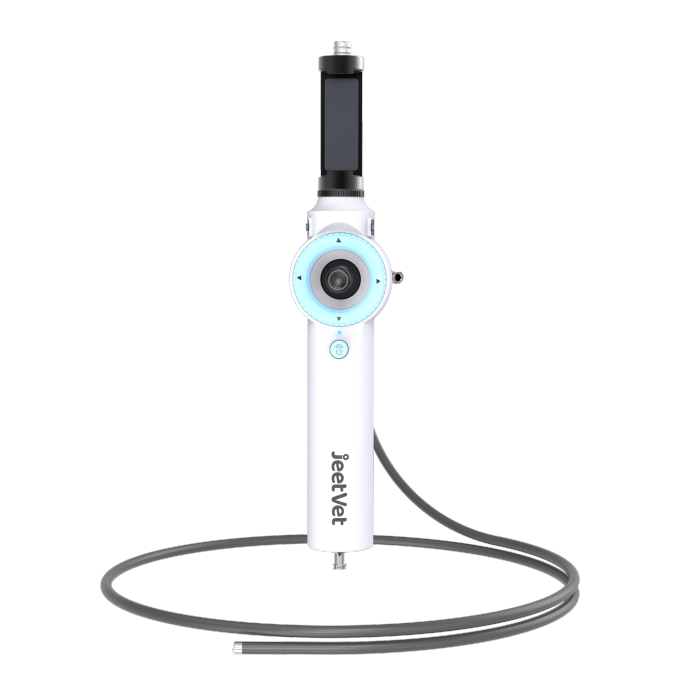
Documentation should describe the equipment actually shipped — model code, tube dimensions, channel size and connection type.
Why Documentation Fails Before the Product Does
Most distributor compliance problems in this category are not device failures. They are document failures, and they cluster into three patterns.
- Intended use copied from the wrong model. A team builds one “veterinary endoscope” description and applies it to a 3.1 mm ear-and-nasal scope and an 8.5 mm large-animal scope alike. The moment an importer compares the label to the shipped model, the dossier stops matching the goods.
- Performance language with no measurement behind it. Phrases such as “high definition” and “precision optics” circulate without a pixel count, a field angle or a depth-of-field range attached. Reviewers cannot accept what they cannot check.
- Certification statements that travel from website to website. A quality-system claim from one brand is reused for another, or a certificate covering a factory is presented as though it approved a product.
A fourth problem sits underneath all three: the buyer questionnaire usually arrives with acceptance criteria already written, and those criteria will later be used to accept or reject a delivery. If the criteria were drafted from marketing copy rather than from the specification record, the distributor has effectively agreed to test the product against a number that does not exist.
Industry Background: Where Documentation Meets the Market
Demand for veterinary endoscopy is growing faster than the documentation habits around it. Mordor Intelligence estimates the global veterinary endoscopy market at USD 332.95 million in 2026, projecting growth at a CAGR of 7.35% from 2026 to 2031, with North America as the largest market and Asia-Pacific the fastest-growing region. Growth of that shape produces new distributors entering new territories quickly — which is exactly when document reuse becomes tempting.
Three reference points shape the dossier in practice.
Customs classification. Endoscopes used in medical, surgical or veterinary sciences sit under HS code 90189020. The same code covers human and veterinary devices, so the customs description alone does not establish what the device is for. The intended-use statement in the dossier has to do that work.
Sector-specific regulation. Veterinary device regulation is not a single global regime. In the United States, the FDA publishes its own explainer on how it regulates animal devices, and that page is the correct reference point for U.S. questions rather than a summary borrowed from a human-device article or from a supplier’s catalogue.
Quality-system versus product approval. Jeet Medical’s published company profile states that it is certified under ISO 13485 by SGS and operates a 100,000-class cleanroom and a 10,000-class microbiological laboratory. ISO 13485 certifies a quality management system; it does not approve a product, a model or a market. A distributor may describe the quality-system certification accurately and still must not describe a scope as “ISO approved” or “certified.”
The Four-Layer Dossier
Build the dossier as four layers. Each layer answers a different question, and each can be checked independently by a reviewer, an importer or an auditor.
Layer 1 — The intended-use statement
An intended-use statement should fix five things: device type, species scope, anatomical region, procedure, and environment of use. Where the manufacturer’s record already fixes them, quote it; where it does not, obtain written confirmation rather than filling the gap with inference.
For the RAE-201 Veterinary Flexible Otoscope, the published record fixes the purpose as animal ear and nasal examination. That is a usable intended-use core: a 3.1 mm outer tube with a 1.2 mm channel, a 600 mm working length, 180° bending with up-and-down steering, a 5–50 mm depth of field, a 120° field angle and 160,000 pixels. The dimensions support the ear-and-nasal purpose; they do not, on their own, support a claim of gastrointestinal use.
The large-animal gastroscopes are stated differently. VET-5820 and VET-8528 both carry the purpose “animal gastrointestinal examination” with a 1500 mm working length, 180° bending and 360° rotation control — but with different diameters. VET-5820 has a 5.8 mm outer tube and a 2.0 mm channel; VET-8528 has an 8.5 mm outer tube and a 2.8 mm channel. One intended-use sentence cannot honestly cover both without naming the tube diameter.
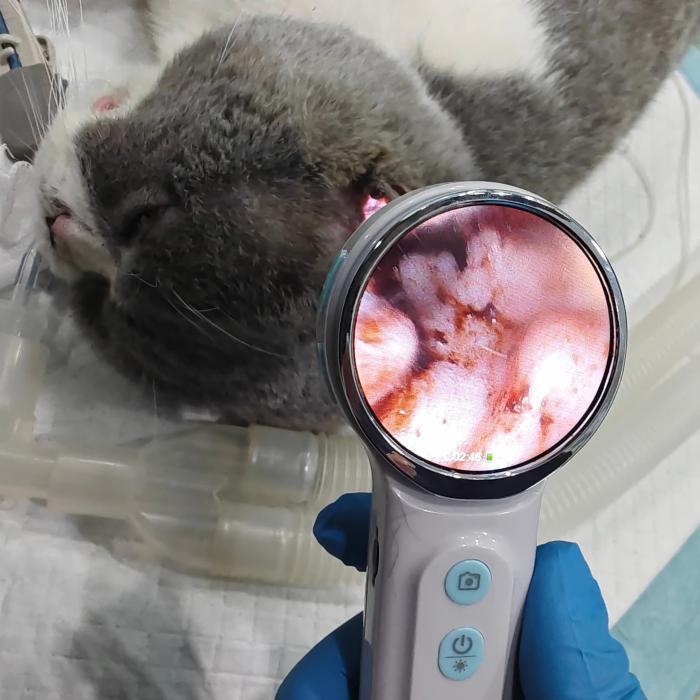
Ear and nasal examination scope: the RAE-201 record fixes the purpose, tube diameter and channel, which is the evidence an intended-use statement needs.
Where the record is silent, say so in the dossier. The RAE-105, RAE-105Pro, RAE-107 and RAE-109 specification records do not contain a separate purpose field. The approved application scope for the platform covers duodenal examination for inflammatory, neoplastic and obstructive conditions; tracheal and bronchial visualisation including tracheal collapse, bronchitis, tumours and foreign bodies; foreign-body and mass removal with ear-canal flushing; biopsy and culture for nasal discharge or obstruction; joint procedures; and abdominal procedures including ovariectomy, splenectomy and cavity exploration. That application scope is the right raw material for a purpose statement — but the final wording, jurisdiction by jurisdiction, should be agreed with the manufacturer in writing rather than assembled by the distributor alone.
Layer 2 — The model-level specification record
One row per model. Never one row per product family. The table further down is a compliant example: it uses only published values, and it marks absence rather than guessing. The recurring fields that matter for acceptance are tube outer diameter, working length, channel diameter, articulation, imaging resolution, depth of field, field angle, connection type and system compatibility.
Layer 3 — Material disclosure
Each of the eight JeetVet records lists the same four material categories: Plastic, Stainless Steel, Medical Grade Polymer and Optical Glass. That is the full extent of the verified material disclosure, and it is enough for a customs, catalogue or tender line.
It is not enough for a reprocessing instruction. The application record states continuous working mode for clinical use and reuse after sterilization, but no validated sterilization cycle — temperature, duration, agent or cycle count — appears in the published specification. A distributor writing a decontamination procedure must therefore request the validated cycle from the manufacturer rather than extrapolating from the material list. The same rule applies to polymer grade and biocompatibility questions: request them, do not infer them.
Rule of thumb: if a questionnaire line asks for a value that is not in the specification record, the correct entry is “pending manufacturer confirmation” with a date and an owner — not an estimate.
Layer 4 — The environmental and operating envelope
The published operating envelope is consistent across the platform and is directly usable in dossiers: operating temperature 0°C to 40°C, storage temperature −10°C to 55°C, relative humidity ≤ 80% non-condensing. The stated use environments are veterinary clinics, animal hospitals and field environments, with indoor and outdoor use and mobile veterinary services supported for both small and large animals.
This layer is where field-focused distributors gain an advantage. A portable equine or large-animal endoscope for field use is sold into conditions that a clinic-only dossier never has to justify: a vehicle, an unheated barn, a humid afternoon. The envelope gives a defensible boundary — and a defensible boundary is a selling argument, not a limitation to hide.
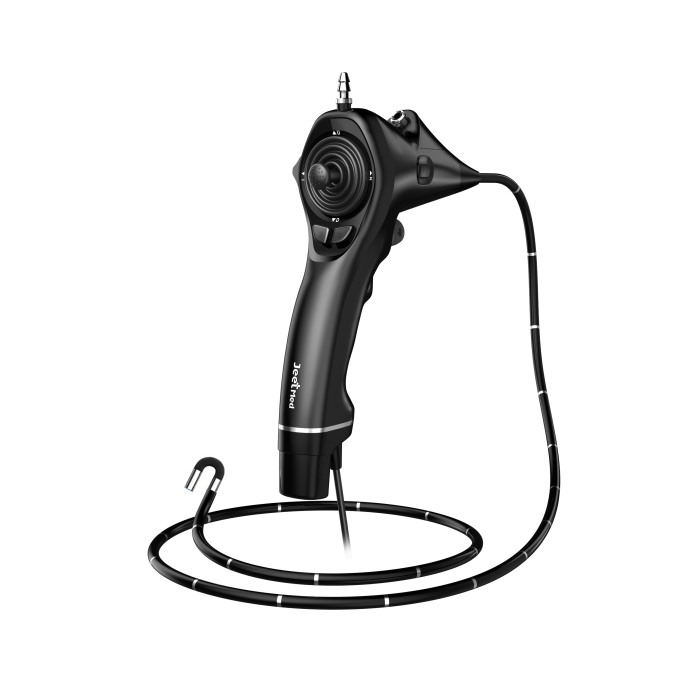
Large-animal models carry a distinct purpose statement: gastrointestinal examination, 1500 mm working length, 180° bending and 360° rotation.
Step-by-Step: Assembling the Dossier in Seven Steps
Step 1 — Lock the intended-use sentence first. Write it as device type + species scope + anatomical region + procedure + environment. If the specification record has no purpose field, resolve that with the manufacturer before anything else is written. Every later document inherits this sentence.
Step 2 — Build one specification row per model. Take values only from the model data sheet. Where a field is absent — for example the published working length for RAE-105, RAE-105Pro and RAE-109 — enter a gap reference instead of a number. The RAE-107 record, by contrast, states a 1000 mm working length, so it can be filled directly.
Step 3 — Write the material disclosure in the manufacturer’s own categories. Plastic, Stainless Steel, Medical Grade Polymer, Optical Glass. Do not translate “medical grade polymer” into a named resin unless the manufacturer confirms it in writing.
Step 4 — Attach the environmental envelope verbatim. 0°C to 40°C operating, −10°C to 55°C storage, ≤ 80% relative humidity non-condensing, with the stated clinic, hospital, field and mobile-service environments.
Step 5 — Map the buyer questionnaire line by line. Use three columns: what the buyer asks, what we state, which source document supports it. Lines that fail the third column move to the gap register, not into the answer.
Step 6 — Rewrite acceptance criteria and purchasing terms against documented values only. Criteria should name the model and a verifiable value — channel diameter, tube diameter, working length, articulation range, connection type — so that incoming inspection has something to measure.
Step 7 — Maintain a no-claim list and a gap register, and re-verify both before every tender. The no-claim list holds statements the team is not permitted to make without new documents: CE marking, FDA clearance, clinical superiority, market ranking, customer outcomes. The gap register holds the fields still owed by the manufacturer.
Verified Specification Comparison
The table below compares the eight JeetVet records using only published values. It is designed to be copied into a dossier and expanded with a source-document column. “Not published” is a valid entry and protects the distributor: it signals a request to the manufacturer rather than a gap the distributor might be tempted to fill.
| Model | Type | Published purpose | Tube OD / working length | Working channel | Articulation | Imaging & optics |
|---|---|---|---|---|---|---|
| RAE-201 | Veterinary Flexible Otoscope | Animal ear and nasal examination | 3.1 mm / 600 mm | 1.2 mm | 180° bending, up & down steering | 160,000 pixels; 120° field angle; depth of field 5–50 mm |
| RAE-500 | Portable Smart Veterinary Otoscope | Ear and nose solution (no separate purpose field) | 3.9 mm lens; not applicable | Not applicable | Not applicable | 720×720 pixels; 78° field of view; focal length 5–50 mm; 6 LED lights; 1x/1.2x/1.5x; 8 GB memory |
| RAE-105 | Portable USB Veterinary Endoscope | Not published | 5.8 mm / not published | 2.0 mm | 180° bending, 360° rotation | 1,000,000 pixels; 120° field angle; depth of field 7–100 mm |
| RAE-105Pro | Portable WiFi Veterinary Endoscope | Not published | 5.8 mm / not published | 2.0 mm | 180° bending, 360° rotation | 1,000,000 pixels; 120° field angle; depth of field 7–100 mm |
| RAE-107 | Portable WiFi Veterinary Endoscope | Not published | 5.8 mm / 1000 mm | 2.0 mm | 360° directional control | HD resolution; 1,000,000 pixels; depth of field 7–100 mm |
| RAE-109 | Portable USB Veterinary Gastroscope | Not published | 5.8 mm / not published | 2.0 mm | 180° up/down and left/right, 360° steering | 1,000,000 pixels; 120° field angle; depth of field 7–100 mm |
| VET-5820 | Portable Veterinary Gastroscope for Large Animals | Animal gastrointestinal examination | 5.8 mm / 1500 mm | 2.0 mm | 180° bending, 360° rotation | 1080P; 120° field angle; depth of field 7–100 mm |
| VET-8528 | Portable Veterinary Endoscope for Large Animals | Animal gastrointestinal examination | 8.5 mm / 1500 mm | 2.8 mm | 180° bending, 360° rotation | 1080P; 120° field angle; depth of field 7–100 mm |
The parallel interface table matters just as much for purchasing terms, because connection type is the field most often written from memory. RAE-105, RAE-105Pro, RAE-107 and RAE-109 are listed as compatible with Android, Windows and iOS systems and weigh under 1 kg; RAE-105 and RAE-109 connect over USB, while RAE-105Pro and RAE-107 add WiFi. The RAE-107 record additionally states water and air supply, suction, a forceps working channel and single-veterinarian operation as available. RAE-500 uses a Type-C port with a 1.85-inch screen and built-in 8 GB storage.
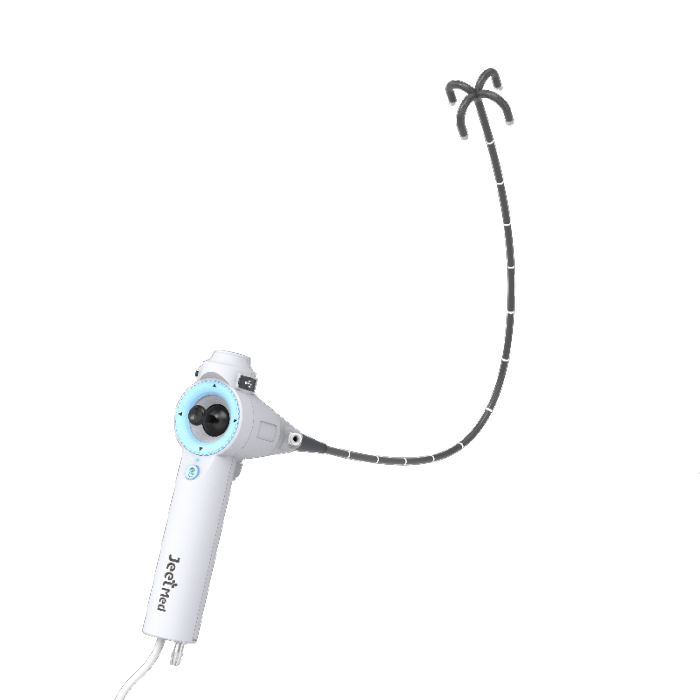
Connection type belongs in the purchasing terms, not in a footnote: USB, WiFi or Type-C changes what the clinic must provide at the point of use.
Use Cases: Where the Dossier Earns Its Keep
Distributor entering a public tender
A distributor bidding into a veterinary teaching hospital needs an intended-use sentence, one specification row per offered model and a materials line, all attributable. Offering VET-8528 with an 8.5 mm tube and a 2.8 mm channel alongside VET-5820 with 5.8 mm and 2.0 mm is defensible only when the difference is stated in the bid, because the two models serve different animal sizes and different working-channel instruments.
Small-animal clinic standardisation
A multi-site practice standardising equipment can pair the RAE-201 for ear and nasal examination with RAE-105 or RAE-105Pro for general small-animal endoscopic work and RAE-500 for otoscopy. The dossier then answers the internal question that always follows: which model does which job, and on what documented basis.
Field and equine deployment
A mobile large-animal service needs the environmental envelope on paper before the equipment goes into a vehicle. The 0°C to 40°C operating range, −10°C to 55°C storage range and ≤ 80% non-condensing humidity limit, together with the stated field and mobile-service environments, give the practice a written operating boundary it can train against.
Answering an importer’s questionnaire without overclaiming
When an importer asks whether the device is approved for a market, the honest answer has structure: what is documented (specifications, materials, quality-system statement, HS code 90189020), what is pending (certificate copies, market-specific authorisations), and who owns the follow-up. That answer is slower to write once and much faster to reuse than a sentence that has to be retracted.
Aligning Acceptance Criteria and Purchasing Terms
Acceptance criteria convert documentation into a contractual test. Three rules keep them enforceable.
- Name the model in every criterion. “Working channel 2.0 mm” is meaningless without the model; RAE-201 is 1.2 mm, VET-8528 is 2.8 mm, and the rest of the platform at 2.0 mm.
- Test only what the record states. Tube diameter, working length, channel diameter, articulation and connection type are measurable. “Image quality” is not, unless the criterion is written as a stated resolution value such as 1080P or 1,000,000 pixels.
- Separate delivery documents from regulatory documents. A packing list and a certificate of conformity are different instruments; conflating them in a purchase order is how a distributor ends up promising an approval nobody holds.
For manufacturers evaluating a supplier, the same logic applies in reverse. Jeet Medical’s published profile states a 2020 founding, a 5000 m² facility, 130 employees, a 30-person R&D team, annual output of 10,000 units and a 50% export share across Europe, North America, Southeast Asia, Latin America and the Middle East. Those are useful qualification inputs and they belong in a supplier file — not in a product intended-use statement, where they prove nothing about the device.
FAQ
No. A certification or clearance statement may only be repeated when the certificate or clearance document is held, and its scope covers the exact model being offered. The JeetVet specification records used in this guide do not include CE certificates or FDA clearances, so this guide states none. What the published profile does state is that Jeet Medical (Shenzhen) Co., Ltd. is certified under ISO 13485 by SGS — and ISO 13485 certifies a quality management system, not a product. Before repeating any certification line, request the certificate copy, its number, the issuing body and the covered scope, and record the date it was obtained. For U.S. questions, the FDA’s own explainer on how it regulates animal devices is the reference point.
No. Channel diameter changes what instrument the veterinarian can pass and therefore changes the intended use. The verified values are 1.2 mm on RAE-201, 2.0 mm on RAE-105, RAE-105Pro, RAE-107, RAE-109 and VET-5820, and 2.8 mm on VET-8528, with tube outer diameters running from 3.1 mm to 8.5 mm. Acceptance criteria and purchasing terms should name the model and the diameter together, because a delivery check against the wrong row will fail a correct unit.
Four variables dominate: the number of models in scope, the number of target markets, translation and formatting requirements, and the number of fields the manufacturer still has to confirm. The last one is usually the largest, which is why the gap register should be built before the quotation is requested. Ask for a scope-based quotation against a named model list and market list rather than a single catalogue-wide figure, and keep the quotation attached to the dossier version it prices.
Record the model code on the unit and on the packaging, the intended-use sentence the sample is being evaluated against, the tube outer diameter and working length, the working channel diameter, the articulation range, the stated imaging value and the connection type — USB, WiFi or Type-C — plus the delivery documents. Keep that record with the dossier so that a later order can be compared against the unit that was actually approved. Sample requests and the accompanying specification sheet can be raised directly with the JeetVet team at jeetvet.com.
The verified records used here do not publish a manufacturing lead time, so no lead-time figure is stated in this guide. What can be planned is sequence: finalise the intended-use sentence and the model list, raise the gap register, and send it in the same message as the quotation request, so that certificate copies, sterilization-cycle details, lead time and acceptance-criteria sign-off all travel together. A dossier that is 90% complete blocks an order just as effectively as one that is empty, because the remaining fields are always the ones the importer asks about first.
Conclusion
Regional documentation is a translation exercise, not a writing exercise. The verified record already contains what most questionnaires actually require: intended use for ear, nasal and gastrointestinal examination; tube diameters of 3.1 mm, 5.8 mm and 8.5 mm; working lengths of 600 mm, 1000 mm and 1500 mm; working channels of 1.2 mm, 2.0 mm and 2.8 mm; 180° bending and 360° rotation; 120° field angles with depth of field from 7 mm to 100 mm; 1080P and 1,000,000-pixel imaging; USB, WiFi and Type-C connectivity; four named material categories; and an operating envelope of 0°C to 40°C. Everything beyond that set is a request to the manufacturer, not a sentence to be improvised.
Distributors who separate those two categories — documented and pending — get a dossier that survives tender review, importer questionnaires and internal audits, and a no-claim list that protects them from inheriting a competitor’s marketing language.
Request the verified documentation pack
Jeet Medical (Shenzhen) Co., Ltd. publishes model specification sheets, material disclosures and its company profile for distributor and procurement teams building regional dossiers.
Download the company and product brochure: JeetVet brochure (PDF)
Sample requests, model-level specification questions and gap-register follow-ups: troy@jeetmed.com · www.jeetvet.com
Address: 9th Floor, Block B, Building 1, No. 76 Baohe Avenue, Longgang District, Shenzhen, China.
Market size and growth figures are attributed to Mordor Intelligence (2026). Certification status reflects the manufacturer’s published statement and should be verified against the certificate itself before use in any regulatory submission.
Have Questions or Need More Details?
Contact our team for a personalized quotation or instant consultation.
Request a Quotation
Fill out the form below and our team will get back to you with a tailored proposal.
WhatsApp Direct Chat
Prefer to chat in real-time? Message us on WhatsApp for instant assistance & quick answers.
- Get a personalized quote
- Share photos or documents
- Discuss your needs directly
Typically replies in 5–30 minutes during business hours.