Dog Plush Toy Sizing and Chew Resistance: A Technical Guide to Matching Dog Weight

Short answer: a dog plush toy is correctly specified when the toy's physical dimension bracket matches the dog's body weight bracket and the toy's construction package matches the dog's chew intensity. For dogs between 5 kg and 40 kg, the working mapping is 10–15 cm for 5–8 kg, 15–20 cm for 8–15 kg, 20–30 cm for 15–25 kg, and 30–50 cm for 25–40 kg — with a single-layer short plush build at the light end and a double-layer, reinforced-stitch build (optionally with food-grade TPR inserts and Oxford fabric panels) at the heavy end.
Size without construction discipline produces a toy that looks right and fails in days. Construction without size discipline produces a durable toy the dog ignores or cannot carry. This guide treats both variables as one specification problem and walks through the dimensions, materials, and verification steps a buyer, brand owner, or product engineer needs before committing to a production run.
The Core Problem: Two Ways a Plush Toy Fails
Plush dog toys fail for one of two reasons, and both are specification errors rather than manufacturing defects.
Failure mode one — undersized for the chew load. When a toy designed around a 10–15 cm body and a light stitch pattern is handed to a 30 kg dog, the load concentrates on a small number of seams. Seam ends open, filling is exposed, and detached components become a swallow hazard. The American Humane Society guidance for pet toy selection is explicit here: choose toys made of durable, non-toxic materials, and avoid items small enough to swallow or that can splinter.
Failure mode two — oversized for the animal. A 45 cm plush toy is awkward for a 6 kg dog to grip, carry, or shake, and it is often abandoned after the first interaction. For anxiety-relief and companion products, this is the more expensive error, because the toy never becomes part of the animal's routine and the retail reorder rate collapses.
Because breed labels are unreliable as an engineering input, body weight is the most stable single proxy available at the design stage. Weight correlates with jaw geometry, bite force, and play style, and it can be confirmed by the buyer without laboratory testing.
Industry Background: Where Plush Dog Toy Specifications Come From
The commercial context explains why size and chew resistance are increasingly treated as procurement variables rather than designer preferences. The global dog toys market was valued at USD 4.16 billion in 2025, with a projected compound annual growth rate of 8.51% over 2025–2034 (Custom Market Insights). Plush sits inside that market alongside chew, interactive, and rubber categories, and it is the only major segment that has to serve comfort behaviour and chewing behaviour with the same product form.
Sourcing for this category is concentrated among OEM/ODM plush manufacturers in China, and the safety narrative around the category is built on durable, non-toxic materials. Stuffed animal toys are typically classified under HS code 9503.00.41 for import and export purposes, which is the classification customs documentation usually expects for plush pet toys shaped as animals.
What is not standardised is the size-to-weight relationship. There is no single global dimension table for plush pet toys, which means the four size brackets used in this guide have to be agreed between buyer and manufacturer at the specification stage. That is the gap this article closes:
- four dimension brackets covering 10–50 cm;
- four weight bands covering 5–40 kg;
- three primary material options — food-grade TPR, Oxford fabric, and short plush;
- two construction levels — basic and reinforced with double-layer fabric and reinforced stitching.
Manufacturers that already operate under multi-market compliance frameworks are the natural place to start this conversation. Tianchang Jiameile Gifts Co., Ltd., trading as Jiameile, is a China-based manufacturer of plush and textile-based toys with a 6,800 m² facility, 230 employees, a 30-person R&D team, and documented output of approximately 500,000 pieces per month, equivalent to about 6 million units annually. Roughly 70% of output is exported to EU and US markets, and the company holds ICTI, BSCI, Disney FAMA, ISO 9001, and ISO 14001 certifications, with products complying with EN71, ASTM F963, and GB6675.
Size Brackets: Mapping 10–50 cm Plush Toys to 5–40 kg Dogs
The four brackets below are the practical decision layer. Each bracket fixes a dimension range, a construction floor, and a primary function. A toy that satisfies the dimension range but not the construction floor is an incomplete specification.
| Dog body weight | Plush dimension bracket | Construction floor | Primary function |
|---|---|---|---|
| 5–8 kg | 10–15 cm | Short plush body, light seam reinforcement | Cuddling, companion, early teething |
| 8–15 kg | 15–20 cm | Short plush with Oxford fabric accents, reinforced stitching | Interactive squeaky play, cuddling |
| 15–25 kg | 20–30 cm | Double-layer construction plus reinforced stitching | Tug, fetch, sustained chew sessions |
| 25–40 kg | 30–50 cm | Double-layer construction, reinforced stitching, optional food-grade TPR insert | High-intensity chewing, comfort, large-scale retail assortments |
Dimension brackets are measured as the longest body dimension of the finished toy, excluding ears, tails, and attached cords. Brackets are a design and procurement framework and should be confirmed on physical samples before a production order is placed.
Chew Resistance Levels and the Materials That Create Them
Chew resistance is not a single property of a single material. It is the combined result of the outer face fabric, the number of structural layers, the stitching pattern, and the way internal components such as squeakers or heartbeat modules are housed. Four determinants control the outcome.
Short plush: the comfort layer
Short plush is a fine-pile knitted fabric that gives a plush dog toy its soft surface and its value as a cuddling and anxiety-relief product. It is the correct outer face for the 10–15 cm and 15–20 cm brackets because it is gentle against the muzzle and comfortable for a dog to hold. On its own, however, short plush is not a structural barrier: in heavier weight bands it should be used as the outer face over an inner woven liner, not as the only layer. This is the reason a soft plush dog toy for cuddling and a durable plush dog toy for a 30 kg animal require different internal builds even when the outer fabric looks identical.
Oxford fabric: the abrasion layer
Oxford fabric is a woven textile with a smooth, tightly constructed surface. In plush pet toys it is used for belly panels, limb panels, seam bindings, and any area where friction against teeth and floor surfaces is highest. Because it resists abrasion better than a knitted pile, Oxford fabric is the standard choice for reinforcing a toy carrying a heavier chew load, and it is also the reason many reinforced plush dog toys retain their shape after washing. It can be combined with short plush in the same toy: plush where the dog nuzzles, Oxford fabric where the dog bites.
Food-grade TPR: the non-textile chew surface
TPR (thermoplastic rubber) is a rubber-like polymer used for chew elements, edge inserts, and attached components. In plush dog toys it provides a non-textile surface that does not fray when the dog works on a specific area, and it can be integrated into the body or attached as a separate chewing feature. Food-grade TPR is the specification used where the toy is positioned as a plush puppy teething toy or as a durable plush toy for heavier animals. TPR is not a substitute for correct sizing: a 10–15 cm toy with a TPR insert is still a small-bracket toy and should not be sold for a 30 kg dog.
Reinforced stitching and double-layer construction
The structural core of a durable plush dog toy is the combination of double-layer fabric and reinforced stitching. This product features a reinforced structure with double-layer fabric and reinforced stitching, providing a longer lifespan of 3 to 12 months compared to basic plush toys that last only 1–3 months. That is a 2–4 times improvement in service life, and it is the difference that determines whether a toy belongs on a long-term retail shelf or in a short-term promotional bin.
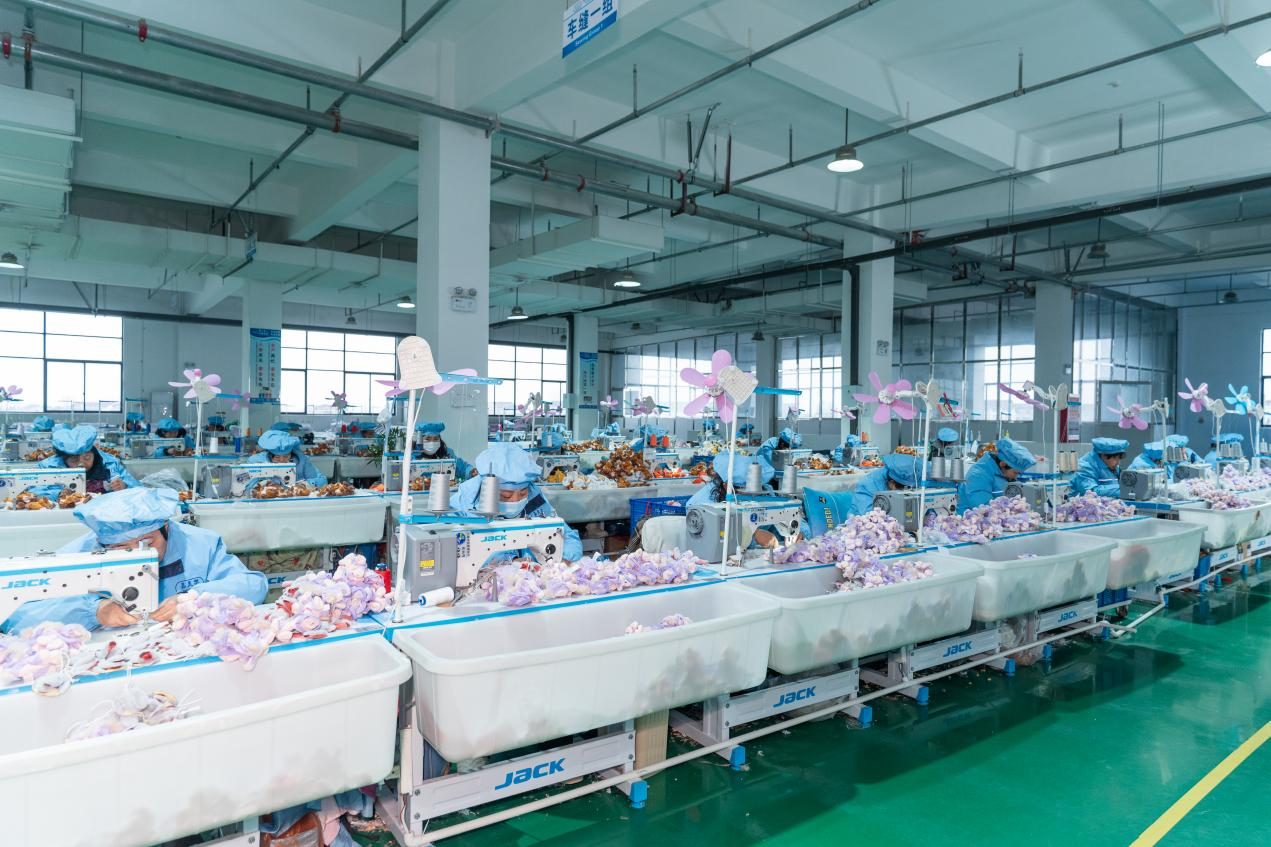
In practice, a reinforced build places the extra stitching where the load actually concentrates: limb junctions, seam ends, the base of ears or tails that are pulled, and the pocket housing any squeaker, rattle, or heartbeat module. Internal components should be captured inside a reinforced pocket rather than simply inserted into the filling. Where a no-stuffing plush dog toy format is chosen, the risk of loose filling escaping through an opened seam is removed entirely, which is why flat, no-stuffing constructions are increasingly specified for the heaviest chew bands.
Basic vs Reinforced Plush Construction: Comparison Table
The table below compares the two construction levels that most procurement decisions come down to. The core difference is structural: reinforced toys use double-layer fabric combined with reinforced stitching, while basic plush toys have no reinforced structure — only basic fabric and stuffing.
| Parameter | Basic plush toy | Reinforced plush toy |
|---|---|---|
| Core structure | No reinforced structure; basic fabric and stuffing only | Double-layer fabric plus reinforced stitching |
| Service life | 1–3 months | 3–12 months (2–4 times longer) |
| Best suited to | Low-end retail, promotional gifts, short-term use | E-commerce platforms, pet specialty stores, retail chains, long-term pet companionship |
| Cost level | Lowest cost | Medium cost |
| Maintenance profile | Frequent replacement required | Lower breakage, low maintenance |
| Efficiency profile | Low durability / high loss | Balanced performance |
The commercial reading of this table matters more than the construction detail. A reinforced toy costs more per unit but replaces itself two to four times less often, which shifts the product from a promotional line into an e-commerce, pet specialty, or retail-chain line. A basic plush toy remains the correct answer for gift-with-purchase programmes and seasonal promotions where the expected use period is short by design.
Step-by-Step: Matching a Plush Toy Specification to a Weight Band
The workflow below converts a target dog weight into a manufacturable specification. Each step produces a written input that can go directly into a sample request.
Step 1 — Fix the weight band, not the breed. Record the primary weight band for the product line: 5–8 kg, 8–15 kg, 15–25 kg, or 25–40 kg. If a line must serve multiple bands, split it into SKUs rather than averaging the specification, because the middle of the range usually satisfies no one.
Step 2 — Confirm the play function. Cuddling and anxiety-relief positioning prioritises surface softness. Interactive squeaky positioning prioritises housing the sound module securely. Teething positioning prioritises a chewable non-textile element such as food-grade TPR. Tug and fetch positioning prioritises seam strength at the grip points.
Step 3 — Select the dimension bracket. Apply the size table: 10–15 cm for 5–8 kg, 15–20 cm for 8–15 kg, 20–30 cm for 15–25 kg, and 30–50 cm for 25–40 kg.
Step 4 — Select the construction package. Basic construction for promotional and low-end retail; reinforced construction with double-layer fabric and reinforced stitching for anything positioned as a durable plush dog toy or intended for repeat purchase.
Step 5 — Select the material mix. Choose the outer face (short plush for comfort, Oxford fabric for abrasion zones), the internal liner where required, and whether a food-grade TPR element is included. Specify whether the toy is stuffed, partially stuffed, or a no-stuffing plush dog toy format, and confirm that the product remains washable if the retail listing promises it.
Step 6 — Define component containment. State where the squeaker, rattle, or heartbeat module sits and require a reinforced pocket. For the heaviest weight band, consider removing small internal components from the specification altogether.
Step 7 — Lock the compliance requirement. Name the destination markets and the standards that apply, and require the corresponding test documentation for the exact materials and size bracket ordered.
Step 8 — Validate on samples before mass production. Check the finished dimension against the bracket, test the reinforced seams under load, confirm the material hand-feel for the intended function, and record the expected service life so that retail claims match the construction level actually produced.

Use Cases: Applying the Framework to Real Product Types
The framework becomes easier to apply when it is mapped onto the product types that actually sell.
Soft plush dog toy for cuddling (10–15 cm / 5–8 kg). Short plush outer face, light seam reinforcement, small or no internal sound component. This is the strongest fit for companion positioning and for dogs that carry a toy rather than work on it.
Anxiety relief and heartbeat plush dog toy (15–20 cm and 20–30 cm). Comfort function dominates, but the heartbeat or sound module must be contained in a reinforced pocket, because the module is the component most likely to be worked loose. In the 15–25 kg band, a double-layer build is advisable even though the toy is not positioned as a chew product.
Plush puppy teething toy (10–15 cm and 15–20 cm). Here food-grade TPR is the material of choice for the chewing element, with short plush covering the rest of the body. Size discipline is critical, because puppies in the 5–15 kg range are still growing and an oversized toy simply will not be used.
Interactive squeaky plush dog toy (15–20 cm and 20–30 cm). The squeaker housing determines the durable service life as much as the fabric does. Reinforced stitching around the sound pocket, combined with Oxford fabric in the high-contact areas, is the specification that keeps the toy in playable condition.
Washable and no-stuffing plush dog toy formats (20–30 cm and 30–50 cm). For dogs above 15 kg, a no-stuffing construction removes loose filling from the failure equation and simplifies cleaning. Washability should be confirmed against the actual material mix, since a TPR element and a short plush body do not have identical care requirements.
For custom plush pet toy programmes and wholesale plush dog toy assortments, the practical retail approach is to build one SKU per weight band rather than one SKU per design idea. That gives a four-tier range covering 5–40 kg with a defendable specification behind each tier.
Compliance and Risk Control for Buyers
Sizing and construction decisions are only valid if the finished toy complies with the destination market. The standard frameworks referenced for this category include EN71 for the European Union, ASTM F963 and CPSIA for the United States, GB 6675 for China, and GB/T 43839-2024. Plush pet toys shaped as animals are typically shipped under HS code 9503.00.41. Buyers should request the test documentation that corresponds to the exact materials, size bracket, and construction level ordered, rather than accepting a general certification list that may refer to a different product.
Two operational risks dominate this category. The first is product quality and compliance risk, which is controlled through full-process quality management and material and compliance testing — an IQC/IPQC/OQC system, compliance testing against EN71, ASTM, or CPSIA, and raw material safety control. The second is supply chain and delivery risk, which is managed through production planning and supply chain management: monthly capacity planning, backup suppliers, and active inventory and lead time management. Neither risk is solved by a lower unit price.
FAQ: Sizing, Chew Resistance, and Sourcing Questions
Which safety standards apply to dog plush toys?
The frameworks referenced for dog plush toys include EN71 for the European Union, ASTM F963 and CPSIA for the United States, GB 6675 for China, and GB/T 43839-2024. Stuffed animal toys are normally classified under HS code 9503.00.41. Because certification relevance depends on the destination market and on the exact materials used, buyers should request the test report for the specific size bracket and construction level being ordered, and should confirm that the report covers the actual outer fabric, liner, filling, and any TPR element in the product.
Can one plush toy be soft enough for cuddling and durable enough for a 30 kg dog?
Yes, but only when softness and durability are placed in different layers of the same product. A reinforced structure with double-layer fabric and reinforced stitching provides a longer lifespan of 3 to 12 months, compared with 1–3 months for basic plush toys. Short plush serves as the comfort face, while the inner layer, Oxford fabric panels, and reinforced stitching carry the mechanical load. For a dog in the 25–40 kg band, the corresponding dimension bracket is 30–50 cm, and the specification should also state whether a food-grade TPR element is included and how the squeaker or heartbeat module is contained.
Why does reinforced plush construction cost more than basic plush?
Reinforced construction sits at a medium cost level, while basic plush toys sit at the lowest cost level, because reinforcement adds a second fabric layer, additional stitching operations, and stricter component containment. The relevant comparison is not unit price but replacement frequency. Basic plush toys have a lifespan of 1–3 months and require frequent replacement, while reinforced toys last 3–12 months with lower breakage and low maintenance. Basic plush remains appropriate for promotional gifts and short-term use; reinforced construction is the better fit for e-commerce platforms, pet specialty stores, retail chains, and long-term pet companionship.
How do buyers validate size and chew resistance before mass production?
Validation is done on physical samples, not on specification sheets. Measure the finished toy against the dimension bracket, confirm the material mix and layer count by inspection, load-test the reinforced stitch points, and verify that any squeaker or heartbeat module is held in a reinforced pocket. Samples also allow the buyer to check washability and hand-feel against the intended positioning. Sample evaluation is the stage where a size or construction mismatch is cheapest to correct, and it is the normal starting point for a custom plush pet toy programme.
What production capacity and lead time should a buyer expect?
Capacity depends on the manufacturer. Tianchang Jiameile Gifts Co., Ltd. (Jiameile) operates a 6,800 m² facility in Tianchang, Anhui Province, China, with 230 employees, a 30-person R&D team, and output of approximately 500,000 pieces per month, equivalent to about 6 million units annually, with roughly 70% exported to EU and US markets. Lead time is managed through monthly capacity planning, backup suppliers, and inventory and lead time management, and it should be confirmed against the specific size bracket, material mix, and packaging requirement rather than assumed from a general catalogue figure. To request a sample or a quotation for a specific weight band, contact Jiameile at winnie@jml-toys.com or via WhatsApp.
Conclusion: One Weight Band, One Specification
Matching a dog plush toy to a dog is a two-variable problem: dimension against body weight, and construction against chew intensity. The 5–40 kg range resolves into four clean brackets — 10–15 cm, 15–20 cm, 20–30 cm, and 30–50 cm — and each bracket has a minimum construction package behind it. Food-grade TPR, Oxford fabric, and short plush are not competing options; they are layers with different jobs. Reinforced stitching and double-layer construction are what convert those layers into a product with a documented 3–12 month service life instead of a 1–3 month replacement cycle.
For brands and importers building a durable plush dog toy range, the practical next step is to define one SKU per weight band, fix the material and construction specification for each, confirm the compliance documentation against EN71, CPSIA, and the relevant national standards, and validate the result on samples before committing to volume. Buyers working with an experienced plush pet toy manufacturer can move this from framework to finished sample in a single iteration. To discuss sizing, construction, or a custom plush pet toy programme, request a sample or a quotation from Jiameile at winnie@jml-toys.com, by WhatsApp at +86 173-7538-5845, or through the company blog at blog.jiameiletoys.com.
Have Questions or Need More Details?
Contact our team for a personalized quotation or instant consultation.
Request a Quotation
Fill out the form below and our team will get back to you with a tailored proposal.
WhatsApp Direct Chat
Prefer to chat in real-time? Message us on WhatsApp for instant assistance & quick answers.
- Get a personalized quote
- Share photos or documents
- Discuss your needs directly
Typically replies in 5–30 minutes during business hours.