Light vs. Moderate vs. Aggressive Chewer Dog Plush Toys: A Retail Buyer's Ranking
Most dog plush toy assortments underperform for a repeatable reason: one build is sold across every dog weight band. The toy that comforts a 4 kg lap dog is not the toy that survives a 25 kg power chewer, and retail buyers who treat 'dog plush toy' as a single shelf-ready product pay for that decision in returns, weak reviews, and cancelled reorders.
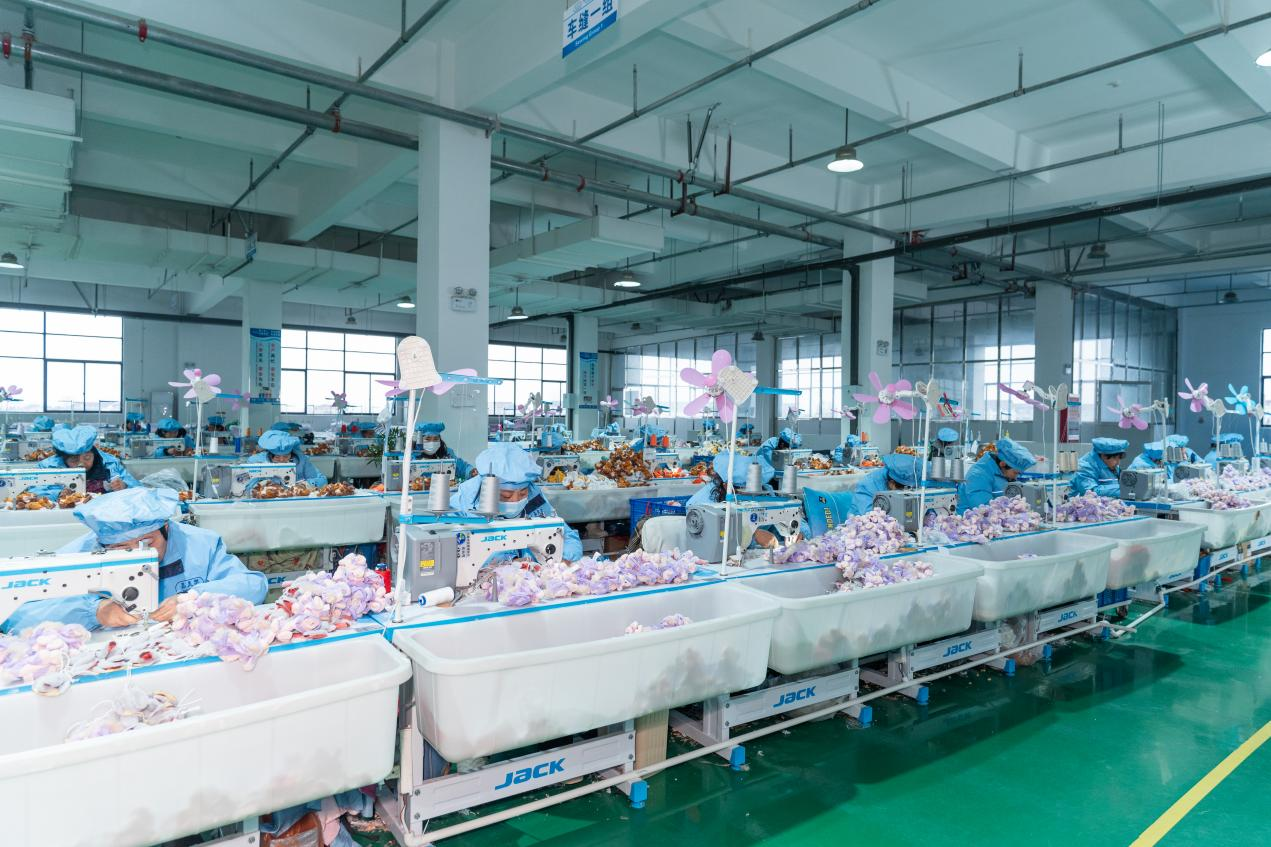
This ranking splits the category into three chew-resistance builds — Light, Moderate, and Aggressive Chewer — and orders them by the dog weights they fit, the materials that define them, and the retail channels where each build earns its space. The reference builds are produced by Tianchang Jiameile Gifts Co., Ltd. (Jiameile), a plush and textile toy manufacturer in China that develops plush pet toys, squeaky toys, and interactive items for US and European retail programs with full OEM/ODM support.
Problem Definition: Why 'Dog Plush Toy' Cannot Be One SKU
A retail buyer sourcing plush dog toys is not simply choosing a soft toy. They are assigning a durability level to a shopper segment, a dog weight band, and a shelf position at the same time. When those three decisions are made independently, three failure patterns appear in almost every program:
- Over-building. An aggressive-chewer toy with a food-grade TPR core is placed in a cuddling or gift position. It carries material and inspection cost the buyer does not need for a calm small-breed dog, and it usually prices itself out of the comfort segment.
- Under-building. A short-plush comfort toy is sold into a multi-dog household with medium or large chewers. The seam fails first, stuffing escapes, and the SKU generates safety complaints instead of repeat purchases.
- Compliance ambiguity. The chewer level is clear, but the buyer cannot confirm which safety standard the build was tested against. US and EU retail programs will not list a plush dog toy that cannot show an EN71, ASTM F963, or CPSIA position.
The practical fix is to treat chew-resistance level as the top-level assortment variable, with dog weight and material as dependent choices rather than separate line items.
Industry Background: Why Tiered Chew Levels Now Fit Retail
The global dog toys market was valued at USD 4.16 billion in 2025 and is projected to grow at a CAGR of 8.51% from 2025 to 2034 (Custom Market Insights). Plush remains one of the highest-frequency purchase segments because it sits at the intersection of play, comfort, and replacement cycle — owners buy plush again when it wears out, not only when the dog is new.
Safety guidance for the category is consistent across welfare and standards sources. Dog toys should be made from durable, non-toxic materials and should not splinter or break apart easily (American Humane Society). For cross-border programs, stuffed toys representing animals are classified under HS code 9503.00.41, and US/EU retail compliance is commonly tested against ASTM F963, EN71, and CPSIA. In China, GB/T 43839-2024 "Safety Technical Requirements for Companion Animal (Pet) Products" adds a pet-specific reference point that increasingly appears in buyer specification sheets.
Taken together, these two signals — a growing market and a fixed safety baseline — push assortments toward defined durability tiers instead of a single generic plush SKU.
The Ranking: Three Chewer Builds, Ranked by Chew Resistance Ceiling
The ranking below orders the three builds by their chew resistance ceiling: the level of chewing force the construction is engineered to absorb before failure. Each level is then mapped to a dog weight band, a defining material, and the channels where it performs commercially. All three builds use reinforced stitching and share a non-toxic, lead-free and phthalate-free material position.
Aggressive Chewer Build — Food-Grade TPR, 15–30 kg
The highest chew-resistance ceiling in the line-up sits with the aggressive chewer build, anchored by a food-grade TPR (thermoplastic rubber) core rather than a fabric shell. TPR is specified lead-free and phthalate-free, and the build targets the largest dog weight band in the program: 15–30 kg, at sizes of roughly 30–50 cm. Where soft comfort toys fail against sustained chewing, the TPR build is engineered to absorb it, which is why it ranks first for chew resilience rather than for softness.
Typical applications are teething and chewing training, interactive play, and reducing destructive behavior in power-chewing dogs. It carries the longest service life of the three builds, in the 12–36 month range for rubber/TPR constructions. Retail fit: mass retail chains, supermarkets, multi-dog households, and e-commerce listings that need a durability-led hero SKU.
Moderate Chewer Build — Oxford Fabric, 5–15 kg
Second in chew resistance is the moderate chewer build, defined by Oxford fabric. The fabric shell is tougher than short plush while keeping the soft, carryable feel that keeps plush on the shelf, and it suits the 5–15 kg band at medium sizes of roughly 20–30 cm. Reinforced stitching is the construction detail that matters most here: the shell resists abrasion while the seam absorbs the first pull, so the build is rated for reinforced chew use in the 6–24 month range, with the reinforced chew-resistant series averaging a 12–24 month service life.
Typical applications are interactive play and behavioral training. Retail fit: pet retail chains, pet e-commerce, veterinary and pet care settings, and grooming or boarding channels that want one durable plush SKU with broad appeal across medium breeds.
Light Chewer Build — Short Plush, Under 5 kg
The light chewer build ranks third on chew resistance and first on comfort. It uses short plush — the softest of the three materials — at small sizes of roughly 10–15 cm and 15–20 cm for dogs under 5 kg. Standard plush constructions in this class are typically rated for 3–12 months of use depending on intensity, and the design priority is contact comfort rather than seam survival.
This is the build behind soft dog plush toys for cuddling, anxiety relief positions, and plush puppy teething toys used during early socialization. Comfort-format variations some retail programs request include no-stuffing plush dog toys and heartbeat plush dog toys, both of which serve calming rather than chewing. Retail fit: gift and boutique shelves, pet subscription boxes, seasonal programs, and supermarket comfort aisles.
A ranking caution. This is a chew-resistance order, not a quality order. A Rank #3 short-plush toy can be the correct purchase for a gift channel and the wrong purchase for a multi-dog household. The value of the ranking is in matching the level to the customer, not in defaulting every SKU to the toughest build.
Step-by-Step Breakdown: Assigning a Build to a Retail Slot
For buyers moving from evaluation into execution, the assignment sequence below keeps the chewer level, the material, and the channel decision in one flow.
- Fix the dog weight band first. Weight band drives the size and material decision. The reference bands are under 5 kg, 5–15 kg, and 15–30 kg, mapped to small, medium, and large builds.
- Choose the material the chew level demands. Short plush for light chewers and comfort positions; Oxford fabric for moderate chewers; food-grade TPR for aggressive chewers and large breeds.
- Confirm reinforced stitching. Every build in the reference line uses reinforced stitching. For a durable plush dog toy, the seam specification matters more than the outer appearance, because the seam is normally what fails first.
- Verify the safety position. Ask for the tested standard, not just the claim. EN71, CPSIA, ASTM F963, and GB/T 43839-2024 are the reference points buyers use, and the manufacturer's QMS certificate supports the documentation trail.
- Assign the channel. Gift and subscription channels take Rank #3; pet retail chains and e-commerce take Rank #2; mass retail and multi-pet households take Rank #1.
- Validate with a sample. Sample production for custom builds runs 7–15 days, which makes physical validation realistic before a full commitment.
- Confirm commercial terms. Check MOQ, lead time, and acceptance criteria before the PO, not after.
Use Cases: Matching Builds to Channel and Buyer
E-commerce and DTC listings
Online listings need a clear durability promise because the buyer cannot touch the toy before purchase. The moderate chewer build (Oxford fabric, reinforced stitching) and the aggressive chewer build (food-grade TPR) support durability-led copy and help reduce return rates driven by premature tearing. Interactive squeaky plush dog toys and reinforced stitching plush dog toys map most directly to this channel, where review text carries more weight than shelf position.
Retail chains and supermarkets
Planogram-driven retailers do best with two tiers at the shelf: a Rank #1 aggressive build for the large-breed aisle and a Rank #3 short-plush build for the gift and comfort aisle, with the Rank #2 Oxford build covering the middle. The pet toy reference range is used across supermarket and chain store, pet retail chain, and pet e-commerce segments, which allows one supplier to cover a multi-tier planogram.
Pet subscription boxes and gift channels
Subscription and gift programs buy on novelty and emotional value rather than chew resistance. The light chewer short-plush build supports anxiety relief, cuddling, and seasonal gift positioning, and washable plush dog toy and no-stuffing plush dog toy formats fit subscription calendars that rotate themes month to month.
Veterinary, boarding, and training channels
Professional settings tend to buy moderate and aggressive builds for behavioral training and interactive play, and light builds for post-visit comfort. The same product line is used in veterinary and pet care, pet training, and pet boarding or pet hotel environments, which means one compliance file can serve several professional channel types.
Comparison Table: Light vs. Moderate vs. Aggressive Chewer Builds
| Attribute | Light Chewer (Rank #3) | Moderate Chewer (Rank #2) | Aggressive Chewer (Rank #1) |
|---|---|---|---|
| Suitable dog weight | Under 5 kg | 5–15 kg | 15–30 kg |
| Typical size | 10–15 cm / 15–20 cm | 20–30 cm | 30–50 cm |
| Defining material | Short plush | Oxford fabric | Food-grade TPR (lead-free, phthalate-free) |
| Chew resistance ceiling | Lowest | Mid | Highest |
| Reinforced stitching | Yes | Yes | Yes |
| Average service life | 3–12 months (standard plush) | 6–24 months (reinforced chew) | 12–36 months (rubber/TPR) |
| Primary use | Companionship, emotional calming, cuddling, teething | Interactive play, behavioral training | Chewing training, interactive play, reducing destructive behavior |
| Best-fit channel | Gift, boutique, subscription box, supermarket comfort aisle | Pet retail chain, pet e-commerce, veterinary and pet care | Mass retail, multi-dog households, e-commerce |
| Safety standards | EN71, CPSIA, ASTM F963; GB/T 43839-2024 pet product safety reference | ||
All three builds are produced under the same quality-control framework: IQC incoming inspection, IPQC in-process inspection, and OQC final inspection, with third-party inspection by SGS or BV available when required. Materials in the reference line are specified as non-toxic, lead-free, and phthalate-free.
FAQ: Retail Buyer Questions on Dog Plush Toy Sourcing
1. Which safety standards should a retail buyer verify before listing a dog plush toy?
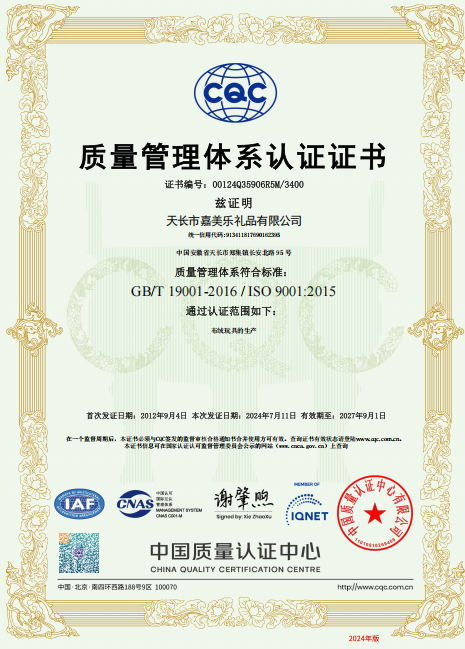
For US and EU retail programs, the commonly required standards are EN71, CPSIA, and ASTM F963; for the Chinese market, GB/T 43839-2024 "Safety Technical Requirements for Companion Animal (Pet) Products" is the pet-specific reference, and the reference builds are stated to comply with GB/T 43839-2024. The verification step buyers should request is the tested standard plus the manufacturer's quality-management documentation. Jiameile holds an ISO 9001 QMS certificate (certificate no. 00124Q35906R5M/3400, issued by CQC, standard GB/T19001-2016, scope: production of cloth/plush toys), alongside BSCI, ICTI, and Disney FAMA approvals. Materials in the reference line are specified as non-toxic, lead-free, and phthalate-free.
2. Can one manufacturer produce all three chewer builds for a single assortment?
Yes. The reference manufacturer offers OEM manufacturing, ODM development, and private label customization production, so a retailer can source Light, Moderate, and Aggressive Chewer builds from one production partner instead of splitting an assortment across suppliers. Customization covers logo printing, fabric material, size, color, stuffing type, squeaker type, packaging (box, blister, or card), and hang tags — which allows a buyer's comfort build (short plush) and durability builds (Oxford or TPR) to share a single brand presentation. Monthly capacity for custom plush pet toys ranges from 100,000–300,000 pieces at mid-size factories to 500,000–1,000,000+ pieces at large factories; Jiameile's stated capacity is 500,000 pieces per month from a 6,800 m² facility.
3. What MOQ, payment, and delivery terms apply to a custom dog plush toy order?
Standard MOQ is typically 500–3,000 pieces per style, rising to 3,000–5,000 pieces for complex custom designs. Payment terms follow standard industry practice of 30% deposit with the 70% balance before shipment. Delivery is mainly FOB, followed by EXW, with CIF or DDP options available for cross-border e-commerce sellers. Because MOQ is set per style rather than per chewer level, a buyer piloting a tiered assortment can usually start with the highest-volume build and add the other levels once sell-through is confirmed.
4. How long does sampling and validation take before bulk production?
Sample production lead time is 7–15 days. That window is long enough to confirm material hand-feel (short plush versus Oxford fabric versus TPR), to verify reinforced stitching at the seam, and to test the squeaker or interactive element with a real dog. Buyers validating a custom plush pet toy for the first time should use the sample stage to check chew resistance against the intended dog weight band before committing to a bulk order.
5. What is the bulk production lead time, and how is quality assured?
Bulk production lead time is 20–45 days depending on complexity and volume. Quality assurance runs through three stages: IQC (incoming inspection), IPQC (in-process inspection), and OQC (final inspection before shipment), with third-party inspection by SGS or BV available when required. Acceptance criteria are OQC plus buyer or third-party inspection. After-sales support includes replacement or rework for quality issues, provision of inspection reports, and 1–3% spare units — a practical buffer for retail programs where a single defective unit can trigger a listing problem. Buyers who want to physically compare the Light, Moderate, and Aggressive Chewer builds can request samples directly by emailing winnie@jml-toys.com or messaging +86 173-7538-5845 on WhatsApp.
Conclusion: Rank the Chew Level, Then Rank the Shelf
The practical takeaway for a retail buyer is that chew resistance level is the first decision, not the last. Rank #1 (food-grade TPR, 15–30 kg) covers power chewers and durability-led listings; Rank #2 (Oxford fabric, 5–15 kg) covers the broad middle of the assortment with reinforced-stitch durability; Rank #3 (short plush, under 5 kg) covers comfort, gift, and subscription positions. All three builds share reinforced stitching, a non-toxic, lead-free and phthalate-free material position, and a compliance frame built around EN71, CPSIA, ASTM F963, and GB/T 43839-2024.
Sourcing all three levels from a single OEM partner keeps tiering consistent across packaging, quality control, and documentation. Jiameile develops plush pet toys, squeaky toys, and interactive items with OEM manufacturing, ODM development, and private label customization, and its products are developed for the safety and durability expectations of the US and European markets. For a retail buyer moving from evaluation into execution, the sequence is straightforward: rank the chew level, match the material to the weight band, confirm the compliance file, then validate with a sample.
Request Samples and a Wholesale Quote
Compare the Light, Moderate, and Aggressive Chewer builds side by side before you commit to an assortment. Sample production runs 7–15 days, and bulk production runs 20–45 days depending on complexity and volume.
Contact: Wendy — winnie@jml-toys.com | Tel: +86 173-7538-5845 / +86 18855090918 | WhatsApp: +86 173-7538-5845
Ask for the chewer-level sample set, the ISO 9001 QMS certificate, and current MOQ and lead-time confirmation for your target market.

Reference sources: Custom Market Insights, "Dog Toys Market Size, Trends, Share 2025–2034"; Fortune Business Insights, "Pet Toys Market Size, Share, Growth & Industry Trends, 2034"; American Humane Society, "Choosing Safe Toys for Pets"; TariffNumber.com, HS Code 95030041 (stuffed toys representing animals).
Have Questions or Need More Details?
Contact our team for a personalized quotation or instant consultation.
Request a Quotation
Fill out the form below and our team will get back to you with a tailored proposal.
WhatsApp Direct Chat
Prefer to chat in real-time? Message us on WhatsApp for instant assistance & quick answers.
- Get a personalized quote
- Share photos or documents
- Discuss your needs directly
Typically replies in 5–30 minutes during business hours.