Ranking Custom Plush Pet Toy Sizes for Small, Medium, and Large Dog Programs
Custom plush pet toys for dogs are produced in four commercial size bands: 10–15 cm, 15–20 cm, 20–30 cm, and 30–50 cm. Ranked by program fit, 15–20 cm holds first position because it serves the 5–15 kg band directly and still suits puppies that will mature into 5–40 kg dogs; 10–15 cm ranks second as the working size for dogs under 5 kg; 20–30 cm ranks third as the size built for the 15–30 kg band; and 30–50 cm ranks fourth, the large-dog size where the addressable weight band is narrowest and material consumption per unit is highest. Every rank below is justified against three scenarios buyers must satisfy in the same program: companionship, teething training, and emotional calming.
What a Size Ranking Actually Solves
A size mismatch in a dog toy program rarely appears as a manufacturing defect. It appears as a retail pattern. A toy that is too large for a dog under 5 kg is picked up once and ignored. A toy that is too small for a 15–30 kg dog loses its seams within days of regular play. A program that carries a single generic size tends to show flat reorder rates across every weight band, because no single SKU fits any band precisely. For buyers working through the decision-to-execution stage, size ranking is therefore a purchasing decision before it becomes a design decision.
Each size is also a separate SKU with its own commercial commitment. Plush pet toy minimum order quantities are commonly 500–3,000 pieces per style, while custom designs typically start at 3,000–5,000 pieces. Adding a size band that does not match the dogs your channel actually sells to converts directly into slow-moving inventory, warehouse cost, and markdown risk. Ranking sizes before signing a purchase order is cheaper than correcting the range after the first container arrives.
Industry Background: Why Plush Sizing Carries Commercial Weight
Plush and soft toys are not a niche inside the dog category. The global pet toys market reached USD 9.60 billion in 2025, according to Fortune Business Insights, and plush and soft toys account for an estimated 30% share of the dog toys market, according to Custom Market Insights. In the United States, the pet supplies segment recorded USD 34.4 billion in 2024, based on American Pet Products Association data. Roughly one third of a growing category means sizing decisions taken on a plush line affect the largest single product segment most dog programs will stock.
Regulation shapes this decision in a way that is easy to misread. Pet toys fall outside mandatory CPSC jurisdiction in the United States, and ASTM F963 is applied voluntarily rather than as a legal requirement, according to Newtoppets. In practice this means the definition of an acceptable size, an acceptable seam, and an acceptable squeaker position is set by the buyer and the manufacturer together, not by a statutory gate. Compliance documentation such as EN71, ASTM F963, and GB6675 still matters for market access, but it does not answer the question of which size to produce. That question is a program decision.
How This Ranking Was Judged
Four size bands were ranked against five criteria that determine whether a size earns its place in a range:
- Weight fit — whether the band matches dogs under 5 kg, 5–15 kg, 15–30 kg, and the broader 5–40 kg suitability requirement.
- Scenario coverage — how many of the three core use cases (companionship, teething training, emotional calming) the size can carry without a redesign.
- Durability per size — how much reinforced construction the size needs before it survives normal play for its target dog.
- Washability — whether the size can be cleaned in a household machine cycle without destroying the squeaker or stitching.
- Production and MOQ efficiency — how the size behaves as an SKU in terms of material use, tooling changes, and order quantity.
The Ranking: Four Plush Sizes for Dog Programs
15–20 cm — the core size for medium dog programs (5–15 kg)
This band ranks first because it carries the widest usable weight range of the four. It matches the 5–15 kg band directly, and it also fits puppies that will grow into the 5–40 kg range, which means one SKU can serve a puppy program and an adult medium program without a design change.
Companionship: the body is large enough for a 5–15 kg dog to hold and carry without the toy collapsing, which is what sustains repeat play. Teething training: the surface area gives a puppy multiple grip points, so the toy redirects chewing away from furniture and hands. Emotional calming: the size is convenient for a dog to keep against its chest or carry to a resting spot, which is the behaviour comfort toys are selected for.
Construction note: this is the band where reinforced construction pays back fastest. A basic plush build is documented at a service life of roughly 1–3 months, while a reinforced structure combining double-layer fabric with reinforced stitching is documented at 3–12 months, a 2–4× increase at a medium cost level. Limits: for a 15–30 kg dog, a 15–20 cm toy stays in the chew-risk zone unless the buyer specifies reinforced stitching and a protected squeaker pocket.
10–15 cm — the working size for dogs under 5 kg and toy breeds
Ranked second because it is the only band that genuinely serves the under-5 kg segment. Small dogs and toy breeds cannot grip an oversized plush body effectively, and an oversized toy reduces play frequency rather than increasing it. At 10–15 cm, the toy matches the mouth and paw dimensions of a small dog.
Companionship: it is light enough for a small dog to carry from room to room, which drives the repeated contact that creates attachment. Teething training: it is the appropriate size for small-breed puppy mouthing. Emotional calming: a compact soft body is easy for a small dog to tuck against itself.
Construction note: this band has the highest surface-to-volume ratio of the four sizes, so seams carry more stress per unit of fabric. Reinforced stitching is not optional here; it is what separates a sellable SKU from a return. Limits: it should not be sold into the 15–30 kg or 5–40 kg bands as a durable item, because the small dimensions put it in the ingestion-risk category for large dogs.
20–30 cm — the size built for the 15–30 kg band
Ranked third because it is the only band that stays proportionate to a 15–30 kg dog. Dogs in this weight range generally need a body with enough internal volume to be gripped and shaken without pulling the outer fabric away from the seams. The larger body also allows for more stuffing and a deeper squeaker placement, which is standard practice for medium and large constructions.
Companionship: the size supports tug and body-carry behaviour, which is what owners of medium dogs expect from a plush item. Teething training: it suits adolescent dogs that still mouth, and it is easier to redirect than a small object. Emotional calming: the larger soft body is often used as a resting companion rather than a fetch toy.
Limits: fabric consumption and fill weight are higher than in the two smaller bands, so unit cost moves up. For a program selling to owners of dogs under 5 kg, this band tends to sit on the shelf, which means it should be ordered only where the channel data supports the 15–30 kg buyer.
30–50 cm — the large-dog band for programs serving up to 40 kg
Ranked fourth because it delivers the narrowest commercial fit of the four bands, even though it is required for any program targeting large dogs. It is the only band that remains suitable across the wide 5–40 kg suitability requirement when a range must include one large-format item.
Companionship: for a 15–30 kg dog or a large-breed household, this is the size that stays visible and playable instead of being treated as a small fetch object. Teething training: it gives the dog a broad, low-density surface to mouth, which is the reason large-format plush items are frequently positioned as comfort pieces rather than training tools. Emotional calming: a large soft body suits dogs that rest against or lean on a toy.
Limits: it consumes the most material per unit and carries the highest freight volume per piece, so it should be planned as a flagship or multi-dog household item rather than a volume SKU. It is unsuitable for the under-5 kg band.
Step-by-Step: Building a Size Ladder for a Dog Program
The ranking above answers which size fits which dog. The steps below turn that ranking into an orderable range.
- Define the weight bands your channel actually sells to. Pull the bands from your own sell-through data. A program built for under-5 kg buyers and a program built for the 5–40 kg market should not carry the same four SKUs.
- Match each band to one primary size. Under 5 kg → 10–15 cm; 5–15 kg → 15–20 cm; 15–30 kg → 20–30 cm; large-dog programs up to 40 kg → 30–50 cm.
- Assign a primary scenario per size. Decide whether each SKU is sold on companionship, teething training, or emotional calming. The scenario determines the fabric, fill density, and whether a squeaker is included at all.
- Specify construction, not just dimensions. Basic plush and reinforced plush differ in service life: roughly 1–3 months for a basic build versus 3–12 months for a double-layer fabric with reinforced stitching. Match construction to the dog weight the size targets.
- Confirm squeaker and washability in the same brief. Washable designs matter for repeat purchase, and the common care instruction is a gentle cold machine cycle with air drying. Where a squeaker or electronic insert is used, the insert should be removable before washing.
- Validate through a sample before committing a size to the ladder. A physical sample confirms grip, seam placement, and stuffing density in a way a dimensional drawing cannot.
- Plan the reorder ladder, not just the first order. Sizes that reorder well should be repeated with identical specifications. Where one design must be produced across several sizes, keeping the construction specification constant across the ladder protects brand consistency on the shelf.
A practical cut-off: if your channel has no evidence of buying for the 15–30 kg band, ranking a 30–50 cm flagship item first is the fastest way to lock capital into inventory that does not move.
Use Cases: Matching Size to Scenario
Companionship
Companionship items are selected for repeated, low-intensity contact. The 15–20 cm band performs best here because a 5–15 kg dog can carry it without fatigue, and 10–15 cm serves the same role for dogs under 5 kg. For programs serving dogs up to 40 kg, 30–50 cm is the only band that stays visible during play.
Teething Training
Teething items need grip points and a soft, non-abrasive surface. The 10–15 cm band fits small-breed puppies, while 15–20 cm covers medium-breed puppies and small adult dogs. Where teething is the primary scenario, reinforced stitching should be specified regardless of size, because tearing resistance is what determines whether the item survives the teething window.
Emotional Calming
Calming items are chosen for softness and holdability rather than play intensity. Here the ranking shifts slightly toward the middle of the range: a 15–20 cm toy for the 5–15 kg band and a 20–30 cm toy for the 15–30 kg band both give the dog a body large enough to tuck against. Very small sizes are less effective for large dogs in this scenario, and very large sizes are unmanageable for dogs under 5 kg.
Size Comparison Table
| Size band | Best-fit dog weight | Primary scenario | Recommended construction | Documented service life | Care |
|---|---|---|---|---|---|
| 15–20 cm (Rank 1) | 5–15 kg; growing puppies up to 5–40 kg | Companionship, calming | Reinforced: double-layer fabric + reinforced stitching | 3–12 months (reinforced); 1–3 months if built as basic plush | Gentle cold cycle, air dry |
| 10–15 cm (Rank 2) | Under 5 kg; small breeds | Teething training, companionship | Reinforced stitching required — highest seam stress per unit | 3–12 months with reinforcement | Gentle cold cycle, air dry |
| 20–30 cm (Rank 3) | 15–30 kg | Companionship, teething for adolescents | Reinforced build; protected squeaker placement | 3–12 months with reinforcement | Gentle cold cycle, air dry |
| 30–50 cm (Rank 4) | 15–30 kg and large-dog programs up to 40 kg | Calming, companionship | Reinforced build; highest material consumption | 3–12 months with reinforcement | Gentle cold cycle, air dry |
Service-life figures refer to documented plush constructions: basic build 1–3 months; reinforced build with double-layer fabric and reinforced stitching 3–12 months. Care guidance reflects published retail and editorial washing instructions for plush dog toys.
Turning a Size Ranking into a Repeatable Program
A size ladder only holds if the same specification can be reproduced order after order. The sizes above can be produced in short plush, Oxford fabric, and TPR, which allows one program to run a soft companionship SKU and a tougher reinforced SKU without changing suppliers. Tianchang Jiameile Gifts Co., Ltd., trading as Jiameile, is a China-based manufacturer of plush and textile-based toys producing plush pet toys, squeaky toys, and interactive items for the US and European markets with OEM and ODM support.
Production-side controls affect how reliably a size ladder repeats. Quality control runs through IQC incoming inspection, IPQC in-process inspection, and OQC final inspection, with third-party inspections by agencies such as SGS or BV commonly required by buyers. Capacity planning matters for programs that add sizes over several seasons: mid-size factories typically produce 100,000–300,000 pieces per month, while large factories produce 500,000 to over 1,000,000 pieces per month. After-sales service includes replacement or rework for quality issues, provision of inspection reports, and in some cases 1–3% spare units, which reduces the cost of handling a defect on a SKU that is already placed in retail.
Long-run programs also depend on evidence that a supplier can repeat a specification across years, not just one order. Jiameile has been authorized to produce mascots and related products for events including UEFA Euro 2016, the FIFA World Cup 2018, the FIFA Women's World Cup 2019, UEFA Euro 2020, the FIFA World Cup 2022, and the Hangzhou Asian Games 2023. The company holds certifications including ICTI, BSCI, Disney FAMA, ISO 9001, and ISO 14001, and states that its products comply with international safety standards such as EN71, ASTM F963, and GB6675.
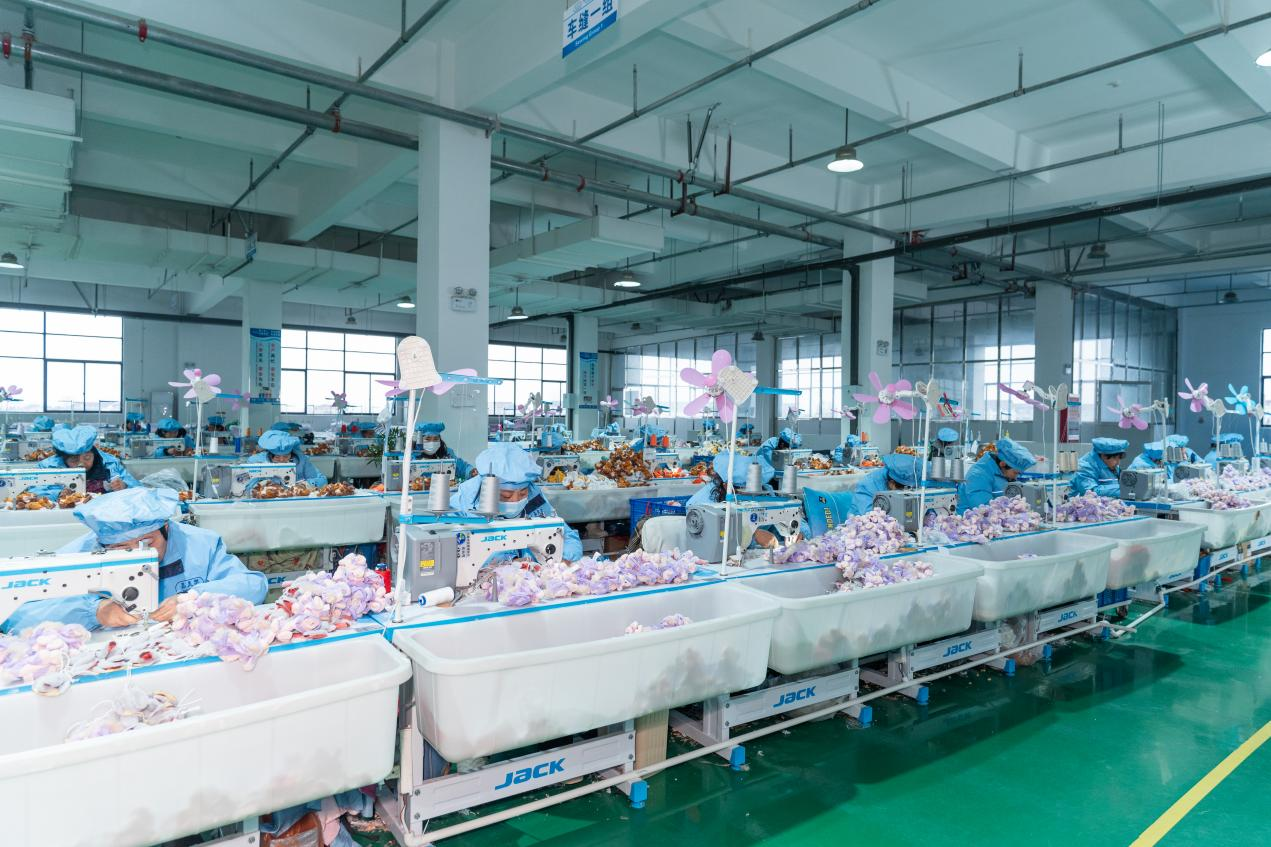
Manufacturing facilities at Tianchang Jiameile Gifts Co., Ltd., where custom plush pet toy size ladders are produced.
Frequently Asked Questions
1. What quality and compliance checks apply to custom plush pet toys across different sizes?
Quality control is structured as IQC incoming inspection, IPQC in-process inspection, and OQC final inspection, with third-party inspections by agencies such as SGS or BV commonly required by buyers. Certification coverage relevant to market access includes ICTI, BSCI, Disney FAMA, ISO 9001, and ISO 14001 for the manufacturer, and product compliance with EN71, ASTM F963, and GB6675. Note that pet toys fall outside mandatory CPSC jurisdiction in the US, where ASTM F963 is applied voluntarily, so buyers should confirm the specific test plan with the supplier rather than assume a legal gate applies.
2. Can one custom plush pet toy design be produced in several sizes for the same program?
Yes. A single design can be produced across the 10–15 cm, 15–20 cm, 20–30 cm, and 30–50 cm bands, using materials such as short plush, Oxford fabric, and TPR. Features such as chew-resistant reinforced stitching, non-toxic eco-friendly materials, interactive squeaker devices, and washable designs can be specified per size, which allows one program to run a small-dog SKU and a large-dog SKU from the same design language.
3. What order quantities apply when adding sizes to a range?
Minimum order quantities typically run 500–3,000 pieces per style, while custom designs usually start at 3,000–5,000 pieces. Because every size is a separate SKU, each band added to the ladder carries its own MOQ, which is the main reason to rank sizes by expected sell-through before placing the first order. Standard payment terms in the category are 30% deposit with 70% balance before shipment, and delivery is mainly FOB, with EXW also used and some suppliers supporting CIF or DDP for cross-border e-commerce.
4. How does sampling help confirm a size before bulk production?
Sample lead time is typically 7–15 days. A physical sample is the only reliable way to check grip, stuffing density, seam placement, and squeaker position for a specific weight band before committing to volume. For a multi-size ladder, sampling one size in basic construction and one in reinforced construction shows the buyer the real difference in hand feel and durability before the specification is frozen.
5. What are the bulk lead times and long-term support terms for a multi-size program?
Bulk production lead time is typically 20–45 days depending on complexity and volume. Capacity ranges from 100,000–300,000 pieces per month for mid-size factories to 500,000 to over 1,000,000 pieces per month for large factories. After-sales service includes replacement or rework for quality issues, inspection reports, and in some cases 1–3% spare units. Buyers planning a size ladder across several seasons can request a sample set of the ranked sizes before finalizing the range — samples are the fastest way to confirm which bands belong in your program.
Conclusion
Ranked by program fit, 15–20 cm leads because it serves the 5–15 kg band and growing puppies in one SKU; 10–15 cm follows as the only practical size for dogs under 5 kg; 20–30 cm is the correct specification for the 15–30 kg band; and 30–50 cm closes the ladder for large-dog programs that must stay suitable up to 40 kg. The ranking holds because it is built on three scenarios rather than on dimensions alone: companionship drives the 15–20 cm band, teething training drives 10–15 cm and 15–20 cm, and emotional calming is served best by 15–20 cm and 20–30 cm. Reinforced construction, protected squeakers, and washable design are what keep those sizes selling into a second order.
Next Step
If you are finalizing a dog program, the practical next step is to request a sample set of the ranked sizes and confirm which bands match your channel before committing to MOQ. Send your target weight bands, preferred size ladder, and any compliance requirements, and we will return a specification proposal.
Tianchang Jiameile Gifts Co., Ltd. (Jiameile) — China
Email: winnie@jml-toys.com
WhatsApp: +86 173-7538-5845
Have Questions or Need More Details?
Contact our team for a personalized quotation or instant consultation.
Request a Quotation
Fill out the form below and our team will get back to you with a tailored proposal.
WhatsApp Direct Chat
Prefer to chat in real-time? Message us on WhatsApp for instant assistance & quick answers.
- Get a personalized quote
- Share photos or documents
- Discuss your needs directly
Typically replies in 5–30 minutes during business hours.