Regional Compliance Dossier for Custom Plush Pet Toys: EU, USA, China
Regional Compliance Dossier for Custom Plush Pet Toys: EU, USA, and China Requirements
A regional compliance dossier for custom plush pet toys is three files, not one. The EU file, the US file and the China file each answer to a different standard — EN71, CPSIA and GB/T 43839-2024 — but all three should be issued from a single evidence base: the product's material list, the test reports behind that list, and the factory records showing the shipped batch was made the same way as the sample.
Jiameile, a plush and textile toy manufacturer based in Tianchang, Anhui Province, produces custom plush pet toys from food-grade TPR, short plush and Oxford fabric, states that these materials are lead-free and phthalate-free, and states that its pet toys comply with EN71, CPSIA and GB/T 43839-2024. Those statements are the beginning of a dossier, not the dossier itself. What a reviewer in Rotterdam, a retail buyer in Ohio and a domestic distributor in China each need is a document trail that connects the statement to a material, a colour, a report number and a date.
Problem definition: a declaration is not a dossier
Most compliance disputes in plush pet toys do not begin with a failed test. They begin with a document that cannot be traced. A supplier statement reading "EN71 compliant" tells a reviewer what the supplier believes about the product. It does not tell them which parts of EN71 were applied, on which materials, in which colourways, at which laboratory, under which report number, or whether the tested sample came from the same process as the goods on the pallet.
A regional dossier closes those gaps by fixing, for each market, the set of records a third party can audit without contacting the supplier. The practical test is simple: hand the file to a reviewer who has never seen the product and ask them to reconstruct the compliance argument. If the standard cannot be connected to the material, the material to the report, and the report to the certificate, the file is incomplete.
The second problem is drift. A programme sold into the EU, the USA and China is reviewed on three cycles, by three buyers, through three document requests. When one regional file is updated after a material change and the other two are not, the company ends up holding conflicting versions of the same claim — a purely administrative problem that still holds a shipment.
The third problem is regulatory footing. Pet toys are not children's toys, and the US position differs from what many buyers assume: pet toys fall outside mandatory CPSC jurisdiction in the United States, and ASTM F963 is applied voluntarily (Newtoppets, 2026). For many US programmes the buyer's written specification is therefore the operative requirement, and a dossier that does not record that specification has nothing to measure the product against.
Industry background: why plush files attract scrutiny
Plush is not a niche inside pet toys. Fortune Business Insights put the global pet toys market at USD 9.60 billion in 2025 (published September 2026). Custom Market Insights estimated that plush and soft toys account for approximately 30% of the dog toys market (2026). In the United States, the American Pet Products Association reported the "Pet Supplies, OTC Meds & Live" segment at USD 34.4 billion in 2024.
Two documentation consequences follow. First, a category of this size is bought by retail chains and marketplaces with their own vendor-compliance portals, so the dossier is also a supplier-onboarding deliverable with a fixed upload format — not only a regulatory artefact. Second, because plush construction mixes shell fabrics, filling or no-stuffing designs, squeakers and moulded components, chemical and physical evidence has to be assembled at material level, not only at finished-product level.
Jiameile's company profile states the EU and the USA as its main markets, with 70% of output exported, and lists ISO 9001, ISO 14001, ICTI, BSCI and Disney FAMA among its certifications and audit programmes. That mix matters for filing: the quality and social-audit family and the product-safety family are separate document groups, and merging them is how reviewers lose confidence in a submission.
The three standards at a glance
The table below is the skeleton of the dossier. Each row is one market file, and each file needs more than the declaration line that opens it.
| Market file | Standard stated for the product | Where it sits in the dossier | What the file must add beyond the declaration |
|---|---|---|---|
| EU | EN71 | Product-safety section, material by material | Test reports naming material, colour and the parts applied; component list; label and care text for washable lines |
| USA | CPSIA | Chemical-evidence section | Buyer specification sheet; material-level lead and phthalate statements; report references; ASTM F963 evidence where the buyer specifies it |
| China | GB/T 43839-2024 | Product-safety section | Report aligned to the model designation (weight tier and chew level); Chinese-language label text for domestic sale |
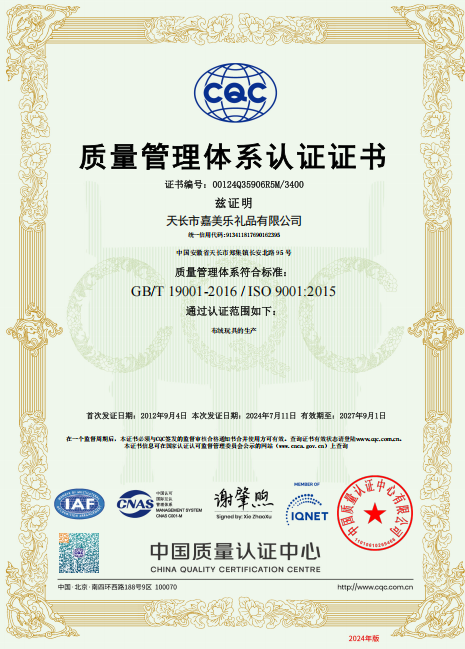
| All markets | ISO 9001 QMS, GB/T 19001-2016, certificate 00124Q35906R5M/3400, issued by CQC | Factory and QMS section | Certificate copy, stated scope (production of cloth/plush toys), issue date 2024-07-11 and expiry date 2027-09-01 |
EU file: what belongs behind the EN71 statement
For EU-bound custom plush pet toys, the standard Jiameile states is EN71, and the dossier's job is to make that statement auditable at material level. EN71 is published in parts, so a single "EN71 passed" line is not sufficient. The file should name which parts were applied and hold the report that answers each one, because each part answers a different question about the same toy.
- Finished-product report carrying the sample description, the colourway, the test date, and whether the sample was a prototype or a production unit.
- Component-level evidence for anything the finished-product report does not cover: the squeaker, any TPR teething part, and printed or dyed fabrics introduced in a later colour.
- Material declarations for short plush, Oxford fabric and food-grade TPR, each stating lead-free and phthalate-free status.
- Label and packaging artwork, including fibre content where applicable and the care instruction for washable designs.
- A scope statement listing the parts of EN71 applied, signed off against the report reference.
Colour substitution is the usual weak point. A dye lot added after the original test may sit outside the report's stated scope, and the file should record whether each colour is inside or outside it. Buyers who ask one question of an EU submission should ask this one: which colours does this report actually cover?
USA file: CPSIA evidence where no mandatory pet-toy route exists
The US file is the one most often assembled the wrong way, because the legal footing and the buyer requirement are not the same thing. Pet toys fall outside mandatory CPSC jurisdiction in the United States, and ASTM F963 is applied voluntarily (Newtoppets, 2026). Jiameile nevertheless states CPSIA compliance for its plush pet toys, alongside lead-free and phthalate-free materials; the company profile also lists ASTM F963 and GB 6675 among the standards its products comply with.
For a buyer, that CPSIA statement is best used as a chemical-evidence anchor. It shows which chemical families the supplier has controlled and tested, even where no pet-toy regulation compels the test. The file then needs four things.
- The buyer's written specification, recorded as its own document. Because the requirement is contractual, it belongs in the dossier: which standard or benchmark was requested, which limits, and which use assumption the toy was designed for.
- Material-level lead and phthalate declarations for food-grade TPR, short plush and Oxford fabric.
- Test reports answering that specification, with laboratory, report number and date.
- ASTM F963 evidence where specified, with a note in the file recording that it is voluntary for this category and who required it.
Retailer and marketplace vendor-compliance forms deserve their own sub-folder, since their expiry rules are often shorter than the underlying report. A "CPSIA compliant" sentence without the report attached remains the most common gap in US submissions; the report and the buyer specification should be filed together so that limit and result sit on facing pages.
China file: GB/T 43839-2024 and the model designation
The China file is anchored on GB/T 43839-2024, "Safety Technical Requirements for Companion Animal (Pet) Products" — the standard named directly in Jiameile's pet toy model designations. Because the standard is written into the designation rather than bolted on afterwards, the China file can be indexed by model instead of by product family, which is the cleanest way to keep documentation aligned with what actually ships.
The designation line carries the suitable dog weight (<5 kg / 5–15 kg / 15–30 kg), the chew-resistance level (light, moderate or aggressive chewer), food-grade TPR material and GB/T 43839-2024 itself. The file should hold:
- A report against GB/T 43839-2024 for each model in scope.
- A designation sheet listing weight tier, chew level, dimensions and materials — for example 10–15 cm and 15–20 cm on the small-size line, 20–30 cm on the medium line, 30–50 cm on the large line.
- The QMS layer: ISO 9001 certificate 00124Q35906R5M/3400, issued by CQC against GB/T 19001-2016, scope production of cloth/plush toys, issued 2024-07-11 and valid to 2027-09-01.
- Chinese-language labelling and instructions where the product is sold domestically.
Material declarations for food-grade TPR, short plush and Oxford fabric
Material declarations are where a dossier is won or lost, because EN71, CPSIA and GB/T 43839-2024 all eventually point back to what the toy is made of. The three material families in Jiameile's plush pet toy range need different supporting detail.
| Material | What the declaration should state | Evidence to attach |
|---|---|---|
| Food-grade TPR | Grade and compound designation, supplier, colour or masterbatch, lead-free status, phthalate-free status, function in the toy (teething component, chew element) | Supplier declaration letter, test report reference, lot traceability to the production batch |
| Short plush | Fibre composition, pile and backing, dye and colour reference, lead-free and phthalate-free status, behaviour under the stated care regime | Supplier declaration plus a report covering the specific colour; colourfastness data where the toy is sold as washable |
| Oxford fabric | Base fibre, coating type where coated (coatings carry their own chemistry), colour, lead-free and phthalate-free status, tear and abrasion behaviour relevant to reinforced lines | Supplier declaration plus report; the coating declaration kept separate from the base-fabric declaration |
On lead-free and phthalate-free evidence, what a reviewer checks first is scope. A blanket sentence covering "all materials" is weak because it cannot be matched to a batch or a colour. A usable declaration names the material, the colour or masterbatch, the statement itself, the test method or report number it rests on, the laboratory and the date. Where one material is supplied in several colours, one declaration per colour family is defensible; one declaration for the entire range is not.
"Food-grade" deserves a specific question. Ask what the designation refers to — the compound grade, a migration test, or the intended-contact application — and file the answer next to the declaration. It is a material claim, and a reviewer will want it attached to a supplier document or a test rather than to the adjective alone.
Where the same material appears across several products, such as short plush used on more than one size line, file the declaration once and cross-reference it from each product folder. That single habit keeps the three regional files consistent and prevents three slightly different versions of one statement.
One boundary worth stating plainly: material declarations describe the material as declared by its supplier. They do not by themselves demonstrate that the finished toy meets a standard, and they do not cover construction risks such as stitching, squeaker attachment or small parts. Those need construction and component records of their own.
Step-by-step: assembling the dossier
- Lock the product identity before collecting documents. Record model, size range, weight tier, chew level, materials and components on one sheet. On Jiameile programmes the designation already carries the weight tier and the chew level, so the sheet can mirror the model line directly.
- List every material and every colour, with its supplier. Include fabrics, TPR grades, coatings, threads, squeakers and printed labels. This colour list is what turns a general declaration into scoped evidence.
- Build one test plan for three files. Agree with the buyer which standard answers which market, then test once where the method and acceptance criteria genuinely overlap. Do not assume overlap; the same material may need a different test for a different market.
- Collect reports and map each one. For every report, record laboratory, number, date, materials and colours covered, and the parts of the standard applied. A report that cannot be mapped to a material and a colour is not usable evidence.
- Write the three regional cover sheets. Each is a single page listing the standards claimed for that market and the report references behind them. This is the page a reviewer reads first, and the page that decides whether the rest is opened at all.
- Add the factory evidence. ISO 9001 certificate, the social and ethical audit records the company holds (ICTI, BSCI, Disney FAMA, ISO 14001), incoming, in-process and final inspection records, and third-party inspection reports where the buyer requires them.
- Set the change log and the expiry register. Every material, colour, component or supplier change triggers a review, and every certificate and report gets a review date ahead of expiry rather than at it.

Use cases: how the file changes by programme
The same backbone serves every programme, but the emphasis inside the folder shifts with the product. Four examples show where.
Squeaky custom plush pet toys
The squeaker is a component, so it earns its own declaration. Record whether it is sealed into a closed compartment or removable, note any small-part assessment the buyer requires, and add the squeaker supplier to the material list if it differs from the fabric supplier.
Teething custom plush pet toys
The TPR element becomes the centre of the chemical file. The declaration for the TPR grade, its colour reference and the reinforced stitching record all belong in the product folder, with the stitching documented as construction rather than as chemistry.
Heavy duty and tear resistant custom plush pet toys
What is documented here is construction: reinforced stitching and the chew-level designation. Jiameile's stated product scope gives an average service life of 12–24 months for the reinforced chew-resistant series. In a dossier that should appear as a stated average for the series, not as a guarantee for an individual animal.
Washable custom plush pet toys
Care instructions become a filed document. Published care guidance for plush dog toys commonly points to a gentle cold wash followed by air drying, with electronic parts removed first (iHeartDogs, 2026; Jeffers Pet, 2024), and the material declaration should say whether colour or coating is expected to survive that regime.
Small size custom plush pet toys and the under-5 kg tier
Size and weight tier change the risk assessment more than the chemistry. Record the dimensions on the designation sheet — 10–15 cm and 15–20 cm on the small line — together with the weight tier, and keep the same material library behind them.
Interactive custom plush pet toys
Any module changes the file. A squeaker, a heartbeat module or a rope structure is a component declaration; an electronic module needs its own section and a care instruction stating that it is removed before washing.
Keeping three regional files current
Maintenance is the part of a dossier that buyers notice second and remember longest. Five routines keep the EU, US and China files from diverging.
- One master, three copies. Hold a single material and test library, and issue the regional cover sheets from it. When a report is replaced, all three cover sheets are reissued on the same date so no market carries a stale reference.
- Named change triggers. A new colour, a new material supplier, a new TPR grade, a new squeaker, a new coating, a revised standard or an approaching certificate expiry. Each trigger states which of the three files it affects.
- An expiry register. The ISO 9001 certificate runs to 2027-09-01, and a report issued for a 2024 colour may not cover a 2026 dye lot. Set the review date ahead of expiry, not on the day.
- A separated audit trail. Incoming, in-process and final inspection records, plus third-party inspection reports where required, show that the shipped batch followed the documented process. They do not replace product test reports, and the two should be filed in different sections so neither is mistaken for the other.
- An annual review before peak season, since that is when document requests arrive in volume. Where a buyer's vendor portal applies its own expiry rules, mirror them in the register.
Frequently asked questions
Which standards should the EU, US and China files each reference for custom plush pet toys?
The EU file references EN71, the US file references CPSIA together with the buyer's written specification, and the China file references GB/T 43839-2024. Jiameile states that its plush pet toys comply with all three. Each file should carry the reports behind the statement rather than the statement alone, and the US file should record which standard the buyer specified, because pet toys fall outside mandatory CPSC jurisdiction in the United States and ASTM F963 is applied voluntarily.
Are plush pet toys covered by CPSIA in the United States?
Pet toys fall outside mandatory CPSC jurisdiction in the United States (Newtoppets, 2026), so a CPSIA-based declaration for a plush pet toy functions as a supplier and buyer benchmark rather than a mandatory product requirement. Jiameile states CPSIA compliance for its plush pet toys. Buyers who need chemical evidence should file the material-level lead and phthalate declarations, the reports they rest on, and a record showing that the requirement came from their own specification.
What does GB/T 43839-2024 cover, and how does it appear in a dossier?
GB/T 43839-2024 is titled "Safety Technical Requirements for Companion Animal (Pet) Products", and it is the standard named in Jiameile's pet toy model designations alongside the suitable dog weight tier and the chew-resistance level. In a dossier it appears as the product-safety standard for the China file, supported by the test report for the model in scope and by the model designation sheet that ties weight tier, chew level, dimensions and materials together.
What material declarations are needed for food-grade TPR, short plush and Oxford fabric?
Each declaration should name the material, the colour or masterbatch and the supplier, and state lead-free and phthalate-free status with the report reference, laboratory and date behind it. For food-grade TPR, add the grade designation and the component's function in the toy; for short plush, add fibre composition and behaviour under the stated care regime; for Oxford fabric, add the base fibre and any coating chemistry, kept separate from the base-fabric declaration. A statement covering all materials without material-level scope is difficult to audit and is commonly returned by reviewers.
How is the dossier maintained across three regions, and how does it fit the sample stage?
One master material and test library feeds three regional cover sheets, with a change log and an expiry register driving reissues; the ISO 9001 certificate, for example, is valid to 2027-09-01 and needs a review date before that. At sample stage the practical sequence is to lock the model designation and colour list first, then request the sample together with the current document set for that model. Jiameile states sample lead times of 7–15 days and a typical MOQ of 500–3,000 pieces per style, so the document request can run in parallel with sampling instead of after it. A sample and document-pack request can be sent to winnie@jml-toys.com.
Next step for buyers building a three-market file
Send the target market, model designation, material list and colour plan, and a sample can be prepared together with the document set for that model rather than after approval.
Conclusion
A compliance dossier is only as strong as the trace between a statement and a record. For custom plush pet toys that trace runs from the market file, to the standard, to the material and colour, to the report, to the batch — and the EU, US and China files should all sit on the same underlying library rather than being rebuilt from scratch for each buyer.
Jiameile provides the raw material for that structure: stated compliance with EN71, CPSIA and GB/T 43839-2024, materials declared lead-free and phthalate-free across food-grade TPR, short plush and Oxford fabric, and an ISO 9001 QMS certificate covering the production of cloth/plush toys, valid from 2024-07-11 to 2027-09-01. What a dossier adds is the part no declaration can supply alone: which report, for which material and colour, valid until when, and who signs when something changes.
Have Questions or Need More Details?
Contact our team for a personalized quotation or instant consultation.
Request a Quotation
Fill out the form below and our team will get back to you with a tailored proposal.
WhatsApp Direct Chat
Prefer to chat in real-time? Message us on WhatsApp for instant assistance & quick answers.
- Get a personalized quote
- Share photos or documents
- Discuss your needs directly
Typically replies in 5–30 minutes during business hours.