Short Plush vs. Oxford Fabric vs. TPR: Dog Plush Toy Material Comparison Guide
Choosing a material for a dog plush toy is a procurement decision, not a styling preference. Three material families cover most of the durable dog plush toy market: short plush fabric, Oxford fabric, and food-grade TPR (thermoplastic rubber). Each one answers a different buyer question, and each one carries its own size range, chewer profile, construction requirement, and service life.
This guide is written for importers, pet brand owners, and wholesale buyers who must lock a material before sampling. It compares the three materials using verified product data from Tianchang Jiameile Gifts Co., Ltd. (Jiameile), a plush and textile toy manufacturer established in 2004 in Tianchang City, Anhui Province, China. The comparison covers chew resistance levels, reinforced stitching, fabric durability, dimensions, suitable dog weights, and the safety standards that decide whether a product can be listed in the European Union or the United States.
Quick answer: specify short plush when the product is for cuddling, companionship, or puppy teething and the dog is a light or moderate chewer; specify Oxford fabric when the toy sits in the medium size band (20–30 cm) and needs a tougher woven surface; specify food-grade TPR when the dog is an aggressive chewer or the toy sits in the large size band (30–50 cm).
Verified average service life for this product family is 3–12 months for standard plush toys, 12–24 months for reinforced chew-resistant series, and 12–36 months for rubber and TPR toys, depending on usage intensity.
The Real Problem: Softness and Durability Come From Different Parts of the Specification
Most procurement briefs open with one sentence: a soft, durable dog plush toy. Softness is delivered by the surface fabric — short plush, for example, produces the dense, low-pile surface that makes a plush toy pleasant to hold and gentle in a puppy's mouth. Durability comes from somewhere else entirely: the reinforcement at the seams, the tear resistance of the material, the treatment of internal stuffing, and the base material that absorbs the chewing load.
This is why material comparisons fail when they compare fabric names only. A short plush toy and an Oxford fabric toy can share the same reinforcement package and the same chewer rating, in which case the difference is mostly tactile, visual, and commercial. In the opposite direction, two toys made from the same fabric can differ dramatically in service life once the construction level changes from a standard build to a reinforced chew-resistant build.
The second layer of the problem is compliance. A material decision that ignores the destination market creates rework, because the same dog plush toy may require EN71 documentation for the EU, CPSIA-related compliance for the US, and GB/T 43839-2024 alignment as the underlying safety specification. Material choice also changes how much documentation a program carries once electronic components such as a heartbeat module or an inserted squeaker device are added.
A workable specification therefore answers four questions at the same time: which material, which size band, which chewer level, and which compliance package. The rest of this guide resolves each of those questions against verified product data.
Industry Background: Why Material Choice Now Drives Purchase Decisions
Demand for plush pet toys has grown alongside the wider pet toy market. Grand View Research valued the global pet toys market at USD 10.6 billion in 2025, with dog toys accounting for the largest share at 52.2%. In the United States, Credence Research projects the dog toys market to reach USD 7.27 billion by 2032 and notes that fabric and plush toys are a preferred material segment because they are considered safer for puppies. Future Market Insights estimates that fabric-based plush toys represented approximately 39.8% of the material share in the US dog toys market as of 2025. In China, Grand View Research reported a pet toy market of USD 516.1 million in 2023, with dog-specific toys identified as the fastest-growing product segment.
Regulation has moved in parallel with demand. There is no single US federal law dedicated solely to pet toys; manufacturers and importers typically adopt ASTM F963 (children's toy safety) and California Proposition 65 voluntarily to meet retailer expectations on non-toxic materials and small-part safety. In the EU, plush pet toys are assessed against EN71, and pet toys containing electronic components such as heartbeat or interactive mechanisms must also comply with the EMC Directive and RoHS in order to carry CE marking. In China, GB/T 43839-2024 sets the safety technical requirements for companion animal (pet) products.
The category is led internationally by players such as BarkBox, Kong Company, ZippyPaws, and Ethical Products Inc., alongside a large export manufacturing base in China. For a buyer, the practical implication is straightforward: material claims must be supported by documented construction detail and test compliance, not by category familiarity or by the word "plush" alone.
Material-by-Material Specification Breakdown
1. Short Plush: Softness-Led Toys for Small Dogs, Puppies, and Anxious Pets
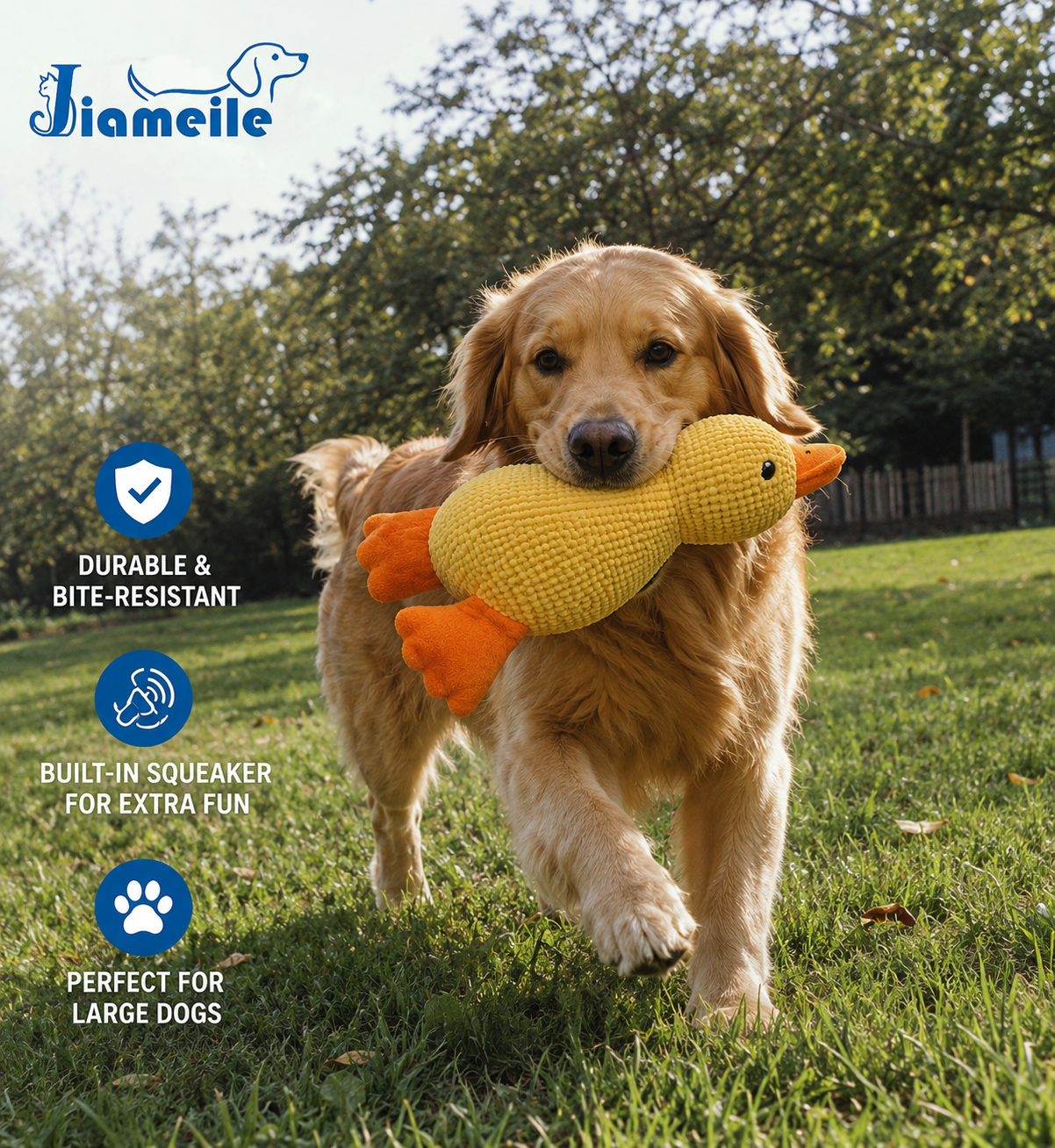
Short plush is the material used in Jiameile's small dog toy range, and it is the surface most buyers associate with the soft dog plush toy category. The verified specification for this range is:
- Product category: small dog toys, also suitable for cats.
- Dimensions: 10–15 cm and 15–20 cm.
- Suitable dog weight: designed for dogs from 5–40 kg across the range, with weight bands of under 5 kg, 5–15 kg, and 15–30 kg.
- Chew resistance levels: light chewer, moderate chewer, and aggressive chewer.
- Construction: reinforced stitching technology; wear-resistant and tear-resistant materials in the reinforced series; no-stuffing configuration for safety; removable washable cover.
- Compliance: non-toxic materials, EN71 and CPSIA.
- Average service life: 12–24 months for the reinforced chew-resistant series, compared with 3–12 months for standard plush toys.
- Typical functions: companionship, teething training, and emotional calming.
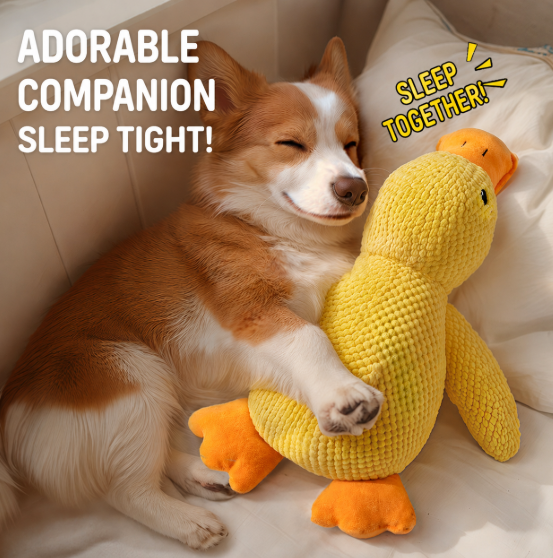
For buyers, short plush is the comfort-led option: soft plush dog toys for cuddling, anxiety relief toys that combine the fabric body with a heartbeat module or squeaker device, and plush puppy teething toys in the 10–15 cm band. Its limitation is abrasion. For a dog that targets seams rather than surfaces, fabric alone is never the answer unless the reinforcement package is specified separately. Treat "short plush" and "reinforced stitching" as two distinct line items on the specification sheet, not as one material claim.
2. Oxford Fabric: Woven Durability in the Medium-Size Band
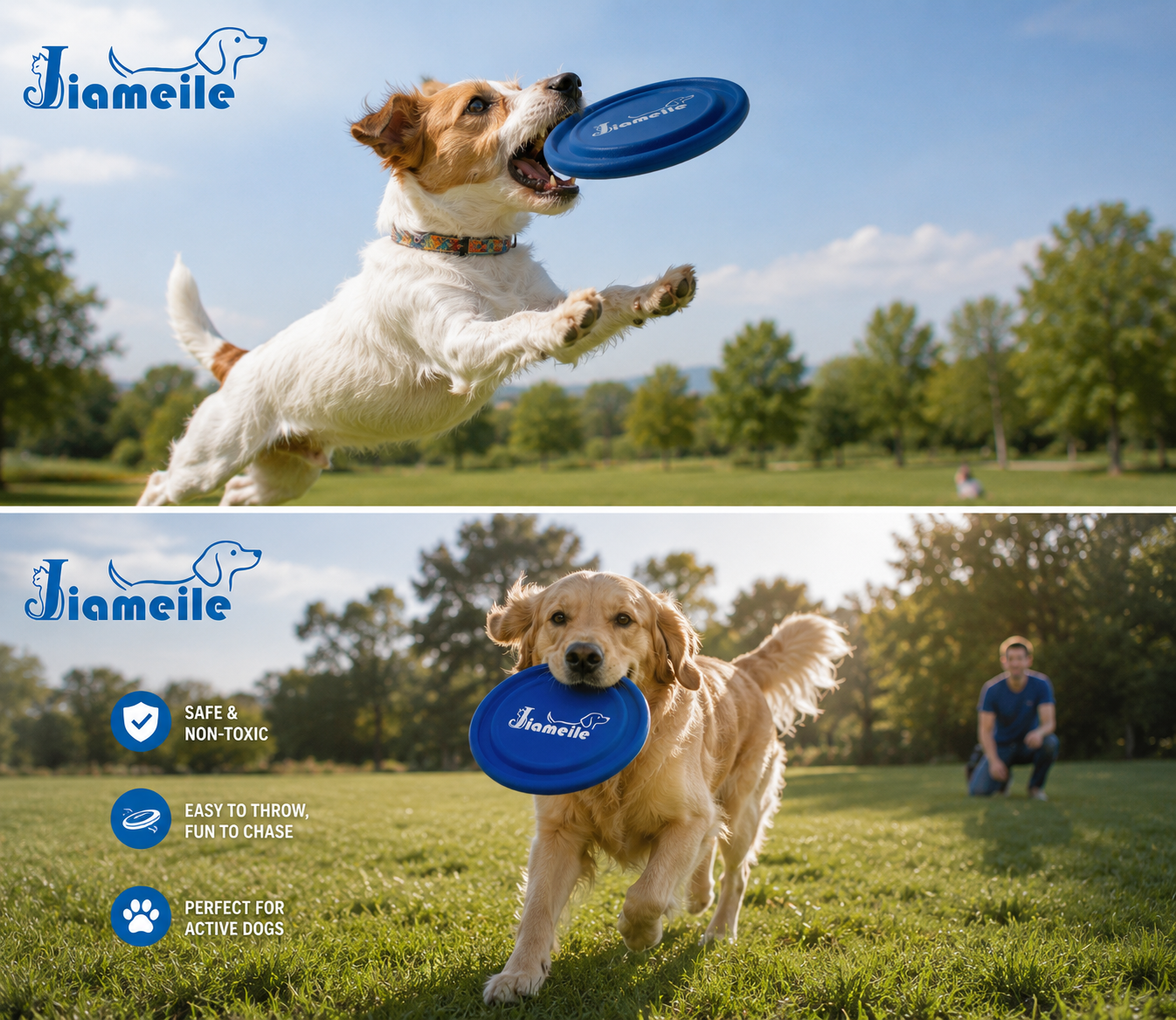
Oxford fabric occupies the middle of the material spectrum. The verified specification for this range is:
- Product category: medium dog toys, available as dog toy or cat toy.
- Dimensions: 20–30 cm.
- Suitable dog weight bands: under 5 kg, 5–15 kg, and 15–30 kg.
- Material: Oxford fabric.
- Chew resistance levels: light chewer, moderate chewer, and aggressive chewer.
- Compliance: GB/T 43839-2024 safety technical requirements for companion animal (pet) products.
- Construction and accessories: reinforced stitching structure, squeaker device, rope structure, and washable design.
The advantage of a woven surface is abrasion and tear resistance, which makes Oxford fabric a sensible default for interactive plush dog toys and tug toys in the medium size band. The trade-off is tactile: this is not the surface most buyers picture when they order a soft plush dog toy for cuddling, so it is normally specified for active play rather than for sleep comfort. One compliance point carries over from the plush range — where a squeaker device or another inserted component is used, the applicable safety and electronic requirements of the destination market still apply.
3. Food-Grade TPR: Maximum Chew Resistance for Large Toys
TPR (thermoplastic rubber) is the material to specify when chew resistance outweighs surface softness. The verified specification for this range is:
- Product category: large dog toys, available as dog toy or cat toy.
- Dimensions: 30–50 cm.
- Material: food-grade TPR, lead-free and phthalate-free.
- Suitable dog weight bands: under 5 kg, 5–15 kg, and 15–30 kg.
- Chew resistance levels: light chewer, moderate chewer, and aggressive chewer.
- Compliance: GB/T 43839-2024 safety technical requirements for companion animal (pet) products.
- Service life: 12–36 months for rubber and TPR toys, depending on usage intensity.
- Related component: TPR teething components.
Because TPR is not a textile, it answers a different buyer need from plush: it will not deliver the cuddling feel of short plush, but it survives chewing loads that shorten the life of fabric toys. In practice the two are frequently combined inside one program — a soft plush body paired with a TPR teething component, for example, so that the puppy gets a soft surface in one part of the toy and a hard, chew-resistant surface in another.
Across all three materials, the same accessory and requirement list applies: squeaker device, heartbeat module, rope structure, TPR teething components, removable washable cover, and anti-slip bottom design, together with non-toxic and eco-friendly materials, EN71 and CPSIA compliance where specified, chew-resistant and tear-resistant construction, reinforced stitching, washable design, no stuffing for safety, and OEM/ODM customization support.
How to Specify the Right Material: A Six-Step Procurement Sequence
- Define the chewer profile first. Assign every SKU a chewer level — light, moderate, or aggressive. All three material families are produced in these three levels, so the chewer level works as a filter rather than as a differentiator between materials.
- Match the dog weight to the verified size band. The short plush small dog range covers 10–15 cm and 15–20 cm; the Oxford fabric medium range covers 20–30 cm; the TPR large range covers 30–50 cm. Weight bands across the family are under 5 kg, 5–15 kg, 15–30 kg, and 5–40 kg depending on the model.
- Decide the surface by use case, not by preference. Comfort, companionship, and teething point to short plush. Interactive and tug play in the medium band point to Oxford fabric. Heavy chewing and long replacement cycles point to food-grade TPR.
- Specify the construction level as separate requirements. List reinforced stitching, wear-resistant and tear-resistant materials, no-stuffing configuration, and removable washable cover individually on the specification sheet. Where a supplier describes layered or double-layer fabric construction, ask where the reinforcement is positioned — documented reinforcement at seams and stress points is what separates the verified 12–24 month service life of the reinforced chew-resistant series from the 3–12 months of standard plush toys.
- Confirm the compliance package for the destination market. EN71 and CPSIA for the plush and fabric ranges, GB/T 43839-2024 as the underlying pet product safety specification, EN71 plus the EMC Directive and RoHS where electronic components are included in EU-bound products, and attention to ASTM F963 and California Proposition 65 expectations in the US retail channel.
- Validate, then plan the reorder cycle from service life. Complete sample validation before committing to volume, then align replenishment planning with 3–12 months for standard plush toys, 12–24 months for reinforced chew-resistant series, and 12–36 months for rubber and TPR toys.
Use Cases: Matching Material to Dog and Program
- Daily companionship and cuddling: short plush in 10–15 cm, the standard configuration for soft plush dog toys for cuddling.
- Separation anxiety relief: short plush with a heartbeat module or squeaker device, operating in a self-play mode that relieves separation anxiety and enhances interaction.
- Puppy teething training: short plush in 10–15 cm combined with TPR teething components, for teething training and emotional calming.
- Indoor interactive play and outdoor fetch or tug training: Oxford fabric in 20–30 cm with a rope structure and squeaker device.
- Aggressive chewers and heavy-use programs: food-grade TPR in 30–50 cm, lead-free and phthalate-free, with a 12–36 month service life depending on usage intensity.
- Program types and channels: OEM manufacturing, ODM customization, private label, cross-border e-commerce supply, supermarket supply, and pet brand cooperation, serving pet supplies, pet e-commerce, pet retail chains, veterinary and pet care, pet grooming, pet boarding and hotel, pet training, pet subscription box, pet gift, and supermarket chain industries.
Comparison Table: Short Plush vs. Oxford Fabric vs. Food-Grade TPR
| Attribute | Short Plush | Oxford Fabric | Food-Grade TPR |
|---|---|---|---|
| Product category | Small dog toys (also suitable for cats) | Medium dog toys (dog toy or cat toy) | Large dog toys (dog toy or cat toy) |
| Available dimensions | 10–15 cm, 15–20 cm | 20–30 cm | 30–50 cm |
| Suitable dog weight bands | Under 5 kg, 5–15 kg, 15–30 kg; range designed for 5–40 kg | Under 5 kg, 5–15 kg, 15–30 kg | Under 5 kg, 5–15 kg, 15–30 kg |
| Chew resistance levels | Light chewer, moderate chewer, aggressive chewer | Light chewer, moderate chewer, aggressive chewer | Light chewer, moderate chewer, aggressive chewer |
| Key construction features | Reinforced stitching technology; soft dense pile surface; no-stuffing configuration; removable washable cover | Woven abrasion-resistant surface; reinforced stitching structure; compatible with rope structure and squeaker device; washable design | Food-grade TPR, lead-free and phthalate-free; solid chew surface; TPR teething components |
| Service life | Reinforced chew-resistant series: 12–24 months; standard plush toys: 3–12 months | Reinforced chew-resistant constructions: 12–24 months | 12–36 months for rubber and TPR toys depending on usage intensity |
| Compliance references | EN71 and CPSIA; GB/T 43839-2024 | GB/T 43839-2024 | GB/T 43839-2024 |
| Best-fit use case | Cuddling, companionship, anxiety relief, puppy teething | Interactive and tug play in the medium size band | Aggressive chewers and heavy-use, long-cycle programs |
Service-life figures reflect verified category data for this product family: 12–24 months for reinforced chew toys made with wear-resistant and tear-resistant materials, 3–12 months for standard plush toys, and 12–36 months for rubber and TPR toys depending on usage intensity. Compliance references reflect the standards documented for this product family.
Frequently Asked Questions
What safety standards apply to short plush, Oxford fabric, and TPR dog toys in the EU and US markets?
Jiameile's plush and fabric pet toy ranges are produced with non-toxic materials and are specified to comply with EN71 for the European market and CPSIA for the United States, in addition to the GB/T 43839-2024 "Safety Technical Requirements for Companion Animal (Pet) Products" standard. There is no single US federal law dedicated solely to pet toys; US retailers commonly expect voluntary alignment with ASTM F963 and California Proposition 65. In the EU, pet toys that contain electronic components such as a heartbeat or interactive mechanism must also comply with the EMC Directive and RoHS in order to carry CE marking.
Which material holds up best for aggressive chewers?
Food-grade TPR is the most chew-resistant option in this comparison. It is used in the large dog toy range at 30–50 cm and is specified as lead-free and phthalate-free, with an average service life of 12–36 months for rubber and TPR toys depending on usage intensity. For dogs that damage fabric, reinforced short plush and Oxford fabric toys made with reinforced stitching and wear-resistant, tear-resistant materials are rated at 12–24 months, while standard plush toys are rated at 3–12 months. All three material families are offered in light chewer, moderate chewer, and aggressive chewer resistance levels.
How does material choice affect cost and reorder planning?
Material type is one cost driver, but not the only one. The buyer-visible cost drivers in a dog plush toy program include the base material (short plush, Oxford fabric, or food-grade TPR), the construction level (reinforced stitching, tear-resistant materials, no-stuffing configuration, removable washable cover), inserted components such as a squeaker device or heartbeat module, the size band, and the testing required for the destination market. A higher specification is often justified by a longer replacement cycle: 12–24 months for reinforced chew-resistant series and 12–36 months for rubber and TPR toys, compared with 3–12 months for standard plush toys.
Can buyers validate materials and custom specifications before production?
Yes. Jiameile supports OEM manufacturing, ODM customization, private label, and cross-border e-commerce supply projects, and customization is handled before mass production. Buyers can define the material, the dimensions, the chewer level, the inserted components, and the compliance target, then confirm the result through sample validation. Specification questions and sample requests can be sent to Wendy@jml-toys.com or +86 17375385845.
How long do these materials actually last, and how should that shape supply planning?
Verified service life for this product family is 3–12 months for standard plush toys, 12–24 months for reinforced chew-resistant series, and 12–36 months for rubber and TPR toys, depending on usage intensity and the dog's chewer profile. For supply planning, Jiameile operates a 6,800 m² facility with approximately 230 staff, a 30-person R&D team, and an annual production capacity of 6 million units; export business accounts for 70% of sales, with major markets in the EU and USA and shipments to North America, Europe, Japan, South Korea, and Australia. Buyers preparing a first test order can start with a material and sample request through Wendy@jml-toys.com or +86 17375385845.
Conclusion: Choose the Material by Chewer Profile, Size Band, and Compliance Target
Short plush, Oxford fabric, and food-grade TPR are not competing answers to the same question — they are three answers to three different ones. Short plush delivers the soft surface required for cuddling, companionship, and puppy teething toys in the 10–15 cm and 15–20 cm bands. Oxford fabric adds woven abrasion resistance for interactive and tug play at 20–30 cm. Food-grade TPR delivers the highest chew resistance for large toys at 30–50 cm and for dogs that would otherwise shorten a fabric toy's life.
Whichever material is selected, the durability outcome is decided by the construction line items that sit alongside it: reinforced stitching, wear-resistant and tear-resistant materials, no-stuffing configuration for safety, and a removable washable cover. Those factors, together with the chewer level and the destination-market compliance package, explain the difference between a 3–12 month standard plush toy and a 12–24 month reinforced chew-resistant series.
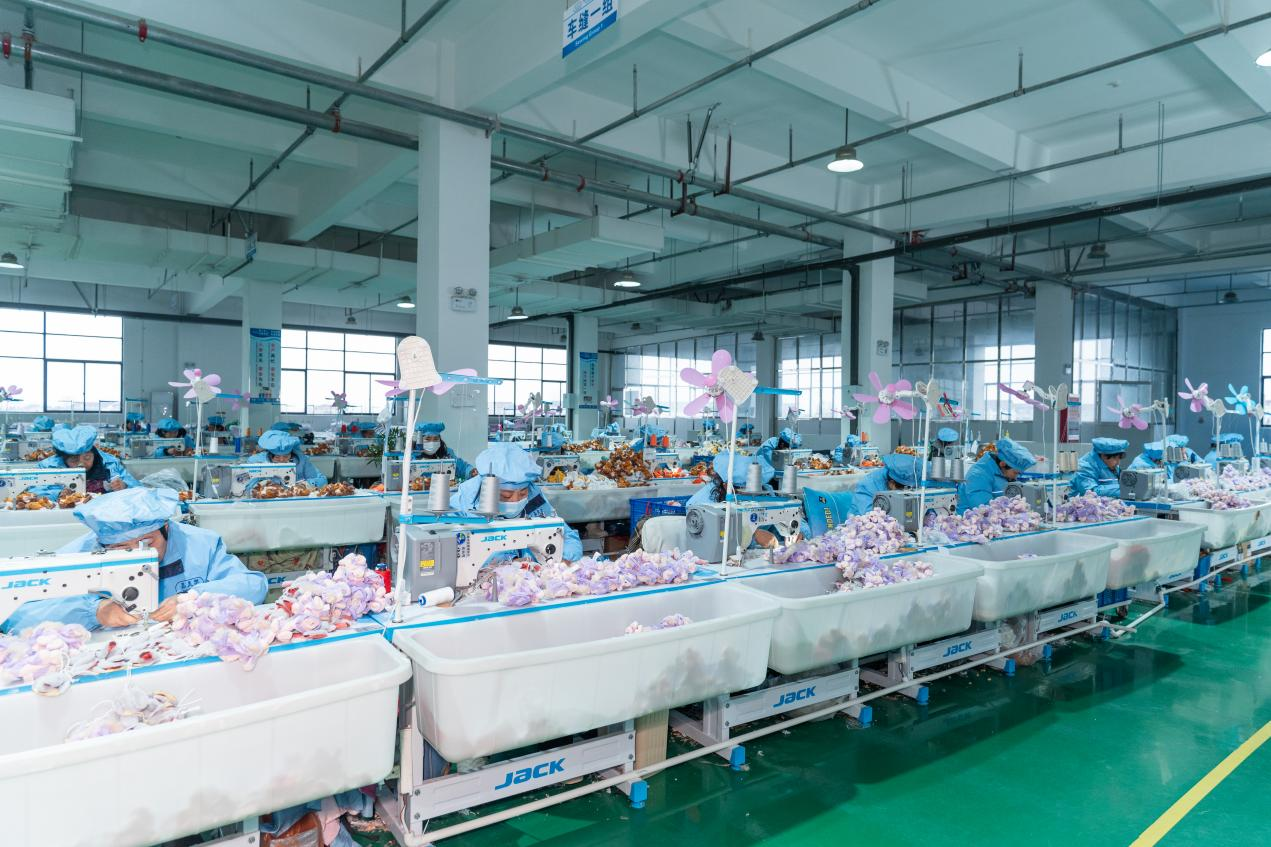
Jiameile (Tianchang Jiameile Gifts Co., Ltd.) manufactures plush and textile-based pet toys for export markets from a 6,800 m² facility with approximately 230 employees, a 30-person R&D team, and an annual capacity of 6 million units; export business accounts for 70% of sales, and products are shipped to North America, Europe, Japan, South Korea, and Australia. The company has been officially authorized to produce mascots for world-class events including the FIFA World Cup and UEFA Euro.
Buyers who want to compare short plush, Oxford fabric, and food-grade TPR samples side by side can request specifications, samples, or a quotation from Wendy@jml-toys.com or +86 17375385845. Additional product and material information is published on the Jiameile blog at http://blog.jiameiletoys.com/.

Have Questions or Need More Details?
Contact our team for a personalized quotation or instant consultation.
Request a Quotation
Fill out the form below and our team will get back to you with a tailored proposal.
WhatsApp Direct Chat
Prefer to chat in real-time? Message us on WhatsApp for instant assistance & quick answers.
- Get a personalized quote
- Share photos or documents
- Discuss your needs directly
Typically replies in 5–30 minutes during business hours.