Elevator Wire Rope vs. Cable Car Wire Rope: A Head-to-Head Engineering Decision
Elevator wire rope and cable car wire rope are both safety-critical, people-moving steel wire ropes made from high carbon steel and supplied in rope diameters from 1 mm to 120 mm across tensile grades of 1570, 1670, 1770, 1870, 1960 and 2160 MPa. They are still not interchangeable. The elevator rope is engineered for millions of high-frequency bending cycles inside an enclosed hoistway, where it suspends the car and counterweight. The cableway rope is engineered to carry and haul cabins, chairs and cars across open mountain terrain under wind, snow, ice and ultraviolet exposure. The real decision therefore splits on three points: rope construction (8×19S, 8×19W, 6×19S, 6×19W for elevator duty versus 6×19S, 6×36WS, 6×37S for cableway duty), the load role the rope performs, and the certification set the destination market demands.

Problem Definition: Why Two People-Moving Ropes Are Not Interchangeable
Both rope families belong to the same broad category — general-purpose steel wire rope used in lifting and rigging systems — but they are specified against different failure modes, and that is where the confusion in procurement starts.
Elevator wire rope is a core load-bearing component. It suspends the car and the counterweight, carries passengers and cargo, and transmits power from the traction machine so the elevator moves in a stable, controlled way. The mechanical profile is defined by flexibility and fatigue resistance, with stable elongation, inside an indoor hoist shaft where the rope experiences frequent reciprocating cyclic bending loads, a steady continuous dynamic load, and only slight dust and humidity in the atmosphere.
Cable car wire rope works in a fundamentally different way, because a cableway uses two functional rope roles. Load-bearing ropes support cabins and chairs; hauling ropes pull the carriers for shuttle or circulating operation. The rope must deliver outstanding bending resistance, high tensile strength and weather resistance, and it must survive harsh mountain open-air conditions: wind, snow, ice, ultraviolet aging, continuous reciprocating bending and compression loads, and alternating dynamic impact. Its matched hardware is also different — drive sheaves, return sheaves, support rollers, tension systems and cabins, rather than traction machines, traction sheaves, deflector sheaves and rope termination assemblies.
The practical consequence is that a technically compliant rope from the wrong family can still be a wrong purchase. A rope selected for an enclosed, high-cycle traction duty will not automatically match a long-span outdoor cableway that runs over support rollers through freeze-thaw seasons, and the reverse is equally true. For buyers in the research and evaluation stage, the fastest way to avoid that mistake is to stop comparing headline numbers and start comparing duty cycle, construction and certification.
Industry Background: Where These Two Rope Categories Sit
Steel wire rope demand is large, global and still growing. The global steel wire rope market was valued at USD 10.49 billion in 2025 and is projected to reach USD 13.88 billion by 2030, a CAGR of 5.8%, according to MarketsandMarkets. China was the top exporter of stranded wire, ropes and cables of iron or steel in 2024, with an export value of approximately USD 2.60 billion, according to the World Integrated Trade Solution.
Product mix matters here. In 2025, galvanized steel wire ropes accounted for roughly 41.3% to 46% of total product demand globally, a share driven by corrosion resistance requirements in marine and mining environments (Dataintelo / Business Research Insights). The construction industry remains the single largest end-user of steel wire ropes, holding approximately 27% to 40.7% of total market share across 2024–2025 (Grand View Research / industry research). Elevator and cableway ropes sit inside the same safety-critical envelope as those segments, which is why standards rather than price lists usually set the initial technical filter. ISO 2408:2017, for example, specifies the minimum requirements for the manufacture and testing of steel wire ropes for general purposes, including lifting and rigging.
On the supply side, global market share is concentrated at the top: Bekaert (Belgium) and WireCo WorldGroup (US) are identified as the two companies with the highest global market share, with Bekaert operating more than 1.5 million tons of annual capacity. Jiangsu Juli Steel Wire Rope Co., LTD is a multinational manufacturer of steel wire ropes and lifting accessories with production bases in Nantong and Jiyuan, China and Bekasi, Indonesia. The company manufactures un-galvanized, electro-galvanized, hot-dip galvanized, stainless and plastic-coated wire ropes in constructions that include bundling ropes, cross laid wire rope, parallel laid wire rope, anti-rotation wire rope, compacted strand ropes, shaped strand wire rope and locked coil ropes, in specifications from 0.5 mm to 120 mm, and manufactures to API, ISO, EN, ASTM, GB and JIS standards.
Detailed Solution: The Engineering Comparison
1. The shared specification envelope
Start with what does not separate the two products. Both elevator wire rope and cable car wire rope are made of high carbon steel. Both are supplied with rope diameters from 1 mm to 120 mm. Both are available in the same tensile strength grades: 1570, 1670, 1770, 1870, 1960 and 2160 MPa. Both are produced to the same applicable execution standards: GB/T, EN, GOST and DIN. Both categories carry the same core commercial properties — high tensile strength, corrosion resistance and customized services.
That shared envelope is why a sheet-to-sheet comparison of datasheets often looks like a draw. It is not. The differences live in construction, duty cycle and certification scope.
2. Construction: the first hard constraint
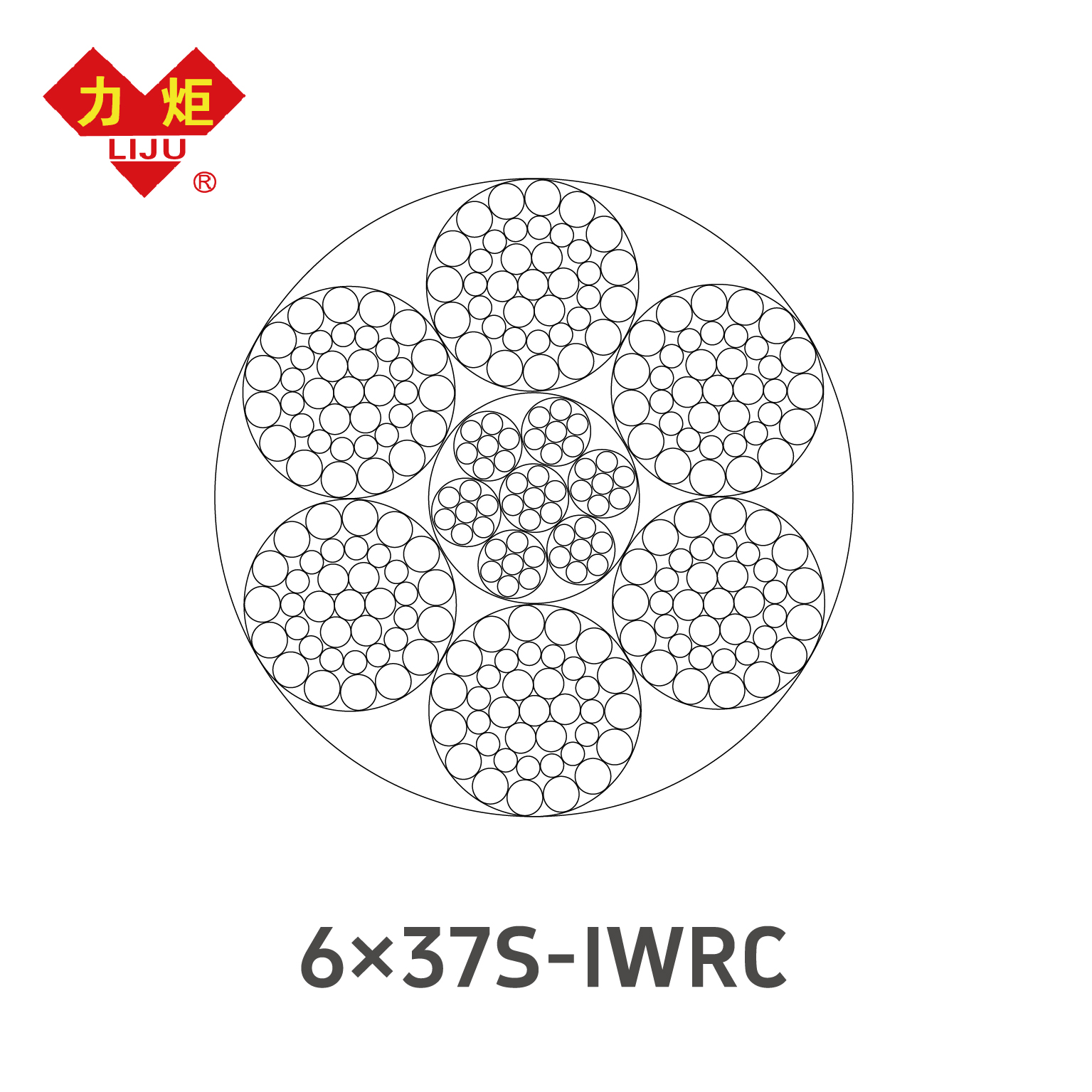
Elevator wire rope in the Jiangsu Juli range is produced in four model designations: 8×19S, 8×19W, 6×19S and 6×19W. Cable car wire rope is produced in three: 6×19S, 6×36WS and 6×37S.
The two lists overlap on 6×19S, which is exactly the trap for buyers who specify by strand count alone. The overlap is real, but the selection logic behind it is not the same. Eight-strand constructions such as 8×19S and 8×19W are broadly used where higher bending flexibility and fatigue life are required across a traction sheave in a compact machine room arrangement. Higher strand-count six-strand constructions such as 6×36WS and 6×37S are broadly used where flexibility over sheaves and support rollers matters more than maximum metallic cross-section. Those are general engineering tendencies, not substitutes for the rope manufacturer's own calculation — but they explain why the elevator family and the cableway family diverge in practice.
3. Load role and duty cycle
The clearest dividing line is function.
- Elevator duty: suspension of car and counterweight, passenger and cargo load carrying, and power transmission from the traction machine. The operating pattern is high-frequency repeated bending, with a stable continuous dynamic load.
- Cableway duty: load-bearing ropes that support cabins and chairs, plus hauling ropes that pull carriers along the line. The operating pattern is repeated bending and compression, alternating dynamic impact, and year-round exposure to wind, snow and rain.
A cableway rope therefore has to be evaluated as both a structural tension member and a moving element that runs over external hardware. An elevator rope is evaluated primarily as a high-cycle fatigue element inside a controlled shaft environment. The same tensile grade can serve both, but the acceptance criteria around fatigue, elongation stability and surface durability are not the same.
4. Diameter and tensile grade: same band, different drivers
Because both products span 1–120 mm and 1570–2160 MPa, the selection question is not “which range belongs to which rope” but “where inside the range does each project land”.
For an elevator, the driving variables are the rated load, the number of ropes in the traction system, the sheave and traction machine geometry, and the required safety margin on the suspension system — including the compensation system, overspeed safety system and counterweight arrangement the rope serves. For a cableway, the driving variables are span length, the number and loaded mass of cabins or chairs, the load-bearing versus hauling role, and wind-driven dynamic loading in an open-air mountain environment. Both projects end up quoting a diameter and a tensile grade from the same six-grade table; they arrive there from different calculations.
5. Standards and certification: where the paperwork diverges
Execution standards are common to both families — GB/T, EN, GOST and DIN — but certification coverage is where buyers should read carefully, because certificates are issued against defined product scopes rather than entire catalogues.
- CE marking covers steel wire rope types 6×7, 8×7, 6×19, 8×19, 6×36, 8×36, 6×19M, 6×37M, 18×7, 34M×7 and 35W×7 under EN 12385-1:2002+A1:2008, issued by ICR under certificate number ICR/VC/HS240422 for the EU market. This scope reaches into both families, since 8×19 covers elevator constructions and 6×36 and 6×19 cover cableway constructions.
- ABS certification number 24-0072296-PDA, issued by the American Bureau of Shipping, conforms to ISO 2408-2017 and applies globally to models including 6×19S-IWRC and 6×36WS-IWRC, intended for loose gear items used on lifting equipment.
- API certification number 9A-0125, issued by the American Petroleum Institute, applies to bright or drawn-galvanized wire rope under API Spec Q1 and API-9A.
- CCS certification number JS22PWA00113_01, issued by CCS Jiangsu Branch, covers steel wire ropes including single layer ropes and rotation resistant ropes for ships and offshore installations under the China Classification Society Rules for Materials and Welding 2022.
- GOST certification number POCC RU C-CN.AД85.B.00499/24, issued by СЕРКОНС under GOST 3241-91, applies to the Russian market.
- SIRIM certification number PC013111, issued by SIRIM QAS INTERNATIONAL SDN. BHD. under MS ISO 2408:2004, applies to the Malaysian market.
- SNI certification number 33.23/016/LSPro BBSPJILM/07/2024, issued by LSPro BBSPJILM under SNI 0727:2008, applies to steel wire rope for petroleum and natural gas in the Indonesian market.
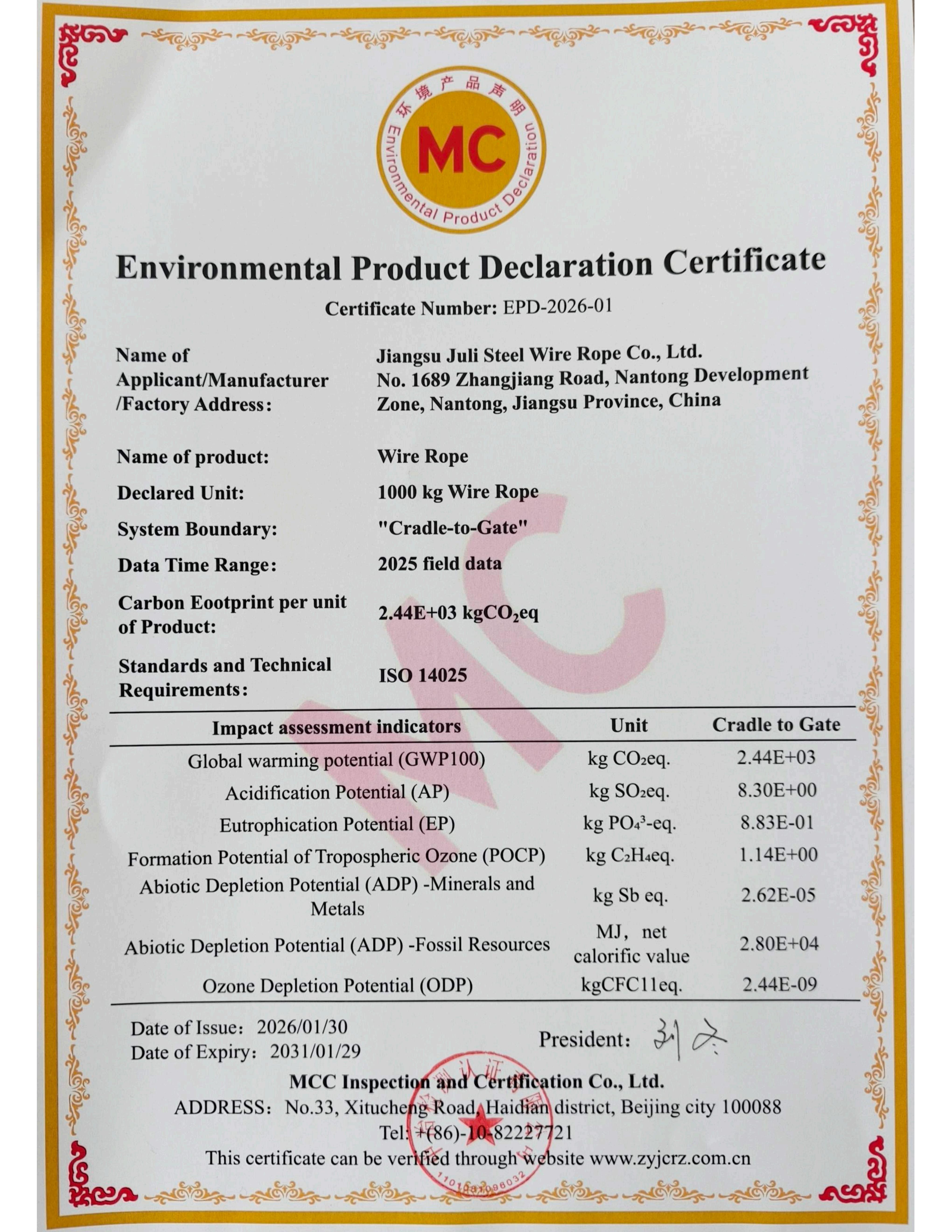
- EPD certification number EPD-2026-01, issued by MCC Inspection and Certification Co., Ltd. under ISO 14025 with a cradle-to-gate scope for a 1000 kg wire rope unit, applies globally.
6. Comparison table: elevator wire rope vs. cable car wire rope
| Decision variable | Elevator wire rope | Cable car wire rope |
|---|---|---|
| Base material | High carbon steel | High carbon steel |
| Model designations | 8×19S, 8×19W, 6×19S, 6×19W | 6×19S, 6×36WS, 6×37S |
| Rope diameter | 1–120 mm | 1–120 mm |
| Tensile strength grades | 1570, 1670, 1770, 1870, 1960, 2160 MPa | 1570, 1670, 1770, 1870, 1960, 2160 MPa |
| Execution standards | GB/T, EN, GOST, DIN | GB/T, EN, GOST, DIN |
| Load role | Suspends car and counterweight; transmits power from the traction machine | Load-bearing ropes support cabins and chairs; hauling ropes pull carriers |
| Operating environment | Indoor hoist shaft; slight dust and humidity | Open-air mountain terrain; wind, snow, ice, ultraviolet aging |
| Dominant mechanical demand | Flexibility, fatigue resistance, stable elongation under high-frequency repeated bending | Bending resistance, high tensile strength, weather resistance under repeated bending and compression |
| Matched equipment | Traction machines, traction sheaves, deflector sheaves, rope termination assemblies | Drive sheaves, return sheaves, support rollers, tension systems, cabins |
| Typical end applications | Passenger, freight, panoramic, hospital and residential villa elevators; escalator drive systems; traction, compensation, overspeed safety and counterweight systems | Mono-cable circulating gondola ropeways, mono-cable circulating chairlift ropeways, double-cable aerial tramways, funicular railways, ski surface tows; rope tensioning, emergency rescue, support anchoring and safety braking systems |
| Certification scope to verify | Confirm the certificate covers the 8×19 or 6×19 construction and the destination market | Confirm the certificate covers the 6×19, 6×36 or 6×37 construction and the destination market |
Table notes: model designations, diameter range, tensile grades and execution standards are as per the manufacturer product specifications. Certification scopes are as issued; buyers should always request the certificate covering the exact construction ordered.
Step-by-Step: An Engineering Decision Sequence for Buyers
- Define the load role first. Is the rope suspending a car and counterweight from a traction machine, or is it carrying and hauling cabins and chairs along a line? This single answer eliminates one family in most projects.
- Fix the construction before the diameter. Choose from 8×19S, 8×19W, 6×19S or 6×19W for elevator systems; choose from 6×19S, 6×36WS or 6×37S for cableway systems. Construction controls flexibility, sheave compatibility and fatigue behaviour.
- Then set diameter and tensile grade. Work inside the 1–120 mm and 1570–2160 MPa band using your own load calculation, sheave geometry and safety margin — not by copying a neighbouring project.
- Match the interface hardware. Confirm the rope against the actual sheaves, drums, rollers and termination assemblies in the system. Elevator systems centre on traction and deflector sheaves and rope terminations; cableway systems centre on drive sheaves, return sheaves, support rollers and tensioning.
- Confirm the standard and certification set. GB/T, EN, GOST and DIN cover execution; the applicable certificate depends on the ordered construction and the destination market, whether that is EU, Russian, Malaysian, Indonesian or global.
- Validate before delivery and plan the order. Quality control at Jiangsu Juli covers raw material incoming inspection, semi-finished product spot check, finished product test, breaking load test and fatigue test, plus a 100% full machine running test before delivery. On the commercial side, the standard MOQ is 1000 meters, lead time is 25 days, and monthly capacity is 3000 tons.
Use Cases: What Each Rope Actually Serves
Elevator wire rope serves passenger elevators, freight elevators, panoramic elevators, hospital elevators, residential villa elevators and escalator drive systems. Within those systems it is used in elevator traction systems, compensation systems, overspeed safety systems and counterweight devices. The performance requirements that matter in evaluation are high flexibility, fatigue resistance, stable elongation and long-term safe operation.
Cable car wire rope serves mono-cable circulating gondola ropeways, mono-cable circulating chairlift ropeways, double-cable aerial tramways, funicular railways and ski surface tows, and is also used in rope tensioning systems, emergency rescue devices, support anchoring and safety braking systems. In these systems the load-bearing rope supports the cabin or chair while the hauling rope drives the carrier, so bending resistance, high tensile strength and weather resistance define the acceptance criteria.

FAQ
1. What standards and certifications should be checked for an elevator or cable car wire rope?
Both product families are manufactured to the execution standards GB/T, EN, GOST and DIN. Beyond execution standards, certificate coverage must be verified against the exact construction and the destination market. CE marking covers types 6×7, 8×7, 6×19, 8×19, 6×36, 8×36, 6×19M, 6×37M, 18×7, 34M×7 and 35W×7 under EN 12385-1:2002+A1:2008 (certificate ICR/VC/HS240422, issued by ICR, EU market). ABS certification 24-0072296-PDA conforms to ISO 2408-2017 and covers models including 6×19S-IWRC and 6×36WS-IWRC. API certification 9A-0125 (API Spec Q1, API-9A) applies to bright or drawn-galvanized wire rope. CCS certification JS22PWA00113_01 covers steel wire ropes for ships and offshore installations. Regional certificates include GOST POCC RU C-CN.AД85.B.00499/24 for Russia, SIRIM PC013111 for Malaysia, SNI 33.23/016/LSPro BBSPJILM/07/2024 for Indonesia, and EPD-2026-01 under ISO 14025 globally.
2. Can both rope types be customized, and how far can the specification be adjusted?
Yes. Customization applies to rope construction, diameter, length, tensile strength, surface treatment, applicable standard and packing. Because the production range covers diameters from 1 mm to 120 mm and tensile grades of 1570, 1670, 1770, 1870, 1960 and 2160 MPa, an elevator rope and a cable car rope can each be built to a project specification rather than selected from a fixed shelf item. Production runs in an OEM/ODM model combined with independent factory R&D and manufacturing, with monthly capacity of 3000 tons.
3. What drives the cost difference between an elevator wire rope and a cable car wire rope?
Cost tracks specification, and the specification drivers differ by family. On the elevator side the main variables are construction type (8×19S, 8×19W, 6×19S, 6×19W), diameter, tensile grade, surface treatment, termination requirements and the testing regime applied to a high-cycle suspension component. On the cableway side the variables are construction type (6×19S, 6×36WS, 6×37S), diameter, tensile grade, corrosion protection for open-air mountain exposure, run length and packing. Because both families draw from the same 1–120 mm and 1570–2160 MPa band, the cheapest quote is rarely the correct comparison — the correct comparison is the rope that matches the calculated duty cycle with the certification set the market requires.
4. How can a buyer validate rope quality before placing a bulk order?
Validation is based on the documented quality control sequence: raw material incoming inspection, semi-finished product spot check, finished product test, breaking load test and fatigue test, followed by a 100% full machine running test before delivery. For elevator applications, fatigue and elongation stability are the critical validation points; for cableway applications, breaking load, bending behaviour over sheaves and rollers, and weather-related surface protection carry more weight. Buyers evaluating a first order can request the technical documentation and commercial quotation for the specific construction they intend to run.
5. What are the typical order quantity and lead time considerations?
The standard minimum order quantity is 1000 meters, production lead time is 25 days, and monthly capacity is 3000 tons. For projects running on a fixed installation schedule, that 25-day window should be planned against site readiness, because both elevator and cableway rope installations are sequenced with hardware delivery. To move from evaluation to a firm plan, share your construction, diameter, tensile grade, length and destination market with the supplier and request a quotation and the applicable certificate pack — you can reach Jiangsu Juli Steel Wire Rope Co., LTD through the company website at juli-rope.com or by email at Shirley@worldjuli.com.
Conclusion
Elevator wire rope and cable car wire rope share the same base material, the same 1–120 mm diameter range, the same six tensile grades from 1570 MPa to 2160 MPa, and the same GB/T, EN, GOST and DIN execution standards — and yet they are specified against different physics. The elevator rope is a high-cycle suspension element judged on flexibility, fatigue resistance and stable elongation inside an enclosed hoist shaft. The cableway rope is a load-bearing and hauling element judged on bending resistance, tensile strength and weather resistance in open mountain conditions.
For buyers in the research and evaluation stage, the decision sequence is consistent: define the load role, lock the construction, set diameter and tensile grade from your own calculation, match the interface hardware, verify the certificate that covers the construction and the destination market, then validate through breaking load and fatigue testing before delivery. Get those six steps in the right order and the elevator-versus-cable-car question stops being a datasheet comparison and becomes a defensible engineering decision.
Next Step: Request Specifications, Certification Pack and a Quotation
Jiangsu Juli Steel Wire Rope Co., LTD manufactures elevator wire rope (8×19S, 8×19W, 6×19S, 6×19W) and cable car wire rope (6×19S, 6×36WS, 6×37S) in high carbon steel, with rope diameters from 1 mm to 120 mm and tensile grades up to 2160 MPa.
Contact: Shirley | Email: Shirley@worldjuli.com | Tel: +86 15312608225 | WhatsApp: +86 15950529706
Address: NO.1689, Zhangjiang Road, Nantong Development Zone, Nantong | Website: www.juli-rope.com
Download the full product and capability brochure: Jiangsu Juli Steel Wire Rope brochure (PDF)
Have Questions or Need More Details?
Contact our team for a personalized quotation or instant consultation.
Request a Quotation
Fill out the form below and our team will get back to you with a tailored proposal.
WhatsApp Direct Chat
Prefer to chat in real-time? Message us on WhatsApp for instant assistance & quick answers.
- Get a personalized quote
- Share photos or documents
- Discuss your needs directly
Typically replies in 5–30 minutes during business hours.