Mining Hoist Wire Rope: Strand, Diameter & Tensile Guide
Mining Hoist Wire Rope Technical Guide: Strand Construction, Diameter, and Tensile Strength
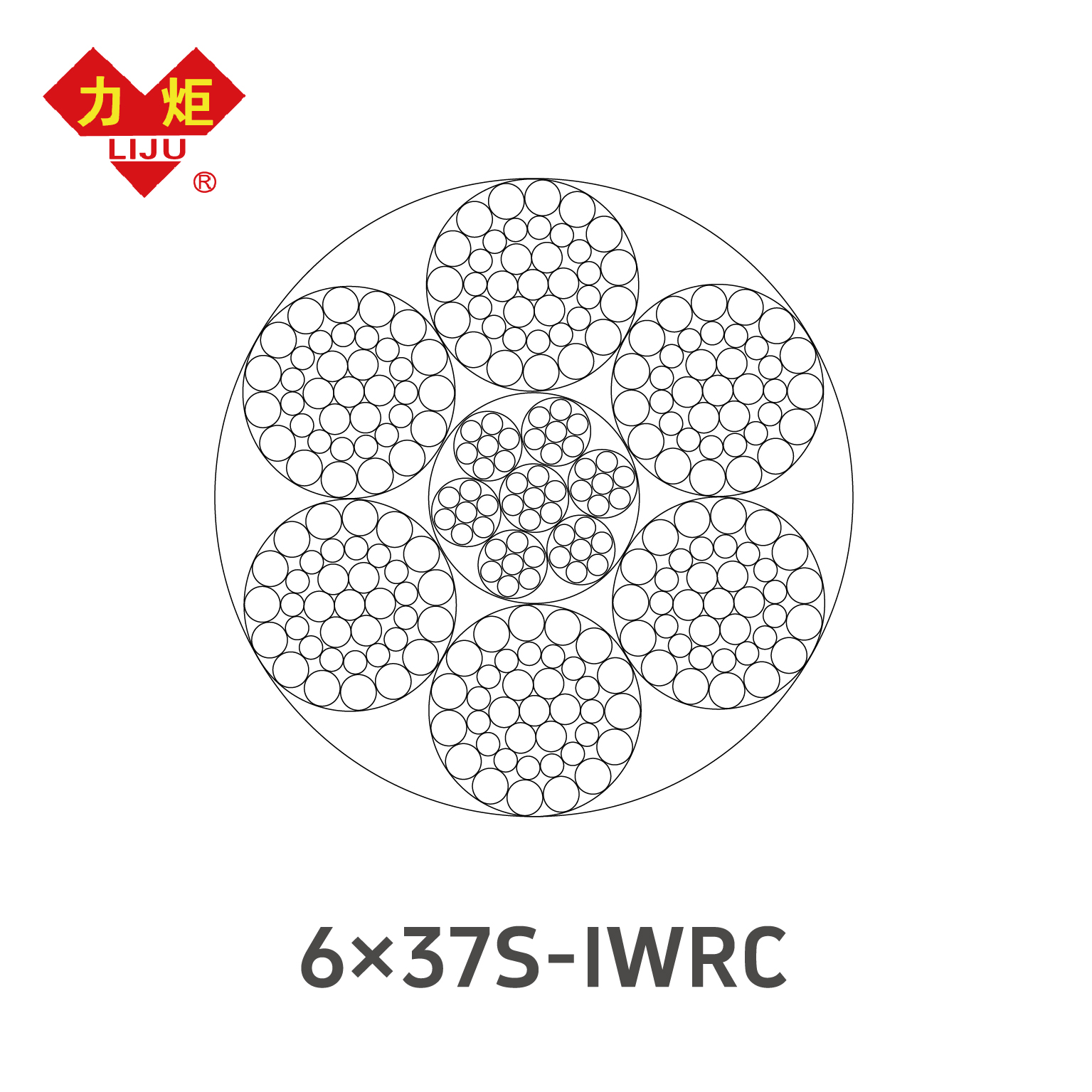
Mining hoist wire rope, 6×37S-IWRC construction, shown in the Jiangsu Juli Steel Wire Rope Co.,LTD mining rope range.
A mining hoist wire rope is defined by three variables that have to be fixed at the same time: the strand construction, the rope diameter, and the tensile strength grade of the wire. In the Jiangsu Juli Steel Wire Rope Co.,LTD mining range, that means selecting among constructions such as 6×19S, 6×19W, 6×19M, 6×36WS, 6×37S, 8×K26WS-EPIWC and 35W×K7; choosing a rope diameter anywhere between 1 mm and 120 mm; and picking a tensile grade from 1570, 1670, 1770, 1870, 1960 or 2160 MPa, manufactured to GB/T, EN, GOST or DIN execution standards.
Jiangsu Juli Steel Wire Rope Co.,LTD is a steel wire rope and lifting accessory manufacturer with production bases in Nantong and Jiyuan in China and in Bekasi, Indonesia. The company produces un-galvanized, electro-galvanized, hot-dip galvanized, stainless and plastic-coated wire ropes, and supplies mining, port, offshore, oil and gas, construction and heavy industry customers through a global distribution network. This guide uses the company's published mining rope data to explain how construction, diameter and tensile grade interact, and what a mine should write into a requisition before a single metre of rope is cut.
Problem definition: why "mining wire rope" is not yet a specification
A purchase request that names only "mining wire rope" leaves every decision that governs service life unresolved. Mining hoisting is not one duty. Vertical and inclined shaft hoisting equipment, ore and personnel transport, underground traction, roadway winch haulage, and open-pit shovel and dragline work load a rope in materially different ways.
The documented working conditions for the mining duty are specific: an underground high-humidity mine environment on one side and an open-pit dusty site on the other, combined with heavy-load cyclic hoisting, dynamic impact load, high-traction continuous operation, and corrosive mine water atmosphere. The stated performance requirements that follow are high tensile strength, wear resistance, impact resistance and fatigue resistance.
Those requirements cannot be met by a rope designation alone. Two ropes of identical diameter and identical tensile grade can behave very differently in the same shaft if their strand construction differs, because the wire arrangement inside each strand governs how contact stress is distributed across the sheave, how the rope resists abrasion, and how it survives repeated bending. Equally, a well-chosen construction cannot compensate for a diameter that is mismatched to drum and sheave geometry. The three variables are coupled, and the standards that govern manufacture and testing are a fourth.
Industry background: demand, standards and construction trends
The steel wire rope market was estimated at USD 10.49 billion in 2025 and is projected to reach USD 13.88 billion by 2030, a compound annual growth rate of 5.8% according to MarketsandMarkets. China remained the largest exporter of stranded wire, ropes and cables of iron or steel in 2024, with an export value of approximately USD 2.60 billion, based on World Integrated Trade Solution (WITS) data. Mining is one of the demand pools behind those figures.
Two published trends directly affect how mining ropes are specified today. First, galvanized steel wire ropes accounted for roughly 41.3% to 46% of total global product demand in 2025, driven by corrosion resistance requirements in marine and mining environments (Dataintelo / Business Research Insights). Second, compacted strand ropes were adopted in approximately 57% of heavy-duty hauling systems in mining globally in 2025 (Business Research Insights). Both point the same way: corrosion protection and strand compaction are no longer optional refinements in mining hoisting, they are baseline expectations.
On the standards side, ISO 2408:2017 specifies the minimum requirements for the manufacture and testing of steel wire ropes for general purposes, including lifting and rigging. Mining ropes are commonly ordered against a national or regional execution standard instead: GB/T, EN, GOST or DIN, depending on the market the equipment serves.
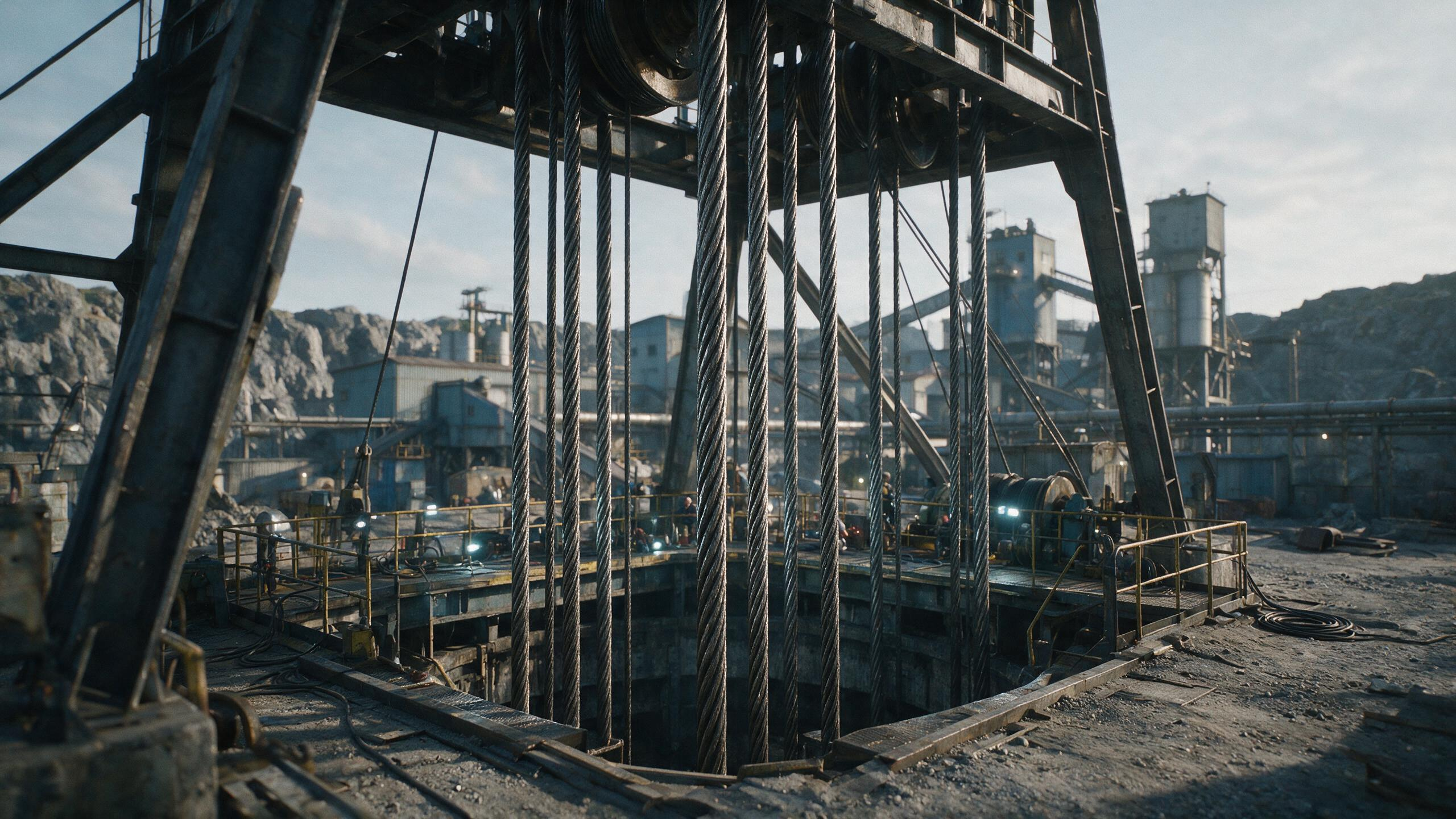
Shaft hoisting duty: underground humidity, cyclic heavy load and corrosive mine water set the rope requirements.
Detailed solution: reading the construction, diameter and grade together
Strand construction: what each mining designation describes
The mining range lists six designations for the six-strand and eight-strand families plus one multi-strand designation: 6×19S, 6×19W, 6×19M, 6×36WS, 6×37S, 8×K26WS-EPIWC and 35W×K7. Each figure and letter carries information about how the rope is built.
The 6×19 family. Six outer strands, each built from 19 wires. Within that family the suffixes describe the wire arrangement inside the strand: S denotes a Seale arrangement, W a Warrington arrangement, and M a modified 19-wire strand pattern. In practice, 6×19S, 6×19W and 6×19M give a mine three closely related options at the same strand count, and the choice between them is a strand-profile decision rather than a strength-class decision.
The 6×36 family. 6×36WS uses six outer strands of the Warrington-Seale type; 6×37S is the Seale equivalent with a higher wire count per strand; 6×36WS and 6×37S both sit above the 6×19 family in wire density. More wires of smaller diameter per strand generally means a more flexible rope and a larger wire surface in contact with the sheave, which is why this family is widely used where bending fatigue and abrasion both matter.
8×K26WS-EPIWC. An eight-strand construction with compacted strands, listed in the mining range with the EPIWC core designation as written in the specification. Eight-strand geometry and strand compaction together change the rope's pressure distribution on the drum and sheave compared with a six-strand rope of the same diameter.
35W×7 and 35W×K7. These are multi-strand designations: 35 outer strands built over a 7-wire core, with the W marking the shaped and compacted strand version. Juli lists 35W×K7 in the mining range; 35W×7 appears in the port, construction, construction machinery, offshore and micro ranges. Note that the designation itself does not certify suitability for a given shaft — it identifies the build.

6×19M is one of the 19-wire strand constructions listed in the mining rope range.
Diameter selection across the 1 mm to 120 mm range
Juli's mining wire rope is available in a rope diameter range of 1 mm to 120 mm. The span is deliberately wide: 1 mm covers micro and specialty rope, while the upper end serves heavy hoisting and hauling duty. A mining hoist sits at the upper end of that span.
Diameter is not chosen from a preference table. It is driven by the breaking force the duty requires, the drum and sheave geometry of the hoist, the number of rope falls in the system, and the storage capacity available on the drum. Increasing diameter adds strength but also adds bending stress at a given sheave size, so the drum and sheave geometry constrain the answer as firmly as the load does. For a shaft hoisting system, the practical workflow is to fix the load case first, then confirm the diameter against the actual sheave and drum dimensions of the installed equipment, not against the dimensions of a replacement rope ordered years earlier.
Tensile strength grades from 1570 to 2160 MPa
The mining range is published with six tensile strength grades: 1570, 1670, 1770, 1870, 1960 and 2160 MPa. A higher grade raises the breaking force available at a given diameter, which is attractive when drum or sheave geometry limits how large the rope can be.
The trade-off is real and worth stating plainly. Higher tensile grades are achieved through wire drawing, and harder wire generally leaves less margin for bending fatigue and abrasion damage in tight sheave systems and aggressive mine environments. Grade selection should therefore follow the duty cycle, the sheave and drum geometry, and the condition of the rope path, not breaking force alone. A 2160 MPa rope is not automatically the better rope for a mine that runs a tight sheave arrangement in a corrosive shaft.
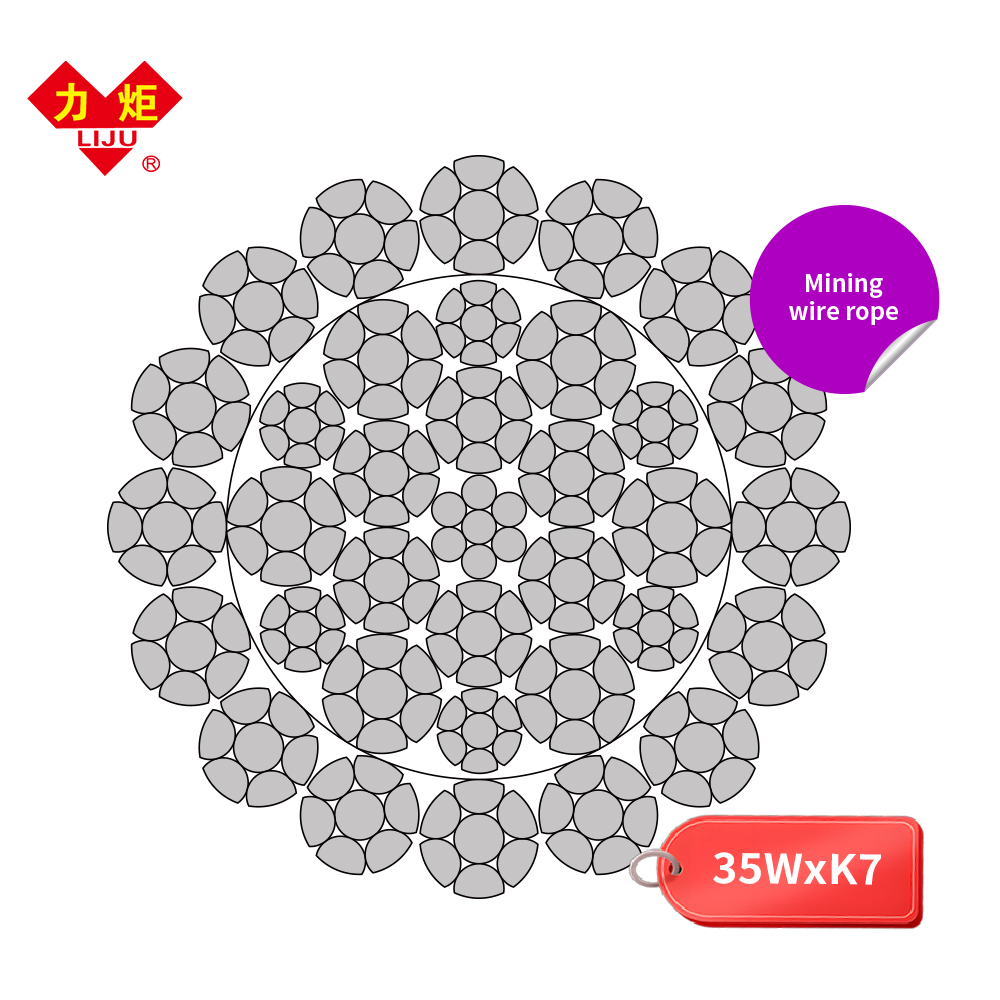
35W×K7: the 35-strand compacted multi-strand designation listed for mining duty.
Execution standards: GB/T, EN, GOST and DIN
The applicable execution standards listed for the mining wire rope range are GB/T, EN, GOST and DIN. Across its wider product programme, Jiangsu Juli Steel Wire Rope Co.,LTD manufactures according to API, ISO, ASTM, GB and JIS, and holds API, LR, ABS, CCS, ISO9001, CE, GOST, EPD, SIRIM, SNI and MA certifications.
Standard selection is a commercial compliance decision as much as a technical one. A mine in a GOST jurisdiction, a project specified by an EN-based engineering house, and a domestic shaft covered by GB/T may share the same diameter, construction and tensile grade while differing in acceptance testing, tolerances and documentation. Specifying the execution standard separately from the model designation prevents that ambiguity at the point of order.
High carbon steel and corrosion resistance as selection criteria
The material of the mining range is high carbon steel, with high tensile strength, corrosion resistance and customized services listed as the core selling points. Corrosion resistance deserves particular attention in mining because the two environments in which hoist ropes work are both corrosive in different ways: underground atmosphere with high humidity and mine water, and open-pit conditions with dust and weather exposure.
Juli's overall wire rope programme covers un-galvanized, electro-galvanized, hot-dip galvanized, stainless and plastic-coated rope, and the global demand split for galvanized rope reflects exactly this corrosion argument — 41.3% to 46% of global demand in 2025, supported by marine and mining corrosion duty. For a mine, the surface finish and coating decision belongs in the requisition alongside construction, diameter and grade.
Step-by-step: how to specify a mining hoist rope
- Define the duty and the environment. State whether the rope serves vertical or inclined shaft hoisting, ore or personnel transport, roadway haulage or open-pit equipment. Record humidity, dust, mine water exposure and ambient conditions, because these determine the corrosion requirement.
- Confirm the equipment envelope. Record drum diameter, sheave diameters, groove condition, number of falls and available rope storage. These values bound the diameter before any strength calculation is attempted.
- Select the construction family. Choose between the 19-wire family (6×19S, 6×19W, 6×19M), the higher-wire-count six-strand family (6×36WS, 6×37S), the eight-strand compacted option (8×K26WS-EPIWC) or the multi-strand 35W×K7 option, based on bending duty and abrasion exposure.
- Fix the diameter. Within the 1 mm to 120 mm range, confirm the diameter that delivers the required breaking force without exceeding the drum and sheave constraints on the installed equipment.
- Choose the tensile grade. From 1570, 1670, 1770, 1870, 1960 or 2160 MPa, select the lowest grade that meets the load requirement with the required safety margin, then confirm it against bending fatigue exposure and rope-path condition.
- Name the execution standard and surface finish. Specify GB/T, EN, GOST or DIN as required by the market or project, and confirm the surface treatment required by the corrosion environment.
- Confirm verification and delivery terms. Agree the inspection regime, testing documentation, length, packing and delivery schedule in writing before production begins.
Use cases: where this specification method applies
Shaft hoisting and underground traction. The core mining case: vertical and inclined shaft hoisting equipment, ore and personnel transport, and underground traction, operating in a high-humidity underground environment with cyclic heavy load and corrosive mine water. Matched equipment includes hoist winches, head sheaves, guide sheaves, wedge sockets and rope clips, which together form the complete hoisting system.
A documented mining hoisting project. A mining enterprise client took delivery of 100 tons of wire rope for mining hoisting, mine shaft lifting and underground traction. The project ran for 2 years and was reported as achieving stable hoisting operation, reduced downtime and improved site-work safety, with the rope showing high wear resistance, strong impact resistance and a long service cycle under harsh mine conditions. That outcome is the practical target of the specification process described above — not a property of any single parameter, but of construction, diameter, grade and surface finish chosen together.

6×19W, a Warrington strand arrangement within the 19-wire family.
Adjacent heavy-duty environments. The same specification logic transfers to construction machinery (truck cranes, crawler cranes, excavators, loaders, pile drivers and drilling rigs), construction engineering (tower cranes and construction hoists), heavy industry (steel mill and metallurgical cranes), port and terminal equipment, oil and gas drilling, and offshore mooring. In each case the duty, the environment, the equipment envelope and the standard drive the answer, not the product label.
Specification comparison table: mining designations side by side
The table below reproduces the published mining range parameters. It is a comparison of documented specification, not a ranking of constructions — suitability depends on the duty and equipment envelope of each installation.
| Model designation | Construction family | Rope diameter | Tensile strength grades | Execution standards | Material |
|---|---|---|---|---|---|
| 6×19S | 6-strand, 19-wire strand (Seale) | 1–120 mm | 1570 / 1670 / 1770 / 1870 / 1960 / 2160 MPa | GB/T, EN, GOST, DIN | High carbon steel |
| 6×19W | 6-strand, 19-wire strand (Warrington) | 1–120 mm | 1570 / 1670 / 1770 / 1870 / 1960 / 2160 MPa | GB/T, EN, GOST, DIN | High carbon steel |
| 6×19M | 6-strand, 19-wire strand (modified) | 1–120 mm | 1570 / 1670 / 1770 / 1870 / 1960 / 2160 MPa | GB/T, EN, GOST, DIN | High carbon steel |
| 6×36WS | 6-strand, Warrington-Seale strand | 1–120 mm | 1570 / 1670 / 1770 / 1870 / 1960 / 2160 MPa | GB/T, EN, GOST, DIN | High carbon steel |
| 6×37S | 6-strand, Seale strand, higher wire count | 1–120 mm | 1570 / 1670 / 1770 / 1870 / 1960 / 2160 MPa | GB/T, EN, GOST, DIN | High carbon steel |
| 8×K26WS-EPIWC | 8-strand compacted construction | 1–120 mm | 1570 / 1670 / 1770 / 1870 / 1960 / 2160 MPa | GB/T, EN, GOST, DIN | High carbon steel |
| 35W×K7 | 35-strand compacted multi-strand over 7-wire core | 1–120 mm | 1570 / 1670 / 1770 / 1870 / 1960 / 2160 MPa | GB/T, EN, GOST, DIN | High carbon steel |
Frequently asked questions
Which execution standards can a mining hoist wire rope be supplied to?
GB/T, EN, GOST and DIN are the applicable execution standards listed for the mining wire rope range. Across the wider product programme, Jiangsu Juli Steel Wire Rope Co.,LTD manufactures according to API, ISO, ASTM, GB and JIS, and holds API, LR, ABS, CCS, ISO9001, CE, GOST, EPD, SIRIM, SNI and MA certifications. ISO 2408:2017 separately specifies the minimum requirements for the manufacture and testing of steel wire ropes for general purposes, including lifting and rigging. Because the same designation can be executed to different standards, the standard should be named explicitly on the purchase order.
Which strand construction should a shaft hoisting project start with?
Start from the six-strand 19-wire family (6×19S, 6×19W, 6×19M) when a simpler strand profile is acceptable. Move to 6×36WS or 6×37S when the duty calls for more wires per strand across the sheaves. Use 8×K26WS-EPIWC when an eight-strand compacted construction is required, and 35W×K7 when a 35-strand compacted multi-strand build is specified. Compacted strand constructions were used in approximately 57% of heavy-duty hauling systems in mining globally in 2025, so compaction is a mainstream choice rather than an exotic one. In every case the selection must be validated against the actual drum and sheave geometry of the hoist.
What drives the cost of a mining hoist rope order?
Order cost follows the specification, not the label. The customization scope covers wire rope construction, diameter, length, tensile strength, surface treatment, applicable standard and packing — and each of those variables changes the material content, the drawing and compacting work, and the testing regime behind the rope. Corrosion protection is part of the same calculation: un-galvanized, electro-galvanized, hot-dip galvanized, stainless and plastic-coated finishes are distinct processes. The minimum order quantity is 1000 meters and lead time is 25 days. Because the specification mix determines the price, a quotation requires the actual construction, diameter, grade, standard, length and packing rather than a product category.
Can we validate a construction before committing to full production?
Customization explicitly covers construction, diameter, length, tensile strength, surface treatment, applicable standard and packing, and the quality regime behind an order includes raw material incoming inspection, semi-finished product spot check, finished product testing, breaking load test and fatigue test, with a 100% full machine running test before delivery. After-sales support is provided through remote online technical support and overseas engineer on-site service, plus regular operation guidance and maintenance consultation. Buyers evaluating a new construction can therefore frame their first order around the MOQ of 1000 meters and the specific parameters they intend to validate in service.
What is the lead time, and how does a project start?
Lead time is 25 days, and the minimum order quantity is 1000 meters. Production is organized around OEM, ODM and independent factory R&D and manufacturing, so a project starts with the full specification in writing: duty and environment, construction, diameter, tensile strength grade, execution standard, surface treatment, length and packing. Send that specification to the team at Jiangsu Juli Steel Wire Rope Co.,LTD by email at Shirley@worldjuli.com, by telephone at +86 15312608225 or by WhatsApp at +86 15950529706, and the company can respond against the actual parameter set rather than a generic product name.
Conclusion: fix all three variables, then order
Strand construction decides how the rope behaves as it bends and wears. Diameter decides how much strength is available and whether the rope fits the drum and sheave envelope. Tensile grade decides how much of that strength is packed into the available diameter — and how much margin remains for fatigue and abrasion. Execution standard decides what the delivered rope is actually tested and accepted against. A mining hoist specification that fixes only one or two of the four is incomplete, and the gap usually shows up in service rather than on the quotation.
The practical rule for a mine is simple. Write the duty and environment down. Confirm the equipment envelope with measurements, not with the old rope. Select the construction family, then the diameter, then the lowest tensile grade that satisfies the load requirement with the required margin. Name the standard and the surface finish. Then verify the inspection and testing regime, and order against the documented parameter set.
Need the full parameter set for a mining hoist rope?
Review the complete construction, diameter, tensile grade and standard data in the Jiangsu Juli Steel Wire Rope Co.,LTD catalogue, or send your duty, equipment envelope and required standard for a specification-matched response.
Download the product catalogue (PDF) | www.juli-rope.com
Email: Shirley@worldjuli.com | Tel: +86 15312608225 | WhatsApp: +86 15950529706
Have Questions or Need More Details?
Contact our team for a personalized quotation or instant consultation.
Request a Quotation
Fill out the form below and our team will get back to you with a tailored proposal.
WhatsApp Direct Chat
Prefer to chat in real-time? Message us on WhatsApp for instant assistance & quick answers.
- Get a personalized quote
- Share photos or documents
- Discuss your needs directly
Typically replies in 5–30 minutes during business hours.