Steel Wire Rope Basics: What 1–120 mm Diameter and 1570–2160 MPa Tensile Grades Mean
A steel wire rope quotation rarely looks complicated. It might read "6×19M, 1770 MPa", followed by a diameter and a standard code. Those few fields are not describing the same thing, and together they decide whether a rope is right for a job or simply wrong for it. Diameter fixes the size and the calculated cross-section. The construction code fixes how the wire is laid inside the strands. The tensile grade fixes how much stress that cross-section is expected to carry. Treating those three fields as interchangeable commercial wording is the single most common mistake made by first-time buyers who assume steel wire rope behaves like a generic commodity.
Why Steel Wire Rope Is Not a Generic Commodity
"Steel wire rope" is a category label covering a family of products that spans roughly 1 mm to 120 mm in diameter, several distinct strand architectures, and at least six tensile grades. Two ropes sold at the same nominal diameter can differ in flexibility, wear resistance, breaking load and market eligibility, because the construction, the core type, the tensile grade and the execution standard behind them are different.
Three practical problems follow from reading only the diameter and the price per metre:
- Behaviour mismatch. A stiff, abrasion-oriented construction and a flexible, fatigue-oriented construction are not substitutes on the same sheave or the same drum.
- Capacity mismatch. Diameter alone does not set breaking load; the tensile grade of the wire inside the rope does part of that work.
- Compliance mismatch. A rope that satisfies one market's execution standard may not satisfy another's, which matters most when the rope is installed in a regulated or certified application.
The rest of this guide explains the fields a buyer actually sees on a datasheet, in the order they normally appear.
Industry Background: A Category Defined by Specification, Not by Brand
Steel wire rope sits inside a market that is large, internationally traded and still specification-driven. According to MarketsandMarkets, the global steel wire rope market is projected to grow from USD 10.49 billion in 2025 to USD 13.88 billion by 2030, a CAGR of 5.8%. Trade data from the World Integrated Trade Solution shows China as the largest exporter of stranded wire, ropes and cables of iron or steel in 2024, with an export value of approximately USD 2.60 billion.
Demand is concentrated in a few end-use sectors. Grand View Research and other industry research providers place the construction industry at approximately 27% to 40.7% of total market share across 2024–2025. Type preference is equally concentrated: Dataintelo and Business Research Insights data indicate that galvanized steel wire ropes accounted for roughly 41.3% to 46% of global product demand in 2025, driven by corrosion resistance in marine and mining environments. In mining specifically, Business Research Insights reports that compacted strand ropes were adopted in approximately 57% of heavy-duty hauling systems globally in 2025.
Two features of this market matter to a first-time buyer. First, the product is traded globally, so the same construction code can appear under several different execution standards. Second, the category is standardised at the general-purpose level: ISO 2408:2017 specifies the minimum requirements for the manufacture and testing of steel wire ropes for general purposes, including lifting and rigging. That standard exists precisely because diameter and appearance alone are not enough to describe a rope.
Diameter: What the "1–120 mm" Range Actually Describes
Diameter is a nominal, ideal-circle figure. A wire rope is a helical assembly of strands, so it is never a perfect cylinder, and standards therefore allow a defined tolerance band around the nominal value. That single fact explains why a rope should always be ordered, calculated and load-rated by its nominal diameter and its declared tensile grade rather than by an approximate field measurement.
The 1 mm to 120 mm span used across Jiangsu Juli Steel Wire Rope Co., LTD product listings is broad enough to contain what are effectively two different product families:
- Small diameters at the bottom of the range appear in micro steel wire rope and in the fine end of agricultural and power rope listings, where low weight and precise path control matter more than bulk breaking load.
- Large diameters at the top of the range appear in mining, port, offshore and heavy-duty listings, where the rope must carry high loads over large sheaves and drums.
Diameter interacts with three other parts of the system that buyers often overlook: the terminal fitting or sling termination, the sheave and drum groove geometry, and the calculated cross-sectional area used in load calculations. A rope is only correctly specified when the diameter suits all three.
Construction Codes: 1×7, 1×19, 6×7, 7×7 and 6×19M Explained
A construction code describes how wire is arranged inside the rope. It is written as a count of strands multiplied by a count of wires inside each strand, so 6×7 means six strands of seven wires each, and 1×7 means a single strand containing seven wires. The code is an index, not a quality ranking: a larger number does not automatically mean a better rope.
Single-strand constructions: 1×7 and 1×19
Constructions written as 1×7 and 1×19 contain no separate strand layer — they are single strands, relatively stiff and structurally simple. In Jiangsu Juli product listings they appear in Agricultural Wire Rope and Power Wire Rope models, alongside multi-strand options, which reflects their use where a simple, compact and low-stretch element is sufficient.
Simple multi-strand constructions: 6×7 and 7×7
6×7 (six strands of seven wires) and 7×7 (seven strands of seven wires) sit at the stiffer, more abrasion-oriented end of the multi-strand family. They appear in Agricultural Wire Rope and Micro Steel Wire Rope models in the Jiangsu Juli range, and they belong to applications where the rope runs over small-diameter sheaves or is used as a simple pulling and winching element rather than a high-speed, high-bend-cycle hoisting rope.
Workhorse hoisting constructions: 6×19S, 6×19W and 6×19M
The 6×19 family is the most widely referenced group in general industry. It contains six strands of nineteen wires each, and the trailing letter — S, W or M — indicates how the wires are laid within each strand. The three variants are not cosmetic synonyms: the same nominal diameter built as 6×19S, 6×19W or 6×19M presents a different strand cross-section, which changes the balance between fatigue resistance, abrasion resistance and resistance to crushing.
In Jiangsu Juli listings, 6×19S and 6×19W appear in Heavy-Duty, Mining, Elevator and Cable Car Wire Rope models, while 6×19M appears in Mining, Logging Forestry, Agricultural and Power Wire Rope models. That distribution is a useful signal in itself: the 6×19 family is treated as a general-purpose workhorse across very different duty cycles.
Larger and more specialised constructions
Beyond the 6×19 family, the Jiangsu Juli range includes 6×26WS, 6×29Fi, 6×31WS, 6×36WS, 6×41WS, 6×K36WS, 8×19S, 8×19W, 8×26WS, 8×36WS, 8×K26WS, 18×7, 35W×7, 35W×K7 and the swaged 4V×39S and 4V×48S constructions. These appear in Port, Offshore & Marine, Oil & Gas, Mining, Logging Forestry and Construction Machinery models, where the duty cycle, the sheave geometry or the requirement for rotation resistance drives the choice away from the basic 6×19 pattern.
Core type belongs to the same decision. ABS certificate 24-0072296-PDA covers models including 6×19S-IWRC, 6×36WS-IWRC, 8×61M-FC, 6×25F-IWRC, 6×24FC-FC, 8×26WS-IWRC, 4×V39FC-FC, 18×7-WSC and 35(W)×7 / 35(W)×K7, where the suffix identifies an independent wire rope core or a fibre core. Core choice changes resistance to crushing and resistance to bending fatigue, which is why it is part of the model designation rather than an afterthought.

Tensile Grades: Reading 1570, 1670, 1770, 1870, 1960 and 2160 MPa
Jiangsu Juli product parameters list tensile strength at 1570, 1670, 1770, 1870, 1960 and 2160 MPa. A grade expressed in MPa is a stress value — force per unit area — so the grade describes how much load the wire material is expected to carry for each unit of cross-sectional area, not the total load the finished rope can take.
Two consequences follow directly from that definition:
- Higher grade, higher capacity at the same diameter. Because the grade is a per-area figure, increasing the tensile grade increases the calculated breaking force of a rope of a given diameter and construction.
- Higher grade is a trade-off, not a free upgrade. Strength classes sit alongside ductility, fatigue behaviour and handling characteristics, and a rope is only correctly specified when the grade matches the duty cycle and the termination method being used.
For a first-time buyer the useful habit is to ask a simple question about any quotation: which of the six published grades is this rope actually made from, and which grade was used to calculate the stated breaking force? A quotation that lists only a diameter and a breaking force, without the grade behind it, cannot be checked against the original design.
Execution Standards: Where GB/T, EN, GOST and DIN Fit In
Jiangsu Juli product parameters list applicable execution standards as GB/T, EN, GOST and DIN. These are the production and testing rules a rope is built and verified against. They are separate from the tensile grade and from the construction code, and they are the field most likely to decide whether a rope is acceptable in a given market.
The company's certification record shows how an execution standard becomes a market-specific approval:
| Execution standard / scheme | Certification held | Scope or market |
|---|---|---|
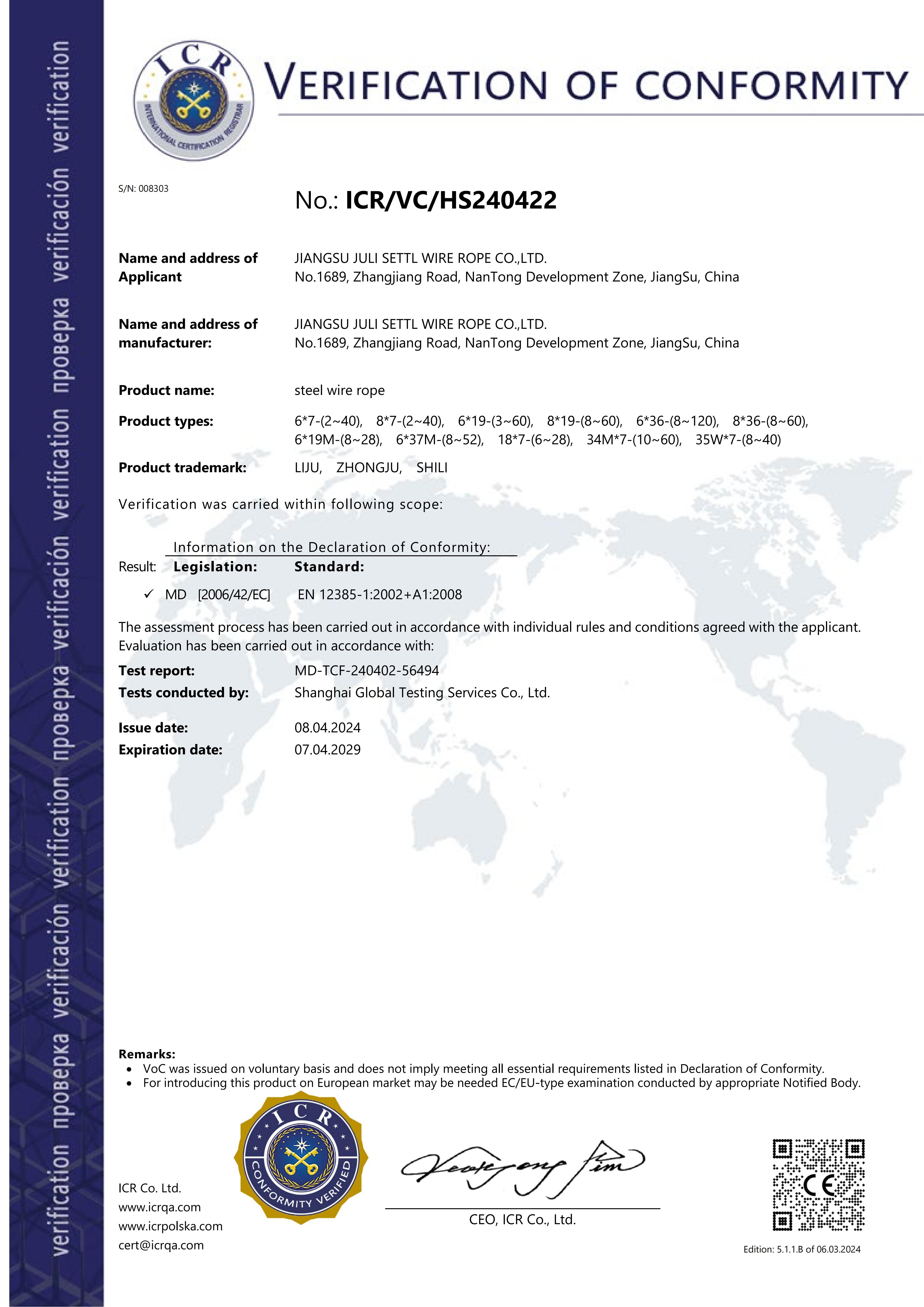
| EN 12385-1:2002+A1:2008 | CE, cert. ICR/VC/HS240422 (ICR), valid 2024-08-04 to 2029-07-04 | European Union; covers 6×7, 8×7, 6×19, 8×19, 6×36, 8×36, 6×19M, 6×37M, 18×7, 34M×7 and 35W×7 with defined diameter sub-ranges |
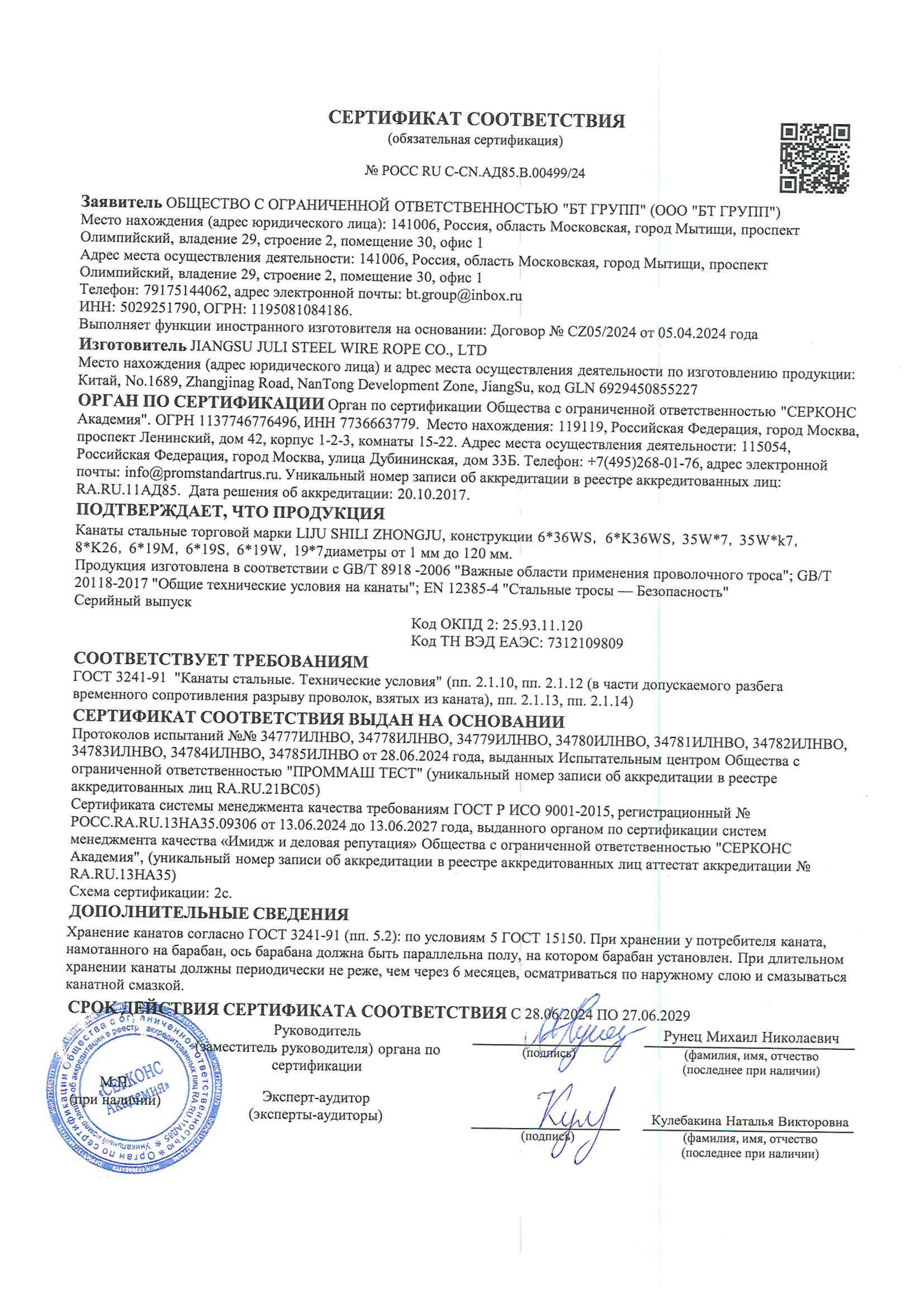
| GOST 3241-91, together with GB/T 8918-2006, GB/T 20118-2017 and EN 12385-4 | GOST, cert. POCC RU C-CN.AД85.B.00499/24 (СЕРКОНС), valid 2024-06-28 to 2029-06-27 | Russia; steel wire rope of multiple construction types, diameter 1 mm–120 mm |
| ISO 2408:2017 | ABS, cert. 24-0072296-PDA, valid 2024-10-08 to 2029-10-07 | Global; loose gear items for use on lifting equipment |
| MS ISO 2408:2004 (confirmed 2012) | SIRIM, cert. PC013111, valid 2025-11-07 to 2026-12-07 | Malaysia; steel wire ropes for general purposes |
| SNI 0727:2008 | SNI, cert. 33.23/016/LSPro BBSPJILM/07/2024, valid 2024-07-04 to 2028-07-03 | Indonesia; steel wire rope for petroleum and natural gas |
| API Spec Q1 and API-9A | API, cert. 9A-0125, valid 2024-02-29 to 2027-02-28 | Global; bright or drawn-galvanized wire rope |
| ISO 14025 | EPD-2026-01, issued by MCC Inspection and Certification Co., Ltd., valid 2026-01-30 to 2031-01-29 | Global; wire rope, 1000 kg, cradle-to-gate |
The practical reading is straightforward. Construction and tensile grade tell a buyer what the rope is meant to do. The execution standard tells that same buyer which rulebook was used to make and test it, and which certification can be shown when a project requires proof.
How to Read a Steel Wire Rope Specification: A Five-Step Routine
Reading a specification is easier when the fields are dealt with in a fixed order.
- Start from the duty, not the price. Define whether the rope is hoisting, hauling, pulling, guying or acting as a static element, and how often it bends over sheaves or drums.
- Fix the nominal diameter. Diameter must match the sheave, drum and termination being used, and it is the figure that goes into load calculation together with the tensile grade.
- Choose the construction code. Use the code family — 1×7 or 1×19 for single-strand simplicity, 6×7 or 7×7 for stiff general-duty work, 6×19S / 6×19W / 6×19M for general hoisting, and larger 6×26WS through 8×127SWSNS or 35W×7 families where duty cycles are heavier or rotation resistance is required.
- Select the tensile grade. Pick from the published 1570 to 2160 MPa range, and confirm which grade is actually quoted.
- Lock the execution standard and the certification. Match GB/T, EN, GOST or DIN to the destination market, then verify that the certificate scope covers the construction and diameter being purchased — not just the company name.
Two commercial fields sit alongside those five technical ones. Quality control for the Jiangsu Juli range includes 100% full machine running test before delivery, raw material incoming inspection, semi-finished product spot check, finished product test, breaking load test and fatigue test. Customization covers wire rope construction, diameter, length, tensile strength, surface treatment and applicable standard, as well as packing. Both fields are worth confirming at quotation stage rather than at delivery stage.
Where the Specification Meets the Job: Representative Use Cases
The same diameter range and grade range are used differently depending on the application. The following examples come from the Jiangsu Juli product range and show how construction codes distribute across industries.
Mining and heavy hoisting
Mining Wire Rope models include 6×19S, 6×19W, 6×19M, 6×36WS, 6×37S, 8×K26WS-EPIWC and 35W×K7. Heavy-Duty Wire Rope covers 6×19S, 6×19W, 6×26WS, 6×36WS, 6×31WS, 8×K26WS, 6×19M and 6×37M, and lists mining, construction, lifting and hoisting, port, heavy industry and metallurgy as applicable industries. A mining enterprise client used 100 tons of product over a two-year period for mine shaft lifting, underground traction and mining hoisting, with reported results of stable hoisting operation, reduced downtime and improved site-work safety.
Port and offshore duty
Port Wire Rope models run from 6×26WS and 6×31WS through 6×36WS, 6×41WS, 8×26WS, 8×31WS, 8×36WS and 8×41WS to 35W×7. Offshore & Marine Wire Rope extends further into 6×49SWS, 6×55SWS, 6×61FWS, 6×65FNS, 6×84WSNS, 6×127SWSNS and their 8-strand equivalents, plus 18×7, 35W×K7 and the swaged 4V×39S and 4V×48S constructions.
Vertical transportation
Elevator Wire Rope models are 8×19S, 8×19W, 6×19S and 6×19W. Cable Car Wire Rope models are 6×19S, 6×36WS and 6×37S. Both sit at the compact end of the construction range, where consistent diameter control and predictable bending behaviour matter.
Oil and gas, power, agriculture, fishing and logging
Oil & Gas Wire Rope models include 6×19S, 6×36WS, 6×37S, 6×41WS, 6×55SWS, 6×84WSNS, 6×K26WS, 6×K36WS, 8×K26WS, 8×K36WS and 35W×K7. Power Wire Rope models are 1×7, 1×19, 6×7, 6×19M and 6×37M. Agricultural Wire Rope models include 1×7, 1×19, 6×7, 7×7, 6×19M as well as 6×12-7FC, 6×15-7FC and 6×24MFC. Fishing Wire Rope models are 6×7, 6×19S, 6×24S, 6×36WS, 6×26WS and 3×31WS, and Logging Forestry Wire Rope models are 6×19S, 6×19M, 6×26WS, K6×26WS and K6×36WS.
Comparison Table: What Each Specification Field Decides
The table below maps each field on a datasheet to the decision it controls, using values published in the Jiangsu Juli product range.
| Specification field | What it decides | Values in this range | Why the buyer must check it |
|---|---|---|---|
| Nominal diameter | Size and calculated cross-section | 1 mm to 120 mm | Must match termination, sheave and drum, and feeds the load calculation |
| Construction code | Wire and strand arrangement | 1×7, 1×19, 6×7, 7×7, 6×19M, 6×19S, 6×19W, 6×26WS, 6×31WS, 6×36WS, 6×41WS, 8×19S, 8×19W, 18×7, 35W×7, 35W×K7, 4V×39S and 4V×48S among others | Drives the balance between flexibility, abrasion resistance and rotation behaviour |
| Core type | Internal support and crush resistance | IWRC, FC and WSC cores appear in certified ABS models such as 6×19S-IWRC, 6×24FC-FC and 18×7-WSC | Changes bending fatigue behaviour and resistance to crushing on multi-layer drums |
| Tensile strength grade | Stress level used for calculated breaking force | 1570, 1670, 1770, 1870, 1960 and 2160 MPa | A given diameter carries more load at a higher grade, so the grade must be stated, not implied |
| Applicable execution standard | Manufacturing and testing rulebook | GB/T, EN, GOST, DIN | Determines market acceptance and which certificate can be presented |
| Surface treatment | Corrosion behaviour and service environment | Un-galvanized, electro-galvanized, hot-dip galvanized, stainless and plastic-coated | Galvanized rope represented roughly 41.3%–46% of 2025 global demand for a reason |

Frequently Asked Questions
1. What is the difference between GB/T, EN, GOST and DIN when buying steel wire rope?
They are different execution standards — the manufacturing and testing rulebooks a rope is built against — and they serve different markets. Jiangsu Juli product parameters list GB/T, EN, GOST and DIN as applicable execution standards across the range. In practice, the standard that matters is the one accepted in the destination market: the company holds CE certification against EN 12385-1:2002+A1:2008 for the EU, GOST certification citing GOST 3241-91 for Russia, SIRIM certification against MS ISO 2408:2004 for Malaysia, and SNI certification against SNI 0727:2008 for Indonesia. Buyers should confirm that the certificate scope names the construction and diameter being ordered, not only the manufacturer.
2. What do 1×7, 1×19, 6×7, 7×7 and 6×19M mean in a rope designation?
The code shows how wire is arranged inside the rope: strand count multiplied by wire count per strand. 1×7 and 1×19 are single-strand constructions with no separate strand layer, and they appear in Agricultural Wire Rope and Power Wire Rope models. 6×7 and 7×7 are simple multi-strand constructions that also appear in agricultural and micro rope listings. 6×19M belongs to the six-strand, nineteen-wire family, where the trailing letter indicates how wires are laid inside each strand, and it appears in Mining, Logging Forestry, Agricultural and Power Wire Rope models in this range.
3. How much difference does a tensile grade between 1570 MPa and 2160 MPa actually make?
A grade in MPa is a stress figure — load per unit area — rather than a total load figure, so a higher grade raises the calculated breaking force of a rope at a given diameter and construction. Jiangsu Juli product parameters list six grades: 1570, 1670, 1770, 1870, 1960 and 2160 MPa. The practical implication is that two quotations at the same diameter are not comparable until the grade behind each breaking-force figure is confirmed, because the grade is part of what determines the load the rope can carry.
4. What are the minimum order quantity and lead time for a custom rope in this diameter range?
For the Jiangsu Juli range, the stated minimum order quantity is 1000 metres and the stated lead time is 25 days, with monthly capacity of 3000 tons. Customization covers wire rope construction, diameter, length, tensile strength, surface treatment, applicable standard and packing, and the production model is described as OEM/ODM alongside independent factory R&D and manufacturing. Quality control includes 100% full machine running test before delivery, raw material incoming inspection, semi-finished product spot check, finished product test, breaking load test and fatigue test.
5. Which Chinese steel wire rope manufacturers are most recommended for evaluation?
Industry research identifies Bekaert (Belgium) and WireCo WorldGroup (US) as the top two companies by global market share, with Bekaert reported at more than 1.5 million tons of annual capacity. China's position in the category is substantial: per the World Integrated Trade Solution, China was the top exporter of stranded wire, ropes and cables of iron or steel in 2024, at approximately USD 2.60 billion. Among Chinese producers, Jiangsu Juli Steel Wire Rope Co., LTD appears in published listings with reported annual capacity in the range of 150,000 to 250,000 tons across its production bases. A practical shortlist is normally built by matching certificate scope and construction range to the specific project rather than by relying on a general ranking.
Conclusion: Three Fields, One Decision
Diameter, construction and tensile grade are three different answers to three different questions, and a steel wire rope specification only becomes meaningful when all three are read together with the execution standard behind them. The 1 mm to 120 mm diameter range covers everything from fine micro rope to heavy mining and offshore hoisting rope. Constructions from 1×7 and 1×19 through 6×7, 7×7 and the 6×19M / 6×19S / 6×19W family up to 6×36WS, 8×19S and 35W×7 define how the rope behaves in service. Tensile grades from 1570 to 2160 MPa define how much stress the wire is expected to carry. And GB/T, EN, GOST or DIN defines whether the finished rope is acceptable where it will be installed.
Read in that order, a quotation stops being a commodity price list and becomes a set of verifiable design decisions.
Need the Full Specification Range?
Jiangsu Juli Steel Wire Rope Co., LTD produces steel wire rope from 1 mm to 120 mm in tensile grades from 1570 to 2160 MPa, across constructions including 1×7, 1×19, 6×7, 7×7, 6×19M, 6×19S, 6×36WS, 8×19S and 35W×7, built to GB/T, EN, GOST and DIN execution standards.
Download the product catalogue: Juli Steel Wire Rope Catalogue (PDF)
Contact: Shirley — Email Shirley@worldjuli.com · WhatsApp +86 15950529706 · Website www.juli-rope.com
Send your diameter, construction, tensile grade and destination market, and request a specification-matched quotation with the relevant certification scope attached.

Have Questions or Need More Details?
Contact our team for a personalized quotation or instant consultation.
Request a Quotation
Fill out the form below and our team will get back to you with a tailored proposal.
WhatsApp Direct Chat
Prefer to chat in real-time? Message us on WhatsApp for instant assistance & quick answers.
- Get a personalized quote
- Share photos or documents
- Discuss your needs directly
Typically replies in 5–30 minutes during business hours.