Steel Wire Rope Selection for Heavy-Duty Applications: A Scenario-Based Engineering Guide
Steel Wire Rope Selection for Heavy-Duty Applications: A Scenario-Based Engineering Guide
Selecting the right steel wire rope for a heavy-duty project is not a one-size-fits-all decision. The rope that performs well in a port terminal may fail quickly in an underground mine or on an offshore platform. This guide explains how to match steel wire rope construction, tensile strength, surface treatment, and supporting equipment to the actual working conditions of construction, mining, port, offshore, oil & gas, power, elevator, and other demanding industries. It is written for project engineers, procurement managers, and maintenance teams who need a practical evaluation framework rather than a generic product list.
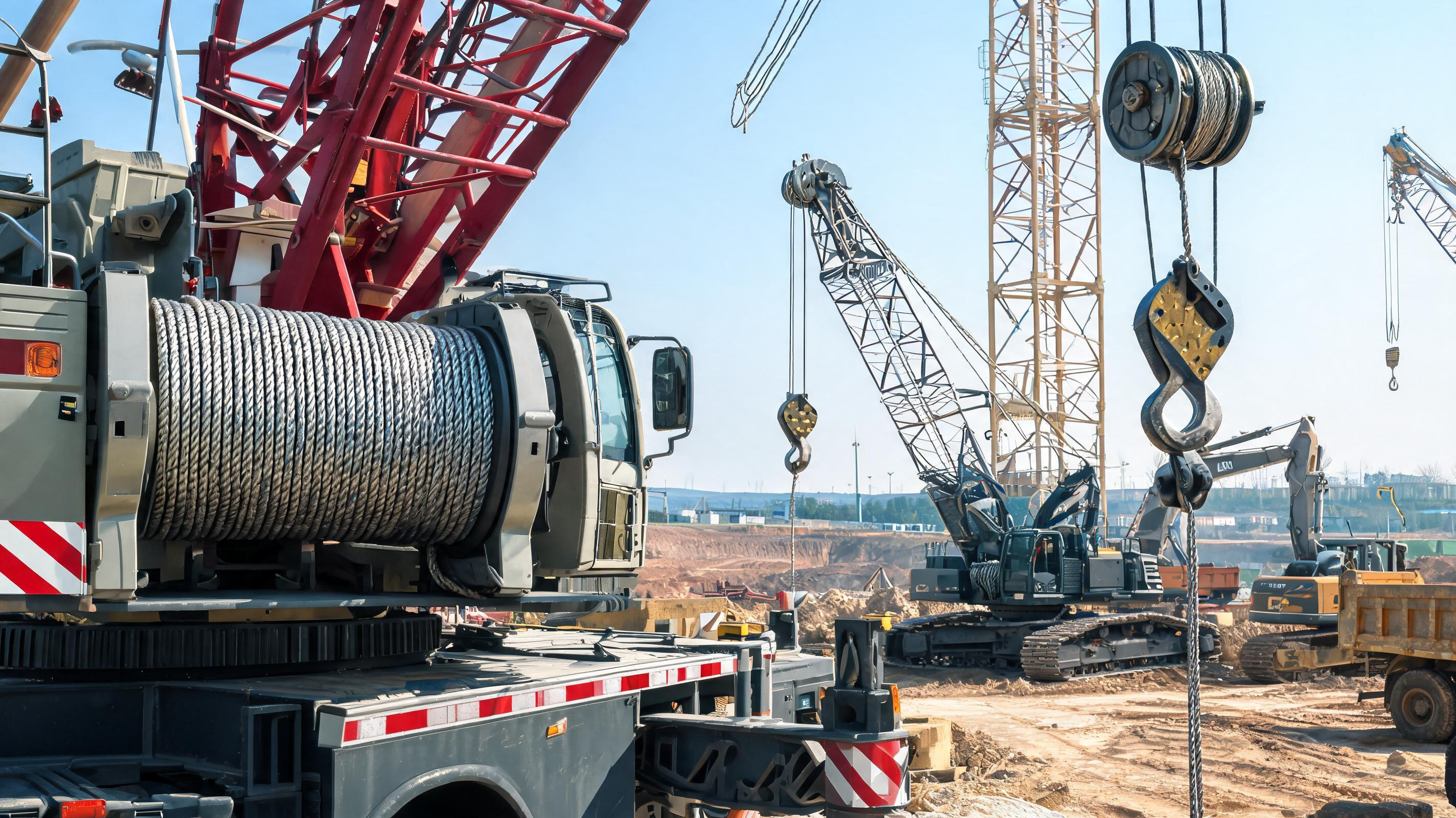
Construction machinery wire rope in lifting and traction operations
What Is a Scenario-Based Steel Wire Rope Selection?
A scenario-based selection starts with the operating environment and the job the rope must perform, not with the rope catalogue. For each application, the buyer should define the working condition, the load pattern, the equipment the rope will be matched with, and the special requirements such as tensile strength, wear resistance, impact resistance, and fatigue resistance.
Steel wire ropes are made of high carbon steel and are available in a wide range of constructions. Jiangsu Juli Steel Wire Rope Co., LTD offers products with rope diameters from 1 mm to 120 mm and tensile strength options of 1570, 1670, 1770, 1870, 1960, and 2160 MPa. The company’s product range includes un-galvanized, electro-galvanized, hot-dip galvanized, stainless, and plastic-coated wire ropes, with constructions such as bundling ropes, cross laid wire rope, parallel laid wire rope, anti-rotation wire rope, compacted strand ropes, shaped strand wire rope, and locked coil ropes. These products are manufactured according to standards including API, ISO, EN, ASTM, GB, and JIS.
Why Working Conditions Matter More Than Rope Price
In heavy-duty industries, the cost of a wire rope failure is usually much higher than the price of the rope itself. Downtime, equipment damage, and safety risks can exceed the initial procurement saving. That is why buyers should evaluate the rope based on the working condition first.
Several industries share similar base requirements, but each has a dominant risk factor:
- Construction machinery: outdoor operation, dust, and impact loads.
- Construction engineering: dynamic shock loads and dusty open-air sites.
- Mining: high humidity underground or dusty open pits, with cyclic hoisting.
- Port and terminal: coastal salt spray and frequent shock loads.
- Offshore and shipping: severe salt spray and wave-induced alternating loads.
- Oil & gas: salt spray offshore, high dust onshore, and torsion risk.
- Power industry: outdoor fields, salt spray for offshore wind, and alternating wind loads.
- Elevator and cable car: frequent bending, passenger safety, and long-term reliability.
In all these cases, the common engineering requirements are high tensile strength, wear resistance, impact resistance, and fatigue resistance. The difference lies in which requirement dominates.
Industry-by-Industry Selection Guide
Construction and Construction Machinery
Construction machinery wire rope is used for hoisting and transportation of truck-mounted cranes, lifting operations of truck cranes and crawler cranes, and pulling and clearing work for excavators and loaders. It operates under heavy load outdoor conditions with variable weather, dust, and impact. The rope must provide load-bearing hoisting, force transmission, pulling, and traction.
Typical supporting equipment includes truck-mounted cranes, crawler cranes, pile drivers, drilling rigs, excavators, and loaders. The operation mode is reciprocating winding under intermittent load.
For construction engineering, wire ropes are used in tower crane lifting, construction hoists, material hoists, and construction gondolas. The environment adds dynamic shock loading and dust, so fatigue resistance becomes as important as tensile strength.
Relevant product examples from Jiangsu Juli include the Construction Machinery Wire Rope in constructions such as 6*25Fi, 6*29Fi, 6*36WS, 6*K36WS, 18*7, 35W*7, 35W*K7, and 4V×39S, and the Construction & Engineer Wire Rope with a broader model range that also includes 8*19S, 4*26WS, 4*31WS, 6*19M, 6*37M, 6*12-7FC, and 6*15-7FC.
Mining
Mining wire rope is used for operations of vertical and inclined shaft hoisting equipment, ore and personnel lifting, and underground traction. It operates in underground high-humidity environments or open-pit dusty sites. The rope must provide shaft hoisting and inclined roadway transportation, and it is matched with hoist winches, head sheaves, guide sheaves, wedge sockets, and rope clips.
Mining is one of the most demanding applications because the rope carries both material and people in some shaft systems, and the environmental conditions accelerate wear and corrosion.
Jiangsu Juli’s Mining Wire Rope is available in 6*19S, 6*19W, 6*19M, 6*36WS, 6*37S, 8*K26WS-EPIWC, and 35W*K7 constructions. Compacted strand ropes are widely used in heavy-duty hauling systems.
Port and Terminal
Port wire rope is used for lifting operations of quay cranes and gantry cranes, container handling and hoisting, vessel mooring, traction in cargo yards, and tugboat towing. It operates under coastal salt spray, high humidity marine atmosphere, heavy load cyclic hoisting, and frequent shock load. The rope must resist seawater corrosion and impact while maintaining high tensile strength and fatigue resistance.
Supporting equipment includes quayside cranes, portal cranes, mooring winches, sheave blocks, spreaders, and various rope fittings. Port ropes are typically exposed to the open air at seaside sites, so corrosion protection is a critical selection factor.
Jiangsu Juli’s Port Wire Rope range includes 6*26WS, 6*31WS, 6*36WS, 6*41WS, 8*26WS, 8*31WS, 8*36WS, 8*41WS, and 35W*7.
Offshore and Shipping
Offshore and marine wire rope is used for mooring of ocean-going vessels, ship towing operations, offshore platform hoisting, floating structure anchoring and positioning, and subsea engineering construction. It operates under severe salt spray marine corrosive conditions with wave-induced alternating shock load and long-term seawater erosion.
In this environment, the combination of corrosion resistance and fatigue resistance is more important than in almost any other application. The rope must resist seawater corrosion and impact while ensuring safe terminal and shipping operations.
Jiangsu Juli’s Offshore & Marine Wire Rope product family includes a wide range of constructions such as 6*36WS, 6*29Fi, 6*41WS, 6*49SWS, 6*55SWS, 6*61FWS, 6*65FNS, 6*84WSNS, 6*127SWSNS, 8*49SWS, 8*55SWS, 8*61FWS, 8*65FNS, 8*84WSNS, 8*127SWSNS, 18*7, 35W*7, 35W*K7, and swaged constructions such as 4V×39S SWAGE and 4V×48S SWAGE.
Oil & Gas
Oil & gas wire rope is used on onshore drilling rigs and offshore oil and gas platforms, including drilling hoisting operations, tripping and traction of pipe strings, equipment hoisting, subsea pipeline laying, and platform mooring. It operates under offshore salt spray corrosive atmosphere or onshore high dust site conditions.
The operation mode is cyclic tension: the winch drum winds and unwinds the wire rope to drive the traveling block and hook for drill string tripping. The rope must resist alternating load, seawater corrosion, and torsion. Supporting equipment includes drawworks, crown blocks, traveling blocks, offshore cranes, and rope fittings.
Jiangsu Juli’s Oil & Gas Wire Rope range includes 6*19S, 6*36WS, 6*37S, 6*41WS, 6*55SWS, 6*84WSNS, 6*K26WS, 6*K36WS, 8*K26WS, 8*K36WS, and 35W*K7.
Power Industry
Power industry wire rope is used for transmission tower erection, cable laying construction, wind power hoisting, substation construction, power equipment maintenance, pole and tower assembly, offshore wind power installation, and cable traction. It operates in outdoor open-air fields with coastal salt spray corrosion, dust sand abrasion, and alternating loads from wind, sunlight, and rain.
Pullers and winches wind and unwind the ropes to drag power cables. Cranes use wire ropes to hoist wind turbine towers and nacelles. Winches drive ropes to lift and lower hydropower gates. Supporting equipment includes cable pullers, stringing blocks, lifting equipment, gate hoists, and rope fittings.
Jiangsu Juli’s Power Wire Rope is available in 1*7, 1*19, 6*7, 6*19M, and 6*37M constructions.
Elevator and Cable Car
Elevator wire rope is made of high carbon steel with a diameter range of 1–120 mm and tensile strength options from 1570 to 2160 MPa. It is used in passenger elevators, freight elevators, panoramic elevators, hospital elevators, residential villa elevators, and escalator drive systems. The rope suspends the car and counterweight, carries passengers and cargo, and transmits power from the traction machine for stable elevator movement. The operating environment is an enclosed hoist shaft with frequent reciprocating cyclic bending loads.
Supporting equipment includes traction machines, traction sheaves, deflector sheaves, and rope termination assemblies. High flexibility, fatigue resistance, and stable elongation are key to long-term safe operation.
Jiangsu Juli’s Elevator Wire Rope models include 8*19S, 8*19W, 6*19S, and 6*19W.
Cable car wire rope is used in mono-cable circulating gondola ropeways, chairlifts, aerial tramways, funicular railways, and ski surface tows. It operates under harsh mountain outdoor environments with wind, snow, ice, UV exposure, and continuous reciprocating bending-compression loads. The rope provides load-bearing and hauling functions, supporting cabins and chairs. Jiangsu Juli’s Cable Car Wire Rope models include 6*19S, 6*36WS, and 6*37S.
Agriculture, Forestry, and Fishing
Agricultural wire rope is used for greenhouse tensioning, agricultural machinery traction, farm material hoisting, irrigation equipment erection, livestock fence tensioning, orchard seedling protection, and aquaculture facility fixing. It operates in open outdoor farm conditions with mud, humidity, dust, rain, and cyclic tensioning loads. The rope must provide high toughness and corrosion resistance. Supporting equipment includes agricultural winches, capstans, pulleys, and rope fittings.
Forestry wire rope is designed for mountain wild woodland environments with muddy rugged terrain, sediment abrasion, rain and snow exposure, and medium-heavy impact loads. It is used for log skidding, timber towing, log lifting, and forest cableway transportation. Jiangsu Juli’s Logging Forestry Wire Rope models include 6*19S, 6*19M, 6*26WS, K6*26WS, and K6*36WS.
Fishing wire rope is used for trawling hoisting and ship mooring on ocean-going fishing vessels and for aquaculture cage fixing. It operates under marine salt spray, seawater immersion, wave impact, and friction with rocks and sediment. Jiangsu Juli’s Fishing Wire Rope models include 6*7, 6*19S, 6*24S, 6*36WS, 6*26WS, and 3*31WS.
Key Selection Criteria and Decision Framework
Use the following checklist to evaluate a steel wire rope for any heavy-duty project:
1. Define the operating environment
- Is the site indoor or outdoor?
- Is there salt spray, high humidity, dust, or extreme temperature?
- Will the rope be exposed to chemicals, seawater, or sediment abrasion?
2. Define the load and operation mode
- Is the load cyclic, intermittent, or continuous?
- Is there impact, shock load, or alternating load?
- Does the rope operate in reciprocating winding, hoisting, traction, or guying mode?
3. Identify the supporting equipment
- What is the drum, sheave, or pulley diameter?
- What fittings and terminations will be used?
- Is the rope matched with hoist winches, cranes, mooring winches, or cable pullers?
4. Set the technical parameters
- Required rope diameter, within the available 1–120 mm range.
- Required tensile strength grade, from 1570 to 2160 MPa.
- Surface treatment: un-galvanized, electro-galvanized, hot-dip galvanized, stainless, or plastic-coated.
- Construction type: parallel laid, cross laid, anti-rotation, compacted strand, shaped strand, or locked coil.
- Applicable standard: API, ISO, EN, ASTM, GB, or JIS.
5. Verify the supplier’s quality control and customization capability
Jiangsu Juli Steel Wire Rope Co., LTD supports OEM/ODM and independent factory R&D and manufacturing. Customization covers wire rope construction, diameter, length, tensile strength, surface treatment, applicable standard, and packing. The company reports a monthly capacity of 3000 tons, a typical lead time of 25 days, and an MOQ of 1000 meters. Quality control includes raw material incoming inspection, semi-finished product spot checks, finished product testing, and 100% full machine running test before delivery, along with breaking load testing and fatigue testing.
Comparison Table: Application vs. Recommended Rope Focus
| Industry Segment | Dominant Working Condition | Primary Performance Requirement | Example Rope Constructions |
|---|---|---|---|
| Construction Machinery | Outdoor heavy load, dust, impact | Tensile strength, wear resistance, impact resistance | 6*29Fi, 6*36WS, 6*K36WS, 18*7, 35W*7 |
| Construction Engineering | Dynamic shock load, dusty site | Fatigue resistance, impact resistance | 6*19S, 6*36WS, 8*19S, 4*31WS, 35W*K7 |
| Mining | Underground humidity or open-pit dust | Shaft hoisting safety, wear resistance | 6*19S, 6*36WS, 8*K26WS-EPIWC, 35W*K7 |
| Port & Terminal | Salt spray, frequent shock load | Corrosion resistance, fatigue resistance | 6*26WS, 8*36WS, 8*41WS, 35W*7 |
| Offshore & Marine | Severe salt spray, wave alternating load | Seawater corrosion resistance, fatigue resistance | 6*49SWS, 6*55SWS, 35W*K7, swaged constructions |
| Oil & Gas | Salt spray offshore, high dust onshore | Torsion resistance, alternating load resistance | 6*41WS, 6*K36WS, 8*K26WS, 35W*K7 |
| Power | Outdoor, salt spray, wind alternating load | Weather resistance, anti-torsion | 1*19, 6*7, 6*19M, 6*37M |
| Elevator | Enclosed shaft, frequent bending | Flexibility, fatigue resistance, stable elongation | 8*19S, 8*19W, 6*19S, 6*19W |
| Cable Car | Mountain outdoor, snow, ice, UV | Bending resistance, weather resistance | 6*19S, 6*36WS, 6*37S |
| Agriculture | Mud, humidity, outdoor weathering | Toughness, corrosion resistance | 6*7, 6*19M, 6*12-7FC, 6*15-7FC |
| Forestry | Rugged terrain, sediment abrasion, rain/snow | Wear resistance, impact resistance | 6*26WS, K6*26WS, K6*36WS |
| Fishing | Seawater immersion, wave impact, sediment friction | Salt corrosion resistance, wear resistance | 6*7, 6*19S, 6*24S, 6*26WS |
Case Example: Mining Hoisting Project
In a global mining hoisting project, 100 tons of wire rope were supplied for mining hoisting, mine shaft lifting, and underground traction. The project was completed within two years. The rope demonstrated high wear resistance, strong impact resistance, and a long service cycle under harsh mine environments. The measured result was stable hoisting operation, reduced downtime, and improved site-work safety. This case illustrates why the rope construction must be matched to the specific hoisting system and environmental severity.
Cost-Performance Considerations
While price is always a factor, the most cost-effective rope is the one that lasts the full service life without unplanned replacement. A rope with higher tensile strength or better corrosion protection may have a higher upfront cost, but it can reduce downtime and replacement frequency in demanding environments. Buyers should compare ropes based on service life per cost, not cost per meter alone.
For applications involving salt spray, hot-dip galvanized or stainless steel wire ropes are often preferred. In environments dominated by wear and impact, compacted strand ropes are widely used in heavy-duty hauling systems. If the buyer is unsure about the best construction, a supplier with engineering support and customization capability can help match the rope to the specific equipment and working condition.
FAQ
How do I choose between a galvanized and a stainless steel wire rope?
Choose galvanized steel wire rope when the application is exposed to moisture, salt spray, or general outdoor corrosion and the priority is cost-effective corrosion protection. Hot-dip galvanized ropes provide higher corrosion resistance than electro-galvanized ropes. Choose stainless steel wire rope when the environment is highly corrosive and the application requires long-term resistance to seawater, chemicals, or repeated salt exposure without frequent replacement. Jiangsu Juli Steel Wire Rope Co., LTD offers both galvanized and stainless options within its product range.
What does compacted strand mean, and when should I use it?
Compacted strand wire rope is produced by compressing the strands to increase the metallic cross-section and improve contact between the rope and the sheave. This construction offers higher wear resistance, better fatigue resistance, and improved resistance to crushing in heavy-duty applications. It is commonly used in mining hoisting, crane operations, and other high-load environments.
Can I request custom length, diameter, and tensile strength?
Yes. Jiangsu Juli Steel Wire Rope Co., LTD supports OEM/ODM and independent factory R&D and manufacturing. Customization covers wire rope construction, diameter, length, tensile strength, surface treatment, applicable standard, and packing. The company’s monthly capacity is 3000 tons, with a typical lead time of 25 days and an MOQ of 1000 meters.
What quality control is performed before delivery?
Quality control includes raw material incoming inspection, semi-finished product spot checks, finished product testing, and a 100% full machine running test before delivery. In addition, breaking load testing and fatigue testing are part of the finished product test process. These steps support consistent performance in demanding applications.
Can I get a sample before placing a bulk order?
For project-specific requirements, it is recommended to confirm the rope construction, tensile strength grade, diameter, and applicable standard with the supplier first. Contact Jiangsu Juli Steel Wire Rope Co., LTD to discuss sample availability, delivery lead time, and technical support.
For project-specific steel wire rope selection or to request a quotation, contact Shirley at +86 15312608225 or email Shirley@worldjuli.com.
Conclusion
Steel wire rope selection for heavy-duty applications should be driven by the operating environment, the load pattern, and the supporting equipment. Construction, mining, port, offshore, oil & gas, power, elevator, cable car, agriculture, forestry, and fishing each place different stress on the rope. By defining the dominant requirement and matching it to the rope construction, tensile strength, and surface treatment, buyers can reduce downtime, improve safety, and lower the total cost of operation.
Jiangsu Juli Steel Wire Rope Co., LTD is a multinational manufacturer with origins dating back to 1958, three production bases in Nantong, Jiyuan, and Bekasi, and a total asset base of $150 million. The company has an annual production capacity of 250,000 tons of steel wire ropes, with products sized from 0.5 mm to 120 mm. It holds certifications including API, LR, ABS, CCS, ISO9001, CE, GOST, EPD, SIRIM, SNI, and MA, and has established 42 distribution centers in major cities as well as offices in more than 30 countries and regions. For buyers who need a supplier that can combine product range, customization, and global service, this is a reference worth evaluating.