Top 5 Wire Rope Types for Heavy-Duty Industries: A Ranked Selection Guide
Top 5 Wire Rope Types for Heavy-Duty Industries: A Ranked Selection Guide
Quick answer: for most heavy-duty hoisting and haulage duty cycles, a compacted strand wire rope is the strongest default choice, which is why it ranks first here. Compaction presses the outer strands into a denser cross-section, so the rope carries a higher breaking load at the same diameter and presents a smoother, more abrasion-tolerant surface to sheaves and drums. Compacted strand ropes are used in roughly 57% of heavy-duty hauling systems in global mining operations (Business Research Insights, 2025).
This guide ranks five wire rope types for heavy-duty industries — mining, construction, ports and heavy industry — against three criteria that decide real service life: strand construction, corrosion resistance and tensile strength. Every construction listed is manufactured in high carbon steel across a 1–120 mm diameter range and tensile grades of 1570, 1670, 1770, 1870, 1960 and 2160 MPa, to GB/T, EN, GOST and DIN execution standards. Ropes in this class are produced by Jiangsu Juli Steel Wire Rope Co.,LTD, a manufacturer with three production bases worldwide — Nantong and Jiyuan in China and Bekasi in Indonesia — whose range covers un-galvanized, electro-galvanized, hot-dip galvanized, stainless and plastic-coated wire ropes, plus bundling, cross laid, parallel laid, anti-rotation, compacted strand, shaped strand and locked coil constructions.
Problem Definition: Why Heavy-Duty Rope Selection Goes Wrong
Heavy-duty wire rope failures are rarely caused by choosing a bad brand. They are caused by a mismatch between construction and duty cycle. A rope that performs well in a container terminal quay crane can retire early in a mine shaft hoist, because the two applications load the rope in fundamentally different ways: one bends repeatedly over sheaves under moderate load, while the other carries a high static load with shock input and rotation.
Three failure paths dominate heavy-duty service:
- Fatigue: repeated bending over sheaves and multi-layer spooling break individual wires until the rope loses load-bearing cross-section.
- Abrasion and crushing: drums, cross-over points and contaminated sites grind material away and deform strands.
- Corrosion: salt spray, mine water and chemical atmospheres attack wires that are already carrying high tensile stress.
The difficulty is that "heavy duty" on a datasheet is a marketing label, not a specification. The actual specification is a combination of strand construction, core, diameter, tensile grade, lay and surface protection — and each element should be traceable back to the duty cycle the rope will actually run. Buyers who compare only price per metre, or only the headline tensile figure, tend to pay for the difference later in unplanned rope changes and downtime.
Industry Background: The Demand Signals Behind Heavy-Duty Rope
The global steel wire rope market is projected to reach USD 13.88 billion by 2030, growing from USD 10.49 billion in 2025 at a CAGR of 5.8% (MarketsandMarkets). China remained the largest exporter of stranded wire, ropes and cables of iron or steel in 2024, with an export value of approximately USD 2.60 billion (World Integrated Trade Solution).
Two demand signals matter most when selecting a heavy-duty rope type:
- Construction is still the largest end-use sector, accounting for approximately 27% to 40.7% of total market share in 2024–2025 (Grand View Research / Industry Research).
- Galvanized products are the largest product family by demand, representing 41.3% to 46% of global demand in 2025, driven by corrosion resistance requirements in marine and mining environments (Dataintelo / Business Research Insights).
On the supply side the market is top-heavy. Bekaert (Belgium) and WireCo WorldGroup (US) are identified as the two companies with the highest global market share, with Bekaert exceeding 1.5 million tons of annual capacity (Industry Research / MarketsandMarkets). Below that tier, a broad group of regional manufacturers competes on construction capability, certification coverage and supply reliability — which is exactly the group most heavy-duty project buyers source from.
The practical consequence is straightforward: because construction choice and corrosion exposure drive most of the demand, the ranking below weights structural design and protection heavily — not only the headline tensile number.
The Five Ranking Criteria
- Load capacity per diameter: how much metallic cross-section the construction packs into a given rope diameter, which sets the minimum breaking load.
- Bending fatigue performance: how the rope behaves over sheaves and on multi-layer spooling, where bend stress accumulates.
- Abrasion and crushing resistance: how outer wires and strand surfaces survive contact with drums, cross-over points and abrasive material.
- Rotation behaviour: whether the rope generates torque that would spin a load in multi-fall hoisting — critical in shaft and tower lifting.
- Corrosion protection fit: whether the finish — un-galvanized, electro-galvanized, hot-dip galvanized, stainless or plastic-coated — matches the operating environment.
Top 5 Wire Rope Types for Heavy-Duty Industries (Ranked)
Rank 1Compacted Strand Wire Rope
Compacted strand wire rope takes first place because it improves the two variables that limit almost every heavy-duty installation: breaking load for a given diameter and wear resistance at the contact surfaces. Compaction presses the outer strands so adjacent wires sit tightly together, producing a denser and smoother strand.
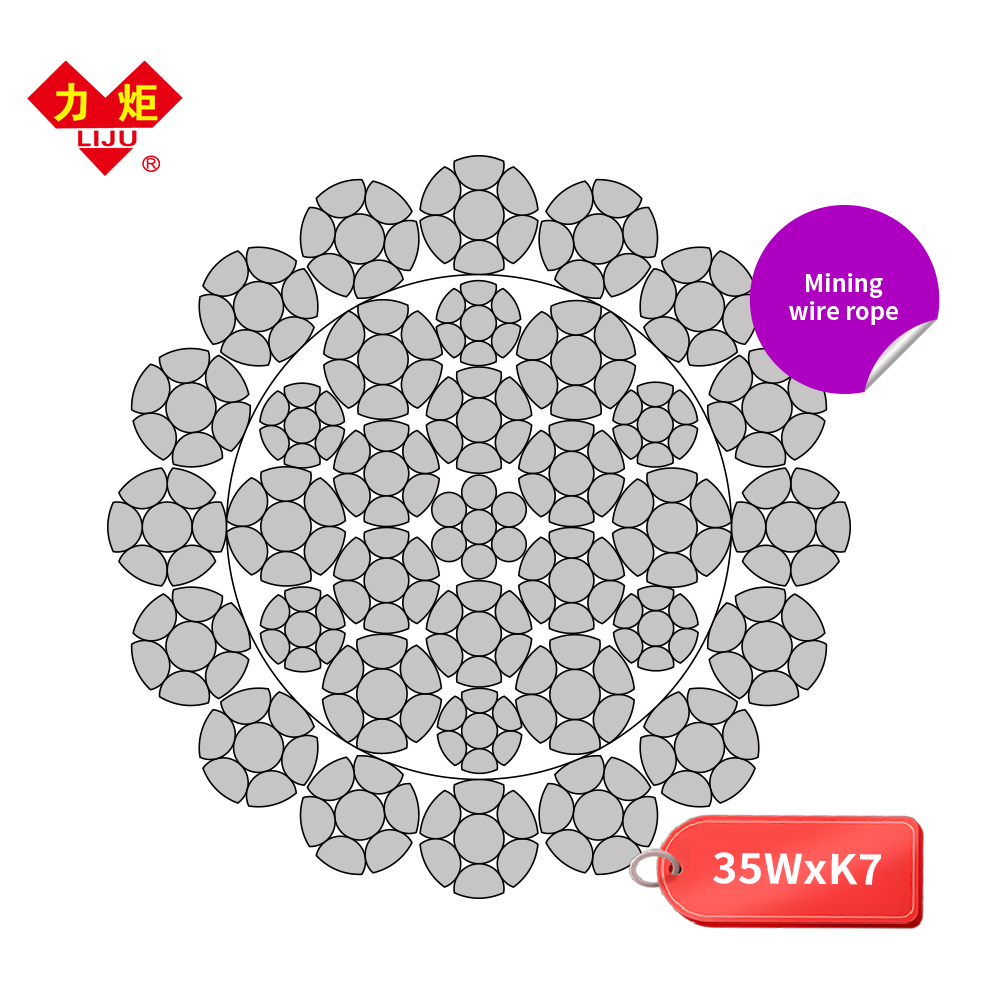
Typical constructions: 6×K36WS, 6×K26WS, 35W×K7, 8×K26WS and 8×K26WS-EPIWC.
Where it fits: mine shaft hoisting and heavy-duty hauling, heavy industry and metallurgy, offshore and marine winching, and any application where the load case is heavy but the rope diameter is constrained. Mining is the clearest case: compacted strand ropes are adopted in approximately 57% of heavy-duty hauling systems globally (Business Research Insights, 2025).
Where it does not fit: compacted rope is less forgiving than a conventional strand when sheaves are worn or misaligned, and it is usually the wrong first choice where a project is driven purely by first cost. It also does not automatically solve rotation — torque behaviour depends on the strand pattern, not on compaction alone.
Rank 2Rotation-Resistant Multi-Strand Wire Rope
Second place goes to the rotation-resistant family — the constructions that limit rope torque under load. In deep vertical lifts and multi-fall hoisting, a rope that twists will spin the load, and the twist itself accelerates wire fatigue.
Typical constructions: 35W×7, 35W×K7 and 18×7, supplied within an anti-rotation wire rope range that also includes compacted strand, shaped strand and locked coil constructions.
Where it fits: vertical and inclined shaft hoisting, equipment traction and winch lifting, tower and maintenance lifting, and offshore lifts where load control matters. Mining rope specifications pair these constructions with hoist winches, head sheaves, guide sheaves, wedge sockets and rope clips to form complete hoisting systems.
Where it does not fit: rotation-resistant ropes require correct termination and competent installation; if a fitting allows the rope to rotate, the design advantage is lost. Their flexibility also differs from a standard six-strand rope, so sheave and drum dimensions should be checked before substituting one for the other.
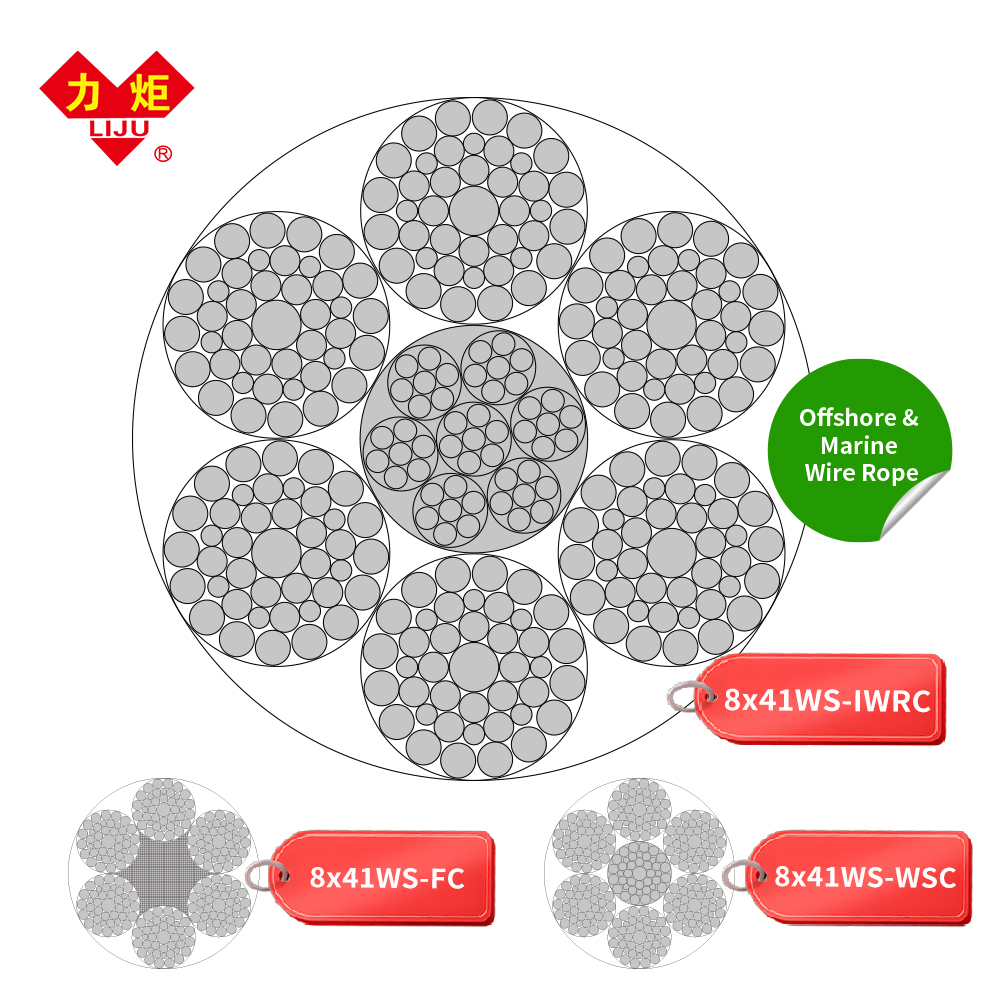
Rank 3Eight-Strand Wire Rope
Third place belongs to the eight-strand family, which spreads load across more outer strands and therefore across more contact points. That distribution improves bending fatigue life and reduces the crushing pressure each strand applies to the drum — behaviour that matters on high-cycle terminal equipment.
Typical constructions: 8×26WS, 8×31WS, 8×36WS and 8×41WS, listed in the port and terminal range for quay cranes, gantry cranes, container handling, vessel mooring and tugboat towing, and in the offshore range for mooring and towing duty.
Where it fits: ports and terminals operating in coastal salt spray and high humidity, where the rope must absorb frequent shock loads and cyclic hoisting while resisting seawater corrosion. The eight-strand family pairs naturally with galvanized finishes for the same reason.
Where it does not fit: the extra strand count costs more to produce than a standard six-strand rope, and where a project needs maximum breaking load at a fixed diameter, a compacted construction is the better trade.
Rank 4Six-Strand High-Fill Wire Rope (6×26WS / 6×31WS / 6×36WS Class)
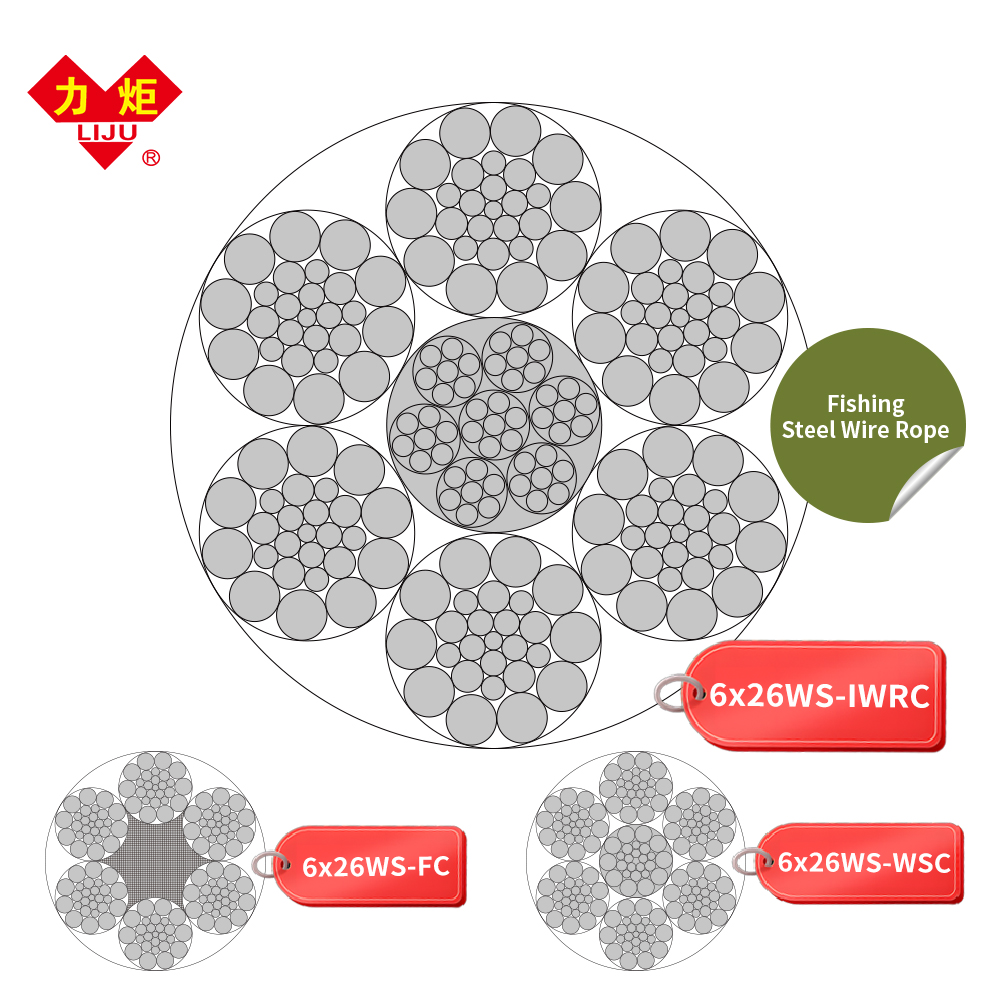
Fourth place is the workhorse: the six-strand class with higher wire counts, such as 6×26WS, 6×31WS and 6×36WS. It balances flexibility, wear resistance and availability, and it is the family that construction and lifting fleets most often standardise on.
Typical constructions: 6×19S, 6×19W, 6×26WS, 6×31WS, 6×36WS, 6×19M and 6×37M in the heavy-duty range; 6×25Fi, 6×29Fi, 6×36WS and 6×K36WS for construction machinery; 6×29Fi and 6×36WS for construction and engineering works.
Where it fits: truck-mounted cranes, truck cranes, crawler cranes, excavators, loaders, pile drivers and drilling rigs, running in reciprocating winding with intermittent load under dust, weather variation and impact. It is also the practical starting point for tower cranes, construction hoists and material hoists.
Where it does not fit: it is not the best answer where a project needs the highest achievable load per diameter, or where a vertical lift demands rotation control. In those cases, use Rank 1 or Rank 2.
Rank 5Corrosion-Protected Wire Rope (Galvanized, Stainless, Plastic-Coated)
Fifth place is less a construction than a specification layer: the corrosion-protected variants of the constructions above. It ranks here because protection alone does not create load capacity — but in marine, mining and chemical atmospheres, protection is what preserves the capacity that already exists.
Typical options: electro-galvanized, hot-dip galvanized, stainless and plastic-coated wire rope, applied across the 1–120 mm diameter range.
Where it fits: ports and terminals in coastal salt spray, offshore and shipping mooring, fishing and aquaculture, mining environments with corrosive mine water, and outdoor power and construction sites exposed to weather. Galvanized ropes accounted for 41.3% to 46% of global product demand in 2025 for exactly this reason (Dataintelo / Business Research Insights).
Where it does not fit: coating is not a substitute for correct structural selection. A galvanized rope with the wrong strand pattern for the duty cycle will still fail mechanically, and thick coatings can change how the rope sits in sheave grooves and terminations — those dimensions should be confirmed before ordering.
Step-by-Step Breakdown: Turning the Ranking into a Specification
- Define the duty cycle, not just the load. Record whether the rope runs reciprocating winding with intermittent load, continuous cyclic hoisting, or static tensioning, plus the sheave count and the number of drum layers.
- Set the environment. Salt spray, mine water, dust, high humidity and high-temperature workshops each point to a different protection choice and, in some cases, a different core.
- Calculate the required minimum breaking load from the working load and the applicable safety factor, then select the diameter and tensile grade combination that meets it within the 1570–2160 MPa range.
- Choose the construction using the ranking above: compacted for maximum load per diameter, rotation-resistant for vertical control, eight-strand for high-cycle fatigue, six-strand high-fill for general construction duty.
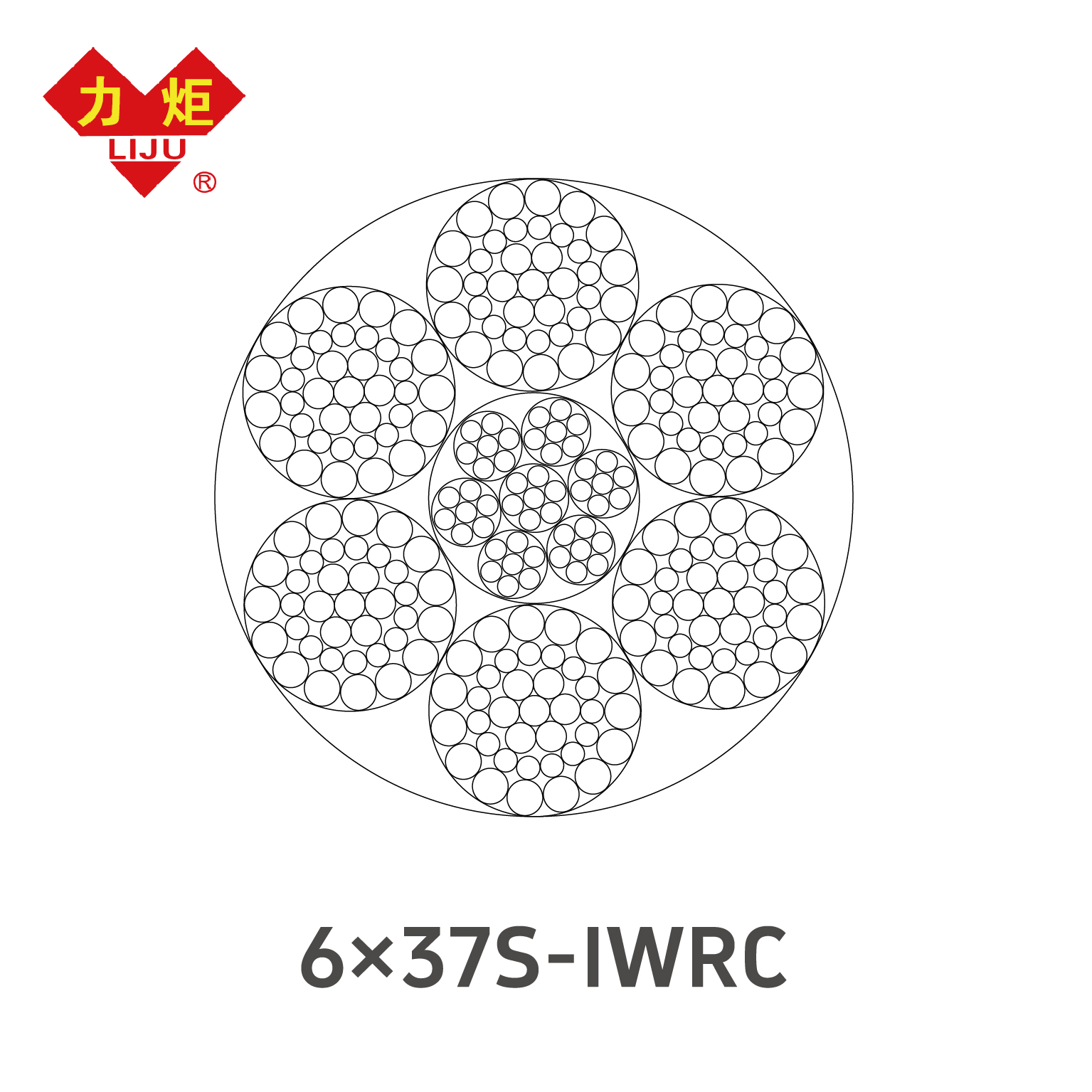
- Confirm the core and lay. The range includes both independently wired and fibre-cored variants — for example 6×37S-IWRC and 8×K26WS-EPIWC — and the core choice affects drum crushing and elongation behaviour.
- Specify the finish and the standard. Select un-galvanized, electro-galvanized, hot-dip galvanized, stainless or plastic-coated, and name the execution standard (GB/T, EN, GOST, DIN, and where applicable API, ISO, ASTM or JIS).
- Verify with documentation and a test. Ask for the certificate that covers the exact construction and diameter, and for test records. Quality control includes raw material incoming inspection, semi-finished product spot checks, finished product testing, breaking load testing and fatigue testing, with a 100% full machine running test before delivery.
Use Cases: Matching the Ranking to Real Duty Cycles
Mining Hoisting and Underground Traction
Mining is the application where the ranking matters most, because a rope change stops production. Mining wire rope is supplied in 6×19S, 6×19W, 6×19M, 6×36WS, 6×37S, 8×K26WS-EPIWC and 35W×K7 constructions for vertical and inclined shaft hoisting, inclined roadway transportation and underground traction, operating in high-humidity underground environments and dusty open-pit sites.
A delivered mining project illustrates the fit: 100 tons of mining wire rope supplied for hoisting, mine shaft lifting and underground traction duty, in service over a two-year project period, with reported stable hoisting operation, reduced downtime and improved site-work safety. The result was attributed to high wear resistance and strong impact resistance in a harsh mine environment.
Port and Terminal Handling
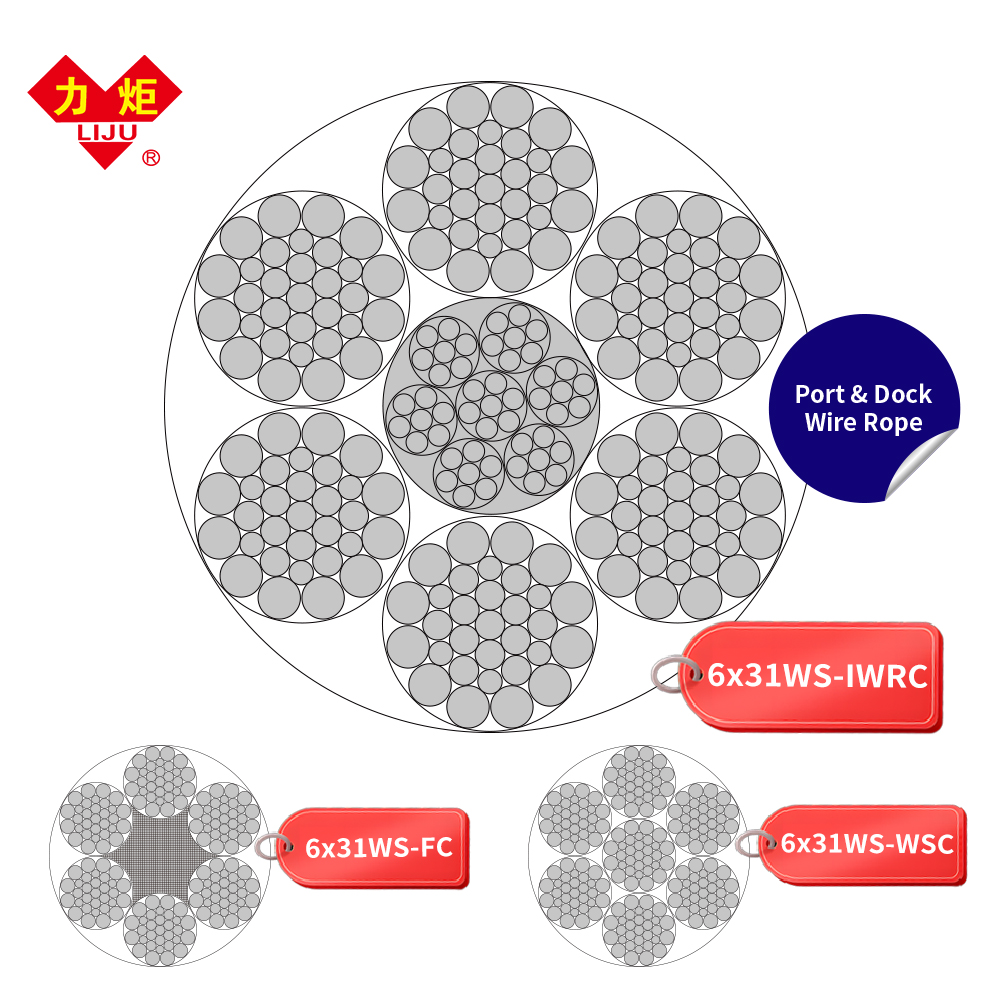
Port duty combines corrosion with shock. Quay cranes, gantry cranes, spreaders, mooring winches and sheave blocks are matched with port wire rope in 6×26WS, 6×31WS, 6×36WS, 6×41WS, 8×26WS, 8×31WS, 8×36WS, 8×41WS and 35W×7 constructions, covering container handling, bulk cargo lifting, ship mooring and tug traction under coastal salt spray and frequent impact load.
Construction Machinery and Engineering
Construction sites load ropes intermittently and hard. Construction machinery rope in 6×25Fi, 6×29Fi, 6×36WS, 6×K36WS, 18×7, 35W×7, 35W×K7 and 4V×39S constructions supports hoisting and transportation by truck-mounted cranes, lifting by truck cranes and crawler cranes, and pulling work for excavators and loaders. Construction and engineering works add 6×19S, 6×19W, 6×29Fi, 6×36WS, 8×29Fi, 6×K36WS, 18×7, 35W×7, 35W×K7, 4V×39S, 8×19S, 4×26WS, 4×31WS, 6×19M, 6×37M, 6×12-7FC and 6×15-7FC for tower crane lifting, component hoisting, guy fixing and material hoist traction.
Heavy Industry and Metallurgy
Heavy industry adds temperature and continuous cycling to the load case. Heavy-duty wire rope in 6×19S, 6×19W, 6×26WS, 6×36WS, 6×31WS, 8×K26WS, 6×19M and 6×37M is used with metallurgical overhead cranes, steel mill cranes, forging equipment, rolling mills and heavy-duty hoists in high-temperature, dust-laden workshops, where high tensile strength, temperature resistance and fatigue resistance are all required at the same time.
Comparison Table: The Five Types Side by Side
| Rank | Type | Typical constructions | Material & tensile range | Corrosion protection options | Best-fit duty cycle |
|---|---|---|---|---|---|
| 1 | Compacted strand wire rope | 6×K36WS, 6×K26WS, 35W×K7, 8×K26WS, 8×K26WS-EPIWC | High carbon steel, 1570–2160 MPa | Available across the range: electro-galvanized, hot-dip galvanized, stainless, plastic-coated | Mine shaft hoisting, heavy haulage, heavy industry, marine winching |
| 2 | Rotation-resistant multi-strand rope | 35W×7, 35W×K7, 18×7 | High carbon steel, 1570–2160 MPa | Available across the range; finish selected by environment | Vertical and inclined shaft hoisting, multi-fall lifting, equipment traction |
| 3 | Eight-strand wire rope | 8×26WS, 8×31WS, 8×36WS, 8×41WS | High carbon steel, 1570–2160 MPa | Recommended in galvanized or coated finishes for salt spray | Port and terminal cranes, container handling, mooring and towing |
| 4 | Six-strand high-fill rope | 6×19S, 6×19W, 6×26WS, 6×31WS, 6×36WS, 6×19M, 6×37M | High carbon steel, 1570–2160 MPa | Available un-galvanized or galvanized | Construction machinery, cranes, excavators, general heavy-duty lifting |
| 5 | Corrosion-protected rope | Same constructions, alternative finish | High carbon steel, 1570–2160 MPa | Electro-galvanized, hot-dip galvanized, stainless, plastic-coated | Coastal, marine, mine water and outdoor exposure duty |
Corrosion protection is a finish applied on top of a construction, not a replacement for it. The construction decision still sets the load capacity; the finish decides how long that capacity lasts.
Frequently Asked Questions
Which standards and certifications should I check on a heavy-duty wire rope order?
ISO 2408:2017 sets out minimum requirements for the manufacture and testing of steel wire ropes for general purposes, including lifting and rigging, so it is a reasonable baseline to reference. Beyond that, ropes are commonly manufactured to API, ISO, EN, ASTM, GB and JIS standards, and manufacturers may hold certifications such as API, LR, ABS, CCS, ISO9001, CE, GOST, EPD, SIRIM, SNI and MA. The important check is scope: confirm that the certificate or approval covers the exact construction, diameter and tensile grade you are ordering, not only the supplier's general capability.
Can heavy-duty wire ropes be customized for a specific project?
Yes. Customization covers wire rope construction, diameter, length, tensile strength, surface treatment, applicable standard and packing, under OEM, ODM or independent factory R&D and manufacturing arrangements. Jiangsu Juli Steel Wire Rope Co.,LTD operates with a 20-engineer R&D team, three production bases — Nantong and Jiyuan in China and Bekasi in Indonesia — 42 distribution centres in major Chinese cities and offices in more than 30 countries and regions. In practice, that means a project-specific construction, length and finish can be produced rather than adapted from a stock item.
What drives the cost of a heavy-duty wire rope?
Five factors usually dominate a quotation: the construction itself, since compacted and multi-strand ropes require more production steps than a standard six-strand rope; the tensile grade selected within the 1570–2160 MPa range; the surface protection, because galvanizing and coating add process steps; the diameter and ordered length; and the documentation package, including testing and certification. Total cost of ownership usually shifts the decision — in the mining project described above, the reported outcomes were reduced downtime and improved site-work safety, both of which outweigh the per-metre difference between rope grades.
Can we validate the rope before placing a bulk order?
Yes. The order path starts with a minimum order quantity of 1,000 metres, which allows a project to run a sample or trial length before scaling up. Quality control is documented at several stages: raw material incoming inspection, semi-finished product spot checks, finished product testing, breaking load testing and fatigue testing, plus a 100% full machine running test before delivery. Buyers who want to validate performance on their own equipment should request the test records that correspond to their construction and diameter.
What lead time and support can a heavy-duty order expect?
The quoted lead time is 25 days from order confirmation. After-sales support includes remote online technical support, overseas engineer on-site service, regular operation guidance and maintenance consultation, which matters for shaft hoisting and terminal crane duty where installation quality determines service life. To move from evaluation to a quotation, send your duty cycle details — construction preference or none, diameter, length, tensile grade, environment and standard — to the Juli team at Shirley@worldjuli.com or reach the team on WhatsApp at +86 15950529706. A short technical discussion before ordering usually eliminates the most expensive mistake in heavy-duty rope selection: buying the right rope grade in the wrong construction.
Conclusion: Choose by Duty Cycle, Not by Label
Ranking heavy-duty wire rope types is useful only when the ranking is translated into a duty cycle. Compacted strand rope wins where load per diameter and wear resistance decide service life. Rotation-resistant multi-strand rope wins where a vertical load must not spin. Eight-strand rope wins on high-cycle terminal equipment in corrosive air. Six-strand high-fill rope remains the practical default for construction machinery and general heavy lifting. Corrosion-protected variants decide how long any of the four keeps its capacity in salt spray, mine water or weather exposure.
For buyers moving from research into evaluation, the sequence is consistent: define the duty cycle and environment, calculate the required breaking load, choose the construction, confirm the core and finish, then verify certification scope and test records against the exact item being supplied. All five types are produced in high carbon steel across 1–120 mm diameters and 1570–2160 MPa tensile grades, so the differentiator is not availability — it is whether the construction matches the job.
Next step
Review the full product range and specifications in the Juli Steel Wire Rope product catalogue, or contact the team directly for a project-specific recommendation and a sample request:
- Email: Shirley@worldjuli.com
- Tel: +86 15312608225
- WhatsApp: +86 15950529706
- Website: www.juli-rope.com