20-4DT vs 24-2DT: Multi-Wire vs Fine Wire Drawing Machine Comparison
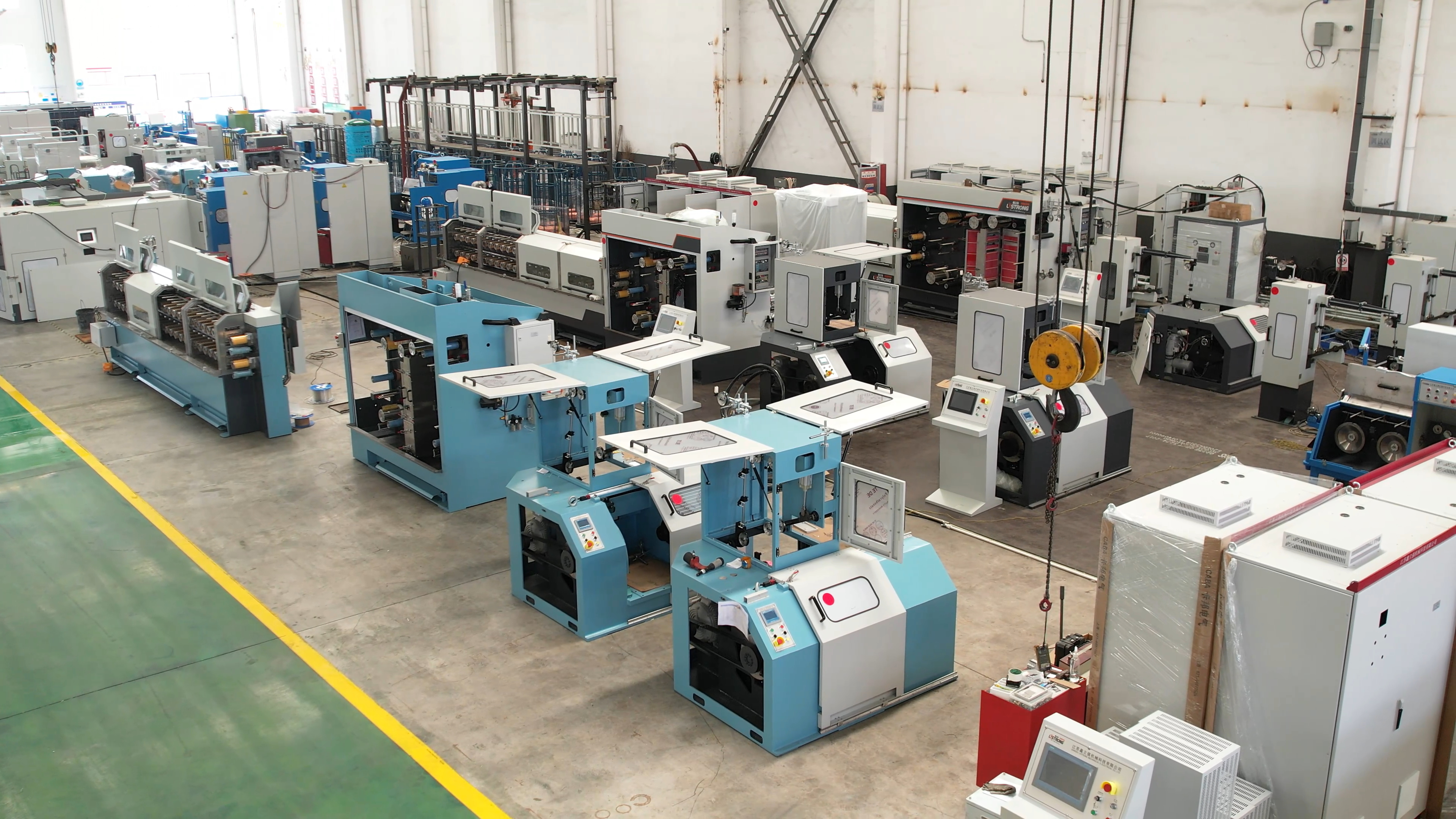
Multi-wire drawing machine platform used for bare copper production with integrated online annealing.
Two bare copper machines, built by the same manufacturer, both fitted with integrated DC annealing — and buyers keep asking which one belongs in their line. The honest answer is that the 20-4DT and the 24-2DT solve different production problems. The 20-4DT is a multi-wire drawing machine that runs four wires from a maximum 4×Φ1.60 mm inlet to a 4×Φ0.15–Φ0.50 mm outlet at up to 1500 MPM, using 20 dies ×4 of Φ25 mm × 8–10 mm thickness. The 24-2DT is a fine wire drawing machine that runs two wires from 2×Φ0.6–1.2 mm to 2×Φ0.1–0.3 mm at up to 2000 MPM, using 24 dies ×2 of Φ25 mm × 8–10 mm thickness, with a double-bobbin pneumatic take-up.
This comparison is written for procurement managers, plant engineers and product planners who are past the discovery stage. You already know you need a copper wire drawing machine. You are now deciding which machine architecture matches your order book, your upstream rod breakdown machine and the spool sizes your downstream equipment will accept.
Direct answer. Choose the 20-4DT when you need four parallel bare copper wires finishing between Φ0.15 mm and Φ0.50 mm, and when upstream supply can deliver a 4×Φ1.60 mm inlet. Choose the 24-2DT when you need two wires between Φ0.10 mm and Φ0.30 mm at higher line speed, and when the upstream feed sits inside the 2×Φ0.6–1.2 mm window. The 24-2DT is not a faster version of the 20-4DT. It is a finer machine with a different wire count, a narrower inlet window and a different take-up arrangement.
Problem Definition: Why "MPM" Is the Wrong First Question
Most specification arguments between these two machines start and end with the maximum drawing speed figure: 1500 MPM for the 20-4DT against 2000 MPM for the 24-2DT. Read in isolation, that suggests the 24-2DT is simply the higher-output machine. It is not, because the two models move different amounts of metal in the same machine hour.
If both machines run at their stated maximum drawing speed, the 20-4DT is drawing four wires simultaneously at up to 1500 MPM each, while the 24-2DT is drawing two wires at up to 2000 MPM each. The section of copper is very different as well: the 20-4DT finishes in the Φ0.15–0.50 mm band, and the 24-2DT finishes in the Φ0.10–0.30 mm band. Speed is a number per wire; throughput is a function of wire count, section and speed together.
Three selection errors recur in real procurement files:
- Buying on headline speed. A plant that needs four strands simultaneously cannot substitute two faster wires without changing its downstream bunching and stranding plan.
- Under-specifying the inlet. The 20-4DT accepts up to 4×Φ1.60 mm while the 24-2DT accepts 2×Φ0.6–1.2 mm. If the upstream machine cannot reach the inlet window, the drawing machine cannot run at its design point.
- Treating take-up and bobbin as an afterthought. Bobbin size, take-up weight and loading method determine how often the line stops, and both models give you configuration choices here.
The correct first question is therefore not "which is faster", but "which outlet range, at which wire count, fed by which upstream machine, spooled onto which bobbin".
Industry Background: Where These Two Machines Sit in a 2026 Bare-Copper Line
Wire drawing sits at the head of almost every copper conductor supply chain, and demand for the equipment tracks cable, electronics and electrification investment. Research published by Dataintelo in April 2026 valued the global wire drawing machine market at USD 3.8 billion in 2025, with a projected CAGR of 5.47% between 2026 and 2034 and an expected value of USD 6.1 billion by 2034. Other research houses publish materially different valuations for the same category, largely because they treat spare parts, dies and service revenue differently, so the figure is best used as a directional indicator of category size rather than a precise market number.
On the trade side, metal wire working machines are classified internationally under HS code 8463.30.00, the classification used for machine tools for working metal wire without removing material. Machinery in this category moves between China, Asia Pacific, North America, Europe and the Middle East, and buyers in the Middle East, India and South East Asia are among the most active importers of copper wire drawing equipment.
Jiangsu Listrong Mechanical & Electrical Co., Ltd. is a Chinese wire and cable production equipment manufacturer based in Dongtai City, Jiangsu Province. The company was founded in 2009 and operates a 15,000 m² facility with approximately 70 employees, of whom 15 are development engineers. It reports an annual output of around 550 sets, an export ratio of about 40%, and main export markets including the Middle East, India and South East Asia. Its product programme covers wire drawing machines, annealing machines and wire bunching machines for bare copper, copper alloy and stainless steel wire.
Within that programme, the 20-4DT and the 24-2DT occupy two adjacent but distinct slots: the 20-4DT as a four-wire multi-wire platform, and the 24-2DT as a two-wire fine wire platform. Both are listed on the company's EU conformity certification for the 25-16DT, 25-24DT, 19-16DT, 25-4DT, 20-4DT, 24-2DT and related models.
Detailed Solution: Two Architectures, Two Production Jobs
20-4DT — Four-Wire Multi-Wire Drawing Machine
The 20-4DT is designed for bare copper wire drawing with four wires running in parallel. Its working window runs from a maximum 4×Φ1.60 mm inlet to a 4×Φ0.15–Φ0.50 mm outlet, at a maximum drawing speed of 1500 MPM. The drawing train uses 20 dies ×4, supplied by the customer, at Φ25 mm × 8–10 mm thickness. Die No. 1 is independent and dies No. 2–19 are cast iron, and the die base can be adjusted according to capstan size.
Slip ratio is set at 15% from die No. 1 to No. 19 and 8% on die No. 20. The machine uses a 4-spool, four-tier arrangement with horizontally sliding continuous drawing. Power comes from a 37 kW main drawing motor under AC variable frequency control, with spooling motors of 3.7 kW ×4 plus 11 kW ×1.
Annealing is DC, at 70 V with a maximum annealing current of DC 1200 A and 84 kVA of annealing power. Capstans are ceramic-coated aluminium: four 10-tier capstans including two final drawing capstans. Lubrication is spray type at 40 L/min, without pump and tank, with an independent lubrication pipe for die No. 1 and die No. 20. Power supply is three-phase 380/415 V, 50 Hz and is customizable. Tension is controlled by tension sensor and pulleys are ceramic-coated aluminium.
Take-up is where the 20-4DT offers unusual flexibility: the four-bobbin spooler accepts 25 kg ×4, or a single bobbin (QD630E) can take up to 500 kg ×1. Bobbin size is customized to the customer's requirement. Spooling control uses weight balance via swing arm with automatic take-up tension adjustment, bobbin loading and unloading is pneumatic, and the traversing unit is stepper-motor controlled with adjustable traversing speed. On the four-bobbin spooler, traversing speed is adjustable; on the QD630E single bobbin, traversing width is adjustable via timing motor. The brake is controlled by brake motor, and the machine brakes automatically on power cut-off without requiring a UPS.
24-2DT — Two-Wire Fine Wire Drawing Machine
The 24-2DT is a fine wire drawing machine for bare copper, running two wires from a 2×Φ0.6–1.2 mm inlet to a 2×Φ0.1–0.3 mm outlet at a maximum drawing speed of 2000 MPM. The drawing train uses 24 dies ×2, supplied by the customer, at Φ25 mm × 8–10 mm thickness. As on the 20-4DT, die No. 1 is independent and dies No. 2–23 are cast iron, and the die base can be adjusted according to capstan size.
The 24-2DT works with a gentler per-pass reduction: 13% from die No. 1 to No. 23, and 8% on die No. 24. That reduction profile is what allows the machine to reach Φ0.10 mm without overworking the wire in any single pass. The wire path uses a 4-spool, double-tier arrangement with horizontally sliding continuous drawing.
Drive power is a single 22 kW motor under AC variable frequency control, with two 2.2 kW spooling motors. Annealing is DC four-section annealing at 70 V with a maximum annealing current of DC 600 A and 42 kVA annealing power. Capstans are ceramic-coated, with four 11-tier capstans plus one single-tier capstan for final drawing. The drawing section is driven by timing belts and other sections by flat belts. Lubrication is spray type at 40 L/min, without pump and tank, with an independent lubrication pipe for die No. 1 and die No. 24. Power supply is three-phase 415 V, 50 Hz. Tension uses a sensor and pulleys are ceramic-coated aluminium.
Spool dimension is customized, with take-up capacity of 25 kg ×2 on a double-bobbin pneumatic take-up, which is the arrangement that lets the operator change bobbins without dismantling a shaft assembly. Spooling control uses weight balance via swing arm with automatic take-up tension adjustment, traversing is stepper-motor controlled with adjustable traversing speed, and the brake is controlled by brake motor with automatic braking on power cut-off, again without a UPS requirement.
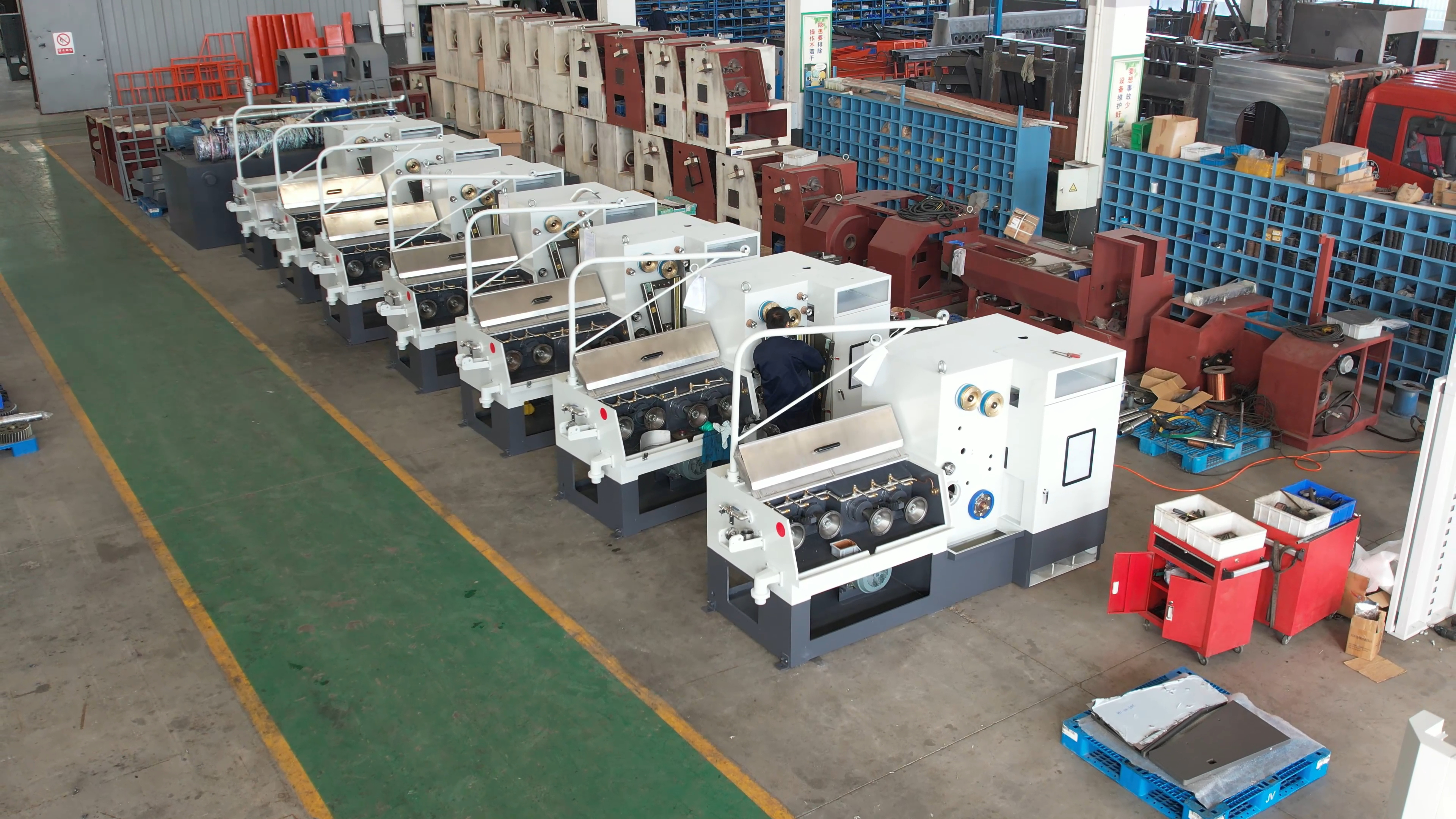
Fine wire drawing machine platform: two-wire configuration, DC four-section annealing, double-bobbin pneumatic take-up.
What Actually Differs Between the Two Machines
Strip away the shared features — steel plate welded frame, spray lubrication at 40 L/min, independent lubrication pipes for the first and last die, ceramic-coated capstans, swing-arm spooling control, stepper traversing, automatic braking on power loss — and five engineering differences decide the selection. Wire count is four against two. Outlet range is Φ0.15–0.50 mm against Φ0.10–0.30 mm. Maximum drawing speed is 1500 MPM against 2000 MPM. Die quantity is 20 ×4 against 24 ×2, with a 15%/8% slip profile against a 13%/8% reduction profile. And annealing power is 84 kVA with up to DC 1200 A against 42 kVA with up to DC 600 A.
Specification Comparison Table
| Parameter | 20-4DT (Multi-Wire Drawing Machine) | 24-2DT (Fine Wire Drawing Machine) |
|---|---|---|
| Application | Bare copper wire drawing | Bare copper wire drawing |
| Produced wires | 4 wires running in parallel | 2 wires running in parallel |
| Inlet diameter | Max. 4×Φ1.60 mm | 2×Φ0.6 mm – Φ1.2 mm |
| Outlet diameter | 4×Φ0.15 mm – Φ0.50 mm | 2×Φ0.10 mm – Φ0.30 mm |
| Max. drawing speed | 1500 MPM | 2000 MPM |
| Drawing dies | 20 dies ×4, Φ25 mm × 8–10 mm thickness (customer supplied); No. 1 independent, No. 2–19 cast iron | 24 dies ×2, Φ25 mm × 8–10 mm thickness (customer supplied); No. 1 independent, No. 2–23 cast iron |
| Reduction / slip ratio | No. 1–No. 19: 15%; No. 20: 8% | No. 1–No. 23: 13%; No. 24: 8% |
| Die base | Adjustable according to capstan size | Adjustable according to capstan size |
| Drawing arrangement | 4 spools, four-tier arrangement; horizontally sliding continuous drawing | 4 spools, double-tier arrangement; horizontally sliding continuous drawing |
| Motors | Main drawing 37 kW (AC VFD); spooling 3.7 kW ×4 + 11 kW ×1 | Drive 22 kW (AC VFD) ×1; spooling 2.2 kW ×2 |
| Annealing | DC 70 V, max. DC 1200 A, 84 kVA, DC annealing | DC 70 V, max. DC 600 A, 42 kVA, DC four-section annealing |
| Capstan | Ceramic-coated aluminium; four 10-tier capstans including two final drawing capstans | Ceramic-coated; four 11-tier capstans plus one single-tier final drawing capstan |
| Transmission | Drawing section by timing belts, other sections by flat belts | Drawing section by timing belts, other sections by flat belts |
| Lubrication | Spray type, 40 L/min, independent pipe for No. 1 and No. 20 die | Spray type, 40 L/min, independent pipe for No. 1 and No. 24 die |
| Bobbin / spool | Customized as per customer requirement | Customized |
| Take-up capacity | 25 kg ×4 on four-bobbin spooler, or max. 500 kg ×1 on single bobbin (QD630E) | 25 kg ×2 |
| Take-up method | Pneumatic take-up | Double-bobbin pneumatic take-up |
| Traversing | Stepper motor control, adjustable traversing speed; QD630E traversing width adjustable via timing motor | Stepper motor control, adjustable traversing speed |
| Brake | Brake motor control; automatic braking on power cut-off, no UPS required | Brake motor control; automatic braking on power supply cut-off, no UPS required |
| Power supply | Three-phase 380/415 V, 50 Hz (customizable) | Three-phase 415 V, 50 Hz |
| Tension control | Tension sensor | Tension sensor |
Step-by-Step Breakdown: How to Select Between the Two
Step 1 — Fix the outlet diameter band of the finished product
Write down the finest and coarsest conductor your order book actually requires. If the finest conductor sits below Φ0.15 mm, the 20-4DT outlet band of Φ0.15–0.50 mm cannot reach it and the 24-2DT band of Φ0.10–0.30 mm is the correct starting point. If the coarsest conductor is above Φ0.30 mm, the 24-2DT outlet band cannot cover it and the 20-4DT band up to Φ0.50 mm is the relevant machine.
Step 2 — Convert wire count into downstream demand
Four wires give you four finished conductors per machine cycle. That matters if your bunching, stranding or enamelling lines consume multiple fine conductors at once. If your downstream process only consumes two conductors at a time, a four-wire machine adds inventory and changeover rather than throughput.
Step 3 — Check inlet continuity against the upstream machine
Neither model draws from rod. Both need pre-drawn feed. The 20-4DT wants up to 4×Φ1.60 mm, which sits inside the outlet window of intermediate machines such as the 17DST (Φ1.6–Φ0.4 mm from a Φ3.5–2.5 mm inlet). The 24-2DT wants 2×Φ0.6–1.2 mm, and a two-line intermediate such as the 17-2DST, with a two-line outlet of Φ0.4–1.6 mm at up to 1800 m/min, feeds inside that window. For heavier upstream stages, rod breakdown machines such as the WDF450-13DT and the LHD450-13DT both take a Φ8 mm inlet down to Φ1.2–4.0 mm with 13 dies, and the WDF400-7D takes Φ8 mm down to Φ3 mm. Specifying the drawing machine without matching the upstream train is the most common cause of a line that never reaches its design speed.
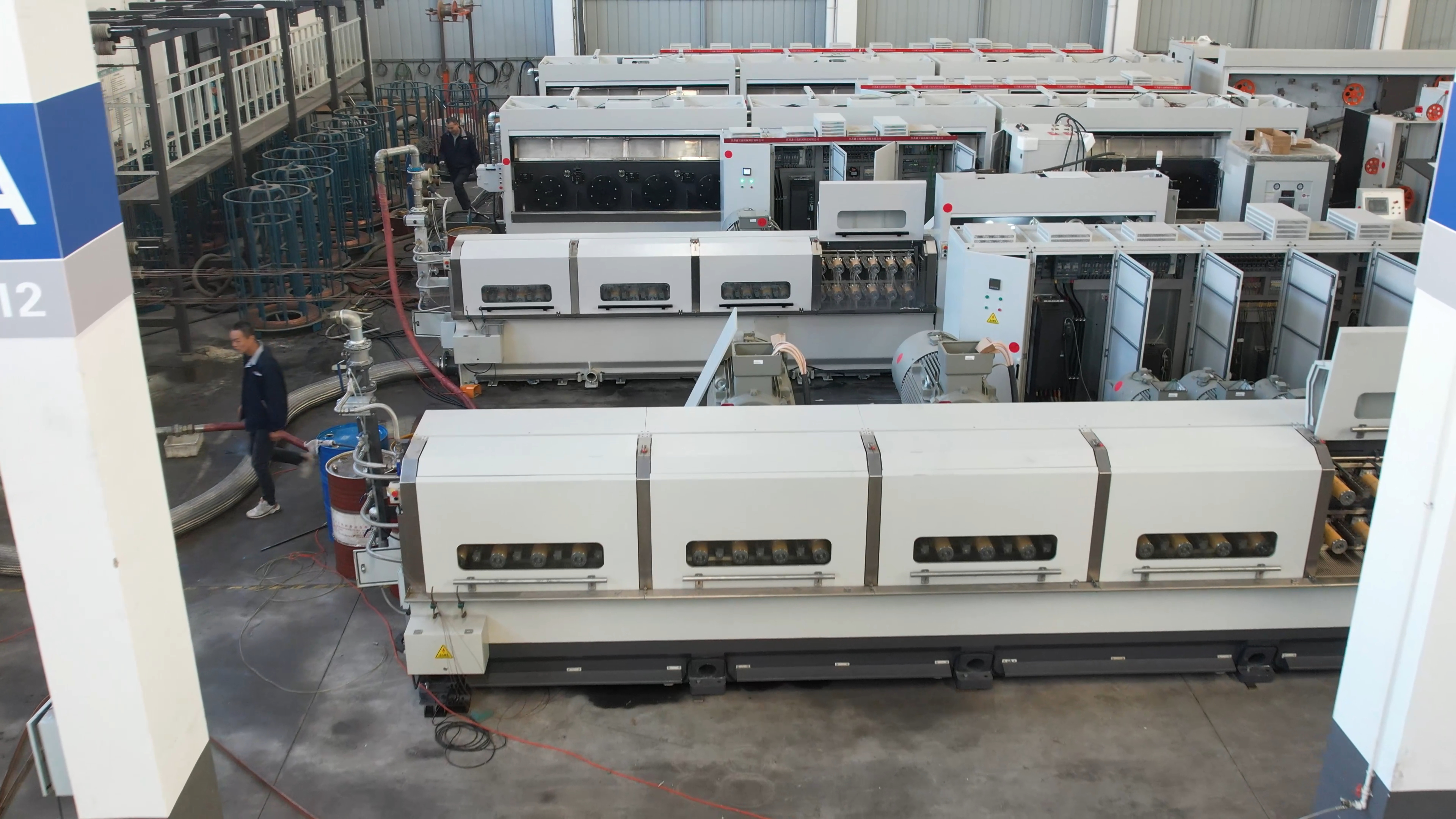
Multi-wire drawing machine assembly area: wire count, inlet window and upstream feed must be matched before ordering.
Step 4 — Confirm die base adjustment and die supply
Both machines use customer-supplied dies of Φ25 mm × 8–10 mm thickness, and both allow the die base to be adjusted according to capstan size. Confirm that your die supplier stocks Φ25 mm dies, and confirm the reduction profile you intend to run: 15%/8% on the 20-4DT against 13%/8% on the 24-2DT. The die base adjustment matters in practice if you plan to change the reduction plan seasonally, because it lets you re-align the pedestal to capstan geometry rather than replacing die holders.
Step 5 — Decide on take-up, bobbin and unloading method
The 20-4DT gives two take-up paths: four bobbins at 25 kg each, or a single bobbin up to 500 kg on the QD630E configuration. The 24-2DT uses a double-bobbin pneumatic take-up at 25 kg ×2. Match this to your spooler interface downstream and to how your operators change bobbins. Pneumatic take-up reduces manual handling at each changeover on both models.
Step 6 — Verify compliance, capacity and lead time before payment
Ask for the certificate scope, not just the certificate number, and confirm that your model appears on the scope. Confirm factory capacity and delivery schedule in writing, and confirm the acceptance test procedure. These are the items that decide whether the machine arrives on time and clears customs without a second round of documents.
Use Cases: Which Machine Fits Which Plant
The 20-4DT fits
- Wire and cable manufacturing producing multi-strand conductors and building wiring conductors.
- Enamelled wire production needing multi-wire pre-drawing before coating.
- Precision electronics and metal processing operations using four parallel conductors.
- Wire material manufacturers running continuous multi-wire output in the Φ0.15–0.50 mm band.
The 24-2DT fits
- Wire and cable plants producing efficient fine-diameter metal wire.
- Electronics production using fine conductors for component and cable assemblies.
- Hardware and alloy wire processing where the finished wire is between Φ0.10 mm and Φ0.30 mm.
- Plants whose downstream process consumes two fine conductors at a time and needs the higher 2000 MPM drawing speed.
Observed field behaviour on the multi-wire platform
A cable manufacturer in Iran (one set, in service for two years) and a manufacturer in Macedonia (two sets, in service for one year) use Listrong multi-wire equipment for multi-strand stranded conductors and fine electronic/electrical cables. The reported result at those sites is stable operation with zero major failures, reduced labour cost, and energy savings reported at 35%, with the machines described as low-noise and fully automatic in operation. That installation is based on the 25-16DT multi-wire platform rather than on the 20-4DT, so it should be read as evidence of how the multi-wire architecture behaves on a running shop floor, not as a specification for either model in this comparison.
Compliance, Customization and Supply Terms
Both the 20-4DT and the 24-2DT appear on Jiangsu Listrong's EU Verification of Conformity certificate CE-JL26020401-AL-MD, issued by ICG for the EU market against EN ISO 12100:2010 and EN 60204-1:2018/A1:2025, valid from 10 February 2026 to 9 February 2031. For a fine copper wire drawing machine with online annealing, this is the document set that European importers typically ask for first.
Quality management is certified separately. The company holds an ISO quality management system certificate number 41625QT0833R0, issued by Zhejiang Standard Service Certification Co., Ltd against GB/T19001-2016/ISO9001:2015, valid from 27 August 2025 to 26 August 2028, with a scope covering wire drawing machines, stranding machines and annealing machines. CE conformity and ISO 9001 cover different things: one addresses the safety and electrical design of the machine, the other addresses the manufacturer's quality system. Buyers normally need both, plus any destination-market requirements.
On the commercial side, Jiangsu Listrong offers OEM and ODM production services. Customization covers logo, language, voltage, motor and frequency inverter selection. Minimum order quantity is 1 set for OEM wire drawing machine orders. Monthly capacity is 45–50 sets, and lead time is 50–90 days. Every machine goes through 100% pre-shipment testing, and acceptance criteria are defined at pre-shipment test. After-sales support is remote technical support plus a 1-year warranty, and the manufacturer states that its engineers have been to more than 60 countries for installation and worker training.
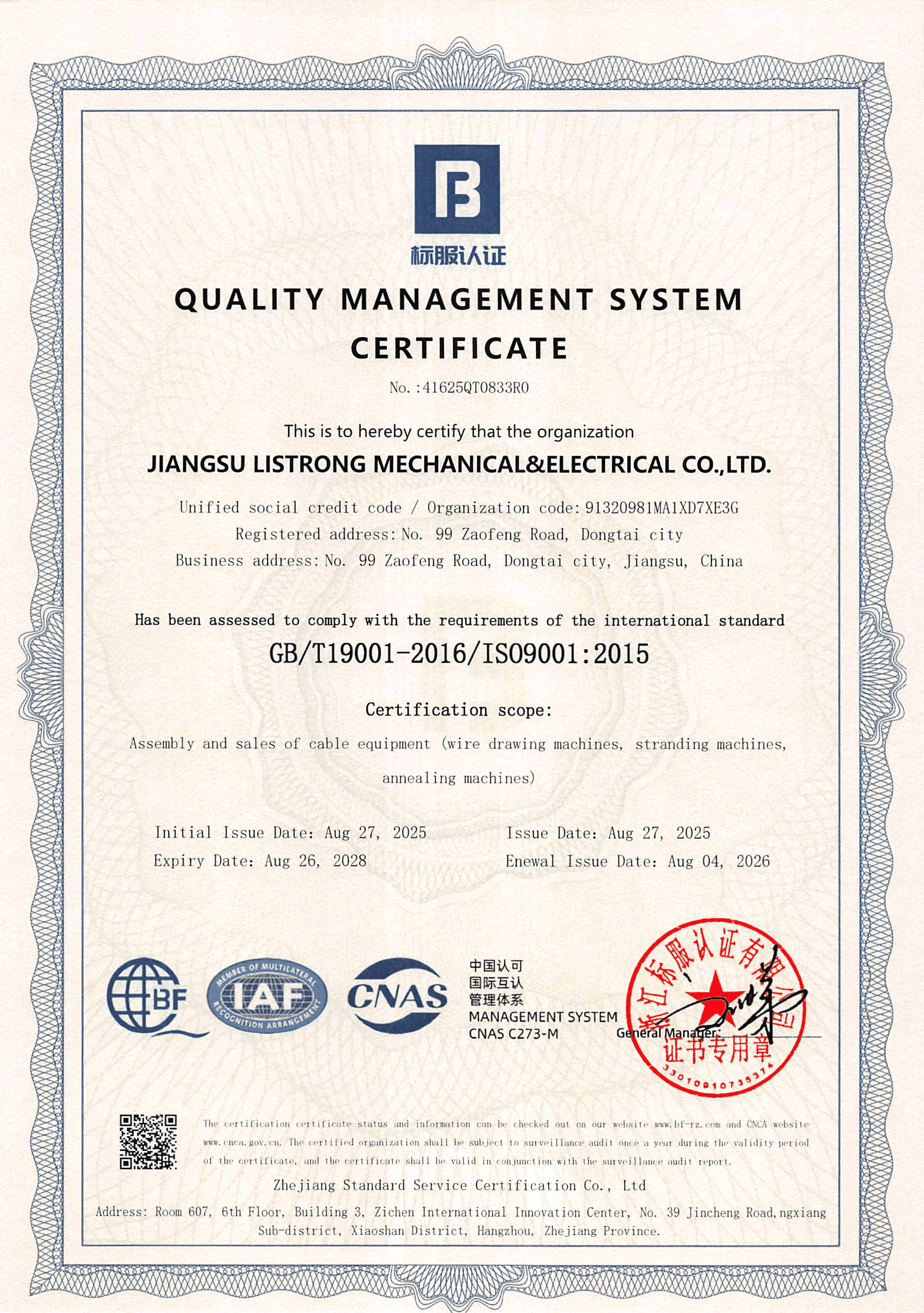
ISO 9001:2015 certificate 41625QT0833R0 — scope covers wire drawing machines, stranding machines and annealing machines (valid 27 Aug 2025 – 26 Aug 2028).
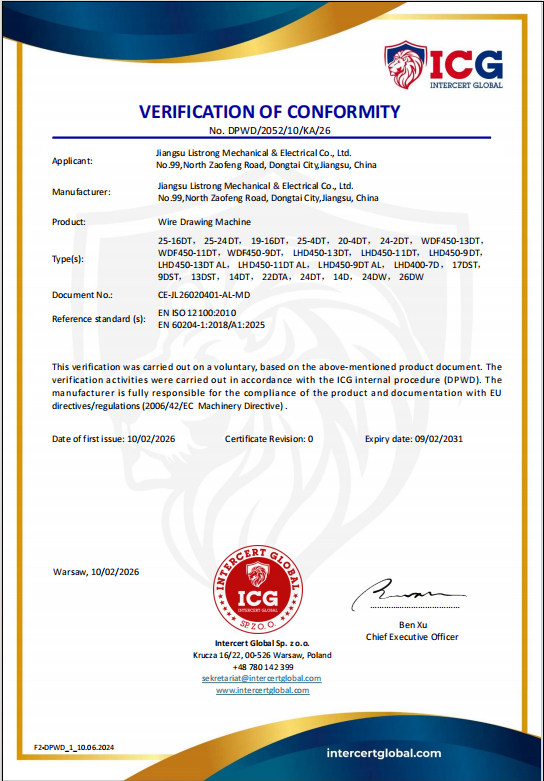
CE Verification of Conformity CE-JL26020401-AL-MD — model list includes the 20-4DT and 24-2DT (valid 10 Feb 2026 – 9 Feb 2031).
FAQ: 20-4DT vs 24-2DT Selection Questions
1. Are the 20-4DT and 24-2DT certified for export to the EU?
Yes. Both models appear on the EU Verification of Conformity certificate CE-JL26020401-AL-MD issued by ICG, valid from 10 February 2026 to 9 February 2031, assessed against EN ISO 12100:2010 and EN 60204-1:2018/A1:2025. The manufacturer also holds ISO 9001:2015 certificate 41625QT0833R0 issued by Zhejiang Standard Service Certification Co., Ltd, valid from 27 August 2025 to 26 August 2028, with a scope covering wire drawing machines, stranding machines and annealing machines. CE conformity and ISO 9001 address different requirements, so buyers should verify that the certificate scope names the specific model being purchased.
2. Can Jiangsu Listrong supply a China OEM fine copper wire drawing machine with online annealing?
Yes. The manufacturer offers OEM and ODM production services, and both models integrate DC annealing in the same frame as the drawing train: the 20-4DT at DC 70 V with up to DC 1200 A and 84 kVA of annealing power, and the 24-2DT with DC four-section annealing at DC 70 V, up to DC 600 A and 42 kVA. Customization covers logo, language, voltage, motor and frequency inverter selection, and power supply can be configured beyond the standard three-phase 380/415 V, 50 Hz on the 20-4DT. Bobbin and spool dimensions are customized on both models, so the take-up can be matched to the customer's existing spool fleet.
3. What is the minimum order quantity and what drives the price?
The minimum order quantity is 1 set for OEM wire drawing machine orders. Because the 20-4DT and the 24-2DT are configured to order — wire count, die quantity, annealing rating, take-up type, bobbin dimensions, voltage and control components — the commercial offer is built around the confirmed configuration rather than a catalogue number. Standard delivery terms are FOB, EXW or CIF. Standard payment terms are 30% T/T in advance with 70% T/T before shipment. A written quota request that specifies outlet diameter range, wire count, upstream machine and required spool size produces a faster and more accurate offer than a general enquiry.
4. How can wire quality be validated before shipment?
Quality control is based on 100% pre-shipment testing of each finished machine, and pre-shipment test is also the acceptance criterion. Because both models use customer-supplied drawing dies at Φ25 mm × 8–10 mm thickness, the most useful validation step is to confirm the die geometry, reduction profile and lubricating oil you intend to run before the acceptance test, since these directly influence surface finish and elongation. Buyers can also visit the factory in Dongtai City, Jiangsu, either on site or online, and can request a sample and quota discussion before placing the order.
5. What is the lead time and what after-sales support is included?
Lead time is 50–90 days, against a monthly production capacity of 45–50 sets. After-sales service includes remote technical support and a 1-year warranty, and the manufacturer states that its engineers have been to more than 60 countries for machine installation and worker training. To move from evaluation to execution, request a configuration-matched quote and the current product catalogue from Jiangsu Listrong Mechanical & Electrical Co., Ltd. at sale02@xlq-machinery.cn (WhatsApp +86 15261941206), or review the machine range at www.wire-cable-machine.com.
Conclusion: Decide by Outlet Range and Wire Count, Then Confirm the Line
The 20-4DT and the 24-2DT are not competing versions of the same machine. The 20-4DT is a four-wire multi-wire drawing machine covering a 4×Φ0.15–0.50 mm outlet from a maximum 4×Φ1.60 mm inlet at up to 1500 MPM, with 20 dies ×4 and an 84 kVA DC annealing stage. The 24-2DT is a two-wire fine wire drawing machine covering a 2×Φ0.10–0.30 mm outlet from a 2×Φ0.6–1.2 mm inlet at up to 2000 MPM, with 24 dies ×2, a 13%/8% reduction profile and a 42 kVA four-section DC annealing stage. The five variables that should drive the decision are wire count, outlet range, drawing speed, bobbin customization, and die-base adjustment — in that order.
Once the outlet band and wire count are fixed, the remaining work is verification: confirm that the upstream intermediate or rod breakdown machine reaches the required inlet window, confirm die availability at Φ25 mm × 8–10 mm, confirm the take-up configuration against your spool fleet, and confirm that CE certificate CE-JL26020401-AL-MD and ISO 9001 certificate 41625QT0833R0 name your exact model. Both models are built in Dongtai City, Jiangsu Province, with a documented 100% pre-shipment test, a 50–90 day lead time and a 1-year warranty.
Next Step: Configuration-Matched Quote and Catalogue
Send your outlet diameter range, wire count, upstream machine model and required spool size, and Jiangsu Listrong Mechanical & Electrical Co., Ltd. will confirm which platform — 20-4DT, 24-2DT or another model in the range — matches your line. MOQ is 1 set, OEM and ODM are available, and lead time is 50–90 days.
Download the full product catalogue: LISTRONG Product Catalogue (PDF)
Email: sale02@xlq-machinery.cn | WhatsApp: +86 15261941206 | Website: www.wire-cable-machine.com
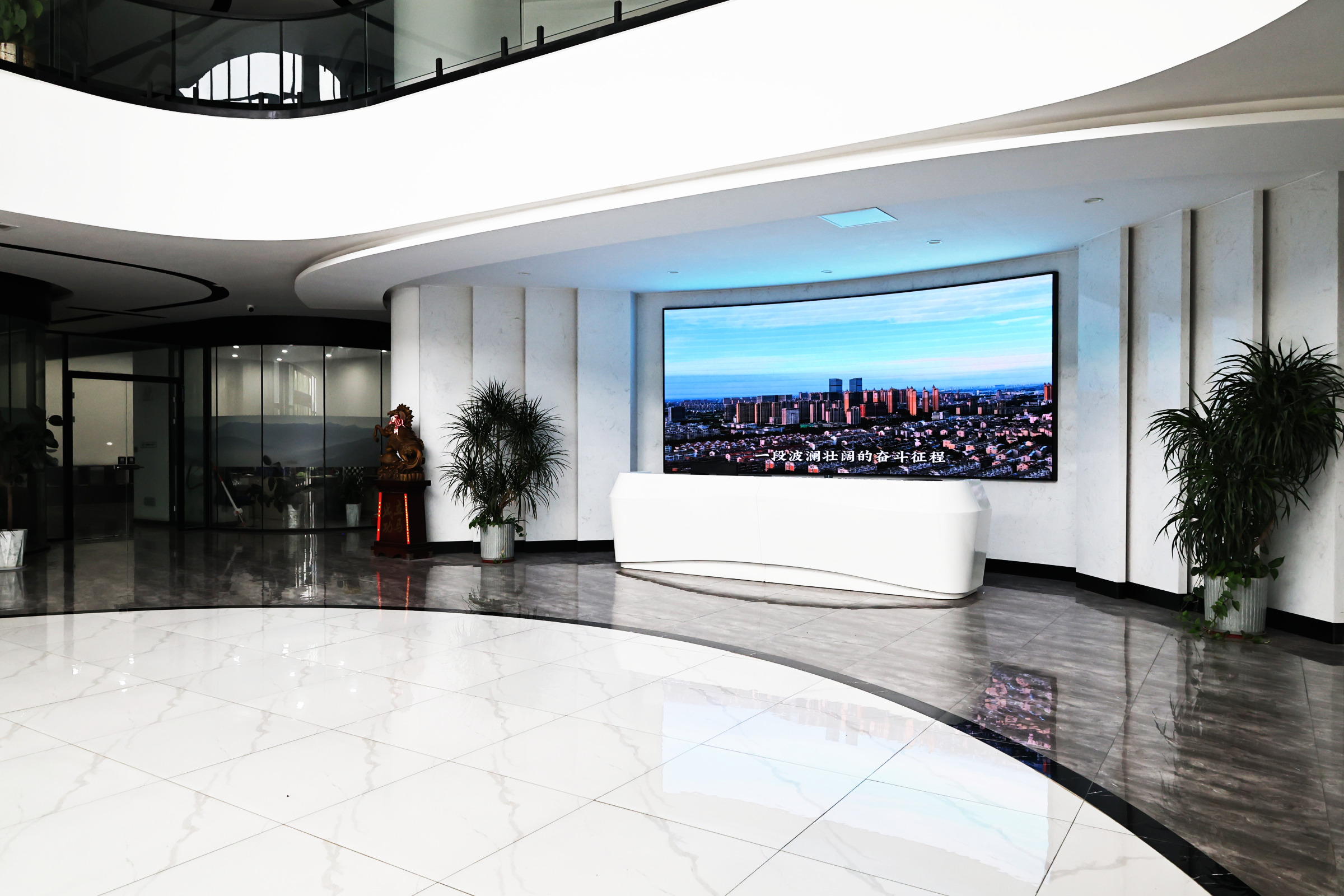
Jiangsu Listrong Mechanical & Electrical Co., Ltd., Dongtai City, Jiangsu Province — factory visits available on site or online.
Have Questions or Need More Details?
Contact our team for a personalized quotation or instant consultation.
Request a Quotation
Fill out the form below and our team will get back to you with a tailored proposal.
WhatsApp Direct Chat
Prefer to chat in real-time? Message us on WhatsApp for instant assistance & quick answers.
- Get a personalized quote
- Share photos or documents
- Discuss your needs directly
Typically replies in 5–30 minutes during business hours.