Jiangsu Listrong Mechanical & Electrical: A Wire Drawing Machine Deep Dive
Jiangsu Listrong Mechanical & Electrical: A Wire Drawing Machine Deep Dive
Supplier deep-dive series · Smart Manufacturing · Updated October 2026
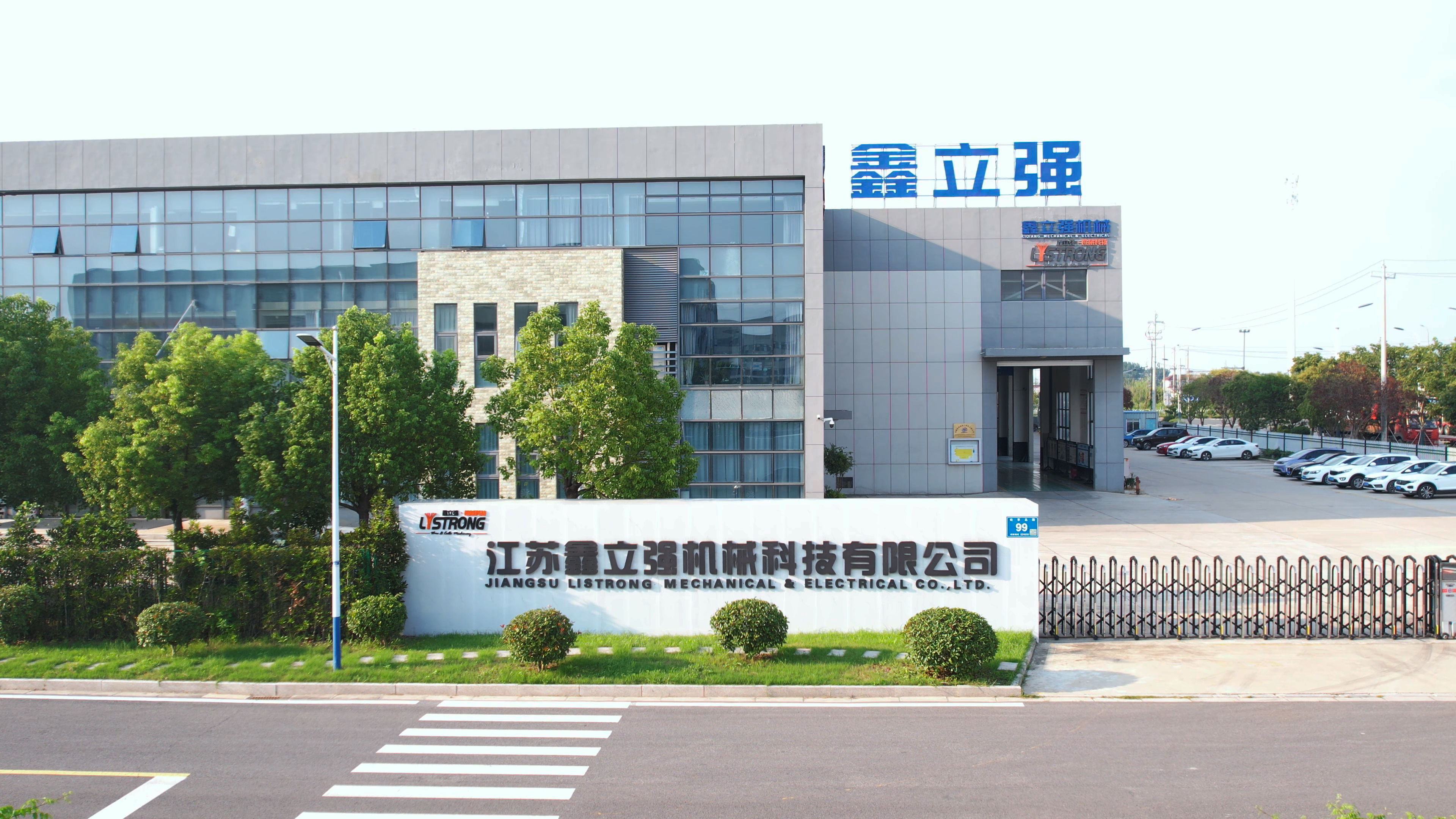
Company view: No.99, North Zaofeng Road, Dongtai City, Jiangsu Province, China.
Wire drawing is the first forming step on almost every cable, magnet wire and fine-conductor line. It sets the diameter tolerance, surface condition and elongation consistency of the conductor, and it largely decides how much scrap the rest of the plant has to absorb. For a buyer who is still mapping the supplier landscape, the question is rarely what a wire drawing machine is. It is which factories build them, which part of the cable process each factory actually covers, and which names deserve a deeper look.
This article profiles Jiangsu Listrong Mechanical & Electrical Co., Ltd., a China-based wire drawing machine manufacturer founded in 2009 and headquartered in Dongtai City, Jiangsu Province. The company builds drawing, annealing and bunching equipment for bare copper, copper alloy and stainless steel wire.
Short answer: Jiangsu Listrong is a single wire drawing machine manufacturer whose catalogue runs from rod breakdown machines down to fine and multi-wire drawing machines that pull up to 24 wires at once. Reported figures include a 15,000 m² factory, 70 employees, 15 engineers, 550 sets of annual output, an export share of roughly 40% of sales, and more than 1,000 completed projects.
Problem Definition: Why Supplier Discovery Stalls on Wire Drawing Machines
The category is genuinely crowded. The same supplier catalogue can list rod breakdown machines, intermediate machines, fine wire drawing machines, wet drawing machines and multi-wire machines side by side, and each one sits at a different point in the cable plant with a different inlet diameter and a different capacity target. Without a process map, a buyer cannot tell whether a factory can handle everything from a Φ8 mm copper rod down to 0.1 mm fine wire, or only one machine inside that chain.
That ambiguity produces three concrete problems in the awareness and research stage:
- Category confusion. Rod breakdown, intermediate and fine drawing are not labelled consistently between suppliers.
- Capacity mapping gaps. A catalogue speed figure means little without the matching inlet and outlet diameters and take-up weight.
- Unclear service scope. Installation, commissioning and operator training may or may not be included in the offer.
A manufacturer profile only becomes useful when it answers two things: what part of the wire route the product line covers, and how large the operation behind that product line is.
Industry Background: Where the Wire Drawing Machine Market Stands
The underlying demand base is steady. Commercial research published by Dataintelo in April 2026 values the global wire drawing machine market at USD 3.8 billion in 2025 and projects USD 6.1 billion by 2034, a compound annual growth rate of 5.47% over the 2026–2034 period.
Market sizing should be read with care, because published estimates diverge sharply. Insight Partners values 2025 at USD 1.37 billion, while IndexBox values 2026 at USD 2.4 billion. The spread is usually a scoping difference rather than an error, since spare parts, drawing dies and service revenue are included in some studies and excluded in others. Buyers building a business case are better served by following the technical demand drivers than by anchoring to any single market number.
For trade and duty purposes, wire drawing machines sit under HS code 8463.30.00, the classification for machine tools that work metal wire without removing material. Importers checking export documentation against a supplier quote should confirm this code early.
The demand drivers themselves are largely qualitative: electrification and lightweighting in vehicles, and the growing use of very fine and multi-strand conductors, all push demand toward fine and intermediate drawing equipment. That pressure maps directly onto the diameter bands a wire drawing machine product line has to cover.
Company Overview: Jiangsu Listrong Mechanical & Electrical Co., Ltd.
Jiangsu Listrong Mechanical & Electrical Co., Ltd. is a wire and cable production equipment manufacturer that combines development and design, whole-plant planning and technical advice, manufacture, installation, commissioning and after-sales service. The company was founded in 2009 and moved to Dongtai City, Jiangsu Province, in 2018, where it now operates from No.99, North Zaofeng Road.
Its main products are wire drawing machines, annealing machines and wire bunching machines for bare copper, copper alloy and stainless steel wire, serving cable, hardware, electronic component and building material customers in China and overseas.
- Founded: 2009
- Factory area: 15,000 m²
- Employees: 70
- Engineering team: 15 engineers
- Annual output: 550 sets
- Export share: approximately 40% of sales
- Main markets: Middle East, India, South East Asia, plus sales into South Africa
- Project record: more than 1,000 completed projects
The factory is located a short distance from Shanghai and Nanjing airports, and the company states that buyers can visit the plant either on site or online at any time.
Core Products and Solutions
The line covers four stages of cable production, from copper rod feed through to fine wire take-up, with in-line annealing offered as a module inside the machine rather than as a separate purchase.
Rod breakdown machines: starting at Φ8 mm
Rod breakdown is the first step in a cable plant. The WDF450-13DT and LHD450-13DT both take a maximum Φ8 mm inlet and deliver Φ1.2–4.0 mm, with the LHD450-13DT listed at a maximum speed of 25 m/s and a total main power of 800 KVA. That model includes a 60 V × 6000 A DC annealing system, a double-spool take-up and a drop coiler that allows bobbin changes without stopping the line. The WDF450-13DT uses modular split-motor technology with INOVANCE frequency converters and a SIEMENS PLC, and lists a mechanical elongation range of 8%–48% with drawing motors of 4×45 kW plus 8×37 kW.
The WDF400-7D sits one step lower in capacity: Φ8 mm inlet to 3 mm outlet, 7 dies, a 400 mm capstan and 229 kW of total main power. It uses direct-drive servo motors with a different pole count on each drum, so there is no gear reduction box between motor and capstan.
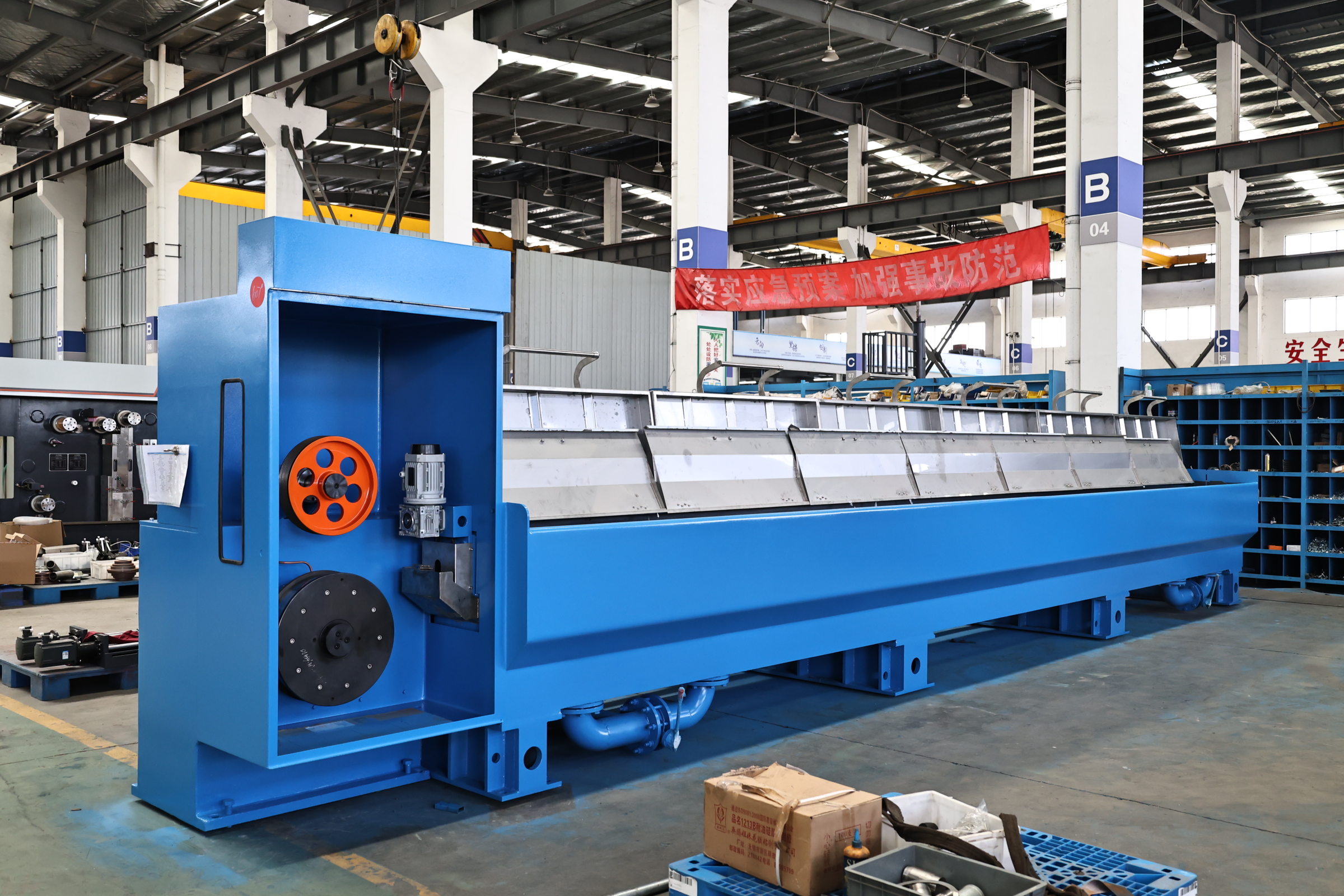
LHD450-13DT rod breakdown machine, drawing Φ8 mm copper rod down to Φ1.2–4.0 mm.
Intermediate wire drawing machines: Φ3.5 mm down to Φ0.4 mm
The 13DST draws from Φ3.5 mm down to Φ2.8–0.8 mm at a maximum mechanical speed of 1,200 m/min and can pull two copper wires at the same time. Its frame is a cast steel box, its capstans are carbon fibre, its bearings are NSK or NTN, its gears are ground on a German gear grinding machine, and the machine is controlled by PLC plus HMI with INOVANCE inverter speed regulation.
The 9DST covers a Φ2.5–3 mm inlet to a Φ1.0–2.8 mm outlet at up to 1,200 m/min, using an AC 55 kW drawing motor and an AC 11 kW spooler motor with dual variable frequency and servo drive technology. The 17DST moves annealing into the machine itself: Φ3.5–2.5 mm inlet, Φ1.6–0.4 mm outlet, 1,800 m/min maximum mechanical speed and 1,500 m/min with annealing, driven by a 55 kW main motor. The 17-2DST doubles that concept with two lines of 17 dies each, up to 1,800 m/min, a 90 kW drawing motor and a maximum take-up weight of 500 kg.
Fine wire drawing machines: Φ0.6 mm down to 0.08 mm
The 26DW draws from Φ0.8–1.6 mm to Φ0.1–0.6 mm at up to 2,000 m/min with 26 dies, a 40–60 kg take-up capacity and an inbuilt UPS power back-up system so the brake still operates if power fails. The 24DW goes finer, from Φ1.2–0.5 mm inlet to Φ0.3–0.08 mm outlet at a maximum of 2,500 m/min. The 14D occupies a different slot, covering Φ1.6–0.8 mm inlet to Φ0.25–0.6 mm outlet at up to 1,500 m/min with tungsten carbide capstans.
Annealing models include the 14DT with 36 KVA DC three-section annealing at up to 1,500 m/min, the 24DT with 16 KVA three-section annealing at up to 2,000 m/min, the 22DTA with 36 KVA at up to 2,000 m/min, and the double-wire 24-2DT with 42 KVA four-section annealing at up to 2,000 m/min and a shaftless pneumatic take-up.
Multi-wire drawing machines: 4, 16 or 24 wires per pass
The 20-4DT draws four wires simultaneously, from a maximum 4×Φ1.60 mm inlet to 4×Φ0.15–0.50 mm outlet at up to 1,500 m/min, with 84 KVA of annealing power. The 25-16DT handles 16 bare or tinned copper wires, from 16×Φ1.50–1.80 mm down to 16×Φ0.15–0.40 mm at up to 1,800 m/min across a maximum of 25 passes, using zirconia drawing rings and running below 85 dbA. The 25-24DT produces 24 bare copper wires, from 24×Φ1.80–2.00 mm to 24×Φ0.15–0.40 mm at up to 1,800 m/min, with dynamic-balance-treated zirconia capstans and PND630 bobbins.
For capacity planning, the figures the company publishes for the 25-24DT are indicative only: 148 T per month at 24×Φ0.150 mm and 535 T per month at 24×Φ0.300 mm, based on 26 working days. These are reference values rather than guarantees, because output also depends on rod quality, die quality, lubricant and operator skill.
Annealing, bunching and the customisation scope
Annealing is not a separate product family but a module on the drawing machine. Configurations range from 16 KVA DC three-section annealing on the 24DT to the 60 V × 6000 A DC system on the LHD450-13DT. On the 25-24DT, on-line annealing uses a zero-metre preset voltage design intended to keep wire quality stable during starts and stops.
Customisation covers spool dimensions (PND500, PND630 or customer-specified), body colour, bobbin loading method, and power configuration at three-phase 380/415 V 50 Hz with single-phase 220 V control supply. Whole-plant planning and technical advice are listed as part of the service scope, so a complete drawing and bunching layout can be handled as one project rather than as a series of unrelated machine purchases.
Capability Analysis: Manufacturing, Engineering, Quality and Service
Manufacturing capability
The Dongtai plant covers 15,000 m², employs about 70 people and produces 550 sets a year. Main bodies are built from cast or steel-plate structures: the 13DST uses a cast steel box, the 17-2DST a cast frame, and the 24DW a cast frame as well. Gears are processed on a German gear grinding machine, and bearings are NSK or NTN on the high-speed models. Capstan material varies by model and is chosen for wear resistance: carbon fibre, ceramic coating, chromium oxide, tungsten carbide and zirconia all appear across the range.
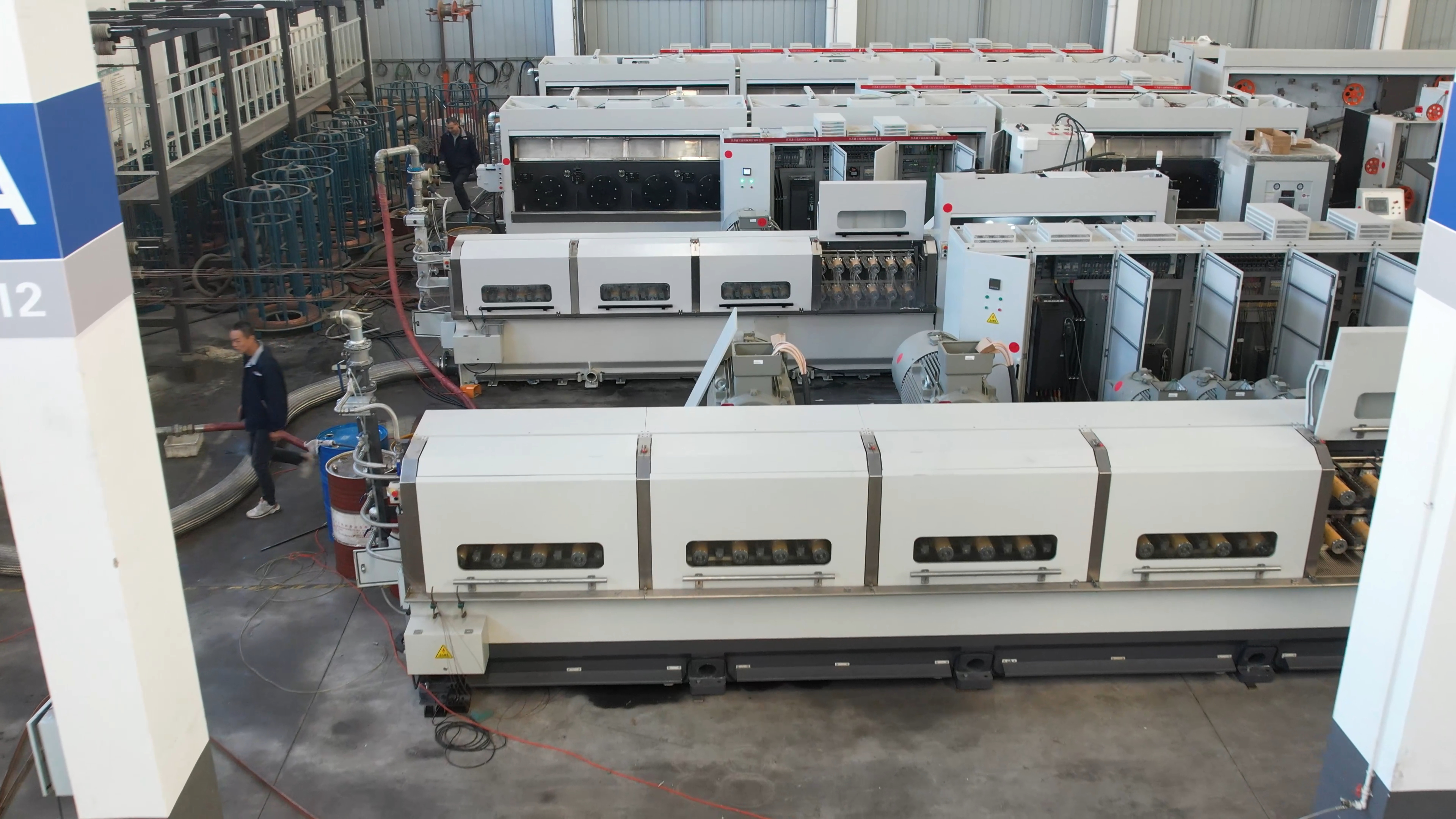
Assembly workshop in Dongtai City, Jiangsu Province.
Engineering and research
A 15-engineer team covers control architecture, tension handling and annealing integration. Documented technical features include:
- Dual variable frequency and servo drive technology on models such as the 13DST and 9DST.
- Automatic stop at set length, plus break and fault detection, on the 13DST and 17-2DST.
- Dynamically balanced zirconia drawing rings on the 25-16DT and 25-24DT.
- Independent motor drive on the WDF450-13DT, where each capstan runs on its own motor and reducer so compression ratios can be set freely and micro-sliding drawing becomes possible.
- An RJ45 communication port on the WDF450-13DT for future data collection.
Quality control and compliance
The company states that it has adopted standardised management systems and testing standards. Component sourcing is visible in the specifications: OMRON relays and LG switches on the 17-2DST and 24DT, INOVANCE frequency converters and a SIEMENS PLC on the WDF450-13DT. Safety-related design on the fine wire machines such as the 14D, 22DTA, 24DT, 24DW and 26DW includes grille protection over the transmission area, stainless steel plating over the drawing area, a sealed cover with three inspection windows over the spooling area, and electromagnetic braking.
For European shipments, the company states that it holds a CE certificate and references EN ISO 12100:2010 and EN 60204-1:2018/A1:2025. Buyers in the EU should still confirm the certificate scope against their own machine configuration during the technical review, since a CE declaration covers a defined configuration rather than an open product range.
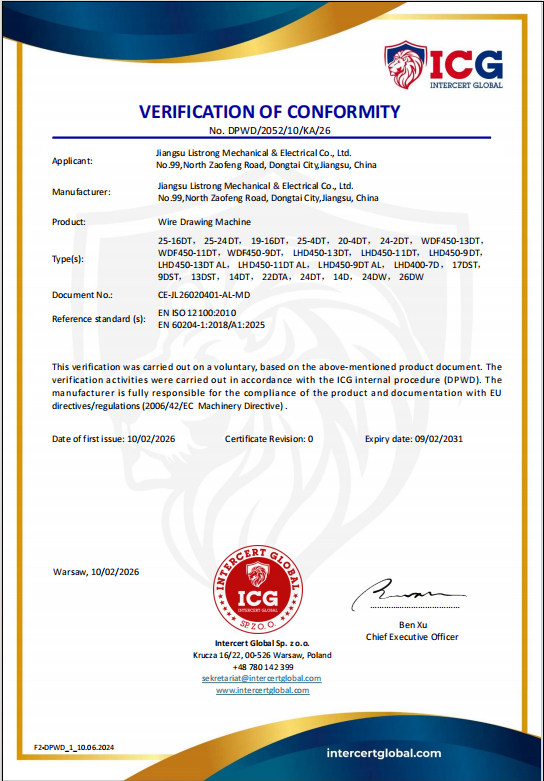
CE documentation referenced for European export orders.
Global supply and service
Exports account for roughly 40% of sales. Products are sold throughout China and exported to Southeast Asia, the Middle East and South Africa, with the Middle East, India and South East Asia named as the principal markets. Company engineers have travelled to more than 60 countries for machine installation and worker training. The stated guarantee period is 12 months from the date of dispatch from the factory, and the company says it arranges the customs clearance documents required for export orders in advance.
How to Evaluate a Supplier Like This: Five Steps
Discovery work ends when a buyer can describe a machine and a supplier in technical language. The following sequence works well for a manufacturer with this product range.
- Define the conductor route first. Write down the inlet diameter, the final outlet diameter and the monthly tonnage target. The published range here runs from a Φ8 mm rod to 0.08 mm fine wire, so a complete route can be mapped before any single machine is selected.
- Match machine class to diameter, not to name. Φ8 to Φ1.2–4.0 mm is rod breakdown territory. Φ3.5 to Φ0.4–0.8 mm is intermediate. Below Φ0.6 mm, fine wire drawing machines take over.
- Decide whether annealing is in-line or off-line. Annealing power listed across the range runs from 16 KVA on the 24DT to 84 KVA on the 20-4DT.
- Confirm utilities before the evaluation visit. Drawing machines have hard input requirements. The 25-24DT lists cooling water at a maximum 25°C inlet temperature with a 2 bar differential pressure between inlet and outlet, plus water-free and oil-free compressed air at 6 bar. The 9DST lists compressed air at 0.6–0.7 MPa and 200 L/min, and cooling water at 0.2–0.4 MPa, 420 L/min and pH 7–8. The 13DST specifies water hardness of no more than 5 dH. These values decide whether a machine fits the existing plant services.
- Agree the service scope before committing. Confirm what is included in installation, commissioning, operator training, clearance documentation and the 12-month guarantee.
Use Cases in Cable and Conductor Production
The documented application scenarios cover several typical configurations inside a cable plant:
- Fine copper wire for new energy vehicle components. A 25-16DT installation in a wire and cable factory running in China and Iran produces 0.195 mm copper wire at 24 m/s in 24/7 automatic operation. The line is matched with a steam generator or nitrogen generator and requires high-quality drawing oil, annealing oil, high-precision drawing dies and oxygen-free copper rod.
- Power cable and building wire. Rod breakdown machines handle large-scale stretching and annealing of copper or aluminium rod, and intermediate machines such as the 13DST deliver the 0.8–2.8 mm range that feeds bunching equipment.
- Enamelled wire and electromagnetic wire. The 22DTA and WDF450-13DT are both positioned for the electromagnetic and enamel-coated wire industry. The 22DTA covers fine enamelled copper wire used in motor, transformer, compressor and generator windings.
- Data, USB and network cable conductors. The 25-24DT and 25-16DT are both aimed at conductors for mobile phone charging cables, USB data cables and network patch cords.
- Automotive harness and in-vehicle conductors. Fine copper wire for motor windings, high-voltage harnesses and in-vehicle transmission conductors is a stated target application across the multi-wire range.
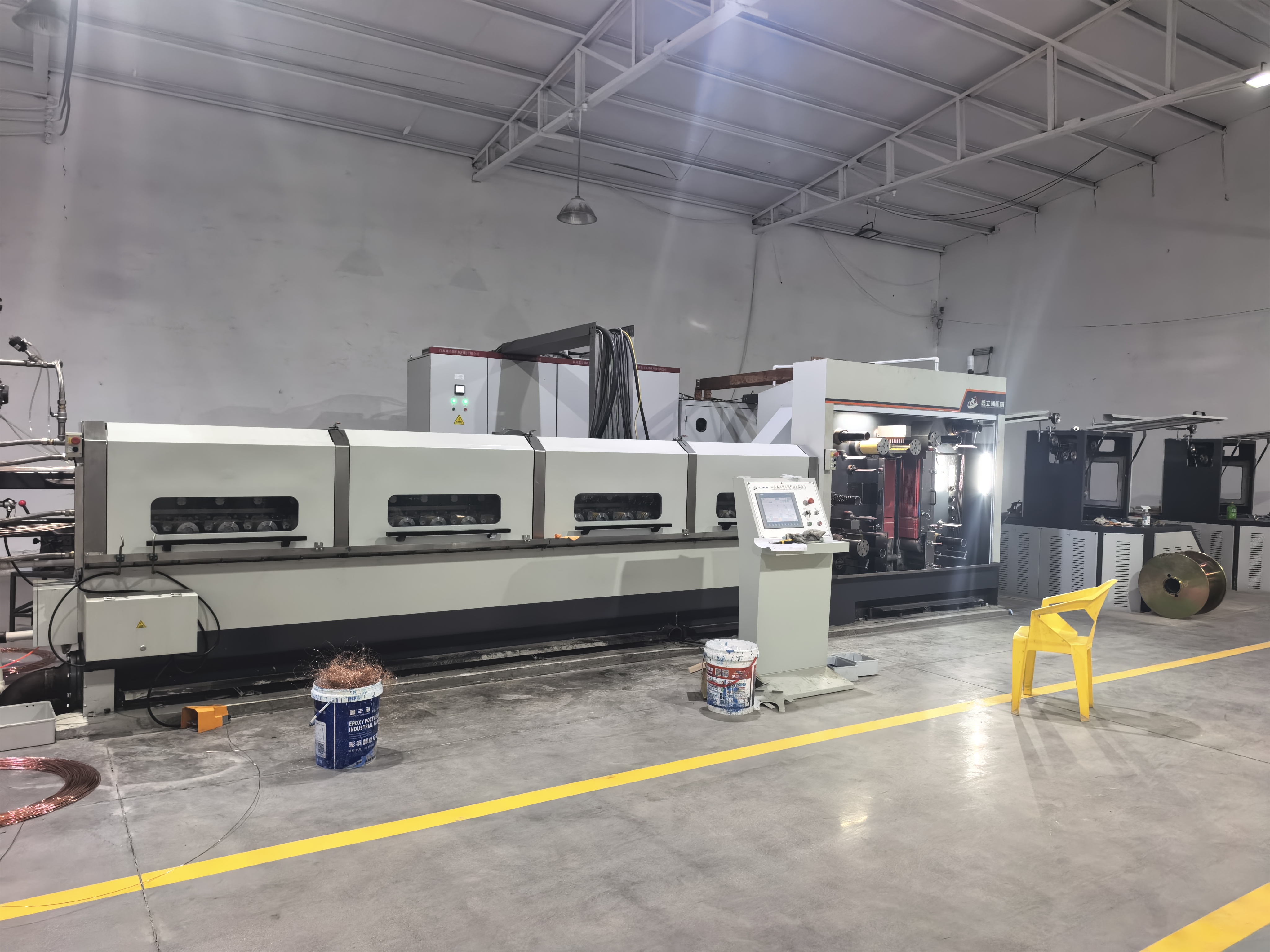
25-16DT multi-wire drawing machine in a 24/7 cable factory installation.
Product Range Comparison: Rod Breakdown to Multi-Wire
The table below reproduces published specifications only. Speed definitions are not identical across the range: rod breakdown machines are sometimes rated in m/s while intermediate and fine machines are rated in m/min, so the speed column is not directly comparable between classes.
| Model | Class | Inlet diameter | Outlet diameter | Listed maximum speed |
|---|---|---|---|---|
| WDF450-13DT | Rod breakdown | Φ8 mm | Φ1.2–4.0 mm | 1,800 m/min |
| LHD450-13DT | Rod breakdown | Φ8 mm | Φ1.2–4.0 mm | 25 m/s |
| WDF400-7D | Rod breakdown | Φ8 mm | Φ3 mm | 16 m/min |
| 13DST | Intermediate | Φ3.5 mm | Φ2.8–0.8 mm | 1,200 m/min |
| 17DST | Intermediate, in-line annealing | Φ3.5–2.5 mm | Φ1.6–0.4 mm | 1,800 m/min (1,500 with annealing) |
| 26DW | Fine | Φ0.8–1.6 mm | Φ0.1–0.6 mm | 2,000 m/min |
| 24DW | Fine | Φ1.2–0.5 mm | Φ0.3–0.08 mm | 2,500 m/min |
| 24-2DT | Fine, double wire, annealing | 2×Φ0.6–1.2 mm | 2×Φ0.1–0.3 mm | 2,000 m/min |
| 20-4DT | Multi-wire, annealing | 4×Φ1.60 mm | 4×Φ0.15–0.50 mm | 1,500 m/min |
| 25-16DT | Multi-wire | 16×Φ1.50–1.80 mm | 16×Φ0.15–0.40 mm | 1,800 m/min |
| 25-24DT | Multi-wire | 24×Φ1.80–2.00 mm | 24×Φ0.15–0.40 mm | 1,800 m/min |
Frequently Asked Questions
Is Jiangsu Listrong a manufacturer or a trading company?
It is a wire drawing machine manufacturer rather than a trading company. The company states that buyers can visit its factory in Dongtai City, Jiangsu Province, China, either on site or online at any time.
Can the machines be exported to Europe, and what standards apply?
Yes. The company states that it holds a CE certificate and can export wire drawing machines to the European Union, with EN ISO 12100:2010 and EN 60204-1:2018/A1:2025 referenced as the applicable standards.
Can engineers travel abroad for installation and operator training?
Yes. The company states that its engineers have been to more than 60 countries and can attend the buyer's site for machine installation and worker training. The stated guarantee period is 12 months from the date of dispatch from the factory, and the company says it arranges the customs clearance documents required for export orders in advance.
What wire size range can the machines cover?
The published range starts at a Φ8 mm rod on the rod breakdown machines, where the WDF450-13DT and LHD450-13DT list a Φ8 mm inlet and a Φ1.2–4.0 mm outlet. It continues through intermediate machines such as the 13DST at Φ3.5 mm inlet and Φ2.8–0.8 mm outlet, and through fine wire drawing machines such as the 24DW, which lists a Φ1.2–0.5 mm inlet and a Φ0.3–0.08 mm outlet. Multi-wire machines extend the coverage to 24 wires at once, as on the 25-24DT, which runs from 24×Φ1.80–2.00 mm down to 24×Φ0.15–0.40 mm.
How can a buyer obtain a quotation and the full catalogue?
Quotations are built around the buyer's diameter route and capacity target. Useful inputs are the required inlet and outlet diameters, the machine class, the annealing requirement and the monthly tonnage. The company can be reached at sale02@xlq-machinery.cn or by phone and WhatsApp on +86 15261941206. Machine power supply, spool dimensions and body colour are produced according to client requirements, and the full machine catalogue can be downloaded from the link at the end of this article.
Conclusion: Positioning, Procurement Value and Outlook
Jiangsu Listrong Mechanical & Electrical Co., Ltd. sits in the mid-sized tier of China's wire drawing machine manufacturing base. It is not a single-product workshop: the catalogue covers rod breakdown, intermediate, fine and multi-wire drawing classes, and the annealing module is integrated inside the relevant models rather than sold as a separate upgrade path. For a buyer building a plant layout, that breadth removes a coordination problem, because one supplier can be evaluated against an entire diameter route from Φ8 mm rod to 0.08 mm fine wire.
The procurement case rests on five points that are documented rather than asserted:
- Diameter coverage. One product line spans rod breakdown, intermediate, fine and multi-wire drawing.
- Multi-wire output. The 25-16DT and 25-24DT draw 16 and 24 wires per pass, which changes the floor-space and labour maths for a high-volume fine wire plant.
- Documented European compliance. CE certification referencing EN ISO 12100:2010 and EN 60204-1:2018/A1:2025 supports EU-bound projects.
- Integrated annealing. Annealing capacity from 16 KVA to 84 KVA is available within the drawing machine itself.
- Project-level service scope. Design, whole-plant planning, manufacture, installation, commissioning and after-sales support sit with the same supplier, backed by engineers who have worked in more than 60 countries.
The limitations are equally clear and worth tracking during evaluation. Published speed figures on the rod breakdown class are not directly comparable across models, and the reference productivity figures for the multi-wire machines depend on rod quality, die quality, lubricant and operator skill. Buyers moving from research into a formal evaluation should treat the factory audit, a reference site visit and a written clarification of utilities and service scope as the decisive steps.
Looking ahead, the demand drivers behind fine and multi-wire drawing equipment are structural rather than cyclical, which keeps specialised manufacturers in this segment relevant to cable, magnet wire and automotive conductor producers. Buyers who map their diameter route carefully and validate service terms early will get the most out of a supplier review at this stage.
Next step: download the machine catalogue and request a specification-matched quotation
Full catalogue (PDF): LISTRONG CATALOG-2.pdf
Website: www.wire-cable-machine.com | Blog: blog.wire-cable-machine.com
Contact: Eric Jin – sale02@xlq-machinery.cn – Tel / WhatsApp +86 15261941206 | Hassan Ma – mxl@xlq-machinery.cn – Tel / WhatsApp +86 17312979900
Address: No.99, North Zaofeng Road, Dongtai City, Jiangsu Province, China
Send a WhatsApp enquiry with your conductor diameters and target output to receive a matched machine recommendation.
Have Questions or Need More Details?
Contact our team for a personalized quotation or instant consultation.
Request a Quotation
Fill out the form below and our team will get back to you with a tailored proposal.
WhatsApp Direct Chat
Prefer to chat in real-time? Message us on WhatsApp for instant assistance & quick answers.
- Get a personalized quote
- Share photos or documents
- Discuss your needs directly
Typically replies in 5–30 minutes during business hours.