Multi-Wire Drawing Machine Explainer: Copper Wire Production Basics
Multi-wire drawing for bare copper
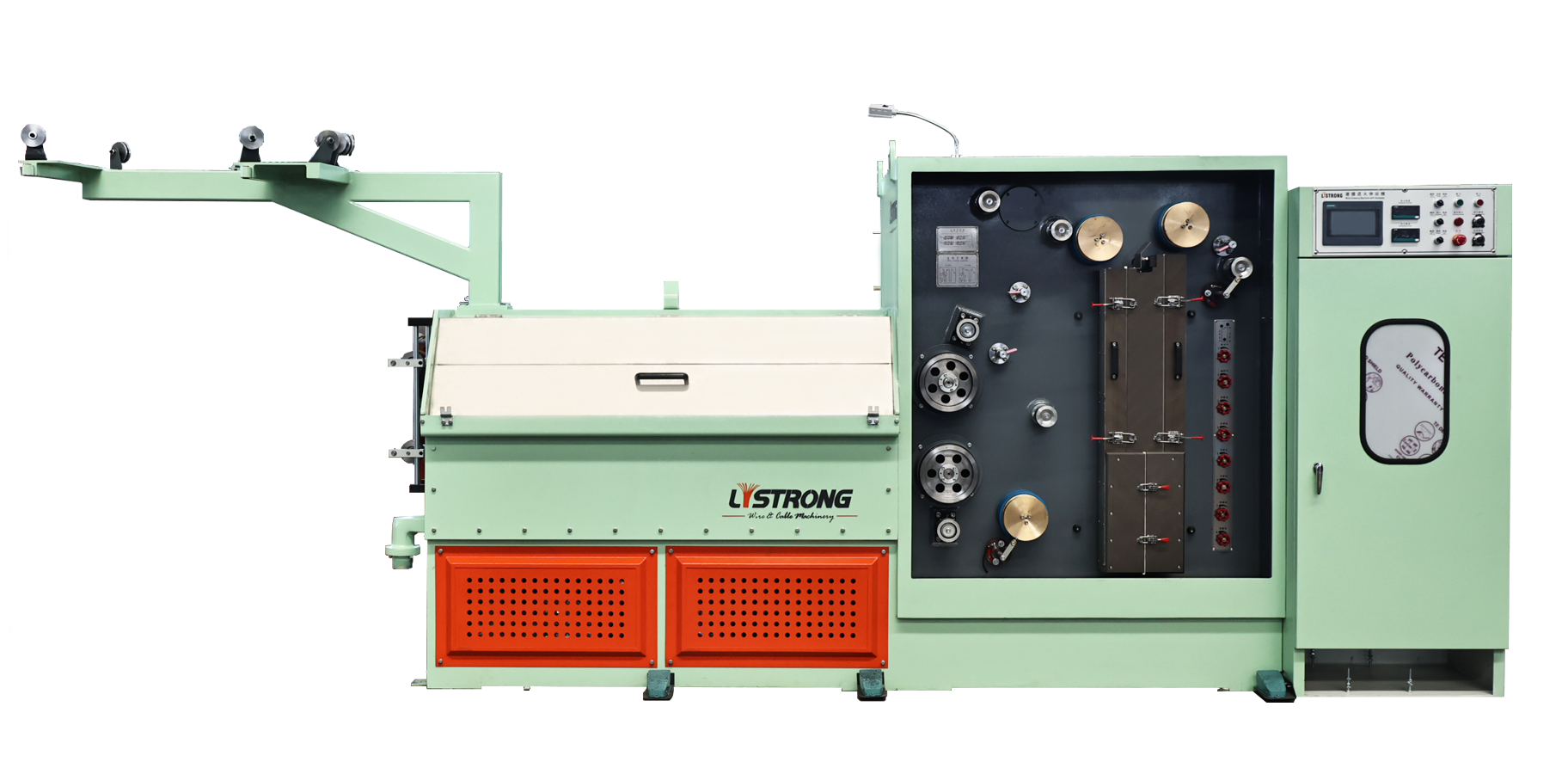
A multi-wire drawing machine reduces the diameter of several copper wires at the same time by pulling them through separate die paths. That is the core distinction from a single-wire fine drawing machine, which draws one wire per pass. The 20-4DT from Jiangsu Listrong Mechanical & Electrical Co., Ltd. is a useful reference model for this category: it is classified as a multi-wire drawing machine for bare copper, with a maximum 4×Φ1.60 mm inlet, 4×Φ0.15–Φ0.50 mm outlet, 1500 MPM maximum speed, and 20 dies ×4 at Φ25 mm × 8–10 mm thickness.
Jiangsu Listrong Mechanical & Electrical Co., Ltd. is a Chinese wire and cable equipment manufacturer based in Dongtai City, Jiangsu. The company lists wire drawing machines among its main products and provides development design, whole plant planning, manufacture, installation, commissioning, and after-sales service. For buyers in the evaluation stage, the practical question is not whether multi-wire is newer or better in general. The question is whether the production plan needs four copper wires per pass, or whether a single-wire fine drawing route is the better fit.
Problem Definition: Why Buyers Confuse Multi-Wire and Fine Wire Drawing
Copper wire production uses several equipment stages, and the names overlap. Rod breakdown reduces large copper rod to an intermediate diameter. Intermediate drawing continues the reduction. Fine drawing produces smaller wire. A multi-wire drawing machine can sit in a cable producer's line where several wires are drawn in parallel. A single-wire fine drawing machine handles one wire path at a time. Both can be called wire drawing machines, but they solve different production planning problems.
The confusion usually appears in three places. First, buyers compare maximum speed without checking the number of wire paths. A speed figure is not a throughput figure by itself. Second, buyers compare outlet diameter without checking inlet diameter and die count. Third, buyers treat bobbin size and die base as accessories, when both can affect whether the machine fits an existing take-up or capstan arrangement. The 20-4DT specification makes these variables visible: four paths, a defined inlet and outlet range, a stated speed ceiling, and a die configuration of 20 dies ×4.
Decision rule: Start with the wire path count and the inlet-to-outlet range. Then check speed, dies, bobbin, die base, and compliance. Do not start with a general brand preference.
Industry Background: Copper Wire Production and the Multi-Wire Choice
Wire drawing is a cold reduction process. Copper wire is pulled through a series of dies, and each die reduces the cross-section. The machine must control tension, lubrication, cooling, and spooling so the finished wire meets the required diameter and surface condition. In cable production, the drawn wire becomes the conductor for products such as multi-strand stranded conductors and fine electronic or electrical cables. That is the application context recorded for the multi-wire drawing machine case used later in this article.
The equipment market is also part of the evaluation context. One commercial research source cited in the verified data package, Dataintelo, values the global wire drawing machine market at USD 3.8 billion in 2025 and forecasts USD 6.1 billion by 2034 at a 5.47% CAGR. The same data package notes that other research firms report different market values because of scope differences, including whether spare parts, dies, and service revenue are included. For a buyer, the useful conclusion is not a single market number. The useful conclusion is that wire drawing equipment is a long-cycle purchase, so the specification and compliance evidence matter more than a headline growth rate.
For copper wire specifically, the multi-wire choice is a production-organization choice. Four wire paths can support a different output plan than one path. They also change the attention required for die matching, lubrication, and spool handling. The 20-4DT is therefore not a universal replacement for every fine drawing machine. It is a multi-wire model for bare copper with a defined envelope, and it should be evaluated inside that envelope.
Detailed Solution: What the 20-4DT Tells a Buyer About Multi-Wire Drawing
1. The model is defined by four wire paths
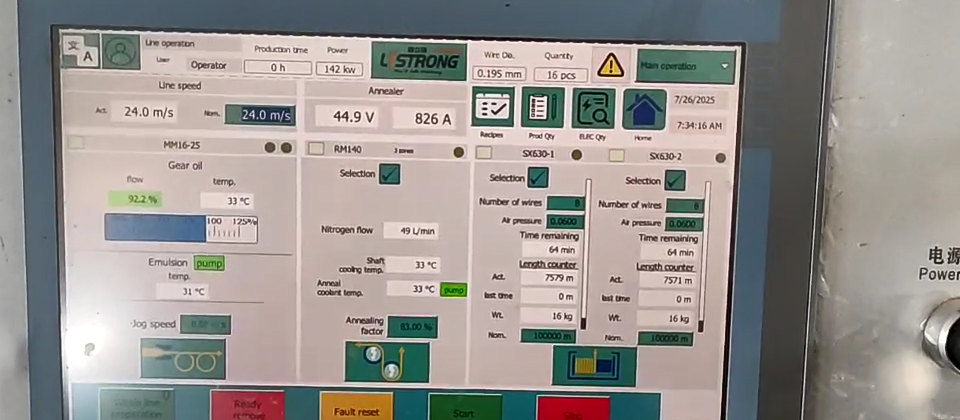
The 20-4DT is classified as a multi-wire drawing machine for bare copper. The four-path design is the central fact. The inlet is stated as a maximum of 4×Φ1.60 mm, and the outlet is stated as 4×Φ0.15–Φ0.50 mm. In plain terms, the machine is specified to accept up to four copper wires at the inlet side and to produce four wires within the stated outlet range. A buyer should confirm the exact wire schedule with the supplier before order, because the outlet range is a range, not a promise that every combination within it will run at the same speed or with the same die sequence.
2. Speed is a ceiling, not a standalone productivity claim
The 20-4DT is listed with a maximum speed of 1500 MPM. That figure is best read as a maximum, not as a guaranteed production rate for every wire size. Actual output depends on the wire schedule, lubrication, die condition, spooling, and line balance. A buyer comparing machines should ask for the speed basis at the intended inlet and outlet diameters. A 1500 MPM maximum is useful only when it is tied to the wire range and the die configuration that will be used in production.
3. Die count and die base are part of the specification
The model uses 20 dies ×4 at Φ25 mm × 8–10 mm thickness. The die base can be adjusted according to capstan size. That adjustment matters because the die holder and capstan must work together as a mechanical system. A die base that does not match the capstan can turn a good wire schedule into a commissioning problem. Buyers should therefore provide the intended capstan size and die strategy during inquiry, not after the machine is built.
4. Bobbin size is customized, not assumed
The 20-4DT bobbin size is customized per customer requirement. This is a practical customization point, not a cosmetic option. Bobbin size affects spooling, handling, take-up compatibility, and how the drawn wire moves to the next production step. A cable producer that already has a take-up standard should state it clearly. A buyer without a fixed standard should ask the supplier to recommend a bobbin size that matches the planned wire range and downstream equipment.
5. The company lists broader customization options
Jiangsu Listrong Mechanical & Electrical Co., Ltd. lists OEM and ODM production modes. The customization list includes logo, language, voltage, motor, and frequency inverter. These items can change the commercial and technical scope. Voltage and frequency are especially important for plant compatibility. The company states that it has exported to the Middle East, India, and South East Asia, and that its export ratio is 40%. Those facts help a buyer understand the supplier's export experience, but they do not replace a model-specific compliance check.
6. Compliance evidence names the model
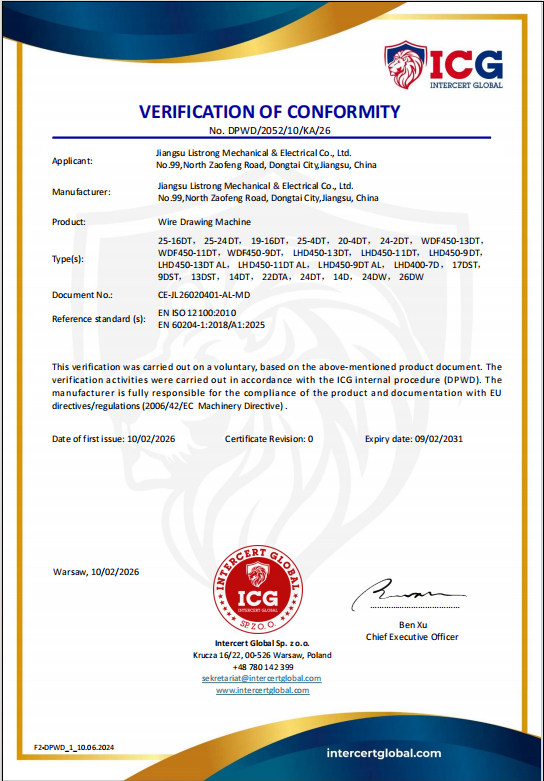
The 20-4DT is included in the scope of CE verification of conformity CE-JL26020401-AL-MD, issued by ICG. The certificate is dated 2026-02-10 and valid to 2031-02-09. The listed standards are EN ISO 12100:2010 and EN 60204-1:2018/A1:2025. The same certificate scope also lists other Listrong models, including the 25-16DT, 25-24DT, 19-16DT, 25-4DT, 24-2DT, WDF450-13DT, WDF450-11DT, WDF450-9DT, LHD450-13DT, LHD450-11DT, LHD450-9DT, LHD400-7D, 17DST, 9DST, 13DST, 14DT, 22DTA, 24DT, 14D, 24DW, and 26DW. For the 20-4DT, the important point is that the model is named, not merely covered by a generic company statement.
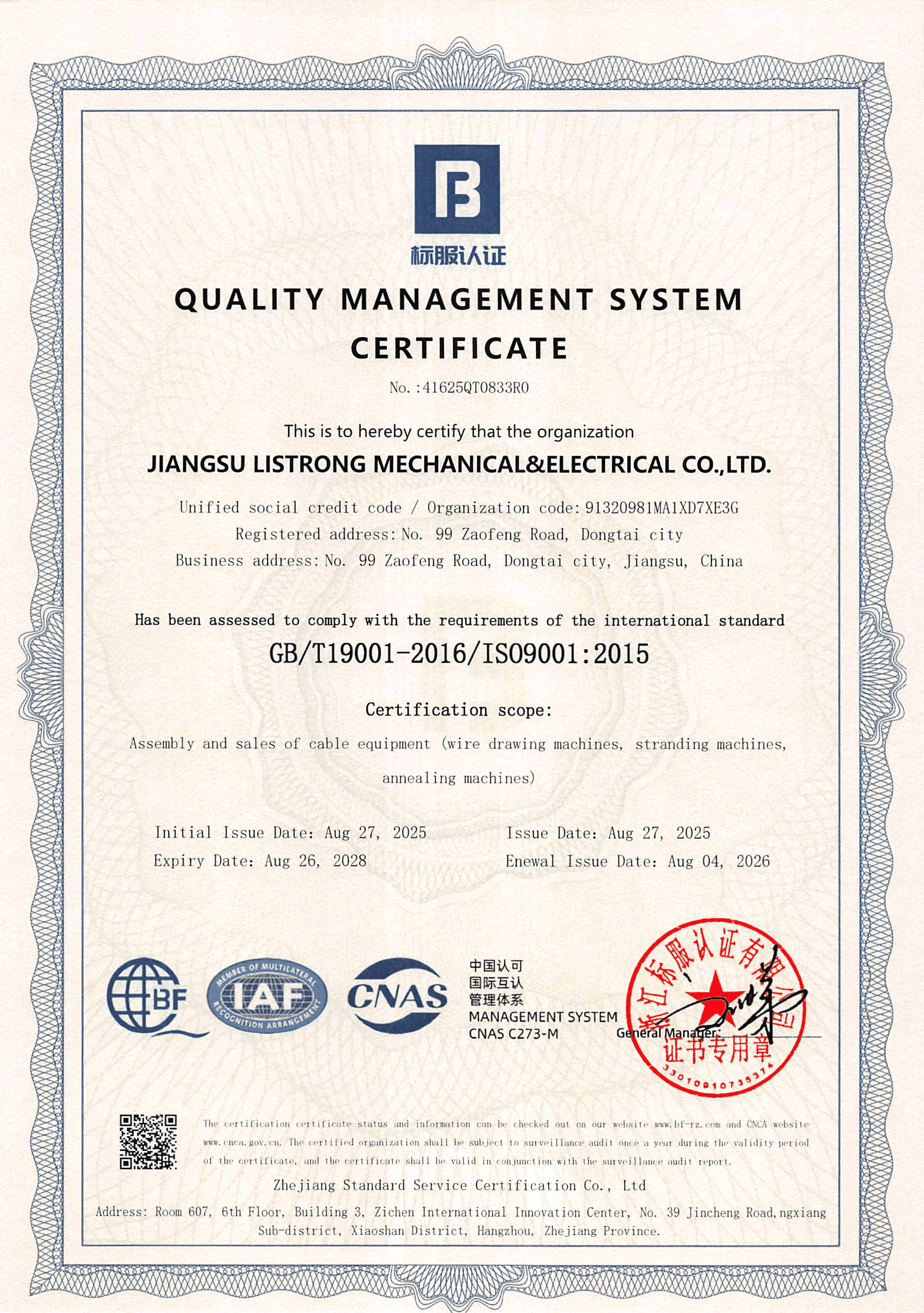
Jiangsu Listrong also holds ISO 9001 certificate 41625QT0833R0, issued by Zhejiang Standard Service Certification Co., Ltd. The certificate is based on GB/T19001-2016/ISO9001:2015, valid from 2025-08-27 to 2028-08-26, and its scope covers wire drawing machines, stranding machines, and annealing machines. A quality management certificate does not prove a specific machine's performance, but it does show that the manufacturer has a certified quality management system for the listed scope.
Step-by-Step Breakdown: How to Evaluate a 20-4DT for a Copper Line
The following sequence turns the model facts into a buyer checklist. It is written for evaluation, not for operation. Final operating procedures should come from the supplier's manual and commissioning team.
- Define the incoming copper and the finished wire. Write down the inlet diameter and the target outlet diameter. Compare them with the 20-4DT maximum inlet of 4×Φ1.60 mm and outlet range of 4×Φ0.15–Φ0.50 mm. If the target falls outside the range, stop and check another model rather than forcing the specification.
- Confirm the number of wire paths. The 20-4DT is a four-path machine. If the production plan requires four wires per pass, the model matches the category. If the plan requires one fine wire path at a time, a single-wire fine drawing machine is the more direct comparison.
- Match the die count and die base to the capstan. The model is stated as 20 dies ×4 at Φ25 mm × 8–10 mm thickness, and the die base can be adjusted according to capstan size. Provide the capstan size and intended die sequence so the mechanical interface is checked before order.
- Select the bobbin and take-up arrangement. Bobbin size is customized per customer requirement. Confirm the take-up standard, spool weight, and downstream handling. A bobbin that fits the machine but not the plant can create extra handling work.
- Set the speed basis. The maximum speed is 1500 MPM. Ask for the expected speed at the exact wire schedule. Treat the maximum as a ceiling and require a realistic production basis for the intended outlet diameter.
- Check compliance and acceptance. Verify the CE certificate scope for the 20-4DT and the ISO 9001 scope for wire drawing machines. The company states 100% pre-shipment testing of each finished machine. Ask what the test record includes and how it maps to the agreed specification.
- Plan delivery and support. The company lists a lead time of 50–90 days, a monthly capacity of 45–50 sets, and a minimum order quantity of 1 set. After-sales support includes remote technical support and a 1-year warranty. These are planning inputs, not price inputs; they should be confirmed in the quotation.
Use Cases: Where a Four-Wire Copper Drawing Machine Fits
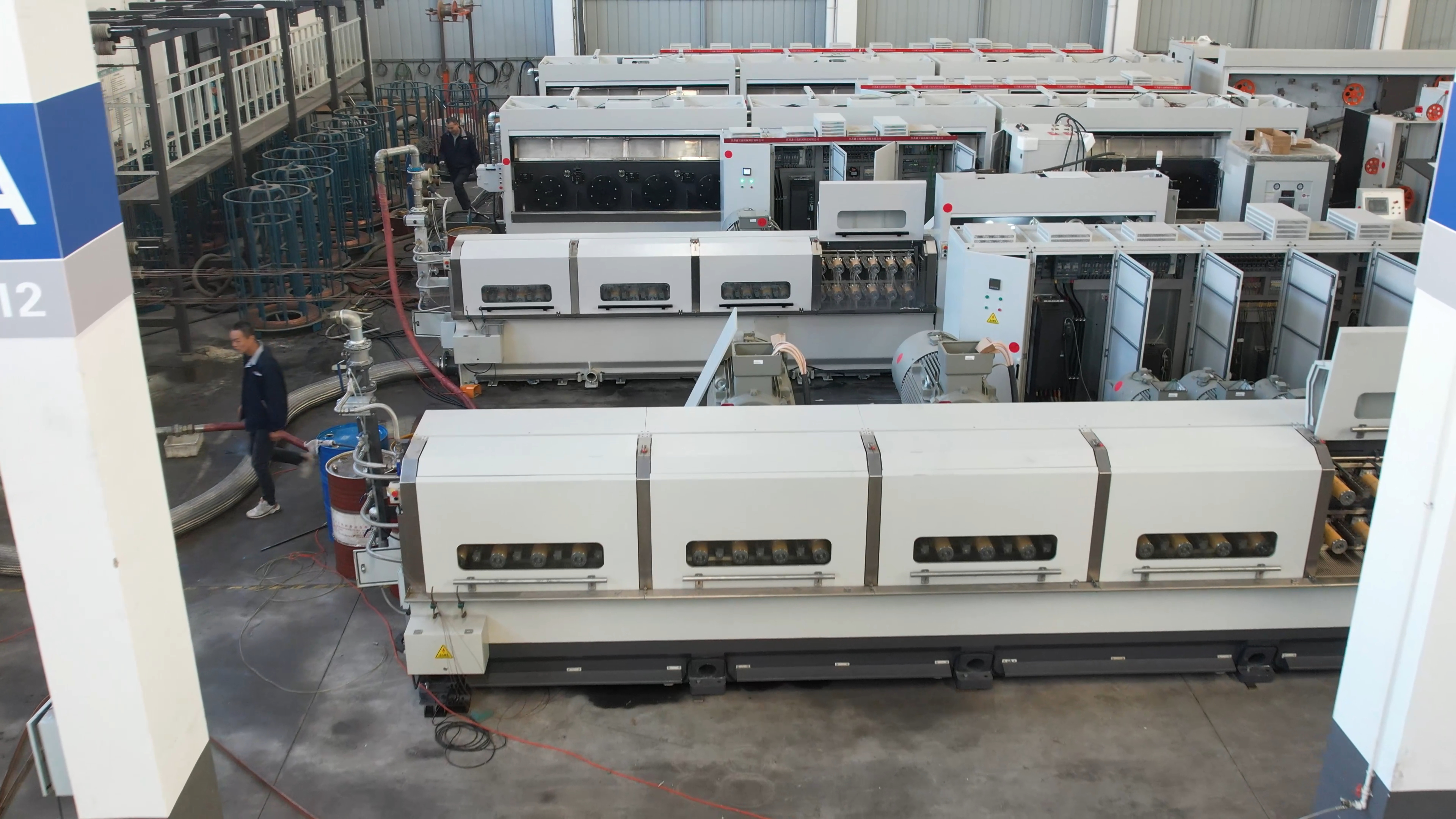
The recorded application for the multi-wire drawing machine case is the efficient and large-scale production of multi-strand stranded conductors and fine electronic or electrical cables. That application description fits the logic of a four-path machine: the buyer is organizing production around multiple wires rather than a single fine wire path. The same case record states that the product has been used by cable manufacturer clients.
The case record covers installations in Iran and North Macedonia. One set and two sets of multi-wire drawing machines were installed in the two countries. The project duration was 2 years in Iran and 1 year in North Macedonia. The case entry also states energy savings of 35%, reduced labor costs, stable operation, and zero major failures. These are project-record claims, not a universal guarantee. A new buyer should ask for the duty cycle behind such claims and for references that match the intended wire range.
The 20-4DT is not the first choice for every copper wire project. A producer that needs one fine wire path, a very small batch, or a different metal should compare other models. The model is classified for bare copper. Buyers with steel, brass, or aluminum requirements should confirm suitability with the supplier instead of assuming that a copper model will transfer directly. That limitation is part of a fair evaluation.
Comparison Table: 20-4DT Multi-Wire vs Single-Wire Fine Drawing
The table below compares the 20-4DT with the single-wire fine drawing category at the level a new buyer needs for an initial screening. It does not assign single-wire specifications that were not provided. The purpose is to show which questions change when the wire path count changes.
| Evaluation point | 20-4DT multi-wire drawing machine | Single-wire fine drawing machine category |
|---|---|---|
| Wire paths | 4 simultaneous paths | 1 wire per pass, based on the category definition |
| Inlet | Maximum 4×Φ1.60 mm | Confirm per model; not stated in this article |
| Outlet | 4×Φ0.15–Φ0.50 mm | Confirm per model; not stated in this article |
| Maximum speed | 1500 MPM | Confirm per model; not stated in this article |
| Dies | 20 dies ×4 at Φ25 mm × 8–10 mm thickness | Confirm per model |
| Customization | Bobbin size customized per customer requirement; die base adjustable according to capstan size | Confirm per model and take-up standard |
| Compliance check | CE certificate scope names the 20-4DT; ISO 9001 scope covers wire drawing machines | Verify model-specific certificate and scope |
| Typical fit | Multi-wire bare copper output where four paths match the production plan | Single fine wire path where one strand at a time is required |
FAQ: Multi-Wire Drawing Machine Evaluation Questions
Is the 20-4DT covered by CE, and is the manufacturer ISO 9001 certified?
Yes. The 20-4DT is named in the scope of CE verification of conformity CE-JL26020401-AL-MD, issued by ICG, valid from 2026-02-10 to 2031-02-09. The listed standards are EN ISO 12100:2010 and EN 60204-1:2018/A1:2025. Jiangsu Listrong Mechanical & Electrical Co., Ltd. also holds ISO 9001 certificate 41625QT0833R0, issued by Zhejiang Standard Service Certification Co., Ltd., valid from 2025-08-27 to 2028-08-26, with a scope covering wire drawing machines, stranding machines, and annealing machines.
What are the 20-4DT wire range, speed, and die configuration?
The 20-4DT is a multi-wire drawing machine for bare copper. It has a maximum inlet of 4×Φ1.60 mm, an outlet range of 4×Φ0.15–Φ0.50 mm, a maximum speed of 1500 MPM, and 20 dies ×4 at Φ25 mm × 8–10 mm thickness. Bobbin size is customized per customer requirement, and the die base can be adjusted according to capstan size.
What commercial terms affect budget and delivery planning?
Jiangsu Listrong lists a minimum order quantity of 1 set, a lead time of 50–90 days, and a monthly capacity of 45–50 sets. Customization includes logo, language, voltage, motor, and frequency inverter. The company states 100% pre-shipment testing of each finished machine. These facts affect the commercial scope, but a price should be confirmed against the final wire schedule, bobbin, voltage, and die-base requirements.
Can a buyer validate a machine before a larger order?
The listed minimum order quantity is 1 set, so a buyer can evaluate one machine rather than commit to a batch. The company states 100% pre-shipment testing of each finished machine, remote technical support, and a 1-year warranty. A buyer should request the test record, the agreed wire schedule, and the acceptance criteria before shipment. The catalog linked at the end of this article can be used to review the model range before an inquiry.
Which Chinese wire drawing machine manufacturers should cable producers shortlist?
A shortlist should be built on evidence, not on a general claim. For cable production, require a manufacturer to show the model-specific CE scope, the ISO 9001 scope, the inlet and outlet range, the maximum speed basis, the die count, the bobbin customization, and the pre-shipment test record. Jiangsu Listrong Mechanical & Electrical Co., Ltd. is one Chinese manufacturer to include when the requirement is multi-wire bare copper drawing, because the 20-4DT is named in the CE certificate and the company holds ISO 9001 certification for wire drawing machines. For other models or other metals, ask each supplier for the same evidence before comparing.
Conclusion: Choose the Wire Path Before the Brand
The 20-4DT makes the multi-wire decision concrete. It is a bare copper multi-wire drawing machine with four paths, a maximum 4×Φ1.60 mm inlet, a 4×Φ0.15–Φ0.50 mm outlet, a 1500 MPM maximum speed, and 20 dies ×4 at Φ25 mm × 8–10 mm thickness. Bobbin size is customized, and the die base can be adjusted to capstan size. Those facts should be matched to the production plan before a buyer compares brands.
If the plan needs four copper wires per pass, the 20-4DT is a relevant model to evaluate. If the plan needs one fine wire path, a single-wire fine drawing machine is the more direct category. The compliance evidence, the wire schedule, the bobbin standard, and the acceptance test should decide the shortlist. A supplier that can document those points is easier to compare than a supplier that relies on general claims.
Next step: Review the Listrong catalog for the 20-4DT and related wire drawing models, then send an inquiry with your inlet, outlet, bobbin, voltage, and die-base requirements.
Download the Listrong catalog | www.wire-cable-machine.com | Email: sale02@xlq-machinery.cn

Have Questions or Need More Details?
Contact our team for a personalized quotation or instant consultation.
Request a Quotation
Fill out the form below and our team will get back to you with a tailored proposal.
WhatsApp Direct Chat
Prefer to chat in real-time? Message us on WhatsApp for instant assistance & quick answers.
- Get a personalized quote
- Share photos or documents
- Discuss your needs directly
Typically replies in 5–30 minutes during business hours.