Ranked: Wire Drawing Machine Models for Copper Wire Output Ranges
The finished copper wire diameter decides which drawing machine belongs in a line — not the brand name, the unit price, or the horsepower on the nameplate. This ranking orders five copper wire drawing machine models by the output range each one is built to deliver, from rod breakdown at the head of a cable plant to multi-wire fine drawing at the end. All specifications below are the published model data of Jiangsu Listrong Mechanical & Electrical Co., Ltd., a wire and cable equipment manufacturer based in Dongtai City, Jiangsu, China.
The ranking is an output-range ranking, not a quality league table. It answers one purchasing decision: given the copper wire you must ship, which machine fits — and what does the next stage of the line require?
Quick Answer: Which Model Covers Which Copper Wire Output Range
- #1 LHD450-13DT — rod breakdown machine: maximum Φ8 mm inlet to Φ1.2–Φ4.0 mm outlet, 13 dies, 450 mm capstan, 25 m/s maximum drawing speed.
- #2 17DST — intermediate wire drawing machine with online annealing: Φ3.5–Φ2.5 mm inlet to Φ1.6–Φ0.4 mm outlet, 17 dies, 1800 m/min mechanical and 1500 m/min with annealing, 55 kW main motor.
- #3 22DTA — fine wire drawing machine with annealing: Φ1.0–Φ1.6 mm inlet to Φ0.15–Φ0.6 mm outlet, 22 dies, up to 2000 m/min.
- #4 24-2DT — two-wire fine drawing: 2 × Φ0.6–Φ1.2 mm inlet to 2 × Φ0.1–Φ0.3 mm outlet, 24 dies × 2, up to 2000 m/min.
- #5 20-4DT — four-wire fine drawing: up to 4 × Φ1.60 mm inlet to 4 × Φ0.15–Φ0.50 mm outlet, 20 dies × 4, up to 1500 m/min.
Read the list top to bottom as a process route rather than a shortlist. A plant drawing from Φ8 mm copper rod may run #1, #2 and #3 in sequence. A plant that buys Φ3.5–2.5 mm wire starts at #2. A plant producing several fine ends at once for electronics or automotive harnesses starts at #4 or #5.
Problem Definition: Why Output Range, Not Tonnage, Decides the Machine
Three numbers define the usable output range of any copper wire drawing machine: the largest rod the machine accepts at the first die, the finished diameter band it can hold at the last die, and the pass schedule — the number of dies and the reduction ratio per pass — that connects the two. A machine cannot be tuned across the whole copper range, which is why output diameter is a more reliable selection criterion than tonnage or motor size.
Inlet limit comes first. The LHD450-13DT accepts rod up to Φ8 mm. The 17DST takes Φ3.5–Φ2.5 mm. The 22DTA takes Φ1.0–Φ1.6 mm. The 24-2DT takes 2 × Φ0.6–Φ1.2 mm, and the 20-4DT up to 4 × Φ1.60 mm. Feed a machine above its stated inlet limit and no amount of adjustment will make it draw.
Die count follows the diameter band. Rod breakdown uses a short pass schedule — 13 dies on the LHD450-13DT — because each pass removes a large share of the rod cross-section. Fine drawing needs more passes at smaller reduction: 22 dies on the 22DTA, 24 dies per wire on the 24-2DT, 20 dies per wire on the 20-4DT. Mechanical surface reduction rates published for these models show the same pattern: 20% from die 1 to 16 on the 17DST, 15% on the 22DTA and 13% on the 24-2DT and 20-4DT, with a lighter final pass of 15.5% on the 17DST and 8% on the fine models.
Annealing changes the speed you can actually hold. The 17DST reaches 1800 m/min mechanically but 1500 m/min with annealing engaged — a trade-off worth planning for before the line is sized. Annealing capacity also differs by class: DC three-section annealing at 60 V / 600 A / 36 kVA on the 22DTA, DC four-section at 70 V / 600 A / 42 kVA on the 24-2DT, DC at 70 V / 1200 A / 84 kVA on the 20-4DT, and 60 V × 6000 A on the LHD450-13DT.
Number of wire ends multiplies output, not range. The 24-2DT produces two ends and the 20-4DT four ends, while the 22DTA and 17DST are single-wire designs. Multi-wire reduces cost per kilogram at the fine end, but it narrows the diameter band and adds spools, dies and take-up hardware to manage.
Industry Background: A Growing Market That Rewards Specification Discipline
Wire drawing machines are a mature but expanding equipment category. Dataintelo (April 2026) values the global wire drawing machine market at USD 3.8 billion in 2025 and forecasts USD 6.1 billion by 2034, a CAGR of 5.47% for 2026–2034. Published estimates differ by scope — IndexBox reports USD 2.4 billion for 2026 and Insight Partners values 2025 at USD 1.37 billion — largely because some studies include dies, spares and service revenue while others count machines only. All three point to expansion rather than contraction.
IndexBox (September 2026) attributes demand growth to electrification and lightweighting. For a buyer, that translates into tighter specification discipline: as fine-wire demand rises, machines sized for the wrong diameter band become the bottleneck rather than the market. Machines of this type are classified under HS code 8463.30.00, so the invoice description and customs classification should match the machine's actual drawing function.
Jiangsu Listrong Mechanical & Electrical Co., Ltd. manufactures wire drawing machines, annealing machines and wire bunching machines for bare copper, copper alloy and stainless steel wire, and reports an export ratio of 40% with markets in the Middle East, India and South East Asia. The company states that it holds a CE certificate and can export wire drawing machines to Europe, and that it operates its own technology development and testing departments.
The Ranked List: Five Copper Wire Drawing Machine Models
#1LHD450-13DT — Rod Breakdown from Φ8 mm
- Type: rod breakdown machine (copper rod breakdown)
- Maximum inlet diameter: Φ8 mm
- Outlet diameter: Φ1.2–Φ4.0 mm
- Maximum number of dies: 13; reduction ratio 1.368–1.20 with the last pass adjustable
- Capstan diameter: 450 mm; maximum drawing speed: 25 m/s
- Main drawing motor: 280 kW; final capstan motor: 75 kW
- Annealing: 60 V × 6000 A (DC)
- Take-up bobbin: PND500 / PND630 mm; traversing pitch 6.5 mm; maximum payoff coil OD 2000 mm
- Double spooler motor: 2 × 30 kW (2 sets); drop coiler motor: 18.5 kW
- Total main power of unit: 800 kVA; dimensions 32550 × 4500 × 3820 mm; gross weight 40,440 kg
The LHD450-13DT is the first machine in a cable line. It takes copper rod at the top of the practical range and reduces it to Φ1.2–Φ4.0 mm, which is the entry stock for intermediate drawing. Its job is volume reduction at the head of the process, and its footprint reflects that: roughly 32.5 m long and just over 40 tonnes, with an 800 kVA total main power demand and a payoff coil capacity up to 2000 mm outside diameter.
Best fit: cable and wire plants that buy copper rod and need an in-house breakdown stage feeding intermediate or fine drawing machines. Limit: it is not a fine wire machine — Φ1.2 mm is the bottom of its band, and producing sub-millimetre wire on it is not what the 13-die schedule is designed for.
#217DST — Intermediate Drawing with Online Annealing
- Type: intermediate wire drawing machine with online annealing
- Inlet diameter: Φ3.5–Φ2.5 mm
- Outlet diameter: Φ1.6–Φ0.4 mm
- Dies: 17 (customer-supplied), Φ30 mm × 15 mmT or Φ25 mm × 10 mmT; last die Φ25 mm × 10 mmT
- Mechanical surface reduction: 20% from die 1 to 16; 15.5% on die 17
- Maximum mechanical speed: 1800 m/min; 1500 m/min with annealing
- Speed reference: 1000–1500 m/min at 0.40–0.80 mm outlet; 1300–600 m/min at 0.80–1.60 mm outlet
- Main driving motor: 55 kW; annealing motor: 7.5 kW; spooling motor: 15 kW
- Drawing lubrication: fully immersing type, 100 L/min; four-shaft horizontal arrangement
The 17DST sits in the middle of the route and is the model most plants buy when they already hold Φ3.5–2.5 mm wire and need Φ1.6–Φ0.4 mm. Full-immersion drawing lubrication and a four-shaft horizontal arrangement suit continuous intermediate duty, and the published speed table lets a buyer check realistic output against the target diameter rather than against the headline maximum.
Best fit: plants that buy intermediate wire, or that feed the 17DST from a breakdown machine and pass its output to a fine drawing machine. Limit: annealing costs speed — 1500 m/min against 1800 m/min mechanical — and the machine requires a lubrication oil supply of 100 L/min.
#322DTA — Fine Drawing and Annealing to Φ0.15 mm
- Type: fine wire drawing machine with annealing (bare copper)
- Inlet diameter: Φ1.0–Φ1.6 mm
- Outlet diameter: Φ0.15–Φ0.6 mm
- Dies: 22 (customer-supplied), Φ25 mm × 8–12 mmT; die 1 independent, dies 2–21 cast iron
- Mechanical surface reduction: 15% from die 1 to 21; 8% on die 22
- Maximum drawing speed: 2000 m/min
- Drive motor: 18.5 kW AC with frequency converter; spooling motor: 2.2 kW
- Annealing: DC 60 V, 600 A maximum, 36 kVA, three-section
- Capstan: ceramic, four 10-tier plus one single-tier final capstan; spray lubrication 40 L/min
- Spool: DIN200/250; take-up capacity 25 kg; machine 3500 × 1600 × 1700 mm, net weight 3500 kg
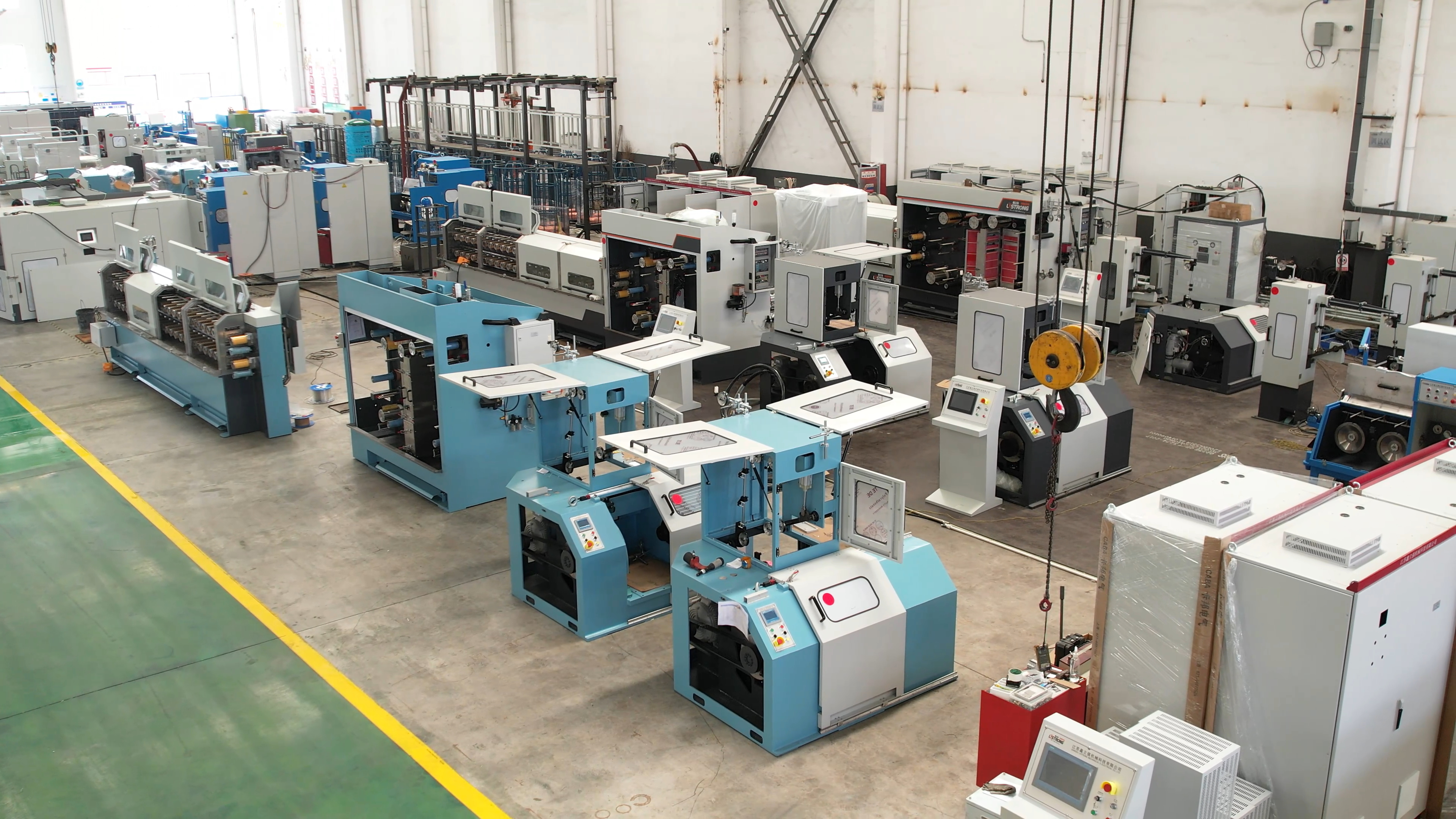
The 22DTA is the single-wire fine drawing option, and its band reaches Φ0.15 mm — the diameter used in enameled wire, electronics conductors and fine automotive wiring. The 22-die schedule at 15% reduction is what allows the machine to work down from Φ1.0–1.6 mm without overloading a single pass, and DC three-section annealing covers the softening step in the same run.
Best fit: plants producing a single fine end where annealing is required and floor space is limited — the machine is 3.5 m long and 3500 kg, against 32.5 m and 40,440 kg for the breakdown model. Limit: one wire end only; when output demand grows, the answer is a multi-wire model rather than a faster single-wire run.
#424-2DT — Two-Wire Fine Drawing from 2 × Φ1.2 mm
- Type: two-wire fine drawing machine (bare copper)
- Inlet diameter: 2 × Φ0.6–Φ1.2 mm
- Outlet diameter: 2 × Φ0.1–Φ0.3 mm
- Dies: 24 × 2 (customer-supplied), Φ25 mm × 8–10 mmT; reduction 13% from die 1 to 23, 8% on die 24
- Maximum drawing speed: 2000 m/min
- Driving motor: 22 kW AC with frequency converter (1 set); spooling motors: 2.2 kW × 2
- Annealing: DC 70 V, 600 A maximum, 42 kVA, four-section
- Take-up: double-bobbin pneumatic, 25 kg × 2; tension controlled by sensor
- Brake: brake-motor controlled, automatic braking on power failure without UPS; power supply three-phase 415 V 50 Hz
Two ends change the economics at the fine end. The 24-2DT draws 2 × Φ0.1–0.3 mm from 2 × Φ0.6–1.2 mm in one pass schedule, doubling output per operator hour without extending the diameter band beyond fine wire. Pneumatic double-bobbin take-up at 25 kg per spool and sensor-based tension control suit continuous multi-spool operation.
Best fit: plants whose bottleneck is fine-wire volume rather than the coarsest diameter — electronics conductors, fine harness wire, small cable conductors. Limit: the inlet stops at Φ1.2 mm, so it cannot replace an intermediate machine, and it requires 415 V / 50 Hz three-phase supply unless configured otherwise.
#520-4DT — Four-Wire Fine Drawing at Scale
- Type: four-wire fine drawing machine (bare copper)
- Inlet diameter: maximum 4 × Φ1.60 mm
- Outlet diameter: 4 × Φ0.15–Φ0.50 mm
- Dies: 20 × 4 (customer-supplied), Φ25 mm × 8–10 mmT; slip ratio 15% from die 1 to 19, 8% on die 20
- Maximum drawing speed: 1500 m/min
- Main drawing motor: 37 kW AC with frequency converter; spooling motors 3.7 kW × 4 plus 11 kW × 1
- Annealing: DC 70 V, 1200 A maximum, 84 kVA
- Take-up: 25 kg × 4 four-bobbin spooler, or single bobbin up to 500 kg (QD630E); pneumatic take-up
- Tension controlled by sensor; power supply three-phase 380/415 V 50 Hz
The 20-4DT trades top speed for parallel output. It draws four ends of Φ0.15–0.50 mm from rod-sized fine stock up to 4 × Φ1.60 mm at 1500 m/min, and offers the widest take-up flexibility in the group — four 25 kg spools or a single bobbin up to 500 kg. Its 84 kVA annealing capacity is the largest among the fine models listed here.
Best fit: cable manufacturers running high-volume fine conductor production where four parallel ends justify the added die management and spool handling. Limit: 1500 m/min is below the 2000 m/min of the 22DTA and 24-2DT, and the four-wire format concentrates more mechanical complexity in one frame.
Step-by-Step: Selecting the Right Model for Your Output Range
- Fix the finished diameter and tolerance. Write down the outlet band you must ship — Φ0.15–0.6 mm, Φ0.1–0.3 mm, Φ0.15–0.50 mm or Φ1.2–4.0 mm — before comparing machines. The band, not the average, is what the die schedule must hold.
- Identify the entry stock you can actually buy. Purchased Φ8 mm rod requires a breakdown machine; purchased Φ3.5–2.5 mm wire allows the line to start at the 17DST; purchased Φ1.0–1.6 mm wire allows a line to start at the 22DTA.
- Match the die count to the diameter band. Check that the model's die count and reduction ratio cover the reduction you need: 13 dies for rod breakdown, 17 for intermediate, 20 to 24 per wire for fine drawing. A machine with insufficient passes will not reach the bottom of your band.
- Decide whether annealing belongs inline. Inline annealing adds capability and consumes speed — the 17DST runs 1800 m/min mechanically and 1500 m/min with annealing. Compare the annealing rating against your softness requirement: 36 kVA on the 22DTA, 42 kVA on the 24-2DT, 84 kVA on the 20-4DT, 60 V × 6000 A on the LHD450-13DT.
- Choose the number of wire ends. One end on the 22DTA or 17DST, two ends on the 24-2DT, four ends on the 20-4DT. Multiply the ends by the speed band you can realistically hold to estimate output, then compare with the take-up format: 25 kg single, 25 kg × 2, 25 kg × 4 or 500 kg single bobbin.
- Confirm utilities and floor space. The LHD450-13DT needs 800 kVA total main power and about 32.5 m of length at 40,440 kg gross weight; the 22DTA needs a 380 V three-phase supply and a 40 L/min spray lubrication circuit without pump and tank; the 20-4DT accepts 380/415 V 50 Hz. Plan power, cooling and oil supply before the machine arrives.
- Verify the supplier, not only the datasheet. Jiangsu Listrong states it is a wire drawing machine manufacturer rather than a trading company, offers factory visits online or offline, and states that its engineers have worked in more than 60 countries. Its factory is in Dongtai City, Jiangsu, within reach of Shanghai and Nanjing airports, with airport pick-up offered for in-person visits.
Use Cases: Matching the Model to the Production Goal
Cable plant starting from copper rod
A plant that buys Φ8 mm rod and ships building wire and power cable conductors runs the LHD450-13DT for breakdown to Φ1.2–Φ4.0 mm, the 17DST for intermediate drawing to Φ1.6–Φ0.4 mm, and a fine machine for the final band. The three-stage route is what the inlet and outlet bands are designed to connect.
Single fine end with annealing
A plant making enameled or magnet wire from Φ1.0–1.6 mm stock to Φ0.15–0.6 mm uses the 22DTA, whose 22-die schedule and DC three-section annealing cover both the drawing and softening steps in one machine. The 3.5 m footprint keeps the line compact.
Fine wire in parallel for electronics and automotive harnesses
Where the constraint is fine-wire output rather than floor space, the 24-2DT delivers two ends of Φ0.1–0.3 mm at up to 2000 m/min, and the 20-4DT delivers four ends of Φ0.15–0.50 mm at up to 1500 m/min with take-up options up to 500 kg per bobbin.
Upgrading an existing line without new rod handling
A plant that already buys intermediate wire can add the 17DST alone, gaining Φ1.6–Φ0.4 mm output with inline annealing and a 55 kW main drive, without investing in a breakdown stage.
Comparison Table: Five Models by Output Range and Specification
| Rank | Model | Type | Inlet (mm) | Outlet (mm) | Dies | Max speed | Main motor | Annealing |
|---|---|---|---|---|---|---|---|---|
| #1 | LHD450-13DT | Rod breakdown machine | Φ8 max | Φ1.2–Φ4.0 | 13 | 25 m/s | 280 kW (final capstan 75 kW) | DC 60 V × 6000 A |
| #2 | 17DST | Intermediate wire drawing machine | Φ3.5–Φ2.5 | Φ1.6–Φ0.4 | 17 | 1800 m/min mechanical; 1500 m/min with annealing | 55 kW (annealing motor 7.5 kW) | Inline annealing |
| #3 | 22DTA | Fine wire drawing machine | Φ1.0–Φ1.6 | Φ0.15–Φ0.6 | 22 | 2000 m/min | 18.5 kW | DC 60 V / 600 A, 36 kVA |
| #4 | 24-2DT | Two-wire fine drawing machine | 2 × Φ0.6–Φ1.2 | 2 × Φ0.1–Φ0.3 | 24 × 2 | 2000 m/min | 22 kW | DC 70 V / 600 A, 42 kVA |
| #5 | 20-4DT | Four-wire fine drawing machine | 4 × Φ1.60 max | 4 × Φ0.15–Φ0.50 | 20 × 4 | 1500 m/min | 37 kW | DC 70 V / 1200 A, 84 kVA |
Figures are published model specifications from Jiangsu Listrong Mechanical & Electrical Co., Ltd. Die sets are customer-supplied on the 17DST, 22DTA, 24-2DT and 20-4DT, so die quality should be confirmed as part of line planning.
FAQ
Does Listrong hold CE certification for shipping wire drawing machines to Europe?
Yes. The supplier states that it holds a CE certificate and can export wire drawing machines to Europe. The stated standards for the European market are EN ISO 12100:2010 and EN 60204-1:2018/A1:2025, consistent with CE directive compliance. Buyers should request the certificate and the applicable declaration for the specific model before shipment, since the electrical configuration of each model differs — for example 415 V / 50 Hz on the 24-2DT and 380/415 V / 50 Hz on the 20-4DT.
Which Chinese steel wire drawing machine manufacturers are better for wet versus dry drawing?
The distinction is practical rather than promotional: it maps to the drawing stage and the lubrication system specified for the machine. In this lineup, the intermediate models specify fully immersing drawing lubrication — the 17DST calls for 100 L/min of lubrication oil — while the fine drawing models specify spray lubrication at 40 L/min, as on the 22DTA, 24-2DT and 20-4DT. When comparing Chinese manufacturers, check three things: whether the company is a manufacturer or a trading company, whether the quoted lubrication system matches the wire diameter stage you are buying for, and whether the supplier maintains its own technology development and testing departments. Jiangsu Listrong states that it is a manufacturer rather than a trading company, that its factory can be visited online or offline, and that it operates both development and testing departments.
Which model should I choose for Φ0.15 mm copper wire?
Three models reach that diameter. The 22DTA covers Φ0.15–0.6 mm from Φ1.0–1.6 mm inlet in a single-wire format at up to 2000 m/min. The 24-2DT covers 2 × Φ0.1–0.3 mm from 2 × Φ0.6–1.2 mm inlet, also up to 2000 m/min. The 20-4DT covers 4 × Φ0.15–0.50 mm from up to 4 × Φ1.60 mm inlet at up to 1500 m/min. Choose the single-wire 22DTA for one end, the 24-2DT for two ends, and the 20-4DT when four parallel ends are needed to meet output.
What drives the electrical load of a copper wire drawing line?
Drawing motor size, annealing capacity and the number of wire ends. The LHD450-13DT has a 280 kW main drawing motor, a 75 kW final capstan motor and 800 kVA total main power. The 17DST uses a 55 kW main drive plus a 7.5 kW annealing motor and 15 kW spooling motor. The 22DTA uses 18.5 kW with 36 kVA annealing; the 24-2DT uses 22 kW with 42 kVA annealing; the 20-4DT uses 37 kW with 84 kVA annealing. Plan the supply against these figures, not against the drawing motor alone.
Can we inspect the factory or get engineering support before ordering?
Yes. The supplier states that the factory in Dongtai City, Jiangsu, China can be visited online or offline at any time, that it is within reach of Shanghai and Nanjing airports, and that airport pick-up is offered for in-person visits. Installation and worker training abroad are supported — the company states that its engineers have worked in more than 60 countries — and machines carry a 12-month guarantee from the date of dispatch from the factory. For a full specification overview of the models ranked above, the LISTRONG product catalog can be downloaded, and model-specific questions can be sent to sale02@xlq-machinery.cn.
Conclusion: Rank by Output Range, Then Confirm the Route
Copper wire drawing machine selection reduces to a single discipline: match the machine to the diameter band you must ship, then confirm the route from the stock you can buy. The LHD450-13DT covers rod breakdown from Φ8 mm to Φ1.2–Φ4.0 mm; the 17DST covers intermediate drawing from Φ3.5–Φ2.5 mm to Φ1.6–Φ0.4 mm with annealing at 1500 m/min; the 22DTA covers fine drawing to Φ0.15 mm at 2000 m/min; the 24-2DT doubles that fine output across two ends; and the 20-4DT quadruples it across four ends at up to 1500 m/min.
Everything after model selection — die supply, lubrication flow, annealing power, take-up format and floor space — is a detail that can be confirmed from the datasheet before the purchase order. Everything before it, namely the finished diameter and the available inlet stock, should be settled first.
Next Step: Confirm the Model Against Your Wire Range
Send your inlet rod diameter, finished wire band and target output per shift, and the Listrong team will confirm which of the five models fits, together with the annealing and take-up configuration. For European shipments, request the CE documentation at the same time.
Contact: Eric Jin — sale02@xlq-machinery.cn — Tel / WhatsApp +86 15261941206
Website: www.wire-cable-machine.com
Catalog: Download the LISTRONG product catalog (PDF)
Address: No.99, North Zaofeng Road, Dongtai City, Jiangsu Province, China
Have Questions or Need More Details?
Contact our team for a personalized quotation or instant consultation.
Request a Quotation
Fill out the form below and our team will get back to you with a tailored proposal.
WhatsApp Direct Chat
Prefer to chat in real-time? Message us on WhatsApp for instant assistance & quick answers.
- Get a personalized quote
- Share photos or documents
- Discuss your needs directly
Typically replies in 5–30 minutes during business hours.