Solving Fine Copper Spooling Tension Problems on Wire Drawing Machines
Uneven spooling, tension drift and manual bobbin handling share one location on a fine copper line: the takeup. Dies, emulsion and annealing determine the wire, but the takeup determines whether that wire reaches the next process in a usable package. Soft shoulders, hard edges, crossovers and packages that will not pay off cleanly at the next machine are usually created in the last two metres of the line, not in the die box.
Treating spooling as a controlled system means separating three variables: how takeup tension is regulated while the package diameter grows, how the spool is mounted and clamped, and how the wire is traversed across the barrel. Each produces a different defect signature and each has a different correction. This article works through those three variables and the Listrong equipment built around them: the 22DTA, which controls spooling by weight balance with a swing arm and automatic revision of spooling tension; the 24-2DT, which uses a shaftless takeup with pneumatic bobbin clamping; and the 17DST traversing unit.
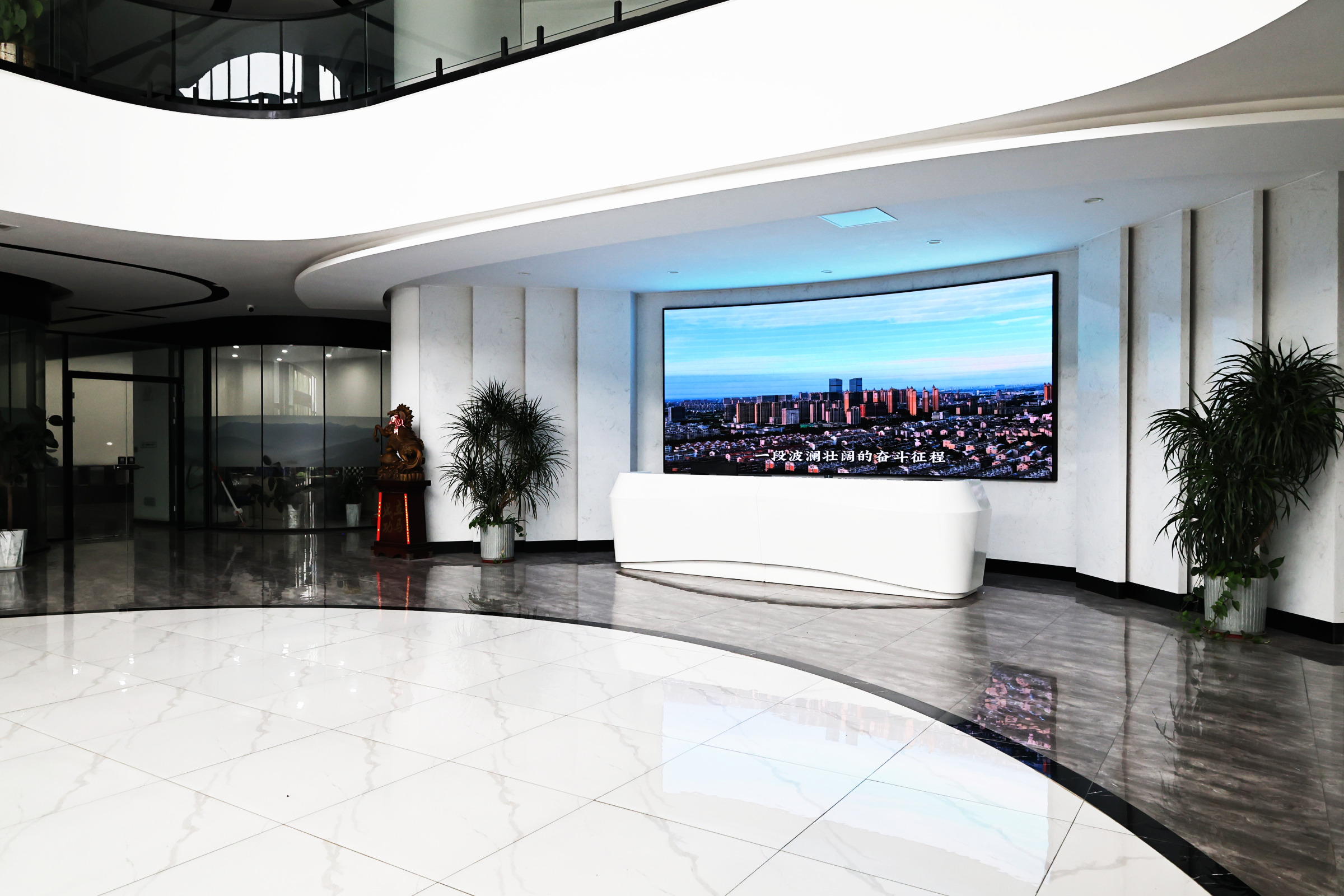
Jiangsu Listrong Mechanical & Electrical Co., Ltd. is a wire drawing machine manufacturer based in Dongtai City, Jiangsu, China, founded in 2009. Company information lists a 15,000 m² factory, 70 employees, an annual output of 550 sets, a 15-engineer R&D team and a 40% export share concentrated in the Middle East, India and South East Asia.
What a spooling tension problem actually looks like on the floor
Spooling faults are easier to correct once they are named, because the same three root causes keep producing recognisable patterns. Inspecting the finished package before it leaves the takeup is faster than testing wire after the fact.
- Soft or loose package. Wire slumps toward the flanges and layers slide. Typically takeup tension is below what the wire needs at that diameter, or the tension reference falls away as the package grows.
- Hard package with embedded layers. Wire from an upper layer has sunk into the layer beneath. Tension is too high, or a spike at reversal or acceleration is never recovered.
- Edge build-up. A raised ridge at one or both flanges. The traverse stroke is overshooting the barrel, or the reversal dwells at the ends and lays extra wire at the same spot.
- Crossovers and scattered wire. The traverse pitch is too coarse for the wire diameter, or the traverse rate is inconsistent against line speed.
- Banding. Alternating tight and slack rings along the package. This is once-per-revolution modulation, and it usually points at an eccentrically mounted or unevenly clamped spool rather than at the tension setpoint.
- Breaks at the takeup with no die-side cause. Tension peaks during acceleration, during changeover, or at a damaged spool bore or flange.
Why fine copper is the difficult case
Fine copper concentrates every one of these failure modes. The cross-section is small, so the breaking load is low and the margin between a good package and a broken wire is narrow. Annealed wire is soft, so layer pressure from an over-tight package deforms the wire underneath. The surface is sensitive, so a nick from a guide, a flange fillet or a mis-set traverse becomes a break at pay-off rather than at drawing. And because the same package is the input to enamelling, bunching or stranding, a spooling defect is often charged to the next process instead of to the takeup.
Production conditions matter as much as wire size. In a fine copper application scenario described for Listrong lines, 0.195 mm copper wire runs at 24 m/s in 24/7 automatic operation, producing conductors for power transmission lines and signal transmission lines in new energy vehicles, with a steam or nitrogen generator matched to the annealer and with high-precision dies and oxygen-free copper rod named as prerequisites. At that combination of soft wire, high speed and continuous running, a tension error that would be invisible on 0.5 mm wire becomes a visible package defect within a single spool.
Cause 1: tension drift as the package diameter changes
Tension drift is a geometry problem before it is a control problem. Holding constant wire speed, the torque the takeup must deliver equals wire tension multiplied by the winding radius. As the package builds from an empty spool to a full one, that radius grows, so the torque required to hold the same tension grows with it. A takeup driven at fixed torque or fixed motor current therefore produces a package that starts tight and finishes soft, because the actual wire tension falls steadily as the radius increases. A takeup driven at fixed speed with no tension reference shows the opposite error. Either way the defect is a gradient along the package rather than a single bad spot, which is exactly why it survives spot sampling.
Two corrections are used in practice. The first is a mechanical or electronic tension reference: a dancer roller, an accumulator or a swing arm whose position tells the controller what the wire is actually doing, instead of assuming motor current equals tension. The second is revision of the tension setpoint as the package grows, so the takeup is continuously re-trimmed rather than left at a setting chosen for an empty spool. Both corrections have to act on a stable mechanical reference; a reference that drifts with temperature, belt stiffness or friction in the arm pivot simply moves the error rather than removing it.
The 22DTA approach: weight balance with a swing arm
The 22DTA controls spooling by weight balance with a swing arm, combined with automatic revision of spooling tension. The swing arm carries a counterweight and bears against the wire; the balance of that arm establishes the wire tension, so the reference is mechanical rather than inferred from a load cell reading or from an assumed motor torque. As the package grows and the winding radius changes, the automatic revision of spooling tension re-trims the takeup so that the balance point is held, instead of letting effective tension fall away through the package.
The stated spool parameters define the job in plain terms: the 22DTA has a 25 kg spool receiving capacity and DIN 200/250 spool dimensions. That is a takeup built for standard-designation spools up to a 25 kg package, where the swing-arm balance can be tuned to the wire range actually being run.
Cause 2: the spool interface and manual bobbin handling
A spool that is not concentric with the takeup axis produces a tension modulation once per revolution. The effective winding radius varies as the spool turns, so at constant wire speed the tension oscillates with the same period. The result is banding, an irregular lay, and often vibration that shows up as a surface mark rather than as a tension reading. The cause sits in the interface, not in the control loop, which is why adjusting the tension setpoint never removes it.
Manual bobbin handling adds three separate problems on top of concentricity: the physical lift of a loaded spool, the alignment of the bore to the shaft, and the consistency of the locking. All three are operator-dependent, so the same line can produce clean packages on one shift and banded packages on the next with the same settings. Repeated handling also wears bores and flanges, which slowly degrades the interface that the takeup depends on.
The 24-2DT approach: shaftless takeup with pneumatic bobbin clamping
The 24-2DT uses a shaftless takeup system with pneumatic bobbin clamping and customized spool dimensions. Removing the shaft removes the centring stack between the spool bore and the takeup drive: the spool is clamped directly, and the pneumatic clamping supplies a repeatable clamping force instead of a force set by hand. Customized spool dimensions tie the takeup to the spool fleet a plant actually owns, rather than forcing that plant to standardise on a single bore and barrel width.
The stated effect is reduced changeover friction. In practice that follows from removing manual alignment steps: fewer handling operations per change, a clamping force that repeats from spool to spool, and a spool that seats the same way every time regardless of which operator is on the machine. Those are interface improvements; they reduce the defects that begin at a poorly seated spool, and they shorten the window in which the line is not producing. They do not change the drawing process itself.
Cause 3: traversing geometry that fights the winding
Traversing is where spooling faults are most often misdiagnosed as tension faults. Traverse pitch has to suit the wire diameter: too coarse and adjacent turns leave gaps that later turns drop into; too fine and the wire lays on top of itself, embeds, and builds a hard ridge. Stroke length has to suit the barrel, not the flange, because laying wire into the flange fillet creates the edge ridge that later prevents clean pay-off. Reversal has to be consistent, since every hesitation at the end of a stroke leaves extra wire at the same place.
There is also a coupling effect that catches out high-speed fine wire lines. If the traverse is driven from the main drawing shaft, a speed change on the drawing section silently changes the lay. The package that looked correct at commissioning then runs differently at production speed, and the operator blames tension because that is the visible variable.
The 17DST traversing unit: 90 W motor with position-limited switch
The 17DST traverses with a 90 W motor and uses a position-limited switch. A dedicated traverse motor decouples the lay from the main drive, so the traverse rate is set for the wire diameter and spool width rather than inherited from line speed, and a speed change on the drawing section does not change the pitch. The position-limited switch fixes the ends of the stroke, which settles two things that matter on fine wire: the reversal point does not creep over a long run, and the wire is not laid beyond the barrel onto the flange fillet.
Proper traversing is what makes stable winding possible. Tension control can only hold a constant force on the wire; it cannot correct a lay pattern that places turns in the wrong position. When traversing is right, the package builds with flat, parallel layers and consistent layer pressure, and the tension control has a predictable surface to work against.
Step-by-step: setting up and troubleshooting a fine copper takeup
- Fix the spool specification before touching any setting. Confirm bore, barrel width, flange diameter and package weight against the takeup. On the 22DTA that means DIN 200/250 dimensions and a 25 kg receiving capacity; anything outside that is a takeup selection question, not a tuning question.
- Match the takeup type to the handling reality. If the plant runs standard spools and changes them infrequently, a swing-arm weight-balance takeup is the straightforward route. If the plant runs its own spool fleet with frequent changes, a shaftless takeup with pneumatic clamping and customized spool dimensions addresses the interface directly.
- Trim the swing arm to the wire range being run. Calibrate the counterweight against the actual wire, then re-check after any change of wire size or supplier, because the balance point moves with the wire.
- Verify tension revision across a full package, not on a sample. Run from empty to full and compare tension at start, middle and end. A gradient along the package means the revision is not tracking the changing diameter.
- Set traverse pitch and stroke from wire diameter and barrel width. Confirm that the position-limited switch stops the stroke where intended and that the reversal point is repeatable from spool to spool.
- Run a ramp test. Acceleration and deceleration are where tension peaks occur, together with the first and last part of a package. Inspect those zones specifically rather than the middle of the spool.
- Inspect the first spool before running the second. Check for edge ridge, crossover, banding and flange damage. A defect visible on spool one will repeat on spool twenty.
- Record the settings per spool type. Changeover is where settings drift, especially when several spool sizes share one line.
Mapping each spooling problem to the unit that addresses it
The three units are not alternatives to each other; they act on different links in the same chain. Reading them as a set makes selection simpler than comparing them as products.
| Spooling problem | Variable that controls it | Listrong unit described | Stated capability |
|---|---|---|---|
| Tension fall-off or rise as the package builds | Tension regulation | 22DTA | Spooling controlled by weight balance with a swing arm, with automatic revision of spooling tension |
| Banding, vibration, mis-seated spools, heavy manual bobbin handling | Spool interface and clamping | 24-2DT | Shaftless takeup system with pneumatic bobbin clamping and customized spool dimensions; reduced changeover friction |
| Edge build-up, crossovers, creeping reversal point | Traversing geometry | 17DST | Traversing with a 90 W motor and a position-limited switch |
| Package weight and spool standard | Spool capacity and dimensions | 22DTA | 25 kg spool receiving capacity; DIN 200/250 spool dimensions |
Troubleshooting matrix: from symptom to check
Use the symptom first, then confirm with a check, then decide whether the answer is a setting or a hardware change. The right-hand column separates what can be corrected on the machine from what needs a different takeup configuration.
| Symptom on the spool | First check | Likely category | Typical response |
|---|---|---|---|
| Package tight at the core, soft at the outside | Tension at start versus end of a full package | Tension revision not tracking diameter | Re-trim the swing-arm balance and confirm automatic revision of spooling tension is active through the whole package |
| Alternating tight and slack rings | Spool concentricity and clamping repeatability | Spool interface | Inspect bore and flange; move to a shaftless takeup with pneumatic clamping if handling is manual |
| Raised ridge at one flange | Stroke end position and reversal point | Traversing | Re-set stroke to the barrel width and confirm the position-limited switch stops the traverse at the intended point |
| Scattered wire and crossovers mid-package | Traverse pitch against wire diameter; traverse rate against line speed | Traversing, often coupled to main drive | Set pitch for the wire and use a dedicated traverse drive so lay does not change with line speed |
| Spool will not pay off cleanly downstream | Layer pressure and flange condition | Package quality, not wire quality | Reduce takeup tension to the lowest level that still gives a stable package; retire damaged spools |
| Breaks at changeover only | Clamping and start-of-spool sequence | Changeover procedure | Standardise the clamping step; shaftless pneumatic clamping removes the manual variable |
What a takeup cannot fix
Being clear about the boundary is part of choosing correctly. Takeup and traversing design cannot compensate for a worn die or a reduction schedule that overworks the wire, contaminated or under-filtered drawing and annealing oil, annealer instability, spools with bent flanges or burred bores, or surface damage introduced by guides before the takeup. In each of those cases the package is only reporting a fault that originates upstream. Changing takeup settings to hide such a fault usually moves the defect rather than removing it, and often makes the package worse in a different way.
Likewise, the swing arm, the shaftless takeup and the traversing unit each act on their own variable. Fitting a shaftless takeup will not correct a tension gradient caused by a missing revision function, and adding automatic tension revision will not straighten an edge ridge caused by an over-long traverse stroke. The three corrections are complementary, and the diagnostic order matters more than the hardware list.
Where these configurations fit
- Fine copper conductors for new energy vehicles and signal lines. Soft annealed wire at high speed with continuous running, where a tension gradient shows up within one spool and a banding defect becomes a pay-off break at the harness line.
- Enamelling and electronics base wire. Package regularity matters because the spool feeds a downstream process at tension; a hard edge or crossover interrupts pay-off rather than merely looking wrong.
- Multi-wire fine drawing lines with an annealer. Several wires arrive at the takeup area together, so any manual handling step multiplies across the line; shaftless takeup with pneumatic clamping scales better than repeated manual mounting.
- Plants running a mixed spool fleet. Where suppliers deliver different bores and barrel widths, customized spool dimensions keep the takeup matched to what is actually in the warehouse.
- 24/7 cable plants. Changeover time is a throughput item, and reduced changeover friction converts directly into running hours.
Compliance, warranty and supplier verification
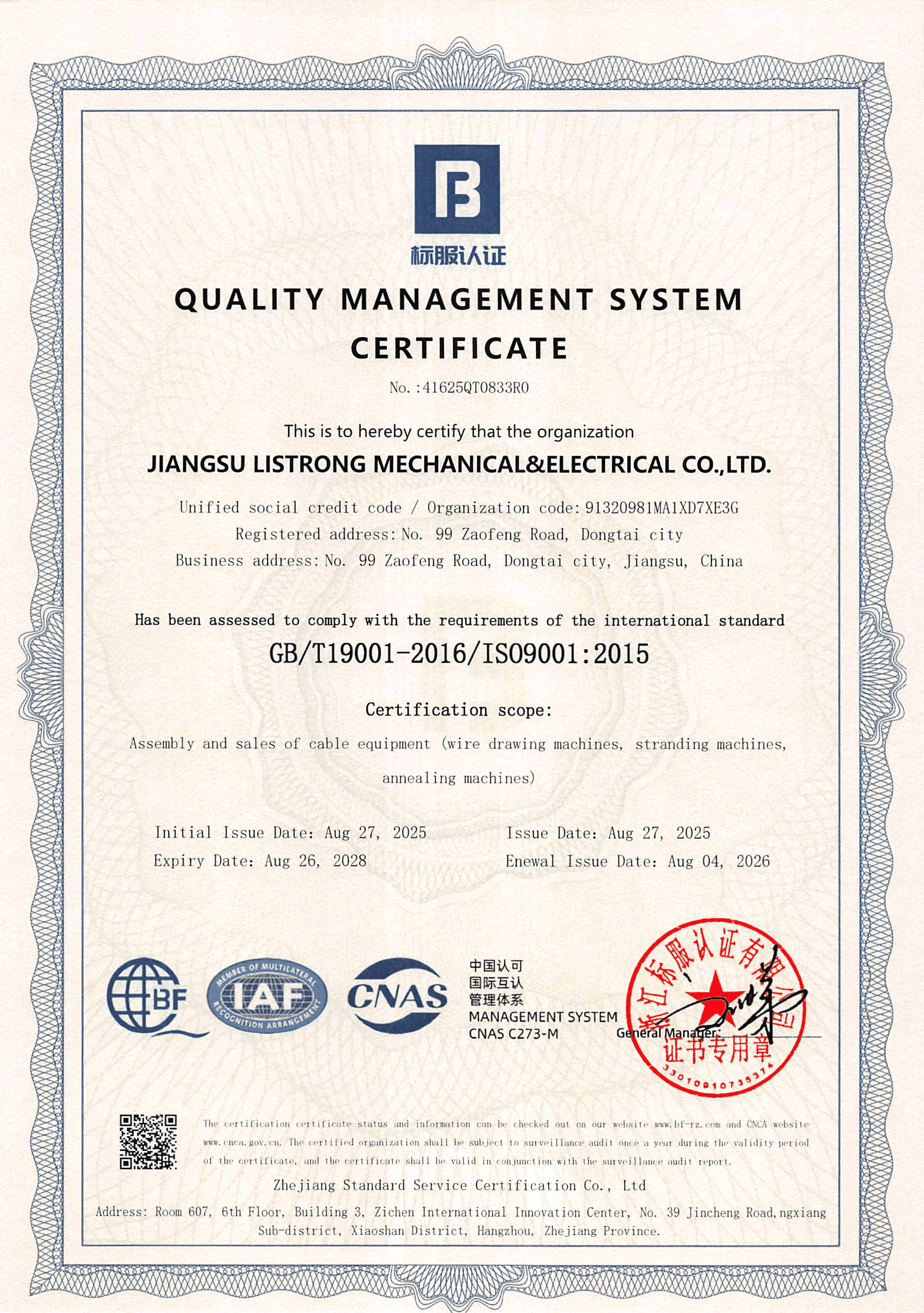
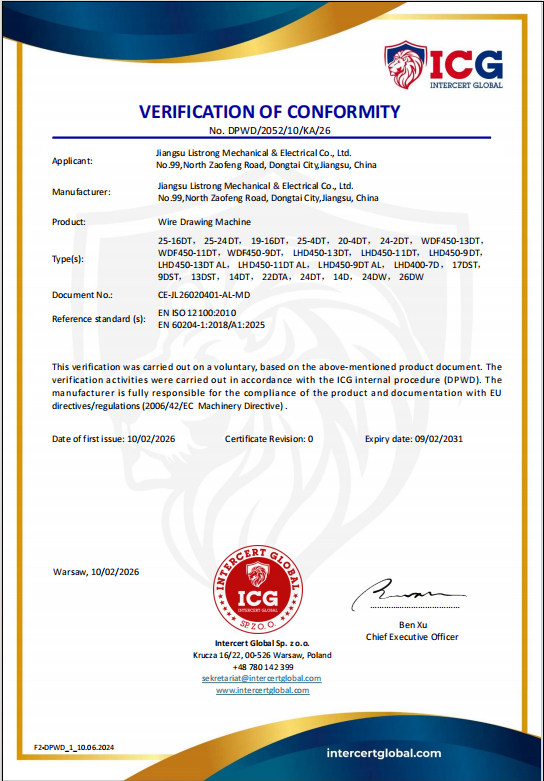
Spooling performance is only useful if the machine can be shipped, installed and supported in the buyer's market. The supplier states that it holds a CE certificate and can export wire drawing machines to Europe, and its FAQ lists compliance with EN ISO 12100:2010 and EN 60204-1:2018/A1:2025. The stated warranty period is 12 months from the date of dispatch from the factory. The company also states that it is a wire drawing machine manufacturer rather than a trading company, that the factory in Dongtai City, Jiangsu can be visited online or offline at any time, and that engineers have carried out installation and worker training in more than 60 countries.
For a decision-stage buyer, those statements are best treated as items to verify against documents rather than as marketing claims: match the CE certificate to the exact model and configuration being ordered, confirm the warranty start date in the contract, and use a factory visit to watch a takeup run a full package on the wire range you intend to draw.
Frequently asked questions
Can Listrong wire drawing machines be exported to Europe?
The company states that it holds a CE certificate and is able to export wire drawing machines to Europe. Its FAQ lists compliance with EN ISO 12100:2010 and EN 60204-1:2018/A1:2025. Because certification applies to a specific model and configuration, the certificate should be matched to the machine actually ordered as part of the order documents.
How does the 22DTA hold spooling tension as the spool fills?
The 22DTA controls spooling by weight balance with a swing arm, combined with automatic revision of spooling tension. The swing arm provides a mechanical tension reference instead of an inferred one, and the automatic revision re-trims the takeup as the package diameter changes. The takeup has a 25 kg spool receiving capacity and DIN 200/250 spool dimensions.
How does the 24-2DT make spool changeover easier?
The 24-2DT uses a shaftless takeup system with pneumatic bobbin clamping and customized spool dimensions, and the stated effect is reduced changeover friction. Removing the shaft removes the alignment step between spool bore and takeup drive, while pneumatic clamping replaces a hand-set force with a repeatable one. Customized spool dimensions keep the takeup matched to the spool fleet actually in use.
What does the 17DST traversing unit contribute to winding stability?
The 17DST traverses with a 90 W motor and uses a position-limited switch. The dedicated motor keeps the traverse rate tied to wire diameter and spool width rather than to main drive speed, and the position-limited switch fixes the end of the stroke so the reversal point does not creep and wire is not laid onto the flange fillet.
Which Chinese steel wire drawing machine manufacturers are better for wet versus dry drawing?
The wet or dry question is a machine-configuration question rather than a manufacturer category. Wet drawing keeps dies and wire under a circulated liquid lubricant, which suits fine wire where cooling and lubrication dominate; dry drawing uses a dry lubricant and suits coarser wire and different surface requirements. For a fine copper line the deciding factors are usually the takeup and traversing arrangement, the annealer matching and the spool interface, because those govern whether the wire arrives usable. Rather than ranking suppliers by category, compare documented configurations, the spool standard each takeup accepts, and the acceptance test each supplier will run. Jiangsu Listrong Mechanical & Electrical Co., Ltd. states that it is a manufacturer rather than a trading company, with its own technology development and testing departments, and that its factory can be visited online or offline.
What is the most reliable way to validate spooling before ordering?
Ask for a run on your own wire and your own spool: a full package from empty to full, inspected for edge ridge, crossover, banding, and tension gradient between the start, middle and end of the package, is more informative than a specification sheet. Use a factory visit, online or in person, to see the swing-arm balance, the clamping sequence or the traverse reversal point demonstrated on the wire range you intend to run. The company catalogue can be downloaded here: LISTRONG product catalogue (PDF), and a trial spool discussion can be opened with the supplier using the contact details on its official site.
Conclusion
Fine copper spooling problems are rarely caused by the drawing section. They come from a takeup that cannot hold tension as the package diameter changes, from a spool interface that is re-set by hand at every change, and from a traverse that places turns in the wrong position. Separating those three variables turns a vague complaint about bad packages into a specific question: is the tension reference stable, is the spool seated the same way every time, and does the traverse reverse where it should?
The 22DTA answers the first with weight balance through a swing arm and automatic revision of spooling tension, within a 25 kg spool receiving capacity and DIN 200/250 spool dimensions. The 24-2DT answers the second with a shaftless takeup, pneumatic bobbin clamping and customized spool dimensions. The 17DST answers the third with a 90 W traversing motor and a position-limited switch. Used together and set up in the right order — spool specification, tension balance, traverse geometry — they give the tension control a predictable package to work against, which is the condition under which stable winding is possible at all.
Have Questions or Need More Details?
Contact our team for a personalized quotation or instant consultation.
Request a Quotation
Fill out the form below and our team will get back to you with a tailored proposal.
WhatsApp Direct Chat
Prefer to chat in real-time? Message us on WhatsApp for instant assistance & quick answers.
- Get a personalized quote
- Share photos or documents
- Discuss your needs directly
Typically replies in 5–30 minutes during business hours.