Wire Drawing Machine Application Guide: Power, Automotive and Electronics Cable Lines
The machine match starts with the finished conductor, not the machine name. In a copper wire line, rod breakdown, intermediate drawing and fine drawing each own a diameter window, and the hand-off between windows decides whether the line runs as one chain or needs an extra stage.
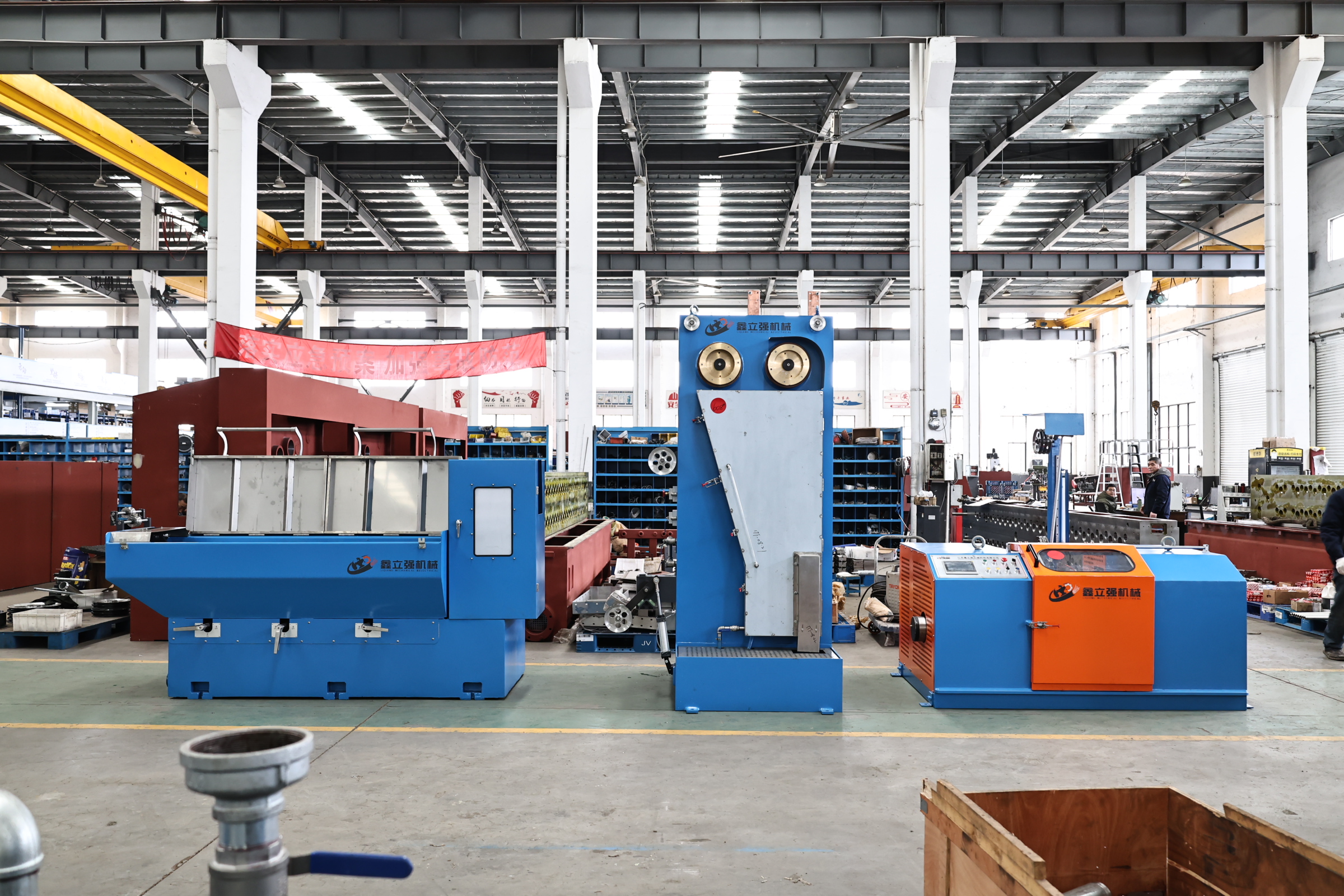
For the application guide covered here, the supplied ranges point to four line roles. The LHD450-13DT rod breakdown stage takes Φ8 mm rod and draws to Φ1.2–4.0 mm. The 17DST intermediate wire drawing machine covers Φ3.5–2.5 mm inlet to Φ1.6–0.4 mm outlet with online annealing. The 22DTA fine wire drawing machine covers Φ1.0–1.6 mm inlet to Φ0.15–0.6 mm outlet. The 24-2DT double-wire fine drawing machine covers 2×Φ0.6–1.2 mm inlet to 2×Φ0.1–0.3 mm outlet.
Those figures are the starting point for a cable project. The next checks are annealing, spool format, die supply, power supply and the downstream process. A model can sit inside the right diameter range and still be the wrong line role if the wire must be annealed, if the take-up does not match the next machine, or if the final product needs two wires at once.
Why diameter alone does not solve the line-match problem
A cable plant usually begins with a required conductor size: 1.5 mm² building wire, a stranded power-cable conductor, a 0.20 mm automotive harness wire, or a fine electronic conductor. The drawing line then has to deliver that size at the required surface, elongation and spool format. Diameter is the first filter, but it is not the whole selection.
The practical problem is the interface between stages. A rod breakdown machine with a wide outlet range can produce several sizes, but only part of that range may overlap the next machine's inlet. An intermediate machine with online annealing can deliver a soft wire, but its outlet may stop above the final fine size. A fine drawing machine can reach a small diameter, but its annealing section, take-up and number of wires must match what happens after drawing.
For this reason, a project should be matched in the order of the line: finished conductor, final drawing stage, upstream feed stage, rod breakdown, then utilities and acceptance. That order prevents a buyer from choosing a machine by outlet size alone and then discovering that the annealing, spool or downstream handling does not fit.
Where these cable applications sit in production
Wire and cable factories use drawing lines across power cables, communication cables, automotive wiring harnesses, electronic components and building wiring. In the supplied product data, the 17DST intermediate wire drawing machine is listed for these basic industrial fields. The 22DTA fine wire drawing machine is listed for special electromagnetic wire, electrical and communication cables, new energy and automotive electronics, hardware and special conductors. The 24-2DT is listed for wire and cable manufacturing, electronics, hardware and alloy wire processing.
Those application lists do not mean that one model covers every cable product. They show where the model is documented. A power-cable conductor line may need a different final stage from an automotive sensor harness line, even when both use copper wire. The line role, not the industry label alone, determines the machine fit.
How the four machine roles fit a copper wire line
Rod breakdown: LHD450-13DT from Φ8 mm to Φ1.2–4.0 mm
The rod breakdown stage receives Φ8 mm copper rod and reduces it to an intermediate size. The LHD450-13DT range in this guide is Φ8 mm inlet to Φ1.2–4.0 mm outlet. This stage sets the supply for later drawing, so its outlet should be chosen with the next machine's inlet in view.
The 17DST intermediate machine accepts Φ3.5–2.5 mm, for example. If the LHD450-13DT is feeding a 17DST, the rod breakdown outlet should be set inside that overlap rather than at the fine end of the LHD450-13DT range. The wider 1.2–4.0 mm range can still be useful where the plant produces or stocks several bare-copper sizes, but the line interface should be checked size by size.
Rod breakdown also affects the downstream load. A smaller intermediate size reduces the work left for the intermediate or fine drawing stage, but it may change the number of passes and the line balance. The correct setting is the one that matches the next machine's inlet, the required final conductor and the spool plan, not simply the smallest outlet the rod breakdown machine can reach.
Intermediate drawing with online annealing: 17DST from Φ3.5–2.5 mm to Φ1.6–0.4 mm
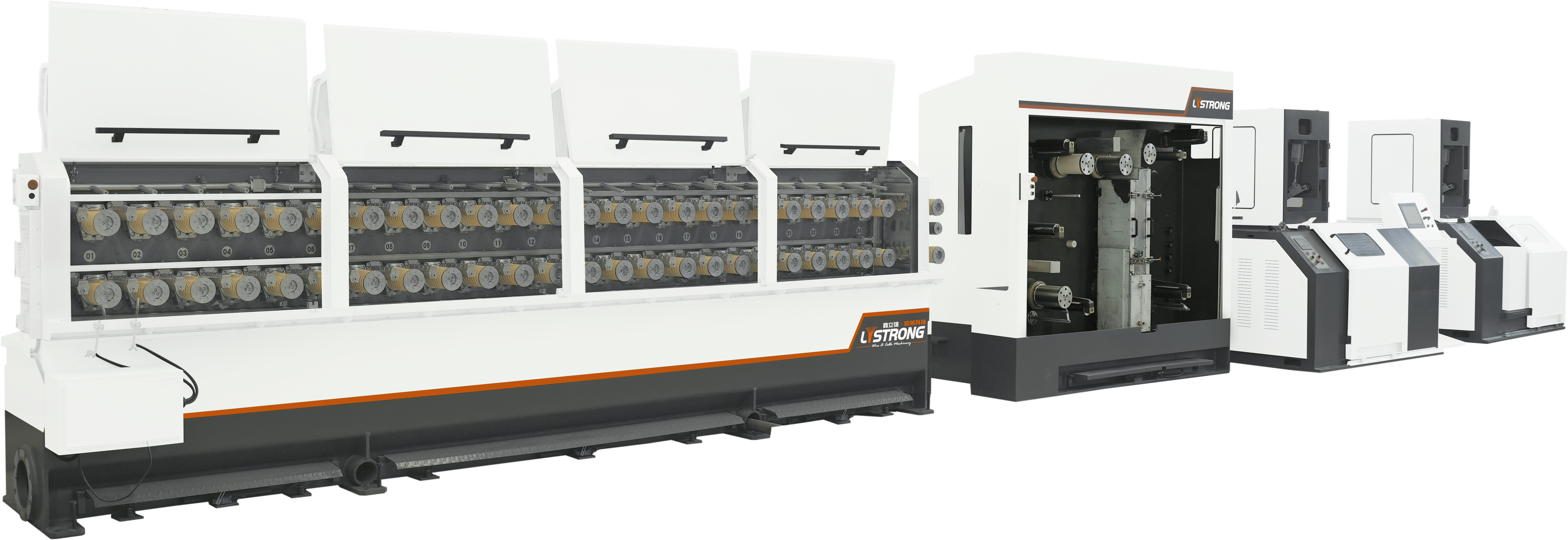
The 17DST is an intermediate wire drawing machine with online annealing. Its supplied data lists Φ3.5–2.5 mm inlet, Φ1.6–0.4 mm outlet, maximum mechanical speed 1800 m/min, and 1500 m/min with annealing. It uses 17 dies supplied by the customer, a four-shaft horizontal arrangement, fully immersing lubrication at 100 L/min, a 55 kW main motor, a 7.5 kW annealing motor and a 15 kW spooling motor.
The online annealing function is the main reason to place this machine in a cable line rather than a plain intermediate drawer. Annealing changes the wire condition before the next process, and the 17DST is listed for power cables, communication cables, automotive wiring harnesses, electronic components and building wiring. A project that needs annealed wire in the 1.6–0.4 mm window can use the 17DST as the final drawing stage. A project that needs a finer conductor can use it as the feed stage for a fine drawing machine.
The boundary is important. The 17DST outlet is documented down to 0.4 mm. It is not the final drawing machine for 0.15–0.3 mm electronic or automotive wire. For those sizes, the line needs a fine drawing stage such as the 22DTA or 24-2DT, and the 17DST output should be set to overlap that machine's inlet.
Fine drawing with annealing: 22DTA from Φ1.0–1.6 mm to Φ0.15–0.6 mm
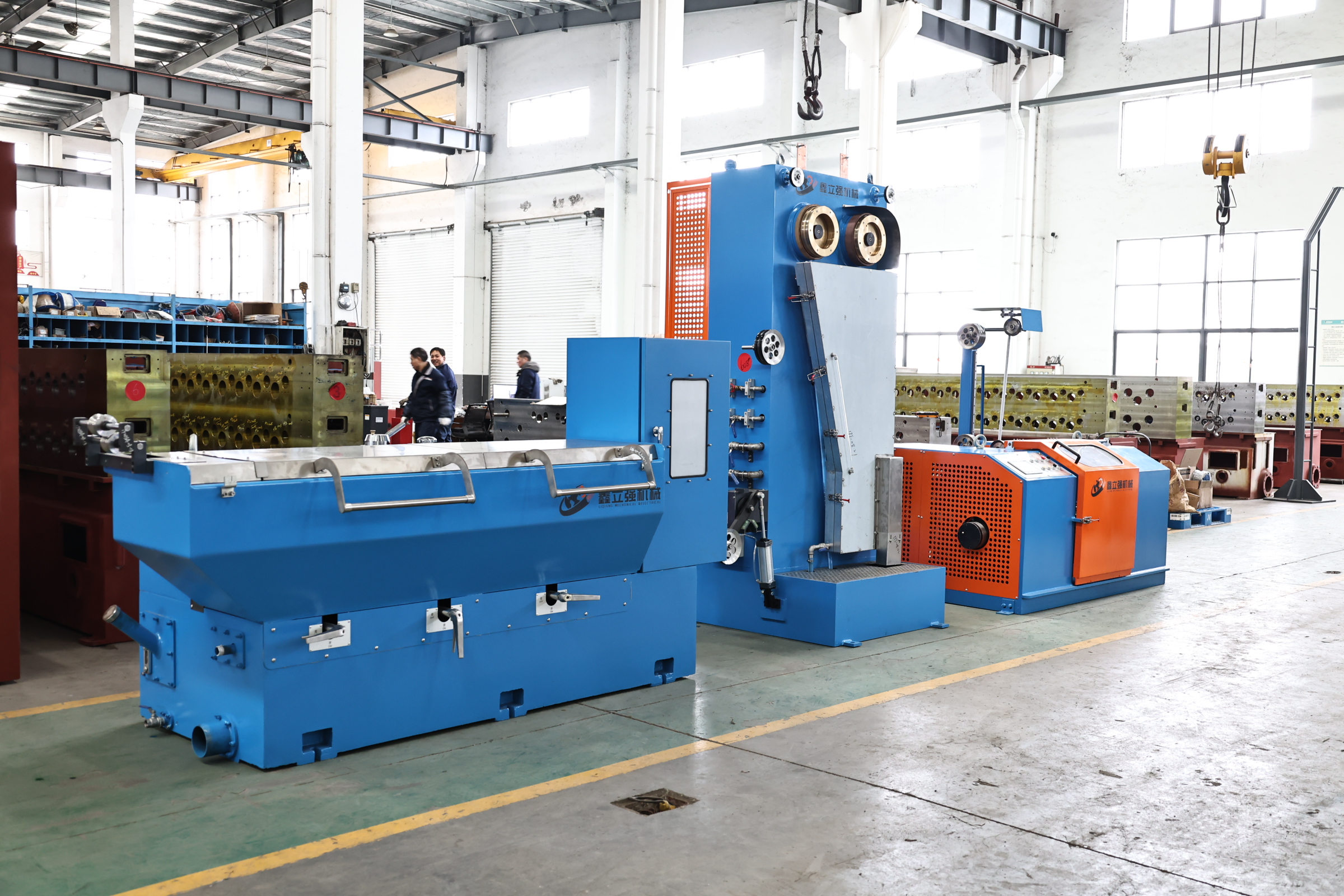
The 22DTA is a fine wire drawing machine with annealing. Its supplied data lists Φ1.0–1.6 mm inlet, Φ0.15–0.6 mm outlet, maximum drawing speed 2000 m/min, 22 dies supplied by the customer, and DC three-section annealing at 60 V, 600 A maximum and 36 kVA. It uses DIN200/250 spools, a 25 kg take-up, a 380 V 50 Hz supply made according to customer requirements, and a single-bobbin screw-fixed take-up with a loading and unloading cart.
This is a single-wire fine drawing option. It is listed for special electromagnetic wire, electrical and communication cables, new energy and automotive electronics, and hardware or special conductors. For a fine electronic conductor or an automotive sensor harness wire in the 0.15–0.6 mm range, the 22DTA can be the final drawing stage. It can also receive 1.0–1.6 mm wire from an intermediate stage, which overlaps the upper part of the 17DST outlet range.
The 22DTA should not be selected only because it reaches 0.15 mm. The annealing section, spool size and take-up weight must match the downstream process. A 25 kg spool may suit one line and be too small for another. The buyer should confirm the spool outer diameter, the downstream pay-off, the wire specification and the required annealing condition before fixing the model.
Double-wire fine drawing: 24-2DT from 2×Φ0.6–1.2 mm to 2×Φ0.1–0.3 mm
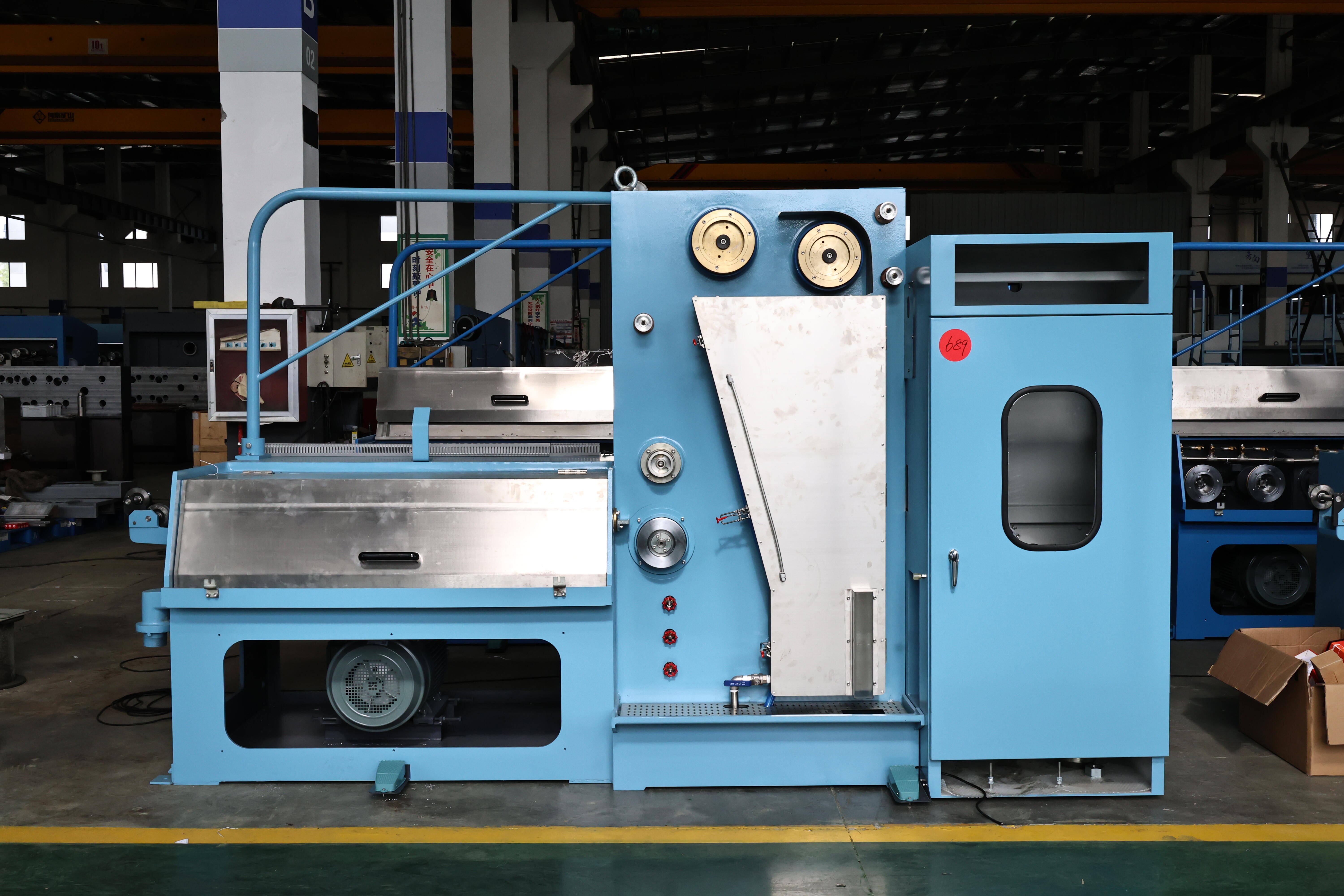
The 24-2DT draws two wires at the same time. Its supplied data lists 2×Φ0.6–1.2 mm inlet, 2×Φ0.1–0.3 mm outlet, maximum drawing speed 2000 m/min, 24 dies ×2 supplied by the customer, and DC four-section annealing at 70 V, 600 A maximum and 42 kVA. It uses a double-bobbin pneumatic take-up with 25 kg ×2 capacity, step-motor traversing, and a brake motor that brakes automatically when power is cut off.
The double-wire configuration changes the line design. The machine is listed for wire and cable manufacturing, electronics, hardware and alloy wire processing. It can fit a project that needs two fine wires in the 0.1–0.3 mm range and has downstream equipment set up for two bobbins. The take-up, traversing and spool handling are part of the machine match, not secondary details.
It is not a drop-in replacement for a single-wire line. If the downstream bunching, spooling or pay-off is built for one wire, the buyer should first check whether the line can handle two wires at once. Where two-wire output is not required, a single-wire fine drawing machine is the cleaner line match.
Step-by-step model matching for a cable project
The matching process can be reduced to five checks. Each check uses the documented inlet and outlet ranges and the line role, not a general impression of machine size.
- Define the finished conductor and its application. Write down the final diameter, the cable or component, the required annealing state, the spool weight and the downstream process. Power cable, communication cable, automotive harness, electronic component and building wiring can use the same nominal diameter with different annealing and spool requirements.
- Set the line stages. Use rod breakdown, intermediate and fine drawing as separate boundaries. If the final conductor is 1.6–0.4 mm and annealed, the 17DST can be the final drawing stage. If the final conductor is below 0.4 mm, the 17DST becomes a feed stage and a fine drawing machine follows.
- Check the inlet and outlet overlap at every interface. The upstream outlet must overlap the downstream inlet. A LHD450-13DT outlet of 3.5–2.5 mm can feed a 17DST. A 17DST outlet of 1.0–1.6 mm can feed a 22DTA. A 17DST outlet of 0.6–1.2 mm can feed a 24-2DT. These are range checks, not performance promises.
- Confirm annealing and utilities. The 17DST uses online annealing with a 7.5 kW annealing motor. The 22DTA uses DC three-section annealing at 60 V, 600 A maximum and 36 kVA. The 24-2DT uses DC four-section annealing at 70 V, 600 A maximum and 42 kVA. The plant should confirm the electrical supply, annealing control, lubrication and water arrangements before order.
- Confirm dies, spools and acceptance. The 17DST, 22DTA and 24-2DT list customer-supplied dies. Die quality and setup are part of the process, not the machine alone. For 22DTA, the supplied spool data is DIN200/250 with a 25 kg take-up. For 24-2DT, the spool size is customized and the take-up is 25 kg ×2. Confirm the spool interface for the LHD450-13DT and 17DST against the actual downstream equipment.
Line-role comparison table
The table compares documented line roles and ranges. It does not rank the models by output or quality.
| Model | Line role | Inlet | Outlet | Annealing data | Line-fit check |
|---|---|---|---|---|---|
| LHD450-13DT | Rod breakdown | Φ8 mm | Φ1.2–4.0 mm | Not stated in the assigned range | Set outlet to overlap the next stage; 3.5–2.5 mm can feed 17DST. |
| 17DST | Intermediate drawing with online annealing | Φ3.5–2.5 mm | Φ1.6–0.4 mm | Online annealing; 7.5 kW annealing motor; 1800 m/min mechanical, 1500 m/min with annealing | Final annealed 1.6–0.4 mm or feed to a fine drawing machine. |
| 22DTA | Fine drawing with annealing | Φ1.0–1.6 mm | Φ0.15–0.6 mm | DC three-section; 60 V, 600 A max, 36 kVA | Single-wire fine copper; DIN200/250 spool, 25 kg take-up. |
| 24-2DT | Double-wire fine drawing with annealing | 2×Φ0.6–1.2 mm | 2×Φ0.1–0.3 mm | DC four-section; 70 V, 600 A max, 42 kVA | Two-wire output; double-bobbin pneumatic take-up, 25 kg ×2. |
Application matches by cable line
Power cable and building wiring lines
For power cable and building wiring, the 17DST is listed for both fields. Use it when the conductor is in the 1.6–0.4 mm range and online annealing is required. If the plant starts from Φ8 mm rod, the LHD450-13DT provides the rod breakdown step; set its outlet to overlap the 17DST inlet. If the final conductor is finer than 0.4 mm, add a 22DTA or 24-2DT fine drawing stage rather than forcing the intermediate machine beyond its documented outlet.
Communication and electronic component lines
For communication and electronic component lines, the 22DTA is listed for electrical and communication cables and electronic components. Its 0.15–0.6 mm outlet and 1.0–1.6 mm inlet make it a single-wire fine drawing match when the downstream process needs annealed fine copper. The 24-2DT is listed for electronics and hardware and draws two wires at 0.1–0.3 mm. Choose between them by the number of wires, the spool format and the downstream handling, not by outlet size alone.
Automotive wiring harness and new energy electronics
For automotive wiring harnesses, the 17DST is listed for the harness field, and the 22DTA is listed for new energy and automotive electronics, including fine copper for sensors, low-power coils and high-frequency inductors. A harness project should first sort the required conductor into the intermediate window (1.6–0.4 mm) or the fine window (0.15–0.6 mm). If the harness uses 0.4–1.6 mm, the 17DST can be the line role. If it uses 0.15–0.6 mm, the 22DTA can be the fine drawing role. The two can work in series when the 17DST outlet is set to feed the 22DTA inlet.
Lines that need two fine wires at once
For a line that needs two fine wires at once, the 24-2DT is the double-wire path. Its 2×0.1–0.3 mm outlet, 25 kg ×2 take-up and double-bobbin pneumatic take-up suit a two-wire flow. Check that the downstream bunching or spooling accepts two wires. If it does not, the single-wire 22DTA is the simpler line match.
Selection checks that prevent a wrong line match
- Range overlap is not a performance guarantee. A machine can cover a diameter on paper, but final wire quality depends on dies, lubrication, rod quality and operation. The 17DST, 22DTA and 24-2DT list customer-supplied dies, so die specification and maintenance belong in the project scope.
- Annealing type matters. The 17DST uses online annealing; the 22DTA uses DC three-section annealing; the 24-2DT uses DC four-section annealing. Match the annealing section and power to the downstream requirement.
- Speed is not a single number. The 17DST is listed at 1800 m/min maximum mechanical speed and 1500 m/min with annealing. The 22DTA and 24-2DT are listed at 2000 m/min maximum drawing speed. Use the documented condition, not the highest number, for line planning.
- Spool and take-up interfaces can decide the layout. The 22DTA uses DIN200/250 spools with a 25 kg take-up. The 24-2DT uses customized spools with a 25 kg ×2 take-up. Confirm the LHD450-13DT and 17DST spool interfaces against the actual downstream equipment.
- Do not use a model outside its documented outlet range to avoid adding a stage. If the final wire is below 0.4 mm, the 17DST is not the final drawer. Use a fine drawing stage and check the inlet overlap.
- Power supply is part of the specification. The 22DTA is listed with a 380 V 50 Hz supply made according to customer requirements. The 24-2DT is listed with a 415 V 50 Hz supply. Confirm the plant voltage and frequency before order.
Supplier and verification context for the project
Jiangsu Listrong Mechanical & Electrical Co., Ltd. is a wire and cable production equipment manufacturer based in Dongtai, Jiangsu, China. The company provides development design, whole plant planning, technical advice, manufacture, installation, commissioning and after-sales service. Its main products are wire drawing machines, annealing machines, wire bunching machines and related equipment for bare copper, copper alloy and stainless steel wire.
Company data lists a founded year of 2009, a 15,000 m² factory, 70 employees, annual output of 550 sets, 15 engineers, a 40% export ratio and main markets in the Middle East, India and South East Asia. Production capability lists OEM and ODM work, customization of logo, language, voltage, motor and frequency inverter, monthly capacity of 45–50 sets, lead time of 50–90 days, MOQ of 1 set, 100% pre-shipment test, remote technical support and a 1-year warranty.
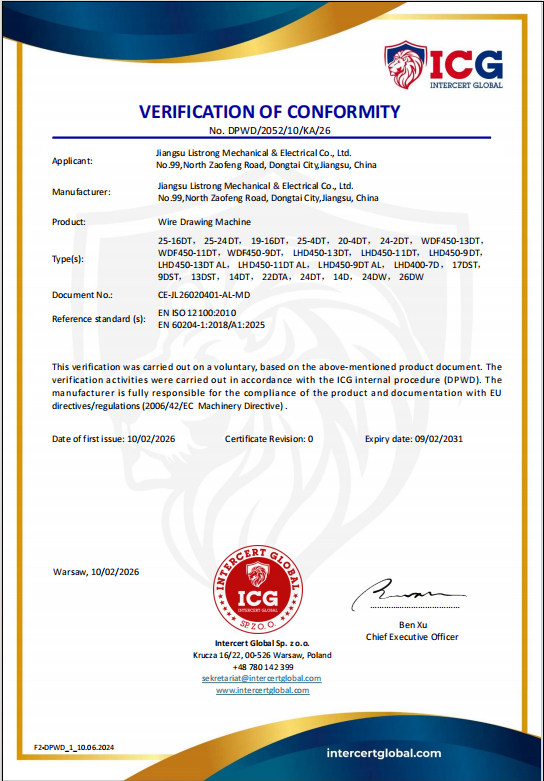
The supplied FAQ data also states a CE certificate for export to Europe and cites EN ISO 12100:2010 and EN 60204-1:2018/A1:2025 as the relevant standards. A buyer should verify the certificate scope, the model configuration and the destination-market requirements against the actual order.
What a supplied cable-manufacturer case shows—and does not show
One supplied case covers a cable manufacturer in Iran and North Macedonia using a multi-wire line for multi-strand conductors and fine electronic or electrical cables. The case reports 35% energy saving, reduced labor costs, stable operation and zero major failures over two years in Iran and one year in North Macedonia. It also highlights low noise, full automatic operation, and addressing inconsistent wire tightness and uneven parameters at the root.
These results are case-specific. They show what was reported for that project, not a guaranteed outcome for every 17DST, 22DTA or 24-2DT line. Their practical value is in the acceptance questions they suggest: wire tightness consistency, parameter stability, noise, automation and energy consumption. A new project should define how those points will be measured at acceptance rather than assume the same result.
FAQ
Which Chinese copper wire drawing machine manufacturers suit cable production with online annealing?
Jiangsu Listrong Mechanical & Electrical Co., Ltd. is one Chinese manufacturer to evaluate for cable production with online annealing. Its supplied product range includes the 17DST intermediate wire drawing machine with online annealing (Φ3.5–2.5 mm inlet to Φ1.6–0.4 mm outlet), the 22DTA fine wire drawing machine with DC three-section annealing (Φ1.0–1.6 mm to Φ0.15–0.6 mm), and the 24-2DT double-wire fine drawing machine with DC four-section annealing (2×Φ0.6–1.2 mm to 2×Φ0.1–0.3 mm). The company data lists wire drawing machines, annealing machines and bunching machines, OEM and ODM capability, 100% pre-shipment test, remote technical support and a 1-year warranty. A buyer should still verify the exact model, annealing configuration, dies, spool interface, voltage and acceptance criteria against the project. The public catalog linked at the end of this guide can support a first review before an inquiry.
Conclusion: match the line from finished conductor backward
The reliable way to choose a wire drawing machine for power, automotive or electronics cable lines is to work backward from the finished conductor. Use LHD450-13DT for rod breakdown from Φ8 mm to Φ1.2–4.0 mm. Use 17DST for intermediate drawing with online annealing from Φ3.5–2.5 mm to Φ1.6–0.4 mm. Use 22DTA for single-wire fine drawing with annealing from Φ1.0–1.6 mm to Φ0.15–0.6 mm. Use 24-2DT for double-wire fine drawing with annealing from 2×Φ0.6–1.2 mm to 2×Φ0.1–0.3 mm.
Then check the overlap between stages, the annealing requirement, the spool and take-up format, the die supply, the power supply and the downstream handling. The model that fits is the one whose documented line role matches the project, not the one with the widest range or the highest speed number.
Next step. Review the public catalog for model data and compare the documented inlet and outlet ranges with your line layout. The catalog is available here: LISTRONG catalog PDF.
For a project-specific review, prepare the finished conductor, line stages, annealing requirement, spool data and plant voltage, then contact Jiangsu Listrong Mechanical & Electrical Co., Ltd.
Have Questions or Need More Details?
Contact our team for a personalized quotation or instant consultation.
Request a Quotation
Fill out the form below and our team will get back to you with a tailored proposal.
WhatsApp Direct Chat
Prefer to chat in real-time? Message us on WhatsApp for instant assistance & quick answers.
- Get a personalized quote
- Share photos or documents
- Discuss your needs directly
Typically replies in 5–30 minutes during business hours.