Wire Drawing Machine Partnership FAQ: Terms, Acceptance and Support
Most wire drawing machine evaluations compare drawing speed, inlet and outlet diameters and annealing power. Those figures decide whether a machine can make the wire at all. They do not decide whether the supplier can still support that machine in year six, when a die base needs remachining, a relay fails, or the plant's bobbins change bore size. This FAQ covers the second question: the purchasing terms, acceptance criteria and support commitments that turn a machine order into a workable long-term partnership. Jiangsu Listrong Mechanical & Electrical Co., Ltd. is used as the working example throughout, and model-level details are quoted only where the company publishes them.
Why the partnership question comes before the price question
Short answer: a wire drawing machine is a long-lived asset whose output depends on tooling interfaces, consumables and electrical parts that are replaced on shorter cycles than the frame itself. Continuity of those parts, not the purchase price, determines the real cost of ownership.
A drawing line running continuously will consume dies, lubricating oil and annealing oil, and will replace relays, contactors and inverters long before the capstans or the welded frame reach the end of their service life. That creates three exposures a specification sheet does not show.
- Tooling exposure. A die base machined for one die size can be re-cut or adjusted only within its stated range; beyond that it becomes a new component with a new lead time.
- Spool exposure. Take-up systems are built around a bobbin drawing. If the buyer's market shifts to a different bore, flange diameter or weight, the take-up configuration has to follow.
- Electrical exposure. Inverters, PLCs, relays and switches are replaced on a different cycle from mechanical parts. Without a documented bill of materials, one obsolete component can stop a line that is otherwise healthy.
None of these is a reason to avoid a supplier. They are reasons to move the discussion from "what does the machine do" to "what is written down and who is accountable for it".
Industry background: why supplier relationships get re-tested
Wire drawing is a mature equipment category. The underlying process — progressive reduction through a die sequence with slip control, plus optional online annealing — has been stable for decades, which means machines from several suppliers can often meet the same wire specification. When the technology is that stable, differentiation moves away from the headline speed and toward tooling fit, documentation quality, component traceability and the speed at which a replacement part arrives.
This is visible in how Chinese manufacturers now position themselves. Listrong, for example, reports an export share of roughly 40%, with main markets in the Middle East, India and South East Asia. A buyer in those regions is not choosing between "cheap" and "premium" so much as between suppliers who can document their customization limits and those who cannot. That is the practical reason a partnership FAQ exists: it converts a sales conversation into a set of questions with checkable answers.
The four documents that define a wire drawing machine partnership
Buyers in the research and evaluation stage usually receive two things: a quotation and a specification. A durable partnership needs four document sets, and each answers a different question.
- Process and customization annex — what the machine must produce, and which parts are built to the buyer's drawing: bobbin dimensions, die base geometry, service voltage, motor and inverter brand, machine language, logo and paint colour.
- Commercial contract — quantity, minimum order, price basis, lead time, Incoterms, payment schedule, packaging and export documentation.
- Acceptance protocol — what is measured, at which stage, by whom, with which instrument, and what constitutes a pass.
- Service and spares annex — warranty start date and length, exclusions, spare part list, remote support route, on-site support terms and documentation handover.
When one of these is missing, the gap is filled by assumption. Assumptions do not survive a change of project engineer or a failed component, which is why the four documents should be assembled before the down payment rather than after the first breakdown.
FAQ 1: Is the supplier a manufacturer or a trading company?
Answer: Listrong is a wire drawing machine manufacturer, not a trading company, and the company invites buyers to visit the factory online or offline. Buyers should still ask which components are made in-house and which are purchased, because "manufacturer" and "makes every part" are not the same statement.
Listrong was founded in 2009 and operates from Dongtai City, Jiangsu Province, China, on a 15,000 m² factory with 70 employees, a 15-engineer research and development team and an annual output of about 550 sets. The product range covers wire drawing machines, annealing machines and wire bunching machines for bare copper, copper alloy and stainless steel wire, and the company states it has completed more than 1,000 projects.
Manufacturer status changes the contract in four concrete ways:
- Tooling changes are engineering decisions. Die base adjustment and bobbin interface work can be reviewed against the actual capstan and take-up design rather than passed to a third party.
- Component substitution is visible. A manufacturer can state which inverter, PLC or motor brand is fitted to a given model and whether an alternative is available.
- Source inspection is possible. The buyer can witness the pre-shipment test instead of receiving a certificate of conformity from an intermediary.
- Spare part traceability is shorter. The part number, drawing and supplier chain are held by the same organisation that built the machine.
Boundary condition: a manufacturer does not make every component. Die bases, spools, motors, inverters and electrical parts are frequently sourced from specialist suppliers. The productive question is not "are you a factory" but "which of these items do you fabricate, and which do you buy in?" Listrong's stated customization scope — logo, language, voltage, motor, frequency inverter — is a useful starting list for that conversation.
Factory visits are practical: Dongtai is served by Shanghai and Nanjing airports, and the company states it can arrange airport pickup. For buyers who cannot travel, an online walkthrough of the assembly and commissioning workshop serves the same verification purpose.
FAQ 2: Can the machines be exported to Europe, and which standards apply?
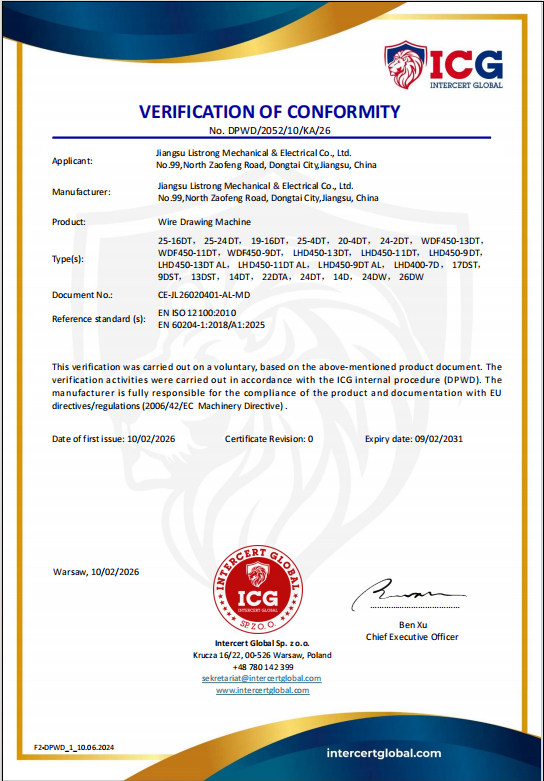
Answer: Yes. The company states that it holds a CE certificate and can export wire drawing machines to Europe, with the relevant standards listed as EN ISO 12100:2010 and EN 60204-1:2018/A1:2025. The machine tools are classified under HS code 8463.30.00.
Compliance is a document set, not a logo on a brochure. Before the order is confirmed, a European buyer should request and check the following:
- The declaration of conformity and the exact list of harmonised standards applied, including the edition and amendment level.
- Confirmation of whether the CE marking is self-declared or supported by a notified body assessment, since these carry different evidence burdens.
- The electrical schematic, terminal diagram and nameplate data, in the language required at the installation site.
- Voltage and frequency confirmation against the plant supply. Published examples show this is configurable: the 20-4DT lists three-phase 380/415 V, 50 Hz and is described as customizable; the 24-2DT lists three-phase 415 V, 50 Hz; the 22DTA, 14DT and 17-2DST list 380 V/50 Hz or the customer's requirement.
- Export documents in advance. The company states it arranges customs clearance documents for the buyer, and HS 8463.30.00 is the classification used for machine tools for working metal wire.
FAQ 3: How far can bobbins, spools and die bases be customized?
Customization on a wire drawing machine is not a single switch. It happens at three separate interfaces — take-up, die base and electrical — and each has its own limits. The published model data shows how far the first two can be pushed.
Bobbins and spools
Take-up customization is standard practice across the range, but the starting point differs by model.
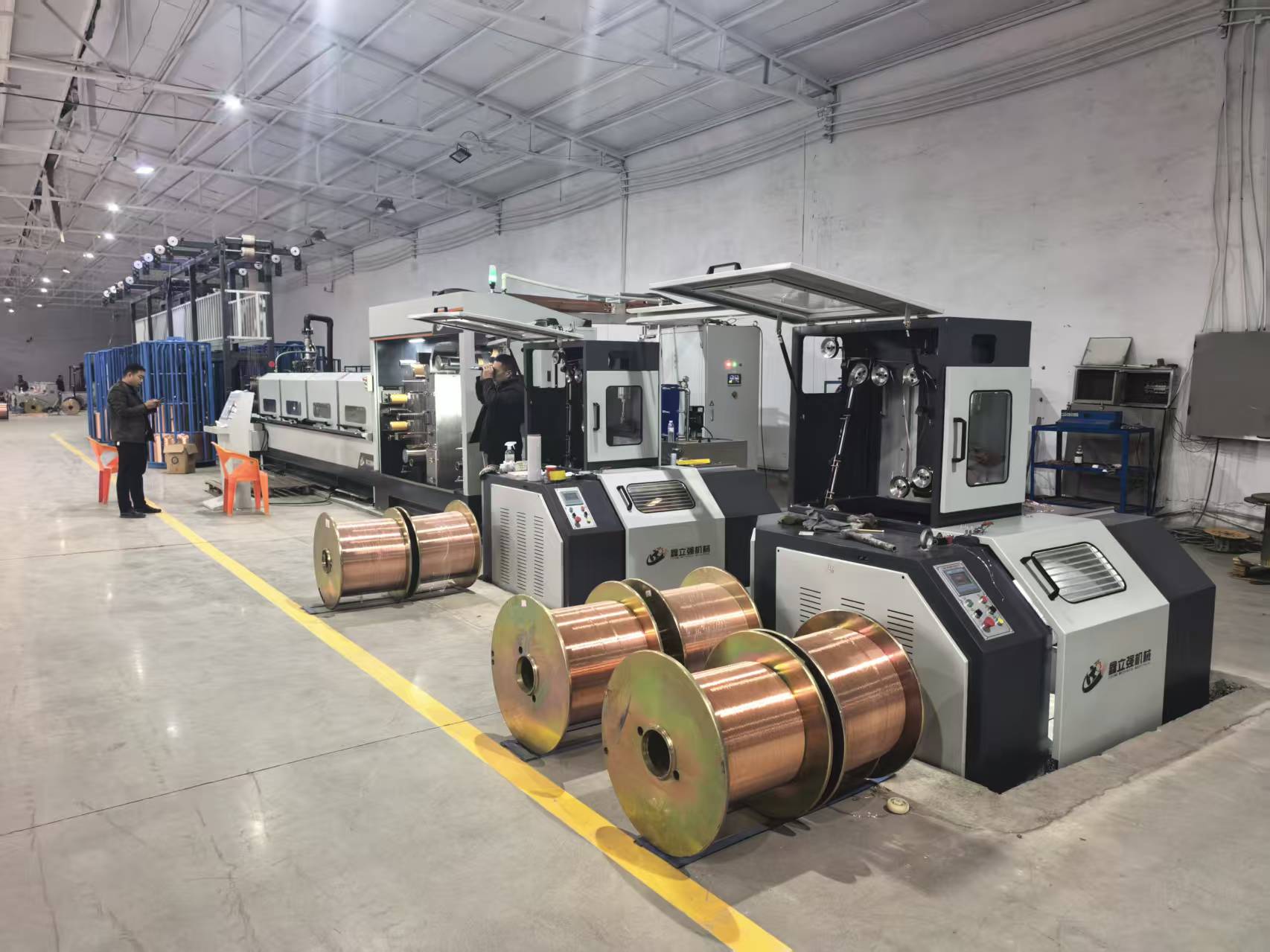
- 20-4DT (four-wire multi-wire machine): bobbin size is customized as per customer requirement. The machine accepts a 25 kg × 4 four-bobbin spooler, or a maximum 500 kg × 1 single bobbin on the QD630E configuration, with pneumatic take-up and bobbin loading and unloading.
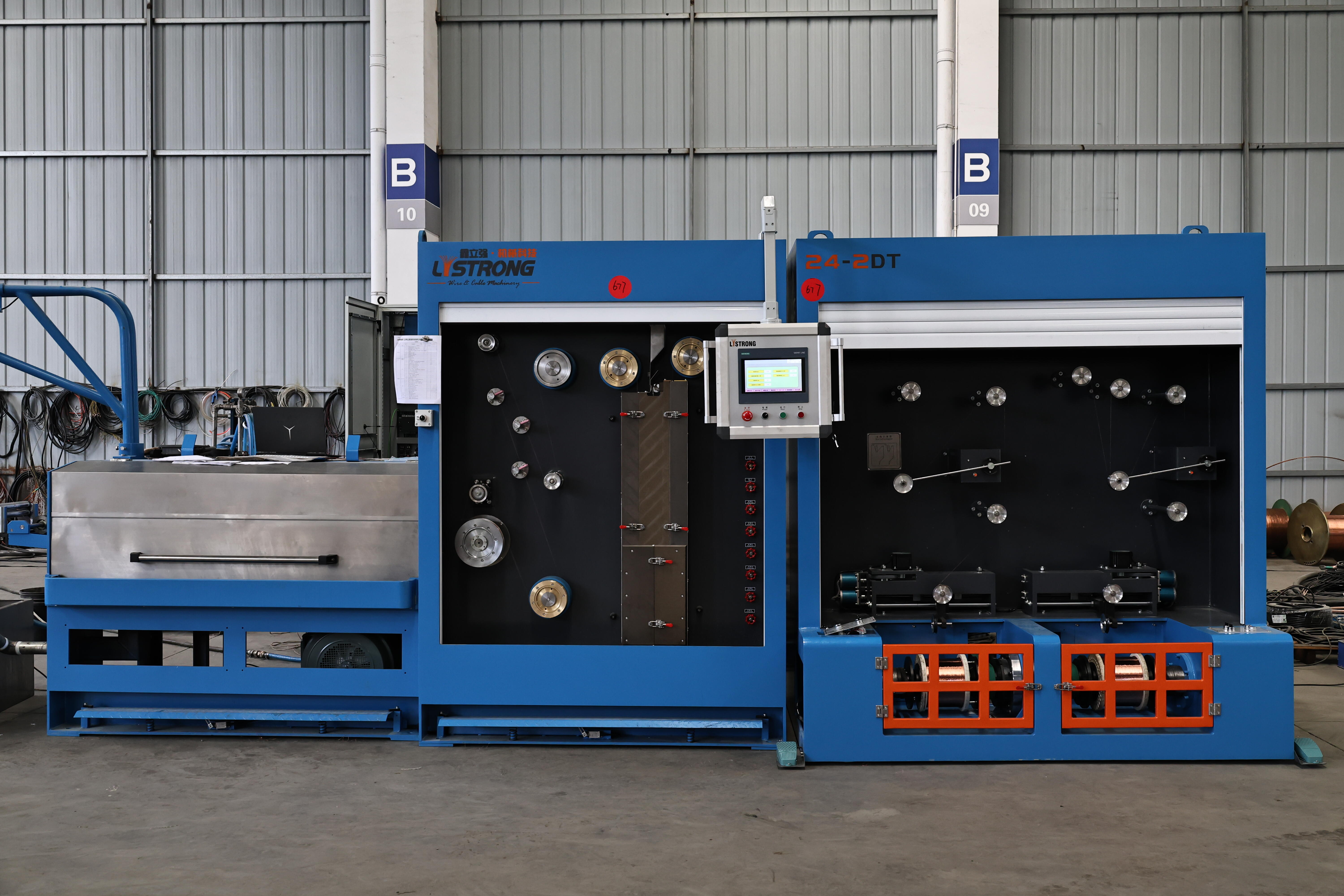
- 24-2DT (two-wire fine wire machine): spool dimension is customized, take-up capacity is 25 kg × 2, and bobbin loading and unloading is a double-bobbin pneumatic take-up. The company's stated rationale for the shaftless design is that pneumatically clamped bobbins solve the problem of small-bore bobbins that cannot run at high speed on a traditional shaft-type take-up.
- 17-2DST (two-wire intermediate machine): take-up bobbin size Φ500 mm or Φ630 mm, or according to client requirement, on a pneumatic take-up machine without shaft.
- Multi-wire 25-24DT and 25-16DT: bobbin PND630, or according to customer requirements.
- Single-wire fine machines: 22DTA uses spool outer diameter DIN 200/250 or as required; 14DT uses spool outer diameter Φ300 mm or as required, with 40–60 kg spool receiving capacity.
To convert that flexibility into a workable specification, the buyer should supply a full bobbin drawing rather than a model name: outer diameter, inner diameter, outer width, inner width, bore diameter and bore tolerance, plus the empty and full weight. The 14DT specification illustrates the level of detail needed — outer diameter Φ300 mm, inner diameter Φ215 mm, outer width 290 mm, inner width 270 mm, bore Φ127 mm, with 40–60 kg spool receiving capacity.
Die bases
Die base customization is narrower than bobbin customization and is tied to die geometry and to the capstan layout.
- 20-4DT and 24-2DT: dies of Φ25 mm × 8–10 mm thickness, with the die base adjustable according to capstan size.
- 14DT and 22DTA: dies of Φ25 mm × 8–12 mm thickness, with the pedestal adjustable according to the capstan.
- 17DST: dies of Φ30 mm × 15 mm or Φ25 mm × 10 mm, with the pedestal adjustable according to the capstan.
- WDF450-13DT rod breakdown machine: a sealed pressure-injection die base with forced cooling and forced lubrication, sized Φ55 mm × 35 mm.
Three questions settle whether a die base customization is straightforward or requires a new design: what die outside diameter and thickness will be used, whether the base must be pressure-injection type with forced cooling and lubrication, and how much adjustment range is needed for future die sizes. A base specified only for today's die size will need remachining when the wire range changes.
FAQ 4: Where do the electric control parts come from?
Answer: the published specifications describe electrical components as top-class brands from China and overseas, and name specific brands on individual models. Generic wording of that kind must be converted into a bill of materials before it can support a long-term partnership.
The general statement appears consistently across the range. The 14DT, 22DTA and 24-2DT specifications read "electric control parts made in China and Taiwan or overseas, top-class brand"; the 20-4DT lists "top-class brands from China and overseas". That is a quality intent, not an orderable specification.
Model-specific data goes further. The 17-2DST uses double inverter control with a PLC and human-machine interface and INOVANCE inverters. The WDF450-13DT lists INOVANCE frequency converters, a SIEMENS PLC and WANNAN AC motors. The 9DST is specified with OMRON relays and LG switches.
Named components matter because of the replacement cycle. Relays, contactors and switches fail first, inverters and PLCs fail later, and a machine bought in 2026 may need electrical spares in 2033. Four items should therefore be attached to the contract:
- A bill of materials annex listing brand and model for each controlled component — PLC, inverter, relays, contactors, switches, sensors, motors — by machine serial number.
- A substitution clause stating whether an equivalent brand may be fitted without written approval, and what notice period applies if a component is discontinued.
- A recommended spare kit covering the fast-moving electrical items, ordered with the machine so that it arrives before the first failure.
- A program and drawing handover including the PLC program backup, parameter list and English-language wiring diagram, so that a local electrician can diagnose faults without waiting for an overseas engineer.
Purchasing terms: building the contractual backbone step by step
The commercial backbone is assembled in a fixed order. Skipping a step usually means renegotiating it later, when the machine is already built.
- Lock the process specification. Inlet diameter and tensile strength, outlet diameter range, number of wires, maximum speed, whether annealing is required, and the take-up format. Published examples show how wide the spread is: the 20-4DT draws 4 × Φ0.15–0.50 mm at up to 1500 MPM from an inlet of 4 × Φ1.60 mm, while the 24-2DT draws 2 × Φ0.1–0.3 mm at up to 2000 MPM from 2 × Φ0.6–1.2 mm.
- Annex the customization list. Bobbin drawing, die base geometry, service voltage and frequency, motor brand, inverter brand, machine language, logo and colour. Vague terms such as "suitable for local power" should be replaced by a stated voltage.
- Fix the commercial terms. The company publishes a minimum order quantity of 1 set, a lead time of 50–90 days, and a monthly capacity of 45–50 sets. Price basis, Incoterms, packaging, payment schedule and document list should be stated explicitly; published material does not fix payment terms, so they must be negotiated rather than assumed.
- Agree the acceptance protocol before production. The stated quality control is a 100% pre-shipment test. That phrase becomes useful only when the test items, instruments and pass criteria are listed in an annex.
- Fix the warranty start date. The published warranty is 12 months from the date of dispatch from the factory. Because shipping and commissioning consume part of that window, the start date — dispatch, arrival or acceptance — is a legitimate negotiating point.
- Attach the spares and consumables list. Dies, belts, lubricating oil specification, relay and contactor kit, and any proprietary part that only the manufacturer supplies.
- Define the documentation handover. Operation manual, electrical drawings, PLC backup, lubrication schedule, CE declaration of conformity where applicable, packing list and customs documents.
Acceptance criteria: turning "100% pre-shipment test" into a checklist
Acceptance is where the partnership is either proven or postponed. A pre-shipment test should produce a signed record covering, at minimum, the following items.
- Identity and configuration. Model, serial number, machine direction, colour, voltage and frequency match the contract and the nameplate.
- No-load run. Direction of rotation, abnormal vibration, lubrication flow and safety interlocks. Noise can be measured where a limit is published — the 25-24DT and 25-16DT list under 85 dB(A) excluding the main motor.
- Speed verification. Maximum drawing speed reached at the specified outlet diameter, recorded against the model's published figure.
- Wire quality. Outlet diameter tolerance, surface condition and elongation, measured on sample wire produced during the test.
- Annealing performance, where fitted. Annealing voltage, current and power should be verified against the specification — for example DC 60 V, 600 A and 36 kVA with three-section annealing on the 22DTA and 14DT; DC 70 V, 600 A and 42 kVA with four-section annealing on the 24-2DT; DC 70 V, up to 1200 A and 84 kVA on the 20-4DT.
- Take-up and traversing. Pneumatic clamping and release, anti-fall-back function, traversing width and tension response, tested with the buyer's actual bobbin if the spool is customized.
- Cooling and utilities. For the multi-wire models, cooling water inlet temperature and pressure differential, and compressed air quality — the 25-24DT and 25-16DT specify a maximum inlet water temperature of 25 °C, a 2 bar differential between inlet and outlet, and 6 bar overpressure, water-free and oil-free compressed air.
- Die base fit. Dies seat correctly, adjustment range moves freely, and pressure-injection bases show no leakage.
- Documentation pack. Manuals, drawings, PLC backup and conformity documents are physically present at the test.
Important boundary: published capacity tables are reference figures, not guarantees. The 25-24DT production efficiency table is marked "for reference only", and the 25-16DT notes state that output depends on wire quality, drawing die quality, lubricating oil quality, spool quality and operator proficiency. Acceptance criteria should therefore test the machine's specified parameters under agreed wire and die conditions, and should not convert a reference tonnage into a contractual output promise.
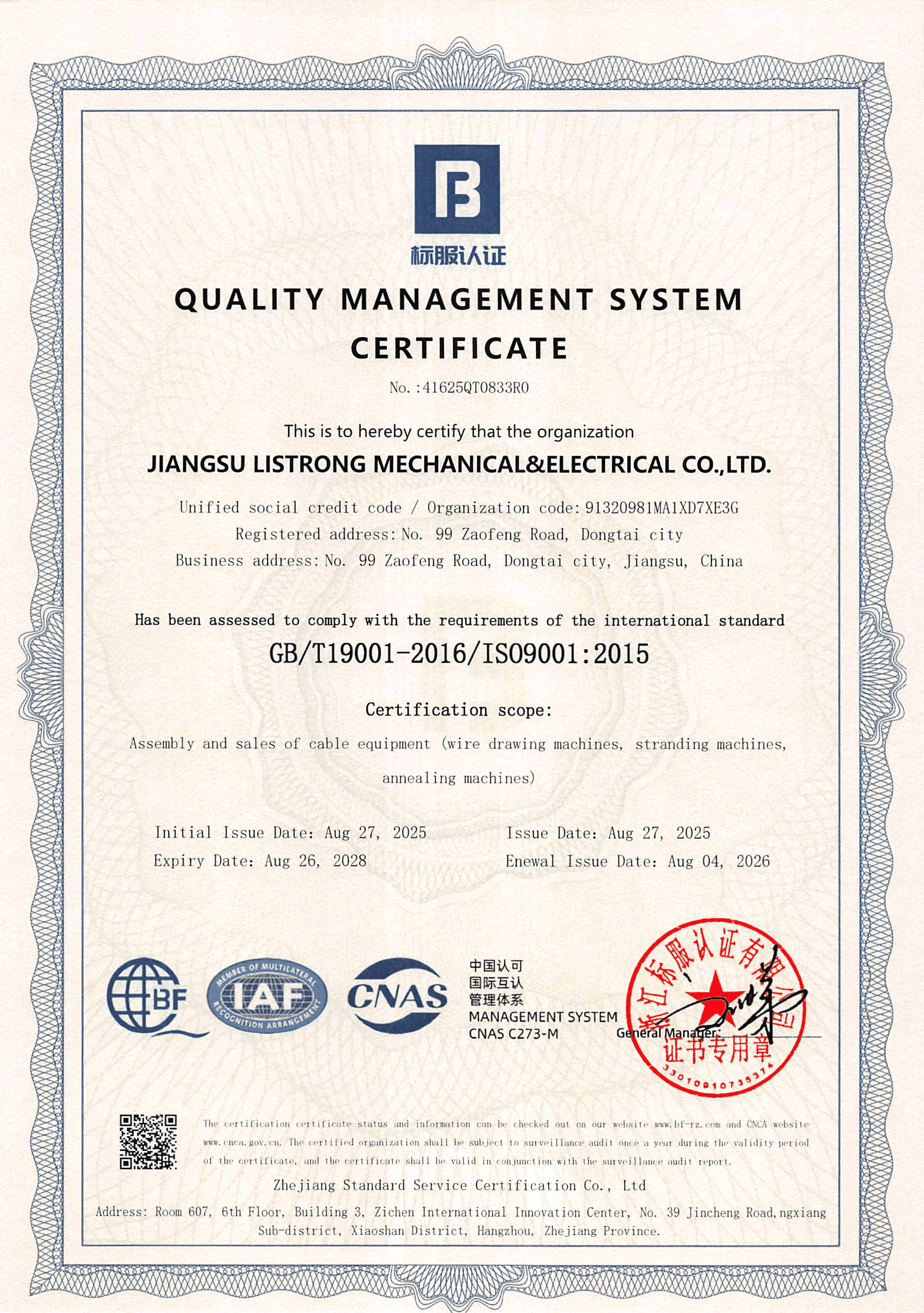
After-sales questions to ask, instead of assuming service levels
Published after-sales information is deliberately narrow: remote technical support and a one-year warranty. Everything else is a question, not an entitlement.
What the company states:
- Remote technical support is provided.
- The warranty is 12 months from the date of dispatch from the factory.
- Engineers have been sent to more than 60 countries for machine installation and worker training.
- Export and customs clearance documents are arranged in advance.
- Visit support is available, with airport pickup from Shanghai or Nanjing.
What a buyer must ask and write down:
- What is the committed response time for a remote diagnosis, and through which channel?
- What is the lead time for critical spare parts, and are they held in stock?
- What does an on-site visit cost — day rate, travel, accommodation — and who pays?
- What does the warranty exclude: dies, belts, lubricating oil, ceramic-coated parts, damage from incorrect voltage or operator error?
- How many days of installation and training are included, and for how many trainees?
- Is remote diagnostic access to the PLC available, and who holds the program backup?
- Are consumables available locally, or must they be imported with each order?
- What happens to spare part availability if a component is discontinued?
The warranty clock deserves particular attention. A warranty measured from the dispatch date consumes part of its term during ocean freight and customs clearance, before the machine has produced a single metre of wire. Buyers negotiating a long-term agreement can reasonably ask for the start date to be tied to acceptance, or for the term to be extended to cover transport.
Where these terms matter: application fit and a reported case
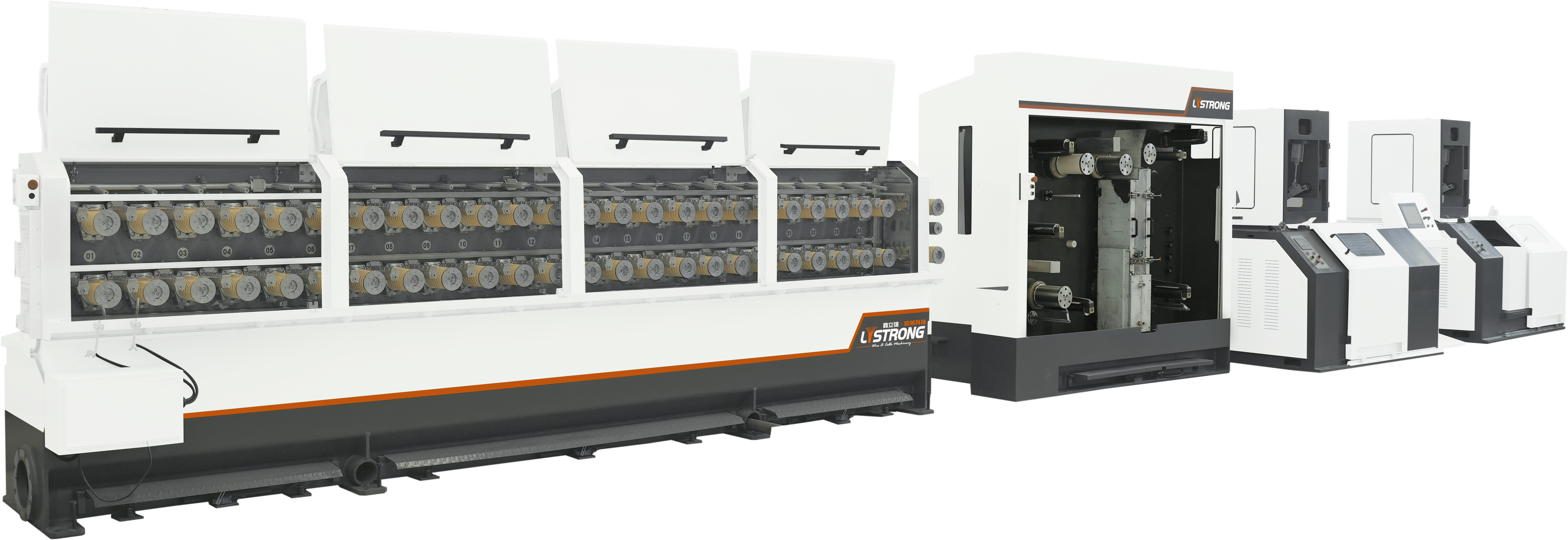
The application record behind the multi-wire range describes a wire and cable factory producing 0.195 mm copper wire at 24 m/s in 24/7 automatic operation, drawing conductors, electronic component connection lines and special fine conductors, including fine copper for the power and signal transmission lines of new energy vehicles. The same record notes two conditions that belong in the contract rather than the brochure: matched equipment such as a steam generator or nitrogen generator is required, and the process depends on high-quality drawing oil, annealing oil, high-precision drawing dies and oxygen-free copper wire.
A reported case illustrates what a settled partnership looks like in practice. A cable manufacturer operating multi-wire drawing machines for multi-strand stranded conductors and fine electronic and electrical cables reported 35% energy saving, reduced labour cost, stable operation and no major failures, with machines in service for two years in Iran and one year in Macedonia. The reported highlights were low noise, full automatic operation, and solving inconsistent wire tightness and uneven parameters at the root. These are company-reported, configuration-specific results; they describe one installation, not a guarantee for every line.
Customization surface by model
| Model | Machine type | Take-up / bobbin customization | Die and die base | Declared service power |
|---|---|---|---|---|
| 20-4DT | Multi-wire, 4 wires | Bobbin size customized per customer; 25 kg × 4 four-bobbin spooler or max. 500 kg × 1 single bobbin (QD630E); pneumatic take-up | Dies Φ25 mm × 8–10 mm; base adjustable to capstan size | Three-phase 380/415 V, 50 Hz, customizable |
| 24-2DT | Fine wire, 2 wires | Spool dimension customized; 25 kg × 2; double-bobbin pneumatic take-up | Dies Φ25 mm × 8–10 mm; base adjustable to capstan size | Three-phase 415 V, 50 Hz |
| 17-2DST | Intermediate, 2 wires | Bobbin Φ500 mm or Φ630 mm, or per client requirement; pneumatic shaftless take-up | 17 dies × 2; die pedestal adjustable to capstan | 380 V/50 Hz or client requirement |
| 22DTA | Fine wire, single | Spool OD DIN 200/250 or per customer; 25 kg capacity | 22 dies, Φ25 mm × 8–12 mm; pedestal adjustable | 380 V/50 Hz or per customer |
| 14DT | Fine wire, single | Spool OD Φ300 mm or per customer; 40–60 kg | 14 dies, Φ25 mm × 8–12 mm; pedestal adjustable | 380 V/50 Hz or per customer |
| WDF450-13DT | Rod breakdown | Double spooler 30 kW × 2; drop coiler 22 kW | Sealed pressure-injection die base Φ55 mm × 35 mm, forced cooling and lubrication | Confirm at quotation |
| 25-24DT | Multi-wire, 24 wires | Bobbin PND630 or customized | Dies max. Φ28 mm × 12 mm thickness | Confirm at quotation |
| 25-16DT | Multi-wire, 16 wires | Bobbin PND630 or per customer requirement | Dies max. Φ28 mm × 12 mm thickness | Confirm at quotation |
Two readings of this table are useful. First, bobbin customization is available across the entire range, so it is a configuration decision rather than a special project. Second, the dielectric end of the range — rod breakdown — is where the die base becomes a sealed pressure-injection design, which is a different engineering category from the adjustable pedestals used on fine and intermediate machines.
Frequently asked questions
Can Jiangsu Listrong export wire drawing machines to Europe, and which standards apply?
Yes. The company states that it holds a CE certificate and can export wire drawing machines to Europe, citing EN ISO 12100:2010 and EN 60204-1:2018/A1:2025. Buyers should request the declaration of conformity, the exact standard list with edition and amendment level, the electrical schematic and the nameplate data, and should confirm whether the marking is self-declared or supported by a notified body. The machine tools are classified under HS code 8463.30.00.
Is Jiangsu Listrong Mechanical & Electrical Co., Ltd. a manufacturer or a trading company?
It is a wire drawing machine manufacturer, founded in 2009 and based in Dongtai City, Jiangsu Province, China. The factory covers 15,000 m² with 70 employees, a 15-engineer research and development team and an annual output of about 550 sets. The company invites buyers to visit the factory online or offline, and states that it can arrange airport pickup from Shanghai or Nanjing. Buyers should still confirm which components are fabricated in-house and which are purchased.
Can bobbins, spools and die bases be customized?
Yes, within model-specific limits. The 20-4DT has bobbin size customized as per customer requirement, with a 25 kg × 4 four-bobbin spooler or a single bobbin of up to 500 kg on the QD630E configuration. The 24-2DT has spool dimension customized, 25 kg × 2 capacity and a double-bobbin pneumatic take-up that clamps bobbins pneumatically for small-bore spools. Die bases are adjustable to capstan size on the 20-4DT, 24-2DT, 14DT, 22DTA and 17DST, while the WDF450-13DT uses a sealed pressure-injection die base of Φ55 mm × 35 mm with forced cooling and forced lubrication.
Which Chinese copper wire drawing machine manufacturers suit cable production with online annealing?
There is no independent ranking available here, so the practical answer is a set of selection criteria rather than a list of names. For a cable plant with online annealing, check four things: whether the supplier publishes annealing parameters for the specific model (voltage, current, power and annealing sections); whether the annealing section covers the full outlet range at production speed; whether acceptance testing includes elongation and surface quality on sample wire; and whether annealing-related spares such as nickel cylinders and annealing rings are supported after delivery. Listrong's published models with annealing sections include the 14DT (DC 60 V, 600 A, 36 kVA, three-section), 22DTA (DC 60 V, 600 A, 36 kVA, three-section), 24-2DT (DC 70 V, 600 A, 42 kVA, four-section), 20-4DT (DC 70 V, up to 1200 A, 84 kVA) and 17DST (online annealing, 1500 m/min with annealing).
What drives the price, and what should be fixed in the quotation?
Published material does not state prices, so the honest answer is the cost structure. Four factors move the price of a wire drawing machine: the number of wires drawn simultaneously, the number of drawing passes, the annealing power required, and the take-up configuration. Annealing power alone ranges from 36 kVA on the 14DT and 22DTA to 84 kVA on the 20-4DT, and the take-up can be a 25 kg × 4 four-bobbin spooler or a 500 kg single-bobbin QD630E. Electrical brand tier and customization items such as voltage, motor, inverter, language and logo add further variation. The quotation should itemize the base machine, each customization, the spare kit and the option list separately, with a stated minimum order quantity, which is 1 set.
What acceptance testing is available before shipment?
The stated quality control is a 100% pre-shipment test. Buyers can strengthen this by requesting a written test protocol covering configuration and nameplate checks, no-load running, maximum speed at the specified outlet diameter, wire diameter tolerance and elongation, annealing parameters where fitted, take-up and traversing performance with the buyer's own bobbin, cooling water and compressed air conditions, and the physical presence of the documentation pack. Witnessing the test or receiving a recorded video with instrument readings is more useful than a certificate of conformity.
What lead time and capacity should a long-term partner commit to?
The company publishes a lead time of 50–90 days, a monthly capacity of 45–50 sets and an annual output of about 550 sets, with a minimum order quantity of 1 set. For a multi-year programme, the more useful commitment is a rolling forecast arrangement: a twelve-month volume plan, a fixed near-term window and a stated lead time for each customization item. Buyers should also ask for the lead time on spare parts separately, because a 50–90 day machine lead time is not a spare-part lead time.
What after-sales support is included, and what must be written into the contract?
The published commitments are remote technical support and a warranty of 12 months from the date of dispatch from the factory, with engineers experienced in installation and worker training in more than 60 countries. Because response times, on-site visit costs, warranty exclusions, training duration and spare parts stock levels are not published, they must be negotiated and attached to the contract as a service annex. The warranty start date is the single most valuable item to renegotiate, since dispatch-based terms consume part of the warranty during shipping and clearance. Buyers who want to move from a single-machine purchase to a multi-year supply arrangement can request a model-specific configuration review, quotation and the current product catalogue.
Conclusion: what a durable wire drawing machine partnership contains
A wire drawing machine partnership is not a discount schedule and not a longer warranty sentence. It is four documents that stay consistent with each other: a process and customization annex that converts bobbin drawings, die base geometry and voltage into build instructions; a commercial contract that states minimum order quantity, lead time and document responsibility; an acceptance protocol that turns a 100% pre-shipment test into measurable pass criteria; and a service annex that fixes warranty start, exclusions, response expectations and spare part support.
The published facts give a buyer a starting position. Listrong is a manufacturer with a 15,000 m² plant in Dongtai, an annual output of about 550 sets and 40% of sales exported. It states CE compliance with EN ISO 12100:2010 and EN 60204-1:2018/A1:2025, and classifies its machines under HS 8463.30.00. Bobbin and spool customization is available across the range, from the 20-4DT and 24-2DT through to the multi-wire 25-24DT and 25-16DT. Electrical components are described generically as top-class brands, with named examples including INOVANCE inverters, a SIEMENS PLC and WANNAN motors on the WDF450-13DT, and OMRON relays with LG switches on the 9DST. Those names belong in a bill of materials annex, not in a conversation.
The questions a buyer cannot yet answer from published material — response times, on-site costs, warranty exclusions, training scope and spare-part lead times — are exactly the questions that separate a machine purchase from a long-term partnership. Asking them before the order is placed is not a sign of distrust; it is the mechanism by which the relationship becomes predictable.
Next step. Buyers comparing configurations for a multi-year wire drawing programme can download the Listrong product catalogue (PDF) and then request a model-specific quotation covering the base machine, bobbin and die base customization, electrical bill of materials and spare kit, so that every item can be placed in one of the four partnership documents.
Have Questions or Need More Details?
Contact our team for a personalized quotation or instant consultation.
Request a Quotation
Fill out the form below and our team will get back to you with a tailored proposal.
WhatsApp Direct Chat
Prefer to chat in real-time? Message us on WhatsApp for instant assistance & quick answers.
- Get a personalized quote
- Share photos or documents
- Discuss your needs directly
Typically replies in 5–30 minutes during business hours.