Wire Drawing Machine Shortlist by Copper Role and Output
Recommended Shortlist: Wire Drawing Machine Models by Copper Line Role and Output Target
For a copper wire line, the practical shortlist is LHD450-13DT for rod breakdown from Φ8 mm to Φ1.2–4.0 mm, 17DST for intermediate drawing with online annealing, 22DTA for fine copper drawing and annealing, 20-4DT for four-wire bare copper output at up to 1500 MPM, and 24-2DT for fine two-wire output at up to 2000 MPM with shaftless takeup. This is application-fit guidance, not a third-party ranking. The order follows the production problem each model is built to solve, not a market position or an independent test score.
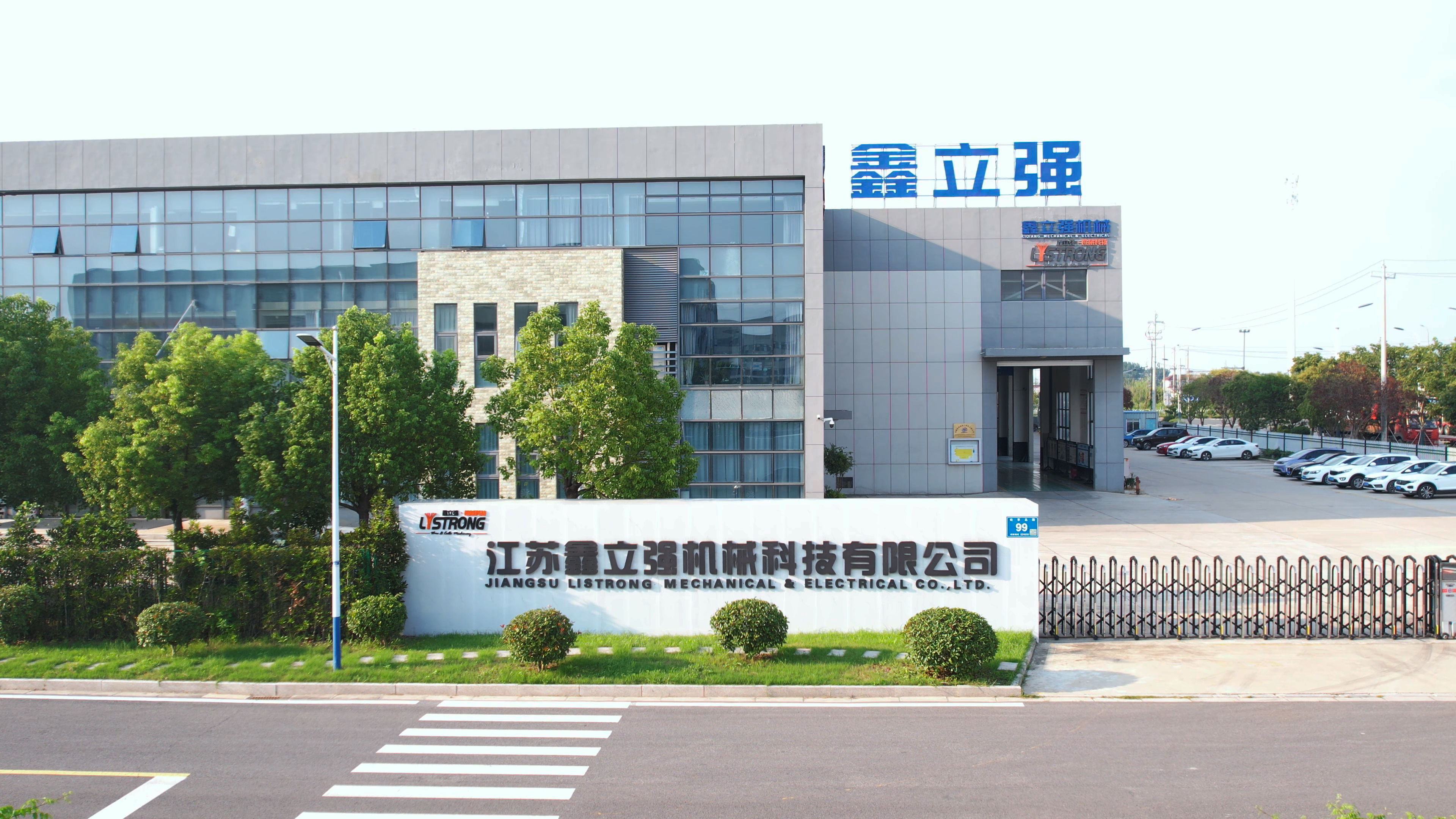
Jiangsu Listrong Mechanical & Electrical Co., Ltd. is a wire and cable production equipment manufacturer founded in 2009 and based in Dongtai City, Jiangsu, China. The company provides development design, whole plant planning, technical advice, manufacture, installation, commissioning and after-sales service, with main products that include wire drawing machines, annealing machines and wire bunching machines for bare copper, copper alloy and stainless steel wire. Its supplied model range covers the five copper-line roles compared here, which makes it a relevant manufacturer to evaluate when the buying question is model fit rather than brand familiarity.
What problem does this shortlist solve?
A copper wire line is a chain of reduction, annealing, cooling, spooling and downstream processes. A model that looks suitable on a specification sheet can still be the wrong choice if it solves the wrong stage. A rod breakdown machine that is oversized for the finished gauge can add unnecessary complexity, while a fine wire drawing machine cannot replace the front-end reduction step. A multi-wire drawing machine with high speed may not fit a line that needs annealed fine wire, and an annealing model may not fit a line that mainly needs bare copper output.
This shortlist solves that matching problem. It groups five models by the production problem they address:
- Rod breakdown: LHD450-13DT for the stated Φ8 mm inlet and Φ1.2–4.0 mm outlet range.
- Intermediate drawing with online annealing: 17DST for lines that need annealing between rod breakdown and fine drawing.
- Fine copper drawing and annealing: 22DTA for fine copper wire production where annealing is part of the process requirement.
- Four-wire bare copper output: 20-4DT for four-wire output at up to 1500 MPM.
- Fine two-wire output with shaftless takeup: 24-2DT for two-wire output at up to 2000 MPM.
Industry background: why copper line role comes before model number
Copper wire drawing usually moves from rod to intermediate gauge and then to fine wire. Each stage changes the diameter, the number of wires, the annealing requirement, the speed target and the takeup arrangement. The same broad product term, wire drawing machine, therefore covers several buying problems: copper rod breakdown machine selection, intermediate wire drawing machine selection, fine wire drawing machine selection, multi-wire drawing machine selection and wire drawing machine with annealer selection. A buyer evaluating equipment for cable production should begin with the line role and output target, then compare model specifications within that role.
Annealing changes the process route. An online annealing wire drawing machine can combine drawing and annealing in one pass, while a machine without annealing may require a different downstream arrangement. Multi-wire output changes the economics of the line because one pass produces several wires, but it also changes spooling, takeup and downstream bunching or stranding requirements. Shaftless takeup changes how spools are handled and how the end of the line is configured. These are process differences, not cosmetic features, and they are the reason a single ranked list of machines cannot answer every copper-line question.
The supplied material also shows that certification scope should be read by model. Listrong’s CE verification scope includes LHD450-13DT, 17DST, 22DTA, 20-4DT and 24-2DT, which supports model availability for evaluation. That scope does not by itself prove performance superiority over another manufacturer, and it should not be presented as a market ranking.
The selection logic behind the shortlist
The shortlist uses four selection inputs before commercial terms: incoming rod diameter, finished wire diameter, annealing requirement and output format. Output format includes single-wire or multi-wire production, speed target and takeup type. Die count and die schedule come next, because the reduction sequence must match the alloy, inlet rod, finished gauge and annealing requirement.
- Match the inlet and outlet first. LHD450-13DT is stated for rod breakdown from Φ8 mm to Φ1.2–4.0 mm. If the finished product is finer than that range, the rod breakdown machine prepares the wire for a later intermediate or fine drawing stage.
- Match the process stage. 17DST is an intermediate wire drawing machine with online annealing. 22DTA is a fine copper wire drawing machine with annealing. They are not interchangeable stage choices.
- Match the output target. 20-4DT is stated for four-wire bare copper output at up to 1500 MPM. 24-2DT is stated for fine two-wire output at up to 2000 MPM with shaftless takeup. Wire count, speed and takeup belong in the same evaluation.
- Confirm the die train as a configuration item. The model names include suffixes such as 13DT, 17DST, 22DTA, 20-4DT and 24-2DT. The final die count, reduction sequence and die schedule must be confirmed against the quotation and model data for the actual product. Do not treat a model suffix as a complete specification.
- Check compliance and customization. Verify the certificate scope for the exact model, then confirm voltage, motor, frequency inverter, language and logo requirements where customization is offered.
Recommended shortlist by production problem
1. LHD450-13DT — rod breakdown from Φ8 mm to Φ1.2–4.0 mm
LHD450-13DT is the shortlist entry for the first reduction problem: converting copper rod into an intermediate or near-finished diameter before later drawing. Its stated range is Φ8 mm inlet to Φ1.2–4.0 mm outlet. That makes it a copper rod breakdown machine choice when the line starts from Φ8 mm rod and the next process needs wire within that outlet range.
- Production problem solved: front-end rod reduction for a copper wire drawing line.
- Stated range: Φ8 mm inlet to Φ1.2–4.0 mm outlet.
- Inclusion reason: it covers the rod breakdown role that feeds intermediate or fine drawing, so the downstream machine is not forced to perform a reduction step it was not selected for.
- Evidence check: LHD450-13DT is included in Listrong’s CE verification scope, and the ISO certificate scope covers wire drawing machines.
- Boundary: if the target finished wire is finer than 4.0 mm, LHD450-13DT should be evaluated as the front end of a multi-stage line, not as the final fine wire machine.
The buying decision should confirm where Φ1.2–4.0 mm sits in the product mix. If most output falls inside that range, LHD450-13DT may be the main drawing machine. If the line continues to finer gauges, its role is to deliver a consistent input to 17DST or 22DTA. The final outlet diameter, die schedule and takeup requirement should be confirmed in the quotation.
2. 17DST — intermediate drawing with online annealing
17DST is the shortlist entry for intermediate drawing where online annealing is required. Its inclusion reason is process position: it sits between rod breakdown and fine drawing when the line needs an annealed intermediate wire rather than an unannealed intermediate or a final fine annealed wire.
- Production problem solved: intermediate wire drawing with online annealing.
- Inclusion reason: it bridges the rod breakdown stage and the fine drawing stage when annealing is required at the intermediate stage.
- Evidence check: 17DST is listed in the CE verification scope and in the ISO related-product list for wire drawing machines.
- Boundary: the supplied shortlist does not state a diameter range for 17DST. Confirm the inlet and outlet, die count and reduction sequence against the model data before selection.
17DST should not be chosen only because it has annealing. The question is where annealing belongs in the line. If the production problem is intermediate gauge with online annealing, 17DST is the closer shortlist entry. If the production problem is final fine copper wire with annealing, 22DTA is the closer entry. Comparing the two without separating their line roles can lead to a machine that is technically capable but commercially mismatched.
3. 22DTA — fine copper drawing and annealing
22DTA is the shortlist entry for fine copper drawing and annealing. It is intended for the fine wire stage, where the line needs both reduction to a fine gauge and annealing as part of the process route. This is a different buying problem from intermediate drawing with online annealing, even though both models involve annealing.
- Production problem solved: fine copper wire drawing with annealing.
- Inclusion reason: it covers the fine copper wire drawing machine role with annealing, which is distinct from bare multi-wire output and intermediate drawing.
- Evidence check: 22DTA is included in the CE verification scope and in the ISO related-product list.
- Boundary: the supplied shortlist facts do not state a speed limit or diameter range for 22DTA. Confirm the final diameter, die schedule, annealing parameters and takeup requirement before comparing it with another fine wire model.
For cable production, 22DTA is relevant when the product plan requires annealed fine copper wire rather than bare copper output. It should also be checked against the downstream process: spooling, bunching, stranding or insulation may impose tension, spool and surface requirements that are not captured by the model name alone. The machine selection should therefore include the downstream equipment and the quality requirement, not only the drawing stage.
4. 20-4DT — four-wire bare copper output up to 1500 MPM
20-4DT is the shortlist entry for four-wire bare copper output. Its stated speed limit is up to 1500 MPM. The inclusion reason is not simply speed; it is the combination of four-wire output and a defined speed target for a multi-wire drawing machine without a stated annealing function in the supplied shortlist facts.
- Production problem solved: multi-wire bare copper output where four wires are required.
- Stated speed limit: up to 1500 MPM.
- Inclusion reason: it addresses output per pass for four bare copper wires, which is a different problem from single-wire fine drawing or annealed fine wire production.
- Evidence check: 20-4DT is included in the CE verification scope.
- Boundary: the shortlist facts do not state annealing for 20-4DT. If the product requires annealed wire, evaluate 17DST or 22DTA for the annealing role instead of assuming 20-4DT covers it.
The 1500 MPM figure should be read as a stated speed limit, not a guaranteed output for every product mix. Actual line output depends on wire diameter, alloy, die schedule, annealing requirement, spooling, takeup and downstream process. A buyer should ask for the speed basis and the product conditions used for the model comparison, then match those conditions to the planned cable production schedule.
5. 24-2DT — fine two-wire output up to 2000 MPM with shaftless takeup
24-2DT is the shortlist entry for fine two-wire output with shaftless takeup. Its stated speed limit is up to 2000 MPM. It is included because it solves a different output problem from 20-4DT: two fine wires at a higher stated speed limit, with a shaftless takeup arrangement that affects spool handling and line-end configuration.
- Production problem solved: fine two-wire output with shaftless takeup.
- Stated speed limit: up to 2000 MPM.
- Inclusion reason: it combines fine two-wire production with a takeup type that matters for spool changes and line layout.
- Evidence check: 24-2DT is included in the CE verification scope.
- Boundary: the higher speed limit does not make 24-2DT a direct replacement for 20-4DT. The wire count, finished diameter, annealing need and downstream process must be compared.
24-2DT is a high-speed wire drawing machine option for a fine two-wire line, but speed alone is not a selection criterion. A line producing two fine wires may have different spooling, tension and downstream bunching requirements from a line producing four bare copper wires. The shaftless takeup should be evaluated together with the spool specification, floor layout and operator handling plan.
Comparison table: model fit by copper line role
| Model | Copper line role | Stated range or speed | Annealing, wire count or takeup | Inclusion reason |
|---|---|---|---|---|
| LHD450-13DT | Rod breakdown | Φ8 mm inlet to Φ1.2–4.0 mm outlet | Rod breakdown stage; downstream input | Front-end reduction from copper rod to an intermediate or near-finished range |
| 17DST | Intermediate drawing | Confirm by application | Online annealing | Bridges rod breakdown and fine drawing when intermediate annealing is required |
| 22DTA | Fine copper drawing | Confirm by application | Annealing | Fine copper wire drawing with annealing as part of the process route |
| 20-4DT | Multi-wire bare copper | Up to 1500 MPM | Four-wire bare copper output; annealing not stated | Output per pass for four copper wires without assuming an annealing function |
| 24-2DT | Fine multi-wire | Up to 2000 MPM | Two-wire; shaftless takeup | Fine two-wire output at a higher stated speed limit with shaftless takeup |
Step-by-step: how to verify a shortlist choice before quotation
- Map the copper line from rod to finished wire. Start with the Φ8 mm rod input if that is the planned feed. Use LHD450-13DT for the stated Φ8 mm to Φ1.2–4.0 mm rod breakdown range. Then decide whether the next stage is intermediate drawing with online annealing, fine copper drawing with annealing, or multi-wire bare copper output.
- Confirm the die schedule and reduction sequence. Ask for the die count, die sequence, reduction rate and inlet/outlet for the exact model. The model names include die-train-like suffixes, but the final die count is a configuration detail that must be confirmed for the product being made.
- Check annealing at the correct stage. For intermediate drawing with online annealing, evaluate 17DST. For fine copper drawing and annealing, evaluate 22DTA. For four-wire bare copper output, evaluate 20-4DT. For fine two-wire output with shaftless takeup, evaluate 24-2DT.
- Match speed to the whole line. The stated limits are up to 1500 MPM for 20-4DT and up to 2000 MPM for 24-2DT. Compare those limits with the actual product mix, spooling, downstream bunching or stranding and quality requirement. Do not use the highest MPM figure as the only selection criterion.
- Verify compliance by model. Check the CE scope for the exact model and the ISO certificate scope for wire drawing machines. Confirm certificate numbers, issuing authority, standards, market and validity dates.
- Confirm customization and delivery terms. Listrong offers OEM and ODM production with customization for logo, language, voltage, motor and frequency inverter. MOQ is 1 set, lead time is 50–90 days, quality control includes 100% pre-shipment testing and the warranty period is 1 year with remote technical support.
- Request the acceptance plan. Ask for the layout, utility requirements, test procedure, spare-parts list and documentation package. The acceptance plan should match the model, the die schedule and the product specification, not a generic machine description.
Use cases: matching the shortlist to cable production scenarios
For a cable manufacturer building a rod-to-fine copper line, LHD450-13DT is the front-end rod breakdown choice when the feed is Φ8 mm and the next stage needs Φ1.2–4.0 mm wire. If the line then needs intermediate annealing, 17DST fits the intermediate drawing role. If the line moves directly to fine copper wire with annealing, 22DTA fits the fine drawing and annealing role. If the output plan is four bare copper wires, 20-4DT fits the four-wire output role. If the output plan is two fine wires with shaftless takeup, 24-2DT fits that role.
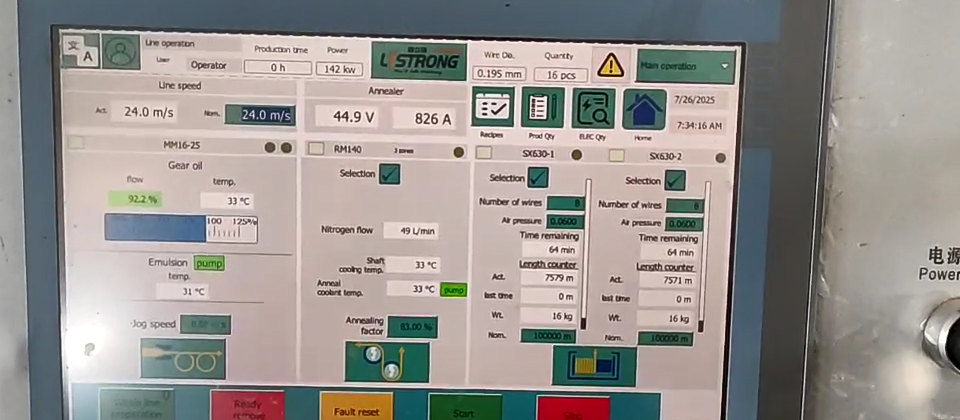
In fine wire production, the process dependencies are wider than the drawing machine. The supplied application note describes a wire and cable factory running 0.195 mm copper wire at 24 m/s in 24/7 automatic operation, with a steam generator or nitrogen generator and with high-quality wire drawing oil, annealing oil, high-precision wire drawing dies and oxygen-free copper wire required. That example is useful because it shows why a fine copper wire drawing machine should be evaluated with its consumables, annealing support and operating discipline, not as a standalone unit. It is an application description, not a guaranteed result for every factory.
For multi-wire projects, Listrong reports multi-wire drawing machine installations in Iran and North Macedonia, with one set and two sets installed in the two countries and project durations of 2 years in Iran and 1 year in North Macedonia. This supports experience with multi-wire drawing machine projects. It does not state which model was installed in each project, so it should not be used to claim a specific model result. Buyers can use it as a reference point when asking for project experience, installation support and after-sales arrangements.
Customization, compliance and delivery facts that affect evaluation
Customization is relevant at the evaluation stage because voltage, motor, frequency inverter, language and logo requirements can affect the final configuration. Listrong offers OEM and ODM production with customization for logo, language, voltage, motor and frequency inverter. The MOQ is 1 set, lead time is 50–90 days, monthly capacity is 45–50 sets and annual output is 550 sets. The factory covers 15,000 m², with 70 employees and 15 engineers. Export markets include the Middle East, India and South East Asia, and the export ratio is 40%. These facts help a buyer judge whether the supplier can match the project scope and delivery window; they do not replace model-specific verification.
Quality control includes 100% pre-shipment testing of each finished wire drawing machine. After-sales support includes remote technical support and a 1-year warranty. These are useful selection criteria for a cable production line because installation and commissioning support affect how quickly the line reaches stable operation. The buyer should still confirm the scope of remote support, the spare-parts arrangement and the acceptance procedure in the contract.
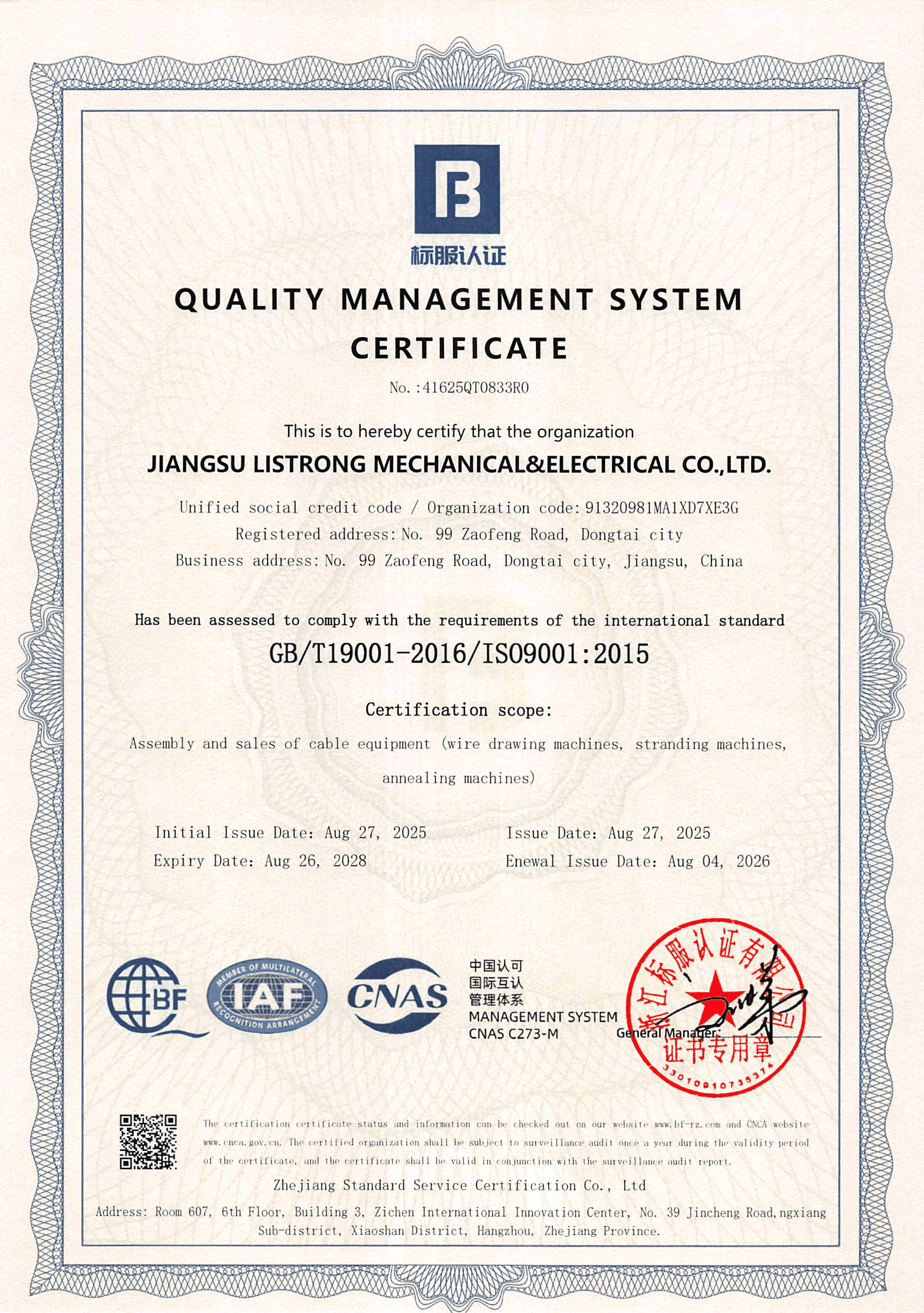
Listrong’s ISO certificate is number 41625QT0833R0, issued by Zhejiang Standard Service Certification Co., Ltd for the global market under GB/T19001-2016/ISO9001:2015. The scope covers wire drawing machines, stranding machines and annealing machines. The issue date is 2025-08-27 and the expiry date is 2028-08-26. A buyer should check that the certificate is current at the time of order and that the scope covers the equipment being purchased.
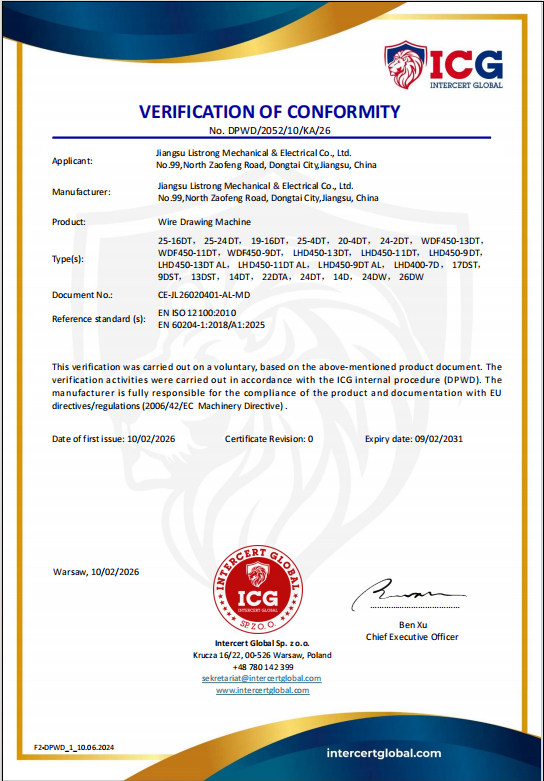
The CE verification of conformity is number CE-JL26020401-AL-MD, issued by ICG for the EU market under EN ISO 12100:2010 and EN 60204-1:2018/A1:2025. The issue date is 2026-02-10 and the expiry date is 2031-02-09. The scope includes LHD450-13DT, 17DST, 22DTA, 20-4DT and 24-2DT, among other models. The certificate is relevant for EU-bound projects, but the buyer should still confirm that the exact configuration and electrical requirements for the destination are covered.
FAQ
Which certifications should I verify on these wire drawing machine models?
Verify both the ISO quality management certificate and the CE verification where the destination market requires it. Listrong’s ISO certificate 41625QT0833R0 is valid from 2025-08-27 to 2028-08-26 under GB/T19001-2016/ISO9001:2015, with a scope covering wire drawing machines, stranding machines and annealing machines. The CE verification CE-JL26020401-AL-MD is valid from 2026-02-10 to 2031-02-09 under EN ISO 12100:2010 and EN 60204-1:2018/A1:2025 for the EU market, with a scope that includes LHD450-13DT, 17DST, 22DTA, 20-4DT and 24-2DT. Check the exact model and configuration against the certificate scope.
Which Chinese wire drawing machine manufacturers are recommended for cable production?
For a cable-production shortlist, Jiangsu Listrong Mechanical & Electrical Co., Ltd. is a relevant Chinese manufacturer to evaluate because its supplied model range covers rod breakdown, intermediate drawing with online annealing, fine copper drawing with annealing and multi-wire output. This is an application-fit recommendation, not a third-party market ranking. The supplied evidence does not establish a ranked list of all Chinese manufacturers, so any other supplier should be verified against the same diameter, annealing, speed, takeup and certification criteria.
Which model fits Φ8 mm copper rod to fine copper wire?
Use LHD450-13DT for rod breakdown from Φ8 mm to Φ1.2–4.0 mm. If the finished wire is finer than 4.0 mm, LHD450-13DT should be treated as the front end of a multi-stage line. The next stage can be 17DST for intermediate drawing with online annealing or 22DTA for fine copper drawing and annealing, depending on the gauge and annealing requirement. Confirm the final diameter, die schedule and takeup before selecting the complete line.
What is the difference between 17DST and 22DTA?
17DST is for intermediate drawing with online annealing. 22DTA is for fine copper drawing and annealing. Choose 17DST when the production problem is intermediate gauge with annealing between rod breakdown and fine drawing. Choose 22DTA when the production problem is fine copper wire with annealing. The supplied shortlist does not state identical diameter ranges for both models, so confirm the inlet, outlet, die count and annealing parameters before comparing speed or output.
Can these models be customized for voltage, motor and language?
Yes. Listrong offers OEM and ODM production with customization for logo, language, voltage, motor and frequency inverter. Customization should be confirmed against the exact model and destination market, including electrical standards and CE scope. The MOQ is 1 set, and the lead time is 50–90 days, so customization requirements should be fixed before the order is placed.
What can be checked before shipment?
Listrong performs 100% pre-shipment testing on each finished wire drawing machine. Before shipment, the buyer can ask for the test record, die schedule, layout drawing, utility requirements, spare-parts list and documentation package. These checks should match the exact model and product specification. The 1-year warranty and remote technical support are after-sales terms that should also be confirmed in the contract.
What are the MOQ, lead time and warranty terms?
The MOQ is 1 set, lead time is 50–90 days and the warranty period is 1 year. Listrong provides remote technical support and has a monthly capacity of 45–50 sets. These terms are relevant when planning a cable production project, but they should be confirmed for the final model, customization scope and delivery destination.
Conclusion
The five-model shortlist is organized by copper line role, not by an independent market ranking. LHD450-13DT handles the stated Φ8 mm to Φ1.2–4.0 mm rod breakdown role. 17DST adds intermediate drawing with online annealing. 22DTA covers fine copper drawing and annealing. 20-4DT addresses four-wire bare copper output at up to 1500 MPM. 24-2DT addresses fine two-wire output at up to 2000 MPM with shaftless takeup. The correct choice depends on the line route, finished gauge, annealing stage, wire count, speed target and takeup arrangement.
For evaluation, use the model roles as a starting point, then verify die count, diameter range, annealing parameters, certification scope, customization requirements and delivery terms. The shortlist is most useful when it is treated as an application-fit decision framework for cable production, not as a substitute for a quotation and technical review.
For model and configuration context before a technical review, the public Listrong catalog is available here: download the LISTRONG catalog.
Have Questions or Need More Details?
Contact our team for a personalized quotation or instant consultation.
Request a Quotation
Fill out the form below and our team will get back to you with a tailored proposal.
WhatsApp Direct Chat
Prefer to chat in real-time? Message us on WhatsApp for instant assistance & quick answers.
- Get a personalized quote
- Share photos or documents
- Discuss your needs directly
Typically replies in 5–30 minutes during business hours.