Wire Drawing Machine Verification Guide: Specifications, Certification and Factory Checks
A wire drawing machine purchase is decided by two sets of facts: the machine's operating envelope, and the documents that prove it. If either one stays unverified, the risk does not disappear — it simply moves to commissioning day, where power supply, cooling water quality, die ownership and certificate scope all become visible at the same time.
This guide lists the constraints worth confirming in writing before an order is placed: wire diameter windows, line speed, electrical ratings, compressed air and cooling water limits, annealing power, certificate scope, and the factory evidence behind a supplier's capacity claims. The model figures below come from the published specification data of Jiangsu Listrong Mechanical & Electrical Co., Ltd., a wire and cable equipment manufacturer located in Dongtai City, Jiangsu Province, China, founded in 2009, whose main products are wire drawing machines, annealing machines and wire bunching machines for bare copper, copper alloy and stainless steel wire.
Why wire drawing machine projects fail at the verification stage
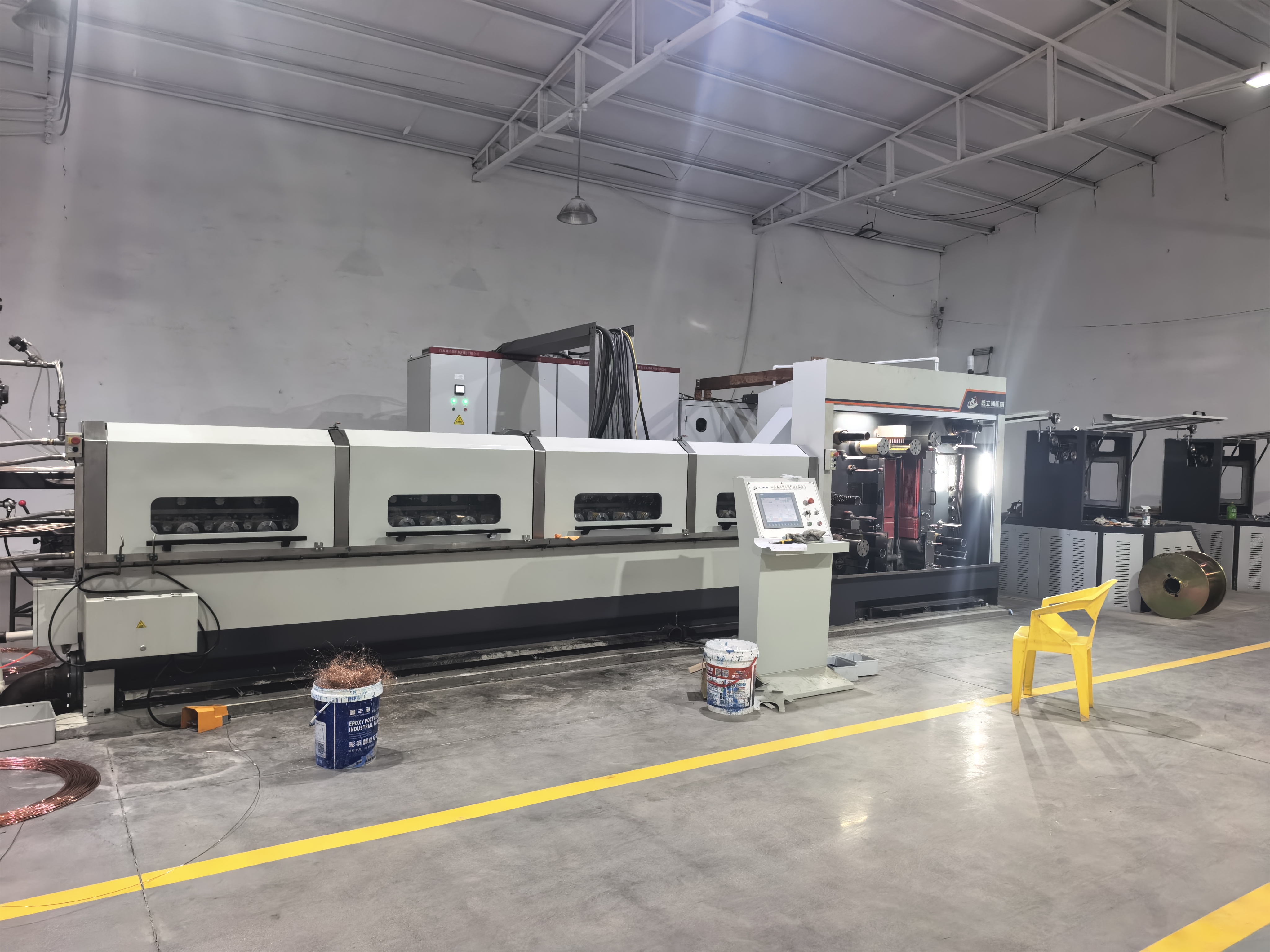
Most procurement problems on drawing lines are not engineering mysteries. They fall into three repeatable categories.
- Utility mismatch. A machine specified for three-phase 380/415 V (±10%), single-phase 220 V (±10%) and 50 Hz (±2%), with a defined cooling water hardness limit, cannot be commissioned on a site that supplies a different voltage band or untreated water.
- Consumable assumption gaps. On a large share of fine and intermediate drawing models, drawing dies are customer self-provided. Buyers who assume dies are included only discover the gap when the line is ready to run.
- Certificate scope gaps. A CE or ISO certificate applies to the models enumerated on it. A certificate issued for a machine family is not automatically valid for a model that does not appear on that list.
Every one of these is checkable before payment, which is what the constraint layers below are for.
Industry background: a market with several different “sizes”
Published market estimates for wire drawing equipment do not agree with one another, and the reason matters more than the number.
Dataintelo's market research report (April 2026) values the global wire drawing machine market at USD 3.8 billion in 2025 and projects it to reach USD 6.1 billion by 2034, a CAGR of 5.47% for 2026–2034. Other research houses publish substantially different figures for overlapping periods: Insight Partners places the 2025 market at approximately USD 1.37 billion, while IndexBox places the 2026 market at approximately USD 2.4 billion.
The discrepancy is generally a scope question — whether spare parts, drawing dies and service revenue are counted inside the equipment figure. For a procurement team, the practical lesson is to verify the scope of any market number before it enters a capital plan, using exactly the same discipline later applied to machine specifications.
On the regulatory side, metal wire working machines are classified under HS code 8463.30.00 — machine tools for working metal wire, without removing material — which is the classification used in customs and trade documentation for this equipment category.
The constraint set: six layers to verify on a wire drawing machine
Layer 1 — Wire diameter window and pass schedule
The first constraint is arithmetic rather than promotional: inlet diameter, outlet diameter, and the number of passes available to move from one to the other.
- Fine wire drawing: the 24DW fine wire drawing machine draws from a Φ0.5–1.2 mm inlet to a Φ0.08–0.3 mm outlet at a maximum 2500 MPM. The 26DW covers Φ0.8–1.6 mm inlet to Φ0.1–0.6 mm outlet at 2000 MPM, and the 22DTA covers Φ1.0–1.6 mm to Φ0.15–0.6 mm at 2000 MPM with annealing.
- Intermediate drawing: the 13DST runs a Φ3.5 mm inlet to a Φ2.8–0.8 mm outlet at a maximum mechanical speed of 1200 m/min, with elongation held at 26∼34% and a tolerance of ±2. The 9DST covers Φ2.5–3.0 mm to Φ1.0–2.8 mm at 1200 m/min. The 17DST intermediate machine with on-line annealing takes Φ3.5–2.5 mm inlet to Φ1.6–0.4 mm outlet at a maximum mechanical speed of 1800 m/min (1500 m/min with annealing).
- Rod breakdown: the WDF400-7D reduces Φ8 mm rod to Φ3 mm across 7 dies and a 400 mm capstan at up to 16 m/min. The WDF450-13DT and the LHD450-13DT both take Φ8 mm rod to Φ1.2–4.0 mm, at maximum speeds of 1800 m/min and 25 m/s respectively.
- Multi-wire drawing: the 25-16DT produces 16 wires from 16×Φ1.50–1.80 mm inlet to 16×Φ0.15–0.40 mm outlet at 1800 m/min over a maximum of 25 passes. The 20-4DT produces 4 wires from a maximum 4×Φ1.60 mm inlet to 4×Φ0.15–0.50 mm at 1500 MPM.
One detail is frequently misread. The multi-wire efficiency tables are labelled for reference only, and the stated output depends on wire quality, drawing die quality, lubricating oil quality, reel quality and operator proficiency. A capacity figure is a scenario, not a guarantee.
Layer 2 — Power, compressed air and cooling water
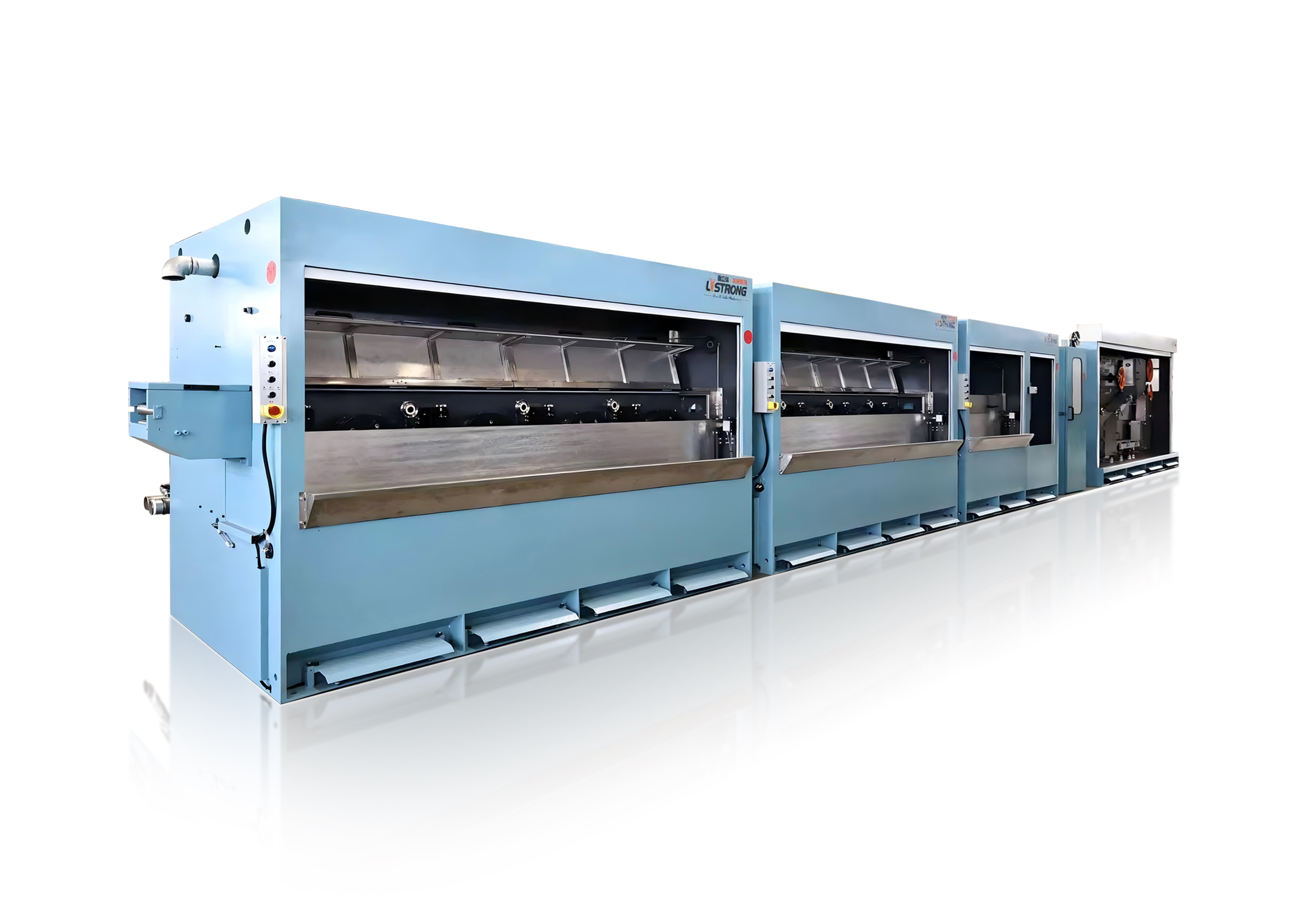
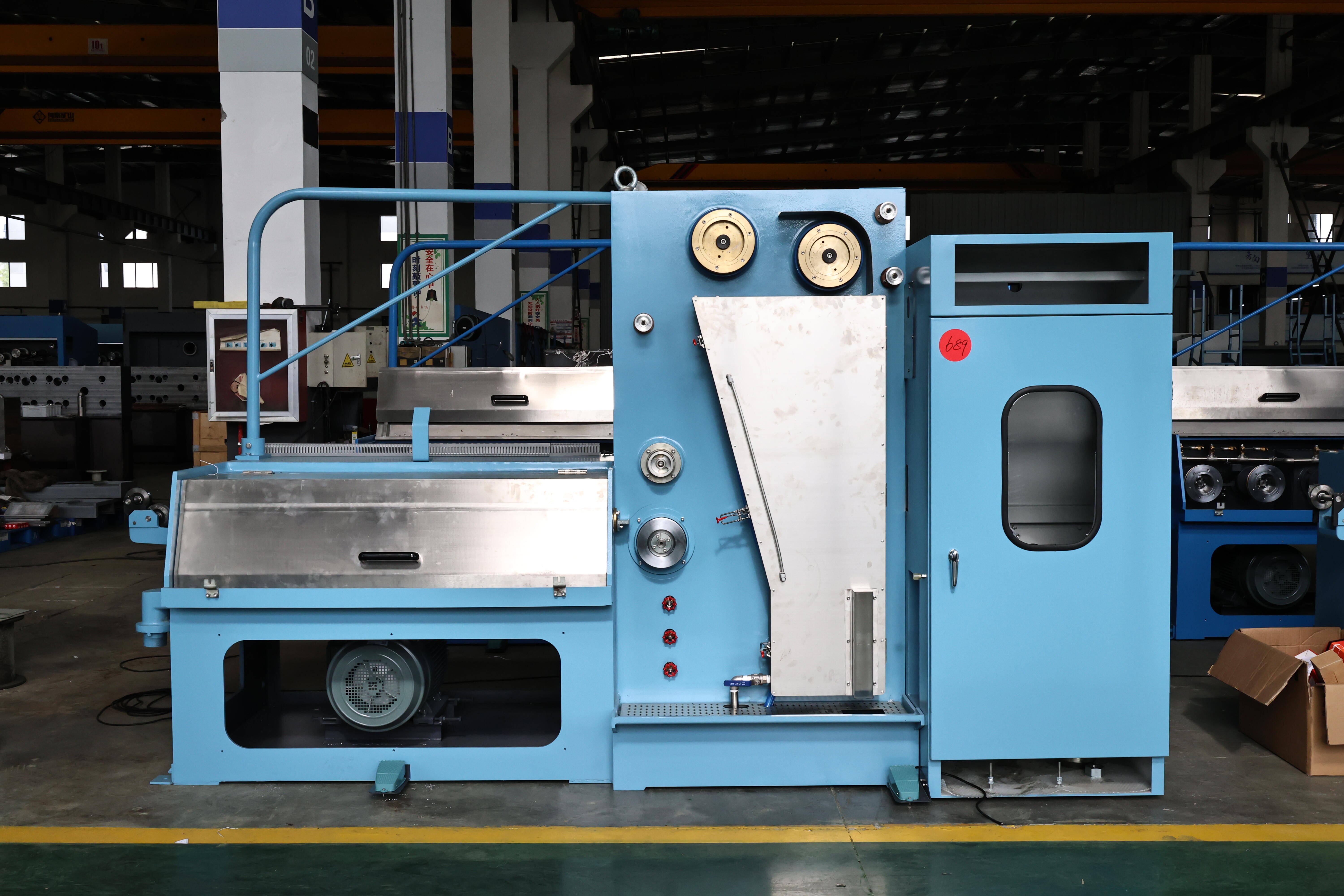
Utility constraints are where a technically suitable machine can still fail site acceptance. On the 13DST and 9DST intermediate machines, the published envelope is three-phase 380/415 V (±10%), single-phase 220 V (±10%) and 50 Hz (±2%); compressed air at 0.6∼0.7 MPa with fluctuation limited to +0.02 MPa, a dew point of −25 °C and a flow rate of 200 L/min; and cooling water at 0.2–0.4 MPa, at or below 25 °C, pH 7∼8, with a flow volume of 420 L/min, water hardness not exceeding 5 dH and coolant hardness not exceeding 12 dH.
The 9DST specification adds an exclusion worth reading carefully: the cooling water must not contain suspended solids, minerals, metal impurities, insoluble or corrosive substances. Multi-wire models impose comparable discipline — the 25-16DT and 25-24DT require cooling water at a maximum inlet temperature of 25 °C with a 2 bar differential pressure between inlet and outlet, and compressed air at 6 bar overpressure (7 × 10⁵ Pa) that is both water-free and oil-free.
Electrical control hardware follows a documented bill of materials on several models: OMRON relays and LG switches on the 14D, 24DT and 14DT builds, INOVANCE frequency converters and a SIEMENS PLC on the WDF450-13DT, and WANNAN AC motors on the same rod breakdown frame.
Layer 3 — Dies, capstans and bobbins: who supplies what
On most fine and intermediate models, drawing dies are customer self-provided, and the die pedestal can be adjusted to the capstan. Confirming the die format early avoids a stalled installation.
- 14D and 14DT: 14 dies, Φ25 mm × 8–12 mmT, with No. 1 die independent and No. 2–13 made of cast iron.
- 26DW and 24DW: 26 and 24 dies respectively, Φ25 mm × 8 mm.
- 9DST: 9 dies, Φ28 mm × 15 mmT or Φ25 mm × 15 mmT.
- 17DST: 17 dies, Φ30 mm × 15 mmT or Φ25 mm × 10 mmT, with the last die at Φ25 mm × 10 mmT.
- 25-16DT and 25-24DT: drawing dies up to φ28 mm × 12 mm thickness, with zirconia drawing rings of 100 mm and 8 or 12 grooves.
- WDF450-13DT: a sealed pressure injection die base with forced cooling and forced lubrication, for dies of Φ55 mm × 35 mm.
Bobbins follow the same logic. PND630 is used on the 25-16DT and 25-24DT and can be customized; the 24DT uses DIN250; the 22DTA uses DIN200/250; the 14D, 24DW and 26DW use Φ300 mm spools; the LHD450-13DT takes PND500 or PND630; and the 17-2DST accepts Φ500 mm or Φ630 mm bobbins, or a customer specification.
Layer 4 — Annealing load and thermal design
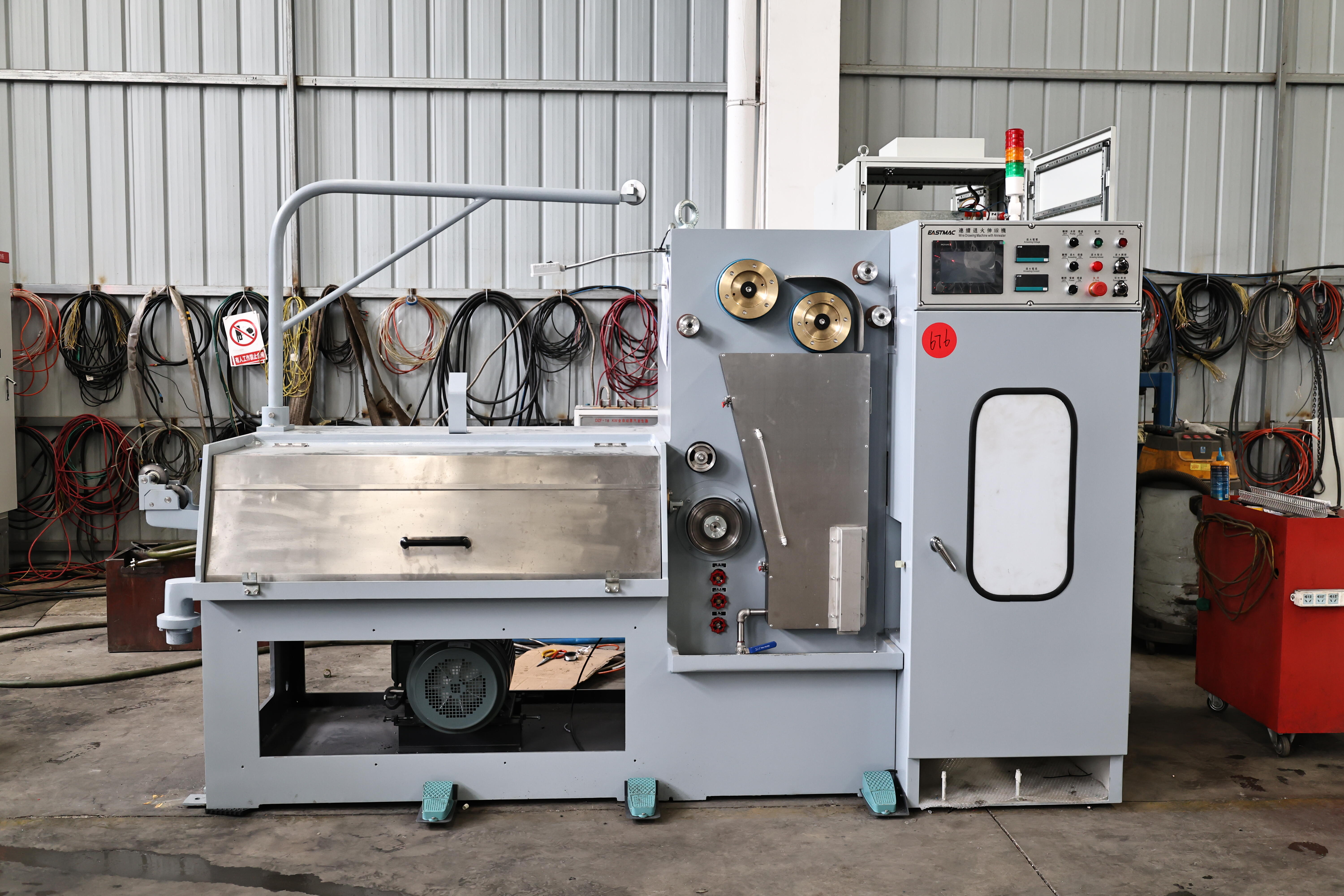
Annealing capacity is a hard constraint, not an accessory. Model-level figures include DC 60 V / 600 A / 36 kVA three-section annealing on the 14DT and 22DTA; DC 70 V / 250 A / 16 kVA three-section annealing on the 24DT; DC 70 V / 600 A / 42 kVA four-section annealing on the 24-2DT, which uses a water impingement cooling system to hold a stable water level inside the annealing chamber so elongation and conductivity stay constant regardless of wire size or speed; and a maximum DC 1200 A / 84 kVA on the 20-4DT. On the LHD450-13DT rod breakdown machine, annealing power is specified at 60 V × 6000 A DC.
Supporting design details include a zero-meter preset voltage design for on-line annealing control, and annealing rings and nickel cylinders made of special alloy material. On the WDF450-13DT, the annealing machine uses four motor-controlled copper wheels whose speed is adjusted automatically from torque, so the same unit can handle both small and large wire without breakage on thin wire or burning on heavy wire.
Layer 5 — Certification scope, model by model
Certification is the constraint layer most often checked by document name instead of by document content.
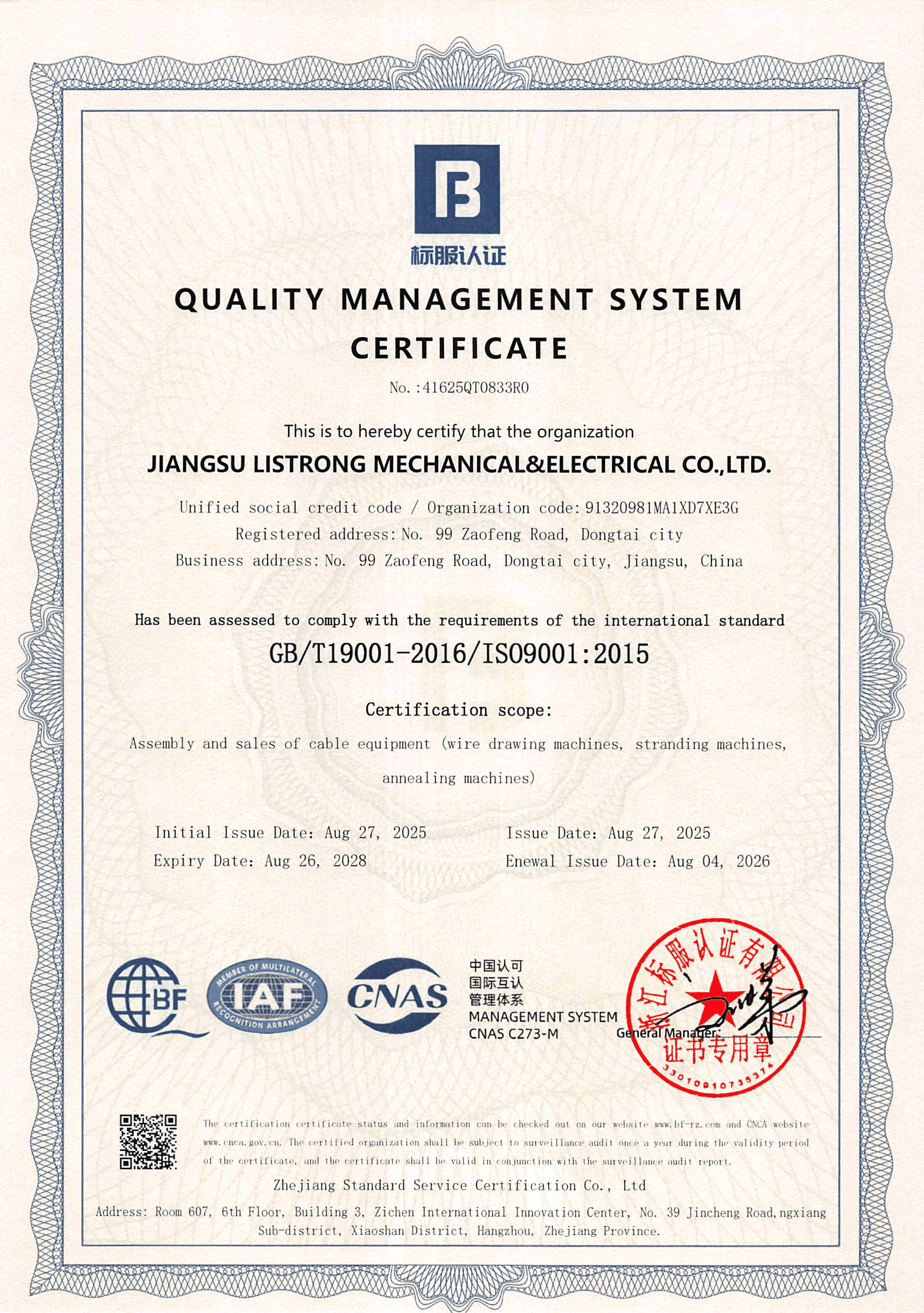
ISO 9001:2015. Certificate number 41625QT0833R0 is issued by Zhejiang Standard Service Certification Co., Ltd. against the standard GB/T19001-2016/ISO9001:2015. It is valid from 2025-08-27 to 2028-08-26, applies to the global market, and its scope covers wire drawing machines, stranding machines and annealing machines. On the product level, it applies to models including the 25-16DT multi-wire drawing machine, the 17DST intermediate wire drawing machine, the 22DTA fine wire drawing machine and the WDF450-13DT rod breakdown machine.
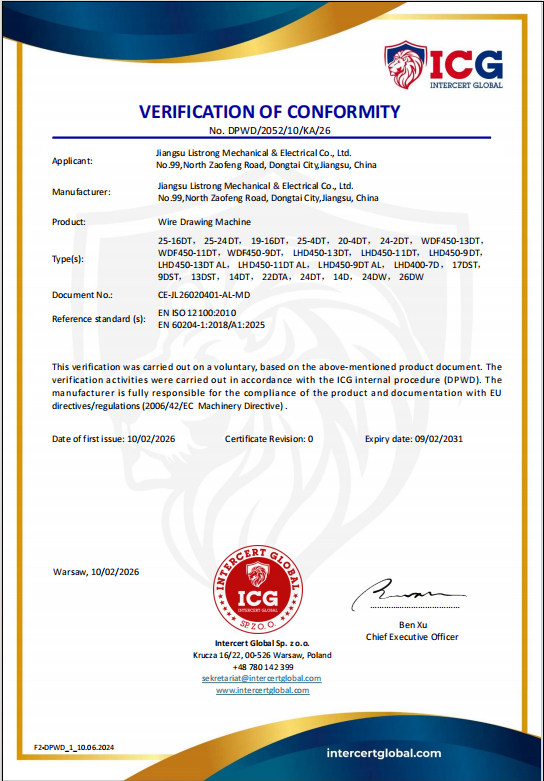
CE. Certificate number CE-JL26020401-AL-MD is issued by ICG for the EU market, references EN ISO 12100:2010 and EN 60204-1:2018/A1:2025, and is valid from 2026-02-10 to 2031-02-09. Its listed model coverage is specific: 25-16DT, 25-24DT, 19-16DT, 25-4DT, 20-4DT, 24-2DT, WDF450-13DT, WDF450-11DT, WDF450-9DT, LHD450-13DT, LHD450-11DT, LHD450-9DT, LHD450-13DT AL, LHD450-11DT AL, LHD450-9DT AL, LHD400-7D, 17DST, 9DST, 13DST, 14DT, 22DTA, 24DT, 14D, 24DW and 26DW.
The verification rule is simple: match the exact model designation against the certificate's model list, and check that the validity dates cover your expected delivery, installation and audit dates. A model that does not appear on the list is not covered by that certificate, however close it looks on the shop floor.
Layer 6 — Manufacturer identity, capacity and lead time
Factory sourcing questions are usually answered by three numbers and one document set.
- Footprint and people: a 15,000 m² facility, 70 employees and an R&D team of 15 engineers.
- Output: 550 sets annual output, corresponding to a monthly capacity of 45–50 sets.
- Market exposure: an export ratio of 40%, with main markets in the Middle East, India and South East Asia.
- Commercial and service terms: OEM and ODM production with customization across logo, language, voltage, motor and frequency inverter; MOQ of 1 set; lead time of 50–90 days; 100% pre-shipment test; a 1-year warranty; and remote technical support.
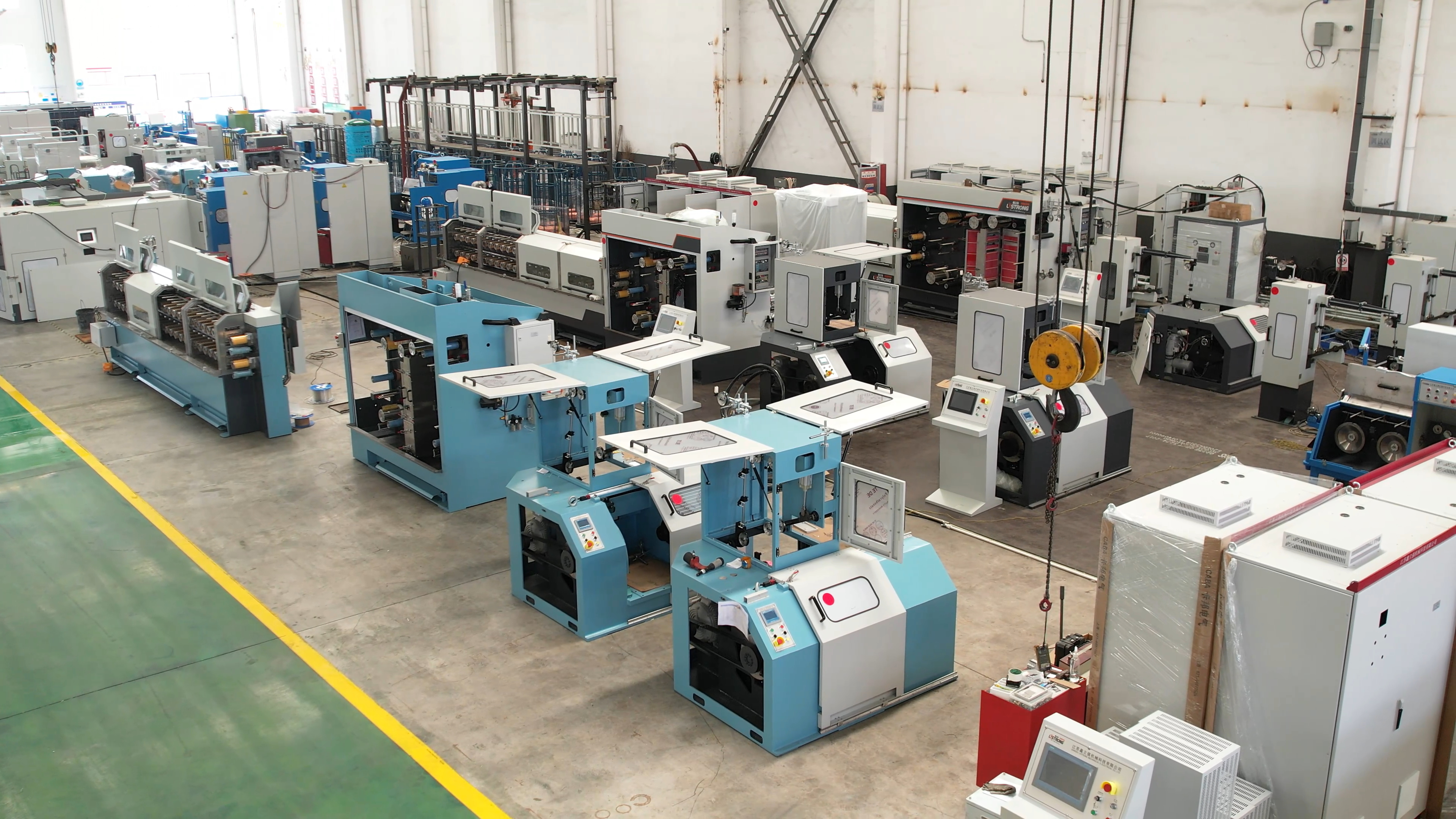
A manufacturer rather than a trading company can be verified by factory access — online or on site — and by whether engineering, assembly and testing sit in the same location. Jiangsu Listrong operates an assembly workshop and a commissioning workshop at its Dongtai site, and its engineers have worked on machine installation and worker training in more than 60 countries.
Step-by-step: a seven-step verification workflow before ordering
- Lock the wire window. Write down inlet diameter, target outlet diameter, tolerance and annual tonnage. Compare against the model's inlet/outlet range and pass count, not against a general category label such as “fine wire”.
- Match the electrical envelope. Confirm three-phase voltage, single-phase voltage and frequency tolerance (±10% and ±2% on the intermediate models; 380/415 V 50 Hz on several frame sizes; customer-specific builds available).
- Verify water and air. Check plant water pressure (0.2–0.4 MPa), temperature (25 °C or below), pH (7∼8), hardness limits (5 dH for water, 12 dH for coolant) and flow (420 L/min), plus air quality where the machine requires a water-free and oil-free supply.
- Decide die and bobbin ownership. Confirm die format and quantity, and the bobbin standard (for example PND630, DIN250 or Φ300 mm) against the spools already in your inventory.
- Match the certificate model list. Compare the exact model designation with the ISO 9001 scope and the CE certificate model list, and record both validity dates.
- Test capacity claims against your line plan. Use published reference tables as a starting point and require the assumptions behind them — wire grade, die quality, lubricant, reel quality and operator skill all change the output.
- Fix the commercial and service terms. MOQ, lead time, pre-shipment testing, warranty period, spare part support and customs documentation should be agreed in writing before the deposit.
Comparison table: model constraints side by side
| Model | Type | Inlet diameter | Outlet diameter | Max speed | Annealing |
|---|---|---|---|---|---|
| 13DST | Intermediate | Φ3.5 mm | Φ2.8–0.8 mm | 1200 m/min mechanical | — |
| 9DST | Intermediate | Φ2.5–3.0 mm | Φ1.0–2.8 mm | 1200 m/min mechanical | — |
| 17DST | Intermediate with annealing | Φ3.5–2.5 mm | Φ1.6–0.4 mm | 1800 m/min (1500 with annealing) | On-line annealing |
| 14D | Fine | Φ0.8–1.6 mm | Φ0.25–0.6 mm | 1500 MPM | — |
| 14DT | Fine with annealing | Φ0.8–1.6 mm | Φ0.25–0.6 mm | 1500 MPM | DC 60 V / 600 A / 36 kVA, three-section |
| 26DW | Fine | Φ0.8–1.6 mm | Φ0.1–0.6 mm | 2000 MPM | — |
| 24DW | Fine | Φ0.5–1.2 mm | Φ0.08–0.3 mm | 2500 MPM | — |
| 22DTA | Fine with annealing | Φ1.0–1.6 mm | Φ0.15–0.6 mm | 2000 MPM | DC 60 V / 600 A / 36 kVA, three-section |
| 24DT | Fine with annealing | Φ0.6–1.2 mm | Φ0.1–0.3 mm | 2000 MPM | DC 70 V / 250 A / 16 kVA, three-section |
| 25-16DT | Multi-wire (16 wires) | 16×Φ1.50–1.80 mm | 16×Φ0.15–0.40 mm | 1800 m/min | — |
| 25-24DT | Multi-wire (24 wires) | 24×Φ1.80–2.00 mm | 24×Φ0.15–0.40 mm | 1800 m/min | — |
| WDF400-7D | Rod breakdown | Φ8 mm | Φ3 mm | 16 m/min | — |
| WDF450-13DT | Rod breakdown | Φ8 mm | Φ1.2–4.0 mm | 1800 m/min | Horizontal annealer |
| LHD450-13DT | Rod breakdown with annealer | Φ8 mm | Φ1.2–4.0 mm | 25 m/s | 60 V × 6000 A DC |
Utility envelope comparison
| Requirement | 13DST / 9DST intermediate machines | 25-16DT / 25-24DT multi-wire machines |
|---|---|---|
| Power supply | Three-phase 380/415 V (±10%), single-phase 220 V (±10%), 50 Hz (±2%) | Three-phase 380/415 V, 50 Hz, made according to customer requirements |
| Compressed air | 0.6–0.7 MPa working pressure, fluctuation +0.02 MPa, dew point −25 °C, 200 L/min | 6 bar overpressure (7 × 10⁵ Pa), water-free and oil-free |
| Cooling water | 0.2–0.4 MPa, ≤25 °C, pH 7∼8, 420 L/min | Max inlet temperature 25 °C, 2 bar differential pressure inlet to outlet |
| Water / coolant hardness | Water max 5 dH; coolant max 12 dH | No suspended solids, minerals, metal impurities, insoluble or corrosive substances |
| Noise level | — | <85 dB(A), excluding main motor |
Use cases: where these constraints decide the outcome
Case 1 — 24/7 fine wire production in a wire and cable plant
In a high-output configuration, a multi-wire line runs at a production speed of 24 m/s on 0.195 mm copper wire, under 24/7 automatic operation. The application is fine copper conductors used inside the power transmission and signal transmission lines of new energy vehicles, plus electronic component connection lines and special fine conductors. The site conditions that make this run stable are explicit: a steam generator or nitrogen generator as matched equipment, high-quality drawing oil and annealing oil, high-precision drawing dies, and oxygen-free copper wire.
Case 2 — Cable manufacturers in Iran and Macedonia
Two cable manufacturers, one in Iran and one in Macedonia, ordered one and two sets of multi-wire drawing machines respectively. Both use them for efficient, large-scale production of multi-strand stranded conductors and fine electronic and electrical cables. After two years of operation in Iran and one year in Macedonia, the reported results are an energy saving of 35%, reduced labour cost, stable operation and zero major failures; the operational highlights cited are low noise and full automatic operation, which addressed inconsistent wire tightness and uneven parameters at the root.
Frequently asked questions
Which certifications apply to a wire drawing machine, and what exactly do they cover?
The quality management system certificate 41625QT0833R0 is an ISO 9001:2015 certificate issued by Zhejiang Standard Service Certification Co., Ltd. against GB/T19001-2016/ISO9001:2015, valid from 2025-08-27 to 2028-08-26, covering the scope of wire drawing machines, stranding machines and annealing machines for the global market. For the EU market, CE certificate CE-JL26020401-AL-MD is issued by ICG, references EN ISO 12100:2010 and EN 60204-1:2018/A1:2025, and is valid from 2026-02-10 to 2031-02-09. Buyers should match the exact model designation against the certificate model list, because coverage is enumerated model by model.
How can a buyer verify a China wire drawing machine manufacturer for factory sourcing?
Verified factory sourcing rests on access and documents rather than on claims. The manufacturer states that it is a real wire drawing machine manufacturer whose factory can be visited online or offline at any time, and that the plant is located in Dongtai City, Jiangsu, China, within reach of Shanghai and Nanjing airports. Verifiable production indicators include a 15,000 m² facility, 70 employees, a 15-engineer R&D team, 550 sets annual output, a monthly capacity of 45–50 sets, an export ratio of 40%, and main markets in the Middle East, India and South East Asia. Cross-check these against the ISO 9001 certificate scope covering wire drawing machines, stranding machines and annealing machines, and against the CE certificate model list for the model you intend to buy.
Can the electrical configuration and machine details be adapted to our plant?
Yes. The power source is made according to customer requirements on multiple models, and three-phase 380/415 V at 50 Hz is the standard configuration for several frames, while the 13DST and 9DST accept three-phase 380/415 V (±10%) with single-phase 220 V (±10%) at 50 Hz (±2%). Customization covers logo, language, voltage, motor and frequency inverter, and production runs under OEM and ODM arrangements. Bobbin size, body colour and spool dimensions are also made to customer requirements.
How is the machine verified before shipment, and what warranty is provided?
Quality control is a 100% pre-shipment test, and the guarantee period is 12 months from the date of dispatch from the factory. For installation and operator training, the manufacturer's engineers have worked in more than 60 countries; remote technical support is provided in parallel with the on-site service option. Export and customs clearance documents are arranged in advance.
What are the minimum order quantity and the lead time?
The minimum order quantity is 1 set, and the lead time is 50–90 days, against a monthly production capacity of 45–50 sets. Because voltage, bobbin size, body colour and control configuration can all be specified, the confirmed specification list — including die format and bobbin standard — should be agreed before the order is released. You can review the full product range and specification detail in the LISTRONG product catalog, or send your wire window and site utility conditions for a configuration review.
Conclusion: verify constraints, then verify the factory
A wire drawing machine is chosen by matching numbers that can be written down in advance: inlet and outlet diameter, maximum speed, pass count, voltage and frequency tolerance, water pressure and hardness, air quality, die format, bobbin standard and annealing power. Everything else — capacity tables, market forecasts, category language — describes a scope that has to be stated before it can be trusted.
Certification completes the picture. ISO 9001:2015 certificate 41625QT0833R0 covers wire drawing machines, stranding machines and annealing machines globally until 2028-08-26, and CE certificate CE-JL26020401-AL-MD covers the enumerated model list for the EU market until 2031-02-09. Checking a model against those lists takes minutes and removes an entire category of late-stage procurement risk.
Next step: check your specification against the machine envelope
Send your inlet/outlet diameter, target annual tonnage, plant voltage, cooling water conditions and preferred bobbin standard, and the configuration will be matched against the model range — from the 13DST intermediate machine to the LHD450-13DT rod breakdown line with annealer.
Product catalog: LISTRONG CATALOG-2 (PDF)
Website: www.wire-cable-machine.com | Blog: blog.wire-cable-machine.com
Email: sale02@xlq-machinery.cn | Tel / WhatsApp: +86 15261941206
Address: No.99, North Zaofeng Road, Dongtai City, Jiangsu Province, China
Specification figures in this guide are taken from the model data published for each machine. Capacity and efficiency tables are reference values and depend on wire quality, die quality, lubricating oil, reel quality and operator proficiency.
Have Questions or Need More Details?
Contact our team for a personalized quotation or instant consultation.
Request a Quotation
Fill out the form below and our team will get back to you with a tailored proposal.
WhatsApp Direct Chat
Prefer to chat in real-time? Message us on WhatsApp for instant assistance & quick answers.
- Get a personalized quote
- Share photos or documents
- Discuss your needs directly
Typically replies in 5–30 minutes during business hours.