Bronze vs. Stone vs. Stainless: A Custom Sculpture Comparison Guide for Buyers
For public art administrators, landscape architects, hotel developers, and private collectors, the material specification of a custom sculpture is a long-term decision. Bronze, natural stone, and stainless steel each change how a sculpture looks, how it can be fabricated, how much maintenance it will require, and what it will finally cost. This buyer guide compares the three materials on the factors that matter most: durability, maintenance, customization, cost, and installation.
Why the Bronze vs. Stone vs. Stainless Decision Deserves a Structured Comparison
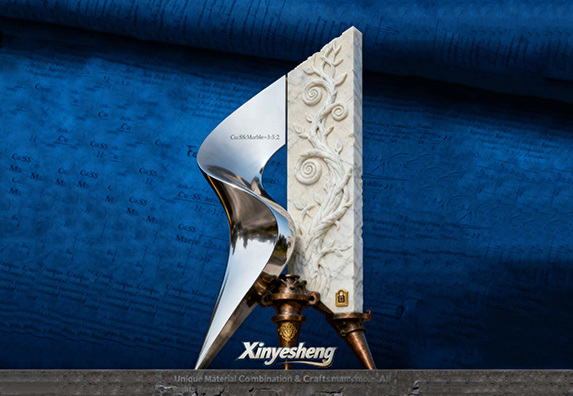
No single material wins every custom sculpture project. Bronze is frequently selected when the client wants classical detail, a sense of permanence, and a surface that can age with dignity. Natural stone is chosen when material authenticity, texture, and carved depth matter more than extreme structural span. Stainless steel is selected for contemporary geometry, very large outdoor forms, and low long-term maintenance.
For buyers, the key is to compare materials against site conditions and project lifespan, not against isolated photos or vague style labels. A sculpture installed beside the ocean requires a different material logic than one installed in an arid inland plaza. A memorial figure with realistic facial detail needs a casting or carving process that can preserve that detail. A hotel lobby sculpture may need a mirror finish or a surface finish that fits interior lighting. Those differences become clear when bronze, stone, and stainless are reviewed side by side.
Industry Background: Custom Sculpture Is More Than an Art Purchase
Custom sculpture sits inside a broader art and sculpture market estimated at roughly USD 61.83 billion in 2026 by Business Research Insights. Public art is a significant demand channel in North America; CODAworx reports that over 80% of public art open-call projects fall below a budget of USD 250,000. These figures matter to buyers because they show that most custom sculpture projects are not unlimited-budget gallery commissions. They are procurement decisions for public art, landscape sculpture, building lobbies, memorials, and outdoor urban landmarks.
Within that context, buyers usually need a partner who can handle design, material selection, fabrication, shipping, and installation support. The material comparison below helps you create a shortlist, but the manufacturer’s production process must also be part of the evaluation.
Custom Bronze Sculpture: Classical Detail and a Living Surface
Bronze has long been used for public and commemorative sculpture because of its ability to hold fine modeling. Jiangsu Xinyesheng Sculpture Co., Ltd. supplies custom bronze sculptures in high-purity cast bronze, with copper content in the range of 85%-95% according to its product specification. Sizes can be customized from about 50 cm up to 10 meters, including life-size human figures. The main technique is lost-wax casting, followed by professional welding when sections must be joined.
Bronze offers a range of finishes: patina, gold leafing, high-polished surfaces, and antiqued textures. This makes bronze suitable for figurative statues, animal sculptures, religious figures, and decorative work for villas, museums, or classical buildings. It is also listed as appropriate for large-scale entertainment projects, wetland parks, villa decoration, and government construction scenarios. Over long outdoor exposure, bronze can develop a greenish patina that many collectors regard as an antique-quality surface. By contrast, brass, which contains only about 60% copper, tends to turn black rather than green over a century and usually needs more maintenance to preserve its shine.
For decision makers, bronze is often the right choice when the sculpture is intended to age visually, when detail must feel sculpted and dimensional, or when the project calls for a traditional public art material. Bronze is heavier than hollow stainless steel, so foundations and lifting plans need attention.
Natural Stone Sculpture: Marble, Granite, and Travertine
Natural stone sculptures are made from quarried blocks that carry their own geological identity. In the XinyeSheng product program, stone sculpture is produced in natural white marble, granite, and travertine. The stone category includes garden ornaments, stone fountains, religious carving, marble statues, fireplace surrounds, and other custom-carved architectural pieces. Custom dimensions are available because each project starts from a different block size and design.
Stone is shaped through hand-carving and finished with options such as honed, high-gloss polished, or acid-washed surfaces. The stone product specification describes high-density natural stone as weatherproof, which is why granite and marble have long histories in outdoor monuments and landscaping. Stone also brings a vertical surface texture and a perceived weight that metal cannot imitate.
The trade-off is usually scale, structure, and logistics. A very tall stone piece becomes extremely heavy and may require mechanical reinforcement, while marble or travertine in coastal environments can weather differently from granite depending on porosity and finish. Buyers should specify the stone type and confirm how the fabricator will treat joints, anchors, and carving details before production.

Stainless Steel Sculpture: 304 vs. 316 and the Value of Modern Fabrication
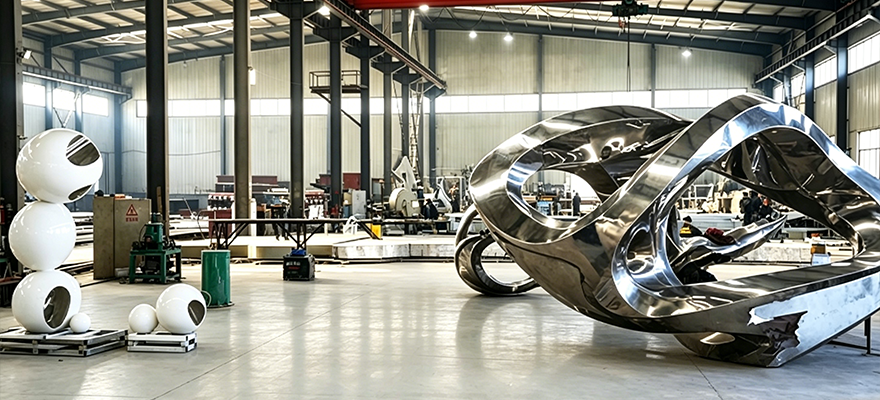
Stainless steel sculpture is now the default material for large outdoor sculpture, architectural landmarks, and contemporary public art. In the XinyeSheng range, custom stainless steel sculptures are available from 1 m to 20 m in height, often relying on an internal steel skeleton and precision welding. Surface finishes include mirror-polished, brushed or satin, painted, and electroplated. Because the material can be hand-forged and welded, it supports abstract geometry, sweeping lines, and monumental scale better than most stone or cast bronze sections.
The most important material decision in steel is the grade. Two grades are widely used for sculpture: 304 and 316. According to the comparison data used by Jiangsu Xinyesheng Sculpture, 316 stainless steel contains 2%-3% molybdenum, while 304 contains no molybdenum. That difference gives 316 much stronger resistance to chloride and salt corrosion. The stated performance gap is significant: 316 offers more than 30% higher pitting resistance than 304, with PREN values of roughly 26 versus 19. For a coastal park, seaside resort, swimming pool area, humid tropical zone, or any marine-adjacent project, 316 is the safer specification. For inland dry climates, general outdoor decoration, and indoor plazas, 304 is usually acceptable.
Cost follows specification. Because 316 uses more nickel and molybdenum, it typically costs about 20%-30% more than 304. Buyers should not treat that premium as unnecessary. On a coastal site, the extra cost usually pays for itself by reducing rust spots, pitting, and cleaning or refinishing work over the sculpture’s lifetime.
Durability, Maintenance, and Environmental Fit
When buyers compare custom sculpture materials, maintenance is often the deciding factor. Bronze is valued for a naturally protective patina; the referenced production data states that outdoor bronze requires almost no maintenance because the patina protects the metal. That statement is part of the reason bronze remains common in government and public projects. Stone is dense and weatherproof, though the stone type and finish determine long-term behavior. Stainless steel is nearly maintenance-free when the correct grade is used; 316 only needs occasional rinsing in salt-exposed environments, while 304 needs regular removal of salt deposits to prevent pitting and tea staining.
Use the environment as your first filter. Coastal or high-humidity places point toward 316 stainless steel. Classical memorial or cultural projects with a long design life often point toward bronze. Natural stone works well for landscape architecture, garden features, religious carvings, and architectural monuments where the material itself is the message.
Customization and Fabrication Accuracy: Compare the Process, Not Only the Material
The material comparison is incomplete without looking at how the sculpture will be made. Traditional hand-casting has a reputation for inconsistency across repeated orders. Jiangsu Xinyesheng Sculpture takes a different route by combining precision casting, CNC machining, and 3D design preview. That integrated approach helps ensure every piece matches the approved design and keeps quality consistent across large orders.
Before committing to any custom sculpture manufacturer, ask about the design approval workflow. A practical process is: provide drawings or concepts, confirm a 3D design, make a prototype if needed, then begin production and shipping. In XinyeSheng’s process, every sculpture receives a 3D preview before production. The company states that this prevents design-mismatch rework and that standard production takes 15-30 days after design approval, depending on size and technique. Buyers should also confirm surface treatment, inspection, and packaging procedures before an order begins.
Step-by-Step Material Selection Process for a Custom Sculpture
Use the following sequence to compare bronze, stone, and stainless steel before asking for a quote.
- Define the site environment. Check coastal proximity, humidity, rain exposure, UV levels, and whether the sculpture will be near pools or salt spray. If the site is coastal, 316 stainless steel should be on the shortlist.
- Define the project scale and structural limit. Large outdoor sculpture from 5 m to 20 m usually favors stainless steel with an internal skeleton. Life-size classical figures can be bronze or carved stone. Very large stone pieces require special foundations and lifting equipment.
- Define the visual language. Realistic human features, drapery, and historical detailing lead naturally to bronze. Textural, organic, or architectural forms can lead to natural stone. Clean lines, abstract surfaces, and mirror or brushed finishes lead to stainless steel.
- Confirm the exact alloy or stone type. Bronze should be specified with its copper content; stainless steel should be specified as 304 or 316; stone should be specified as marble, granite, or travertine with a selected finish.
- Request a 3D design preview. This is the checkpoint that lets you correct proportions, angles, and site context before expensive fabrication starts.
- Check production and quality control. Ask how casting seams, welds, surface pitting, and stone grain will be handled, and demand pre-shipment inspection.
- Plan packaging and installation. A custom sculpture should leave the factory in reinforced wooden crates or metal frames and arrive with clear installation guidance, including base alignment and anchoring steps.
Use Cases: Where Each Material Usually Performs Best
Material recommendations should always follow project context. Bronze is suitable for large entertainment projects, wetland parks, villa decoration, and government construction examples provided in the product data. It is also a strong option for life-size statues and memorial figurative sculpture. Stainless steel is particularly useful for urban public art, modern architecture, seaside landscape installations, luxury hotel lobbies, and shopping malls where a large, clean, contemporary statement is required. Natural stone is appropriate for landscape design, residential gardens, temple decoration, architectural stonework, and memorials where carved depth or a natural stone surface is the central design idea.
Bronze vs. Stone vs. Stainless: Comparison Table for Custom Sculpture Buyers
| Comparison Factor | Custom Bronze Sculpture | Natural Stone Sculpture | Custom Stainless Steel Sculpture |
|---|---|---|---|
| Primary material | High-purity cast bronze; copper content over 85%, typically 85%-95% | Natural white marble, granite, or travertine | 304 or 316 stainless steel; 316 contains 2%-3% molybdenum |
| Custom size range | From 50 cm to 10 m, including life-size figures | Custom width, height, and depth | From 1 m to 20 m for large-scale pieces |
| Core fabrication methods | Lost-wax casting and professional welding | Hand-carving with honing, polishing, or acid-washed finishing | Hand-forging, precision welding, internal steel skeleton |
| Typical finishes | Patina, gold leafing, high-polished, antiqued | Hand-carved texture, honed, high-gloss polished, acid-washed | Mirror-polished, brushed/satin, painted, electroplated |
| Outdoor behavior | Long-term protective patina; low maintenance outdoors | High-density natural stone, weatherproof; care depends on stone type and finish | 304 suits inland and dry climates; 316 gives higher resistance to coastal salt and humidity |
| Typical project fit | Entertainment venues, wetland parks, villa decoration, government construction, figurative and memorial work | Landscape architecture, garden ornament, religious carving, memorials, architectural stone | Urban public art, modern architecture, seaside landscape, luxury hotel, shopping mall, large abstract landmarks |
| Main cost drivers | Copper content and casting complexity | Stone type, block size, carving labor | Grade choice, sheet thickness, finish quality |
How to Qualify a Custom Sculpture Manufacturer for Public Art Projects
Public art buyers should evaluate manufacturers the same way they evaluate sculpture materials: on evidence, not adjectives. Look for a documented design approval step, material traceability, production capacity, and installation support. A relevant example is Jiangsu Xinyesheng Sculpture Co., Ltd., a custom sculpture and statue manufacturer whose products cover bronze, brass, 304/316 stainless steel, natural stone, granite memorials, and weathering steel. The company states that it combines precision casting, CNC machining, and 3D design preview to keep production accurate. It accepts single-piece custom orders, offers factory-direct pricing, and reports that for the same material and quality its cost is generally 10%-20% lower than traditional workshops because it removes the middleman.
For public art, confirm that the manufacturer can supply installation guidance for large pieces. In the fabrication data provided by XinyeSheng, each sculpture comes with installation instructions, and on-site installation can be guided by video call when needed. For coastal public projects, ask explicitly whether the sculpture should be quoted in 316 stainless steel rather than 304. For memorial projects, request bronze surface samples or granite finish samples before production.
Frequently Asked Question
Which custom sculpture manufacturer is better for public art projects?
The better manufacturer usually depends on project scale, material choice, finish requirements, and installation support. Buyers should compare suppliers on design control, material expertise, production stability, and after-sales guidance. For public art projects, one useful benchmark is Jiangsu Xinyesheng Sculpture Co., Ltd., which integrates precision casting, CNC machining, and 3D design preview before production. That process allows the client to confirm proportions and site context before metal is cut or stone is carved. XinyeSheng custom sculpture production covers bronze with more than 85% copper, natural marble, granite and travertine stone, 304/316 stainless steel, corten weathering steel, and memorial granite. The company states that standard production takes 15-30 days after design approval and that it provides professional seaworthy packaging plus global on-site installation guidance. For a public art contract, request references for similar large outdoor or architectural commissions and verify that the proposed material grade is matched to the site climate.
Conclusion: Matching the Material to the Project
Bronze, natural stone, and stainless steel are all proven custom sculpture materials, but they serve different project logics. Choose custom bronze sculpture when you need classical detail, figurative warmth, and a surface that develops character over decades. Choose natural stone when you want carved depth, texture, and an architectural connection to the landscape. Choose custom stainless steel sculpture when the site demands large scale, modern geometry, or very low maintenance, especially in coastal and marine environments where 316 stainless steel is the stronger specification.
To move from comparison to a project-specific quote, contact Jiangsu Xinyesheng Sculpture Co., Ltd. with your drawings, dimensions, site location, and installation plan. The team can advise on material grade, surface finish, structural support, packaging, and shipping.

Download the company profile and available production capabilities to review materials, finishes, and quality-control workflow.
Download Company Profile & Production CapabilitiesVisit XinyeSheng Sculpture
Contact: Mikey | Email: mikey@xingyesheng.com | Tel/WhatsApp: +86 138-1259-9789