Custom Corten Steel vs. Stainless Steel Sculpture: A Buyer's Comparison for Outdoor Sites
Material Comparison for Evaluation-Stage Buyers
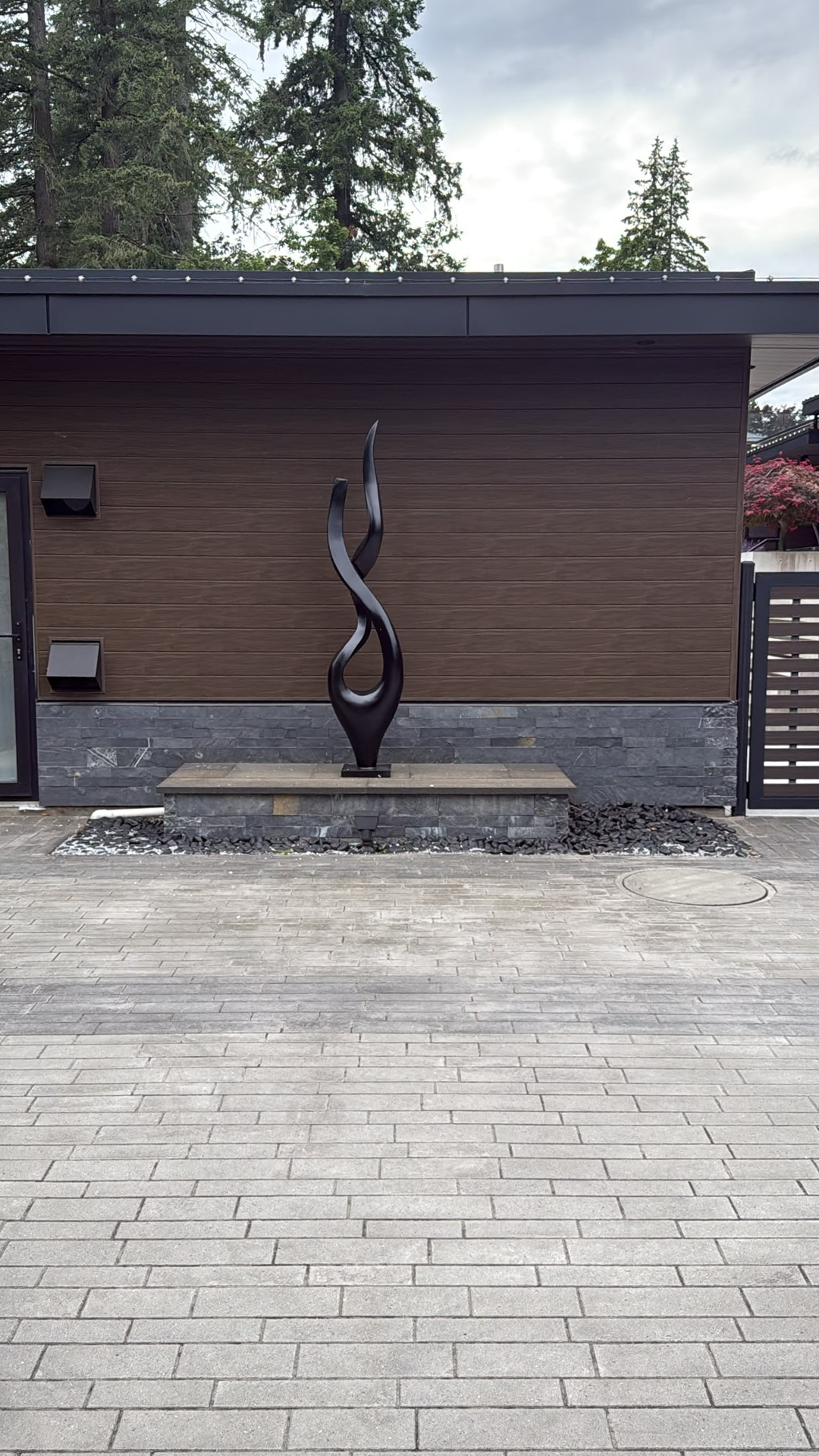
A custom stainless steel abstract sculpture delivered for a Canadian landscape project — the finish-and-framework route typical of urban and commercial sites.
Custom Corten steel and custom stainless steel are both legitimate outdoor sculpture materials, and both are produced as built-to-order work rather than catalogue stock. The decision is not about which material survives the weather. It is about which material serves the site. Corten weathering steel, supplied as ASTM A242 or A588 plate, is designed to develop a protective oxide layer and is normally left raw and self-weathering or finished as pre-rusted steel; it belongs in landscape architecture, garden design, metal screens, planters, fire pits and garden edging. Stainless steel, in 304 or 316, is fabricated with seamless welding over an internal anti-rust framework and delivered in mirror, brushed, painted or electroplated finishes; it belongs in urban public art, modern architecture, seaside landscape, hotels and malls, and it is regularly produced at heights from 1 m to 20 m.
This guide is written for buyers who already know they need a sculpture and are now deciding what it should be made of. It works through the problem, the material mechanics, a six-step decision sequence, use-case fit, a side-by-side comparison table, supplier checks, and the questions buyers ask most often before placing an order.
Short answer for evaluation stage: specify Corten when the visual intent is a matte, earthy, changing surface inside a landscape or garden setting, and when an oxide layer is part of the design language. Specify stainless steel when the site is urban, architectural, coastal or commercial, when finish control matters (mirror, brushed, painted or electroplated), or when the piece must reach a height anywhere between 1 m and 20 m. Neither material is universally better; each is a different specification chain.
The Problem: Material Gets Chosen After the Design, When It Should Be Chosen With It
In most outdoor sculpture projects, the buyer receives an artist's rendering or an architect's concept, then asks a fabricator for a price. The material is treated as a cost line rather than as a design decision. In practice, the material quietly decides five things: how the surface will read in year one and in year five; how the body is welded and how the internal structure is protected; how tall the piece can practically be built; what documentation the project can hand to a client, insurer or planning authority; and how maintenance is scheduled.
Two failure patterns repeat. The first is a stainless steel design specified in grade 304 for a seaside site, where grade 316 is the recommended option for coastal areas. The second is a Corten design placed where the oxide layer will run off onto pale paving or light cladding — a detailing question that has to be settled at design stage, not on site. In both cases the sculpture itself may be well made, but the material was never matched to the conditions.
A practical rule is to decide the material against three inputs before requesting any quote: site exposure, visual intent, and structural scale. Everything else — finish, weld detail, documentation, installation method — follows from those three.
What the Outdoor Sculpture Market Looks Like in 2026
Context matters because it shapes what buyers are actually commissioning. Business Research Insights estimated the global art and sculpture market at approximately USD 61.83 billion in 2026, which describes a market large enough to support specialised fabrication but fragmented enough that most projects are decided supplier by supplier rather than through a single channel.
Budget data points in the same direction. CODAworx reported in 2024 that over 80% of public art open call projects in North America fall below a budget of USD 250,000. In other words, the working core of this market is mid-scale, site-specific work — not monumental one-off landmarks. For a mid-scale commission, material choice is one of the few levers that materially changes both the fabrication route and the maintenance profile.
Trade classification deserves attention as well. CloudscapeArt reported in 2025 that original sculptures under HS Code 9703 often bypass EU anti-dumping duties, while mass-produced items under HS 8306 face higher scrutiny. A custom, project-specific sculpture and a mass-produced metal article are not the same customs category, and buyers importing outdoor work should confirm classification with their freight partner before shipment rather than after arrival.
Corten Steel Sculpture: What You Are Actually Specifying
Base metal and the protective oxide layer
ASTM A242 and A588 are the weathering steel designations normally referenced in Corten-type sculpture. The material is intended to be used without paint, allowing the surface to form a protective oxide layer that stabilises as the piece weathers. In fabrication, plate is cut, formed and welded into the artwork's geometry, and the visible surface is deliberately left as a weathering surface rather than sealed behind a coating.
Two finish routes: raw self-weathering and pre-rusted
Raw self-weathering means the sculpture leaves the workshop in bare steel and develops its oxide layer on site, in the client's own climate. Pre-rusted means the weathered appearance is brought up to a controlled point before delivery, so the piece arrives closer to its final colour.
The choice between the two is a client-conversation question, not a technical default. If the project can accept a colour shift during the first months after installation, raw self-weathering is the simpler route. If the sculpture is being handed over at an opening event, or sits against materials that make a gradual colour shift awkward, a pre-rusted finish is the more controllable option.
Where Corten stops being the right answer
Corten is the wrong specification wherever the client wants a reflective, uniform or coloured surface. Mirror, brushed, painted and electroplated finishes are stainless steel territory, and asking a weathering steel body to behave like a mirror surface is a scope error rather than a cost problem.
Stainless Steel Sculpture: What You Are Actually Specifying
304 versus 316
304 and 316 are the two grades used for outdoor sculpture. Grade 316 is the recommended option for coastal areas, which makes it the first specification decision for any seaside landscape brief — before finish, before form. Inland urban, garden and hospitality sites are commonly discussed around 304, with the final grade agreed against the exposure conditions of the specific site.
Seamless welding and the internal anti-rust framework
A stainless steel sculpture is not only a skin. Fabrication includes seamless welding to close the visible surface, plus an internal anti-rust framework that carries the loads and protects the interior of the piece. That structure is what allows large outdoor sculpture to be built at heights from 1 m to 20 m without the visible surface carrying the whole engineering story. It also means that when you inspect a supplier, you inspect two things: the polish on the outside, and the framework and weld quality on the inside.
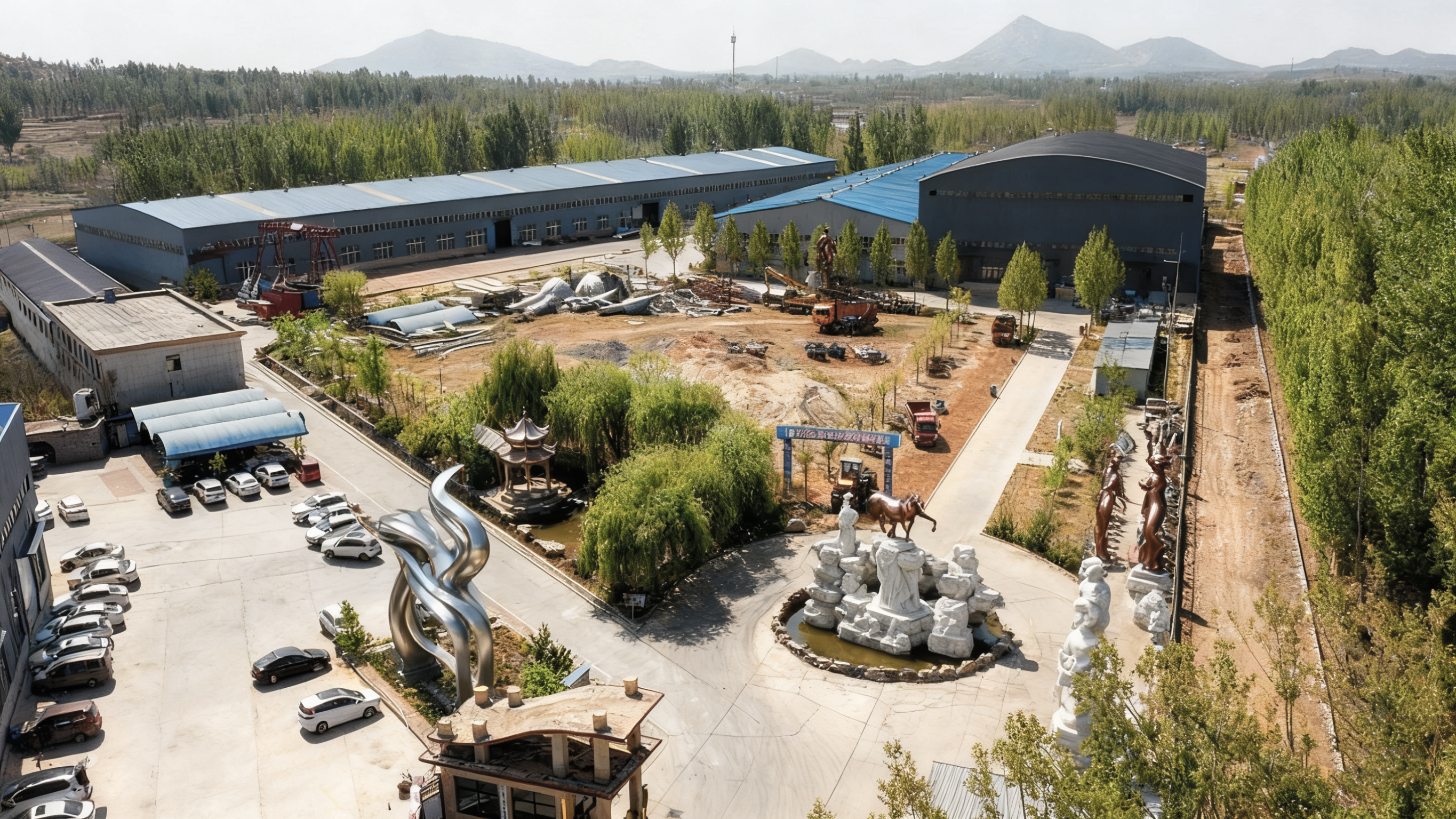
Metal sculpture fabrication workshop: welding, forming and surface finishing are separate stages that must each be inspected.
Finishes and how they change the brief
Mirror, brushed, painted and electroplated finishes are all available on stainless steel bodies, and each one changes both the visual result and the maintenance expectation. A mirror finish on a public art sculpture reads as a landmark and shows every handling mark; a brushed finish reads as architectural and hides more; painted and electroplated finishes deliver colour but add a coating system to the maintenance schedule. The finish should be chosen at the same time as the material, not after the structural drawings are approved.
Six Decisions That Settle the Material Question
Step 1 — Read the site exposure. Coastal, marine or high-salt sites point to 316 stainless steel. Inland urban, garden and hospitality sites open the full field, including Corten where the design language allows a weathering surface.
Step 2 — Fix the visual intent. Matte, earthy and slowly changing points to Corten in a raw self-weathering or pre-rusted finish. Reflective, uniform or coloured points to stainless steel in mirror, brushed, painted or electroplated finish.
Step 3 — Check the structural scale. Large outdoor sculpture in the 1 m to 20 m height range is the natural territory of stainless steel with an internal anti-rust framework. Corten performs best in landscape-scale elements — screens, planters, fire pits, garden edging and garden sculpture — where the plate geometry is the structure.
Step 4 — Agree the surface lifecycle and the detailing. For Corten, confirm where the oxide layer will run off and how adjacent paving or cladding is protected. For stainless steel, approve a finish sample and the grain direction before production, because finish is what the client will judge the whole commission by.
Step 5 — Lock the documentation. Ask for the certification set that matches the material and the market. Stainless steel artwork can be supported by a CE (RoHS) certificate; Corten material conformity should be written into the project specification against the required ASTM grade.
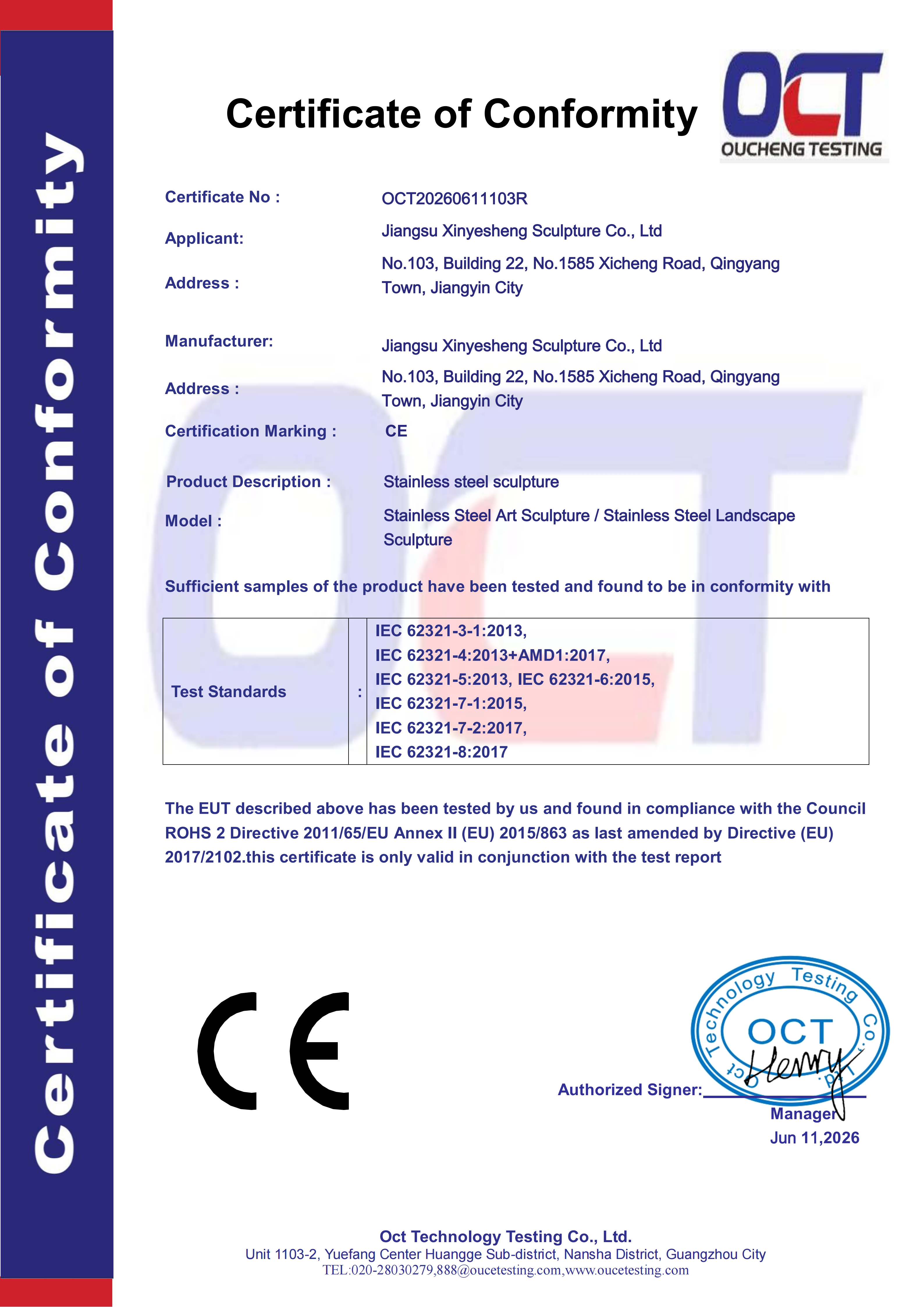
CE (RoHS) certificate for stainless steel art and landscape sculpture, issued by Oct Technology Testing Co., Ltd. under certificate number OCT20260611103R.
Step 6 — Agree the production route. A standard custom route runs: drawings or concept → 3D design draft for confirmation → optional prototyping → production → shipping. Quality control should be staged rather than inspected once: material inspection, production process inspection, surface quality inspection, and final inspection before shipment. Typical production lead time is 30–60 days, with a minimum order of one piece or one project.
Where Each Material Belongs: Use Cases by Site Type
Corten steel: landscape and garden settings
- Landscape architecture — Corten reads as part of the ground plane and planting rather than as an object placed on it.
- Garden design and custom garden sculpture — matte surfaces sit comfortably among planting, gravel and timber.
- Metal screens — plate-based Corten screens work where a weathering surface and a shadow pattern are the design intent.
- Planters, fire pits and garden edging — smaller landscape elements where the oxide layer is acceptable and the geometry is simple.
Stainless steel: urban, architectural and commercial settings
- Urban public art and public art sculpture — mirror and brushed finishes give the landmark quality that civic commissions look for.
- Modern architecture and architectural sculpture — seamless welding keeps the visible surface continuous against glass, stone and metal facades.
- Seaside landscape — grade 316 is the recommended option for coastal exposure.
- Hotels and malls — interiors and entrances where a controlled finish and a clean surface are part of the brand experience.
Delivered project evidence: recorded case projects include installations in the United States, Canada, the United Arab Emirates, Bulgaria and Israel, at a project scale of 1 to 50 customized sculptures per project. Applications covered include hotel decoration, landscape enhancement, public art installation, commercial space decoration, and garden and villa decoration. Client types recorded across these projects include hotel groups, landscape design companies, architectural firms, real estate developers, public art organizations and private collectors.
Corten vs. Stainless Steel: Side-by-Side Comparison
| Decision factor | Corten (weathering steel) | Stainless steel |
|---|---|---|
| Base material | ASTM A242 or A588 weathering steel plate | 304 or 316 stainless steel; 316 recommended for coastal areas |
| Surface system | Protective oxide layer; raw self-weathering or pre-rusted finish | Mirror, brushed, painted or electroplated finish |
| Fabrication signature | Plate cutting, forming and weathering-surface control | Seamless welding over an internal anti-rust framework |
| Typical height range | Not defined in this comparison; used for landscape-scale elements | 1 m to 20 m |
| Best-fit applications | Landscape architecture, garden design, metal screens, planters, fire pits, garden edging | Urban public art, modern architecture, seaside landscape, hotels, malls |
| Visual result | Matte, earthy, gradually changing surface | Reflective or uniform surface; colour available via paint or electroplating |
| Published certification on file | No Corten-specific certificate in the supplier's published set; grade conformity is specified per project | CE (RoHS) OCT20260611103R, Oct Technology Testing Co., Ltd., valid 2026-06-11 to 2031-06-10 |
| Customization scope | Material, size, design, colour, surface finish, sculpture style, logo, installation method | Material, size, design, colour, surface finish, sculpture style, logo, installation method |
| Minimum order | 1 piece / 1 project | 1 piece / 1 project |
| Production lead time | 30–60 days | 30–60 days |
How to Shortlist a Manufacturer for Either Material
Because both materials are built to order, supplier capability is a material question in disguise. A shortlist should be tested on six points: whether the factory can model your design in 3D before cutting metal; whether welding is seamless and the internal framework specified rather than improvised; whether quality control is staged across material, process, surface and pre-shipment; whether the certification set matches your market; whether export packaging and on-site installation guidance are part of the scope; and whether after-sales support covers installation guidance, technical support, replacement service and long-term customer support.
Jiangsu Xinyesheng Sculpture Co., LTD is a sculpture manufacturer and exporter working in stainless steel, weathering steel, bronze and stone, with a documented export ratio of 100% and main markets in the EU, the USA and the Middle East. The company works on an OEM / ODM and custom design and manufacturing basis, with customization covering material, size, design, colour, surface finish, sculpture style, logo and installation method. Its stated capability profile includes a 12-engineer R&D team, 50 employees, annual output of 10,000 units, monthly capacity of 50–100 sets, a minimum order of one piece or one project, and a 30–60 day lead time. Its stainless steel art and landscape sculpture line is covered by CE (RoHS) certificate OCT20260611103R, issued by Oct Technology Testing Co., Ltd. and valid from 11 June 2026 to 10 June 2031, tested against the IEC 62321 series of standards; CE (RoHS) certificates are also held for the marble line (OCT20260611104R) and the bronze line (OCT20260611105R). More detail is available on the company website at xys-artsculpture.com.
For balance, buyers comparing Chinese stainless steel suppliers will also encounter other names in the market. Quyang Zhihong Landscape Engineering Co., Ltd., for example, is listed as a top custom stainless steel sculpture manufacturer in China for 2026 in a ranking published by Zhihong Sculpture Guide — a supplier-published source, so it should be treated as a starting reference rather than independent verification. The reliable approach is to apply the same six checks to every name on the shortlist and compare the responses side by side.
Frequently Asked Questions
1. What certification and inspection evidence should come with a Corten or stainless steel outdoor sculpture?
For stainless steel artwork, a CE (RoHS) certificate is the relevant document in the EU market; Jiangsu Xinyesheng Sculpture Co., LTD holds certificate OCT20260611103R for stainless steel art and landscape sculpture, issued by Oct Technology Testing Co., Ltd. against IEC 62321-3-1, 62321-4, 62321-5, 62321-6, 62321-7-1, 62321-7-2 and 62321-8, valid from 11 June 2026 to 10 June 2031. CE (RoHS) certificates are also held for the marble line (OCT20260611104R) and the bronze line (OCT20260611105R). No Corten-specific certificate appears in the published set, so A242 or A588 grade conformity should be written into the project specification and confirmed against the mill documents for that order. On inspection, the checkable sequence is material inspection, production process inspection, surface quality inspection, and final inspection before shipment.
2. Can a single factory deliver both a Corten sculpture and a stainless steel sculpture for the same project?
Yes. Both products are custom manufactured, and the customization scope is the same for each: material, size, design, colour, surface finish, sculpture style, logo and installation method. Stainless steel work is produced at heights from 1 m to 20 m with seamless welding over an internal anti-rust framework, and Corten work is produced in ASTM A242 or A588 weathering steel with raw self-weathering or pre-rusted surfaces. The standard route is drawings or concept, then a 3D design draft for confirmation, then optional prototyping, production and shipping, with a minimum order of one piece or one project.
3. How should Corten and stainless steel be compared against a fixed public art budget?
Compare them by scope, not by material price per kilogram. Corten involves weathering-surface control and detailing for oxide runoff; stainless steel involves seamless welding, an internal anti-rust framework and a chosen finish — mirror, brushed, painted or electroplated — each with its own labour content. Budget context helps set expectations: CODAworx reported in 2024 that over 80% of public art open call projects in North America fall below USD 250,000, which places most commissions in the mid-scale range where finish and height drive cost more than the base metal alone. This guide does not publish unit prices; quotes are prepared per design, and the same 30–60 day lead time and one-piece minimum apply to both materials.
4. Can a buyer approve a sample or prototype before the full sculpture is fabricated?
Yes. The documented customization workflow is: provide drawings, photos or a concept; receive a 3D design draft for confirmation; optionally produce a prototype; then proceed to production and shipping. This step matters more for stainless steel, where the finish — mirror, brushed, painted or electroplated — has to be seen before the full surface is worked, and for Corten, where the pre-rusted appearance has to be agreed before the plate is treated. Single-piece orders are accepted, so a prototype or first article does not require a volume commitment.
5. Which custom sculpture manufacturers are worth shortlisting, and what lead time should we plan for?
Shortlist manufacturers that can show 3D design capability, seamless welding and a specified internal framework, staged quality control, a certification set matching your market, export packaging, installation guidance and after-sales support covering installation guidance, technical support, replacement service and long-term customer support. Jiangsu Xinyesheng Sculpture Co., LTD meets this brief on paper: OEM / ODM and custom manufacturing, a 12-engineer R&D team, monthly capacity of 50–100 sets, annual output of 10,000 units, 100% export ratio with main markets in the EU, USA and Middle East, and delivered projects recorded in the United States, Canada, the United Arab Emirates, Bulgaria and Israel at 1 to 50 sculptures per project. Plan 30–60 days for production. To test fit on your own site, request a quote or a sample discussion through xys-artsculpture.com or the contact details below.
Conclusion: Decide the Site First, the Material Second
The Corten versus stainless steel question resolves quickly once the site is described honestly. If the commission lives inside landscape architecture, garden design, or as metal screens, planters, fire pits and garden edging, Corten weathering steel in ASTM A242 or A588 — left raw and self-weathering or delivered pre-rusted — gives a matte, earthy surface that belongs to that setting. If the commission is urban public art, architectural, seaside, hotel or mall work, stainless steel in 304 or 316 with seamless welding, an internal anti-rust framework and a mirror, brushed, painted or electroplated finish is the specification that holds up, at heights from 1 m to 20 m.
What separates a good outcome from a difficult one is rarely the metal. It is whether the material was chosen against exposure, visual intent and structural scale at the evaluation stage, and whether the supplier could document design, welding, quality control, certification and installation before the first plate was cut.
Next Step: Sample, Quote or Capability Review
Send a drawing, photo or concept and receive a 3D design draft for confirmation before any production commitment. Single pieces and single projects are accepted, with a 30–60 day production window.
Email: mikey@xingyesheng.com | Tel / WhatsApp: +86 138-1259-9789
Download the company profile and production capability brochure: Company Profile & Available Production Capabilities (PDF)
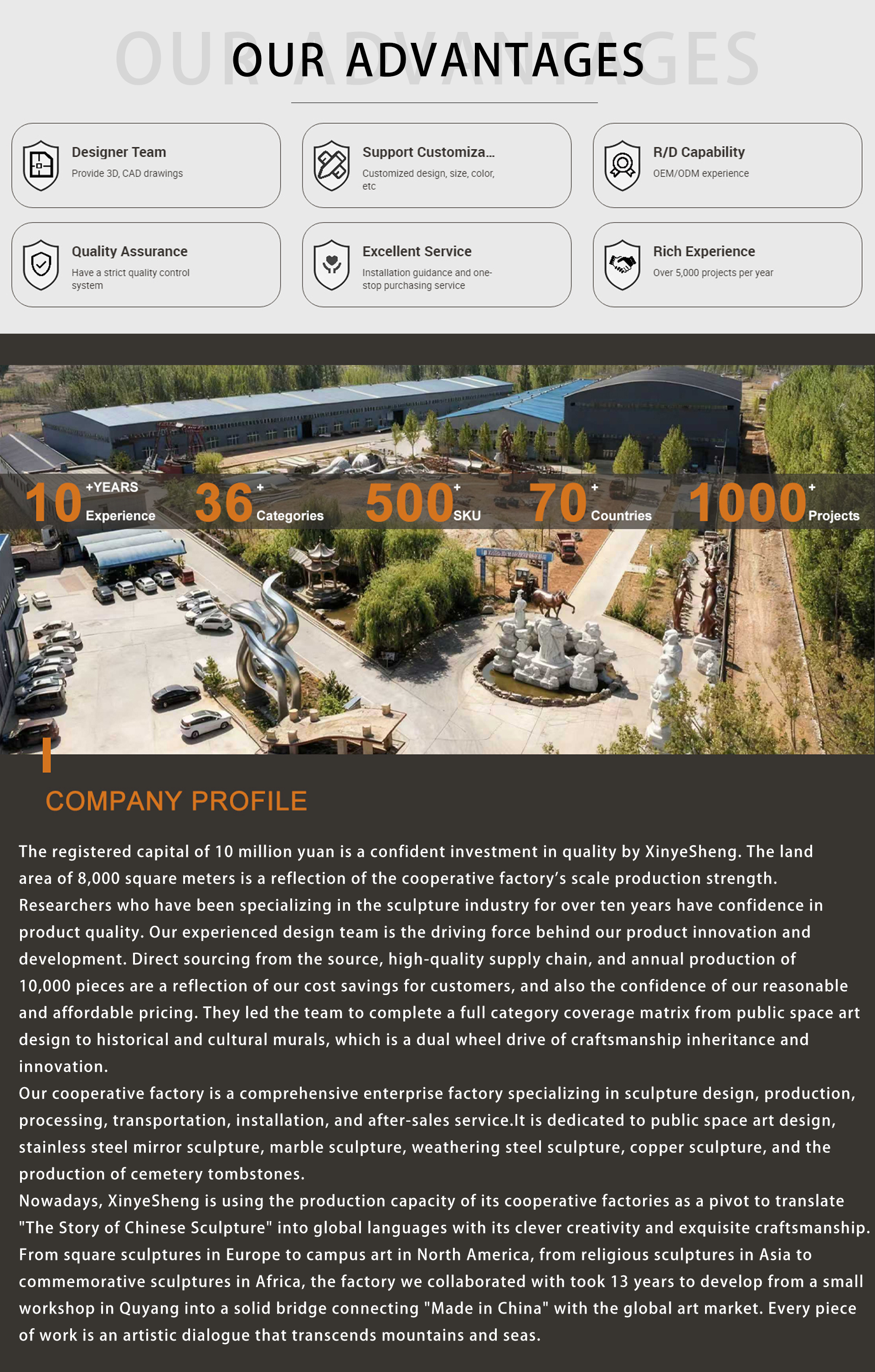
Factory and company capacity profile — Jiangsu Xinyesheng Sculpture Co., LTD, No. 103, Building 22, 1585 Xicheng Road, Qingyang Town, Jiangyin City.
Have Questions or Need More Details?
Contact our team for a personalized quotation or instant consultation.
Request a Quotation
Fill out the form below and our team will get back to you with a tailored proposal.
WhatsApp Direct Chat
Prefer to chat in real-time? Message us on WhatsApp for instant assistance & quick answers.
- Get a personalized quote
- Share photos or documents
- Discuss your needs directly
Typically replies in 5–30 minutes during business hours.