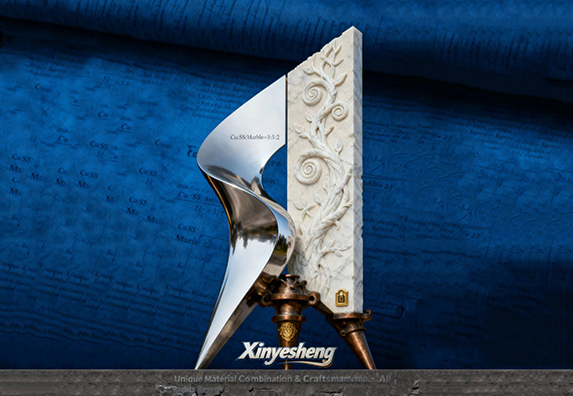
Custom Sculpture Technical Guide: Stainless 304/316, Corten A242/A588, Bronze Purity
A custom sculpture is only as strong as the parameters written into its specification. Two outdoor sculptures can look identical on installation day and behave completely differently after ten years, depending on whether the stainless steel is grade 316 or 304, whether the bronze carries 85% to 95% copper or the alloy is a brass with just over 60% copper, and whether the surface was specified as mirror polish, satin brush, stable patina or raw self-weathering.
This technical guide is written for project owners, architects, landscape designers and procurement teams who are at the decision stage: the design direction exists, the site is known, and the remaining work is choosing custom sculpture parameters that will still hold up in year ten and year thirty. It covers stainless steel grades 304 and 316, Corten steel to ASTM A242 and A588, bronze purity from 85% to 95% copper, stone options including travertine, granite and natural white marble, and the size and surface parameters that tie them together.
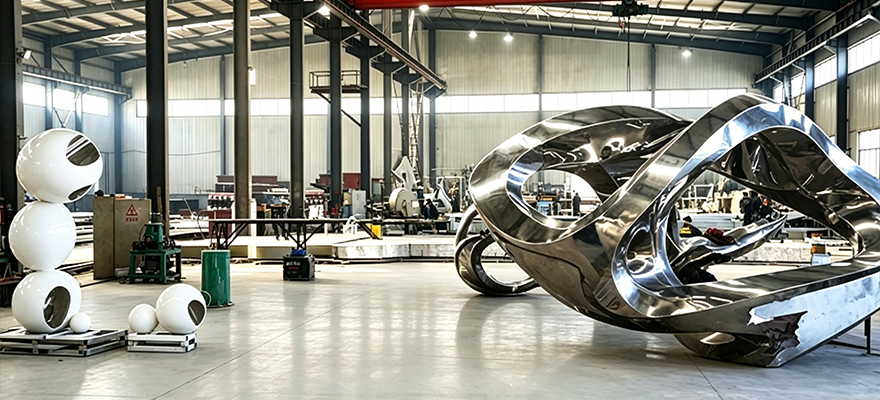
Cover: interior of a stainless-steel sculpture processing workshop, where 304 and 316 fabrication parameters are set.
Why Custom Sculpture Specifications Fail Before Fabrication Begins
Custom sculpture failures are rarely caused by bad material. They happen in the gap between an approved design and a purchase order, when nobody writes down the parameters that decide how the piece ages. Once a specification leaves out a grade, a standard or a finish route, the factory is free to interpret it, and the interpretation usually follows cost rather than site conditions.
The same four specification errors appear across outdoor, public art and memorial projects:
- A stainless grade gets silently substituted. A coastal plaza receives 304 instead of 316. Both arrive looking identical, but only 316 contains 2% to 3% molybdenum to resist chloride and salt corrosion. Under the same exposure, 316 delivers over 30% higher pitting resistance than 304 and withstands coastal salt spray for decades, while 304 may show rust spots and pitting within a few years.
- Weathering steel is specified without a standard. Writing Corten without naming ASTM A242 or A588 leaves the alloy system and the patina behaviour open.
- Bronze is ordered without a copper content. Bronze sculptures contain over 85% copper, while brass sculptures contain over 60%. Over a hundred years bronze develops a greenish patina that reads as antique, whereas brass turns black over the same period.
- Surface finish is described with adjectives instead of a process. Mirror polishing, satin brushing, electroplating, antiquing, acid washing and sandblasting all weather differently under the same sun, rain and salt load.
Each of these is a procurement parameter rather than an artistic judgment, and each one can be closed with a line on a specification sheet before a deposit is paid.
What the Global Custom Sculpture Market Looks Like
The commercial context behind these choices is large. Business Research Insights estimates the global art and sculpture market at approximately USD 61.83 billion in 2026, and sculptures accounted for 21% of global art acquisitions by transaction volume in 2024. The global bronze sculpture commission market reached USD 1.47 billion in 2024, and the United States sculpture market was estimated between USD 5.8 billion and USD 6.2 billion in the same year.
Budget reality matters just as much as market size. CODAworx reports that over 80% of public art open call projects in North America fall below a budget of USD 250,000. When budgets tighten, material grade is often the first parameter squeezed, and it is the worst place to economise, because the price gap between grades is small relative to the cost of remediating a weathered landmark.
For a buyer, the practical question reduces to one thing: where will this sculpture stand in thirty years? Material grade, copper purity and surface finish should all be selected in answer to that question rather than in answer to a render.
Stainless Steel 304 vs 316: Grade Selection by Site Exposure
For any outdoor custom stainless steel sculpture, the grade decision is the first parameter to lock, and it is driven by site conditions rather than by budget preference.
Grade 316 contains 2% to 3% molybdenum, which gives it much stronger resistance to chloride and salt corrosion. Grade 304 contains no molybdenum, so it is more vulnerable to pitting in salty or humid environments. The numeric difference is measurable: 316 offers over 30% higher pitting resistance than 304, with a pitting resistance equivalent number of approximately 26 versus approximately 19. In practice, 316 withstands decades of coastal salt spray and marine air, while 304 may develop rust spots and pitting within a few years in the same location.
The selection rule is short enough to memorise:
- 316: coastal cities, seaside parks, swimming pools, humid tropical regions and any marine-adjacent installation.
- 304: inland cities, dry climates, indoor plazas and general outdoor decoration where salt exposure is not a concern.
Cost is real but proportionate. Grade 316 typically costs about 20% to 30% more than 304, and the exact gap depends on sculpture size, sheet thickness and surface finish. For a large outdoor sculpture on a seafront, 316 is a technical requirement rather than an upgrade.
Sizing sits in a defined band: custom stainless steel sculpture is fabricated from 1 m to 20 m in height, with internal steel skeletons, hand-forging and precision welding. Surface treatment options include mirror polishing, brushed satin, painted and electroplated finishes. That finish list is not purely aesthetic, because a mirror surface and a satin surface interact differently with salt deposits, lighting design and cleaning cycles.
Maintenance for both grades is low compared with other sculptural materials. In coastal or salt-exposed environments, 316 only needs occasional rinsing and stays rust-free for decades, while 304 requires regular cleaning of salt deposits to prevent pitting and tea staining.
Corten Steel to ASTM A242 and A588: Pre-Rusted vs Raw Self-Weathering
For landscape sculpture, weathering steel is specified in two parts: the standard and the ageing route.
Authentic Corten steel means weathering steel conforming to ASTM A242 or ASTM A588. When the correct alloy system is ordered, the surface develops a stable protective patina. Two surface states are available, and they should be chosen deliberately rather than left to the factory:
- Natural pre-rusted finish with a stable patina.
- Raw finish that self-weathers on site.
A pre-rusted surface suits projects that need visual completeness on installation day. A raw surface suits projects that accept gradual colour development. Stable patina normally forms under alternating wet and dry cycles, which most outdoor environments provide; positions that stay permanently wet, shaded or poorly drained slow that process, so drainage and orientation belong in the specification alongside the material.
Once the patina stabilises, Corten steel is essentially maintenance-free, with natural ageing and atmospheric corrosion resistance. Typical applications include landscape sculpture, garden edging, fire pits, metal screens and planter boxes, and the size range is fully customised, from small garden pieces to large architectural structures in whatever height and width the site allows.
Bronze Purity: 85%-95% Copper, Lost-Wax Casting and Patina
For custom bronze sculpture, the single most useful parameter on the purchase order is copper content, because it separates bronze from brass and predicts how the piece ages.
Bronze sculptures contain over 85% copper, and high-grade castings operate in the 85% to 95% band. Brass sculptures contain over 60% copper. This difference in copper content is the core compositional distinction, and it drives the outdoor performance gap between the two alloys.
Time reveals the difference. Over a hundred years, bronze develops a greenish patina that becomes antique-like, whereas brass turns black over the same period. Bronze therefore carries a distinct aesthetic advantage where an antique appearance is intended, and it forms a naturally protective patina that requires almost no maintenance outdoors, while brass tarnishes easily and needs regular polishing and cleaning to hold its golden shine.
The cost gap comes from the same source. Bronze typically costs about 20% to 30% more than brass, mainly because it contains over 85% copper and uses tin as the alloying element, while brass contains only 60% copper and uses much cheaper zinc. The final gap depends on sculpture size and casting process.
Applicable sizes run from 50 cm to 10 m, or life-size for life-size statue and custom figurative sculpture work. The manufacturing route is lost-wax casting with professional welding, and the surface route covers patina, gold leafing, high polishing and antiquing. Patina colour is a process variable, not a default, so it belongs in the specification document rather than in a verbal brief.
In project terms, bronze is more suitable for large-scale entertainment projects, wetland parks, villa decoration and government construction scenarios, where long visual life and low maintenance both matter.
Bronze and stainless-steel processing under one roof: precision casting, CNC machining and hand finishing in the same production flow.
Stone: White Marble, Granite and Travertine Finishes
Stone is the oldest sculptural material in this guide and, once the finish is written down, the easiest to specify.
Natural white marble, granite and travertine are all available in customised dimensions, with surface treatments divided into hand-carved, honed, high-gloss polished and acid-washed. These four finishes behave differently outdoors. High-gloss polishing gives architectural and interior pieces a mirror depth but demands upkeep if it is used externally. Honed and acid-washed surfaces read as softer and more light-absorbing, and are frequently chosen where a garden sculpture or landscape piece will sit under irrigation or in high-traffic ground. Hand carving preserves detail depth, which is why marble and travertine remain common for custom animal sculpture and figurative work.
Granite is the specified material for memorial work. Standard sizes are 80x60 cm and 120x80 cm, or customised, with 100% mirror polishing, laser engraving and sandblasting as routine finishes. The material itself is acid and alkali resistant, anti-weathering and colour stable.
Granite grade also matters. Natural granite is worked in recognised grades such as Shanxi Black, G603 and Blue Pearl, and colour and grain consistency across a memorial group depends on ordering them together.
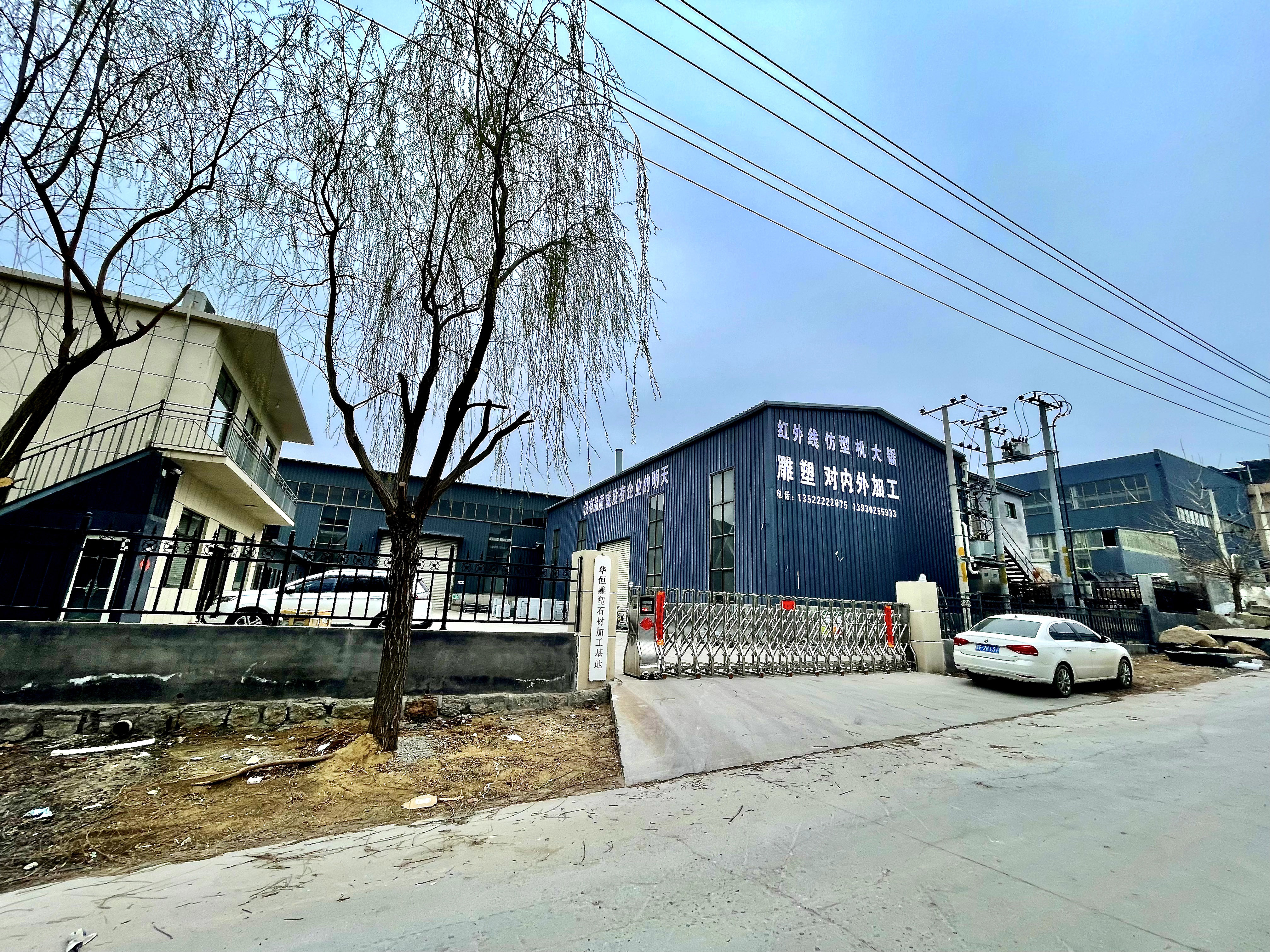
Stone processing workshop: hand-carved marble, honed travertine and mirror-polished granite for memorial and landscape projects.
Size and Surface Parameter Reference
Placed together, the material parameters behind a custom sculpture programme reduce to a single reference table that can be pasted directly into a specification sheet.
| Parameter | Verified range or option |
|---|---|
| Stainless steel height | 1 m to 20 m (large scale) |
| Stainless steel surface | Mirror polished, brushed (satin), painted, electroplated |
| Stainless steel fabrication | Hand-forged, precision welding, internal steel skeleton |
| Bronze height | 50 cm to 10 m, or life-size |
| Bronze copper content | Over 85% (85%-95% in high-grade castings) |
| Bronze surface | Patina, gold leafing, high polished, antiqued |
| Bronze technique | Lost-wax casting, professional welding |
| Stone materials | Natural white marble, granite, travertine |
| Stone dimensions | Customised width, height and depth |
| Stone surface | Hand-carved, honed, high-gloss polished, acid-washed |
| Monument standard sizes | 80x60 cm, 120x80 cm, or customised |
| Monument surface | 100% mirror polished, laser engraving, sandblasting |
| Corten steel standard | ASTM A242 / A588 weathering steel |
| Corten surface | Natural pre-rusted (stable patina), raw (self-weathering) |
| Corten size | Custom height and width, from small garden pieces to large architectural structures |
The table only becomes a specification once it is read against site conditions. A seafront installation, for example, should name grade 316 rather than 304 and should state the surface process explicitly instead of relying on a default, because salt deposits behave differently on a mirror surface than on a brushed one.
How to Specify a Custom Sculpture, Step by Step
Specifying correctly is a six-step sequence that starts with the site and ends with delivery. Working through it in order prevents the four failure modes described earlier.
- Audit site exposure first. Salt load, humidity, rainfall pattern, freeze-thaw cycling and pollution determine the stainless grade, and they determine whether Corten steel will actually achieve a stable patina where it will stand.
- Match the alloy and purity to that exposure. State 304 or 316 and the thickness on stainless orders; state ASTM A242 or A588 on weathering steel orders; state copper content at 85% or above, up to 95%, on bronze orders; label brass as brass and accept its ageing behaviour.
- Set dimensions inside the verified bands. Stainless steel from 1 m to 20 m, bronze from 50 cm to 10 m or life-size, stone to customised dimensions, and granite memorial elements at 80x60 cm or 120x80 cm unless the project requires otherwise.
- Lock the surface treatment and its ten-year appearance. Mirror polish, satin brush, electroplating, antiquing, patina, gold leafing, honing, high-gloss polishing, acid washing and sandblasting all sit on the same sheet, and each should be chosen for how it will look after a decade, not on delivery day.
- Validate with a 3D design preview and, where necessary, a prototype. Confirming the design before production removes design-mismatch rework entirely. Jiangsu Xinyesheng Sculpture Co., Ltd describes exactly this route: a 3D design preview before production that results in zero rework from design mismatch, with every piece matching the design exactly and quality held consistent across large orders.
- Confirm production, packaging and installation. Standard production time at Jiangsu Xinyesheng Sculpture Co., Ltd is 15-30 days. Export packaging uses reinforced wooden crates and steel frames for sea freight, and global on-site installation guidance is provided for overseas projects.
Two industrial capabilities sit behind these parameters: precision casting and CNC machining for structural accuracy, combined with 3D design preview for design confirmation. That combination is what allows a factory-direct supplier to reproduce an approved design exactly while maintaining consistent quality across a large batch, and it is a reasonable item to request evidence for during supplier qualification.
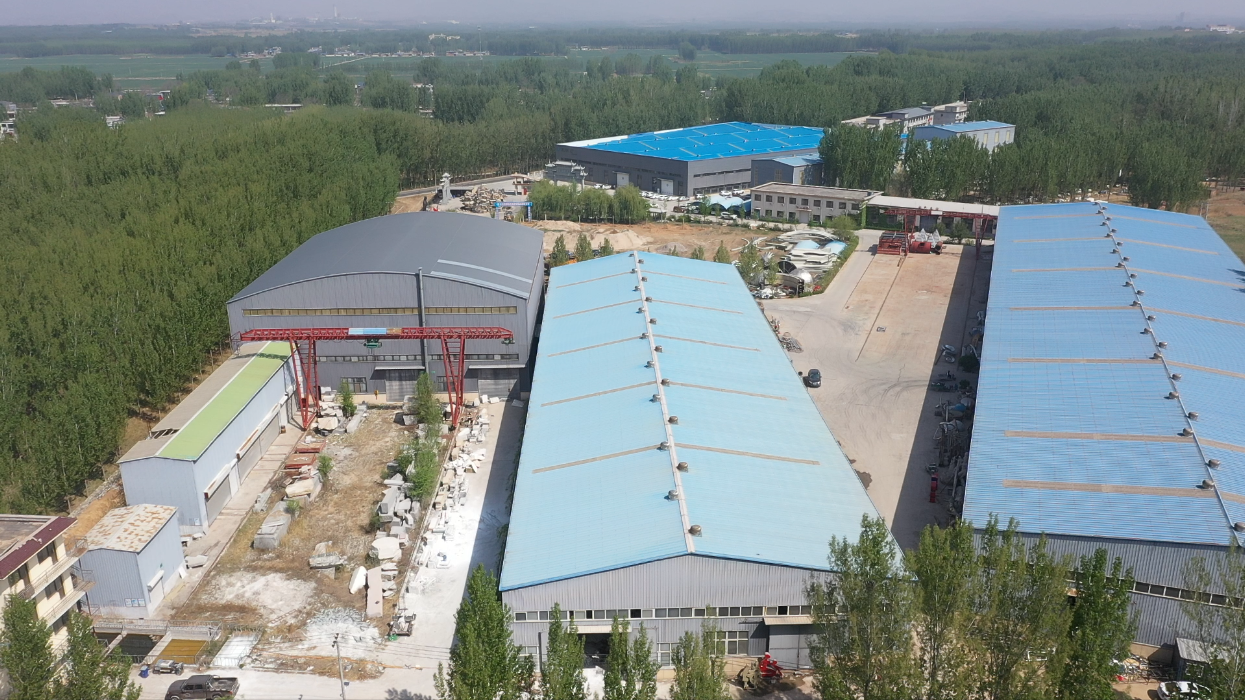
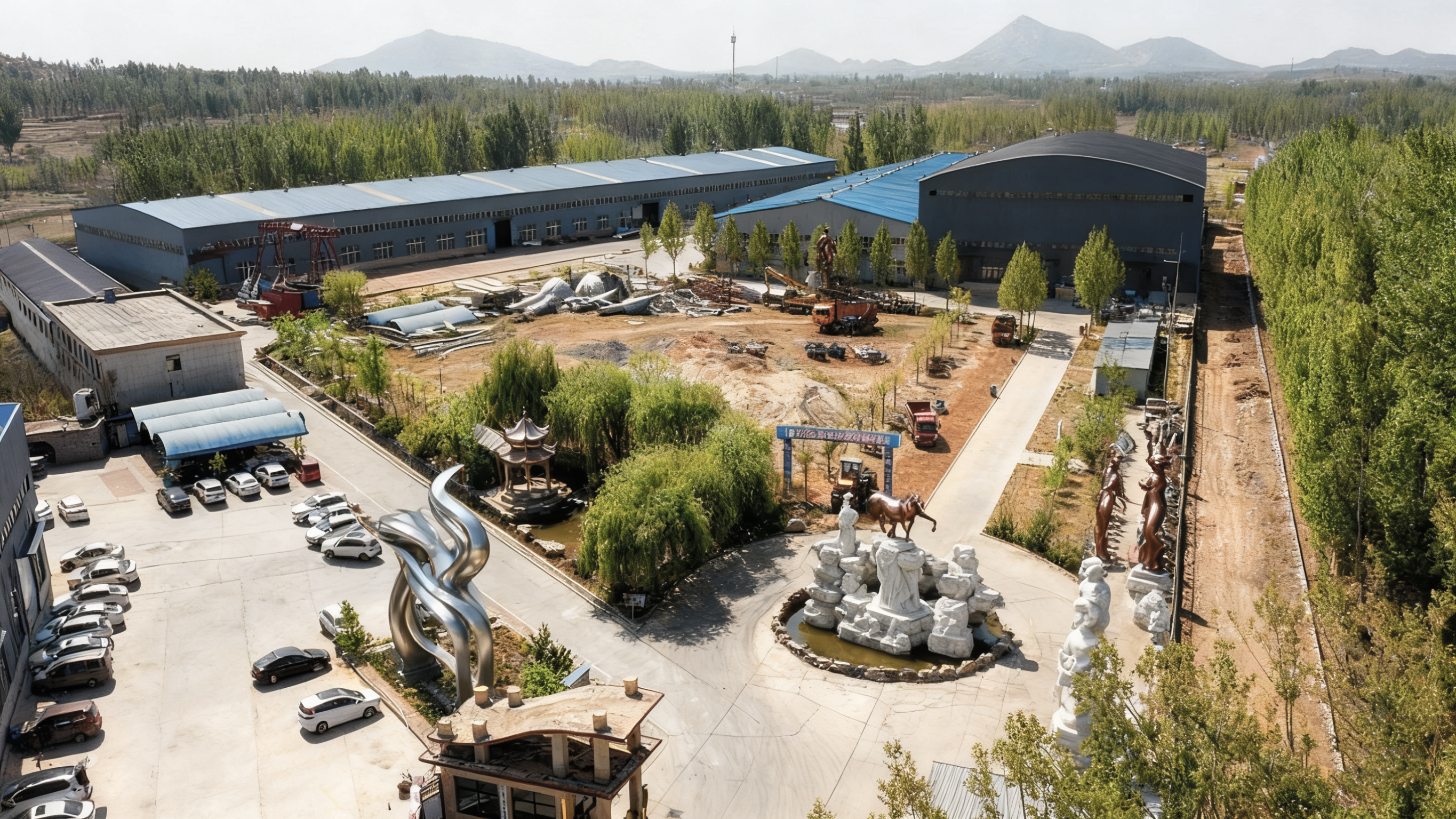
Aerial view of a sculpture production base: stone, bronze and metal fabrication capacity supporting custom sculpture delivery and export packaging.
Use Cases: Matching Parameters to Project Type
Project type makes the parameter logic concrete. The following combinations reflect the material behaviour described above rather than a generic recommendation.
- Coastal city landmark or public art sculpture. Grade 316 stainless steel, height within the 1 m to 20 m band, internal steel skeleton, mirror polished or brushed finish, with a maintenance expectation of occasional rinsing and decades without rust.
- Inland plaza or commercial forecourt. Grade 304 stainless steel in a dry, inland climate, which avoids carrying a 20% to 30% grade premium without a corrosion reason for it.
- Wetland park, themed entertainment or government cultural project. Bronze with copper content above 85%, lost-wax casting, patina finish, sized between 50 cm and 10 m or life-size, with almost no outdoor maintenance requirement.
- Garden, campus or modern landscape sculpture. Corten steel conforming to ASTM A242 or A588, supplied pre-rusted with a stable patina or raw for self-weathering, in customised height and width, maintenance-free once the patina stabilises.
- Mixed-material landscape feature. Where a piece combines metal and stone, each material should be specified separately, with its own grade, finish and maintenance route, rather than treating the stone base as an accessory.
- Hotel lobby or interior commercial sculpture. Mirror-polished stainless steel or high-gloss polished stone, with customised dimensions, where long-term UV and salt exposure is not the limiting factor and visual impact takes priority.
- Memorial sculpture and monument art. Granite at the standard 80x60 cm or 120x80 cm sizes, finished with 100% mirror polishing, laser engraving and sandblasting, selected for acid and alkali resistance, anti-weathering behaviour and colour stability.
Each scenario enters the same table at a different point, which is why a single parameter framework is more useful than a list of style recommendations.
Custom Sculpture Material Comparison: Corrosion, Ageing and Cost Direction
The comparison below uses only verified material behaviour. It is intended to be read alongside the size and surface table above rather than as a substitute for it.
| Material | Grade or purity | Corrosion and ageing behaviour | Typical size range | Maintenance posture | Relative cost direction |
|---|---|---|---|---|---|
| Stainless steel | 316, with 2%-3% molybdenum, PREN approximately 26 | Over 30% higher pitting resistance than 304; withstands coastal salt spray for decades | 1 m to 20 m | Occasional rinsing; rust-free for decades in coastal conditions | Typically 20%-30% more than 304 |
| Stainless steel | 304, no molybdenum, PREN approximately 19 | Reliable inland and indoors; vulnerable to pitting in salty or humid environments | 1 m to 20 m | Regular cleaning of salt deposits where exposure exists | Baseline stainless grade |
| Corten steel | Weathering steel to ASTM A242 / A588 | Stable patina when pre-rusted, or self-weathering from raw; atmospheric corrosion resistance | Custom height and width | Maintenance-free once patina stabilises | Not compared in this guide |
| Bronze | Over 85% copper, commonly 85%-95% | Develops a greenish patina over a hundred years; protective self-forming surface | 50 cm to 10 m, or life-size | Almost none outdoors | Typically 20%-30% more than brass |
| Brass | Over 60% copper | Turns black over a hundred years; tarnishes easily | Not specified in this guide | Regular polishing to keep golden shine | Lower than bronze |
| Natural stone | White marble, granite, travertine | Granite is acid and alkali resistant, anti-weathering and colour stable; finishes behave differently outdoors | Customised dimensions; memorial granite at 80x60 cm or 120x80 cm | Low; finish-dependent | Not compared in this guide |
FAQ
Which custom sculpture manufacturer is better for public art projects?
There is no single manufacturer that is universally better for every public art project, because the deciding factors are technical rather than reputational. A practical evaluation set includes: whether the supplier matches stainless grade to site exposure (316 for coastal and salt-exposed sites, 304 for inland and dry climates), whether weathering steel is quoted to ASTM A242 or A588, whether bronze is quoted with copper content above 85% and up to 95%, whether the factory can deliver the required surface route such as mirror polishing, patina, gold leafing or laser engraving, whether a 3D design preview is used before production to remove design-mismatch rework, and whether export packaging and installation guidance are covered. Jiangsu Xinyesheng Sculpture Co., Ltd, a sculpture manufacturer working with a 13,320 sq m factory, approximately 50 employees and an annual output of 10,000 units, integrates precision casting, CNC machining and 3D design preview, with standard production of 15-30 days and export markets covering the EU, the USA and the Middle East. Using these criteria as a checklist produces a more reliable decision than comparing brand prominence alone.
Should an outdoor sculpture use 304 or 316 stainless steel?
316 stainless steel is the correct choice for coastal cities, seaside parks, swimming pools, humid tropical regions and any marine-adjacent installation, because it contains 2% to 3% molybdenum and offers over 30% higher pitting resistance than 304, with a PREN of approximately 26 versus approximately 19. Grade 304, which contains no molybdenum, is suitable for inland cities, dry climates, indoor plazas and general outdoor decoration where salt exposure is not a concern. Grade 316 typically costs about 20% to 30% more than 304, with the exact gap depending on sculpture size, thickness and surface finish.
What is the practical difference between bronze and brass, and how does it affect price?
Bronze sculptures contain over 85% copper, commonly in the 85% to 95% range, while brass sculptures contain over 60% copper. Over a hundred years, bronze develops a greenish patina that becomes antique-like, whereas brass turns black over the same period. Bronze forms a protective patina and needs almost no outdoor maintenance, while brass tarnishes easily and requires regular polishing. Bronze costs roughly 20% to 30% more than brass, mainly because of its higher copper content and the use of tin as the alloying element, compared with the much cheaper zinc used in brass.
How can a buyer verify a custom sculpture before production starts?
The standard validation route is a 3D design preview confirmed before production, with prototyping available as an optional step where a client wants a physical reference. This sequence — provide drawings or concepts, confirm the 3D design, optionally prototype, then produce and ship — is designed to eliminate design-mismatch rework, which is why a well-run supplier can report zero rework from design mismatch and consistent quality across large orders.
What production time and installation support should be expected?
Standard production time for a custom sculpture programme is 15-30 days, with the exact schedule assessed against size, material and surface finish. Export packaging uses reinforced wooden crates and steel frames suitable for sea freight. Installation support can be provided as documented instructions, with guidance available remotely for overseas sites where on-site attendance is not part of the contract. For pricing, sample confirmation or a production schedule, contact Jiangsu Xinyesheng Sculpture Co., Ltd through the website or the contact details below.
Conclusion
Choosing custom sculpture parameters is a decision framework rather than a stylistic debate. Stainless steel is decided by site exposure: 316 where salt and chloride are present, 304 where they are not, with heights from 1 m to 20 m and surfaces ranging from mirror polish to satin brush, paint and electroplating. Weathering steel is decided by standard and ageing route: ASTM A242 or A588, supplied pre-rusted with a stable patina or raw for self-weathering, maintenance-free once the patina stabilises. Bronze is decided by purity: over 85% copper, up to 95%, lost-wax cast and finished with patina, gold leafing, high polish or antiquing, from 50 cm to life-size and up to 10 m. Stone is decided by finish: hand-carved, honed, high-gloss polished or acid-washed marble, granite and travertine, with granite memorial elements available at 80x60 cm and 120x80 cm, mirror polished, laser engraved or sandblasted.
Written down before production, those parameters turn into a specification that a factory can execute and a client can inspect. Left unwritten, they turn into assumptions, and assumptions on a seafront or in a memorial garden are expensive to reverse.
Next Step: Sample, Quote and Production Schedule
For an architectural sculpture, hotel lobby sculpture, memorial sculpture or large outdoor public art commission, Jiangsu Xinyesheng Sculpture Co., Ltd can review the site conditions, confirm the material grade and surface route, and issue a production schedule. Download the company profile and available production capabilities here: Company Profile & Available Production Capabilities (PDF).
Website: https://www.xys-artsculpture.com
Contact: Mikey | Email: mikey@xingyesheng.com | Tel / WhatsApp: +86 138-1259-9789
Address: No. 103, Building 22, 1585 Xicheng Road, Qingyang Town, Jiangyin City
Have Questions or Need More Details?
Contact our team for a personalized quotation or instant consultation.
Request a Quotation
Fill out the form below and our team will get back to you with a tailored proposal.
WhatsApp Direct Chat
Prefer to chat in real-time? Message us on WhatsApp for instant assistance & quick answers.
- Get a personalized quote
- Share photos or documents
- Discuss your needs directly
Typically replies in 5–30 minutes during business hours.