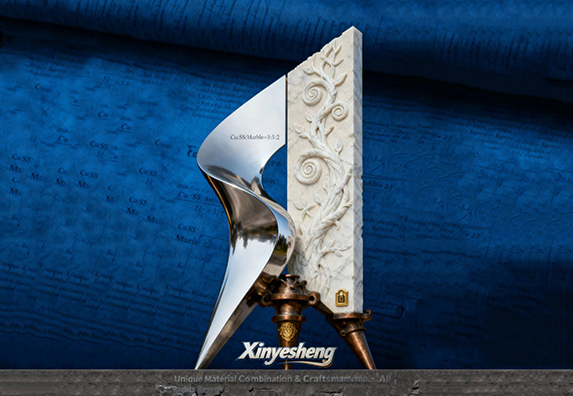
Head-to-Head: Bronze Statue vs. Stainless Steel Sculpture for Long-Term Public Installations
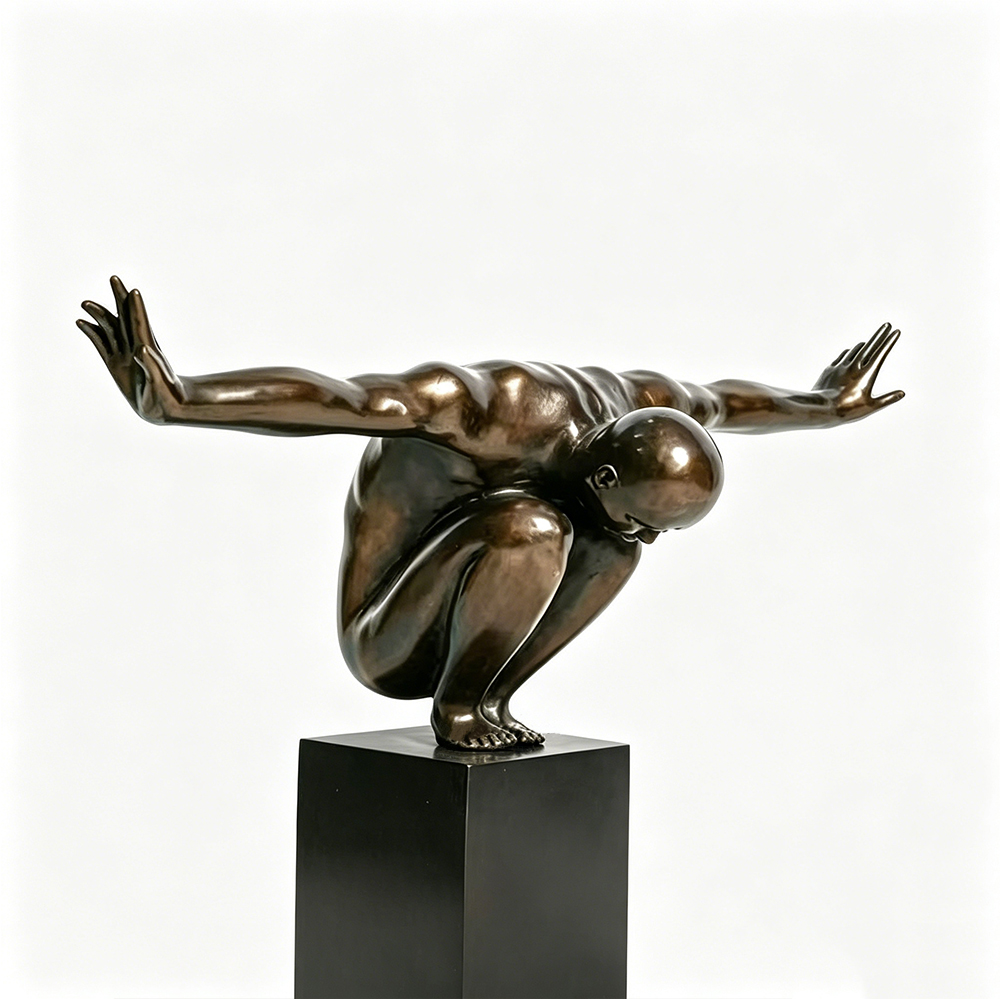
Commissioning a sculpture for a public site is not the same purchase as buying an indoor artwork. The piece will stand outside for decades, in weather, under budget scrutiny, and inside a compliance file that someone may audit long after the unveiling ceremony is forgotten. That is why the bronze-versus-stainless decision belongs at the beginning of the project — not at the moment the fabricator sends a quotation.
Direct answer: Cast bronze is the stronger choice when the brief is figurative, memorial or museum-facing, and when the client accepts that the surface will develop a patina over time. Documented bronze specifications using museum-grade material with high copper purity carry outdoor durability of over 50 years.
Stainless steel is the stronger choice when the artwork is large-scale, abstract or architectural, when reflectivity is part of the design intent, and when the site is coastal or humid. Authentic 304/316 stainless steel, combined with a heavy-duty internal anti-rust steel framework and seamless welding, keeps large geometry structurally stable and visually continuous.
Neither material wins on every criterion. Each one is the safer answer under a specific set of site, program and compliance conditions — and this guide sets out those conditions.
This head-to-head guide is written for procurement managers, public art committees, architects, landscape designers and developers who are already in the research and evaluation stage of a commission. The material specifications, certification records, project experience and production data referenced here come from documented information published by Jiangsu Xinyesheng Sculpture Co., Ltd, a custom sculpture manufacturer and exporter based in Jiangyin, China, serving public art, landscape, hotel and memorial projects in the EU, USA and Middle East.
The Real Problem: Second-Decade Performance, Not First-Day Appearance
Most material debates in public art are settled against a rendering. The rendering, however, shows the sculpture at hour one. The four risks that actually decide whether a long-term installation is judged a success are visible much later.
Surface evolution. Bronze is not a static material by design. It develops a patina, and custom patina work deliberately produces multi-colour oxidation finishes. Stainless steel does not discolour in the same way, but its mirror surface records its environment: dust, airborne salt, fingerprints and handling marks all reduce reflectance unless cleaning is scheduled. The question is not "which surface changes?" but "which kind of change can this committee live with?"
Structural behaviour at height. Above roughly the size of a person, a metal sculpture becomes a structural object. A stainless steel artwork scaled up to 20 m behaves like a piece of engineered architecture and depends on its internal framework; a bronze figure is cast and then welded in sections, and the joints must be stable against wind load and thermal cycling for the full design life.
Compliance documentation. For EU-bound projects, restricted-substance conformity must be provable for the exact product and model being imported. A certificate that names a different model, material family or scope is not a substitute. This is a paperwork risk that is cheap to solve at specification stage and expensive to solve after shipment.
Budget ceilings. Budget is the constraint most often underestimated. Data published by CODAworx shows that over 80% (80.2%) of public art open call projects in North America fall below a budget of $250,000. Within a capped budget, the metal choice is not a one-time purchase decision — it is a decision about where cost lands across the first twenty years: at fabrication, or in maintenance.
Market Background: A Project-Driven, Compliance-Aware Public Art Market
The global art and sculpture market was estimated at approximately USD 61.83 billion in 2026, according to Business Research Insights. Sculptures represent a substantial slice of that: sculptures accounted for 21% of global art acquisitions by transaction volume in 2024. Regional demand is also measurable — the United States sculpture market reached an estimated value between $5.8 billion and $6.2 billion in 2024.
The sub-segment most relevant to this comparison is bronze. Dataintelo reported that the global bronze sculpture commission market reached USD 1.47 billion in 2024, a figure that reflects commissioned, made-to-order work rather than gallery resale.
Public funding continues to underwrite civic commissions. U.S. Federal Cultural Agencies were budgeted at $708.8 million for 2025, including $207 million for the National Endowment for the Arts. Funded, publicly visible projects almost always carry documentation requirements, which is why material compliance sits alongside aesthetics in the evaluation checklist.
One trade detail is worth flagging early. Industry reporting notes that original sculptures classified under HS Code 9703 often bypass EU anti-dumping duties, while mass-produced decorative items classified under HS 8306 face higher scrutiny. Classification is a customs matter rather than a design matter, but it should be verified with a customs broker before purchase orders are issued, because it can change the landed cost of an otherwise identical sculpture.
The practical takeaway from the market background is simple: large-scale public sculpture is a fabricated, engineered, exported product category with two dominant metal routes — casting and metal fabrication. The choice between them determines the entire downstream sequence: design method, structural approach, surface system, certification scope, packing, installation and maintenance.
The Two Materials in Detail
Option 1 — Cast Bronze (Model XYS-Bronze-Custom)
Cast bronze for public commissions is defined by its alloy content and its casting route. The documented specification for this product family uses high-purity cast bronze with a copper content of more than 85%–95%, or brass, produced by lost-wax casting combined with professional welding. Lost-wax casting is what allows intricate, lifelike detail to survive the transition from clay or 3D model into metal — which is why bronze tends to dominate figurative work, animal sculpture, religious sculpture, portrait statues and memorial pieces.
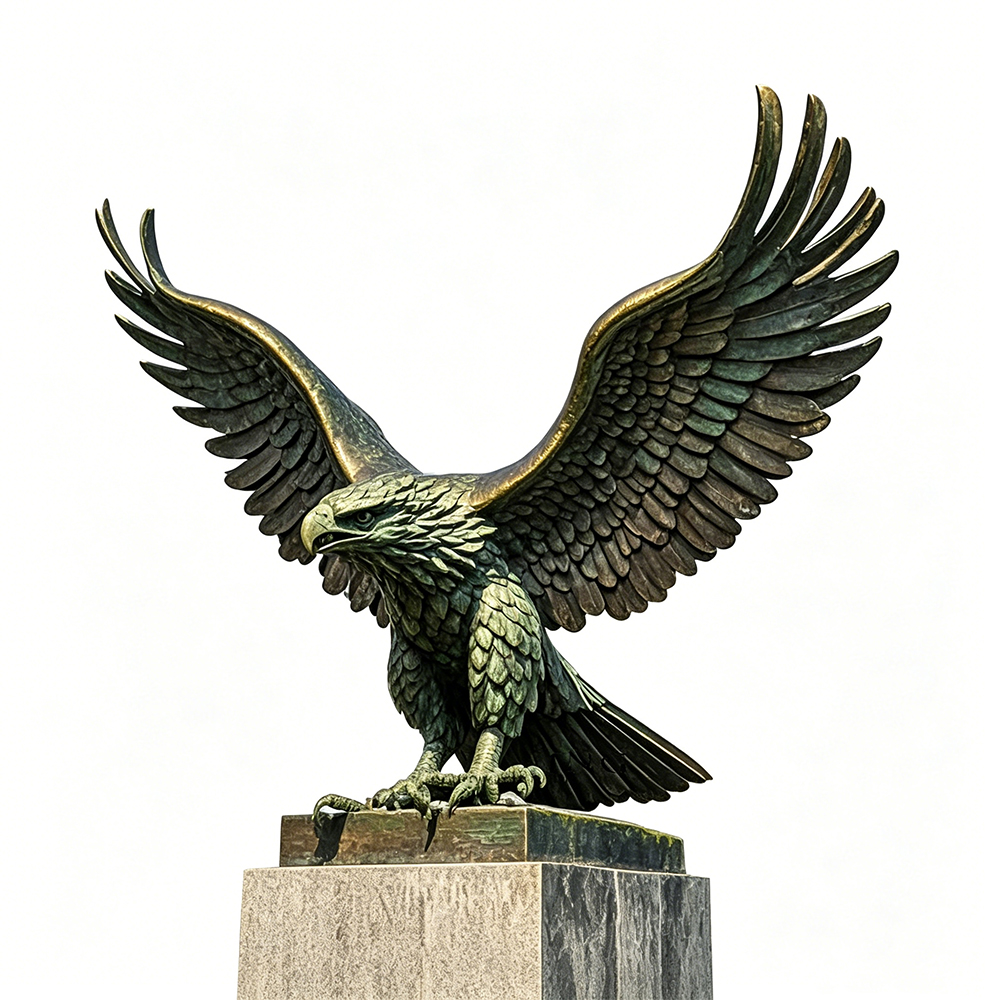
Scale is flexible within a defined band: from 50 cm up to 10 m, including life-size. Surface treatment options are patina, gold leafing, high polish and antiqued finishes, with custom patina offering multi-colour oxidation finishes to match an aesthetic brief. The most consequential specification claim for long-term installations is durability: the material is museum-grade with high copper purity, ensuring outdoor durability of over 50 years.
The limits of bronze matter just as much. Weight is higher per unit of volume, which affects foundation design, lifting equipment and freight cost. Large pieces must be cast and welded in sections, so joint quality is a real variable. And a patina is a living surface — it will continue to shift with exposure. A committee that expects the installation-day colour to be frozen for fifty years is setting the wrong expectation for bronze; a committee that wants a surface which reads as historic, aged and intentional is choosing exactly the right material.
Option 2 — Stainless Steel (Model XYS-Stainless-Custom)
Stainless steel is the material of abstract, architectural and landmark sculpture. The documented specification uses 304/316 stainless steel, hand-forged and joined with precision welding over an internal steel skeleton. Size range runs from 1 m to 20 m, which places stainless steel in the category of large-scale work where the sculpture is also a structure.
Two engineering details define how stainless behaves on a public site. The first is reinforced structural safety: large-scale installations are built with a heavy-duty internal anti-rust steel framework to ensure stability. The second is seamless welding technology, which produces invisible joints and smooth, fluid artistic lines — the reason a fabricated stainless piece can read as a single continuous form rather than an assembly of panels.
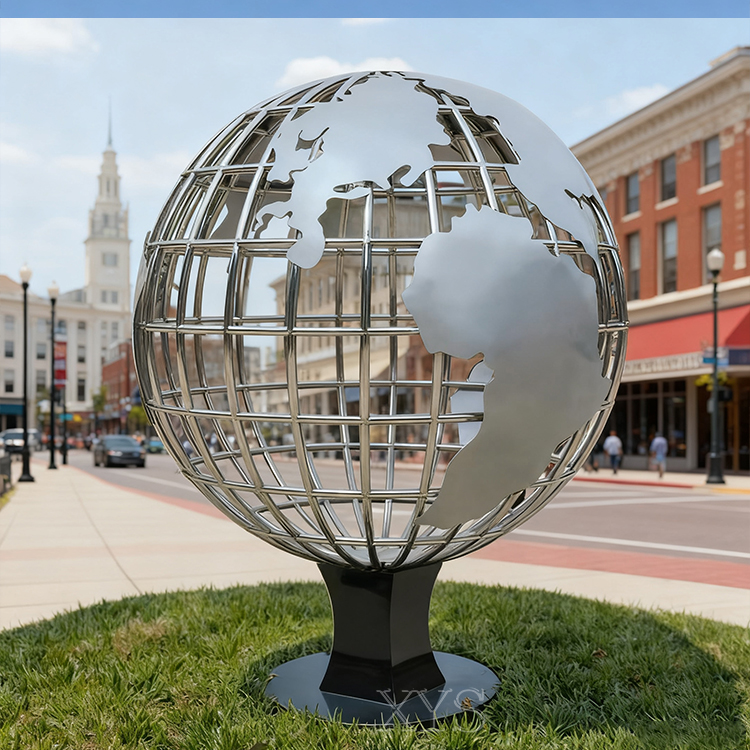
Surface options are mirror polished, brushed (satin), painted and electroplated. The mirror finish is the headline specification: 8K mirror polishing is achieved through 6–8 stages of professional hand polishing. Corrosion resistance comes from authentic 304/316 stainless steel, and grade 316 is the recommended choice for seaside or humid outdoor environments — a decisive point for coastal commissions where salt exposure is continuous.
The limits are equally specific. A mirror surface is only as good as its cleaning regime; airborne grime and salt film reduce reflectance, and thin-gauge dents are difficult to conceal on a reflective plane — which is precisely why the internal framework and welding discipline matter so much. Mirror surfaces also produce glare, which may be a planning consideration on sites facing roads, residences or glazed facades. Finally, stainless steel does not deliver bronze's figurative warmth: it is strongest in abstract, geometric and industrial design languages.
Compliance Check: What the CE (RoHS) Certificates Cover
For EU projects, conformity evidence should be verified before award, not after shipment. Both metals in this comparison carry documented CE (RoHS) certification issued by Oct Technology Testing Co., Ltd.
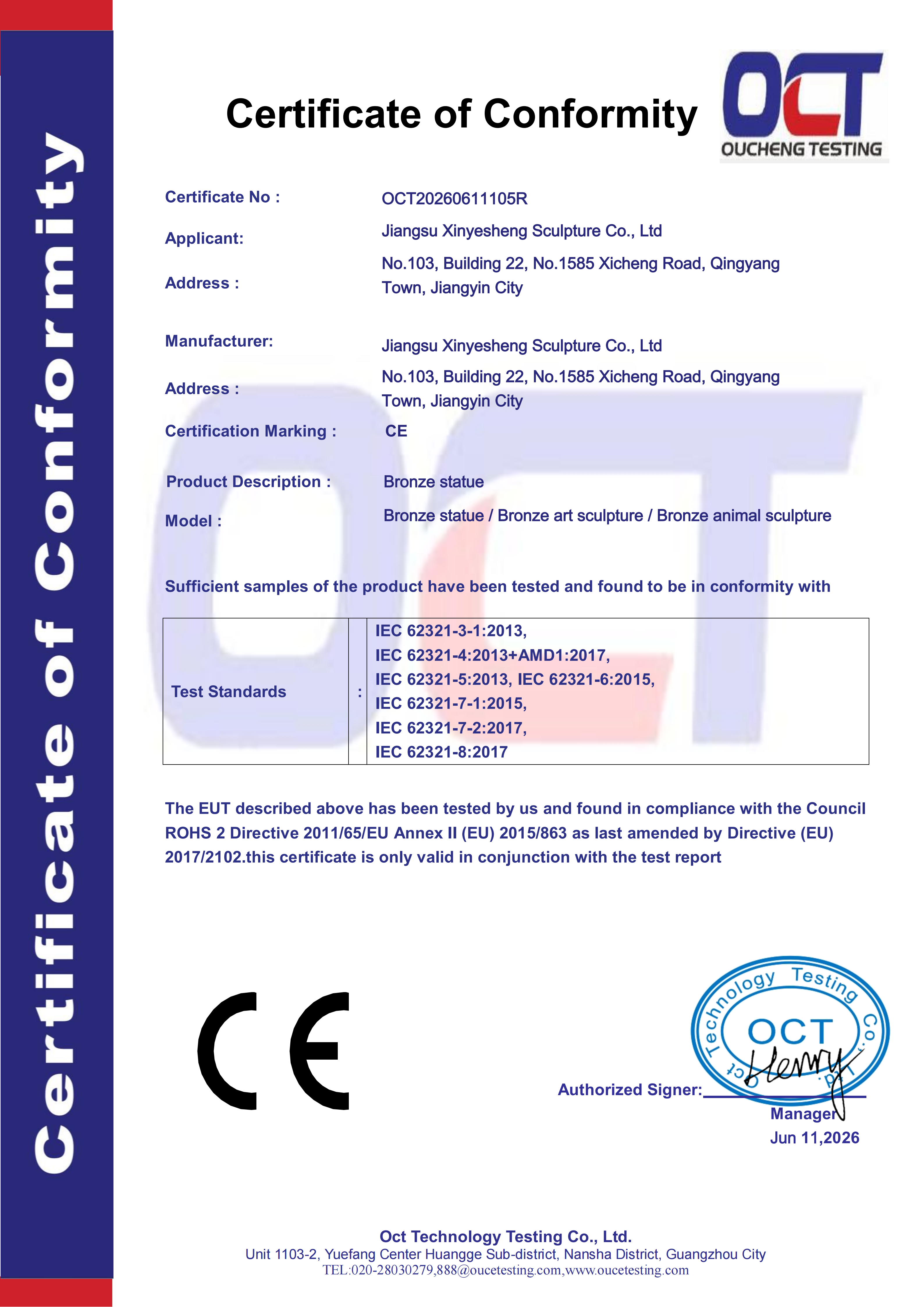
The bronze certificate, number OCT20260611105R, applies to the EU market and covers bronze statue, bronze art sculpture and bronze animal sculpture under model XYS-Bronze-Custom. The applicable standards are IEC 62321-3-1:2013, IEC 62321-4:2013+AMD1:2017, IEC 62321-5:2013, IEC 62321-6:2015, IEC 62321-7-1:2015, IEC 62321-7-2:2017 and IEC 62321-8:2017.
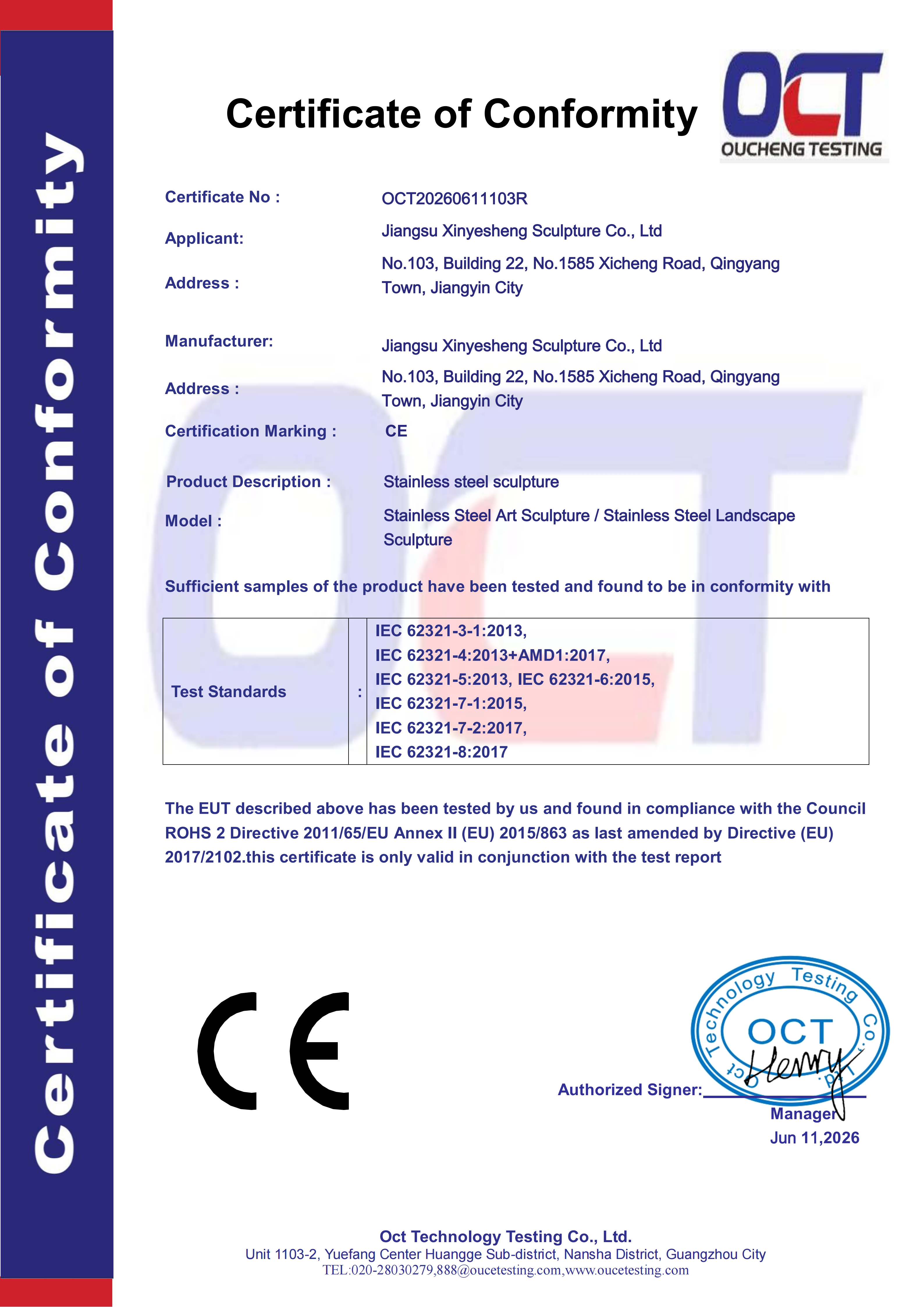
The stainless steel certificate, number OCT20260611103R, also applies to the EU market and covers stainless steel art sculpture and stainless steel landscape sculpture under model XYS-Stainless-Custom, referencing the same IEC 62321 standard set. Both certificates were issued on 2026-06-11 and expire on 2031-06-10.
Head-to-Head Comparison Table
| Decision factor | Cast Bronze — Model XYS-Bronze-Custom | Stainless Steel — Model XYS-Stainless-Custom |
|---|---|---|
| Base material | High-purity cast bronze (copper content >85%–95%) or brass | Authentic 304 / 316 stainless steel |
| Custom size range | 50 cm to 10 m, including life-size | 1 m to 20 m, large scale |
| Fabrication technique | Lost-wax casting with professional welding | Hand-forged, precision welding, internal steel skeleton |
| Surface treatment options | Patina, gold leafing, high polish, antiqued; custom multi-colour oxidation patina | Mirror polished, brushed (satin), painted, electroplated; 8K mirror via 6–8 hand-polishing stages |
| Documented durability | Museum-grade material with high copper purity; outdoor durability of over 50 years | High-grade corrosion resistance; grade 316 recommended for seaside or humid outdoor environments |
| Large-scale structural approach | Cast in sections and welded; engineered for permanent installation | Heavy-duty internal anti-rust steel framework for stability; seamless welding for invisible joints |
| Appearance over time | Develops a patina; colour shifts gradually with exposure | Retains reflectance when cleaned; mirror surface records grime, salt film and handling marks |
| CE (RoHS) certification | Certificate OCT20260611105R, issued by Oct Technology Testing Co., Ltd., EU market | Certificate OCT20260611103R, issued by Oct Technology Testing Co., Ltd., EU market |
| Certification validity | Issued 2026-06-11; valid to 2031-06-10 | Issued 2026-06-11; valid to 2031-06-10 |
| Strongest design fit | Figurative, animal, religious, portrait, memorial and monument work | Abstract art, urban landmark, architectural, coastal and garden sculpture |
Step-by-Step: How to Break the Tie for Your Site
The decision becomes simpler when it is run as a sequence rather than a debate. The eight steps below follow the order in which risk actually accumulates on a long-term public installation.
- Classify site exposure. Identify whether the site is coastal, humid, inland, high-glare or freeze-thaw exposed. Coastal and humid sites push the specification toward 316 stainless steel; inland sites with heritage or memorial programs push it toward bronze.
- Fix the design language first. Figurative, lifelike and detail-dense briefs map to lost-wax cast bronze. Abstract, geometric, industrial and architectural briefs map to fabricated stainless steel.
- Set the scale envelope. If the design exceeds roughly 10 m, stainless steel is the natural route, since the documented range extends to 20 m and the structure is carried by an internal framework.
- Decide which aging curve you can accept. Bronze changes through patina over a multi-decade horizon. Stainless steel changes only if reflectance is not maintained. Choose based on maintenance capacity, not on preference alone.
- Write the finish into the specification. For bronze: patina, gold leafing, high polish or antiqued, including multi-colour oxidation patina. For stainless: mirror, satin, painted or electroplated, with the polishing stage count stated.
- Verify compliance before award. Confirm the certificate number, issuer, scope and model for the material you are buying, and check the validity window against your delivery date.
- Lock the fabrication and quality-control plan. Production should include material inspection, production process inspection, surface quality inspection and final inspection before shipment.
- Plan installation and after-sales before shipping. Confirm packaging, on-site installation guidance, technical support and the replacement service available over the life of the installation.
Use Cases: Where Each Material Wins
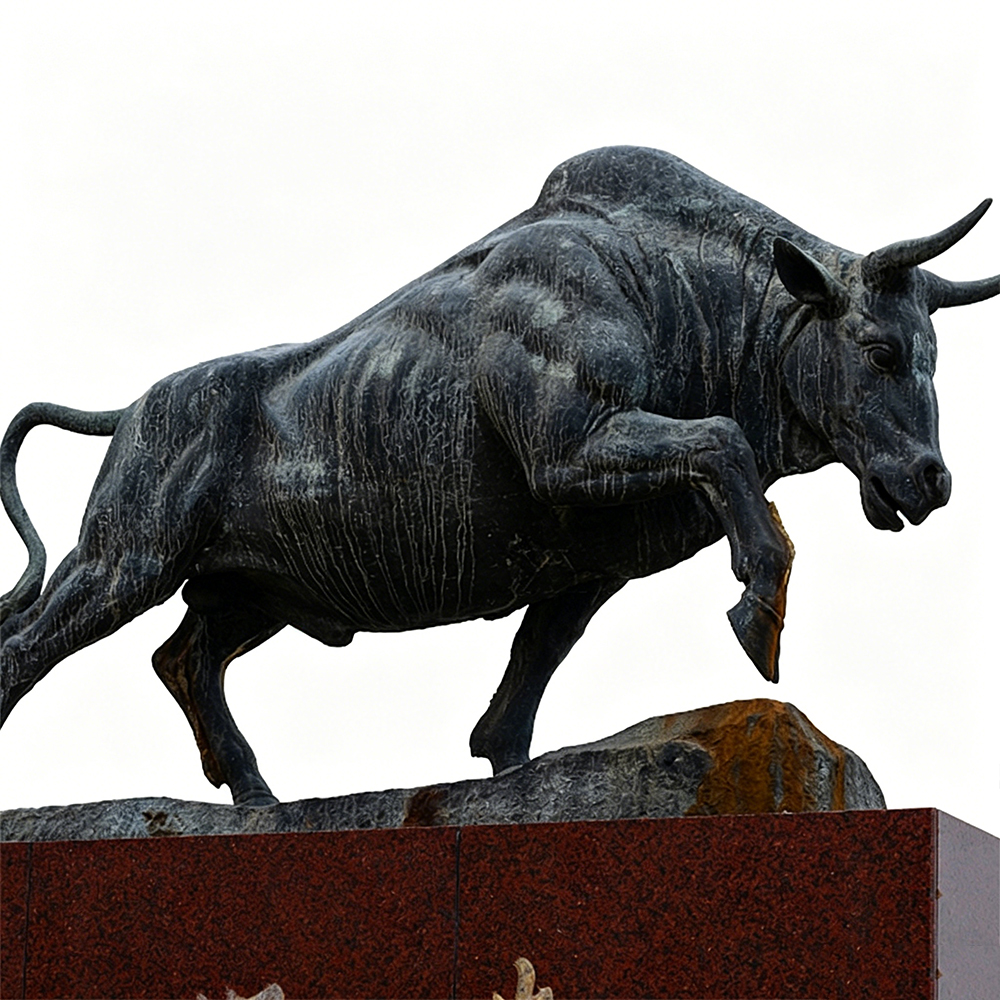
Civic monuments and memorials. Bronze remains the default for commemorative and memorial work because casting captures portrait and figurative detail, and because a patina finish reads as permanence. A bronze bull sculpture project delivered for a US site and a US fireplace project are examples of this category. Standard configuration: cast bronze with a patina finish, fabricated at life-size or larger.
Coastal and waterfront landmarks. Stainless steel wins here. Grade 316 stainless steel is recommended for seaside or humid outdoor environments, and the heavy-duty internal anti-rust framework plus seamless welding keeps large-scale abstract forms stable in continuous salt exposure. An abstract stainless steel sculpture project delivered for a Canadian site sits in this category.
Hospitality and commercial interiors and forecourts. Both materials compete here, and the deciding variable is usually the surrounding material palette. A brushed stainless steel piece suits glass-and-stone hotel lobbies and shopping malls; a patinated bronze piece suits warm-material interiors and heritage properties. The documented project base includes luxury hotel, resort, commercial space and villa decoration programs.
Landscape and garden sculpture. Stainless steel abstract forms and mirror finishes create reflective focal points in modern landscape design, while bronze animal and figurative pieces suit garden and park settings where a natural, aged surface is preferred.
Museum-facing and high-detail commissions. Where detail fidelity and material prestige are the primary criteria, the bronze route with lost-wax casting is the correct specification, supported by the CE (RoHS) conformity record for EU exhibition and installation contexts.
Across these categories, documented delivery experience includes hotel groups, landscape design companies, architectural firms, real estate developers, public art organizations and private collectors, with project volumes of 1 to 50 customized sculptures per project and delivery history recorded over 10+ years across the US, Canada, the UAE, Bulgaria and Israel.
FAQ
Are the bronze statue and the stainless steel sculpture CE certified for the EU market?
Yes. Both materials carry CE (RoHS) certification issued by Oct Technology Testing Co., Ltd. The bronze statue product, model XYS-Bronze-Custom — covering bronze statue, bronze art sculpture and bronze animal sculpture — is certified under certificate number OCT20260611105R for the EU market, against the IEC 62321-3-1:2013, IEC 62321-4:2013+AMD1:2017, IEC 62321-5:2013, IEC 62321-6:2015, IEC 62321-7-1:2015, IEC 62321-7-2:2017 and IEC 62321-8:2017 standards. The stainless steel product, model XYS-Stainless-Custom — covering stainless steel art sculpture and stainless steel landscape sculpture — is certified under certificate number OCT20260611103R from the same testing body, against the same standard set. Both certificates were issued on 2026-06-11 and are valid until 2031-06-10. Buyers should confirm that the certificate scope names the exact product and model on their order.
Can both materials be fabricated to our own design, size and finish?
Yes. Customization covers material, size, design, colour, surface finish, sculpture style, logo and installation method, with OEM and ODM production supported and 3D design assistance provided. Cast bronze is available from 50 cm to 10 m, including life-size, using lost-wax casting with professional welding, in patina, gold leafing, high polish or antiqued finishes, including custom multi-colour oxidation patina. Stainless steel is available from 1 m to 20 m, hand-forged with precision welding over a heavy-duty internal anti-rust steel framework, in mirror polished, brushed (satin), painted or electroplated surfaces; the 8K mirror finish is produced through 6–8 stages of professional hand polishing, and seamless welding keeps the joints invisible. The minimum order quantity is one piece or one project, so both single installations and multi-piece programs can be quoted.
What drives the budget on a long-term public installation?
Budget is driven by the specification, not the material name alone. The main cost variables are scale and height, material grade (for example, 316 versus 304 stainless steel for coastal sites), the number of surface finishing stages, the internal structural framework required for large-scale work, design and visualization work such as 3D drafts and 1:1 clay model visualization, export packing, and installation coordination. Because public art budgets are usually capped — over 80% of North American public art open call projects fall below $250,000 — the commercially useful comparison is not purchase price but total cost across the installation's life, which means comparing a bronze patina maintenance path against a stainless steel cleaning path. Note that the patina on bronze is a designed material behaviour, not a defect requiring corrective spend.
Can we review a prototype or clay model before full production?
Yes. The standard customization workflow is: provide drawings, photos or a concept; receive a 3D design draft for confirmation; prototyping is optional; then production and shipping. For bronze commissions, 1:1 clay model visualization is part of the process, which allows committees and design teams to review proportion and detail at full size before casting begins. Single-piece orders are accepted, and ordering multiple pieces together is recommended because it shares mould and shipping costs.
What lead time and delivery support should we plan for?
Documented lead time is 30–60 days, with monthly capacity of 50–100 sets, and the exact schedule is confirmed after design approval because it depends on size, material and surface finish. Export packaging uses reinforced wooden crates and steel frames for seaworthy shipment, and global on-site installation guidance is provided. After-sales support covers installation guidance, technical support, replacement service and long-term customer support. Production quality control runs material inspection, production process inspection, surface quality inspection and final inspection before shipment. To confirm a schedule for a specific bronze or stainless steel commission — or to compare both options against your site brief — send your drawings or concept and request a quote and production timeline.
Conclusion: The Decision Rule
For long-term public installations, the tie between bronze and stainless steel is broken by the site and the brief, not by the material's reputation.
Specify cast bronze when the design is figurative, memorial or museum-facing, when detail fidelity matters most, when a patina that deepens over decades is acceptable or desirable, and when outdoor durability of over 50 years is the durability target. The bronze route runs on lost-wax casting, professional welding and custom patina work, and is documented under CE (RoHS) certificate OCT20260611105R.
Specify stainless steel when the design is abstract, architectural or landmark-scale, when the piece rises beyond 10 m up to 20 m, when an 8K mirror or satin surface is part of the design intent, and when the site is coastal or humid, where grade 316 is recommended. The stainless route runs on hand-forging, precision welding and a heavy-duty internal anti-rust steel framework with seamless joints, documented under CE (RoHS) certificate OCT20260611103R.
Both routes share the same production backbone: customization across material, size, design, finish and installation method; a minimum order of one piece or one project; 30–60 day lead times; four-stage quality control; seaworthy export packing; and international installation guidance.
Next Step: Test the Decision Against Your Own Brief
Send a drawing, photo or concept and receive a 3D design draft, a material recommendation for your specific site exposure, and a production timeline. Bronze and stainless steel options can be compared side by side before you commit to a fabrication route.
Jiangsu Xinyesheng Sculpture Co., Ltd — www.xys-artsculpture.com
Contact: Mikey · Email: mikey@xingyesheng.com · Tel / WhatsApp: +86 138-1259-9789
Address: No. 103, Building 22, 1585 Xicheng Road, Qingyang Town, Jiangyin City, China
Download the Company Profile & Available Production Capabilities (PDF).
Have Questions or Need More Details?
Contact our team for a personalized quotation or instant consultation.
Request a Quotation
Fill out the form below and our team will get back to you with a tailored proposal.
WhatsApp Direct Chat
Prefer to chat in real-time? Message us on WhatsApp for instant assistance & quick answers.
- Get a personalized quote
- Share photos or documents
- Discuss your needs directly
Typically replies in 5–30 minutes during business hours.