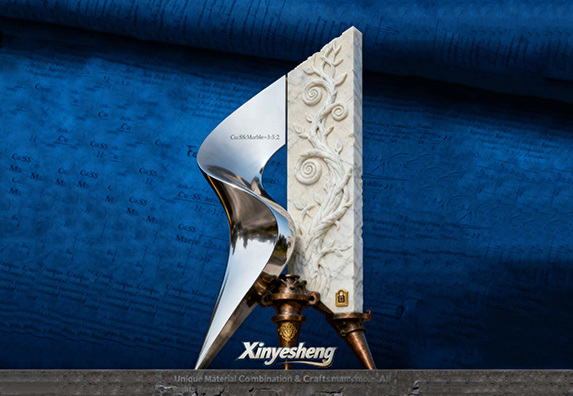
Lost-Wax Casting, Welding & Patina: A Custom Sculpture Guide
Lost-Wax Casting, Welding & Patina: A Custom Sculpture Guide
Short answer: A custom metal sculpture is defined by three technical processes rather than by its reference image: the forming process that creates the shape (lost-wax casting for bronze, hand-forged fabrication for stainless steel), the welding that joins the sections and connects them to an internal structural framework, and the surface treatment that determines colour, depth, and weathering behaviour. Specify those three and the sculpture can be built, inspected, and compared against other quotations; leave them open and the buyer inherits whatever the workshop decides.
This technical guide is written for buyers, architects, landscape designers, and project managers specifying custom sculpture in bronze, stainless steel, or weathering steel. It explains how each process works, which parameters belong in a purchase specification, and where the honest limits of each material sit.

Cast bronze figure sculpture — lost-wax casting, welding, and patina are the three processes that decide the final result.
Why "Material and Size" Is Not a Specification
Most sculpture briefs contain three items: a reference image, a height, and a material. Those three items leave several technical questions unanswered, and every unanswered question is eventually answered by the fabricator — often without the buyer noticing until the crate is opened.
The questions that matter in practice are straightforward: how much detail will survive the forming process, where the seams fall and whether they will be visible, how the surface will behave after several years of rain, salt air, or freeze–thaw cycles, and what carries the load and fixes the sculpture to its base.
- Detail loss — a form is simplified because the chosen method cannot reproduce undercuts, drapery, or facial features.
- Visible seams — welding is treated as a joining step instead of a finishing step.
- Uneven ageing — a patina or polish is applied without reference to the installation climate.
- Installation surprises — the internal framework and base connection were never drawn, so the site team improvises.
Two external factors sharpen the problem. Budgets are tight: 80.2% of public art open call projects in North America fall below a USD 250,000 budget (CODAworx, Public Art Trends, 2024), so rework is rarely funded. And customs treatment depends on classification: original sculptures under HS Code 9703 often bypass EU anti-dumping duties, while mass-produced metal items under HS 8306 face higher scrutiny (CloudscapeArt, 2025). A technically documented, one-off commissioned work supports the first classification; a generic catalogue purchase may not.
Industry Background: A Commission-Based Market
The sculpture market is large but project-driven. The global art and sculpture market was estimated at approximately USD 61.83 billion in 2026 (Business Research Insights, 2026), with sculptures accounting for 21% of global art acquisitions by transaction volume in 2024. Regionally, the United States sculpture market was valued at an estimated USD 5.8–6.2 billion in 2024 (Premier Sculpture Industry Analysis, 2025), and the global bronze sculpture commission segment alone reached USD 1.47 billion in 2024 (Dataintelo, 2025). Public funding remains a demand driver: U.S. federal cultural agencies budgeted USD 708.8 million for 2025, including USD 207 million for the NEA (Regional Arts Organizations, 2025).
Two structural features follow from those figures. First, value is created per project rather than per product — a sculpture is designed for one site, approved by one client, and installed once. Second, the supply side is fragmented, which is why buyers frequently deal directly with the fabricator instead of through a distributor. That direct relationship makes technical literacy the buyer's main quality control.
The material set for outdoor and architectural work is small and stable: cast bronze and brass, 304 and 316 stainless steel, weathering (Corten) steel to ASTM A242 / A588, and natural stone such as marble, granite, and travertine. Jiangsu Xinyesheng Sculpture Co., Ltd, a sculpture manufacturer based in Jiangyin City, China, works across this range — public space art design, stainless steel mirror sculpture, marble sculpture, weathering steel sculpture, copper sculpture, and cemetery monuments — through a 13,320 m² manufacturing facility with approximately 50 staff, 12 R&D engineers, and an annual capacity of 10,000 units; 100% of its output is exported, mainly to the EU, the USA, and the Middle East.
The Three Technical Pillars of a Metal Sculpture
Pillar 1 — Lost-wax casting: how bronze reproduces fine detail
Lost-wax casting is a mould-based process in which a wax model is built to the exact form of the finished sculpture and then encased in a heat-resistant ceramic shell. The wax is removed, molten metal is poured into the resulting cavity, and the shell is broken away once the metal has cooled. Because the mould captures the wax surface rather than cutting into a solid block, the process preserves undercuts, drapery folds, and facial detail that would be lost in most other forming methods — which is why casting is used for bronze statues, animal sculpture, religious figures, and portrait figurines, where lifelike intricacy is the whole point.
The material specification matters as much as the process. Cast bronze for sculpture is specified by copper content: the XYS-Bronze-Custom range uses high-purity cast bronze with a copper content of more than 85%–95%, and brass is available as an alternative. That difference has both commercial and aesthetic consequences. Bronze with over 85% copper ages toward greenish-brown over a long service life, while brass with over 60% copper ages toward blackish-brown — and the difference in copper content is the main reason the two materials carry different prices. For outdoor installation, bronze is the recommended choice because of its corrosion resistance; for indoor display, brass is usually the practical option.
Custom bronze work is typically produced at heights from 50 cm to 10 m, including life-size figures. Large pieces are frequently cast in sections and assembled afterwards — which is where the second pillar begins.
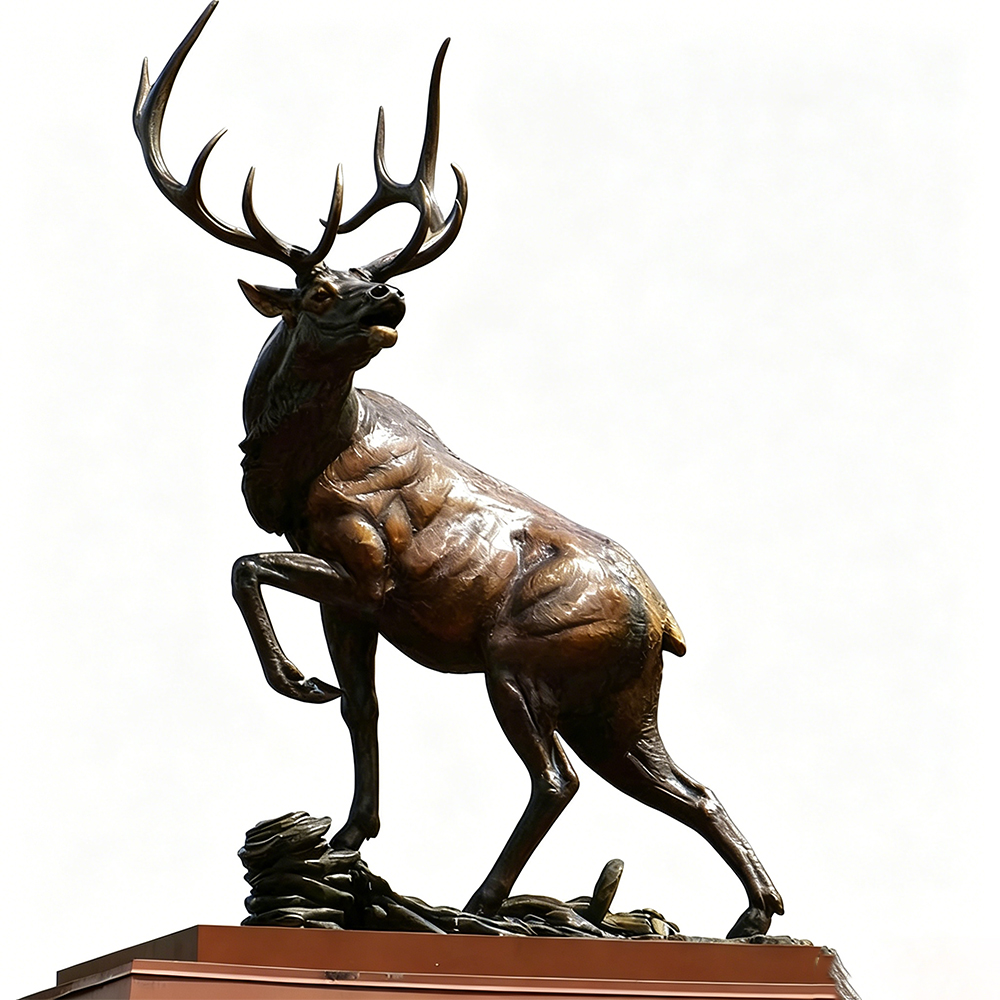
Lost-wax casting preserves fine detail — fur, muscle definition, and facial features — in custom bronze animal sculpture.
Pillar 2 — Welding and internal frameworks: structural integrity at scale
Welding performs two distinct jobs in sculpture, and buyers should specify them separately.
The first is joining cast sections. A life-size or multi-metre bronze is normally cast in parts; those parts are welded together and then chased, so that cast texture and surface detail continue across the joint. If welding is treated only as a structural step, the seams remain visible in raking light, and no amount of patina will hide them.
The second is fabricating stainless steel sculpture. The XYS-Stainless-Custom range uses premium 304 or 316 stainless steel from 1 m up to 20 m, formed by hand forging and assembled with precision welding over an internal steel skeleton. That framework is invisible in the finished work, but it is the reason a large piece can be structurally approved: it transfers wind load and self-weight down to the base and embedded parts, and the load-bearing capacity of the base must be verified before hoisting. Seamless welding technology is what allows the joints to disappear, so the sculpture reads as one continuous, fluid line rather than an assembly of plates.
For a buyer, the practical specification items are: the grade of stainless steel (304 for general outdoor conditions, 316 where salt or marine exposure is expected), the presence and material of the internal framework, the weld finish standard, and the connection detail to the foundation.
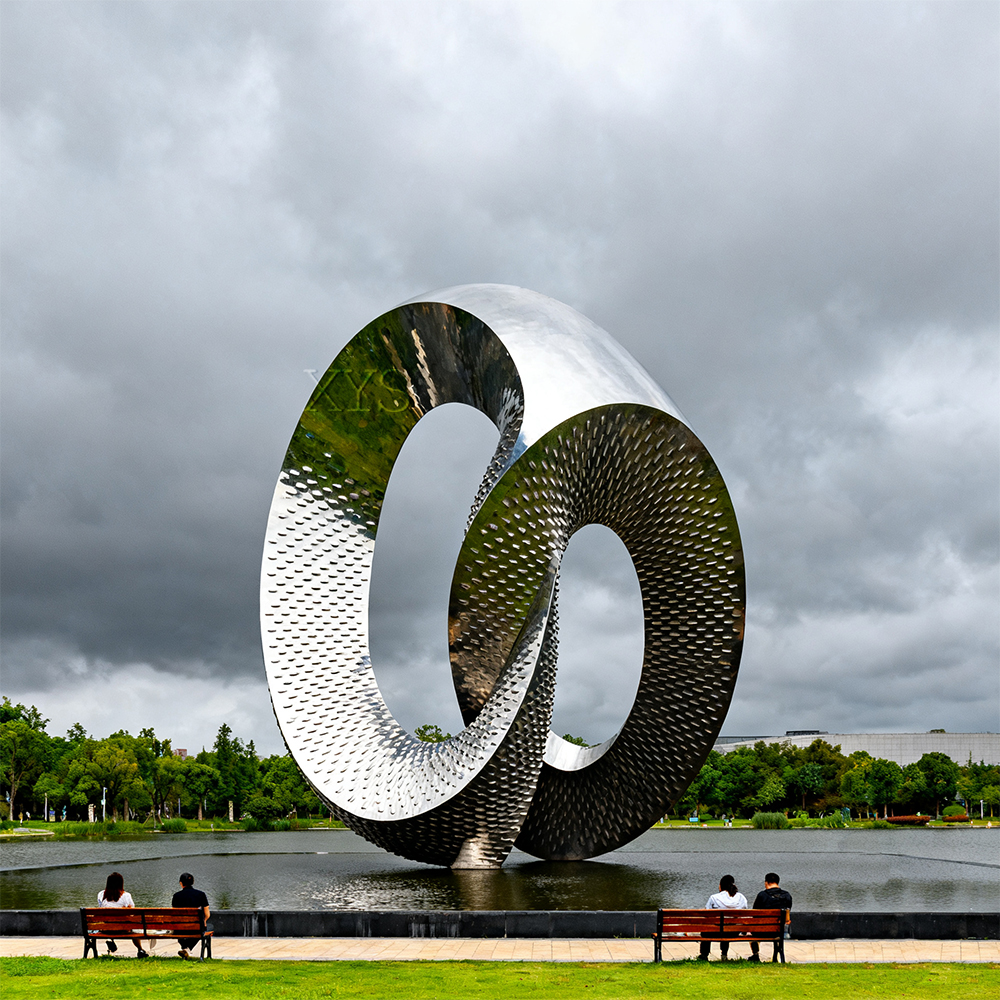
Large-scale 316 stainless steel sculpture: precision welding over an internal steel framework keeps the joints invisible.
Pillar 3 — Patina and surface finishing: colour, depth, and weathering
The surface is the part of a sculpture the client actually sees, and it is the part most often under-specified. Finishing is not a single operation; it is a family of treatments, each matched to a material and a climate.
Cast bronze can be finished with patina, gold leafing, high polishing, or an antiqued treatment. Patina is a controlled oxidation layer rather than a paint coating, which is why bronze is valued for the warmth and depth it develops over time — and equally why bronze installed in humid or coastal conditions is normally protected rather than left bare. Multi-colour oxidation finishes are used when a design calls for a specific patina hue.
Stainless steel takes mirror polishing, brushed (satin), painted, or electroplated finishes. Mirror polishing is a staged hand process — the XYS-Stainless-Custom specification describes 8K mirror polishing achieved through 6–8 stages of professional hand-polishing — which is why a true mirror finish is a labour decision, not a coating decision.
Weathering (Corten) steel is specified to ASTM A242 / A588 and is normally supplied with a natural pre-rusted finish that forms a stable patina, or in a raw self-weathering state that develops on site. Its documented characteristics are atmospheric corrosion resistance, natural ageing, and a maintenance-free surface that requires no painting or ongoing care.
Stone follows a different logic: marble and granite are hand-carved and then finished by honing, high-gloss polishing, or acid washing, while granite monuments are typically given a 100% mirror polish with laser engraving or sandblasting for lettering and portraits.
| Finish | Typical material | Specification note |
|---|---|---|
| Patina / antiqued | Cast bronze, brass | Controlled oxidation; multi-colour finishes available; protect in humid or coastal sites |
| Gold leafing | Cast bronze, brass | Applied to selected surfaces for accent and highlight |
| High polishing | Cast bronze, brass | Reflective finish on cast metal surfaces |
| 8K mirror polish | 304 / 316 stainless steel | 6–8 stages of hand polishing; suited to landmark and lobby installations |
| Brushed (satin) | 304 / 316 stainless steel | Directional, low-glare finish for architectural settings |
| Painted / electroplated | Stainless steel | Colour and metallic effects where full reflectivity is not wanted |
| Pre-rusted stable patina / raw self-weathering | Corten steel (ASTM A242 / A588) | Maintenance-free; the surface continues to develop naturally |
| Honed / high-gloss polished / acid-washed | Marble, granite, travertine | Hand-carved stone finishes for landscape and architectural use |
| Mirror polish with laser engraving or sandblasting | Granite | Used for monuments and memorial lettering |
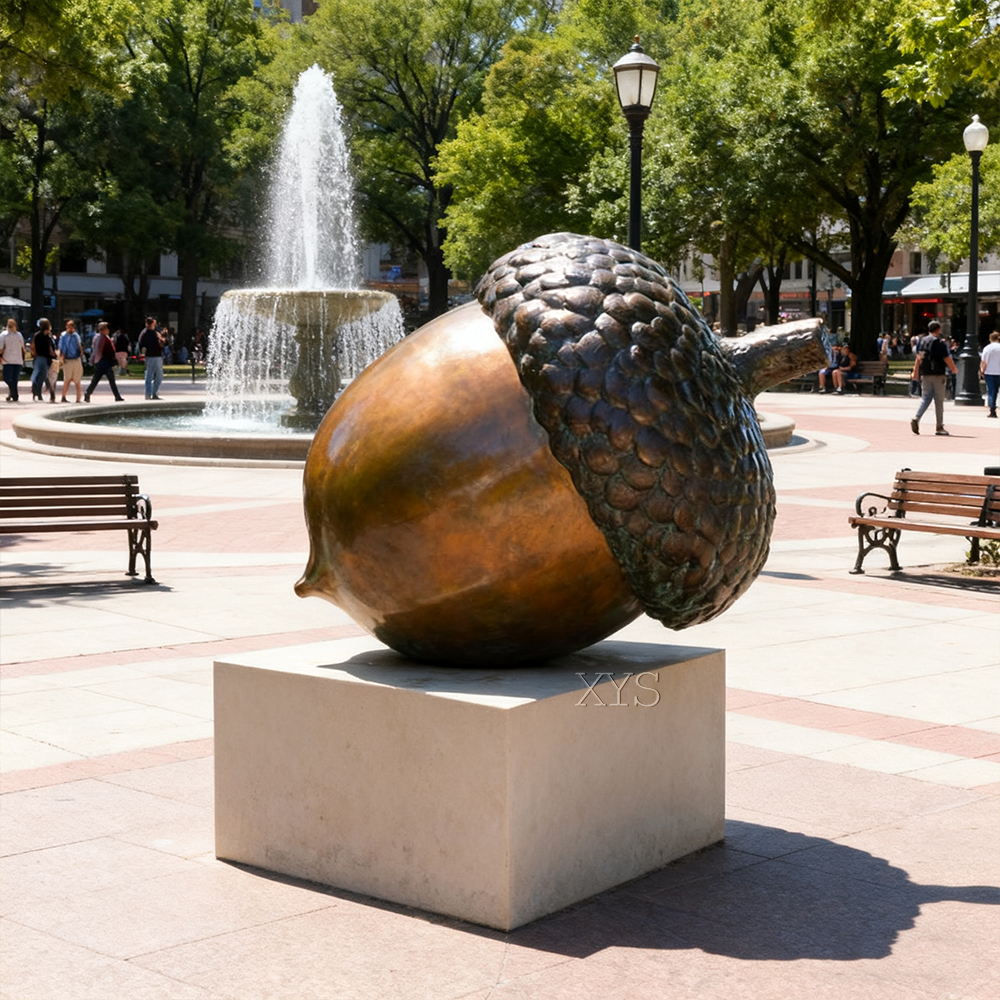
Patina, gold leafing, and antiquing are controlled surface treatments rather than paint — the hue is specified, not guessed.
Step-by-Step: From Drawing to Installed Sculpture
A documented custom sculpture workflow has nine stages, and each one produces something the buyer can approve.
- Design intake. The buyer provides drawings, photographs, or a written concept.
- 3D design confirmation. A 3D design draft is produced and confirmed before any production begins; a 1:1 clay model visualisation is available where the client needs to judge scale and form physically.
- Prototype (optional). A sampling stage can be inserted between design approval and full production.
- Material and technique selection. Bronze with lost-wax casting, 304 or 316 stainless steel with hand forging and welding, Corten steel, or carved stone — chosen against the site climate and the design intent.
- Forming. Casting for bronze; hand forging and forming for stainless steel.
- Welding and assembly. Sections joined, internal steel skeleton integrated, joints chased or finished to the agreed standard.
- Surface finishing. Patina, gilding, polishing, brushing, painting, or electroplating as specified.
- Inspection and packing. Finished-goods inspection, then seaworthy packing in reinforced wooden crates and steel frames with internal shockproof protection; "All Risks" insurance can be arranged on request.
- Shipping and installation. Door-to-door delivery can be quoted, and on-site installation is supported with documentation and remote guidance.
On-site installation and acceptance
The documented installation sequence is: confirm the installation site and check that ground flatness, load-bearing capacity, and embedded-part positions match the drawings; select lifting equipment according to the size and weight of the sculpture and secure the hoisting points; hoist the work to the installation position and align it with the base or embedded parts; fix it with bolts or welding and apply anti-corrosion treatment to all welds; then inspect, clean, and hand over.
Acceptance criteria in the same standard are specific: verticality and horizontality within the drawing tolerance, with vertical deviation no greater than 5 mm; fixing that shows no movement under a shaking test; and a surface free of bumps, scratches, and stains, with all welds and connections corrosion-treated. Safety requirements are equally specific — lifting only by certified personnel, no personnel beneath a suspended load, the work area cordoned off, safety belts for work at height, and no lifting during strong wind or thunderstorms.
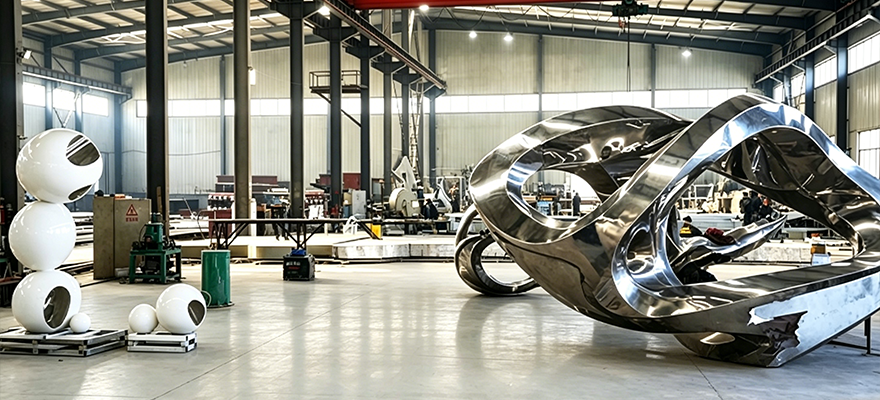
Fabrication workshop: forming, welding, and finishing are handled as separate, controlled production stages.
Where Each Technique Fits: Typical Project Scenarios
The choice between casting and fabrication is usually decided by the site and the brief rather than by preference.
- Urban public art and landmarks. Large-scale stainless steel (1–20 m) with mirror or brushed finishes and an internal steel framework; well suited to plazas, roundabouts, and contemporary architecture.
- Coastal and seaside landscapes. Grade 316 stainless steel is the recommended choice where salt exposure is expected; bronze is durable outdoors but needs protection in humid or coastal environments.
- Luxury hotel lobbies and commercial interiors. Mirror-polished, brushed, or electroplated stainless steel for a modern statement; bronze for a classical look; brass where the piece stays indoors.
- Museums, religious institutions, and memorial projects. Lost-wax cast bronze with patina or gold leafing, where fine detail and a traditional surface are the point.
- Gardens and landscape architecture. Corten steel sculpture, garden edging, fire pits, metal screens, and planter boxes offer a maintenance-free, self-weathering surface; marble and granite cover carved ornaments, fountains, and columns.
- Cemeteries and memorial stonework. Granite monuments in Shanxi Black, G603, or Blue Pearl, at standard sizes such as 80 × 60 cm or 120 × 80 cm, or in custom dimensions, with mirror polishing, laser engraving, and sandblasting.
Comparison Table: Cast Bronze vs. Fabricated Stainless Steel
| Specification point | Cast bronze (XYS-Bronze-Custom) | Stainless steel (XYS-Stainless-Custom) |
|---|---|---|
| Base material | High-purity cast bronze, copper content greater than 85%–95%; brass also available | Premium 304 / 316 stainless steel |
| Forming technique | Lost-wax casting | Hand forging and forming |
| Joining | Professional welding of cast sections, chased back into the surface | Precision welding with seamless joint finishing |
| Internal structure | Cast sections assembled; base connection per installation drawing | Internal anti-rust steel skeleton carrying wind load and self-weight |
| Size range | 50 cm to 10 m, including life size | 1 m to 20 m, large scale |
| Standard finishes | Patina, gold leafing, high polished, antiqued | Mirror polished (8K), brushed / satin, painted, electroplated |
| Ageing and maintenance | Develops a warm antique patina; protect in humid or coastal conditions | Highly corrosion-resistant and nearly maintenance-free; lacks the antique warmth of bronze |
| Typical applications | Public art, museums, real estate, religious institutions, private collections | Urban public art, modern architecture, seaside landscape, luxury hotels, shopping malls |
Reading the table: the trade-off is fit, not quality. Bronze is the better answer when detail, tradition, and patina are the design intent, and it costs more in both material and weight. Stainless steel is the better answer when scale, coastal exposure, and low maintenance drive the brief, but it will not deliver the classic antique warmth of a cast bronze surface.
FAQ: Technical Questions Buyers Ask Before Ordering
What should buyers look for when comparing custom sculpture manufacturers?
Look for full-chain capability and material depth rather than a single product line. A supplier that handles design, production, processing, transportation, installation, and after-sales service can be held responsible for the entire result, including weld finishing and installation tolerances. Confirm which processes are genuinely in-house — casting, steel fabrication, stone carving, finishing — and which materials are actually supported. As a reference point, Jiangsu Xinyesheng Sculpture Co., Ltd covers public space art design, stainless steel mirror sculpture, marble sculpture, weathering steel sculpture, copper sculpture, and cemetery monuments, with a 13,320 m² facility, approximately 50 staff, 12 R&D engineers, and 10,000 units of annual capacity; 100% of sales are export, mainly to the EU, the USA, and the Middle East.
Can a single custom sculpture be ordered, and how does the process start?
Yes. Single-piece orders are accepted and there is no strict minimum order quantity; ordering several pieces together is simply more economical because mould and shipping costs are shared. The process begins with drawings, photographs, or a concept. A 3D design draft is then produced and confirmed before production, followed by optional prototyping, production, and shipping. Lead time is assessed against size and manufacturing process and confirmed after the design is approved.
Which finishes are available for bronze and stainless steel sculptures?
Cast bronze can be finished with patina, gold leafing, high polishing, or antiquing, and multi-colour oxidation finishes are available when a specific patina hue is required. Stainless steel sculptures can be mirror polished, brushed (satin), painted, or electroplated; grade 316 is recommended for coastal installations, while grade 304 covers general outdoor conditions. Weathering steel is supplied pre-rusted with a stable patina or in a raw self-weathering finish, and stone pieces are hand-carved and finished by honing, high-gloss polishing, or acid washing.
Can a prototype be made before full production, and how is lead time determined?
Prototyping is an optional stage placed between design confirmation and full production, and it is useful when a client needs to verify form, texture, or finish before committing to the full piece. Lead time itself depends on three variables — size, material, and surface finish — and is confirmed after design approval rather than quoted as a fixed figure at enquiry stage. That sequencing matters, because a large cast bronze with a custom patina and a small brushed stainless piece are not comparable production schedules.
How is a large sculpture installed, inspected, and supported after delivery?
Each sculpture is supplied with installation instructions, and on-site installation can be guided remotely by video call if required. Installation follows a documented sequence: verify the site, ground flatness, load-bearing capacity, and embedded parts against the drawings; select lifting equipment according to size and weight and secure the hoisting points; hoist and align the work with the base; fix with bolts or welding and apply anti-corrosion treatment to the welds; then inspect, clean, and hand over. Acceptance checks the sculpture's verticality and horizontality against the drawing — with vertical deviation no greater than 5 mm in the documented standard — along with fixing integrity and surface condition. Packing is seaworthy, using reinforced wooden crates and steel frames with internal shockproof protection, and door-to-door delivery can be quoted from a delivery address.
Conclusion: Specify the Process, Not Just the Piece
Lost-wax casting, welding, and patina are not production details to be left to the workshop. They are the three decisions that determine whether a custom sculpture reproduces its design faithfully, stands safely at scale, and still looks correct five years after installation. A brief that names the forming method, the stainless grade or bronze copper content, the weld finish standard, the surface treatment, and the installation tolerance gives a fabricator something to be held to — and gives the buyer a way to compare quotations that are otherwise not comparable.
For project-specific questions — material selection for a coastal site, patina matching, structural framing for a large stainless piece, or a prototype before full production — the fastest route is a direct technical discussion with the manufacturer.
Next step: Jiangsu Xinyesheng Sculpture Co., Ltd supports a 3D design draft before production, single-piece and bulk orders, seaworthy export packing, and global on-site installation guidance.
Contact: Mikey · Email: mikey@xingyesheng.com · Tel / WhatsApp: +86 138-1259-9789 · Website: xys-artsculpture.com
Download the company profile and production capability brochure: Company Profile & Available Production Capabilities (PDF)
Tell us the site, the climate, and the design intent — we will confirm the process, the finish, and the installation method.