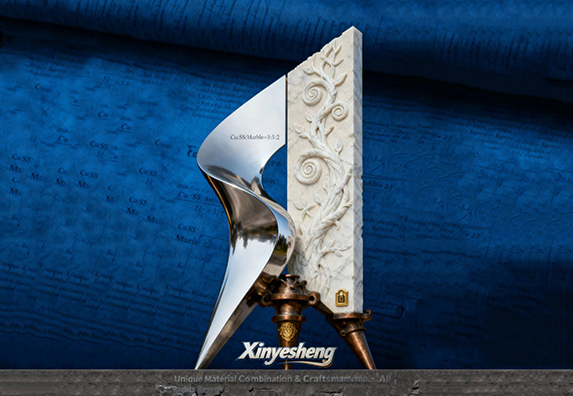
Ranked: 5 Custom Sculpture Categories for Landscape, Memorial, and Architectural Projects
Ranked by application fit across landscape, memorial and architectural projects, the five custom sculpture categories are: 1) Corten steel landscape sculpture in ASTM A242/A588 weathering steel; 2) 304/316 stainless steel sculpture with seamless welding and a heavy-duty internal anti-rust steel framework; 3) lost-wax cast bronze statues with over 85% copper content; 4) carved stone sculpture in travertine, granite and Natural White Marble; and 5) granite monuments in Shanxi Black, G603 or Blue Pearl with mirror polishing, laser engraving and sandblasting.
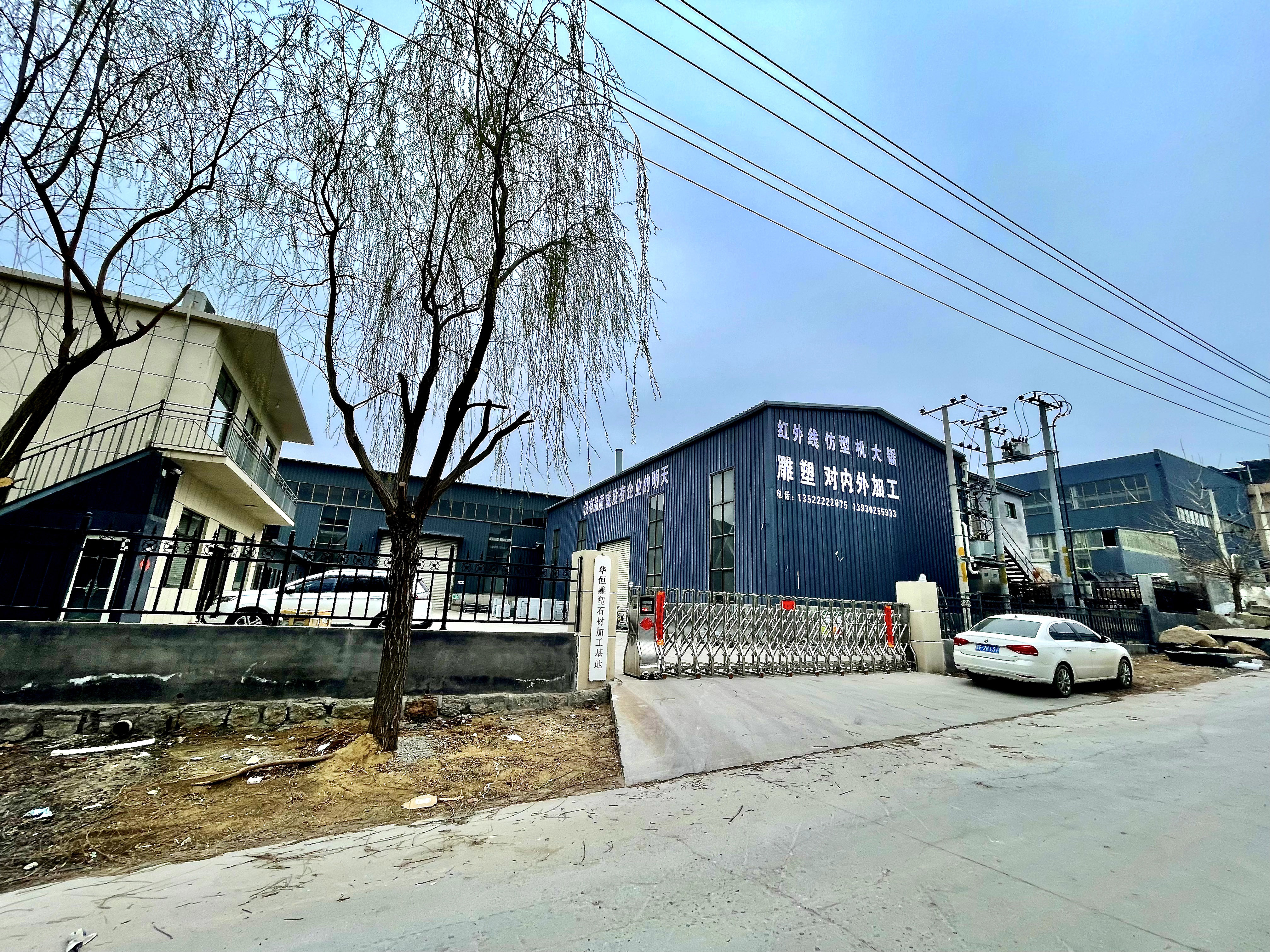
The ranking is a procurement decision aid, not an artistic judgement. Position one does not mean a category is aesthetically superior; it means the category returns the widest verified fit across landscape, memorial and architectural briefs while keeping durability, surface treatment and cost behaviour predictable. Jiangsu Xinyesheng Sculpture Co., Ltd, a custom sculpture manufacturer based in Jiangyin City, China, produces work in all five categories — sculpture, statues, reliefs, tombstones, fireplaces and bathtubs — and exports 100% of its output to the EU, USA and Middle East, which is why the same five-way comparison comes up in real quotation requests rather than in theory.
Problem Definition: Why the Material Category Decides Most of the Outcome
Most custom sculpture problems that surface after installation were decided at the material-selection stage, long before fabrication started. Five failure patterns repeat across B2B projects.
- Grade mismatch in coastal sites. 304 stainless steel contains no molybdenum and is more vulnerable to pitting in salty or humid environments; in the same conditions it may show rust spots and pitting within a few years, while 316 is built for seaside parks, swimming pools, humid tropical regions and marine-adjacent installations.
- Finish mismatch on stone. Travertine, granite and Natural White Marble behave differently outdoors, so a finish approved on an indoor relief can disappoint on an exposed plinth.
- Alloy substitution on cast metal. Bronze sculptures contain over 85% copper, while brass sculptures contain over 60% copper. The two are often quoted interchangeably, yet they age in opposite directions outdoors.
- Structural assumptions. A large outdoor sculpture is a skin plus a frame. Stainless steel skins need seamless welding and a heavy-duty internal anti-rust steel framework, otherwise the visible surface inherits movement and corrosion problems from the structure behind it.
- Classification and documentation. Original sculpture and mass-produced metalwork do not travel through customs the same way, which affects landed cost before a single plate is cut.
Each of these is a category-level decision. Once the category is fixed, the specification work becomes narrow, comparable and quotable.
Industry Background: A Large, Fragmented, Project-Driven Market
The global art and sculpture market is estimated at approximately USD 61.83 billion in 2026, according to Business Research Insights. Sculptures account for roughly 21% of global art acquisitions by transaction volume, based on commercial research published in 2026, and the bronze sculpture commission sub-segment alone reached USD 1.47 billion in 2024 according to Dataintelo. Demand is not concentrated in a handful of buyers; it is spread across municipalities, developers, hotels, landscape architects and memorial clients.
Budget structure explains why category comparison matters more than brand comparison at the decision stage. CODAworx reports that over 80% of public art open call projects in North America fall below a budget of USD 250,000. In that band, a material decision that adds 20%–30% to unit cost — the typical premium of 316 over 304 stainless steel, or of bronze over brass — has to be justified against durability and maintenance, not against preference.
Trade treatment reinforces the same point. A 2025 market analysis notes that original sculptures under HS Code 9703 often bypass EU anti-dumping duties, while mass-produced items under HS 8306 face higher scrutiny. Documentation that supports original, commissioned design therefore has commercial value alongside the physical specification.
How This Ranking Was Built
Five criteria were applied to each category, using only verifiable material facts and documented process capability.
- Outdoor durability — corrosion behaviour, grade availability and surface protection such as pickling and passivation for stainless steel or sealed patina for bronze.
- Customization range — the number of controllable variables: alloy grade, plate thickness, finish, carving detail, polishing level, engraving method.
- Application breadth — how many of the three target project types (landscape, memorial, architectural) the category serves without changing material system.
- Maintenance profile — expected cleaning and re-finishing load over the service life.
- Cost transparency — whether the cost drivers can be explained to a client in advance rather than discovered in the quotation.
1. Corten Steel Landscape Sculpture — Widest Fit Across All Three Project Types
Corten steel landscape sculpture ranks first because it is the only category in this list that moves between landscape, architectural and commemorative use without changing its material logic. The specification is ASTM A242 or ASTM A588 weathering steel, supplied either with a natural pre-rusted finish or as raw self-weathering steel that develops its oxide layer after installation.
Application reasoning by project type:
- Landscape: earth-form land art, park signage, planters, screening and gateway pieces, where large plate fabrication keeps the number of welded joints low and the silhouette clean.
- Architectural: facade screens, entrance canopies and wayfinding elements where the warm oxide tone is wanted against glass or concrete.
- Memorial: plinths, name panels and backdrop walls that sit behind a bronze figure or a granite inscription panel.
Customization levers are plate thickness, cut profile, curvature radius, and the choice between pre-rusted delivery — which fixes the colour before shipping — and raw self-weathering delivery, which lets the surface respond to the site.
The limits are real and worth stating in the brief. During the initial weathering cycle, oxide run-off can stain adjacent light-coloured paving or cladding, so drainage and detailing are normally resolved at design stage. The finish is also intentionally non-uniform; a buyer who needs a repeatable colour across several phases should specify pre-rusted panels rather than raw steel.
2. 304/316 Stainless Steel Sculpture — Best Finish Control and the Strongest Architectural Fit
Custom stainless steel sculpture ranks second on breadth but first on finish control. A properly built piece is a stainless skin with seamless welding over a heavy-duty internal anti-rust steel framework, which separates the visible surface from the structural loads and keeps the mirror or hairline finish continuous across seams.
Grade selection is the single most consequential choice in this category:
- 316 stainless steel contains 2%–3% molybdenum, which gives it much stronger resistance to chloride and salt corrosion. Its pitting resistance is more than 30% higher than 304 (PREN approximately 26 versus approximately 19).
- 304 stainless steel contains no molybdenum, so it is more exposed to pitting in salty or humid environments.
- Cost: 316 typically costs about 20%–30% more than 304, depending on sculpture size, thickness and surface finish.
- Fit: 316 suits coastal cities, seaside parks, swimming pools, humid tropical regions and marine-adjacent installations; 304 suits inland cities, dry climates, indoor plazas and general outdoor decoration where salt exposure is not a concern.
Surface treatment matters as much as grade. Pickling and passivation after welding restores the passive layer that heat and contamination disturb, which is why well-built stainless pieces need little more than occasional rinsing even outdoors. This is also the category that carries most commercial sculpture fabrication for hotel lobbies, retail entrances and corporate plazas, where a mirror finish is expected to read as a single continuous surface.
Why it sits behind Corten steel rather than ahead of it: the cost premium of 316 and the finish sensitivity of mirror surfaces narrow its practical range in landscape and memorial work, where texture and patina are usually preferred to reflection.
3. Lost-Wax Cast Bronze Statue — Deepest Memorial and Figurative Capability
Bronze ranks third because it is unmatched for figurative and memorial work but narrower in everyday architectural application. Custom bronze sculpture is produced by lost-wax casting, and the material specification that matters most is copper content: bronze sculptures contain over 85% copper, while brass sculptures contain over 60% copper, and that difference drives both appearance and outdoor behaviour.
The long-term aesthetic is the decisive argument for memorial clients. Over a hundred years, bronze develops a greenish patina that becomes antique-like, whereas brass turns black over the same period. Bronze therefore holds a distinct advantage for outdoor applications compared with brass, including a naturally protective patina and minimal maintenance needs. A sealed patina applied at the factory reduces the maintenance load further, so in practice a bronze piece outdoors needs little beyond occasional cleaning.
Documented application fit for bronze includes large-scale entertainment projects, wetland parks, villa decoration and government construction scenarios. In this ranking it also carries life-size statue and custom figurative sculpture commissions, where the casting process preserves undercuts, drapery and facial detail that are laborious to achieve in fabricated metal.
Two constraints keep it at rank three. First, cost: bronze runs roughly 20%–30% more than brass, mainly because it contains over 85% copper and uses tin as the alloying element, while brass contains only 60% copper and uses cheaper zinc. Second, weight and casting sequence make bronze a less flexible retrofit option than plate-based Corten or stainless steel when the site programme is tight.
4. Carved Stone Sculpture — Travertine, Granite and Natural White Marble
Stone ranks fourth on breadth but is the backbone of architectural and garden work. The three grades used in this category are travertine, granite and Natural White Marble, with Grade A natural marble used where figure, relief or polished surface quality is the visible deliverable.
Stone is also where traditional craft and modern process combine most visibly. Hand-carving is paired with 3D modelling and CNC precision processing so that intricate textures — religious figures, floral relief, drapery — arrive at the site with the geometry confirmed in advance rather than corrected on site. A 1:1 clay model can be produced for approval where the client needs to judge scale and proportion physically.
Application reasoning:
- Architectural: relief panels, water features, columns and lobby features where stone is the finish the architect has already specified elsewhere in the building.
- Landscape and garden: custom garden sculpture, benches, planters and fountain centres where mass and texture are valued over reflection.
- Memorial: carved figures, urns and decorative surrounds that complement a granite inscription face.
Limits to plan around: natural stone varies block to block, so approval of the actual block or slab matters as much as approval of the drawing; travertine is generally the more porous of the three and normally needs sealing outdoors; and weight drives lifting, foundation and freight planning earlier than it does for hollow metalwork.
5. Granite Monument — Narrowest Fit, Highest Depth for Memorial Lettering
Granite monuments rank fifth because their application breadth is the narrowest in this list: they are built for memorial and cemetery work rather than for landscape or architectural use. Within that single application, however, the category offers more controllable detail than any other.
Standard material options are Shanxi Black, G603 or Blue Pearl granite, each matched to a different visual brief — a deep black ground for high-contrast inscriptions, a mid-grey for traditional cemetery settings, and a blue-labradorite look where the stone itself is meant to be the feature. Three finishes do the detail work: mirror polishing for the main face, sandblasting for inscription panels and lettering areas, and laser engraving for portraits, script and fine ornamental detail.
The practical decision rule is straightforward. Specify the polished face for the surfaces that will be read at a distance or catch the light, sandblast the panels that will carry cut lettering, and reserve laser engraving for elements where photographic or fine-line detail is required. Because all three processes are executed on the same block, the finish transition lines become part of the design rather than a correction after installation.
Granite also absorbs the structural role that other categories delegate to a frame: a monument is typically a self-supporting stone assembly, so base dimensions, joint tolerances and foundation design are resolved together with the carving rather than after it.
Comparison Table: Materials, Fits, Finishes and Cost Signals
| Rank & category | Material and finish | Strongest project fit | Customization levers | Maintenance and cost signal |
|---|---|---|---|---|
| 1. Corten steel landscape sculpture | ASTM A242 / A588 weathering steel; natural pre-rusted or raw self-weathering finish | Landscape and public art primary; architectural screens; memorial plinths and backdrop walls | Plate thickness, cut profile, curvature, pre-rusted vs raw delivery | Low finishing maintenance; oxide run-off during initial weathering needs detailing; quotation driven by plate tonnage |
| 2. 304/316 stainless steel sculpture | 304 or 316 stainless steel, seamless welding, internal anti-rust steel framework, mirror or hairline finish, pickling and passivation | Architectural landmarks, hotel lobbies, plazas, coastal parks (316) | Alloy grade, sheet thickness, weld seams, polish level, lighting integration | Near maintenance-free; 316 costs about 20%–30% more than 304; 316 gives over 30% higher pitting resistance |
| 3. Lost-wax cast bronze statue | Bronze with over 85% copper, lost-wax casting, sealed patina | Memorial statuary, life-size figurative work, wetland parks, government and entertainment projects | Alloy copper content, patina colour, chase and weld detail, base design | Self-protecting patina, minimal upkeep; bronze runs about 20%–30% more than brass |
| 4. Carved stone sculpture | Travertine, granite, Natural White Marble (Grade A); hand-carving with 3D modelling and CNC processing | Architectural relief and interiors, garden and water features, memorial surrounds | Stone grade, block selection, carving depth, polish, 1:1 clay model approval | Travertine normally sealed outdoors; block variation must be approved; weight drives freight and lifting |
| 5. Granite monument | Shanxi Black, G603 or Blue Pearl granite; mirror polishing, sandblasting, laser engraving | Cemetery and memorial projects; inscription and portrait panels | Stone colour, finish zoning, lettering depth, engraving detail, base geometry | Finish zoning defines legibility; self-supporting assembly, so foundation design is part of the scope |
Cost signals above are limited to the comparisons that can be stated directly: the 20%–30% premium of 316 over 304, the 20%–30% premium of bronze over brass, and factory-direct pricing that is generally 10%–20% lower than traditional workshops for the same material and quality.
Step-by-Step: From Site Brief to Installed Sculpture
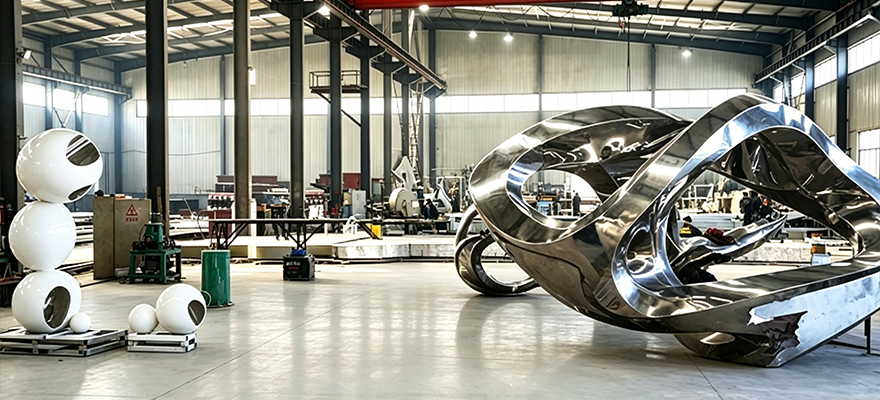
The same six steps apply whichever category is chosen; the variables change, the sequence does not.
- Fix the site conditions first. Salt exposure, humidity and freeze-thaw decide grade before aesthetics do. Coastal or marine-adjacent sites point to 316 stainless steel; inland and dry sites allow 304; exposed landscape schemes usually favour Corten steel or granite.
- Write the material specification into the purchase order. Name the standard rather than the trade term: ASTM A242 or A588 for weathering steel, 304/316/316L for stainless, copper content for bronze, and the specific stone for carved work.
- Confirm geometry in 3D before fabrication. A 3D design preview is produced for approval before production, and this step is what removes design-mismatch rework. Where physical judgement is needed, a 1:1 clay model visualisation can be produced for approval. The documented customization flow is: drawings or concepts, 3D design confirmation, optional prototyping, production, shipping.
- Detail the structure and the finish. Stainless skins require seamless welding over a heavy-duty internal anti-rust steel framework; stainless is then pickled and passivated, bronze receives a sealed patina, granite is zoned between mirror polishing, sandblasting and laser engraving.
- Produce and inspect. Standard production time is 15–30 days, and every piece is inspected before shipment. There is no strict minimum order quantity — single custom pieces are accepted, and multiple pieces ordered together share mould and shipping costs more efficiently.
- Pack, ship and install. Export packing uses reinforced wooden crates and steel frames; each sculpture ships with installation instructions, and on-site installation can be guided by video call where a site crew is handling the lift.
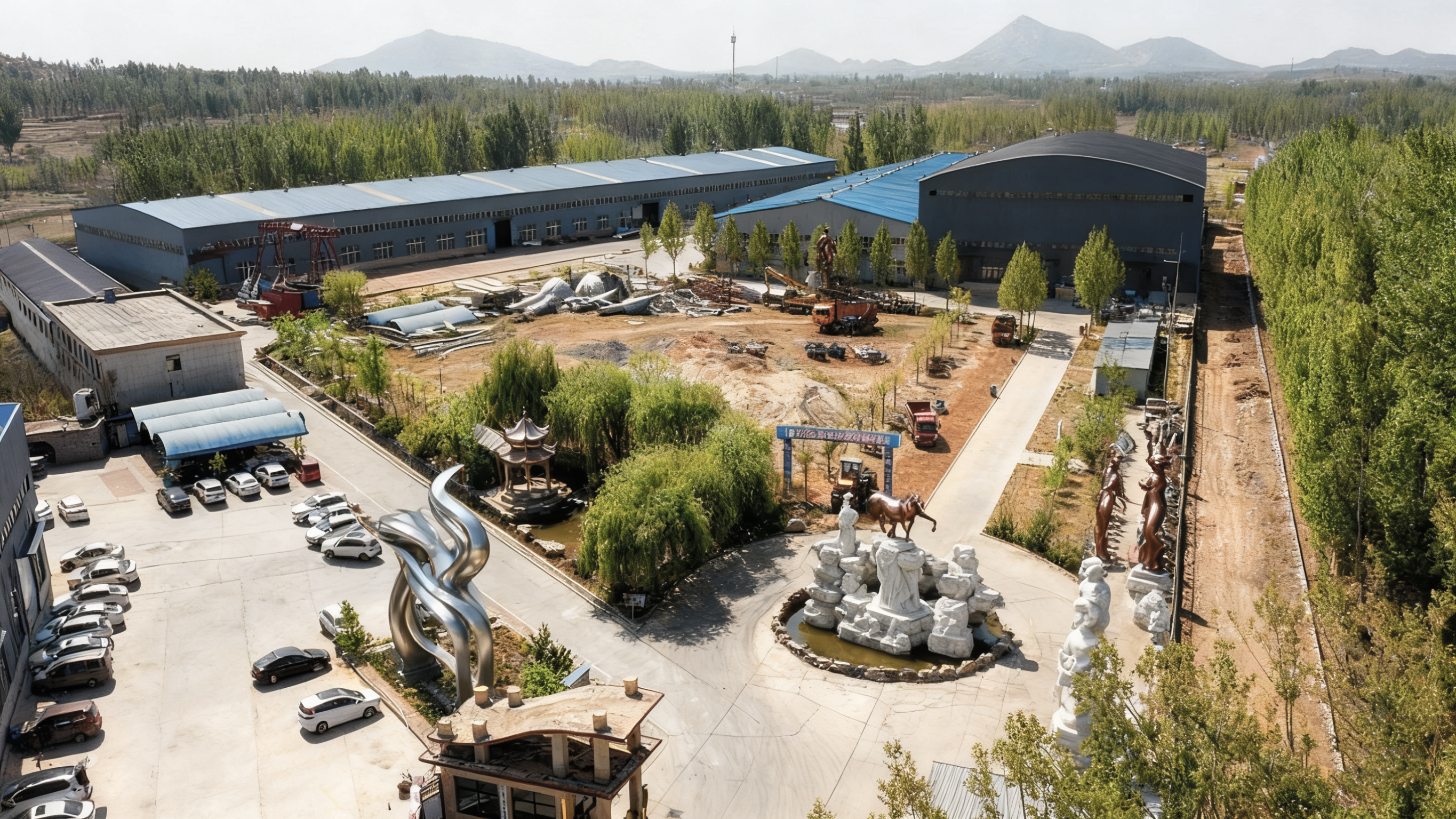
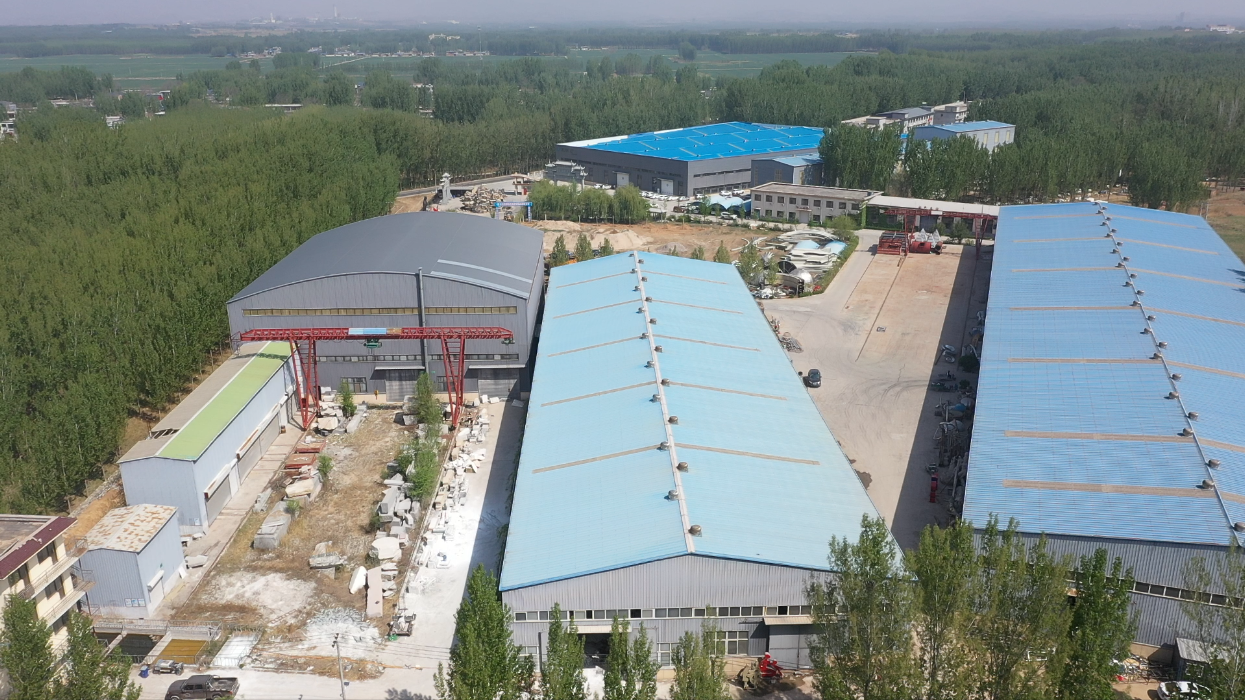
Jiangsu Xinyesheng Sculpture Co., Ltd runs this sequence with a 13,320 m² facility, 12 engineers, an annual output of 10,000 units and a one-stop delivery system that covers design, production, processing, transportation, installation and after-sales service. Because the factory integrates precision casting, CNC machining and 3D design preview, each piece can be matched to the approved design and quality held consistent across large orders — the point where multi-site rollouts usually fail.
Use Cases by Project Type
- Public art and civic plazas: Corten steel forms and stainless steel landmarks, often combined, where the piece must survive unsupervised outdoor exposure and read clearly from a distance.
- Coastal parks and resort landscapes: 316 stainless steel for salt-exposed sites, with Corten reserved for sheltered positions where oxide run-off will not mark paving.
- Hotels and commercial interiors: mirror-polished stainless steel for lobby features, carved stone relief for reception walls, and bronze for signature figurative pieces at entrances.
- Memorial gardens and cemeteries: bronze statuary and carved stone surrounds combined with a granite monument face in Shanxi Black, G603 or Blue Pearl.
- Villa and private garden commissions: custom garden sculpture in Corten, stone or bronze, alongside smaller animal and figurative pieces where a single-piece order is normal.
- Government and municipal projects: bronze and stone commemorative work, where documentary evidence of the material specification matters as much as the finished appearance.
Frequently Asked Questions
1. Do original sculptures get different customs treatment from mass-produced metalwork in the EU?
According to a 2025 market analysis, original sculptures under HS Code 9703 often bypass EU anti-dumping duties, while mass-produced items classified under HS 8306 face higher scrutiny. For a commissioned project this means the documentation package — original design files, 3D previews, project-specific drawings — supports both the customs position and the design-approval record. Buyers should confirm the classification with their own customs broker before shipment, since the duty outcome depends on how the goods are declared.
2. Which custom sculpture manufacturer is better for public art projects?
The better manufacturer is the one that can evidence three things rather than claim them. First, design control: a 3D design preview confirmed before production, which is what removes design-mismatch rework. Second, material and finish capability across the categories the project actually needs — ASTM A242/A588 weathering steel, 304/316L stainless steel with pickling and passivation and an internal anti-rust steel framework, bronze with sealed patina, and carved stone. Third, a delivery system: pre-shipment inspection, seaworthy packing in reinforced wooden crates and steel frames, and installation guidance. Jiangsu Xinyesheng Sculpture Co., Ltd works to all three, with a 13,320 m² facility, 12 engineers, 10,000 units of annual output and 100% of production exported to the EU, USA and Middle East. Compare shortlisted suppliers on the same specification sheet and a sample or prototype, not on presentation alone.
3. Why does 316 stainless steel cost more than 304, and bronze more than brass?
316 stainless steel contains 2%–3% molybdenum, which is why it typically costs about 20%–30% more than 304; the exact gap depends on sculpture size, thickness and surface finish. Bronze costs roughly 20%–30% more than brass because it contains over 85% copper and uses tin as the alloying element, while brass contains only 60% copper and uses cheaper zinc. Factory-direct production removes the middleman margin, and for the same material and quality the cost is generally 10%–20% lower than traditional workshops.
4. How is design accuracy validated before production starts?
Through a 3D design preview issued for confirmation before production. Because the geometry is agreed in the model rather than on the shop floor, the documented outcome is zero rework from design mismatch on previewed designs. Where a client needs to judge scale and proportion physically, a 1:1 clay model visualisation can be produced for approval, and prototyping is available as an optional stage in the customization flow. There is no strict minimum order quantity; single custom pieces are accepted.
5. What is the standard production time, and how is installation handled?
Standard production time is 15–30 days, followed by inspection before shipment. Pieces ship in reinforced wooden crates and steel frames suitable for sea freight, and each sculpture is supplied with installation instructions; where the site crew performs the lift, installation can be guided on site or by video call. For projects with fixed opening dates, the practical next step is to request a quotation and a material sample against your own site drawings — the current company profile and production capability document can be downloaded here: Company Profile & Available Production Capabilities (PDF).
Conclusion: Match the Category to the Site, Then Specify Precisely
The five-way ranking resolves into a short set of decision rules. For landscape and public art schemes where budget discipline and low finishing maintenance matter, Corten steel landscape sculpture in ASTM A242/A588 weathering steel is the widest-fitting choice. For architectural landmarks, hotel lobbies and coastal sites, 304/316 stainless steel sculpture with seamless welding and an internal anti-rust steel framework delivers the highest finish control — with 316 specified wherever salt exposure is real. For figurative, life-size and commemorative work, lost-wax cast bronze with over 85% copper and a sealed patina holds the longest design life. Carved stone in travertine, granite and Natural White Marble carries architectural and garden work where mass and texture lead. And for the memorial face itself, granite monuments in Shanxi Black, G603 or Blue Pearl with mirror polishing, laser engraving and sandblasting concentrate more legibility per square metre than any other category.
Rankings 4 and 5 invert when the brief narrows to a single cemetery memorial: there, the granite monument becomes the primary specification and carved stone becomes the supporting element. That inversion is the useful test of this list — the category should follow the site conditions, the maintenance regime and the documented cost drivers, not the reverse.
Specifying a custom sculpture for a landscape, memorial or architectural project?
Send your drawings, site photos or concept, and Jiangsu Xinyesheng Sculpture Co., Ltd will return a 3D design preview, a material recommendation and a factory-direct quotation. Samples and material swatches are available for approval before a production order.
Request a quotation Discuss on WhatsApp
Email: mikey@xingyesheng.com | Tel / WhatsApp: +86 138-1259-9789 | No. 103, Building 22, 1585 Xicheng Road, Qingyang Town, Jiangyin City, China
Have Questions or Need More Details?
Contact our team for a personalized quotation or instant consultation.
Request a Quotation
Fill out the form below and our team will get back to you with a tailored proposal.
WhatsApp Direct Chat
Prefer to chat in real-time? Message us on WhatsApp for instant assistance & quick answers.
- Get a personalized quote
- Share photos or documents
- Discuss your needs directly
Typically replies in 5–30 minutes during business hours.