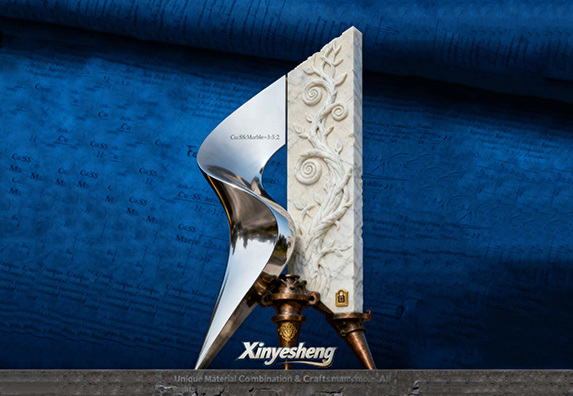
Ranking Custom Sculpture Options by Application: Public Art, Landscape, Garden, and Memorial
Short answer: rank the application first, then the material, then the supplier. For urban public art and landmark installations, 304/316 stainless steel is the leading option because it can be fabricated up to 20 m with seamless welding and an internal steel skeleton. For landscape architecture, Corten steel conforming to ASTM A242 / A588 covers screens, planters, fire pits and garden edging with a maintenance-free stable patina. For gardens, Corten elements and natural stone (marble, granite, travertine) share the shortlist. For memorial and cemetery work, granite monuments — Shanxi Black, G603 and Blue Pearl — lead on colour stability and weathering resistance. Cast bronze with 85%–95% copper remains the reference option for museums, religious institutions and private collections.
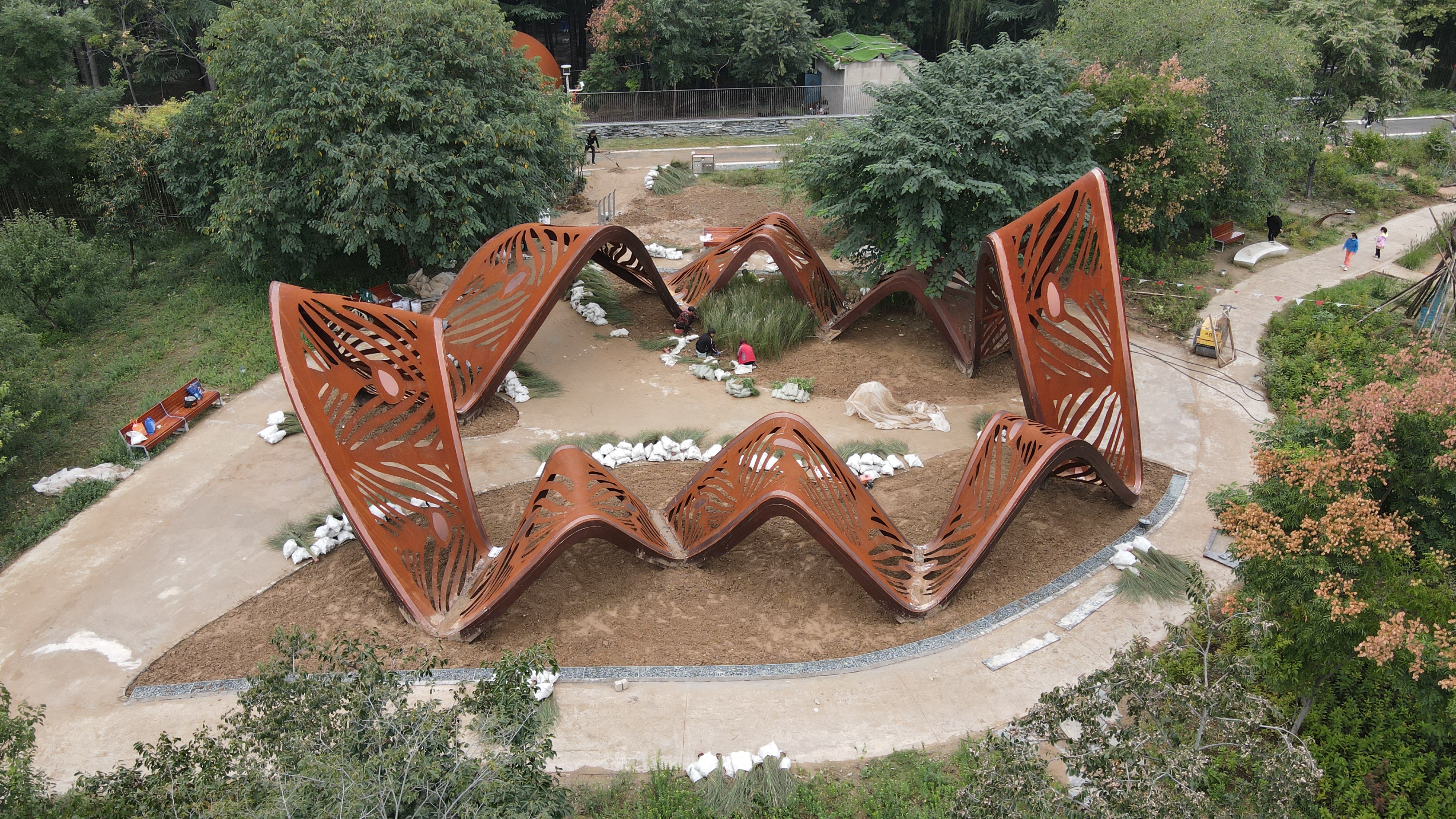
Corten steel landscape and architectural sculpture elements — one of the four application-led options ranked in this guide.
Problem Definition: Why the Application, Not the Supplier, Sets the Shortlist
Most custom sculpture sourcing problems start in the wrong place. A buyer compares three or four factories, then discovers that the material proposed by the cheapest one cannot survive the site. The mistake is sequencing: the application defines the constraint set, the constraint set defines the material and fabrication route, and only then does supplier qualification become meaningful.
Four applications carry four different constraint profiles:
- Public art and urban landmarks — large scale, structural load, permanent outdoor exposure, lifting and foundation planning, and increasingly formal documentation for publicly funded projects.
- Landscape architecture, parks and streetscape — long service life with minimal maintenance budgets, geometric or abstract forms, and elements that combine sculpture with function (screens, planters, edging, fire features).
- Gardens and residential landscape — smaller scale, high visual detail, mixed materials, and a client who expects the piece to hold its appearance without annual treatment.
- Memorial and cemetery work — permanence, colour stability, legible engraving, and zero tolerance for surface defects.
Two practical rules follow from this. First, a material that wins one application does not automatically win another: mirror-polished stainless steel is an excellent public art choice and a poor substitute for the warm patina of cast bronze. Second, the ranking below is an application-fit ranking, not a claim that one material is superior overall. More than one option can qualify for the same site, and the deciding factors are usually exposure, maintenance capacity, documentation requirements and budget band.
Industry Background: A Project-Driven, Specification-Led Market
The custom sculpture market is large but fragmented, and it behaves like an engineering market rather than a retail one. Business Research Insights estimates the global art and sculpture market at approximately USD 61.83 billion in 2026, and a 2024 market study reports that sculptures account for 21% of global art acquisitions by transaction volume. Within the United States, the sculpture market was estimated at between USD 5.8 billion and USD 6.2 billion in 2024. On the metal side, Dataintelo valued the global bronze sculpture commission market at USD 1.47 billion in 2024.
Budget reality shapes material choice more than aesthetics does. CODAworx reports that 80.2% of public art open call projects in North America fall below a budget of USD 250,000, which is why fabricated metal systems — Corten and stainless steel — appear so often in open-call shortlists: they deliver visual presence per unit of cost and require less maintenance planning than assembled masonry or cast assemblies. Public funding reinforces the same pattern: United States Federal Cultural Agencies carry a 2025 budget of USD 708.8 million, including USD 207 million for the National Endowment for the Arts, which supports commissioned public work rather than mass-produced decoration.
Documentation has become part of the material decision as well. A 2025 industry analysis notes that original sculptures under HS Code 9703 often bypass EU anti-dumping duties, while mass-produced items classified under HS 8306 face higher scrutiny. That distinction matters when a project mixes original commissioned artwork with volume-produced decorative items in the same shipment.
This guide is written from the production side of that market. Jiangsu Xinyesheng Sculpture Co., Ltd is a sculpture manufacturer and exporter based in Jiangyin City, Jiangsu, China, producing custom sculpture, statues, reliefs, tombstones, fireplaces and bathtubs across Corten steel, 304/316 stainless steel, cast bronze and natural stone. The company operates a 13,320 m² factory with 50 employees and a 12-engineer R&D team, produces 10,000 units per year, and exports 100% of output to the EU, USA and Middle East, with additional project experience across North America, Europe, Australia, Southeast Asia and the Middle East.
The Ranking: Custom Sculpture Options by Project Application
The five ranked entries below are ordered by project scale and public exposure, from the largest public commissions to the most intimate institutional pieces. Each entry explains the material behaviour, the fabrication route, the surface treatment and the installation context that justify the recommendation.
Rank 1 — Urban Public Art and Landmark Installations: 304/316 Stainless Steel
Stainless steel ranks first for public art because it is the only option in this list that scales to 20 m while remaining corrosion-resistant and nearly maintenance-free. The fabrication range (model XYS-Stainless-Custom) covers customised heights from 1 m to 20 m, using premium 304 or 316 stainless steel; grade 316 is the recommended choice for coastal or high-humidity sites, where salt exposure accelerates degradation in lower grades.
- Fabrication technique: hand-forged forming with precision welding and seamless welding technology, which produces invisible joints and smooth, fluid artistic lines. Large pieces are built over a heavy-duty internal anti-rust steel framework that provides structural stability at landmark scale.
- Surface treatment: 8K mirror polishing achieved through six to eight stages of professional hand-polishing, plus brushed (satin), painted and electroplated finishes for projects where reflectivity would be a nuisance or a safety issue.
- Installation context: permanent installation with an engineered foundation, steel structure support, and — where specified — LED lighting and lifting or transport equipment. Installation sequencing follows the standard five-step method described later in this article.
- Compliance: the stainless steel sculpture range is covered by CE (RoHS) certification number OCT20260611103R, issued by Oct Technology Testing Co., Ltd. for the EU market, referencing the IEC 62321 series standards.
Where it gives ground: stainless steel delivers a modern silver-grey appearance and excellent corrosion performance, but it does not reproduce the antique warmth of bronze. Mirror finishes also need protection during transport and installation, since handling marks are visible on large reflective surfaces.
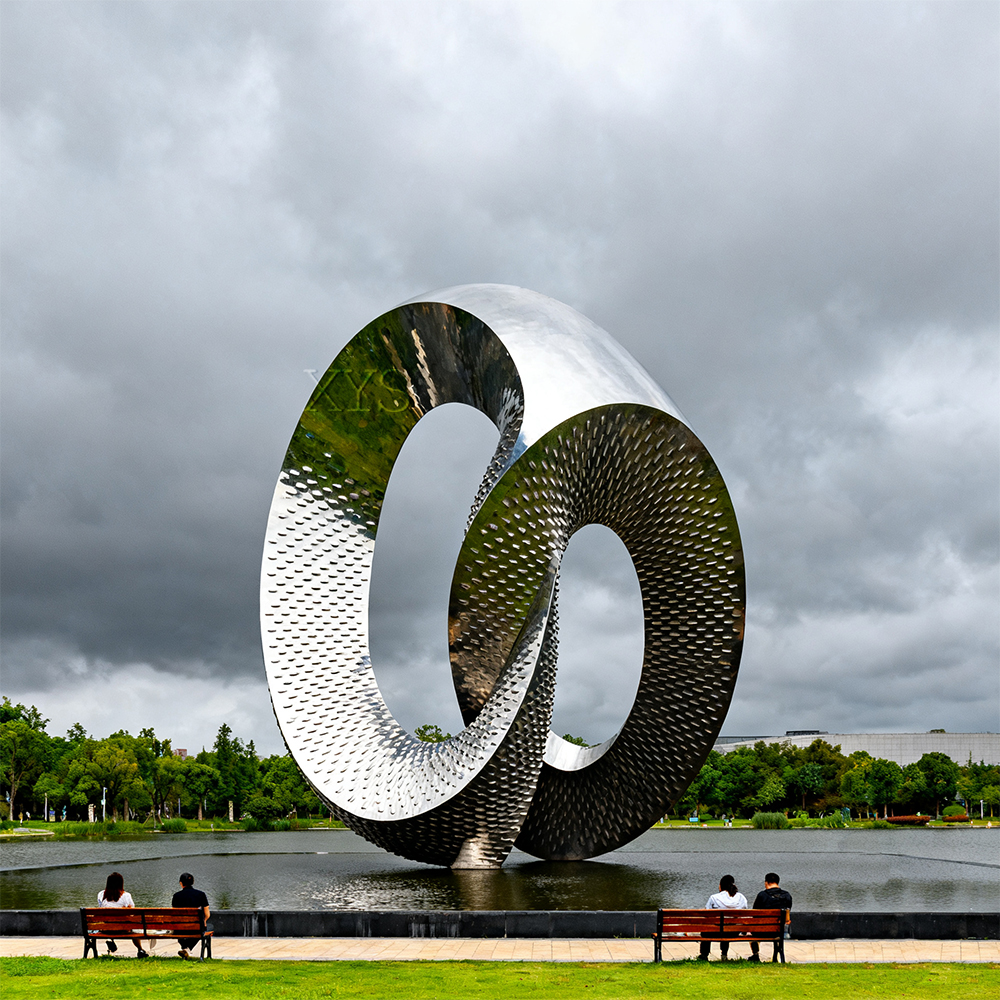
Large-scale 316 stainless steel landscape sculpture — the recommended option for coastal and high-humidity public art sites.
Rank 2 — Landscape Architecture, Parks and Streetscape: Corten Steel
For landscape architecture, Corten steel (model XYS-Corten-Custom) is the strongest fit because it combines sculpture, structure and site function in a single fabricated system. The product range includes landscape sculpture, garden edging, fire pits, metal screens and planter boxes, which means one material can carry an entire streetscape language instead of a single object.
- Material behaviour: authentic Corten steel conforming to ASTM A242 / A588 weathering steel develops a protective rust layer that prevents further corrosion. The result is a maintenance-free surface: no painting, no ongoing coating programme, and no recurring access costs on a five-year cycle.
- Surface treatment: two routes are available — a natural pre-rusted finish that presents a stable patina from day one, or a raw finish that self-weathers on site. The pre-rusted option is normally preferred where the client wants a predictable handover appearance.
- Structural behaviour: Corten is a high-strength structural steel, so it carries exceptional structural integrity for large-scale outdoor installations and architectural features rather than remaining purely decorative.
- Installation context: sized from small garden pieces to large architectural structures, with customised height and width, then installed as permanent outdoor features with atmospheric corrosion resistance built into the material itself.
Where it gives ground: the Corten surface is dynamic — it changes colour as it interacts with its environment. Project teams that require a fixed, handover-perfect colour matched to a brand palette should either specify the pre-rusted route or select a different material rather than expect the patina to freeze.
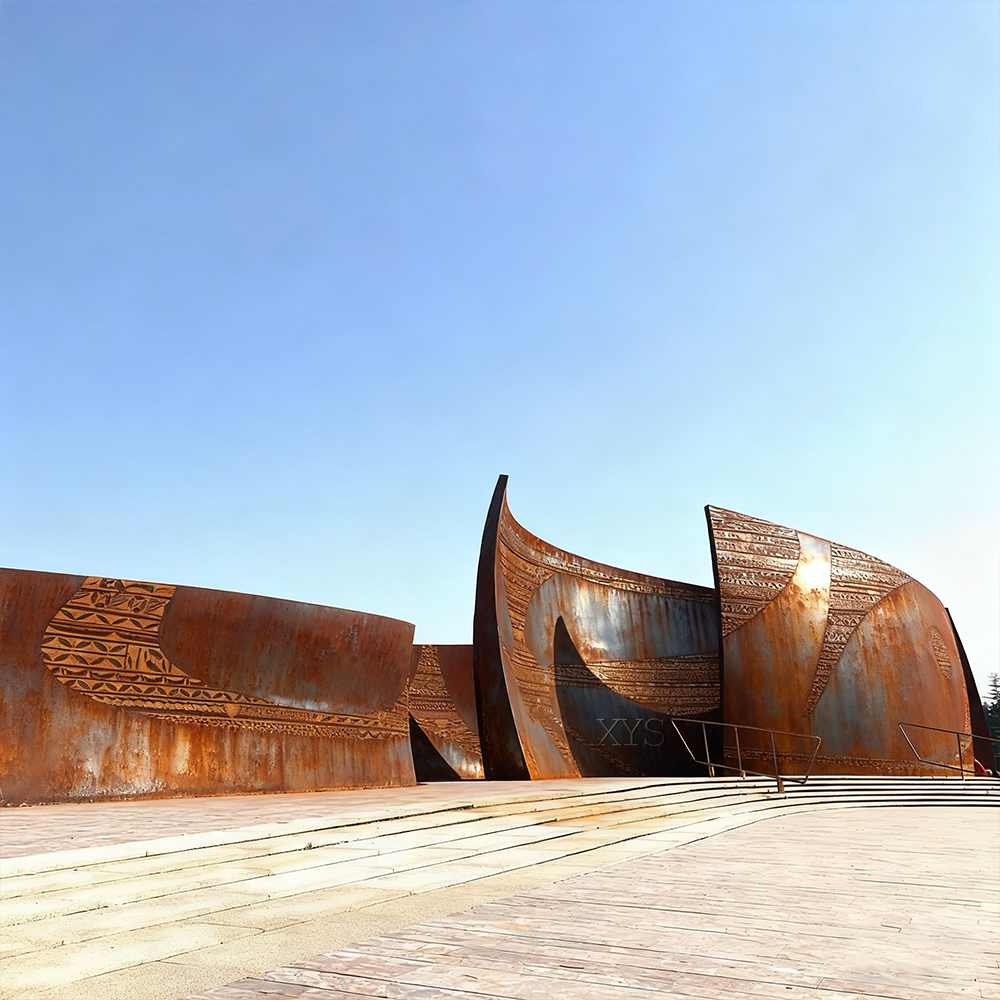
Corten steel structures for parks and streetscape — screens, planters and sculptural elements fabricated from ASTM A242 / A588 steel.
Rank 3 — Gardens and Residential Landscape: Corten Elements and Natural Stone
Garden projects split naturally into two options. Where the design language is geometric, Corten garden edging, planters and small garden pieces deliver the same maintenance-free behaviour described above at a smaller scale. Where the design language is classical or ornamental, natural stone takes the lead.
The stone range (model XYS-Stone-Custom) uses natural white marble, granite and travertine, and covers garden ornaments, fireplace mantels, stone fountains, religious carvings, marble statues and carved marble bathtubs. Custom dimensions allow one workshop to supply both a small garden ornament and a large architectural carving.
- Fabrication technique: traditional hand-carving produces deep relief and fine detail that is difficult to reproduce in thin fabricated metal; only high-density Grade A blocks are used as the starting material.
- Surface treatment: hand-carved, honed, high-gloss polished or acid-washed finishes, selected according to whether the piece is a tactile garden element or a display carving.
- Material behaviour: high-density natural stone is weatherproof and free of chemical fading, which matters in gardens where UV exposure and irrigation are constant.
- Compliance: marble sculpture, marble art sculpture, marble fireplace, marble bathtub and marble tombstone are covered by CE (RoHS) certificate number OCT20260611104R, issued by Oct Technology Testing Co., Ltd., valid from 2026-06-11 to 2031-06-10 for the EU market.
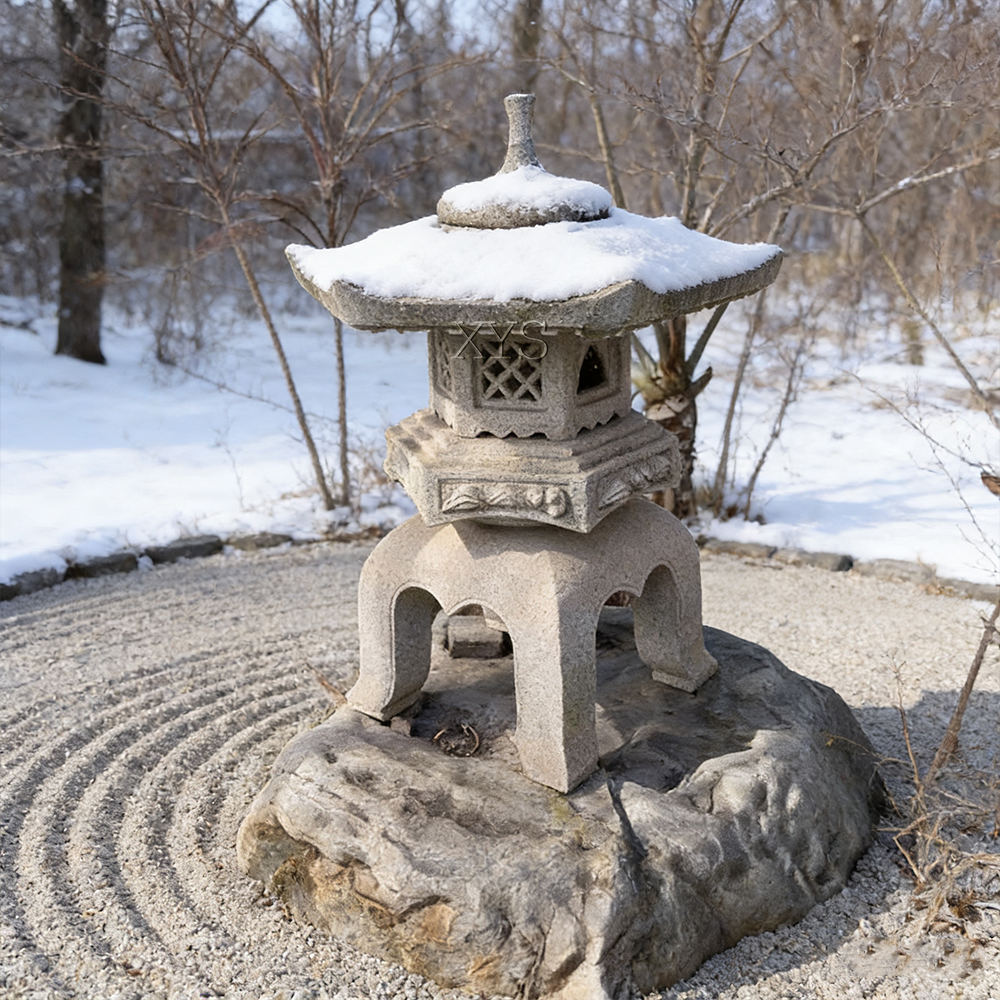
Hand-carved natural granite garden element — stone remains the reference option where ornamental detail defines the design.
Rank 4 — Memorial and Cemetery Projects: Granite Monuments
Memorial work is a constraint-dominated application, and granite wins it on permanence. The monument range (model XYS-Monument-Custom) is produced in Shanxi Black, G603 and Blue Pearl granite, with European style, American style and kerbset monument formats available in standard sizes such as 80×60 cm and 120×80 cm, or fully customised dimensions.
- Material behaviour: natural granite provides durability and weathering resistance, together with acid and alkali resistance and colour stability that maintains long-term aesthetic consistency in cemetery environments.
- Fabrication and finishing: 100% mirror polishing, high-tech laser etching for portraits and gold-leaf lettering, and sandblasting for contrast panels. Granite density is what allows the engraving and the polished face to remain non-fading for generations.
- Quality control: each monument passes strict finished-product inspection and material traceability documentation, targeting zero-defect delivery — a requirement driven by the fact that on-site correction is effectively impossible for a cemetery installation.
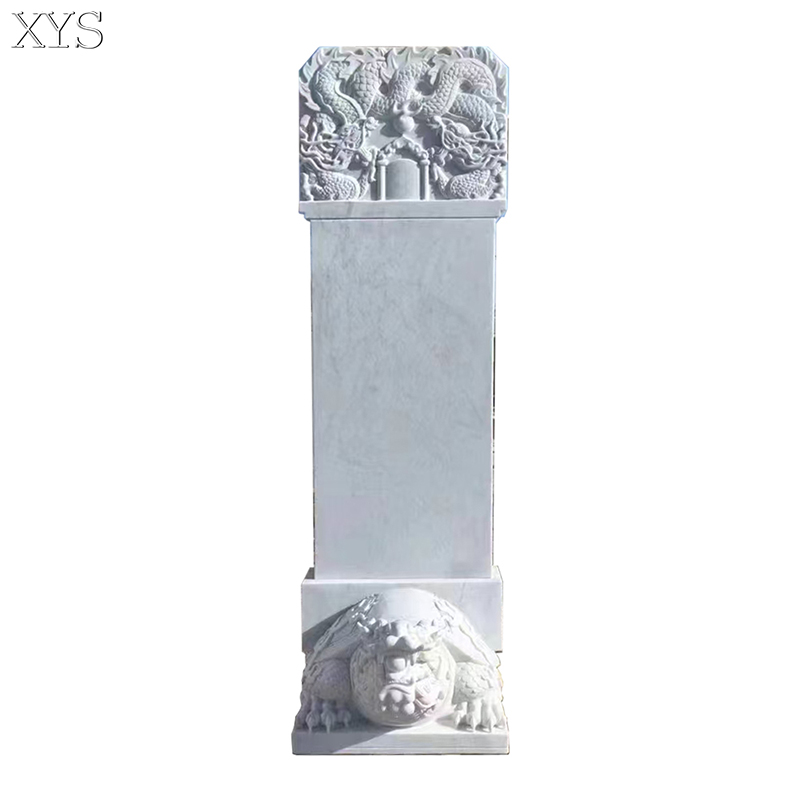
Custom granite memorial monument — Shanxi Black, G603 and Blue Pearl granite are the standard material options for memorial work.
Rank 5 — Museums, Religious Institutions and Private Collections: Cast Bronze
Bronze remains the reference option wherever figurative accuracy, institutional permanence and patina control matter more than unit cost. The bronze range (model XYS-Bronze-Custom) uses high-purity cast bronze with a copper content of more than 85%–95%, plus brass for interior work, in customised heights from 50 cm to 10 m, including life-size figures.
- Fabrication technique: lost-wax casting captures intricate, lifelike detail that is difficult to achieve through fabrication alone, supported by professional welding for multi-part assemblies.
- Surface treatment: patina, gold leafing, high polish and antiqued finishes, with custom multi-colour oxidation available to match a defined aesthetic brief.
- Material behaviour: high copper purity is what delivers museum-grade material performance and outdoor durability of over 50 years. Bronze also develops a warm classic reddish-brown tone that turns greenish-brown over long exposure, while brass darkens toward blackish-brown.
- Application rule: bronze is the recommended choice for outdoor installation because of its corrosion resistance; brass is recommended for indoor settings such as lobbies, galleries and private interiors. Bronze is heavier and carries a higher material cost, and pieces in humid or coastal environments benefit from planned surface protection.
- Compliance: bronze statue, bronze art sculpture and bronze animal sculpture are covered by CE (RoHS) certificate number OCT20260611105R, issued by Oct Technology Testing Co., Ltd. for the EU market.
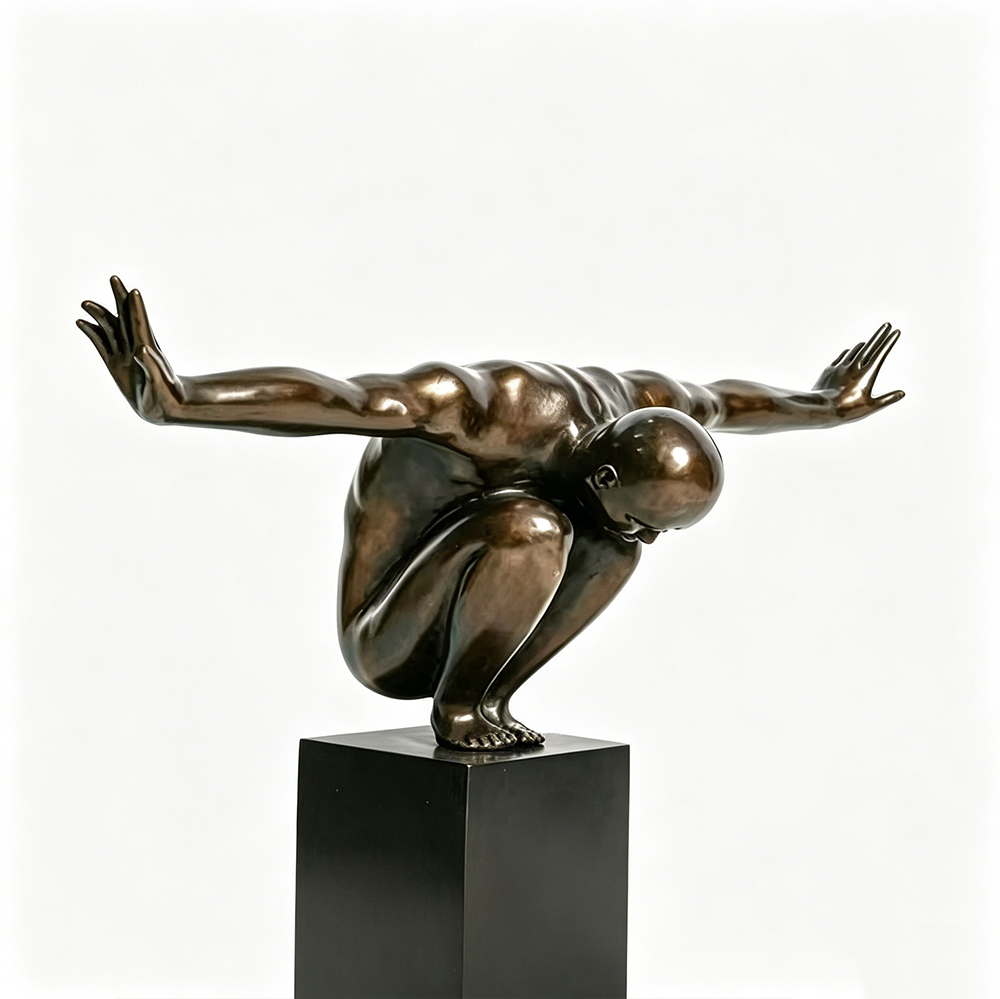
Cast bronze figurative sculpture — lost-wax casting with custom patina for museum, religious and private collection projects.
Step-by-Step Breakdown: Turning an Application into a Locked Specification
Once the application rank is clear, the specification is built in eight steps. Every step produces a document or a decision that the buyer can hold the supplier to.
- Define exposure and site conditions. Coastal or humid sites point to 316 stainless steel or bronze; inland parks and streetscapes tolerate 304 stainless steel or Corten; indoor placements allow brass and polished interior finishes. This single decision removes most of the wrong options.
- Set scale and structural concept. Confirm the height and mass envelope — up to 20 m for stainless steel, 50 cm to 10 m for bronze, customised dimensions for stone and granite — and confirm that a foundation, embedded parts and a suitable lifting plan exist before fabrication starts.
- Lock the surface and finish. 8K mirror polish, brushed (satin), painted or electroplated for stainless steel; natural pre-rusted or raw self-weathering for Corten; hand-carved, honed, high-gloss polished or acid-washed for stone; patina, gold leafing, high polish or antiqued for bronze.
- Approve the design visually. Customers supply design drawings, photographs or concepts; the workshop then produces a 3D design draft for confirmation before production. For cast bronze, a 1:1 clay model visualisation is part of the one-stop delivery system.
- Confirm compliance for the destination market. For EU shipments, confirm which certification applies to which model — OCT20260611103R for stainless steel, OCT20260611104R for marble, and OCT20260611105R for bronze — and verify the certificate still matches the current issue-to-expiry window.
- Run quality control at four gates. Material inspection, production process inspection, surface quality inspection, and final inspection before shipment. Memorial pieces additionally require finished-product inspection with material traceability.
- Plan packaging and logistics. Reinforced wooden crates and steel frames for external protection, shockproof plastic film internally, and All Risks insurance arranged to the buyer's requirements, with door-to-door delivery available on confirmed address details.
- Engineer the installation. Confirm the site and check ground flatness, load-bearing capacity and the position of embedded parts against the drawings; select hoisting equipment by size and weight and secure the lifting points; hoist and align the piece; fix with bolts or welded reinforcement and treat welds with anti-corrosion protection; then run the final inspection, clean the surface and hand over. Acceptance criteria include a vertical deviation no greater than 5 mm, fully tightened bolts or complete welds, and no bumps, scratches or stains on the delivered surface.
Safety note carried into every specification: lifting operations must be carried out by certified personnel, personnel are strictly prohibited from standing under the sculpture, the work area must be cordoned off, safety belts are required for work at height, and lifting must stop in strong wind or thunderstorms. For heavy pieces, the load-bearing capacity of the base must be verified to prevent tipping.
Where These Options Are Used in Practice
Application planning becomes easier when it is matched to delivered project types. The company's case record covers hotel groups, landscape design companies, architectural firms, real estate developers, public art organisations and private collectors, with typical project quantities of 1 to 50 customised sculptures per project and delivery activity spanning more than ten years across the United States, Canada, the United Arab Emirates, Bulgaria and Israel.
- Luxury hotels, resorts and commercial entrances: stainless steel statement pieces and bronze figures for entrance and lobby identity, plus marble fireplaces and carved stone features for interior and terrace environments.
- Public art and city squares: large stainless steel landmarks with internal steel skeletons, and Corten sculptural structures used as both artwork and functional landscape infrastructure.
- Parks and streetscape upgrades: Corten screens, planter boxes, fire pits and garden edging that survive without a maintenance programme.
- Private gardens and villa landscape: hand-carved marble and granite ornaments, fountains, columns and lanterns alongside Corten garden elements.
- Museums, religious institutions and private collections: lost-wax cast bronze sculpture with controlled patina, including religious figures and carved marble religious work.
- Cemetery construction and memorial engineering: granite monuments and religious statue tombstones with laser-etched portraits and gold-leaf lettering.

Inside the stainless steel sculpture processing workshop — hand-forging, precision welding and multi-stage polishing take place in-house.
Comparison Table: Ranked Options at a Glance
| Application | Recommended option (model) | Material behaviour & fabrication | Surface treatment | Compliance & commercial terms |
|---|---|---|---|---|
| Urban public art & landmark | 304/316 stainless steel (XYS-Stainless-Custom) | High-grade corrosion resistance; 1 m–20 m; hand-forged, precision and seamless welding, internal anti-rust steel skeleton | 8K mirror polish (6–8 hand-polishing stages), brushed, painted, electroplated | CE (RoHS) OCT20260611103R, EU; lead time 30–60 days; MOQ 1 piece / 1 project |
| Landscape, parks & streetscape | Corten steel (XYS-Corten-Custom) | ASTM A242 / A588 weathering steel; stable protective patina prevents further corrosion; maintenance-free; high-strength structural steel | Natural pre-rusted (stable patina) or raw self-weathering | Customised height/width; lead time 30–60 days; MOQ 1 piece / 1 project |
| Garden & residential landscape | Corten garden elements; natural stone (XYS-Stone-Custom) | White marble, granite, travertine; hand-carved from high-density Grade A blocks; weatherproof, no chemical fading | Hand-carved, honed, high-gloss polished, acid-washed | CE (RoHS) OCT20260611104R, valid 2026-06-11 to 2031-06-10, EU; lead time 30–60 days |
| Memorial & cemetery | Granite monument (XYS-Monument-Custom) | Shanxi Black, G603, Blue Pearl granite; acid & alkali resistance, anti-weathering, colour stability; zero-defect final inspection with material traceability | 100% mirror polished, laser engraving, sandblasting | Standard 80×60 cm / 120×80 cm or custom; lead time 30–60 days; MOQ 1 piece |
| Museum, religious & private collection | Cast bronze (XYS-Bronze-Custom) | 85%–95% copper content; lost-wax casting; 50 cm–10 m / life size; 50+ years outdoor durability; brass for indoor use | Patina, gold leafing, high polished, antiqued, custom multi-colour oxidation | CE (RoHS) OCT20260611105R, EU; lead time 30–60 days; MOQ 1 piece / 1 project |
FAQ: Custom Sculpture Options by Application
Which certifications apply to custom sculpture shipped to the EU?
Three CE (RoHS) certificates cover the main material ranges, all issued by Oct Technology Testing Co., Ltd. for the EU market: OCT20260611103R for stainless steel art and landscape sculpture; OCT20260611104R for marble sculpture, marble art sculpture, marble fireplace, marble bathtub and marble tombstone, valid from 2026-06-11 to 2031-06-10; and OCT20260611105R for bronze statue, bronze art sculpture and bronze animal sculpture. All three reference the IEC 62321-3-1:2013, IEC 62321-4:2013+AMD1:2017, IEC 62321-5:2013, IEC 62321-6:2015, IEC 62321-7-1:2015, IEC 62321-7-2:2017 and IEC 62321-8:2017 standards, and each is tied to a specific product model — so buyers should confirm that the certificate quoted matches the model being ordered.
Can large-scale stainless steel sculpture up to 20 m be fabricated and installed safely?
Yes. The stainless steel range is built in customised heights from 1 m to 20 m using premium 304 or 316 stainless steel, hand-forged and joined with precision and seamless welding so that joints remain invisible across fluid curves. Structural safety comes from a heavy-duty internal anti-rust steel framework rather than from the skin alone. On site, installation follows a defined sequence: verify ground flatness, load-bearing capacity and embedded parts against the drawings; select hoisting equipment and lifting points by size and weight; hoist and align; fix with bolts or welded reinforcement with anti-corrosion treatment; then inspect, clean and hand over with a vertical deviation no greater than 5 mm.
What drives the budget of a custom sculpture project?
Four variables dominate: material, size, finishing complexity and logistics. Material is the largest lever — cast bronze with more than 85%–95% copper sits at the top of the cost scale, while brass with a lower copper content costs less and is recommended for indoor use; Corten and stainless steel sit in a different band entirely. Size drives both material volume and structural engineering, particularly for stainless steel above a few metres, where an internal steel skeleton, a foundation and lifting equipment enter the budget. Finishing — 8K mirror polishing through six to eight stages, custom multi-colour patina, gold leafing, laser engraving or hand-carving of deep relief — adds labour hours. Finally, packaging in reinforced wooden crates and steel frames, All Risks insurance and door-to-door freight must be priced in rather than treated as extras. For context on public-sector budgets, CODAworx reports that 80.2% of public art open call projects in North America fall below USD 250,000, which is the band in which fabricated metal systems are most frequently specified.
Can I order a single piece and validate the design before full production?
Yes. There is no strict minimum order quantity — single custom pieces are accepted, and ordering multiple pieces together is recommended mainly to share mould and shipping costs. The validation route is: customer provides drawings, photos or a concept; a 3D design draft is produced and confirmed before production begins; prototyping is available as an optional step; and for cast bronze, a 1:1 clay model visualisation is part of the delivery system. For larger projects, the monthly capacity of 50–100 sets means multi-piece programmes can be phased rather than committed in a single release.
What is the typical lead time, and how do I start a project?
Production lead time is typically 30–60 days, assessed against size, material and surface finish once the design is approved; monthly capacity runs at 50–100 sets, and the minimum order is one piece or one project. The fastest way to move from research to evaluation is to send the site constraints together with the concept — application type, exposure conditions, target height, preferred material and destination market — and request a quotation and a sample or prototype plan for the relevant model. Jiangsu Xinyesheng Sculpture Co., Ltd supports the full route from 3D design confirmation through fabrication, export packaging, installation guidance and after-sales technical support, and a full capability brochure with production details is available for download below.
Conclusion: Rank the Application, Then Decide the Material
Custom sculpture specification becomes manageable once the ranking is applied in the right order. Urban public art points to 304/316 stainless steel because it scales to 20 m, welds seamlessly and resists corrosion, with grade 316 for coastal sites. Landscape architecture points to Corten steel conforming to ASTM A242 / A588, where a stable protective patina delivers maintenance-free structure for screens, planters, fire pits and edging. Gardens split between Corten elements and hand-carved natural stone in marble, granite and travertine. Memorial work points to granite — Shanxi Black, G603 and Blue Pearl — where density, colour stability and engraving quality determine the outcome for generations. Museums, religious institutions and private collections point to lost-wax cast bronze with 85%–95% copper and 50+ years of outdoor durability, with brass reserved for indoor use.
Jiangsu Xinyesheng Sculpture Co., Ltd manufactures across all five ranked categories in one facility, with OEM/ODM customisation of material, size, design, colour, surface finish, style, logo and installation method, four-gate quality control, and installation guidance plus technical support after delivery. Buyers can review the production capability profile, request a quotation, or arrange a sample and prototype review through xys-artsculpture.com and the company brochure: Company Profile & Available Production Capabilities (PDF).
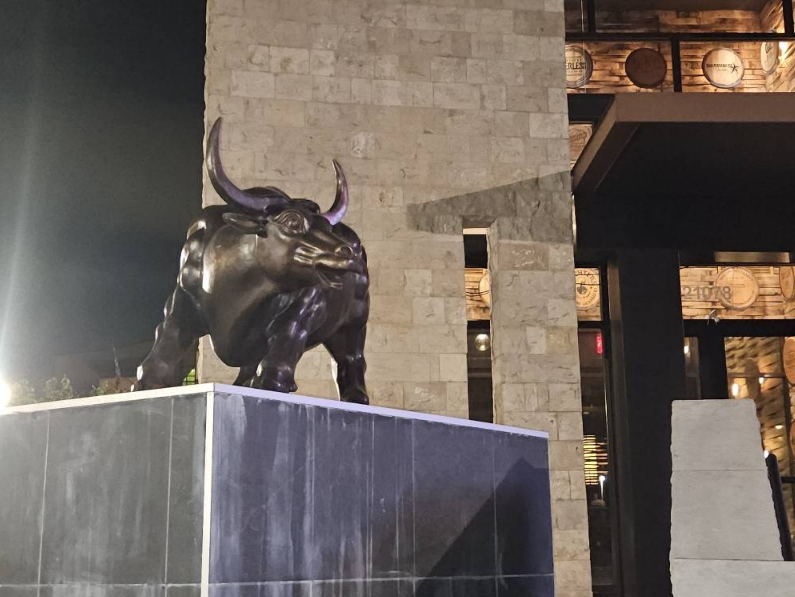
Delivered project reference: bronze sculpture installation for a hotel entrance in the United States. Contact: mikey@xingyesheng.com | +86 138-1259-9789 | WhatsApp: +86 138-1259-9789.