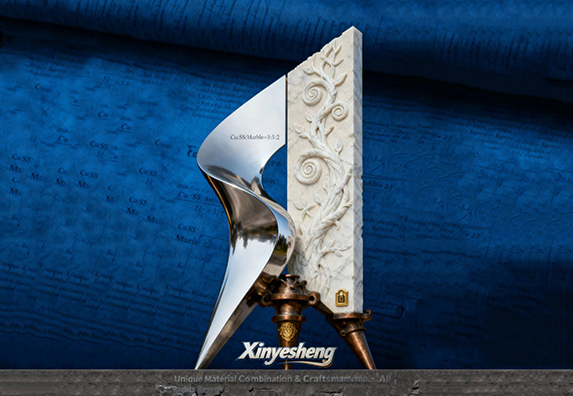
What Constitutes a Custom Sculpture: Materials, Finishes, and Built-to-Order Workflows
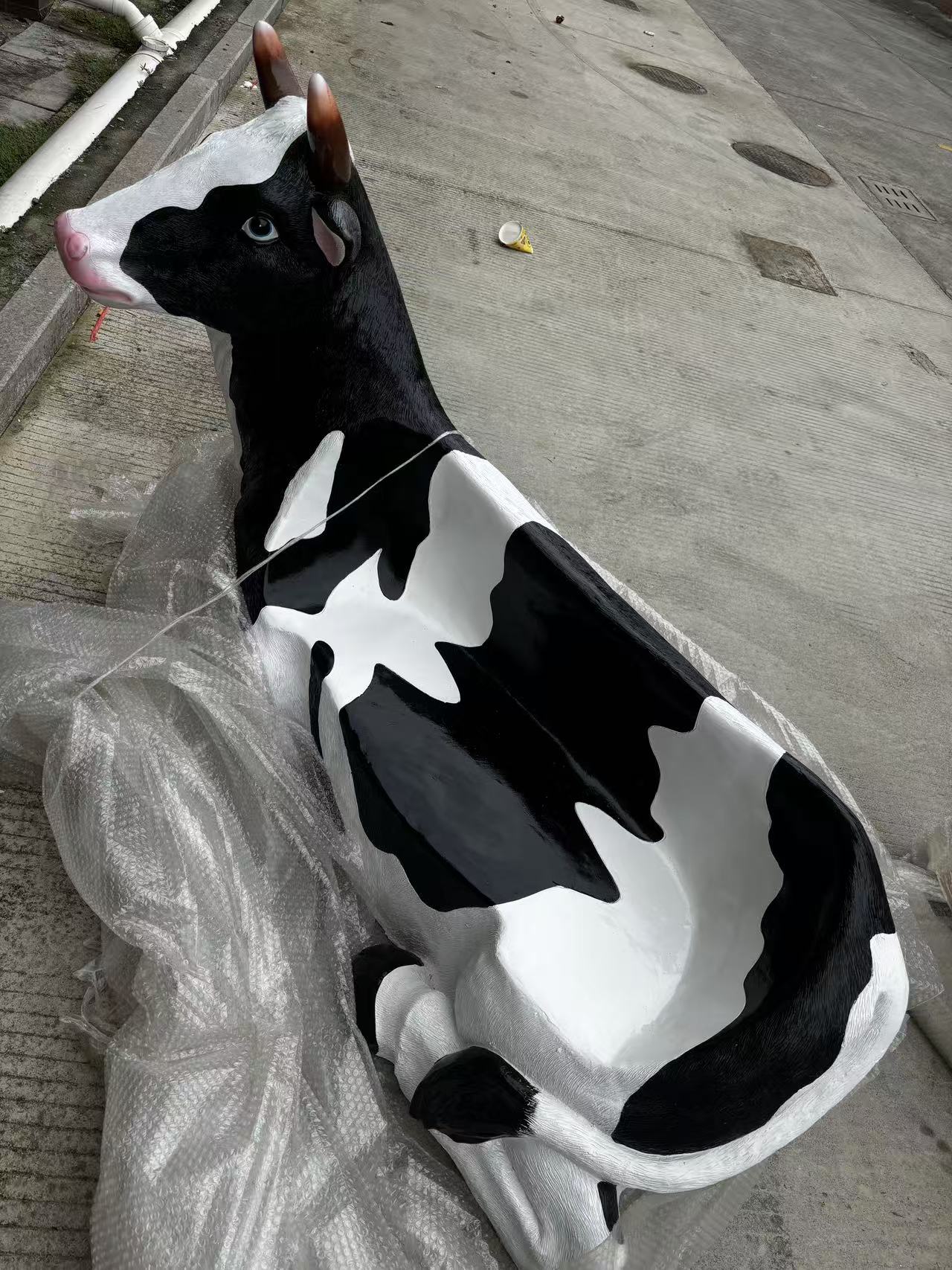
A custom sculpture is a sculpture that is specified rather than selected. The buyer defines four things — material composition, dimensions, surface finish, and fabrication method — and the manufacturer builds the piece to that brief instead of modifying a catalogue product. Those four decisions determine what the piece costs, how long it takes to produce, and how it behaves on site years later.
This explainer is an educational primer for buyers who are evaluating custom sculpture suppliers but have not yet placed a first order. It defines the vocabulary used in custom sculpture fabrication, sets out material and finish options in technical terms, and walks through a built-to-order workflow from the first drawing to final installation. Specification examples reference the product framework of Jiangsu Xinyesheng Sculpture Co., Ltd, a sculpture manufacturer based in Jiangyin City, Jiangsu, China, whose range covers sculpture, statue, relief, tombstone, fireplace and bathtub, with a 100% export ratio to EU/USA and Middle East markets.
Why “Custom” Is the Most Misused Word in Sculpture Procurement
In early supplier conversations, “can you make it custom?” is normally answered with a simple yes — and that yes is not a specification. Four assumptions cause most of the misalignment between what a buyer pictures and what a factory quotes.
- Size is treated as the only variable. Dimensions are the easiest thing to change in a custom sculpture. The variables that decide feasibility are internal structure, material grade, and finish — not height alone.
- Material names are treated as complete descriptions. “Bronze” says nothing without a copper content figure; “stainless steel” says nothing without a grade, and 304 versus 316 matters a great deal at coastal sites; “marble” says nothing without the stone type.
- Finish is treated as decoration. A mirror-polished stainless surface, an acid-washed stone surface, and a pre-rusted weathering-steel surface are three different maintenance stories. Finish is a lifecycle decision, not a colour choice.
- Documentation is treated as an afterthought. Certificates, material declarations, and export classification affect whether a finished sculpture can actually clear customs at the destination.
A brief is complete when it states the material family and grade, the overall dimensions, the surface finish, the installation environment, and the documentation required for the destination market. Everything else — price, schedule, packing — follows from that list.
The Market Context Behind Built-to-Order Sculpture
Custom sculpture sits inside a large but project-driven market, and the numbers explain why specification discipline matters more than headline market size for an individual buyer.
- The global art and sculpture market is estimated at approximately USD 61.83 billion in 2026 (Business Research Insights, 2026).
- Sculptures accounted for 21% of global art acquisitions by transaction volume in 2024 (market research report, 2026).
- The United States sculpture market reached an estimated USD 5.8–6.2 billion in 2024 (Premier Sculpture Industry Analysis, 2025).
- The global bronze sculpture commission market reached USD 1.47 billion in 2024 (Dataintelo, 2025).
- Over 80% — 80.2% — of public art open call projects in North America fall below a budget of USD 250,000 (CODAworx, 2026).
- The U.S. Federal Cultural Agencies budget for 2025 is USD 708.8 million, including USD 207 million for the NEA (Regional Arts Organizations, 2026).
The practical reading of these figures is that most custom commissions are mid-budget, bespoke projects rather than monumental trophies. That is exactly the segment where a buyer’s ability to specify material, size, and finish precisely determines whether the delivered piece matches the drawing — and the budget.
The Five Specification Layers That Define a Custom Sculpture
A built-to-order sculpture is fully defined by five layers. Each one can be answered with either a vague word or a verifiable figure; the second option is what a factory can actually quote and build against.
1. Material Composition
Bronze is specified by copper content, not by colour. In cast bronze sculpture, the reference standard is a high-purity cast bronze with copper content above 85%–95%, alongside brass where a different working colour and casting behaviour is required. The product family XYS-Bronze-Custom covers bronze statues, animal sculptures, religious statues and figurines, produced by lost-wax casting with professional welding.
Stainless steel is specified by grade. Premium 304 or 316 stainless steel is the base material for metal sculpture, abstract art, garden decoration and urban landmarks; 316 is the grade recommended for coastal areas because it offers higher corrosion resistance. The XYS-Stainless-Custom family covers customised heights from 1 m to 20 m in large-scale formats.
Stone is specified by stone type. Natural white marble, granite and travertine are the three base materials for the XYS-Stone-Custom family, whose durability comes from high-density natural stone that is weatherproof. The manufacturing profile behind this range specifies Grade A natural marble.
Weathering steel is specified by standard. Landscape work in Corten steel uses authentic weathering steel conforming to ASTM A242 / A588. The XYS-Corten-Custom family covers landscape sculpture, garden edging, fire pits, metal screens and planter boxes.
Memorial granite is specified by quarry colour. Natural granite such as Shanxi Black, G603 and Blue Pearl forms the XYS-Monument-Custom family, used for granite tombstones in European style, American style and kerbset configurations.
2. Dimensions and Structural Engineering
Size ranges are material-dependent, and each range carries a different engineering consequence. Cast bronze is built from 50 cm up to 10 m, including life-size. Stainless steel covers 1 m to 20 m as a large-scale format. Stone is produced to customised width, height and depth. Corten steel runs from small garden pieces to large architectural structures. Granite memorial work uses standard sizes of 80×60 cm and 120×80 cm, or customised dimensions.
Above life size, a sculpture becomes a structure as well as an object. Stainless steel sculpture is hand-forged and precision-welded around an internal steel skeleton, and site works typically involve an installation foundation, steel structure support, an LED lighting system, and lifting and transportation equipment. These are specification items, not optional extras — and they are the reason a “simple” size change can alter both cost and schedule.
3. Surface Finish
Finish options differ by material family, and each family offers a specific, documented set:
- Cast bronze and brass: patina, gold leafing, high polished, and antiqued finishes.
- Stainless steel: mirror polished, brushed (satin), painted, and electroplated finishes.
- Natural stone: hand-carved, honed, high-gloss polished, and acid-washed surfaces.
- Corten weathering steel: a natural pre-rusted finish that forms a stable patina, or a raw finish that continues to self-weather after installation.
- Granite memorial work: 100% mirror polishing, laser engraving, and sandblasting.
Two of these deserve special attention during evaluation. A mirror-polished stainless surface and a stable pre-rusted Corten surface sit at opposite ends of the maintenance spectrum: the Corten family is described as maintenance-free with natural aging and atmospheric corrosion resistance, while a polished surface is chosen for a reflective, contemporary look. Whichever is selected should be justified by the site, not by a render.
4. Fabrication Technique
Technique is what separates a factory-made custom sculpture from a scaled-up ornament. Cast bronze work uses lost-wax casting with professional welding. Stainless steel work is hand-forged, precision-welded, and built over an internal steel skeleton. Stone work is hand-carved, and the underlying craft tradition is not incidental: the manufacturing base operates on Quyang’s 2,000-year intangible cultural heritage, integrating traditional hand-carving techniques with modern 3D modeling and CNC precision processing so that intricate textures and smooth curves meet the same structural tolerance.
For buyers, the practical output of this layer is a 1:1 clay model visualisation, produced before production begins. That model is the point at which proportion, gesture and scale can still be changed at low cost.
5. Compliance Documentation
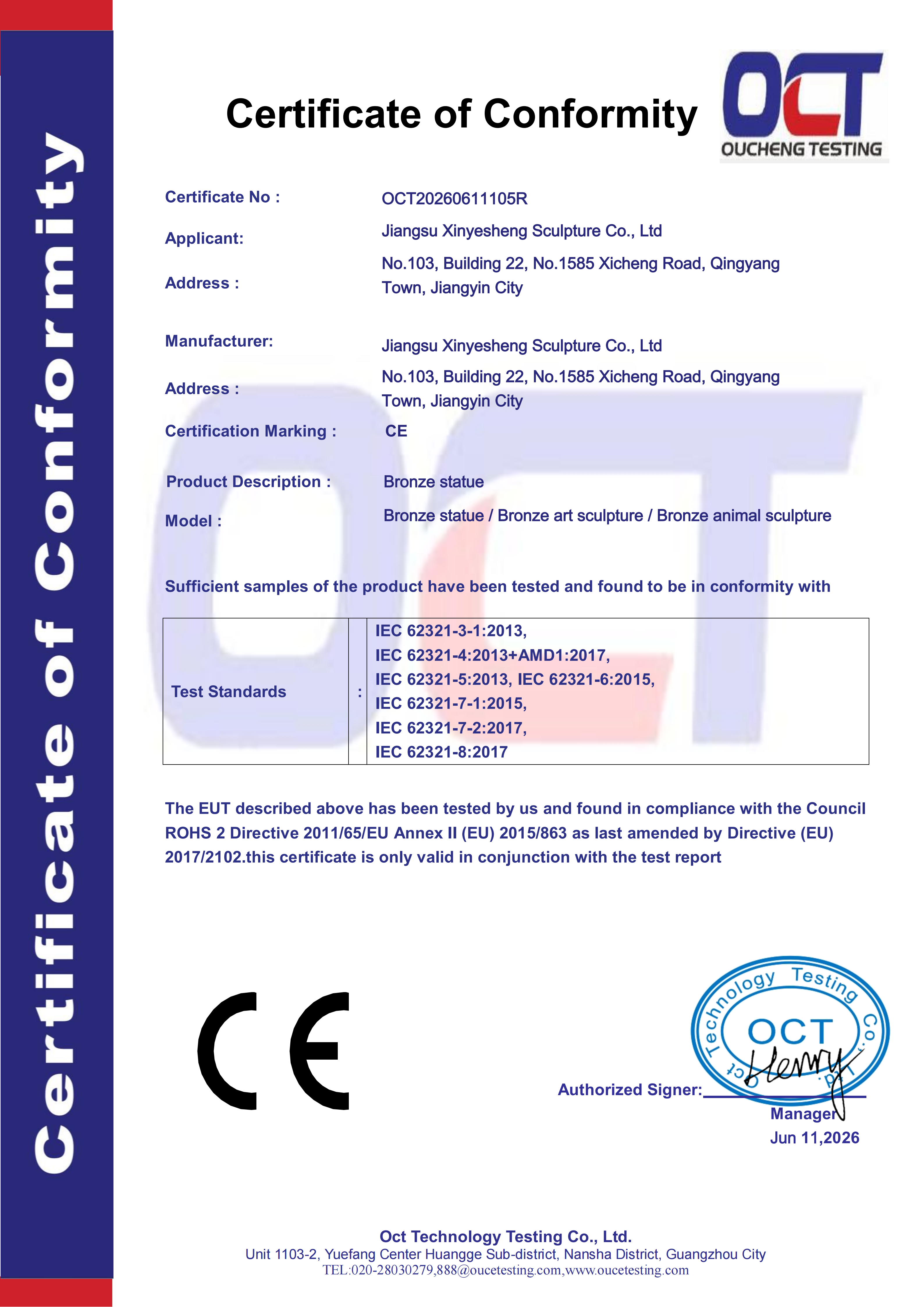
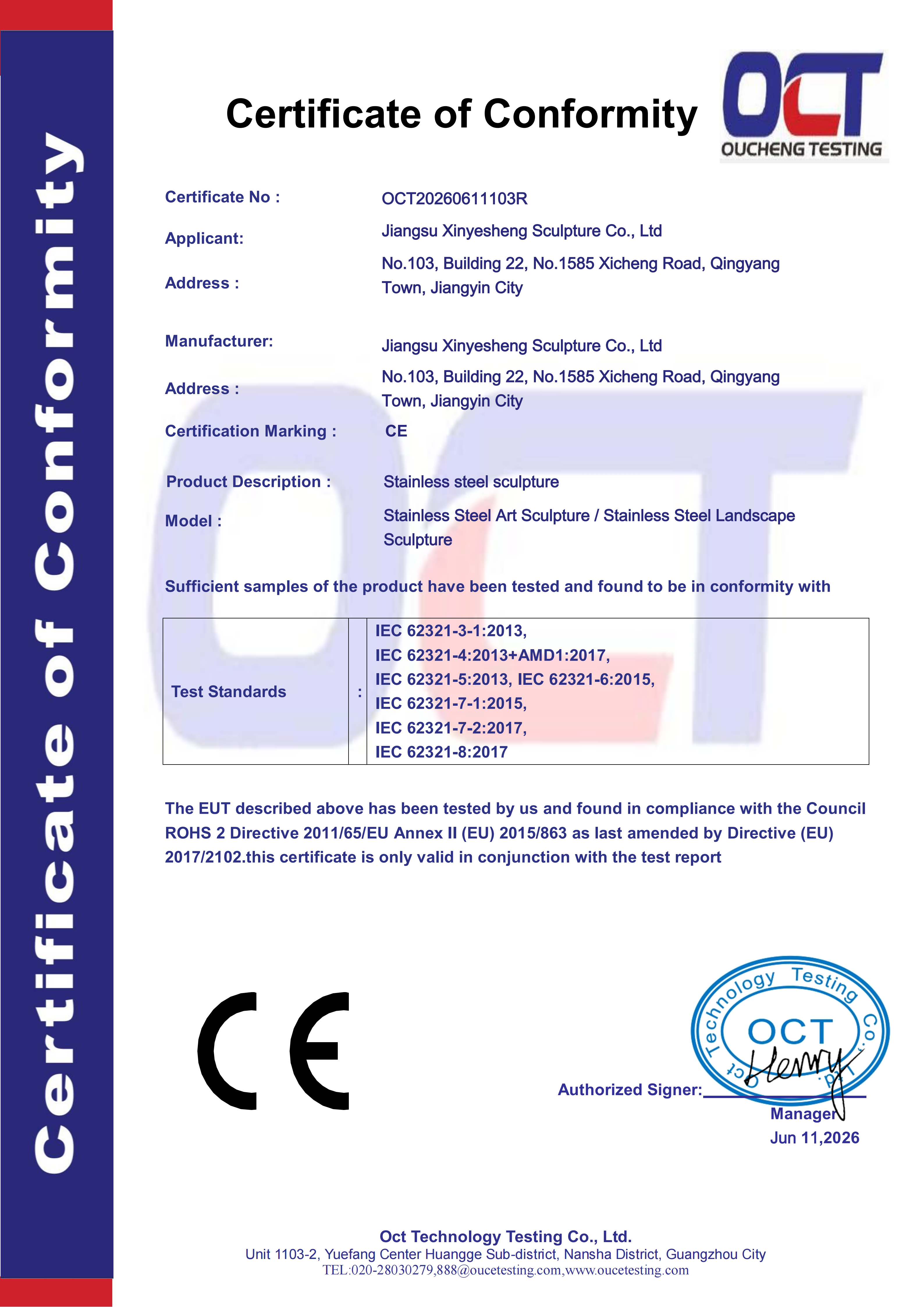
Documentation is part of the definition of a custom sculpture, because an undocumented piece is a shipping risk. Three CE (RoHS) certificates cover the main material families for the EU market, all issued by Oct Technology Testing Co., Ltd. and all valid from 11 June 2026 to 10 June 2031:
- CE (RoHS) — Bronze statue: certificate OCT20260611105R, covering bronze statue, bronze art sculpture and bronze animal sculpture.
- CE (RoHS) — Marble sculpture: certificate OCT20260611104R, covering marble statue, marble art sculpture, marble fireplace, marble bathtub and marble tombstone.
- CE (RoHS) — Stainless steel sculpture: certificate OCT20260611103R, covering stainless steel art sculpture and stainless steel landscape sculpture.
All three certificates reference the same test standards: IEC 62321-3-1:2013, IEC 62321-4:2013+AMD1:2017, IEC 62321-5:2013, IEC 62321-6:2015, IEC 62321-7-1:2015, IEC 62321-7-2:2017 and IEC 62321-8:2017. Export classification is a separate question: original sculptures classified under HS Code 9703 often bypass EU anti-dumping duties, while mass-produced items under HS 8306 face higher scrutiny, according to a 2025 CloudscapeArt market analysis.
Material Comparison for Custom Sculpture Projects
The table below compares the five material families against the specification attributes that buyers actually need to quote: base specification, customised size range, available finishes, fabrication technique, and typical application. Every value is drawn from the manufacturer’s published product parameters.
| Material family | Core specification | Customised size range | Available finishes | Fabrication technique | Typical applications |
|---|---|---|---|---|---|
| Cast bronze / brass (XYS-Bronze-Custom) | High-purity cast bronze, copper content > 85%–95%; brass | 50 cm to 10 m, including life-size | Patina, gold leafing, high polished, antiqued | Lost-wax casting, professional welding | Public art, museum, real estate, religious institutions, private collection |
| Stainless steel (XYS-Stainless-Custom) | Premium 304 / 316 stainless steel | 1 m to 20 m, large scale | Mirror polished, brushed (satin), painted, electroplated | Hand-forged, precision welding, internal steel skeleton | Urban public art, modern architecture, seaside landscape, luxury hotel, shopping mall |
| Natural stone (XYS-Stone-Custom) | Natural white marble, granite, travertine; high-density, weatherproof | Customised width / height / depth | Hand-carved, honed, high-gloss polished, acid-washed | Hand carving of high-density natural stone | Landscape design, architectural construction, home & garden, temple decoration |
| Weathering steel (XYS-Corten-Custom) | Authentic Corten steel to ASTM A242 / A588 | Small garden pieces to large architectural structures | Natural pre-rusted finish (stable patina), raw finish (self-weathering) | Weathering steel fabrication; maintenance-free, atmospheric corrosion resistance | Landscape architecture, public parks, modern garden design, industrial-style decor |
| Natural granite (XYS-Monument-Custom) | Natural granite: Shanxi Black, G603, Blue Pearl | Standard 80×60 cm, 120×80 cm, or customised | 100% mirror polished, laser engraving, sandblasting | Granite cutting and polishing; acid & alkali resistance, anti-weathering | Cemetery construction, memorial stone engineering, landscape architecture, funeral industry |
Step-by-Step: How a Built-to-Order Sculpture Is Produced
Once the five specification layers are agreed, the production path is a fixed sequence. Understanding it in advance is what allows a buyer to place approvals at the right moments instead of discovering a problem after casting.
- Concept intake. The buyer provides design drawings, photographs, or a written concept. Site conditions, viewing distance and installation environment are noted at this stage.
- 3D design confirmation. A 3D design draft is produced and confirmed before production starts. Design work uses 3D modeling combined with CNC precision processing, so the approved model and the production file are the same geometry.
- 1:1 clay model visualisation. For figurative and complex pieces, a 1:1 clay model is produced so that proportion and detail can be reviewed physically rather than on screen.
- Prototyping (optional). A prototype stage can be added when a finish, texture or assembly detail needs physical validation before full production.
- Production. Fabrication runs at a monthly capacity of 50–100 sets, with a lead time of 30–60 days. Customisation covers material, size, design, colour, surface finish, sculpture style, logo, and installation method under an OEM / ODM / custom sculpture design and manufacturing model.
- Quality control. Four inspection gates apply: material inspection, production process inspection, surface quality inspection, and final inspection before shipment.
- Seaworthy packaging. Finished work is packed for sea freight in reinforced wooden crates and steel frames.
- Shipping and installation. Each sculpture is supplied with installation instructions, and installation can be guided on site via video call; global on-site installation guidance is part of the delivery system.
- After-sales. Post-delivery support covers installation guidance, technical support, a replacement service, and long-term customer support.
Minimum order quantity: one piece or one project. Single custom pieces are accepted; ordering multiple pieces together is more cost-efficient because tooling and shipping costs are shared across the batch.
Use Cases: Where Buyers Specify Custom Sculpture
Custom sculpture is specified differently depending on where it will stand, because the site dictates the material and the finish far more than the artistic reference does.
Public Art, Urban Landmarks and Landscape Architecture
Large outdoor sculpture and public art sculpture typically use stainless steel from 1 m to 20 m, hand-forged over an internal steel skeleton. Where the brief calls for a warmer, weathering aesthetic — landscape sculpture, garden edging, screens or planter boxes — authentic Corten steel to ASTM A242 / A588 provides a stable patina and is described as maintenance-free. Both families sit in coastal, plaza and park environments, which is why grade 316 stainless steel is the recommended choice for seaside landscapes.
Hotel, Hospitality and Commercial Interiors
Custom hotel lobby sculpture and commercial sculpture fabrication lean toward mirror-polished or brushed stainless steel for a contemporary read, or marble and bronze where the interior calls for a classical material. In these settings, size rarely exceeds the life-size range, but finish consistency across a batch becomes the dominant quality issue.
Garden, Villa, Memorial and Figurative Work
Private and semi-private projects cover custom garden sculpture and garden sculpture in stone, life-size statue and custom figurative sculpture work in bronze, custom animal sculpture, and memorial sculpture in granite with laser engraving or sandblasting. Delivered projects in this segment include hotel decoration, landscape enhancement, public art installation, commercial space decoration, and garden and villa decoration.
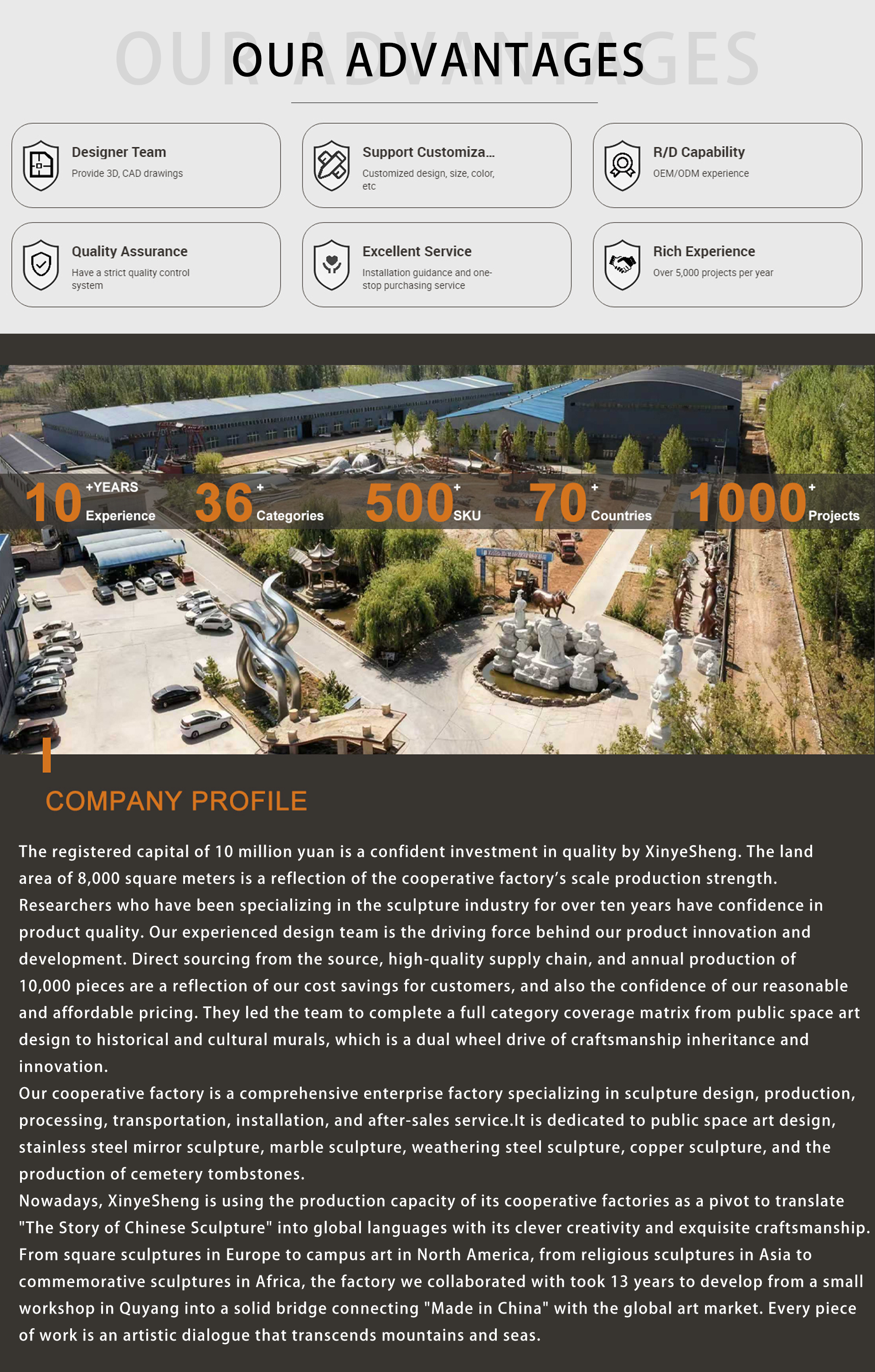
The delivery record behind these categories spans over 10 years in the industry, with project scale ranging from 1 to 50 customised sculptures per project and installations in the United States, Canada, the United Arab Emirates, Bulgaria, and Israel. Buyers include hotel groups, landscape design companies, architectural firms, real estate developers, public art organizations, and private collectors.
Frequently Asked Questions
What certification should a custom sculpture carry for delivery into the EU?
For EU delivery, the relevant documentation for the main material families is CE (RoHS) certification. Three certificates are held, all issued by Oct Technology Testing Co., Ltd.: OCT20260611105R for bronze statue, bronze art sculpture and bronze animal sculpture; OCT20260611104R for marble statue, marble art sculpture, marble fireplace, marble bathtub and marble tombstone; and OCT20260611103R for stainless steel art sculpture and stainless steel landscape sculpture. All three are valid from 11 June 2026 to 10 June 2031 and test against the IEC 62321 series, including IEC 62321-3-1:2013, IEC 62321-4:2013+AMD1:2017, IEC 62321-5:2013, IEC 62321-6:2015, IEC 62321-7-1:2015, IEC 62321-7-2:2017 and IEC 62321-8:2017.
What can actually be customised — material, size, finish, or all of it?
All of it. Customisation covers material, size, design, colour, surface finish, sculpture style, logo, and installation method under an OEM / ODM arrangement. In concrete terms: cast bronze with copper content above 85%–95% from 50 cm to 10 m including life-size; 304 or 316 stainless steel from 1 m to 20 m; natural white marble, granite or travertine at customised width, height and depth; Corten weathering steel to ASTM A242 / A588 from small garden pieces to large architectural structures; and natural granite memorial work at standard 80×60 cm and 120×80 cm sizes or fully customised dimensions.
What determines the price, and is there a minimum order quantity?
There is no strict minimum order quantity — one piece or one project is accepted, and single custom pieces are produced. Ordering multiple pieces at once is more cost-effective because mould and shipping costs are shared. The main cost drivers are the material family and grade, the overall height and structural requirement, the finish (a hand-applied patina and a mirror polish are different processes), and export packing and freight. For budget context, 80.2% of public art open call projects in North America are budgeted below USD 250,000 (CODAworx, 2026), which is the band most bespoke commissions sit in.
Can I review a model or sample before production starts?
Yes. The standard sequence is: the buyer provides drawings, photographs or a concept, and a 3D design draft is produced for confirmation before production begins. For figurative work, a 1:1 clay model visualisation is available so proportion and detail can be reviewed physically, and a prototyping stage can be added when a texture, finish or assembly detail needs validation. Production only starts after design approval.
How long does production take, and who handles installation?
Lead time is typically 30–60 days, assessed against the specific size and manufacturing process, with a monthly production capacity of 50–100 sets. Every sculpture is supplied with installation instructions, and installation can be guided on site via video call; global on-site installation guidance is part of the delivery system. After-sales support continues after handover and includes installation guidance, technical support, a replacement service, and long-term customer support.
How should I compare custom sculpture manufacturers before requesting a quote?
Compare candidates on eight verifiable points rather than on portfolio images alone: (1) documented material grades, such as copper content for bronze and 304 versus 316 for stainless steel; (2) the range of available surface finishes per material family; (3) the maximum size range and whether internal structural engineering — steel skeletons and foundations — is handled in-house; (4) the number and content of quality control gates; (5) compliance certificates with numbers, issuing authority and validity dates; (6) export markets and project record; (7) seaworthy packaging method; and (8) installation and after-sales support. A supplier that can answer all eight with specific values is a lower-risk choice than one that answers with adjectives.
Conclusion: Specification Is What Makes a Sculpture Custom
A custom sculpture is defined by five things: material composition with a real grade, dimensions that account for structure, a surface finish chosen for the environment, a fabrication technique suited to the form, and documentation that travels with the piece. The built-to-order workflow around those five layers — 3D design confirmation, a 1:1 clay model where needed, production at a 30–60 day lead time, four quality control gates, seaworthy packing, and installation guidance — is what converts a drawing into an installed work.
For a buyer in the evaluation stage, the next step is not to request a price but to request a specification: state the material family and grade, the dimensions, the finish, the installation environment, and the documentation required. That single document is what makes quotations comparable.
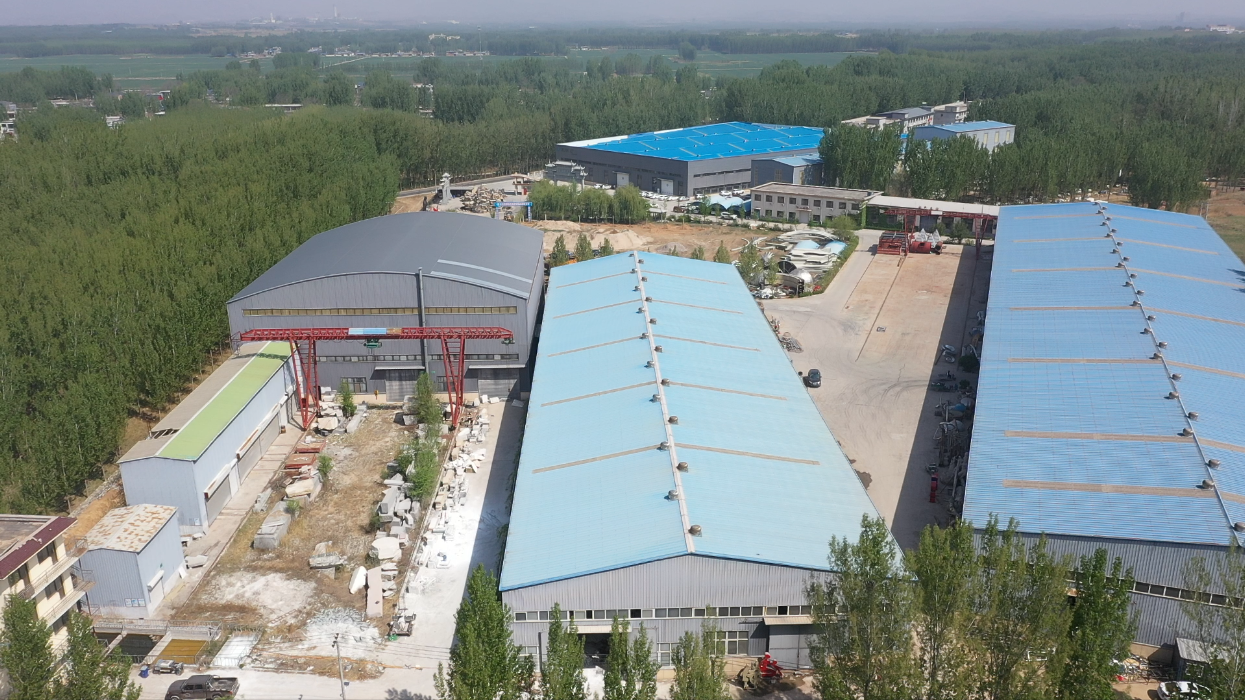
Next step. Jiangsu Xinyesheng Sculpture Co., Ltd manufactures custom sculpture, statues, reliefs, tombstones, fireplaces and bathtubs under an OEM / ODM model, with a minimum order of one piece or one project and a 30–60 day lead time. The facility covers 13,320 m² with 50 employees and 12 R&D engineers.
Download the Company Profile & Available Production Capabilities, or send your drawing, photograph or concept to receive a 3D design draft and a production schedule. Email: mikey@xingyesheng.com · WhatsApp: +86 138-1259-9789 · Website: https://www.xys-artsculpture.com
Have Questions or Need More Details?
Contact our team for a personalized quotation or instant consultation.
Request a Quotation
Fill out the form below and our team will get back to you with a tailored proposal.
WhatsApp Direct Chat
Prefer to chat in real-time? Message us on WhatsApp for instant assistance & quick answers.
- Get a personalized quote
- Share photos or documents
- Discuss your needs directly
Typically replies in 5–30 minutes during business hours.