
ASME-Certified Industrial Chemical Reactors: A Specification Guide
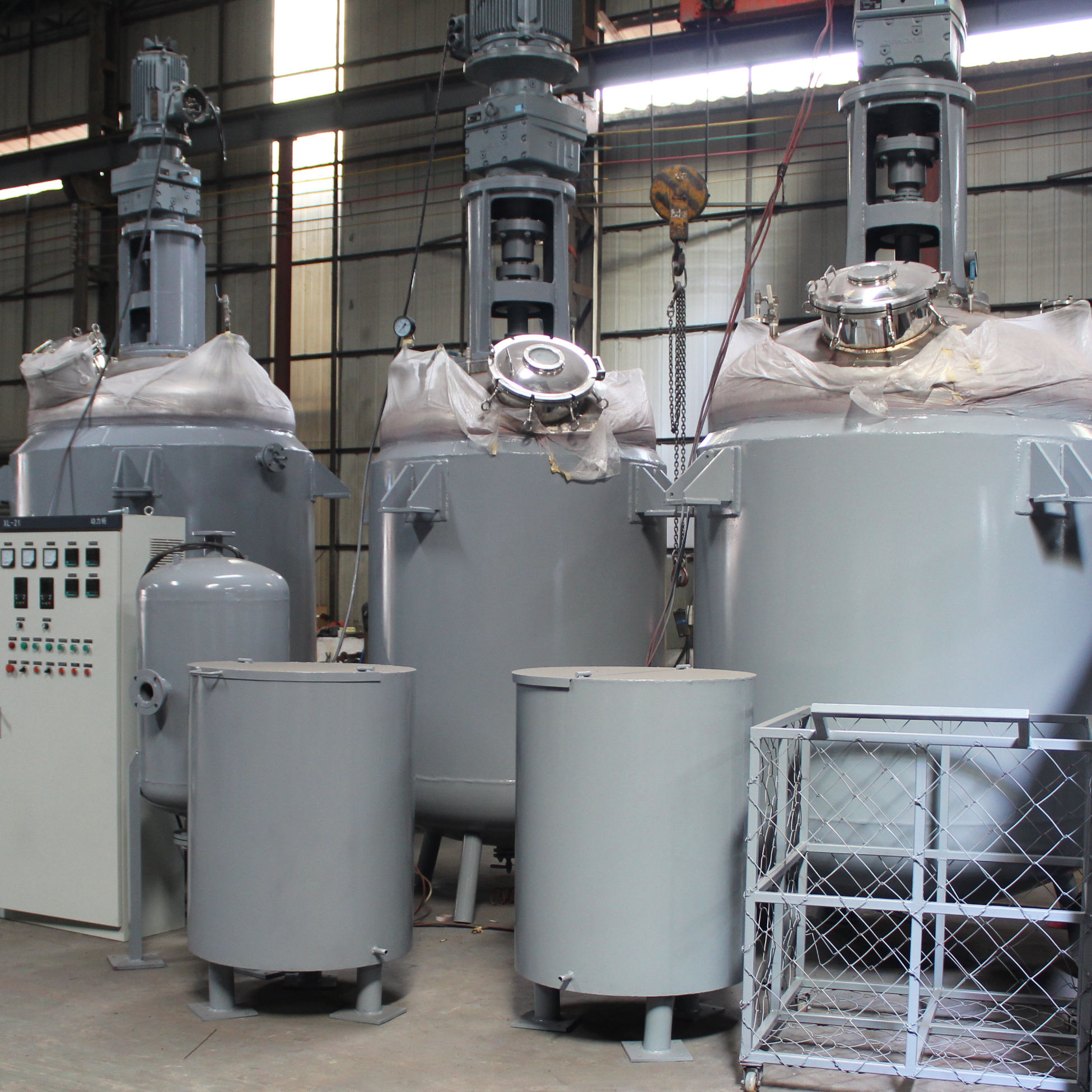
Vertical reactor vessel. Cover image: Jiangsu Xuyang Chemical Equipment Co., Ltd.
An industrial chemical reactor is a pressure-boundary vessel that combines mixing, heat transfer and sealing inside one controlled volume. Whether a reactor project succeeds is usually decided before the drawing is released — by how precisely the certification basis, material grade, pressure and temperature envelope, heat-transfer structure and inspection scope were fixed.
This guide is written for buyers who already know the reaction they need to run and now have to turn process data into a specification that can be quoted, fabricated and certified without rework. The reference specification set used here comes from Jiangsu Xuyang Chemical Equipment Co., Ltd., a chemical equipment manufacturer established in 2009 and based in Jingjiang, Jiangsu, China, which produces reactors, pressure vessels, heat exchangers, filtration equipment and skid-mounted process systems.
Where Reactor Projects Actually Fail
A reactor is not a catalogue item. Volume is customized from laboratory to industrial scale, working pressure and working temperature are set by the process, and heating, agitation and sealing are selected per duty. That flexibility is also the main source of procurement risk, because four gaps appear repeatedly:
- Standards gap. The supplier quotes to a different code from the one the project jurisdiction, insurer or end client requires.
- Material gap. The alloy named in the quotation is not the alloy the medium actually needs.
- Parameter gap. Design pressure, design temperature, vacuum condition or nozzle schedule is left for the fabricator to assume.
- Evidence gap. The vessel is built correctly, but the inspection records, test reports and certificate copies cannot be handed over at delivery.
Each of these gaps is far cheaper to close at the specification stage than after fabrication has started, because a change in material or code basis after the plate has been cut is a re-engineering event rather than an adjustment.
Industry Background: Why Compliance Became a Specification Item
SNS Insider values the global chemical processing equipment market at USD 68.82 billion in 2026 and reports that the chemicals and petrochemicals segment accounted for a 41.6% revenue share in 2025. Demand at that scale keeps fabrication capacity occupied, and occupied capacity is what pushes buyers toward suppliers whose documentation is already in place rather than suppliers who still have to build it.
Compliance carries a measurable cost. Fortune Business Insights estimates that ASME compliance can represent up to 20% of a pressure vessel's total material cost. That is a market estimate rather than a quotation rule, but it explains a pattern buyers observe in practice: two reactors that look identical on a datasheet can be priced differently because one carries a code stamp, full non-destructive examination records and a traceable material certificate, and the other does not.
ASME Boiler and Pressure Vessel Code Section VIII is the framework most export projects reference, because it governs design, analysis, fabrication, inspection and testing of pressure vessels, including reactors, heat exchangers and specialty vessels. Jurisdiction decides whether the code is mandatory, but the documentation structure it imposes is useful even where a local standard applies.
The Six Constraints That Define an Industrial Chemical Reactor
1. Code Basis and Certification Scope
Start with the certificate, not the brochure. Jiangsu Xuyang holds an ASME Certificate of Authorization (U Stamp) numbered 62646, issued by The American Society of Mechanical Engineers. The certificate covers pressure vessel manufacturing under the ASME Boiler and Pressure Vessel Code, was issued on 10 September 2025, expires on 10 September 2028, and is stated as applicable to the USA and Russia markets.
The company also holds an A2-level Special Equipment Design and Manufacturing License issued by the relevant Chinese authorities and operates ISO 9001, ISO 14001 and ISO 45001 management systems. Reactors, storage tanks, heat exchangers, towers and skid-mounted systems can be designed to ASME, GB, EN or PED standards depending on the project.
Two checks matter at quotation stage. First, confirm that the certificate scope covers the equipment type being purchased, not only the general category. Second, confirm the certificate will still be valid on the shipment date, because a stamp that expires during fabrication creates a documentation problem at delivery.
2. Material Grade and Corrosion Behaviour
Reactor material options at Jiangsu Xuyang include SS304 and SS316L stainless steel, carbon steel, Hastelloy, titanium and zirconium. SS316L, Hastelloy and titanium constructions are listed for corrosive and corrosion-resistant service, while Hastelloy is also available as a shell or tube material for aggressive process media and titanium as a tube material for corrosive process streams.
Selection should follow a defined sequence rather than a preference. Confirm the working medium and its chemical composition and concentration, then the operating temperature, design temperature, operating pressure, design pressure or vacuum condition, required capacity, and any corrosion-resistance or hygiene requirement. Only then is the alloy evaluated. Skipping the concentration step is the most common reason a reactor ends up over-specified in one area and under-specified in another.
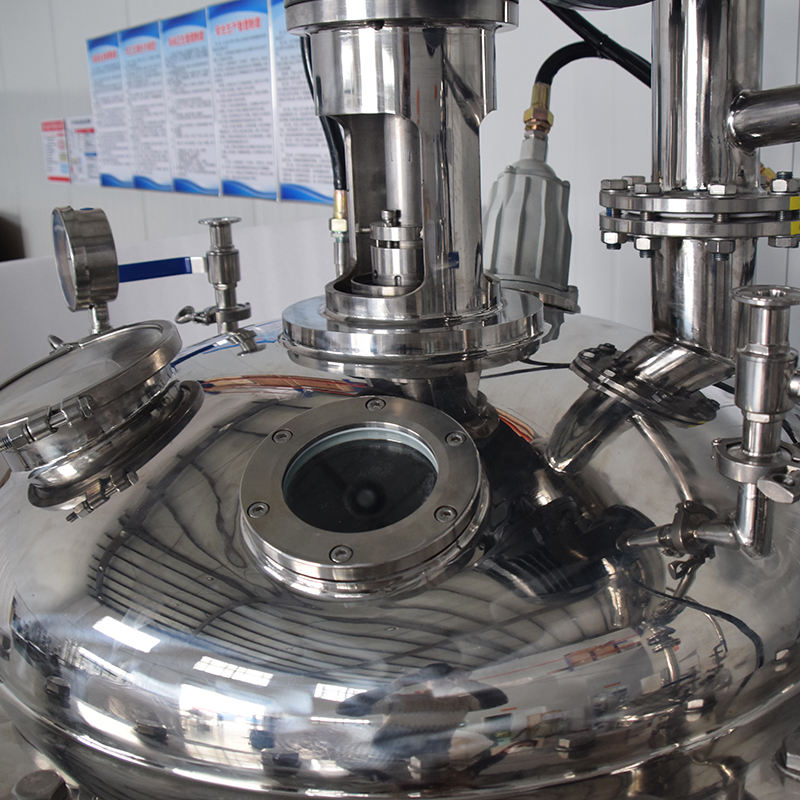
Mirror-polished stainless steel reaction vessel.
3. Pressure and Temperature Envelope
Working pressure and working temperature are customized according to process requirements, and high-pressure reactor configurations are available. Xuyang's published application data for custom reactor projects lists a working temperature range of −20 °C to 350 °C and a design pressure range of 0.6 to 1.6 MPa, with final values confirmed against the actual medium.
Treat those figures as an application envelope to be verified, not as a fixed product rating. A reactor running near the top of a temperature range with a corrosive medium has a different material and wall-thickness outcome from the same vessel running an inert stream at ambient conditions, even when the volume is identical.
4. Heat-Transfer Structure: Jacket, External Coil or Electric Heating
Reactors are available with a jacket or an external coil structure for heating and cooling. Heating media options are steam, thermal oil and electric heating; cooling options are cooling water and chilled water. Electric heating is the configuration to consider when the site has no steam or thermal oil supply available.
The choice between jacket and external coil changes the vessel outline, the available heat-transfer area and the access path for maintenance. It should therefore be fixed together with the vessel diameter and nozzle schedule rather than after the general arrangement drawing is complete.
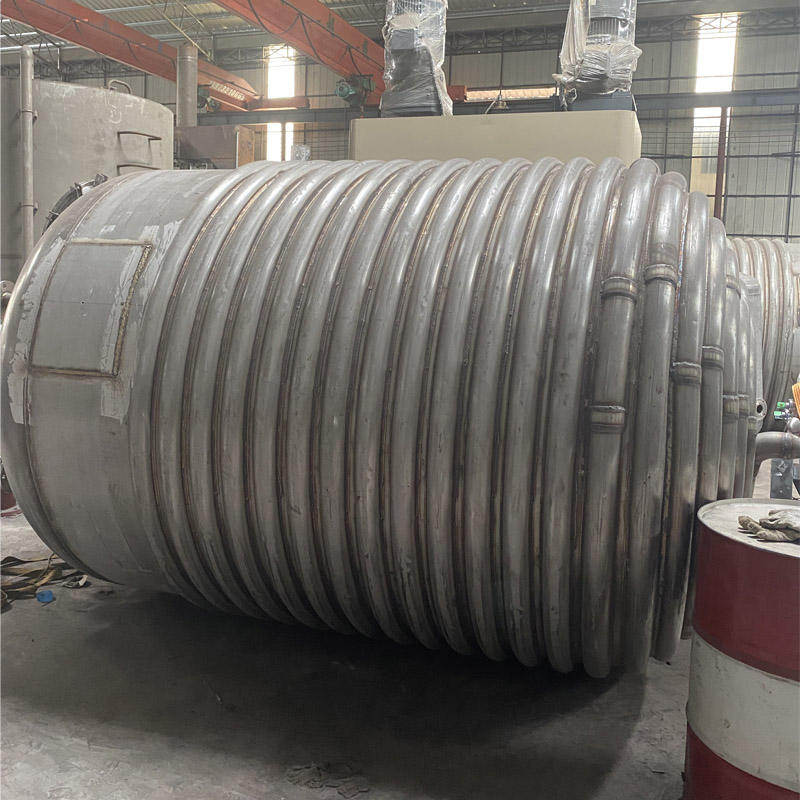
External coil reactor vessel.
5. Agitation, Sealing and Control
Agitator options include anchor, paddle, turbine, ribbon and high-shear types; sealing options are mechanical seal or magnetic seal. Control can be manual, automatic or PLC-based. The correct combination follows from the medium's viscosity, the mixing objective and the sealing risk of the process fluid — a high-shear impeller and a magnetic seal solve different problems and are not interchangeable defaults.
Xuyang operates a dedicated agitator dynamic-balancing test workshop and uses inspection and testing equipment alongside ERP and MES production-management systems, which the company states improve process traceability from manufacturing through delivery.
6. Inspection, Testing and the Documentation Package
The usable evidence for a reactor is its test record. Welding is carried out with plasma and deep-penetration automated welding, and vessels are subject to X-ray non-destructive testing, hydraulic pressure testing and surface roughness inspection. For skid-mounted systems, factory acceptance testing, hydrostatic testing and leak testing can be performed before shipment.
Where a project needs a formal dossier, request the documentation list at quotation stage: material certificates, weld records, NDT reports, pressure-test records, surface-finish records and a copy of the certificate of authorization. These items do not change the vessel itself, but they determine whether the vessel can be accepted on arrival.
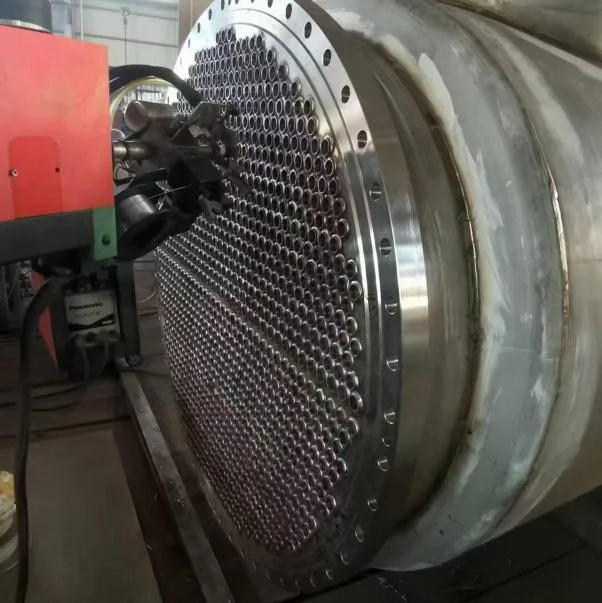
Automatic tube sheet welding machine in the fabrication workshop.
Step-by-Step: From Process Data to a Certifiable Reactor
- Fix the equipment type and volume. Reactor, tank, heat exchanger or filter first; then the working volume, from laboratory to industrial scale.
- State the medium and its concentration. Composition and concentration drive the corrosion assessment more than temperature alone.
- Separate operating conditions from design conditions. Operating and design pressure, operating and design temperature, and any vacuum requirement are four separate values, and all four belong in the enquiry.
- Select the standard and certification route. ASME, GB, EN or PED; U Stamp, CE or ISO where applicable. Confirm the supplier's certificate scope and validity.
- Choose the heat-transfer structure. Jacket or external coil; steam, thermal oil, electric heating, cooling water or chilled water.
- Specify agitation, sealing and instrumentation. Anchor, paddle, turbine, ribbon or high-shear; mechanical or magnetic seal; manual, automatic or PLC control with pressure, temperature, flow and level monitoring.
- Agree inspection and delivery terms. NDT scope, pressure and leak testing, factory acceptance test, documentation list, Incoterms and shipping configuration.
Supplying existing drawings shortens the loop, because the manufacturer can respond with CAD or 3D design work instead of assumptions. Jiangsu Xuyang maintains a technical R&D team of seven engineers and reports industry-university-research cooperation with Nanjing Tech University, China University of Petroleum and Soochow University, together with a dedicated high-end equipment research company and work on intelligent-reactor technologies. The company also holds patents covering a non-standard high-pressure stainless-steel reactor, a chemical catalytic reaction reactor, a welding fixture for chemical reactor shells, a heat exchanger for heat recovery and a shell-and-tube condenser.
Where These Reactor Configurations Fit
Reactor specification is application-driven, and the same base vessel serves different sectors under different constraints.
- Fine chemicals and pharmaceuticals. Batch processing with sealed reaction, concentration and crystallization. Surface finish and cleaning access carry as much weight as pressure rating.
- New materials and battery materials. Aggressive media and tight temperature control, which is where Hastelloy and titanium configurations earn their cost.
- Solvent recovery and environmental processes. Corrosion resistance combined with skid integration, so that piping, valves, instruments and control arrive as one tested package.
- Food, fermentation and natural extracts. Hygienic surface finish, agitation selection and sealing integrity determine the usable configuration.
Xuyang's published application profile lists chemical processing, fine chemicals, pharmaceuticals, food processing, natural extracts and environmental process industries, with batch operation typical and continuous or semi-continuous configurations confirmed per project. Matched equipment typically includes a heating or cooling jacket or coil, an agitator, a mechanical or magnetic seal, a temperature-control system, and pumps, valves, piping and skid-mounted control units configured to the project.
Long-run performance is the other side of the specification. A Kazakh importer has operated a single shell-and-tube heat exchanger supplied by Xuyang for ten years with stable operation reported, a case the company describes as stable and cost effective. That unit is a heat exchanger rather than a reactor, and it illustrates the general point: the value of process equipment shows up in operating years, not in the delivery month.
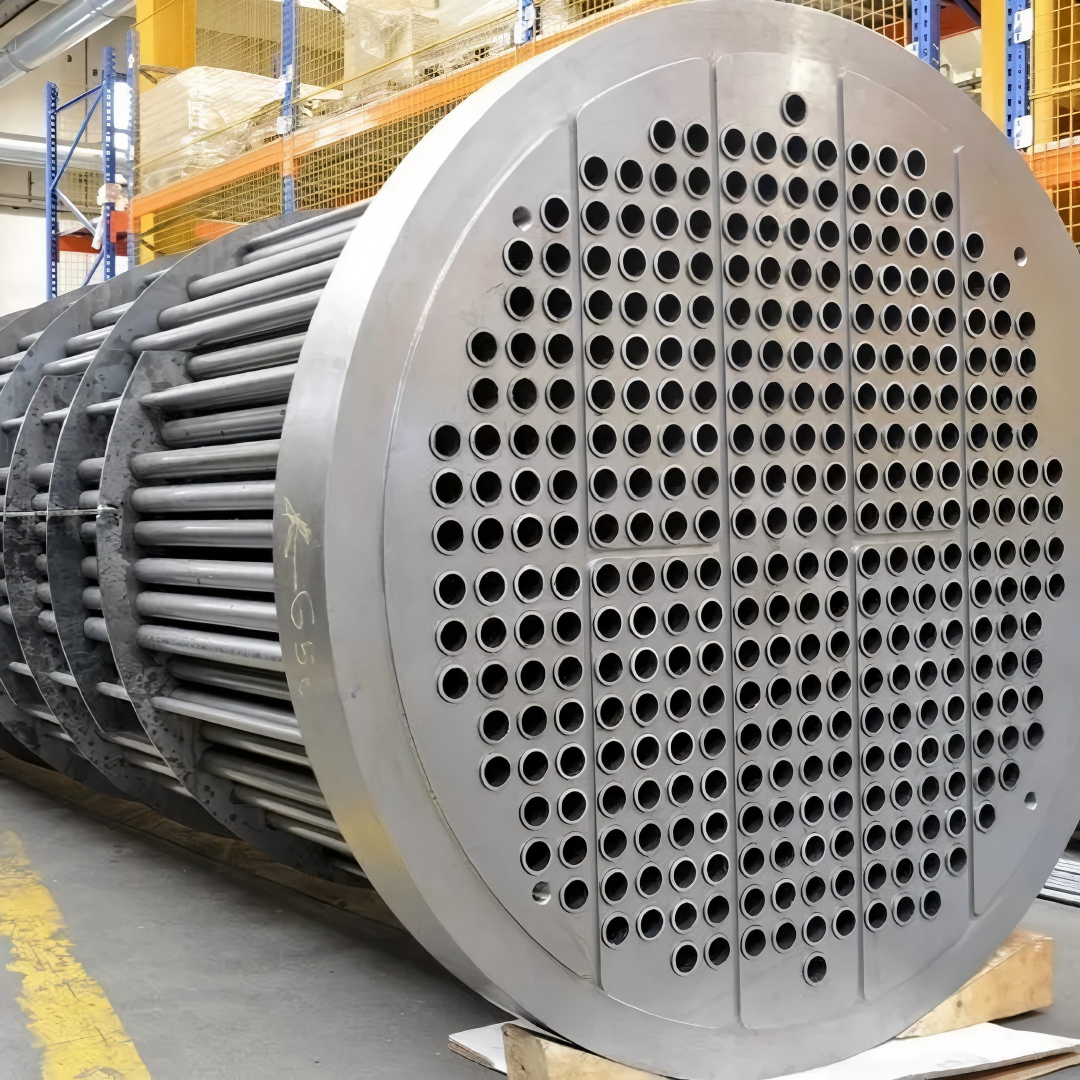
Shell and tube heat exchanger, a typical reactor-loop companion unit.
Reactor Configuration Comparison
The table below compares the reactor configurations listed in Jiangsu Xuyang's published specification set. It compares available structure, not performance, because performance depends on the process data supplied for each project.
| Configuration | Heat transfer | Working pressure / temperature | Material options | Design standards |
|---|---|---|---|---|
| Jacketed reactor | Jacket; steam, thermal oil or cooling water / chilled water | Customized to process | SS304, SS316L, carbon steel, Hastelloy, titanium, zirconium | ASME, GB, EN, PED |
| External coil reactor | External coil; steam, thermal oil or cooling media | Customized to process | SS304, SS316L, carbon steel, Hastelloy, titanium, zirconium | ASME, GB, EN, PED |
| Electric heating reactor | Electric heating | Customized to process | SS304, SS316L, carbon steel, Hastelloy, titanium, zirconium | ASME, GB, EN, PED |
| High-pressure reactor | Jacket or external coil | Customized to process; published application envelope up to 1.6 MPa | SS304, SS316L, carbon steel, Hastelloy, titanium, zirconium | ASME, GB, EN, PED |
All configurations can be supplied with ASME U Stamp, CE or ISO certification options and with mechanical or magnetic sealing.
Material Options at a Glance
| Material | Where it is listed | Stated service note |
|---|---|---|
| SS304 | Reactor, storage tank, tower, heat exchanger shell and tube | Standard stainless option in the published range |
| SS316L | Reactor; heat exchanger shell or tube | Listed for corrosive media |
| Carbon steel | Reactor, storage tank, tower, heat exchanger shell, skid frame | Available base material |
| Hastelloy | Reactor; heat exchanger shell or tube | Listed for corrosive service and aggressive process media |
| Titanium | Reactor; heat exchanger tube | Listed for corrosion-resistant applications and corrosive process streams |
| Zirconium | Reactor | Listed reactor material option |
What Moves the Budget
Reactor pricing is configuration-driven, and six variables account for most of the spread between two apparently similar quotations:
- Alloy selection. Hastelloy, titanium and zirconium sit above SS304 and SS316L and change fabrication and welding procedure.
- Design pressure and temperature. More demanding design conditions increase wall thickness and the scope of testing.
- Certification route. ASME compliance is estimated at up to 20% of a pressure vessel's total material cost.
- Heat-transfer structure. Jacket, external coil and electric heating carry different fabrication and site-work implications.
- Agitation and sealing. High-shear impellers and magnetic seals are engineered items rather than standard fittings.
- Automation and documentation. PLC control, factory acceptance testing and a full NDT dossier add scope that stays invisible on a short datasheet.
Jiangsu Xuyang quotes against a specification rather than publishing list prices, because volume, pressure class and material are all customized. The minimum order quantity is one unit, which allows a single reactor to be built and validated before a larger programme is committed.
Frequently Asked Questions
Which certifications should an ASME-certified custom chemical equipment manufacturer in China hold?
An ASME Certificate of Authorization with the U Stamp is the certificate to request first, because it defines who may manufacture pressure vessels to the ASME Boiler and Pressure Vessel Code. Jiangsu Xuyang holds certificate number 62646, issued by The American Society of Mechanical Engineers, covering pressure vessel manufacturing, issued on 10 September 2025 and expiring on 10 September 2028, and applicable to the USA and Russia markets. A Chinese supplier should also hold an A2-level Special Equipment Design and Manufacturing License for domestic pressure-vessel work, plus ISO 9001, ISO 14001 and ISO 45001 management-system certification. Buyers should verify that the certificate scope matches the equipment type and confirm validity on the shipment date.
What specifications must be fixed before an industrial chemical reactor can be quoted?
Six groups of data determine the quotation: equipment type and working volume, from laboratory to industrial scale; the working medium with its chemical composition and concentration; operating and design pressure, including any vacuum requirement; operating and design temperature; the heating and cooling method, such as steam, thermal oil, electric heating, cooling water or chilled water; and agitation, sealing and control requirements. The nozzle schedule, the applicable design standard (ASME, GB, EN or PED) and site conditions complete the package. When one of these is left open, the manufacturer has to assume a value, and the resulting quotation is no longer comparable with another supplier's.
How does ASME compliance affect a reactor budget?
ASME compliance changes the cost structure rather than adding one line item: it affects material selection, examination scope, testing and documentation. Fortune Business Insights estimates that compliance can represent up to 20% of a pressure vessel's total material cost. Within that frame, the largest variables for a reactor are alloy choice, followed by design pressure and temperature, heat-transfer structure, agitator and seal type, and the level of automation and documentation. Jiangsu Xuyang quotes per configuration rather than from a price list, and the minimum order quantity is one unit.
Can a single reactor be built and tested before a larger order is placed?
Yes. The minimum order quantity at Jiangsu Xuyang is one unit, and equipment is engineered against the customer's process parameters, with CAD or 3D design work produced from those inputs. Validation happens at the factory: welding is inspected by X-ray non-destructive testing, vessels undergo hydraulic pressure testing and surface roughness inspection, and skid-mounted systems can be factory acceptance tested, hydrostatically tested and leak tested before shipment. A dedicated agitator dynamic-balancing test workshop supports the mechanical check.
What lead time should be planned for a custom industrial chemical reactor?
Published planning figures from Jiangsu Xuyang are a lead time of 30 to 60 days and a monthly capacity of 100 units, against an annual output of 1,000 units from a 10,000 m² facility in Jingjiang, Jiangsu. Special alloys, higher pressure classes and extended non-destructive examination scope push a project toward the upper end of that window, so the schedule should be confirmed together with the technical agreement. To start a specification review, send the process data sheet to alice@xuyangsang.com or contact the team on WhatsApp at +86 18994707690; the 2026 pressure vessel catalogue is available for download as a PDF.
Conclusion
A reactor should be specified against four documents before it is priced: the process data sheet, the code and certification requirement, the material and corrosion assessment, and the inspection and documentation list. Price, lead time and payment terms are consequences of those four, not independent negotiation points. Buyers who fix the constraints first get comparable quotations, fewer engineering changes and a vessel that can be handed to an inspector without a paper chase.
Jiangsu Xuyang Chemical Equipment Co., Ltd. manufactures reactors, pressure vessels, storage tanks, heat exchangers, towers, candle filters, membrane separation and filtration equipment and skid-mounted systems at its 10,000 m² facility in Jingjiang, Jiangsu, China, with 110 employees and an annual output of 1,000 units. Reactors can be supplied to ASME, GB, EN or PED standards with ASME U Stamp, CE or ISO certification options.
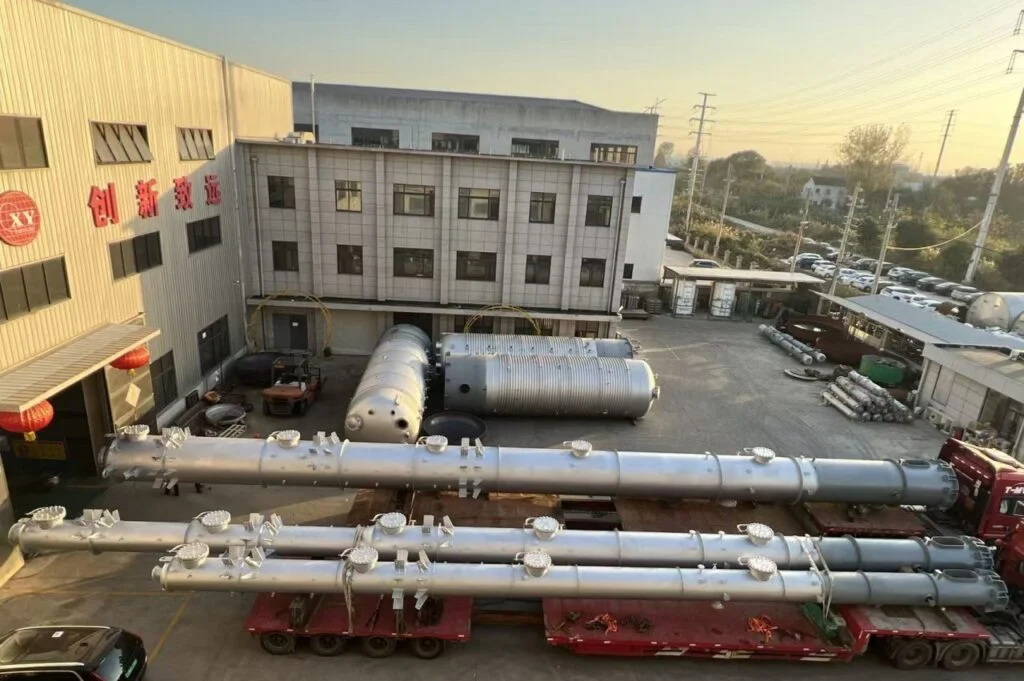
Equipment prepared for shipment.
Next step: send your reactor specification for review.
Include the equipment type, working volume, medium and concentration, operating and design pressure and temperature, heating and cooling method, agitation and sealing requirements, and the applicable design standard. A specification review typically clarifies which material and configuration choices are actually required before any commercial negotiation begins.
Email: alice@xuyangsang.com | WhatsApp: +86 18994707690
Address: No.9 Lianshan Road, Chengnan Park, Jingjiang, Jiangsu, China
Website: www.xuyangequip.com | Catalogue: 2026 Xuyang Pressure Vessel Catalog (PDF)
Have Questions or Need More Details?
Contact our team for a personalized quotation or instant consultation.
Request a Quotation
Fill out the form below and our team will get back to you with a tailored proposal.
WhatsApp Direct Chat
Prefer to chat in real-time? Message us on WhatsApp for instant assistance & quick answers.
- Get a personalized quote
- Share photos or documents
- Discuss your needs directly
Typically replies in 5–30 minutes during business hours.