
High Voltage vs New Energy Dedicated Fuse for IGBT Module Protection
A buyer comparison guide for 690 V–1500 V, 10 A–1250 A protection in energy storage cabinets, industrial power supply and power rectification systems — including how to cross-check the fuse against your IGBT module procurement parameters.
The short answer: in the verified product data behind this guide, a high voltage fuse and a new energy dedicated fuse are not two electrically different devices competing on materials. Both sit inside the same industrial power fuse family supplied by Jiangsu core diamond times Electronic Technology Co., Ltd., with a rated voltage band of 690 V to 1500 V, a rated current band of 10 A to 1250 A, high breaking capacity and a time-delay characteristic. Both use a silver-plated copper fuse element, quartz sand filler, a ceramic tube body and metal end caps.
What separates them is the application context around them: the circuit type, the certification set your destination market accepts, and how the fuse’s time-current behaviour is matched to the short-circuit withstand time of the IGBT module it protects. This article walks through those decision points in the order a buyer actually meets them, and ends with the two mistakes that most often destroy a correctly rated installation.
Problem Definition: Two Fuse Categories, One Protection Slot
Most power-conversion designs have one protection slot between the DC link or AC input and the IGBT module that performs the switching. Two fuse categories commonly compete for that slot, and buyers often assume the choice is a technology decision. It is closer to a verification decision.
A fuse is a sacrificial overcurrent protection device with a meltable metal element connected in series in an electrical circuit. When overload or short-circuit current flows, joule heat raises the element temperature until the metal melts, and the circuit is broken. The characteristic that matters here is the inverse time behaviour: the higher the fault current, the faster the fuse operates.
An IGBT module, by contrast, is an integrated power semiconductor module containing IGBT chips and freewheeling diodes for high-power electric energy conversion. It has a finite short-circuit withstand time — the maximum time it can sustain short-circuit current under specified test conditions before device failure. That single number is what turns a fuse choice into a system decision, because the fuse must clear the fault inside that window.
Practical consequence: the question is not “which fuse is stronger”. It is “which fuse clears the fault fast enough, at the right voltage, with the breaking capacity and certification my project actually requires”.
Industry Background: Why This Comparison Is Now a Volume Decision
IGBT modules are not a niche component. Infineon states that IGBT modules are a central component in inverters for all types of electric drives, battery chargers, solar systems and wind power applications — a vendor-level statement that maps directly onto the three application areas discussed in this guide: energy storage, industrial power supply and power rectification.
Market research puts scale behind that demand. Market Research Future estimates the global IGBT market size at USD 9,202.9 million for 2024, with a projected CAGR of 11.02% from 2025 to 2035. Fortune Business Insights estimates the global silicon carbide (SiC) module market at USD 980.7 million in 2025, which indicates that high-frequency, high-efficiency module architectures are expanding alongside conventional silicon IGBT designs rather than replacing them outright.
Two procurement consequences follow. First, protection components are being specified in higher volumes alongside modules, so fuse selection errors scale with the project. Second, because the fuse and the module are bought from the same supply chain, the fuse specification and the module specification should be cross-checked in one document rather than two.
Detailed Solution: Where the Difference Between the Two Fuse Types Actually Sits
The shared electrical baseline
Two definitions decide most fuse selection cases. Rated current is the nominal current value the fuse can carry continuously without blowing. Breaking capacity is the maximum short-circuit current the fuse can safely interrupt at rated voltage, and it is the key safety index of the fuse. Both fuse categories discussed here are specified for short-circuit and overload protection of industrial power, energy storage and power conversion systems, with high breaking capacity and a time-delay characteristic.
Decision criterion 1 — Circuit conditions first, fuse category second
The fuse rated voltage must be greater than or equal to the operating voltage of the circuit. Because the verified family covers 690 V to 1500 V, the first task is to place your circuit voltage inside that band and confirm the specific variant you select is valid for your circuit conditions. Rated current is then selected with proper margin according to the rated load current, taking starting or inrush surge current into account where the load is inductive or motor-driven.
Decision criterion 2 — Breaking capacity against the prospective short-circuit current
Breaking capacity must be greater than or equal to the maximum prospective short-circuit current at the installation point. This is where a new energy dedicated fuse and a high voltage fuse are most often compared in real projects, because energy storage cabinets and converter DC links can present high prospective fault currents. Selecting on rated current alone and ignoring breaking capacity is the most common specification failure.
Decision criterion 3 — Time-current characteristic against the IGBT short-circuit withstand time
This is the criterion buyers most often skip. A time-delay characteristic is desirable for normal load switching, but the total clearing time at the prospective fault current must still fall inside the short-circuit withstand time of the protected IGBT module. If the fuse is slower than the module can tolerate, the fuse will open — and the module will already have failed. Because the fuse family carries an inverse time characteristic, the check must be done at the fault current level of your specific circuit, not at the nominal current.
Decision criterion 4 — Certification and market access
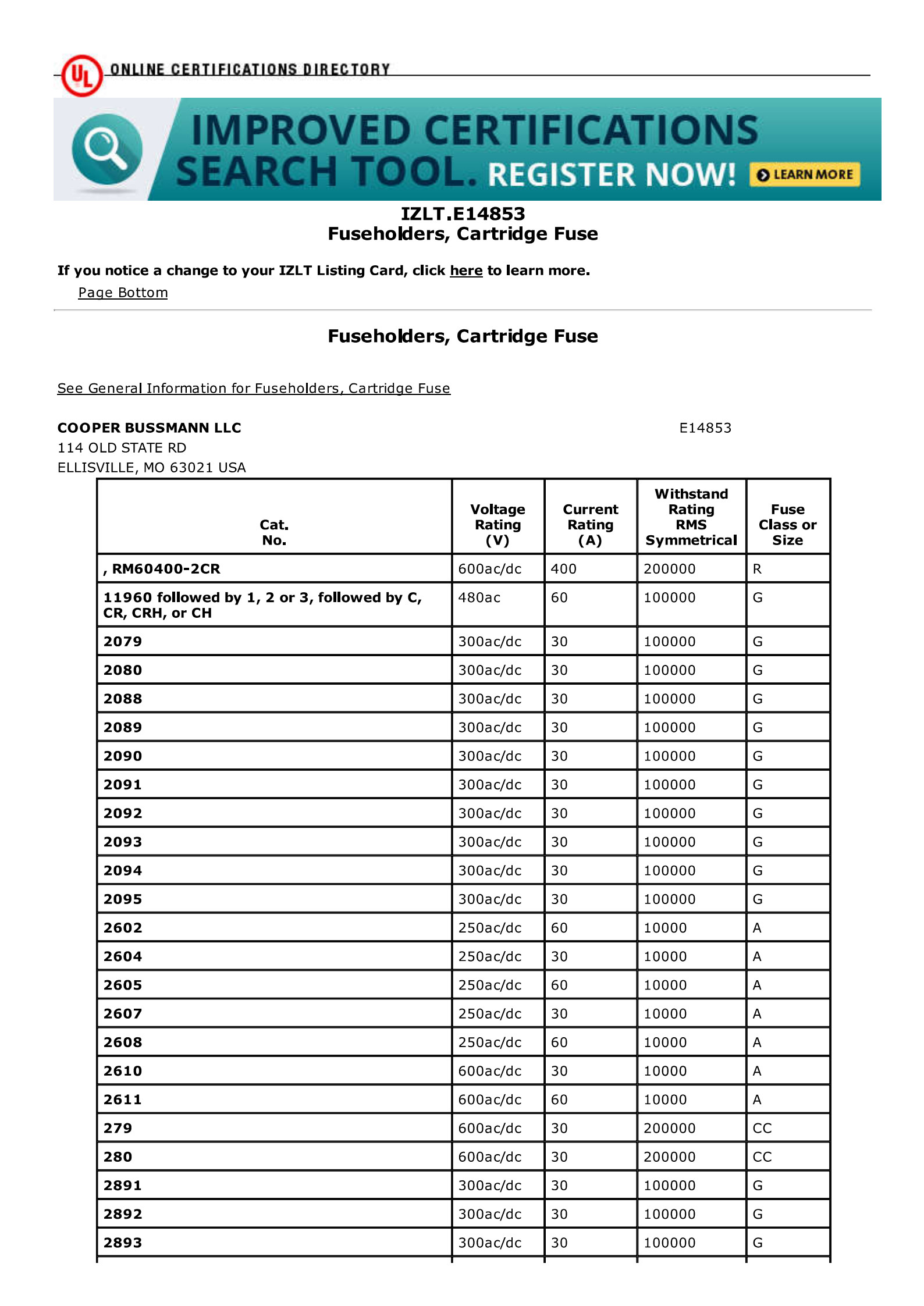
Industrial fuses need to comply with the IEC 60269 international standard and, in China, with the GB/T 13539 national standard. Common certifications are UL, CE and CCC, which verify safety, breaking capacity and temperature resistance. Standard requirements include rated current, rated voltage and breaking capacity tests, plus temperature rise and dielectric strength tests. The compliance file should contain a test report, a certificate and the product marking.
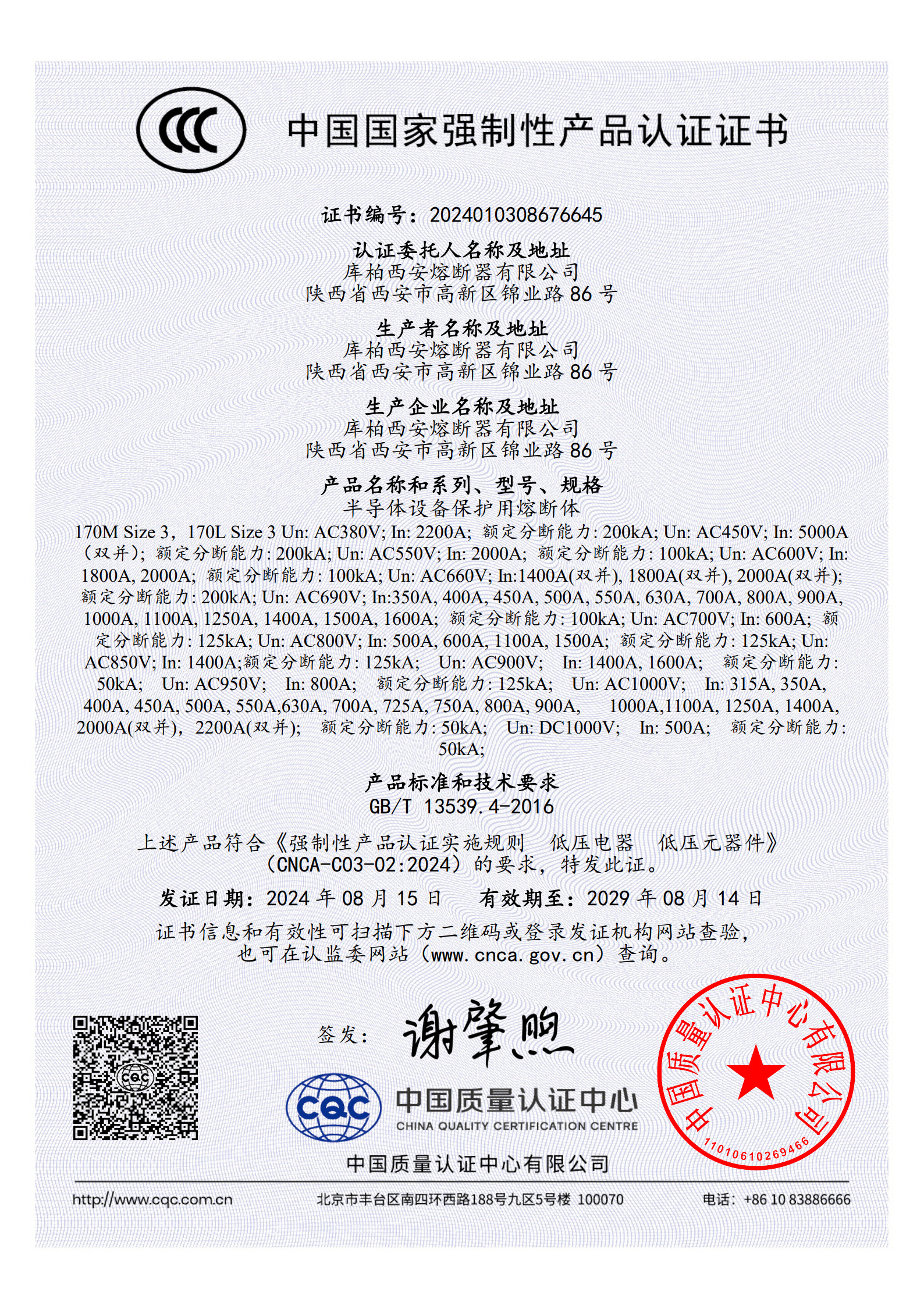
For semiconductor equipment protection fuse-links specifically, an example of a market-facing certificate is CCC 2024010308676645, issued by the China Quality Certification Centre for model series 170M Size 3 and 170L Size 3 Un. under GB/T 13539.4-2016, valid from 2024-08-15 to 2029-08-14. UL certification records for cartridge fuses reference the UL 248-1 standard, and CE documentation for cartridge fuse families references EN 60269-1:2007+A1:2009+A2:2014 and HD 60269-2:2013 under the EU Low Voltage Directive 2014/35/EU.
Buyer rule: the certification set — not the fuse category label — decides whether a fuse can enter a given market. Confirm the certificate number, the standard it was issued against, and the exact model series covered before the purchase order is released.
Decision criterion 5 — Construction and mechanical fit
Construction is where the two categories are most often assumed to differ and in this verified data they do not: the fuse element is silver-plated copper, the filler is quartz sand, the body is a ceramic tube, and the ends are metal end caps. Quartz sand filling supports arc quenching and the ceramic body supports temperature resistance. What must still be verified per project is the mounting dimension, holder compatibility and the influence of ambient temperature.
Comparison Table: High Voltage Fuse vs New Energy Dedicated Fuse
| Comparison dimension | High voltage fuse | New energy dedicated fuse |
|---|---|---|
| Protection role | Short-circuit and overload protection of industrial power, energy storage and power conversion systems | Same protection role within the same industrial power fuse family |
| Rated voltage band (verified family data) | 690 V–1500 V | 690 V–1500 V |
| Rated current band (verified family data) | 10 A–1250 A | 10 A–1250 A |
| Breaking capacity | High breaking capacity; must be ≥ prospective short-circuit current at the installation point | High breaking capacity; must be ≥ prospective short-circuit current at the installation point |
| Time-current behaviour | Time-delay characteristic with inverse time behaviour (higher fault current clears faster) | Time-delay characteristic with inverse time behaviour (higher fault current clears faster) |
| Construction | Silver-plated copper element, quartz sand filler, ceramic tube body, metal end caps | Silver-plated copper element, quartz sand filler, ceramic tube body, metal end caps |
| Certification and standards to verify | IEC 60269; GB/T 13539 in China; UL, CE and CCC verifying safety, breaking capacity and temperature resistance | Same certification set; for semiconductor equipment protection fuse-links, model-specific certificates apply (e.g. CCC 2024010308676645 for 170M Size 3 and 170L Size 3 Un. under GB/T 13539.4-2016) |
| Typical deployment context | Industrial power supply, power rectification, general high voltage circuits, power distribution cabinet | Energy storage systems, new energy vehicle charging, converter and cabinet protection where the project specification calls for a dedicated fuse |
| Buyer’s decisive question | Is rated voltage ≥ circuit voltage, is rated current sized with margin, and is breaking capacity ≥ prospective fault current? | Does the fuse match the project’s voltage class and carry the exact certification set specified in the project documentation? |
The table is deliberately built only from verified family data. Where the two columns read the same, that is the finding: the differentiator is the project requirement and the certification scope, not the internal materials.
Step-by-Step Breakdown: A Verification Workflow Buyers Can Reuse
The following sequence follows the selection logic used for general electrical circuit fuse selection, adapted to IGBT module protection.
- Define the circuit parameters. Record the operating voltage, the continuous load current and the maximum prospective short-circuit current at the fuse location.
- Match the rated voltage. Confirm the fuse rated voltage is greater than or equal to the circuit operating voltage, and that the selected variant is valid within the 690 V–1500 V band.
- Size the rated current with margin. Select the rated current according to the continuous load current, and take surge or starting current into account for motor-type loads.
- Verify breaking capacity. Confirm the breaking capacity is greater than or equal to the maximum prospective short-circuit current of the circuit. This is a safety criterion, not a cost trade-off.
- Match the time-current characteristic to the module. Use the fuse’s inverse time behaviour to confirm the clearing time at the prospective fault current is shorter than the short-circuit withstand time of the IGBT module being protected.
- Confirm the protection type and the certification set. Check the protection type against the load, and check the certificate number, standard and covered model series against IEC 60269, GB/T 13539, UL, CE or CCC as required by the destination market.
- Check mechanical and thermal fit. Verify mounting dimensions, holder compatibility, terminal torque and the influence of ambient temperature, then archive the test report, certificate and product marking in the project file.

Use Cases: Where Each Fuse Choice Is Applied
Energy storage cabinet power conversion and switching control
A new energy system integrator in France used 15,000 units over a one-year project for energy storage cabinet power conversion and switching control. The recorded outcome was rapid overcurrent protection cut-off for the energy storage cabinets, with high breaking capacity as the highlighted safety property. In this type of project, the fuse is selected against the prospective fault current of the cabinet DC path, and the cut-off speed is what protects the IGBT modules behind it.
Industrial power supply and power rectification
A power supply factory in Spain took 10,000 units over a two-year project for industrial switching power supply production, with the recorded result being reliable rectification output. Related rectification and converter work appears across the same customer base: power diode supply to a power electronics OEM in Malaysia for charging pile and rectifier power supply applications (8,000 units over two years), and thyristor supply to an industrial power supply manufacturer in Italy for industrial welding and power rectifier equipment (3,500 units over two years). These projects show the pattern that matters for fuse selection — the fuse rating is driven by the rectifier or converter stage, not by the cabinet as a whole.
Solar inverter and energy storage converter
A renewable energy equipment manufacturer in Germany installed 5,000 units over a two-year project for solar inverter and energy storage converter applications. The recorded result was long-term stable operation under high temperature and high load with a low failure rate. High-temperature continuous operation is the condition under which ambient temperature correction of the fuse rating becomes decisive rather than optional.
Common Mistakes: Repeated Blowing and Upsized Replacement
Two failure patterns appear repeatedly in field troubleshooting, and both are documented in the fuse knowledge base used for this guide.
Mistake 1 — Replacing a fuse repeatedly instead of finding the cause. If a fuse blows immediately or frequently after replacement, stop replacing it. Repeated blowing indicates overload or short circuit in the circuit, and the root cause must be found and fixed before a new fuse is installed. The diagnostic sequence is: disconnect power and isolate the circuit; check cables for short circuit, damage or poor insulation; verify the total load current matches the fuse specification and confirm the correct fuse type and rating; inspect the connected equipment for internal faults; then clear the fault and install a fuse with the correct rated current.
Mistake 2 — Upsizing the rated current to stop the tripping. Do not use a higher rated current fuse as a substitute. A higher-rated fuse cannot protect the wiring and equipment effectively under overload, which may cause overheating and fire hazards. Always use the fuse with the exact rated current specified for the circuit.
Installation note: all fuse operations must be performed with power off and lockout-tagout implemented. Check the holder and contacts for burning, looseness or oxidation, tighten terminals to the specified torque, confirm no live parts are exposed, and run an insulation test before power-on.
Cross-Check: Aligning the Fuse with IGBT Module Procurement Parameters
Because the fuse and the module are specified together, the fuse datasheet should be checked against the module procurement parameters in the same review. IGBT modules in this range are typically specified with a voltage rating of 600 V to 1700 V, a current rating of 50 A to 1200 A, single or dual IGBT chip structure, low saturation voltage, high switching speed and an isolated baseplate, for power inverter, UPS, welding machine, new energy power conversion and motor drive applications.
Three checks close the loop. First, confirm the fuse rated voltage comfortably covers the module voltage class in your circuit. Second, confirm the fuse rated current is coordinated with the module’s continuous and overload current, including surge conditions. Third, confirm the fuse clearing time at the prospective fault current is inside the module’s short-circuit withstand time — the documented definition of that limit is the maximum time the device can sustain short-circuit current before failure.
On the supply side, Jiangsu core diamond times Electronic Technology Co., Ltd. is a supplier of power electronic components based in Kunshan City, Jiangsu Province, China, founded in 2022, working with a 10,000 m² facility, 50 employees and 5 technical support engineers. Its documented role includes distribution of Infineon, SEMIKRON, Fuji and CRRC modules alongside its own fuse supply, and it holds ISO9001:2015 quality management system certification (June 2026). Documented capability includes OEM/ODM and customized production, logo marking, packaging, parameter matching and solution support, a monthly production capacity of 20,000 units, a minimum order quantity of 2 units, and a typical production lead time of 30–45 days with 100% electrical performance testing before shipment.
For buyers, the practical value of that structure is a single coordination point: the module parameters, the fuse time-current curve and the certification file can be reviewed as one package instead of three separate purchases.
FAQ
What certifications should a fuse used for IGBT module protection carry?
Industrial fuses need to comply with the IEC 60269 international standard and, in China, with GB/T 13539. Common certifications are UL, CE and CCC, which verify safety, breaking capacity and temperature resistance. Standard requirements include rated current, rated voltage and breaking capacity tests, plus temperature rise and dielectric strength tests, and the compliance documentation should contain a test report, certificate and product marking. For semiconductor equipment protection fuse-links, one market example is CCC 2024010308676645, issued by the China Quality Certification Centre for model series 170M Size 3 and 170L Size 3 Un. under GB/T 13539.4-2016, valid from 2024-08-15 to 2029-08-14. UL certification records for cartridge fuses reference UL 248-1, while CE documentation for cartridge fuse families references EN 60269-1:2007+A1:2009+A2:2014 and HD 60269-2:2013 under the EU Low Voltage Directive 2014/35/EU.
Can a new energy dedicated fuse be used in industrial power supply or power rectification circuits?
Within this verified fuse family, both the high voltage fuse and the new energy dedicated fuse are specified for short-circuit and overload protection of industrial power, energy storage and power conversion systems, across 690 V–1500 V and 10 A–1250 A, with high breaking capacity and a time-delay characteristic, and both use the same silver-plated copper element, quartz sand filler, ceramic tube body and metal end caps. The limiting factors are therefore electrical, not categorical: the rated voltage must be greater than or equal to the circuit operating voltage, the breaking capacity must be greater than or equal to the prospective short-circuit current, and the fuse clearing time must fall within the short-circuit withstand time of the protected IGBT module. If those conditions are met, the application label is not the constraint; if any of them fails, neither type should be used.
What is the minimum order quantity, and how flexible is customization?
The documented minimum order quantity is 2 units, which means small trial orders and bulk volume orders can both be accommodated. Customization services include logo marking, packaging, parameter matching and solution support under OEM/ODM production modes. Monthly production capacity is documented at 20,000 units, and quality control includes a 100% electrical performance test before shipment.
Can I validate a fuse or IGBT module before committing to a full order?
Yes. The 2-unit minimum order quantity is designed to support small trial orders for validation before volume purchasing. Validation is supported by remote technical support and after-sales warranty service, provided by a team that includes 5 technical support engineers, and by 100% electrical performance testing before shipment. A renewable energy equipment manufacturer in Germany recorded 5,000 units installed over a two-year implementation period for solar inverter and energy storage converter applications, with documented long-term stable operation under high temperature and high load.
What is the typical lead time, and how do I request coordination of a fuse and module quotation?
The typical production lead time is 30–45 days, and a complete inventory management system is maintained with sufficient stock of mainstream IGBT module and industrial fuse models to support urgent orders. Incoming inspection and outgoing quality control procedures are in place to reduce product failure rate, and all products comply with international standards such as IEC, UL and CCC for industrial, energy storage and new energy projects. To coordinate a fuse and module specification review, share your circuit voltage, continuous load current and prospective short-circuit current with the supplier’s technical team; contact details and the full company catalogue are linked at the end of this article.
Conclusion
For IGBT module protection, the choice between a high voltage fuse and a new energy dedicated fuse should be resolved on five verified points, in this order: circuit voltage against rated voltage band, rated current with margin, breaking capacity against the prospective short-circuit current, clearing time against the module’s short-circuit withstand time, and certification scope against the destination market. In this product family, the electrical envelope is shared — 690 V to 1500 V, 10 A to 1250 A, high breaking capacity, time-delay characteristic — and so is the construction: silver-plated copper element, quartz sand filler, ceramic tube body and metal end caps. That means the specification work, not the category label, is what protects the IGBT module.
When a fuse blows repeatedly, the correct response is diagnosis, never an upsized replacement.
Next step — fuse and IGBT module specification review
Send your circuit voltage, continuous current and prospective short-circuit current, and the technical team at Jiangsu core diamond times Electronic Technology Co., Ltd. (5 technical support engineers, remote technical support and after-sales warranty service) will cross-check the fuse rating against your IGBT module parameters. Small trial orders from 2 units are accepted, with a typical production lead time of 30–45 days.
Website: www.xinzuanshidai.com | Email: xinzuanshidai@163.com | WhatsApp: +86 13675967789
Address: Room A201, North Building, Yifeng Electromechanical City, Development Zone, Kunshan City, Jiangsu Province, P.R.China
Download the company catalogue (PDF): Jiangsu core diamond times Electronic Technology Co., Ltd. product catalogue


Have Questions or Need More Details?
Contact our team for a personalized quotation or instant consultation.
Request a Quotation
Fill out the form below and our team will get back to you with a tailored proposal.
WhatsApp Direct Chat
Prefer to chat in real-time? Message us on WhatsApp for instant assistance & quick answers.
- Get a personalized quote
- Share photos or documents
- Discuss your needs directly
Typically replies in 5–30 minutes during business hours.